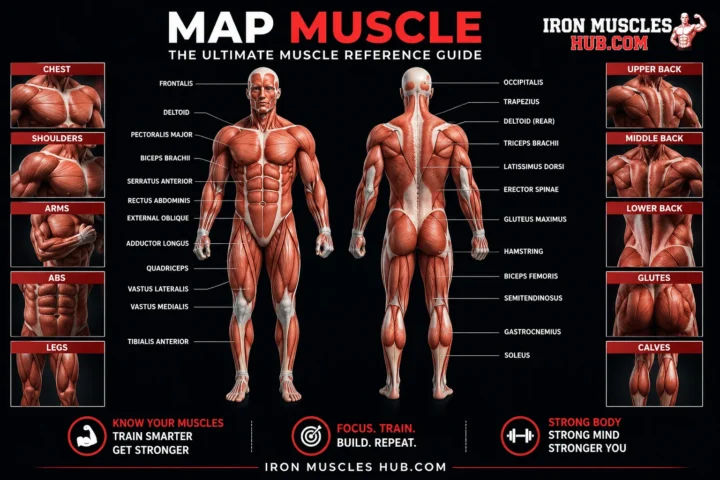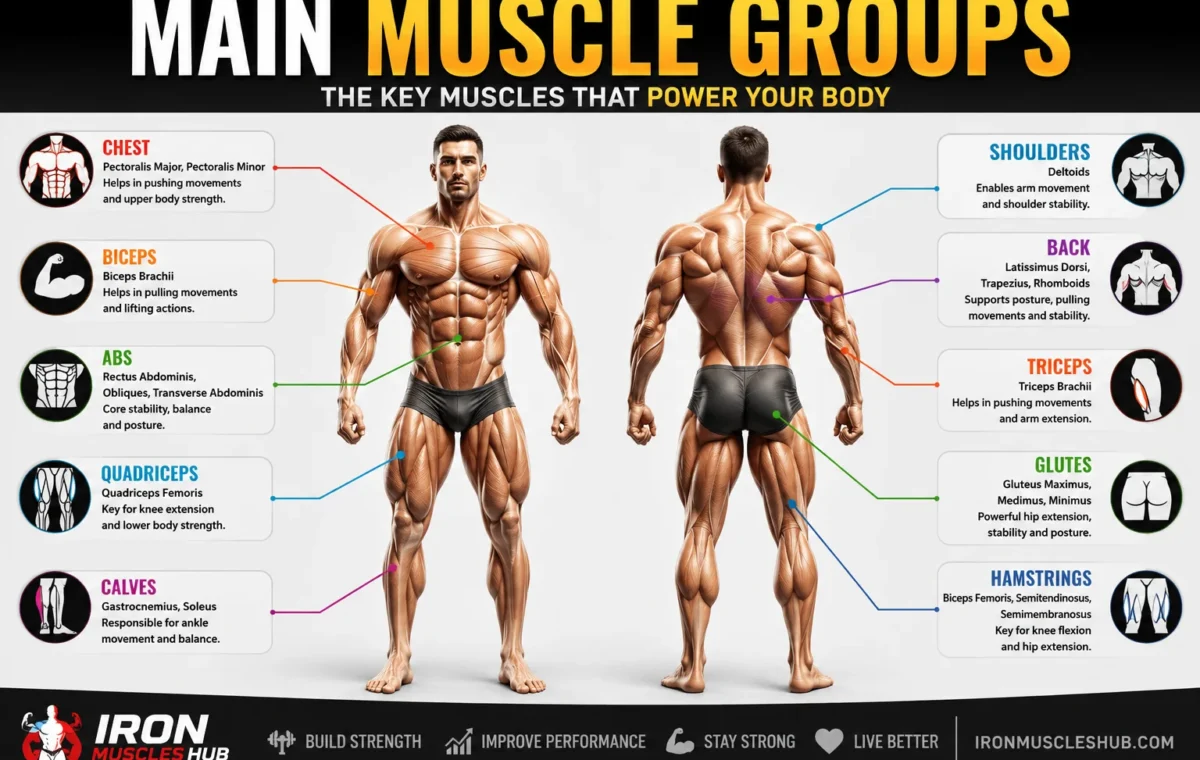
The main muscle groups are the major areas of muscles that help your body move, maintain posture, and perform daily activities. They include the chest, back, shoulders, arms, core, glutes, and legs. Learning these muscle groups helps beginners understand how the body works and how different exercises target different areas.
- What Do Chest Muscles Do?
- Common Chest Exercises
- What Do Back Muscles Do?
- Common Back Exercises
- Why Are Shoulders Important?
- Biceps
- Triceps
- Forearms
- 5. Core Muscles
- What Do Core Muscles Do?
- Common Core Exercises
- What Do Glutes Do?
- Common Glute Exercises
- Quadriceps
- Hamstrings
- Calves
- 1. Glutes
- 2. Legs
- 3. Back
- 1. Train Full Body
- 2. Focus on Proper Technique
- 3. Increase Gradually
- Mistake 1: Only Training Visible Muscles
- Mistake 2: Skipping Leg Training
- Mistake 3: Using Too Much Weight
- Mistake 4: Ignoring Recovery
- How many main muscle groups are there?
- What are the most important muscle groups to train?
- Which muscle group is the strongest?
- What muscle groups should beginners train first?
- Can you train the same muscle group every day?
- Why is it important to train all muscle groups?
Your muscles are not just for building strength or changing appearance. They help you walk, lift objects, breathe, balance, protect your joints, and complete almost every movement you make.
Whether you want to start exercising, improve your fitness knowledge, or simply understand your body better, knowing the major muscle groups is a great first step. For more insights read here :-muscle anatomy and muscle names.
Quick Answer: What Are the Main Muscle Groups?
| Main Muscle Group | Location | Primary Function |
|---|---|---|
| Chest (Pectorals) | Front upper body | Pushing movements and arm movement |
| Back | Upper and middle rear body | Pulling movements and posture support |
| Shoulders (Deltoids) | Top of arms | Arm lifting and shoulder stability |
| Arms | Upper and lower arms | Bending, extending, and gripping |
| Core | Abdomen and trunk | Balance, stability, and body control |
| Glutes | Hips and buttocks | Hip movement and power generation |
| Legs | Thighs and lower legs | Walking, jumping, and supporting body weight |
Why Understanding Muscle Groups Matters
Your body contains more than 600 muscles, and they work together as a coordinated system. Instead of thinking about muscles as separate parts, it helps to see them as teams that cooperate during movement.
For example, a simple movement like picking up a box uses:
- Your legs to create stability.
- Your core to keep your body balanced.
- Your back to support your posture.
- Your arms and shoulders to lift.
- Your hands and forearms to grip.
A strong understanding of muscle groups can help you:
- Exercise more effectively.
- Reduce the risk of muscle imbalance.
- Choose better workouts.
- Understand fitness programs.
- Improve body awareness.
The 7 Major Muscle Groups Explained
Most beginner fitness programs focus on seven major muscle areas:
- Chest
- Back
- Shoulders
- Arms
- Core
- Glutes
- Legs
These groups include many smaller muscles that work together to create strength and movement.
1. Chest Muscles (Pectorals)
The chest muscles, also called the pectorals, are located on the front of your upper body.
The main chest muscles are:
- Pectoralis major – the larger chest muscle responsible for many pushing movements.
- Pectoralis minor – a smaller muscle underneath that helps control shoulder movement.
What Do Chest Muscles Do?
Your chest muscles help you:
- Push objects away from your body.
- Move your arms across your chest.
- Support shoulder movement.
- Stabilize the upper body.
Daily activities involving chest muscles include:
- Pushing open a door.
- Carrying objects.
- Pushing yourself up from a chair.
Common Chest Exercises
Examples of exercises that target the chest include:
- Push-ups
- Bench presses
- Chest presses
- Dumbbell fly movements
Beginners should focus on proper form instead of lifting heavy weights too quickly.
2. Back Muscles
The back contains some of the largest and strongest muscles in the human body.
Important back muscles include:
- Latissimus dorsi (lats) – large muscles that help pull the arms downward and backward.
- Trapezius (traps) – muscles supporting the neck, shoulders, and upper back.
- Rhomboids – muscles that help move and stabilize the shoulder blades.
What Do Back Muscles Do?
Your back muscles help with:
- Pulling movements.
- Maintaining upright posture.
- Supporting the spine.
- Moving the shoulders and arms.
Strong back muscles are important because they help balance the pushing movements performed by chest muscles.
Common Back Exercises
Popular back exercises include:
- Pull-ups
- Rows
- Lat pulldowns
- Back extensions
3. Shoulder Muscles (Deltoids)
The shoulder muscles, mainly the deltoids, sit around the shoulder joint.
The deltoid has three main sections:
| Deltoid Area | Main Role |
|---|---|
| Front deltoid | Raises arms forward |
| Side deltoid | Moves arms outward |
| Rear deltoid | Helps move arms backward |
Why Are Shoulders Important?
Healthy shoulders allow a wide range of movement.
They help you:
- Lift objects overhead.
- Throw a ball.
- Rotate your arms.
- Maintain upper-body stability.
Because the shoulder joint moves in many directions, balanced shoulder training is important.
4. Arm Muscles
The arms contain several important muscles that control movement and strength.
The main arm muscles include:
Biceps
The biceps are located on the front of the upper arm.
They help with:
- Bending the elbow.
- Pulling movements.
- Rotating the forearm.
Triceps
The triceps are located on the back of the upper arm.
They help with:
- Straightening the elbow.
- Pushing movements.
- Supporting arm strength.
Forearms
Forearm muscles control:
- Grip strength.
- Wrist movement.
- Hand control.
Your arms work with your shoulders, chest, and back during many everyday activities.
5. Core Muscles
The core is the group of muscles located around your abdomen, lower back, pelvis, and hips. Many people think the core only means visible abdominal muscles, but it includes several deeper muscles that help stabilize your entire body.
Important core muscles include:
- Rectus abdominis – the front abdominal muscles involved in bending movements.
- Obliques – muscles on the sides of the abdomen that help with rotation and side movements.
- Transverse abdominis – a deep abdominal muscle that supports stability.
- Erector spinae – muscles along the spine that help maintain posture.
What Do Core Muscles Do?
Your core muscles help you:
- Maintain balance.
- Keep proper posture.
- Transfer power between your upper and lower body.
- Support your spine.
- Perform everyday movements safely.
A strong core helps during activities such as lifting, running, climbing stairs, and carrying objects.
Common Core Exercises
Examples include:
- Planks
- Dead bugs
- Bird dogs
- Leg raises
- Crunch variations
A strong core is not only about appearance. It is important for movement quality and body control.
6. Glute Muscles
The glutes are the muscles located in your buttocks and are among the strongest muscle groups in the human body.
The three main glute muscles are:
| Muscle | Main Function |
|---|---|
| Gluteus maximus | Hip extension and powerful movements |
| Gluteus medius | Hip stability and side movement |
| Gluteus minimus | Supports hip control and balance |
What Do Glutes Do?
Your glute muscles help you:
- Stand upright.
- Walk and run.
- Jump.
- Climb stairs.
- Stabilize your hips.
Weak glutes can affect movement patterns because they play a major role in controlling the hips and pelvis.
Common Glute Exercises
Exercises that target the glutes include:
- Squats
- Hip thrusts
- Lunges
- Step-ups
- Glute bridges
7. Leg Muscles
The legs contain some of the largest muscle groups in the body. They are responsible for supporting your body weight and allowing movement.
Major leg muscles include:
Quadriceps
Located on the front of the thigh, the quadriceps help straighten the knee.
They are used during:
- Walking
- Running
- Jumping
- Standing up
Hamstrings
Located on the back of the thigh, hamstrings help bend the knee and move the hip.
They support:
- Running speed
- Leg control
- Lower-body strength
Calves
The calf muscles include:
- Gastrocnemius
- Soleus
They help with:
- Standing on your toes.
- Walking.
- Jumping.
- Pushing off the ground.
Main Muscle Groups and Their Functions
| Muscle Group | Main Movement | Everyday Example |
|---|---|---|
| Chest | Pushing | Opening a heavy door |
| Back | Pulling | Carrying a backpack |
| Shoulders | Arm movement | Lifting an object overhead |
| Arms | Bending and gripping | Carrying groceries |
| Core | Stability | Maintaining posture |
| Glutes | Hip power | Climbing stairs |
| Legs | Movement and support | Walking and running |
The Biggest Muscle Groups in the Human Body
Some muscle groups are larger and produce more force than others.
The largest and most powerful muscle areas include:
1. Glutes
The gluteus maximus is often considered one of the strongest muscles based on the amount of force it can produce.
It plays a major role in:
- Hip movement.
- Sprinting.
- Jumping.
- Standing.
2. Legs
The quadriceps, hamstrings, and calves work together to support movement and body weight.
Strong legs improve:
- Balance.
- Mobility.
- Athletic performance.
3. Back
The back contains several large muscles that support posture and pulling strength.
How Muscle Groups Work Together During Exercise
Muscles rarely work alone. Most exercises involve multiple muscle groups.
For example, during a squat:
| Muscle Group | Role |
|---|---|
| Quadriceps | Straighten the knees |
| Glutes | Drive the hips upward |
| Hamstrings | Assist movement and control |
| Core | Stabilize the body |
| Back | Maintain posture |
A bench press also involves more than just the chest:
- Chest muscles create pushing force.
- Shoulders assist movement.
- Triceps help extend the arms.
- Core muscles stabilize the body.
Beginner Guide: How to Train Main Muscle Groups
A balanced training routine should include all major muscle groups rather than focusing only on one area.
A beginner-friendly approach:
1. Train Full Body
Many beginners benefit from full-body workouts because they practice important movement patterns.
Examples:
- Squats
- Push-ups
- Rows
- Lunges
- Planks
2. Focus on Proper Technique
Good form helps you:
- Use muscles correctly.
- Reduce unnecessary strain.
- Build better movement habits.
3. Increase Gradually
Progress can come from:
- Adding a little more weight.
- Increasing repetitions.
- Improving control.
- Performing exercises with better form.
Progress does not need to happen overnight.
Common Mistakes When Training Muscle Groups
Mistake 1: Only Training Visible Muscles
Many beginners focus only on chest, arms, or abs.
A balanced routine should also include:
- Back muscles.
- Legs.
- Glutes.
- Core.
Ignoring certain areas can create strength imbalances.
Mistake 2: Skipping Leg Training
Leg workouts are often avoided because they can feel challenging.
However, leg muscles support:
- Daily movement.
- Balance.
- Overall strength.
Mistake 3: Using Too Much Weight
Lifting heavier does not automatically mean better results.
Poor technique can reduce effectiveness and increase injury risk.
Start with manageable resistance and improve gradually.
Mistake 4: Ignoring Recovery
Muscles adapt during recovery, not only during exercise.
Important recovery habits include:
- Getting enough sleep.
- Eating nutritious foods.
- Allowing muscles time to rest.
Simple Weekly Muscle Group Example
A beginner schedule could look like this:
| Day | Focus |
|---|---|
| Monday | Full body workout |
| Tuesday | Rest or light activity |
| Wednesday | Full body workout |
| Thursday | Rest |
| Friday | Full body workout |
| Weekend | Walking, stretching, or recovery |
The best routine depends on your goals, experience, health, and schedule.
Frequently Asked Questions
How many main muscle groups are there?
Most beginner fitness programs divide the body into seven major muscle groups: chest, back, shoulders, arms, core, glutes, and legs. These groups contain many smaller muscles that work together for movement and stability.
What are the most important muscle groups to train?
All major muscle groups are important because they support different movements. A balanced routine usually includes pushing muscles, pulling muscles, lower-body muscles, and core muscles.
Which muscle group is the strongest?
The gluteus maximus is often considered one of the strongest muscles because it produces powerful hip movements needed for walking, running, jumping, and standing.
What muscle groups should beginners train first?
Beginners should focus on learning basic movements that use several muscle groups together. Exercises like squats, push-ups, rows, and planks help build overall strength and coordination.
Can you train the same muscle group every day?
Training the same muscle group intensely every day may not allow enough recovery time. Muscles usually need rest after challenging workouts so they can repair and adapt.
Why is it important to train all muscle groups?
Training all major muscle groups helps create balanced strength, supports posture, improves movement, and reduces the chance of developing weak areas.
Final Thoughts
Learning the main muscle groups gives you a better understanding of how your body creates movement, strength, and stability. Your muscles do not work as separate parts; they work together every time you walk, lift, run, sit, or perform everyday tasks.
A balanced approach to fitness means paying attention to your entire body, including your chest, back, shoulders, arms, core, glutes, and legs. Building strength takes consistent effort, proper technique, good nutrition, and enough recovery time.
You do not need a complicated routine to start improving. Focus on learning basic movements, training your major muscle groups regularly, and creating healthy habits that support long-term progress.