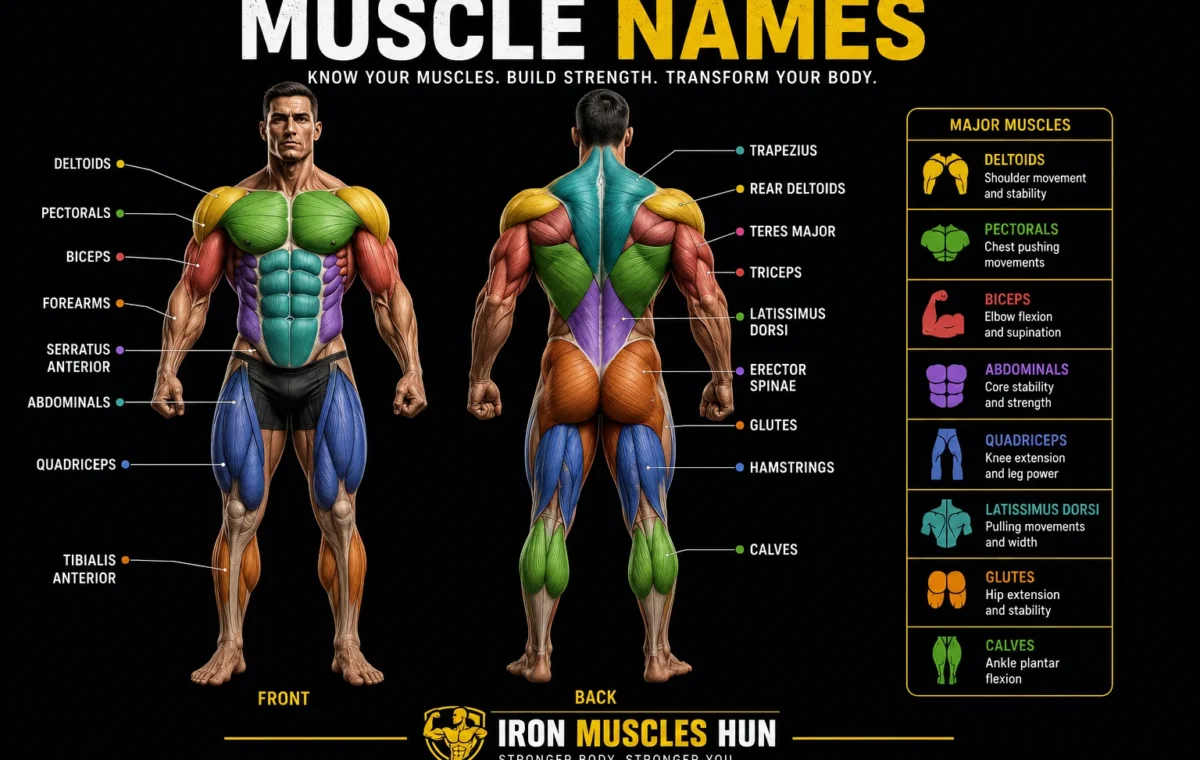
Knowing the major muscle names makes it much easier to understand exercise, anatomy, and how your body moves. While the human body has more than 600 skeletal muscles, most beginners only need to learn the major muscle groups first.
- Quick Answer
- Why Are Muscles Given Different Names?
- Head and Neck
- Chest Muscles
- Pectoralis Major
- Pectoralis Minor
- Shoulder Muscles
- Deltoid
- Back Muscle Names
- Arm Muscle Names
- Biceps Brachii
- Triceps Brachii
- Brachialis
- Brachioradialis
- Core Muscle Names
- Rectus Abdominis
- External Obliques
- Internal Obliques
- Transversus Abdominis
- Hip and Glute Muscle Names
- Leg Muscle Names
- Quadriceps
- Hamstrings
- Calf Muscles
- Thinking the biceps are the largest arm muscle
- Believing abs are one muscle
- Memorizing names without understanding function
- How many muscles are in the human body?
- What are the biggest muscles in the body?
- What muscle names should beginners learn first?
- Why are muscle names in Latin?
- Are all muscles voluntary?
- Muscle Names Chart (Front and Back of the Body)
- Push Muscles
- Pull Muscles
- Lower Body Muscles
- Core Muscles
- 1. Learn by Body Region
- 2. Connect Muscles to Exercises
- 3. Learn Common Latin Words
- What are the main muscle names everyone should know?
- How many muscles are in the human body?
- Which is the largest muscle in the body?
- Which is the smallest muscle in the body?
- Which muscle is the strongest?
- Why do muscles have Latin names?
- Do muscles work by themselves?
- Quick Revision Sheet
Whether you’re starting a fitness journey, studying anatomy, or simply curious about how your body works, this guide explains the most important muscle names in clear, everyday language. For more insights read here :- lean muscle female and lean body women.
Quick Answer
| Body Area | Main Muscle Names | Primary Function |
|---|---|---|
| Chest | Pectoralis Major | Pushes the arms forward |
| Shoulders | Deltoid | Raises and rotates the arm |
| Back | Trapezius, Latissimus Dorsi | Pulling movements and posture |
| Upper Arms | Biceps, Triceps | Bend and straighten the elbow |
| Forearms | Flexors, Extensors | Wrist and finger movement |
| Abdomen | Rectus Abdominis, Obliques | Core stability and trunk movement |
| Hips | Gluteus Maximus, Medius, Minimus | Hip movement and balance |
| Front Thigh | Quadriceps | Straightens the knee |
| Back Thigh | Hamstrings | Bends the knee |
| Lower Leg | Gastrocnemius, Soleus | Walking, running, jumping |
Why Are Muscles Given Different Names?
Scientists don’t choose muscle names randomly. Most skeletal muscles are named according to one or more characteristics, including:
- Location (where the muscle is)
- Shape
- Size
- Direction of muscle fibers
- Number of attachment points (origins)
- Action the muscle performs
For example:
| Muscle Name | Meaning |
|---|---|
| Biceps | Two heads (two origins) |
| Triceps | Three heads |
| Quadriceps | Four heads |
| Deltoid | Triangle-shaped |
| Trapezius | Trapezoid-shaped |
| Gluteus Maximus | Largest gluteal muscle |
| Gluteus Minimus | Smallest gluteal muscle |
| Flexor | Bends a joint |
| Extensor | Straightens a joint |
Learning these patterns makes unfamiliar muscle names much easier to remember.
Major Muscle Names by Body Region
Head and Neck
| Muscle | Main Job |
|---|---|
| Frontalis | Raises eyebrows |
| Temporalis | Helps chew |
| Masseter | Powerful chewing muscle |
| Sternocleidomastoid | Turns and bends the head |
Chest Muscles
Pectoralis Major
Often called the “pecs,” this is the large chest muscle responsible for pushing movements like push-ups and bench presses.
Pectoralis Minor
Located underneath the pectoralis major, it helps stabilize the shoulder blade.
Shoulder Muscles
Deltoid
The rounded shoulder muscle is divided into three sections:
- Front (anterior)
- Middle (lateral)
- Rear (posterior)
Together they lift and rotate your arm.
Back Muscle Names
The back contains several large muscles that help with posture and pulling movements.
| Muscle | Function |
|---|---|
| Trapezius | Moves shoulders and neck |
| Latissimus Dorsi | Pulls the arm downward and backward |
| Rhomboids | Pull shoulder blades together |
| Erector Spinae | Keeps the spine upright |
Arm Muscle Names
Biceps Brachii
Located on the front of the upper arm.
Main functions:
- Bend the elbow
- Rotate the forearm
Triceps Brachii
Located on the back of the upper arm.
Main function:
- Straighten the elbow
Brachialis
Works with the biceps during elbow bending.
Brachioradialis
A major forearm muscle that helps flex the elbow.
Core Muscle Names
The core includes much more than the “six-pack.”
Rectus Abdominis
Commonly called the six-pack muscle.
Functions:
- Flexes the spine
- Stabilizes the torso
External Obliques
Located on each side of the abdomen.
They help:
- Rotate the trunk
- Bend sideways
Internal Obliques
Work together with the external obliques.
Transversus Abdominis
The deepest abdominal muscle.
Its primary role is stabilizing the spine and core.
Hip and Glute Muscle Names
| Muscle | Function |
|---|---|
| Gluteus Maximus | Hip extension and power |
| Gluteus Medius | Balance during walking |
| Gluteus Minimus | Hip stabilization |
The gluteus maximus is the body’s largest skeletal muscle by volume.
Leg Muscle Names
Quadriceps
The quadriceps consists of four muscles:
- Rectus Femoris
- Vastus Lateralis
- Vastus Medialis
- Vastus Intermedius
Together they straighten the knee.
Hamstrings
The hamstrings include:
- Biceps Femoris
- Semitendinosus
- Semimembranosus
These muscles bend the knee and extend the hip.
Calf Muscles
Gastrocnemius
The large calf muscle visible from the outside.
Soleus
Located underneath the gastrocnemius.
Important for standing, walking, and endurance.
Easy Trick to Remember Muscle Names
Instead of memorizing hundreds of muscles individually, group them by body area.
| Region | Remember These First |
|---|---|
| Chest | Pectoralis Major |
| Shoulder | Deltoid |
| Back | Trapezius, Latissimus Dorsi |
| Arms | Biceps, Triceps |
| Core | Rectus Abdominis, Obliques |
| Glutes | Gluteus Maximus |
| Thigh | Quadriceps, Hamstrings |
| Calf | Gastrocnemius, Soleus |
Learning these 15–20 muscles gives you a strong foundation before studying smaller muscles.
Common Mistakes Beginners Make
Thinking the biceps are the largest arm muscle
The triceps actually make up more of the upper arm’s muscle mass.
Believing abs are one muscle
Your core contains several muscles, including the rectus abdominis, obliques, and transversus abdominis.
Memorizing names without understanding function
It’s much easier to remember muscles when you connect each one to its main movement.
Frequently Asked Questions
How many muscles are in the human body?
The human body contains more than 600 skeletal muscles, along with smooth and cardiac muscles. Exact counts vary depending on how individual muscles are classified.
What are the biggest muscles in the body?
Some of the largest include the gluteus maximus, quadriceps, latissimus dorsi, trapezius, and pectoralis major. These muscles generate power and support many everyday movements.
What muscle names should beginners learn first?
Start with the major muscle groups:
- Deltoid
- Pectoralis Major
- Trapezius
- Latissimus Dorsi
- Biceps
- Triceps
- Rectus Abdominis
- Gluteus Maximus
- Quadriceps
- Hamstrings
- Gastrocnemius
These cover the muscles most commonly referenced in fitness and anatomy.
Why are muscle names in Latin?
Modern anatomy uses many Latin and Greek terms because early anatomists adopted those languages to describe body structures. Understanding common roots such as bi-, tri-, maximus, and flexor helps decode many muscle names.
Are all muscles voluntary?
No. Skeletal muscles are generally under voluntary control, while smooth muscles work automatically in organs, and cardiac muscle forms the heart and contracts without conscious control.
Learn Muscle Names More Easily
Learning muscle names doesn’t have to be overwhelming. Rather than trying to memorize hundreds of anatomical terms, focus on the major muscle groups first and understand what each muscle does. Once you know the chest, shoulders, back, arms, core, hips, and legs, you’ll recognize the muscles mentioned in workout programs, anatomy books, and fitness videos with much more confidence.
As your knowledge grows, you can build on this foundation by learning smaller muscles and how they work together during movement.
Muscle Names Chart (Front and Back of the Body)
The table below lists many of the most commonly studied muscle names. While the human body contains more than 600 skeletal muscles, these are the ones you’ll most often see in anatomy books, fitness programs, and physical therapy resources.
| Body Region | Muscle Name | Primary Function |
|---|---|---|
| Forehead | Frontalis | Raises eyebrows |
| Jaw | Masseter | Closes the jaw during chewing |
| Neck | Sternocleidomastoid | Turns and bends the head |
| Shoulder | Deltoid | Lifts and rotates the arm |
| Chest | Pectoralis Major | Pushes the arm forward |
| Chest | Pectoralis Minor | Stabilizes the shoulder blade |
| Upper Back | Trapezius | Supports neck and shoulder movement |
| Mid Back | Rhomboids | Pull shoulder blades together |
| Lower Back | Erector Spinae | Keeps the spine upright |
| Side Back | Latissimus Dorsi | Pulls the arm downward |
| Upper Arm | Biceps Brachii | Bends the elbow |
| Upper Arm | Triceps Brachii | Straightens the elbow |
| Upper Arm | Brachialis | Assists elbow flexion |
| Forearm | Brachioradialis | Flexes the elbow |
| Abdomen | Rectus Abdominis | Flexes the spine |
| Side Abdomen | External Obliques | Rotates the trunk |
| Deep Core | Transversus Abdominis | Stabilizes the core |
| Hip | Gluteus Maximus | Extends the hip |
| Hip | Gluteus Medius | Stabilizes the pelvis |
| Hip | Gluteus Minimus | Assists hip movement |
| Front Thigh | Quadriceps | Straightens the knee |
| Back Thigh | Hamstrings | Bends the knee |
| Inner Thigh | Adductors | Pull the legs inward |
| Outer Hip | Tensor Fasciae Latae | Stabilizes the hip |
| Calf | Gastrocnemius | Pushes the foot downward |
| Lower Calf | Soleus | Helps walking and standing |
| Shin | Tibialis Anterior | Lifts the foot upward |
Understanding Muscle Groups
Instead of learning muscles one by one, it’s much easier to study them in groups. This method is commonly used by personal trainers, anatomy students, and healthcare professionals.
Push Muscles
These muscles help you push objects away from your body.
Examples include:
- Pectoralis Major
- Deltoids
- Triceps
Exercises:
- Push-ups
- Bench Press
- Shoulder Press
Pull Muscles
These muscles pull objects toward your body.
Main muscles:
- Latissimus Dorsi
- Trapezius
- Rhomboids
- Biceps
Exercises:
- Pull-ups
- Rows
- Lat Pulldowns
Lower Body Muscles
These muscles generate power for walking, running, climbing stairs, and jumping.
Major muscles include:
- Gluteus Maximus
- Quadriceps
- Hamstrings
- Adductors
- Gastrocnemius
- Soleus
Exercises:
- Squats
- Lunges
- Deadlifts
- Calf Raises
Core Muscles
Your core is responsible for stability, posture, and protecting the spine.
Important muscles include:
- Rectus Abdominis
- External Obliques
- Internal Obliques
- Transversus Abdominis
- Erector Spinae
Strong core muscles improve balance and reduce the risk of lower back injuries.
Which Muscles Are Used in Everyday Activities?
Many people associate muscles only with exercise, but your muscles work continuously throughout the day.
| Activity | Main Muscles Used |
|---|---|
| Walking | Glutes, Hamstrings, Quadriceps, Calves |
| Standing | Core, Glutes, Calves |
| Sitting Down | Quadriceps, Glutes |
| Lifting Groceries | Biceps, Forearms, Core |
| Climbing Stairs | Glutes, Quadriceps, Calves |
| Opening a Door | Deltoids, Biceps, Forearms |
| Picking Up a Child | Legs, Core, Back, Arms |
| Running | Nearly every major muscle group |
Understanding which muscles perform everyday tasks helps explain why balanced strength training benefits overall health—not just athletic performance.
Largest and Smallest Muscles You Should Know
Here are a few interesting muscle facts that beginners often enjoy learning.
| Muscle | Interesting Fact |
|---|---|
| Gluteus Maximus | Largest muscle by volume |
| Sartorius | Longest muscle in the body |
| Masseter | One of the strongest muscles relative to size |
| Stapedius | Smallest skeletal muscle, located in the middle ear |
| Heart (Cardiac Muscle) | Works continuously throughout your life |
These examples show how muscles vary greatly in size and function, from tiny muscles that help you hear to powerful muscles that let you run and jump.
Tips for Memorizing Muscle Names
Learning anatomy becomes much easier when you use simple memory techniques.
1. Learn by Body Region
Study the muscles of one body part before moving to another.
For example:
- Chest
- Back
- Arms
- Core
- Legs
This creates smaller, manageable learning sessions.
2. Connect Muscles to Exercises
Associate each muscle with a movement.
Examples:
- Bench Press → Pectoralis Major
- Pull-Up → Latissimus Dorsi
- Squat → Quadriceps and Glutes
- Biceps Curl → Biceps
- Triceps Pushdown → Triceps
Making these connections helps you remember muscles naturally during workouts.
3. Learn Common Latin Words
Many muscle names become easier once you recognize recurring terms.
| Word | Meaning |
|---|---|
| Maximus | Largest |
| Minimus | Smallest |
| Longus | Long |
| Brevis | Short |
| Flexor | Bends a joint |
| Extensor | Straightens a joint |
| Adductor | Moves toward the body |
| Abductor | Moves away from the body |
Knowing these terms allows you to understand unfamiliar muscle names without memorizing every detail.
Common Beginner Questions About Muscle Names
Many new learners wonder if they need to memorize all muscles. The answer is no. For fitness, sports, and general anatomy knowledge, learning the major muscle groups is enough to understand most exercises and training plans.
Another common question is whether muscles work alone. In reality, muscles almost always work in teams. For example, during a squat, your quadriceps, glutes, hamstrings, calves, and core all work together to produce a safe and controlled movement.
Likewise, even simple actions such as reaching for a shelf or carrying groceries involve several muscles working at the same time. Understanding these muscle partnerships makes anatomy much easier to grasp.
What are the main muscle names everyone should know?
If you’re just getting started, focus on these major muscles:
- Deltoid
- Pectoralis Major
- Trapezius
- Latissimus Dorsi
- Biceps Brachii
- Triceps Brachii
- Rectus Abdominis
- External Obliques
- Gluteus Maximus
- Quadriceps
- Hamstrings
- Gastrocnemius
- Soleus
These muscles are the ones most commonly mentioned in fitness programs, anatomy classes, and physical therapy.
How many muscles are in the human body?
The human body contains more than 600 skeletal muscles, along with smooth muscle and cardiac muscle. The exact number varies slightly depending on how anatomists classify individual muscles.
Which is the largest muscle in the body?
The gluteus maximus is generally recognized as the largest skeletal muscle by volume. It provides the power needed for standing up, climbing stairs, running, and jumping.
Which is the smallest muscle in the body?
The stapedius is the smallest skeletal muscle. It is located in the middle ear and helps stabilize a tiny bone involved in hearing.
Which muscle is the strongest?
There isn’t one simple answer because “strongest” can mean different things.
Examples include:
- Masseter – extremely powerful for chewing
- Gluteus Maximus – generates tremendous force during movement
- Quadriceps – among the strongest muscles for lower-body power
Different muscles are considered the strongest depending on how strength is measured.
Why do muscles have Latin names?
Most anatomical terms come from Latin and Greek because these languages have been used in medicine for centuries. Learning common words like maximus, minimus, flexor, and extensor makes muscle names much easier to understand.
Do muscles work by themselves?
No. Nearly every movement involves multiple muscles working together. For example, when you perform a squat, your glutes, quadriceps, hamstrings, calves, and core all coordinate to produce a safe and efficient movement.
Quick Revision Sheet
Here’s a simple cheat sheet you can review in under a minute.
| Muscle | Location | Main Function |
|---|---|---|
| Frontalis | Forehead | Raises eyebrows |
| Masseter | Jaw | Chewing |
| Sternocleidomastoid | Neck | Turns the head |
| Deltoid | Shoulder | Raises the arm |
| Pectoralis Major | Chest | Pushes the arm |
| Trapezius | Upper Back | Shoulder movement |
| Latissimus Dorsi | Mid Back | Pulling motions |
| Biceps | Front Upper Arm | Bends the elbow |
| Triceps | Back Upper Arm | Straightens the elbow |
| Rectus Abdominis | Abdomen | Flexes the trunk |
| External Obliques | Sides | Rotation |
| Gluteus Maximus | Buttocks | Hip extension |
| Quadriceps | Front Thigh | Knee extension |
| Hamstrings | Back Thigh | Knee flexion |
| Gastrocnemius | Calf | Pushes the foot downward |
| Soleus | Lower Calf | Standing and walking |
| Tibialis Anterior | Shin | Lifts the foot |
Muscle Names by Workout Day
Many workout routines are organized by muscle groups. Here’s a quick reference.
| Workout Day | Primary Muscles |
|---|---|
| Chest Day | Pectoralis Major, Triceps, Front Deltoids |
| Back Day | Latissimus Dorsi, Trapezius, Rhomboids, Biceps |
| Shoulder Day | Deltoids, Trapezius |
| Arm Day | Biceps, Triceps, Forearms |
| Leg Day | Quadriceps, Hamstrings, Glutes, Calves |
| Core Day | Rectus Abdominis, Obliques, Transversus Abdominis |
Understanding these groupings will help you follow workout plans and target muscles more effectively.
Key Takeaways
If you remember only a few things from this guide, make them these:
- The human body contains more than 600 skeletal muscles.
- Learning major muscle groups is more useful than trying to memorize every muscle.
- Most muscles are named based on location, shape, size, function, or number of origins.
- Muscles rarely work alone—they operate together to create movement.
- Knowing muscle names helps you understand exercise programs, anatomy, injury prevention, and overall fitness.
Final Thoughts
Learning muscle names may seem overwhelming at first, but it becomes much easier when you break the body into sections and study one muscle group at a time. Start with the shoulders, chest, back, arms, core, and legs, then gradually build your knowledge as you gain confidence.
Whether your goal is improving your workouts, studying anatomy, or simply understanding how your body moves, knowing the major muscle names provides a solid foundation. You don’t need to memorize every muscle overnight—focus on the most important ones, review them regularly, and connect each muscle to the movements you perform every day.
Over time, these names will become familiar, making it easier to follow exercise instructions, understand fitness advice, and appreciate how the human body works.