If you want a simple protein food list printable, start with whole foods you can actually buy, cook, and repeat. This guide gives you a practical chart covering meat, fish, eggs, dairy, beans, lentils, soy foods, nuts, seeds, and other useful choices.
- Quick Answer
- What Is a Protein Food List Printable?
- Chicken breast
- Turkey
- Lean beef
- Pork tenderloin
- Salmon
- Tuna
- Shrimp
- Eggs
- Greek yogurt
- Cottage cheese
- Lentils
- Beans
- Tofu
- Tempeh
- Edamame
- Worked Example: 180 lb / 82 kg Beginner
- Mistake 1: Eating protein only at dinner
- Mistake 2: Assuming "more protein" always means "better"
- Mistake 3: Ignoring calories from protein-rich foods
- Mistake 4: Treating plant protein as useless
- Mistake 5: Comparing raw and cooked weights
- Step 1: Choose 3–5 main protein foods
- Step 2: Choose 2–3 backup foods
- Step 3: Put them on your grocery list
- Step 4: Build your meals around the protein
- Step 5: Repeat
- Meat & Poultry
- Fish & Seafood
- Dairy & Eggs
- Plant Protein
- Nuts & Seeds
- Protein-Containing Staples
- What foods are highest in protein?
- How can I get 100 grams of protein a day?
- What is a good source of protein for beginners?
- How much protein should I eat if I lift weights?
- Are plant foods good sources of protein?
- Final Thoughts
For most beginners, the goal isn’t to eat the highest-protein food at every meal. It’s to make protein a regular part of breakfast, lunch, dinner, and snacks while keeping your overall diet balanced. For more insights read here :- how to put on muscle fast and how to become lean .
Quick Answer
- Best everyday protein choices: chicken, turkey, fish, eggs, Greek yogurt, cottage cheese, beans, lentils, tofu, and tempeh.
- Animal foods generally provide concentrated protein, while legumes, nuts, seeds, and whole grains provide protein alongside other nutrients.
- The adult protein RDA is 0.8 g/kg (0.36 g/lb) of body weight per day.
- For people resistance training, research suggests that increasing total protein to around 1.6 g/kg/day (0.73 g/lb/day) is generally enough to capture most of the additional muscle-building benefit seen with higher protein intake.
- Use the printable chart below as a shopping and meal-planning tool, not as a prescription for how much protein you personally must eat.
What Is a Protein Food List Printable?
A protein food list printable is simply a reference sheet showing foods that contribute meaningful amounts of protein.
You can print it, save it to your phone, or use it while making your weekly grocery list.
The most useful version doesn’t just list meat. It includes animal and plant protein sources, because beginners have different budgets, preferences, cooking habits, and dietary patterns.
The USDA’s MyPlate protein-food group includes seafood, meat, poultry, eggs, beans, peas, lentils, nuts, seeds, and soy products. It also recommends varying your protein choices.
That’s the approach I’d recommend as a coach: build variety first, then worry about fine-tuning numbers.
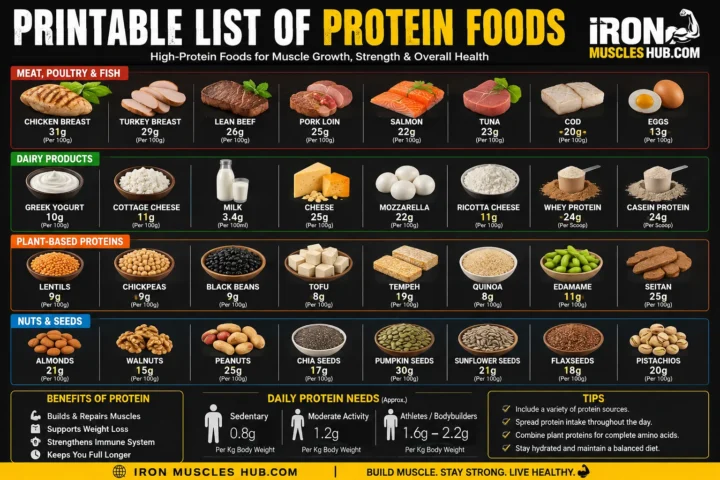
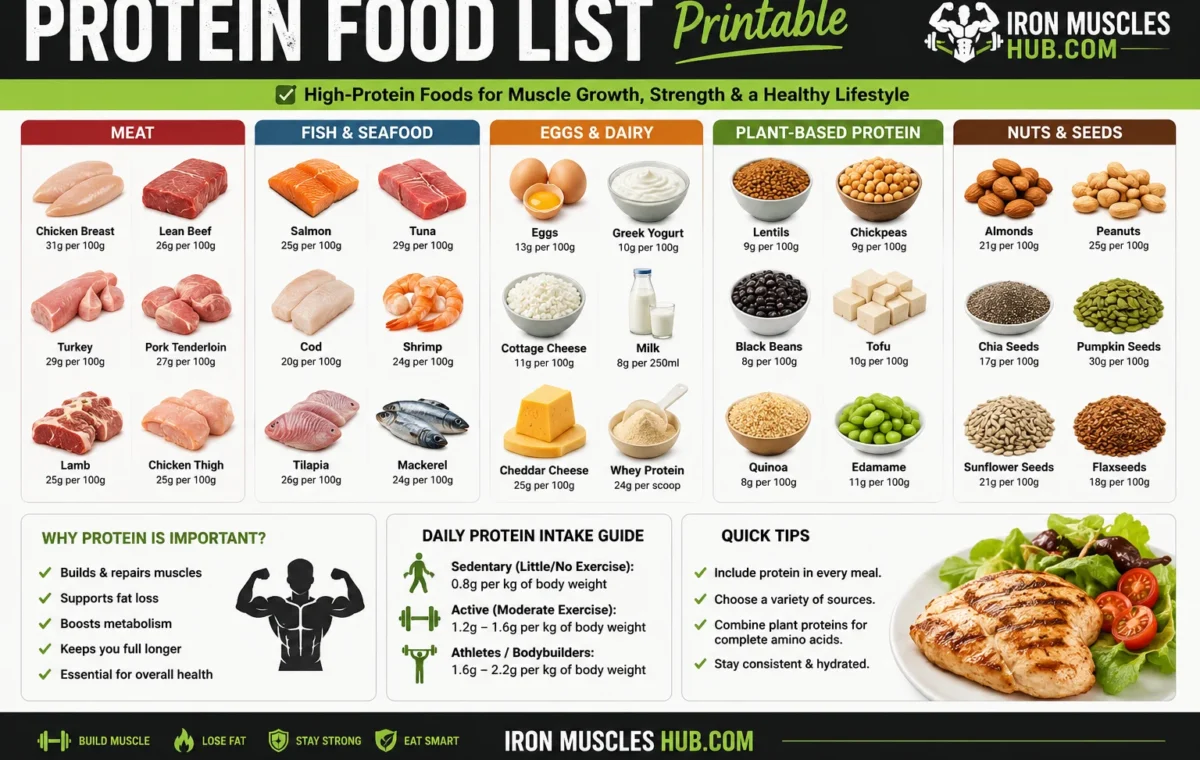
Printable Protein Food List
The following chart is designed to be easy to copy or print.
Protein amounts are approximate reference values because preparation, food variety, brand, and serving size can change the final number. For packaged foods, your nutrition label should take priority.
The serving values below are consistent with USDA-derived reference data and an independent sports-nutrition guide from USADA.
| Protein Food | Typical Serving | Approx. Protein |
|---|---|---|
| Chicken breast, cooked | 3 oz / 85 g | 26 g |
| Turkey breast, cooked | 3 oz / 85 g | 26 g |
| Lean beef, cooked | 3 oz / 85 g | 26 g |
| Ground turkey, cooked | 3 oz / 85 g | 23 g |
| Pork tenderloin | 3 oz / 85 g | 22 g |
| Chicken thigh, cooked | 3 oz / 85 g | 21 g |
| Tuna, canned in water | 3 oz / 85 g | 22 g |
| Salmon, cooked | 3 oz / 85 g | 19 g |
| Shrimp, cooked | 3 oz / 85 g | 19 g |
| Cod, cooked | 3 oz / 85 g | 19 g |
| Tilapia, cooked | 3 oz / 85 g | 22 g |
| Trout, cooked | 3 oz / 85 g | 20 g |
| Sardines | 3 oz / 85 g | 21 g |
| Tempeh | 3 oz / 85 g | 17 g |
| Firm tofu | 1/2 cup / 126 g | 22 g |
| Greek yogurt, plain nonfat | 1 cup / 245 g | 25 g |
| Cottage cheese, low-fat | 1/2 cup / 113 g | 12 g |
| Plain low-fat yogurt | 1 cup / 245 g | 13 g |
| Eggs | 2 large / 100 g | 13 g |
| Edamame, cooked | 1 cup / 155 g | 18 g |
| Lentils, cooked | 1 cup / 198 g | 18 g |
| Split peas, cooked | 1 cup / 196 g | 16 g |
| Beans, cooked | 1 cup | ~15 g* |
| Milk | 1 cup / 240 mL | 8 g |
| Quinoa, cooked | 1 cup | 8 g |
| Whole-wheat pasta | 1 cup | 8 g |
| Peanut butter | 2 tbsp | 8 g |
| Nuts or seeds | 1 oz / 28 g | 8 g |
| Cheese | 1 oz / 28 g | 7 g |
*Bean protein varies considerably by bean type and preparation.
The point of this chart isn’t to declare one food “best.” A 3 oz (85 g) serving of chicken and a cup of lentils aren’t nutritionally interchangeable, even if both help you reach your protein target.
1. High-Protein Meat and Poultry
For beginners who eat meat, poultry can make reaching a higher protein intake relatively straightforward.
Chicken breast
Chicken breast is one of the easiest foods to build meals around.
A 3 oz (85 g) cooked portion provides roughly 26 g of protein in USDA-derived reference data.
Try it with:
- Rice and vegetables
- Whole-wheat wraps
- Potatoes and salad
- Pasta and tomato sauce
- Mixed-grain bowls
Turkey
Turkey breast is another lean option.
It’s useful for sandwiches, wraps, salads, rice bowls, and simple meal prep.
Ground turkey also works well when you want something that cooks quickly.
Lean beef
Lean beef provides protein plus nutrients such as iron and vitamin B12.
Choose leaner cuts more often if you want to keep saturated fat lower, while remembering that a balanced diet doesn’t require every food to be extremely lean.
Pork tenderloin
Pork tenderloin can be a useful alternative when you’re tired of chicken.
It works particularly well with roasted potatoes, rice, vegetables, or whole-grain pasta.
Coach’s tip: Don’t build your entire diet around one protein source. Rotating chicken, fish, eggs, dairy, beans, and soy foods makes meal planning much easier.
2. Fish and Seafood Protein Sources
Fish and seafood can add variety without requiring complicated recipes.
Good choices include:
- Salmon
- Tuna
- Cod
- Tilapia
- Trout
- Sardines
- Shrimp
- Halibut
The USDA MyPlate guidance specifically encourages seafood choices and recommends varying protein sources.
Salmon
Salmon gives you protein along with omega-3 fats.
That makes it different from very lean fish. You aren’t choosing salmon simply because it has the highest possible protein-to-calorie ratio.
You’re choosing it because it provides protein plus other nutrients.
Tuna
Canned tuna is convenient for:
- Sandwiches
- Wraps
- Salads
- Rice bowls
- Quick lunches
Check the product label because protein and sodium can vary between brands and preparations.
Shrimp
Shrimp is a useful lean seafood option.
You can throw it into stir-fries, pasta, tacos, rice bowls, or salads without needing a long cooking time.
3. Eggs and Dairy Protein
Dairy and eggs are particularly convenient for breakfast and snacks.
USADA’s sports nutrition guide lists 2 eggs at about 12 g protein and 1 cup of Greek yogurt or cottage cheese at about 25 g protein, while actual products can vary.
Eggs
Eggs are inexpensive, easy to prepare, and versatile.
Use them for:
- Scrambled eggs
- Omelets
- Boiled eggs
- Egg sandwiches
- Breakfast wraps
You don’t need to remove the yolk simply because you’re interested in protein. Whole eggs provide protein along with other nutrients.
Greek yogurt
Plain Greek yogurt is one of the easiest high-protein foods for beginners.
Use it with:
- Berries
- Oats
- Fruit
- Nuts
- Seeds
You can also use it as a base for sauces and dips.
Cottage cheese
Cottage cheese works well as a snack or as part of breakfast.
Try it with fruit, whole-grain toast, or vegetables.
Common beginner mistake: Choosing a flavored yogurt without checking the nutrition label.
Why: Some products contain considerably more added sugar than plain versions.
Fix: Compare labels and choose the product that fits your overall diet.
4. Plant-Based Protein Foods
You don’t need to eat meat to include plenty of protein-rich foods.
The USDA protein-food group includes beans, peas, lentils, nuts, seeds, and soy products.
Mayo Clinic also identifies soy, nuts, seeds, beans, and lentils as useful plant protein sources.
Lentils
Lentils are inexpensive, versatile, and easy to add to meals.
Use them in:
- Soups
- Curries
- Salads
- Rice dishes
- Lentil bowls
A cup of cooked lentils provides roughly 18 g of protein in USDA-derived reference data.
Beans
Black beans, kidney beans, pinto beans, chickpeas, and other legumes can contribute substantial protein while also providing carbohydrates and fiber.
That combination makes them particularly useful when you’re building a balanced meal.
Tofu
Tofu is one of the easiest soy foods to use as a meat alternative.
You can:
- Drain it.
- Press it if desired.
- Cut it into cubes.
- Season it.
- Bake, pan-cook, or stir-fry it.
Firm tofu can provide a substantial amount of protein per serving, although exact values depend on the product.
Tempeh
Tempeh is another soy-based option with a firmer texture.
It works well in stir-fries, sandwiches, salads, and grain bowls.
Edamame
Edamame makes a simple snack or side dish.
Cooked edamame also works well in salads and rice bowls.
5. Nuts, Seeds, and Other Protein Foods
Nuts and seeds contribute protein, but there’s an important distinction.
They’re not usually the most efficient way to get large amounts of protein because they also contain substantial amounts of fat and therefore calories.
Useful choices include:
- Peanuts
- Almonds
- Pumpkin seeds
- Sunflower seeds
- Hemp seeds
- Chia seeds
- Peanut butter
- Mixed nuts
They’re still excellent foods to include.
Think of them as protein-containing foods, rather than treating every nut or seed as a concentrated protein source.
For example, peanut butter can be excellent on whole-grain toast or mixed into oats, but eating increasingly large spoonfuls just to raise protein can also raise calories quickly.
6. Protein Foods Compared by Goal
Here’s a more useful comparison than simply asking, “Which food has the most protein?”
| Your Priority | Good Choices |
|---|---|
| Convenient meal prep | Chicken, turkey, eggs, Greek yogurt |
| Lean protein | Chicken breast, turkey breast, tuna, shrimp |
| Fish-based meals | Salmon, tuna, cod, trout |
| Vegetarian | Eggs, dairy, tofu, tempeh, lentils, beans |
| Vegan | Tofu, tempeh, edamame, beans, lentils |
| Protein + fiber | Lentils, beans, edamame |
| Protein + omega-3 fats | Salmon, sardines |
| Quick breakfast | Eggs, Greek yogurt, cottage cheese |
| Quick snack | Greek yogurt, cottage cheese, edamame |
| Budget-friendly options | Eggs, lentils, beans, milk, yogurt |
| Meal prep | Chicken, turkey, lean beef, lentils |
This is one of the key information gains over basic printable charts: the highest-protein food isn’t automatically the best food for your situation.
How Much Protein Do Beginners Need?
The standard adult protein RDA is 0.8 g/kg (0.36 g/lb) per day. This is an established reference for healthy adults, not a bodybuilding target.
Resistance training changes the conversation.
A large meta-analysis found that increasing total protein intake above approximately 1.6 g/kg/day (0.73 g/lb/day) did not produce additional gains in fat-free mass from resistance training in the analyzed healthy adults.
Mayo Clinic likewise notes that athletes can often meet protein needs through ordinary foods and that more protein isn’t automatically better.
Worked Example: 180 lb / 82 kg Beginner
Suppose you weigh 180 lb (about 82 kg).
Using the adult RDA:
82 kg × 0.8 g/kg = about 66 g protein/day
For a resistance-training context, using 1.6 g/kg as an upper reference from the meta-analysis:
82 kg × 1.6 g/kg = about 131 g protein/day
That doesn’t mean you must eat exactly 131 g every day.
It demonstrates why protein needs depend on body weight, activity, age, health, and overall diet.
A Simple 30-Second Protein Decision Rule
Here’s the rule I’d give a beginner:
Look at your plate and ask: “Where is the protein?”
If you can’t identify a clear protein source, add one.
Examples:
- Oats → add Greek yogurt or milk
- Toast → add eggs
- Rice → add chicken, tofu, beans, or fish
- Salad → add tuna, chicken, eggs, beans, or tofu
- Fruit → add Greek yogurt or cottage cheese
- Pasta → add lean meat, seafood, lentils, or beans
You don’t need to calculate every gram of protein in every bite.
Start by making protein visible in your meals.
Common Mistakes → Why → Fix
Mistake 1: Eating protein only at dinner
Why: A huge evening serving can make your daily target harder to reach.
Fix: Put a protein source into breakfast and lunch too.
Mistake 2: Assuming “more protein” always means “better”
Why: Protein is important, but your body also needs carbohydrates, fats, vitamins, minerals, fiber, and adequate energy.
Fix: Build balanced meals rather than trying to turn every meal into a protein-only meal.
Mayo Clinic specifically advises pairing protein foods with fruits, vegetables, and whole grains rather than making protein the entire meal.
Mistake 3: Ignoring calories from protein-rich foods
Why: Nuts, seeds, cheese, and peanut butter contain useful protein but can also be calorie-dense.
Fix: Choose portions based on your overall goal rather than judging food only by protein grams.
Mistake 4: Treating plant protein as useless
Why: Plant foods can provide meaningful protein, but individual foods differ in amino-acid profiles and protein density.
Fix: Eat a varied diet containing legumes, soy foods, grains, nuts, and seeds. Mayo notes that complementary plant foods don’t necessarily have to be eaten in the same meal for your body to use their amino acids.
Mistake 5: Comparing raw and cooked weights
Why: Cooking changes water content, so protein per 100 g can change even though the food hasn’t suddenly created more protein.
Fix: Use the same measurement method when tracking foods. If a database says cooked chicken, compare it with cooked chicken.
Who This Protein Food List Is NOT For
This printable is designed for generally healthy adults who want a simple nutrition reference.
It’s not a substitute for individualized nutrition care.
Speak with a doctor or registered dietitian if you have kidney disease, another medical condition affecting nutrition, are pregnant or breastfeeding, have a history of an eating disorder, or have been prescribed a specific therapeutic diet.
Children and teenagers also have different nutrition needs and shouldn’t simply copy an adult high-protein target.
How to Use This Protein Food List Printable
You don’t need to print the entire article.
For a simple weekly system, copy the chart into a document and print it.
Then follow these steps:
Step 1: Choose 3–5 main protein foods
For example:
- Chicken
- Eggs
- Greek yogurt
- Salmon
- Lentils
Step 2: Choose 2–3 backup foods
Maybe:
- Tuna
- Cottage cheese
- Tofu
Step 3: Put them on your grocery list
Buy enough for several meals rather than relying on one food.
Step 4: Build your meals around the protein
Then add:
- Vegetables or fruit
- A carbohydrate source
- A suitable fat source
Step 5: Repeat
Consistency makes nutrition easier.
You don’t need 50 different protein foods every week. A small rotation of foods you enjoy is often much easier to maintain.
Protein Food List for a Beginner Grocery Trip
Here’s a simple starter list.
Meat & Poultry
- Chicken breast
- Chicken thighs
- Turkey breast
- Lean ground turkey
- Lean beef
- Pork tenderloin
Fish & Seafood
- Salmon
- Tuna
- Cod
- Tilapia
- Trout
- Sardines
- Shrimp
Dairy & Eggs
- Eggs
- Greek yogurt
- Cottage cheese
- Plain yogurt
- Milk
- Cheese
Plant Protein
- Lentils
- Black beans
- Kidney beans
- Chickpeas
- Split peas
- Tofu
- Tempeh
- Edamame
Nuts & Seeds
- Peanuts
- Almonds
- Pumpkin seeds
- Sunflower seeds
- Hemp seeds
- Chia seeds
- Peanut butter
Protein-Containing Staples
- Quinoa
- Whole-wheat pasta
- Oats
- Whole-grain bread
- Milk
This approach also reflects MyPlate’s recommendation to vary protein choices rather than relying on one category.
FAQ: Protein Food List Printable
What foods are highest in protein?
Lean meats, poultry, fish, seafood, dairy, soy foods, and some legumes are among the most useful whole-food protein sources. Chicken breast, turkey, lean beef, tuna, Greek yogurt, tofu, lentils, and edamame can all fit into a high-protein diet. The best choice depends on your dietary preferences, calorie needs, budget, and the rest of your meal.
How can I get 100 grams of protein a day?
Start by distributing protein across your meals instead of trying to consume it all at once. For example, choose a protein-rich breakfast, lunch, and dinner, then add one or two protein-containing snacks if needed. You can combine foods such as eggs, Greek yogurt, chicken, fish, lentils, tofu, milk, or cottage cheese. Your exact target should depend on your body size, activity level, and health.
What is a good source of protein for beginners?
Choose foods that are easy for you to buy, prepare, and eat consistently. Eggs, chicken, Greek yogurt, cottage cheese, milk, tuna, beans, lentils, tofu, and fish are practical starting points. You don’t need expensive specialty foods. Mayo Clinic notes that whole-food protein sources can meet protein needs and provide nutrients that isolated supplements don’t provide.
How much protein should I eat if I lift weights?
There isn’t one number that applies to every lifter. The adult RDA is 0.8 g/kg/day, while a major meta-analysis of resistance-training research found that benefits to fat-free mass generally plateaued around 1.6 g/kg/day. Your appropriate intake can differ based on body weight, training, age, calorie intake, and health.
Are plant foods good sources of protein?
Yes. Beans, lentils, peas, soy foods, nuts, seeds, and whole grains can all contribute protein. Plant foods also bring other nutrients such as fiber and minerals. Mayo Clinic recommends eating a variety of plant protein sources rather than relying on one food. If you’re vegan, pay attention to overall dietary variety and make sure your diet supplies all essential nutrients.
Final Protein Food List
The easiest way to use a protein food list printable is to treat it as a decision-making tool, not a strict diet.
Pick several foods you genuinely enjoy. Rotate animal and plant sources if they fit your diet. Put a protein source into your regular meals, then build the rest of your plate around vegetables or fruit, carbohydrates, and healthy fats.
For beginners who lift weights, more protein isn’t automatically better. A consistent diet, progressive resistance training, adequate recovery, and enough total food matter too. Research suggests that around 1.6 g/kg/day (0.73 g/lb/day) is a useful upper reference for maximizing resistance-training-related gains for many healthy adults, while individual needs vary.
Final Thoughts
A protein food list printable can make healthy eating much simpler. You don’t need a complicated meal plan or a kitchen full of specialty products. Start with a few reliable protein foods you enjoy, keep them available, and build balanced meals around them.
Chicken, fish, eggs, Greek yogurt, cottage cheese, beans, lentils, tofu, tempeh, and other protein-rich foods can all have a place in your diet. If you’re strength training, adequate daily protein can support muscle-building alongside consistent resistance training. Research suggests that benefits generally level off around 1.6 g/kg (0.73 g/lb) per day for many healthy adults doing resistance training.
The biggest win is consistency. Print the list, take it grocery shopping, choose several foods for the week, and make protein a regular part of your meals. Then let your training, recovery, and overall diet do the rest.