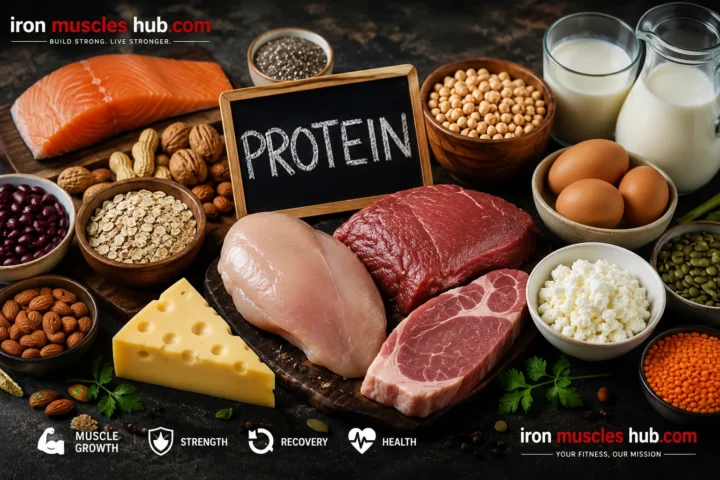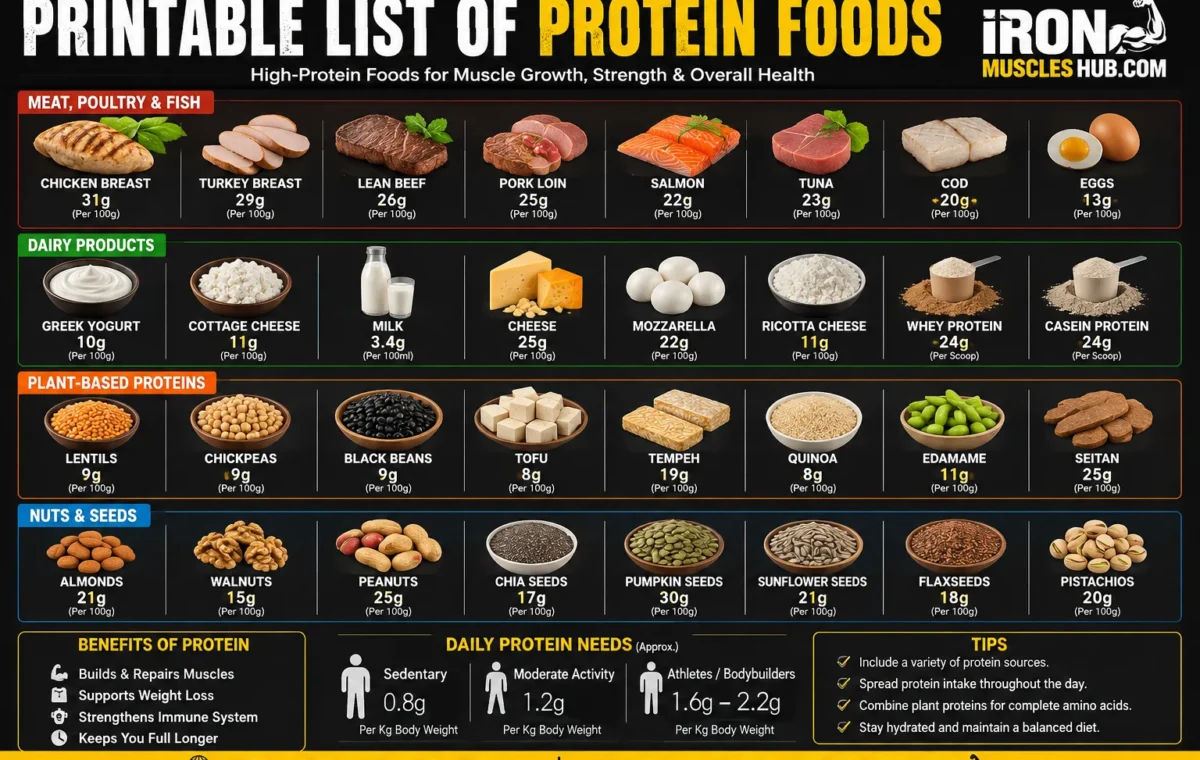
If you want a printable list of protein foods, the simplest approach is to keep a mixture of lean meats, fish, eggs, dairy, beans, lentils, soy foods, nuts, and seeds available. You don’t need to eat the same protein every day, and you don’t need protein supplements to build a solid diet.
- Quick Answer
- Printable List of Protein Foods
- Meat and Poultry
- Fish and Seafood
- Legumes and Soy
- Other Plant Protein Choices
- High-Protein Animal Foods
- High-Protein Plant Foods
- Easy Protein Snacks
- Quick Conversion
- Step 1: Choose one protein anchor
- Step 2: Add a carbohydrate
- Step 3: Add vegetables or fruit
- Step 4: Add fats as needed
- Mistake 1: Thinking every protein food is equally protein-dense
- Mistake 2: Eating almost all your protein at dinner
- Mistake 3: Assuming you need protein powder
- Mistake 4: Choosing foods only because they contain protein
- Mistake 5: Ignoring the serving size
- Ask three questions:
- What are the best foods to eat for protein?
- What foods are highest in protein?
- How much protein should I eat each day?
- What are the best high-protein foods for muscle growth?
- Can I get enough protein from plant foods?
- Meat & Poultry
- Fish & Seafood
- Eggs & Dairy
- Plant Protein
- Nuts & Seeds
For beginners, the most useful list is one that shows realistic portions, approximate protein amounts, and easy ways to use each food. This guide gives you that list, plus a simple method for estimating your daily protein needs. For more insights read here :- lean and muscle body and fastest way to gain muscle .
Quick Answer
- Best everyday protein choices: chicken, turkey, fish, eggs, Greek yogurt, cottage cheese, tofu, tempeh, lentils, beans, and edamame.
- For people who lift weights: around 1.6 g of protein per kg of body weight per day is a useful evidence-based target for many healthy resistance-trained adults. That’s about 0.73 g per lb.
- You don’t need one giant protein meal. Dividing protein across several meals can make it easier to reach your daily intake. Research has examined approximately 0.4 g/kg per meal as a practical target.
- Food values are estimates. Brand, cooking method, fat content, and serving size can change the protein number, so use the Nutrition Facts label when available.
Printable List of Protein Foods
Here’s the section you can print or save for grocery shopping.
Meat and Poultry
| Food | Typical serving | Approx. protein |
|---|---|---|
| Chicken breast, roasted | 3 oz / 85 g | 26 g |
| Turkey breast, roasted | 3 oz / 85 g | 26 g |
| Lean beef/sirloin | 3 oz / 85 g | 26 g |
| Ground turkey | 3 oz / 85 g | 23 g |
| 90% lean ground beef | 3 oz / 85 g | 23 g |
| Pork tenderloin | 3 oz / 85 g | 22 g |
| Chicken thigh | 3 oz / 85 g | 21 g |
| Pork loin | 3 oz / 85 g | 21 g |
These values are useful estimates based on common serving sizes and USDA-derived food data. Actual values can vary depending on the cut, cooking method, and product.
Beginner tip: If you’re meal prepping, chicken breast and turkey are easy choices because you can cook several portions at once and add them to rice, potatoes, wraps, salads, or sandwiches.
You don’t have to avoid beef or pork. Just pay attention to the fat content and choose leaner cuts more often if you’re trying to keep meals relatively protein-dense.
Fish and Seafood
| Food | Typical serving | Approx. protein |
|---|---|---|
| Tuna, canned in water | 3 oz / 85 g | 22 g |
| Tilapia | 3 oz / 85 g | 22 g |
| Sardines | 3 oz / 85 g | 21 g |
| Rainbow trout | 3 oz / 85 g | 20 g |
| Cod | 3 oz / 85 g | 19 g |
| Shrimp | 3 oz / 85 g | 19 g |
| Salmon | 3 oz / 85 g | 19 g |
| Halibut | 3 oz / 85 g | 16 g |
USDA-derived food data show that fish and seafood can provide substantial protein in a relatively modest serving.
Fish also gives you nutrients that you won’t get in exactly the same combination from chicken or beef. The USDA recommends varying protein choices and specifically includes seafood among the main protein-food categories.
Easy meal idea: Put salmon, potatoes, and vegetables on one plate. Or mix canned tuna with a whole-grain wrap, salad vegetables, and Greek yogurt-based dressing.
Eggs and Dairy Protein Foods
| Food | Typical serving | Approx. protein |
|---|---|---|
| Greek yogurt, plain nonfat | 1 cup / 245 g | 25 g |
| Two large eggs | 2 eggs / 100 g | 13 g |
| Low-fat cottage cheese | 1/2 cup / 113 g | 12 g |
| Plain low-fat yogurt | 1 cup / 245 g | 13 g |
Eggs are especially convenient because they’re inexpensive, easy to cook, and work at breakfast, lunch, or dinner.
Greek yogurt is another strong option for beginners. You can eat it with fruit and oats, mix it into a smoothie, or use it as a higher-protein replacement for some sauces.
Cottage cheese is useful as a snack or part of a meal. Try it with fruit, whole-grain toast, or vegetables.
Milk also contributes protein. It doesn’t have to be the main protein source of your diet, but it can help add protein to breakfast, cereal, oats, smoothies, or meals.
Plant-Based Protein Foods
You don’t need meat to eat a protein-rich diet.
The USDA Protein Foods Group includes beans, peas, lentils, nuts, seeds, and soy products, along with meat, poultry, seafood, and eggs.
Legumes and Soy
| Food | Typical serving | Approx. protein |
|---|---|---|
| Edamame, cooked | 1 cup / 155 g | 18 g |
| Lentils, cooked | 1 cup / 198 g | 18 g |
| Split peas, cooked | 1 cup / 196 g | 16 g |
| Firm tofu | 1/2 cup / 126 g | 22 g |
| Tempeh | 3 oz / 85 g | 17 g |
Beans and lentils also provide carbohydrate and fiber, so don’t compare them with chicken as if they’re nutritionally identical.
That’s actually one reason they’re useful.
A bowl containing lentils, rice, vegetables, and yogurt can provide protein while also giving you carbohydrates, fiber, and several micronutrients.
Other Plant Protein Choices
- Black beans
- Kidney beans
- Chickpeas
- Pinto beans
- Navy beans
- Green peas
- Soybeans
- Tofu
- Tempeh
- Edamame
- Lentils
- Split peas
- Seitan
- Quinoa
- Peanuts
- Almonds
- Pumpkin seeds
- Chia seeds
- Sunflower seeds
- Hemp seeds
The protein content varies significantly between these foods, so don’t assume that every plant food provides the same amount.
Nuts, Seeds, and Nut Butters
Nuts and seeds are useful protein foods, but they’re different from chicken, fish, or Greek yogurt because they also contain substantial amounts of fat.
Examples include:
- Almonds
- Peanuts
- Pistachios
- Walnuts
- Cashews
- Pumpkin seeds
- Chia seeds
- Sunflower seeds
- Sesame seeds
- Peanut butter
- Almond butter
- Tahini
The USDA counts nuts, seeds, and nut or seed butters within the Protein Foods Group.
Coach’s point: Don’t choose nuts only because they say “high protein.”
They’re nutritious, but they’re usually not the most protein-dense choice per calorie. If your main goal is to add a large amount of protein without adding much food volume, Greek yogurt, chicken, fish, lean meat, tofu, or cottage cheese may be easier.
A Simple Protein Food Chart for Your Fridge
You can use this shorter version as your everyday checklist.
High-Protein Animal Foods
- Chicken breast
- Turkey breast
- Lean beef
- Lean pork
- Tuna
- Salmon
- Cod
- Shrimp
- Sardines
- Trout
- Eggs
- Greek yogurt
- Cottage cheese
- Milk
High-Protein Plant Foods
- Lentils
- Black beans
- Chickpeas
- Kidney beans
- Edamame
- Tofu
- Tempeh
- Soybeans
- Split peas
- Seitan
- Quinoa
- Peanuts
- Almonds
- Pumpkin seeds
- Chia seeds
- Sunflower seeds
Easy Protein Snacks
- Greek yogurt
- Cottage cheese
- Boiled eggs
- Tuna
- Edamame
- Milk
- Peanut butter with whole-grain toast
- Cheese with fruit
- Yogurt with oats
- Hummus with vegetables
How Much Protein Do You Need?
For general adults, the established protein RDA is 0.8 g/kg of body weight per day. People who train regularly, particularly with resistance exercise, may have higher needs.
For resistance-trained adults, a large systematic review found that protein intake around 1.6 g/kg/day was sufficient to capture most of the additional benefit for fat-free mass from protein supplementation during resistance training, with little evidence of further benefit above that level for this outcome.
That doesn’t mean every beginner must hit exactly 1.6 g/kg.
Your needs can differ based on your training, total diet, body size, age, health status, and goal.
Quick Conversion
1.6 g/kg is approximately 0.73 g/lb.
So if you weigh:
| Body weight | Approx. protein at 1.6 g/kg |
|---|---|
| 60 kg / 132 lb | 96 g/day |
| 70 kg / 154 lb | 112 g/day |
| 80 kg / 176 lb | 128 g/day |
| 90 kg / 198 lb | 144 g/day |
| 100 kg / 220 lb | 160 g/day |
These are simple calculations from the 1.6 g/kg reference point, not personalized medical recommendations.
Worked Example: A 176-lb Beginner
Let’s say you weigh 80 kg (176 lb) and regularly perform resistance training.
Using 1.6 g/kg:
80 × 1.6 = 128 g protein per day
You don’t need to eat 128 g in one sitting.
A simple four-meal structure could look like this:
- Breakfast: 30 g
- Lunch: 35 g
- Snack: 25 g
- Dinner: 38 g
Total = 128 g
The foods could be eggs and Greek yogurt at breakfast, chicken and rice at lunch, cottage cheese or edamame as a snack, and salmon or lean beef with potatoes and vegetables at dinner.
This is the important part: the food list gives you options; the daily target tells you roughly how much to use.
How to Build a High-Protein Meal
Here’s the easiest method I give beginners.
Step 1: Choose one protein anchor
Pick:
- Chicken
- Turkey
- Beef
- Fish
- Eggs
- Greek yogurt
- Cottage cheese
- Tofu
- Tempeh
- Lentils
- Beans
- Edamame
Step 2: Add a carbohydrate
Examples:
- Rice
- Potatoes
- Oats
- Whole-grain bread
- Pasta
- Quinoa
- Fruit
Step 3: Add vegetables or fruit
This helps make the meal more balanced instead of turning every meal into “meat plus nothing.”
Step 4: Add fats as needed
Examples:
- Olive oil
- Nuts
- Seeds
- Avocado
- Nut butter
You don’t need to remove fat simply because you’re increasing protein.
How to Spread Protein Across the Day
You don’t have to obsess over exact timing.
Daily protein intake matters, and distributing protein over several meals can be a practical way to reach your total.
One review proposed approximately 0.4 g/kg per meal across at least four meals when aiming for 1.6 g/kg/day.
For an 80 kg / 176 lb person, 0.4 g/kg is about:
80 × 0.4 = 32 g per meal
Four meals of roughly 32 g would give about 128 g.
That’s a useful planning example, not a rule that you must follow perfectly.
A 12-week resistance-training study also investigated a more even distribution of protein across breakfast, lunch, and dinner, highlighting why spreading protein rather than saving most of it for the evening can be a practical strategy.
Common Mistakes → Why → Fix
Mistake 1: Thinking every protein food is equally protein-dense
Why:
Protein foods vary widely in protein, fat, carbohydrate, water, and calorie content.
A handful of nuts contains protein, but it also contains considerable fat. Chicken breast provides much more protein per typical serving.
Fix:
Compare foods using the same serving size or, even better, compare realistic portions that you actually eat.
Mistake 2: Eating almost all your protein at dinner
Why:
A huge dinner may help you reach your daily total, but it can make the rest of the day unnecessarily difficult.
Fix:
Put a protein source into breakfast and lunch instead of trying to “catch up” at night.
Mistake 3: Assuming you need protein powder
Why:
Protein powder is convenient, but it’s not required for a high-protein diet.
Fix:
Start with ordinary foods. Use supplements only if they make your routine easier and fit your dietary needs.
Chicken, eggs, dairy, fish, tofu, lentils, beans, and soy foods can all contribute protein.
Mistake 4: Choosing foods only because they contain protein
Why:
A food can contain protein without being the best choice for every meal.
For example, some processed meats can be high in sodium or saturated fat.
Fix:
Build variety into your protein choices. The USDA specifically recommends varying protein foods and choosing leaner meat and poultry options more often.
Mistake 5: Ignoring the serving size
Why:
“20 g of protein” means very little unless you know whether that came from 50 g, 100 g, one cup, three ounces, or an entire package.
Fix:
Look at both the serving size and protein grams on the Nutrition Facts label.
30-Second Protein Decision Rule
If you’re standing in the grocery store and don’t know what to buy, use this:
Ask three questions:
1. Does this food provide a useful amount of protein?
If yes, keep it on the list.
2. Can I realistically eat it several times per week?
If no, don’t build your diet around it.
3. Does it fit the rest of my meal?
If yes, buy it.
For example:
Chicken + rice + vegetables = easy meal
Greek yogurt + oats + berries = easy breakfast
Lentils + rice + vegetables + yogurt = easy plant-forward meal
Tuna + whole-grain bread + salad = easy lunch
The best protein food isn’t necessarily the food with the highest number on a chart. It’s the food you can consistently buy, prepare, enjoy, and fit into a balanced diet.
Budget-Friendly Protein Foods
Eating more protein doesn’t have to mean buying expensive steak every week.
Try:
- Eggs
- Milk
- Greek yogurt
- Cottage cheese
- Canned tuna
- Canned sardines
- Lentils
- Dried or canned beans
- Chickpeas
- Edamame
- Tofu
- Peanut butter
- Chicken thighs
- Ground turkey
- Lean ground beef when on sale
Beans, peas, lentils, nuts, seeds, soy foods, eggs, seafood, meat, and poultry are all recognized as protein-food options by the USDA.
Budget tip: Buy whichever protein source is affordable in your local supermarket and build meals around it. Frozen, canned, and dried foods can make protein planning easier.
Protein Foods for Muscle Growth
If your goal is gaining muscle, protein is only one piece of the plan.
You also need a consistent resistance-training stimulus, enough total food to support your goal, adequate sleep, and a diet that supplies carbohydrates, fats, vitamins, minerals, and fiber.
Research supports the role of adequate protein alongside resistance training. A large meta-analysis of 49 studies involving 1,863 participants found that protein supplementation during prolonged resistance training modestly increased strength and fat-free mass, with the additional fat-free-mass benefit leveling off around 1.6 g/kg/day in its analysis.
That doesn’t mean eating more protein automatically creates more muscle.
Think of protein as raw material, while resistance training provides the stimulus.
Who This Printable Protein List Is NOT For
This guide is intended for generally healthy adults looking for practical nutrition information.
It isn’t a substitute for individualized dietary care if you have:
- Kidney disease
- Liver disease
- A medically prescribed diet
- Significant gastrointestinal problems
- Pregnancy or breastfeeding-related nutrition needs
- A history of an eating disorder
- Other medical conditions that affect protein or nutrient requirements
If you’re in one of these groups, speak with a doctor or registered dietitian before making major changes to your protein intake.
Frequently Asked Questions
What are the best foods to eat for protein?
There isn’t one single best protein food. Good choices include chicken, turkey, fish, eggs, Greek yogurt, cottage cheese, lean beef, tofu, tempeh, lentils, beans, and edamame. The USDA recommends varying protein choices because different foods provide different nutrients.
For everyday meals, prioritize foods you enjoy and can consistently afford. Variety also makes your diet easier to maintain.
What foods are highest in protein?
Among common foods, lean meats, poultry, fish, Greek yogurt, tofu, tempeh, eggs, and some soy foods provide substantial protein per typical serving. For example, USDA-derived data list roasted chicken breast and lean beef at about 26 g per 3 oz / 85 g serving, while plain nonfat Greek yogurt provides about 25 g per cup.
Exact values vary by brand, cut, preparation, and serving size.
How much protein should I eat each day?
The basic adult RDA is 0.8 g/kg/day. People who regularly perform resistance training may benefit from more. A major meta-analysis found that around 1.6 g/kg/day was a useful point for maximizing most of the additional fat-free-mass benefit associated with protein supplementation during resistance training.
Your ideal intake can differ based on your health, training, age, body size, and goal.
What are the best high-protein foods for muscle growth?
For muscle-focused diets, choose practical protein sources such as chicken, lean beef, turkey, fish, eggs, Greek yogurt, cottage cheese, tofu, tempeh, lentils, beans, and edamame.
The key isn’t finding one magic food. It’s consistently eating enough total protein while performing progressive resistance training and maintaining an appropriate overall diet. Protein works as part of that larger plan.
Can I get enough protein from plant foods?
Yes. Plant-based diets can include protein from beans, lentils, peas, soy foods, nuts, seeds, and grains. The USDA specifically includes beans, peas, lentils, nuts, seeds, and soy products within its Protein Foods Group.
If you eat mostly or entirely plant-based, use a variety of protein sources rather than relying on one food. Tofu, tempeh, edamame, lentils, beans, and soy foods can make this easier.
Printable Weekly Protein Shopping List
Use this as a simple grocery checklist.
Meat & Poultry
- Chicken breast
- Chicken thighs
- Turkey breast
- Lean ground turkey
- Lean beef
- Pork tenderloin
Fish & Seafood
- Salmon
- Tuna
- Cod
- Trout
- Sardines
- Shrimp
Eggs & Dairy
- Eggs
- Greek yogurt
- Cottage cheese
- Milk
- Plain yogurt
Plant Protein
- Lentils
- Chickpeas
- Black beans
- Kidney beans
- Edamame
- Tofu
- Tempeh
- Split peas
- Soybeans
Nuts & Seeds
- Peanuts
- Almonds
- Pistachios
- Walnuts
- Pumpkin seeds
- Chia seeds
- Sunflower seeds
- Peanut butter
How to Use This List Every Week
Don’t try to buy everything.
Pick two or three main proteins for your meals, two easy breakfast/snack proteins, and a couple of plant-based options.
For example:
Monday–Wednesday: chicken + Greek yogurt + eggs
Thursday–Friday: salmon + cottage cheese + lentils
Weekend: lean beef + tuna + tofu
This gives you variety without turning meal planning into a complicated project.
The goal is not to make every meal perfect.
The goal is to make protein easy enough that you can repeat the habit.
Final Takeaway
A good printable list of protein foods should make eating better easier, not make nutrition more complicated. Keep several dependable options in your kitchen, build meals around a protein source, and use realistic serving sizes when estimating your intake.
For people who lift, around 1.6 g/kg/day is a useful evidence-based reference point, but it isn’t a mandatory number for every person.
Start with foods you actually enjoy: chicken, eggs, yogurt, fish, lean meat, lentils, beans, tofu, tempeh, or edamame. Spread protein across your meals, eat a varied diet, and let consistency do most of the work.
Save or print the checklist above and use it the next time you plan your grocery shop.