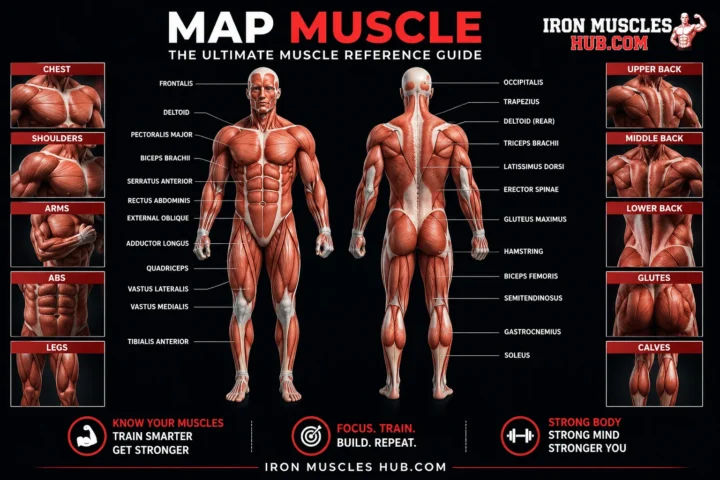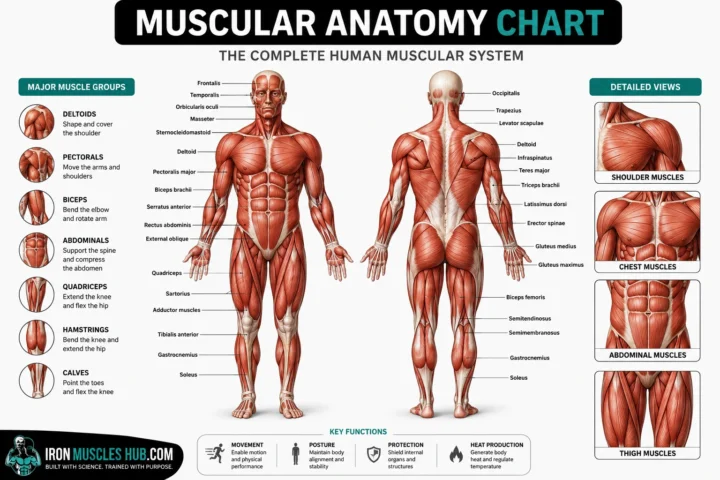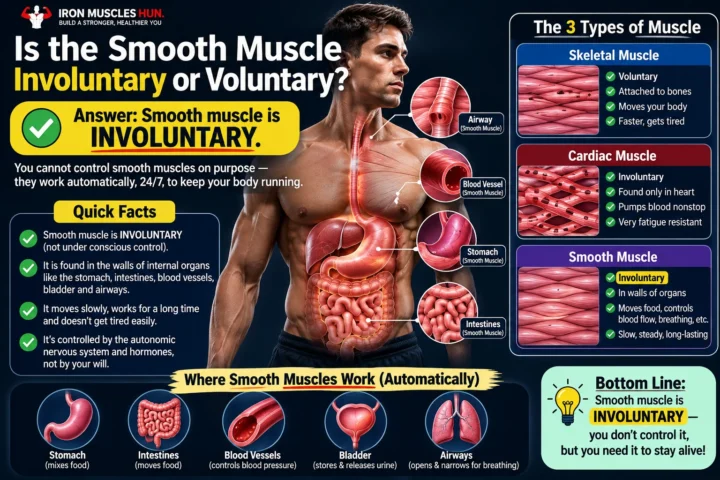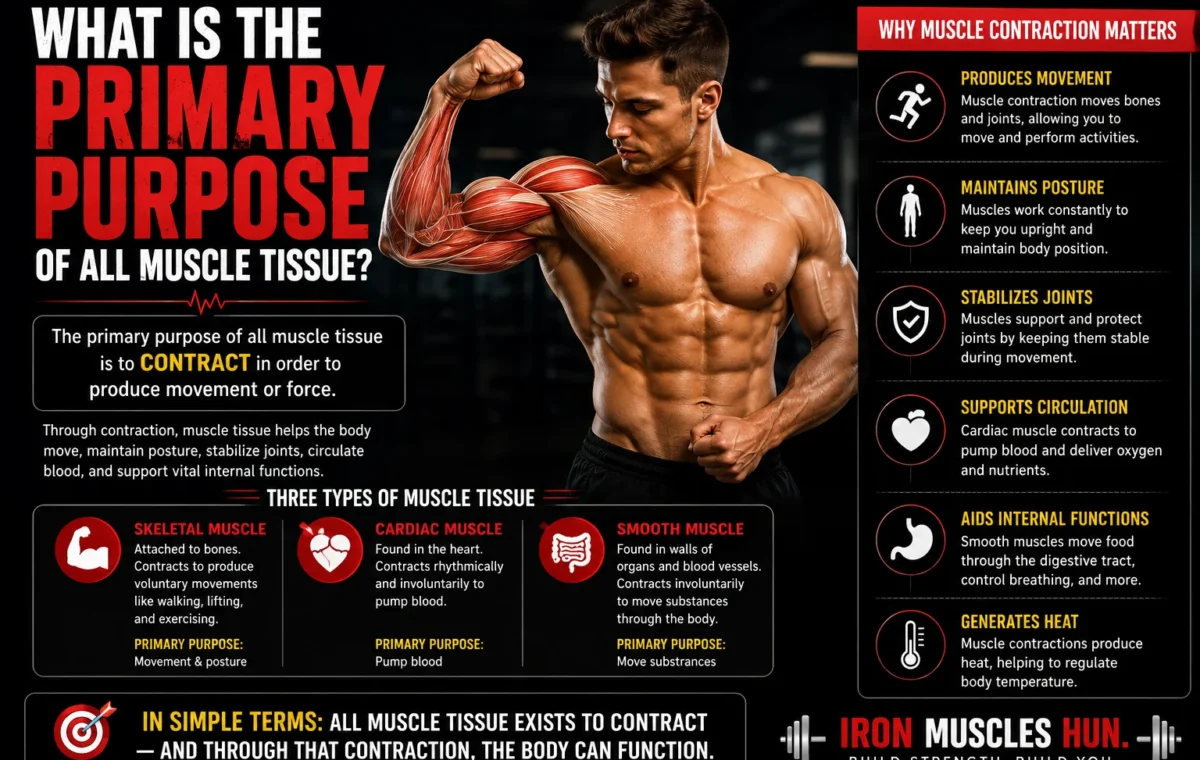
The primary purpose of all muscle tissue is to produce movement by contracting and generating force. Muscle tissue allows the body to move, helps internal organs function, pumps blood through the heart, and controls important processes such as digestion and blood flow.
- Quick Answer: what is the primary purpose of all muscle tissue
- 1. Skeletal Muscle: Creates Body Movement
- 2. Cardiac Muscle: Keeps the Heart Pumping
- 3. Smooth Muscle: Controls Internal Body Functions
- Mistake 1: Thinking All Muscles Are Voluntary
- Mistake 2: Believing Muscles Only Move Bones
- Mistake 3: Assuming Bigger Muscles Always Mean Better Function
- What is the primary purpose of all muscle tissue?
- What are the three types of muscle tissue?
- Why can muscle tissue contract?
- Which muscle tissue is responsible for moving bones?
- Does all muscle tissue require conscious control?
- Why is muscle tissue important for survival?
- 1. Producing Movement
- 2. Maintaining Body Posture
- 3. Pumping Blood Throughout the Body
- 4. Moving Substances Inside the Body
- “All muscles are the same.”
- “Muscles only matter for athletes.”
- “The only purpose of muscles is to make the body stronger.”
- 1. The Brain Sends a Signal
- 2. Muscle Fibers Activate
- 3. The Muscle Produces Force
- 4. The Muscle Relaxes
- Example 1: Walking
- Example 2: Eating Food
- Example 3: Exercise
- What is the primary purpose of all muscle tissue?
- What do all three types of muscle tissue have in common?
- Which muscle tissue controls body movement?
- Which type of muscle tissue works automatically?
- Why is muscle contraction important?
- Can muscle tissue become stronger?
Many people think muscles only mean the muscles they train in the gym, such as the biceps or chest muscles. However, muscle tissue exists throughout the body and performs essential jobs that happen automatically every second of the day. Your heart beating and food moving through your digestive system are both examples of muscle tissue at work. For more insights read here :- fastest way to gain muscle and how to get bigger .
Quick Answer: what is the primary purpose of all muscle tissue
| Question | Answer |
|---|---|
| Primary purpose of all muscle tissue | To contract and create movement or force |
| Main ability of muscle cells | Contraction (shortening) |
| Number of major muscle tissue types | Three: skeletal, cardiac, and smooth |
| Controlled by conscious thought? | Some muscles are voluntary, while others work automatically |
Key Takeaways
- All muscle tissue works by contracting.
- Muscle contraction creates movement inside and outside the body.
- Skeletal muscle moves bones and helps maintain posture.
- Cardiac muscle pumps blood by beating continuously.
- Smooth muscle controls movements inside organs.
How Does Muscle Tissue Create Movement?
Muscle tissue contains specialized cells that can contract. A contraction happens when muscle fibers shorten and create force. This force can move a body part, push substances through an organ, or maintain essential body functions.
A simple example is lifting a cup:
- Your brain sends a signal to your arm muscles.
- The muscle fibers in your arm contract.
- The contraction pulls on your bones through tendons.
- Your hand moves upward and lifts the cup.
The same basic idea happens in other parts of the body, although not every muscle is under your conscious control.
The Three Main Types of Muscle Tissue
The human body has three main types of muscle tissue:
- Skeletal muscle
- Cardiac muscle
- Smooth muscle
Each type has the same basic ability — contraction — but each is designed for a different job.
1. Skeletal Muscle: Creates Body Movement
Skeletal muscle is the type most people recognize. It attaches to bones and allows voluntary movements such as walking, running, lifting objects, and changing facial expressions.
Examples include:
- Biceps when you bend your arm
- Quadriceps when you straighten your knee
- Back muscles when you maintain posture
Skeletal muscles also help stabilize joints and produce heat during activity.
2. Cardiac Muscle: Keeps the Heart Pumping
Cardiac muscle is found only in the heart. Its main purpose is to contract continuously so the heart can pump blood throughout the body.
Unlike skeletal muscle, cardiac muscle works automatically. You do not need to think about making your heart beat.
3. Smooth Muscle: Controls Internal Body Functions
Smooth muscle is found in the walls of organs and passageways. It helps move substances through the body and controls processes that happen without conscious effort.
Examples include:
- Moving food through the digestive system
- Controlling blood vessel diameter
- Helping the bladder function
Why Is Muscle Contraction So Important?
Without muscle contraction, the human body could not perform basic survival functions.
Muscle contractions help with:
| Body Function | How Muscle Tissue Helps |
| Movement | Skeletal muscles move bones and joints |
| Heart circulation | Cardiac muscle pumps blood |
| Digestion | Smooth muscle moves food through organs |
| Breathing | Muscles help expand and contract the chest |
| Stability | Muscles maintain posture and body position |
Muscle tissue is unique because contraction allows it to create force, which separates it from many other types of body tissue.
Muscle Tissue vs Muscle Strength: What Is the Difference?
Muscle tissue’s primary purpose is not simply to become bigger or stronger. Its biological purpose is to create force through contraction.
Muscle strength is the ability of your muscles to produce force. Exercise can improve muscle size, endurance, and strength, but the basic job of muscle tissue remains the same.
For example:
- A professional athlete uses skeletal muscle for powerful movement.
- A person sitting still uses muscles to maintain posture.
- Your heart uses cardiac muscle without stopping to keep blood circulating.
Common Mistakes About Muscle Tissue
Mistake 1: Thinking All Muscles Are Voluntary
Not all muscles are controlled by conscious decisions.
Fix: Remember:
- Skeletal muscles are mostly voluntary.
- Cardiac and smooth muscles work automatically.
Mistake 2: Believing Muscles Only Move Bones
Skeletal muscles move bones, but other muscle tissues control internal functions.
Fix: Think beyond exercise. Your heartbeat and digestion also depend on muscle tissue.
Mistake 3: Assuming Bigger Muscles Always Mean Better Function
Muscle size is only one part of performance.
Fix: Healthy muscle function also depends on coordination, endurance, and the ability to contract properly.
Simple Example: Muscle Tissue Working Together
Imagine you are eating a meal:
- Skeletal muscles help you chew and swallow.
- Smooth muscles move food through your digestive tract.
- Cardiac muscle keeps blood circulating to deliver oxygen and nutrients.
Different muscle tissues work together to keep the body functioning.
Frequently Asked Questions
What is the primary purpose of all muscle tissue?
The primary purpose of all muscle tissue is to contract and produce force. This contraction creates movement, supports body position, pumps blood, and controls movements inside organs. Every type of muscle tissue performs these jobs in a specialized way.
What are the three types of muscle tissue?
The three types of muscle tissue are skeletal muscle, cardiac muscle, and smooth muscle. Skeletal muscle controls body movement, cardiac muscle creates heartbeats, and smooth muscle manages movements inside organs such as the digestive tract and blood vessels.
Why can muscle tissue contract?
Muscle cells contain specialized structures and proteins that allow them to shorten and generate force. This ability to contract is the main feature that allows muscles to create movement.
Which muscle tissue is responsible for moving bones?
Skeletal muscle is responsible for moving bones. It attaches to the skeleton and contracts when you perform voluntary movements such as walking, lifting, or reaching.
Does all muscle tissue require conscious control?
No. Only skeletal muscle is mainly under conscious control. Cardiac muscle and smooth muscle operate automatically to support essential body functions.
Why is muscle tissue important for survival?
Muscle tissue supports survival because it enables movement, keeps the heart pumping, helps breathing, and allows organs to perform their functions. Without muscle contractions, many essential body processes would stop.
Related Articles to Link Internally on Iron Muscle Hub
- What Are Muscles? A Beginner’s Guide to the Human Muscular System
- What Are Some Major Muscles in the Human Body?
- Cardiac vs Skeletal Muscle: Key Differences Explained
Understanding the Role of Muscle Tissue
Muscle tissue does far more than create visible movement. Its main purpose is contraction, and this simple ability supports almost every major action your body performs. From walking and exercising to pumping blood and digesting food, muscles provide the force needed for life.
Understanding the three types of muscle tissue helps you see why muscles are essential beyond fitness and appearance. Taking care of your muscles through regular movement, proper nutrition, and healthy habits supports better function throughout life.
How Does Muscle Tissue Work in the Human Body?
Muscle tissue works through a process called contraction. When muscle cells receive signals from the nervous system, they use stored energy to shorten and create force. This force allows the body to move, maintain stability, and control important internal processes.
Although all muscle tissue shares the ability to contract, each type has a different role. Some muscles create visible movement, while others work quietly inside the body without you even noticing.
The Main Functions of Muscle Tissue
The primary purpose of all muscle tissue is contraction, but this contraction supports several important functions.
1. Producing Movement
The most noticeable function of muscle tissue is movement. Skeletal muscles attach to bones and pull on them when they contract.
Examples include:
- Walking and running
- Lifting objects
- Turning your head
- Changing facial expressions
- Maintaining posture
Your muscles do not push bones directly. Instead, they create pulling forces that move joints.
2. Maintaining Body Posture
Muscles help keep your body upright even when you are not actively exercising.
Small, continuous muscle contractions help you:
- Sit upright
- Stand balanced
- Hold your head in position
- Stabilize your joints
Without constant muscle activity, maintaining posture would become extremely difficult.
3. Pumping Blood Throughout the Body
The heart is made of cardiac muscle, which contracts continuously to move blood through your circulatory system.
Every heartbeat depends on cardiac muscle creating enough force to push blood to:
- The brain
- Muscles
- Organs
- Other tissues
Unlike skeletal muscles, cardiac muscle does not require conscious effort.
4. Moving Substances Inside the Body
Smooth muscle controls movement inside many organs.
For example:
- Smooth muscle pushes food through the digestive system.
- It helps regulate blood flow by changing blood vessel size.
- It controls movements in organs such as the bladder.
These actions happen automatically to keep the body functioning properly.
Comparison Table: Three Types of Muscle Tissue
| Muscle Type | Location | Main Purpose | Voluntary or Involuntary? |
|---|---|---|---|
| Skeletal Muscle | Attached to bones | Creates body movement | Mostly voluntary |
| Cardiac Muscle | Heart | Pumps blood | Involuntary |
| Smooth Muscle | Internal organs and blood vessels | Controls internal movements | Involuntary |
Why Is Contraction the Key Feature of Muscle Tissue?
Muscle tissue is different from other tissues because its cells can generate force.
A muscle contraction happens when:
- The nervous system sends a signal.
- Muscle fibers respond to the signal.
- Protein structures inside the muscle slide together.
- The muscle shortens and creates force.
This process allows muscles to perform everything from lifting weights to keeping your heart beating.
Does Muscle Tissue Only Help With Movement?
No. Movement is only one part of what muscle tissue does.
Many essential body processes depend on muscles, including:
- Breathing
- Digestion
- Circulation
- Temperature regulation
- Joint stability
For example, your diaphragm is a muscle that helps you breathe. Every breath you take involves muscle contraction.
The Importance of Muscle Tissue for Health and Fitness
Healthy muscle tissue supports daily life, physical performance, and overall body function.
Building and maintaining muscle through:
- Regular resistance training
- Adequate protein intake
- Good sleep habits
- Consistent physical activity
can improve strength and physical ability.
However, muscle health is not only about appearance. Strong, functional muscles help you perform everyday activities more easily.
Common Misunderstandings About Muscle Tissue
“All muscles are the same.”
This is incorrect. The body has three different muscle tissue types, and each one has a specialized job.
Better understanding:
Skeletal muscle helps movement, cardiac muscle supports circulation, and smooth muscle manages internal functions.
“Muscles only matter for athletes.”
Muscle tissue is important for everyone.
A person does not need to be an athlete to benefit from healthy muscles. Muscles help with basic activities such as walking, carrying groceries, breathing, and maintaining balance.
“The only purpose of muscles is to make the body stronger.”
Strength is one benefit, but muscle tissue has a much broader role.
The primary biological purpose of muscle tissue is creating force through contraction, which supports many life processes.
How Muscle Contraction Happens Step by Step
Muscle contraction is the basic process that allows all muscle tissue to perform its job. Although the details can be complex, the main idea is simple: muscle cells receive signals, shorten, and create force.
Here is the process in a beginner-friendly way:
1. The Brain Sends a Signal
When movement is needed, the nervous system sends an electrical message to the muscle.
For example, when you decide to pick up a book, your brain signals the muscles in your arm.
2. Muscle Fibers Activate
The signal reaches the muscle cells, causing internal structures inside the muscle fibers to become active.
These structures contain proteins that allow the muscle to shorten.
3. The Muscle Produces Force
As the muscle contracts, it pulls on connected structures.
In skeletal muscles, this force pulls on bones through tendons, creating movement.
4. The Muscle Relaxes
After the movement is complete, the muscle relaxes and returns to its resting state.
This cycle of contraction and relaxation happens repeatedly throughout life.
Real-Life Examples of Muscle Tissue Working
Understanding muscle tissue becomes easier when you see how it works during everyday activities.
Example 1: Walking
Walking requires many skeletal muscles working together.
Your:
- Leg muscles move your bones
- Core muscles help maintain balance
- Foot muscles help control movement
Without muscle contraction, walking would not be possible.
Example 2: Eating Food
Eating uses multiple types of muscle tissue.
- Skeletal muscles help you chew and swallow.
- Smooth muscles move food through the digestive tract.
- Cardiac muscle continues pumping blood to support digestion.
Example 3: Exercise
During strength training, skeletal muscles contract repeatedly against resistance.
Over time, the body adapts by improving muscle strength and size.
Exercises such as:
- Squats
- Push-ups
- Pull-ups
- Weight training
challenge muscles to produce greater force.
Muscle Tissue and Energy Use
Muscles require energy to contract. The body uses a molecule called ATP (adenosine triphosphate) as the immediate energy source for muscle activity.
When muscles work harder, they require more energy.
This is why physical activities such as running, lifting weights, or sports increase energy demands.
How Are the Three Muscle Types Different?
Although all muscle tissues contract, they have different structures and responsibilities.
| Feature | Skeletal Muscle | Cardiac Muscle | Smooth Muscle |
|---|---|---|---|
| Main job | Body movement | Heart pumping | Internal organ control |
| Location | Attached to bones | Heart wall | Organs and blood vessels |
| Control | Conscious control | Automatic | Automatic |
| Appearance | Striated | Striated | Non-striated |
| Example | Arm movement | Heartbeat | Digesting food |
Frequently Asked Questions
What is the primary purpose of all muscle tissue?
The primary purpose of all muscle tissue is to contract and produce force. This ability allows muscles to create movement, maintain posture, pump blood, and control internal body functions.
What do all three types of muscle tissue have in common?
All three types of muscle tissue share the ability to contract. Skeletal, cardiac, and smooth muscles use contraction to perform different jobs throughout the body.
Which muscle tissue controls body movement?
Skeletal muscle controls body movement. It connects to bones through tendons and allows actions such as walking, running, lifting, and jumping.
Which type of muscle tissue works automatically?
Cardiac muscle and smooth muscle work automatically. Cardiac muscle controls heartbeats, while smooth muscle controls movements inside organs such as the digestive tract.
Why is muscle contraction important?
Muscle contraction is important because it creates force. Without contraction, the body could not move, circulate blood, digest food, or perform many other essential functions.
Can muscle tissue become stronger?
Yes. Skeletal muscle can become stronger through regular resistance training, proper nutrition, and recovery. The body adapts to exercise by improving the ability of muscles to produce force.
Final Thoughts: Understanding the Purpose of Muscle Tissue
The answer to “what is the primary purpose of all muscle tissue?” is simple: muscle tissue contracts to create force. This one ability allows the human body to move, maintain posture, circulate blood, breathe, and complete many automatic processes.
Muscles are much more than the tissues responsible for lifting weights or building a strong appearance. They are essential systems that keep the body working every second of the day.
Learning how muscle tissue functions gives you a better understanding of your body and why maintaining muscle health matters throughout life.