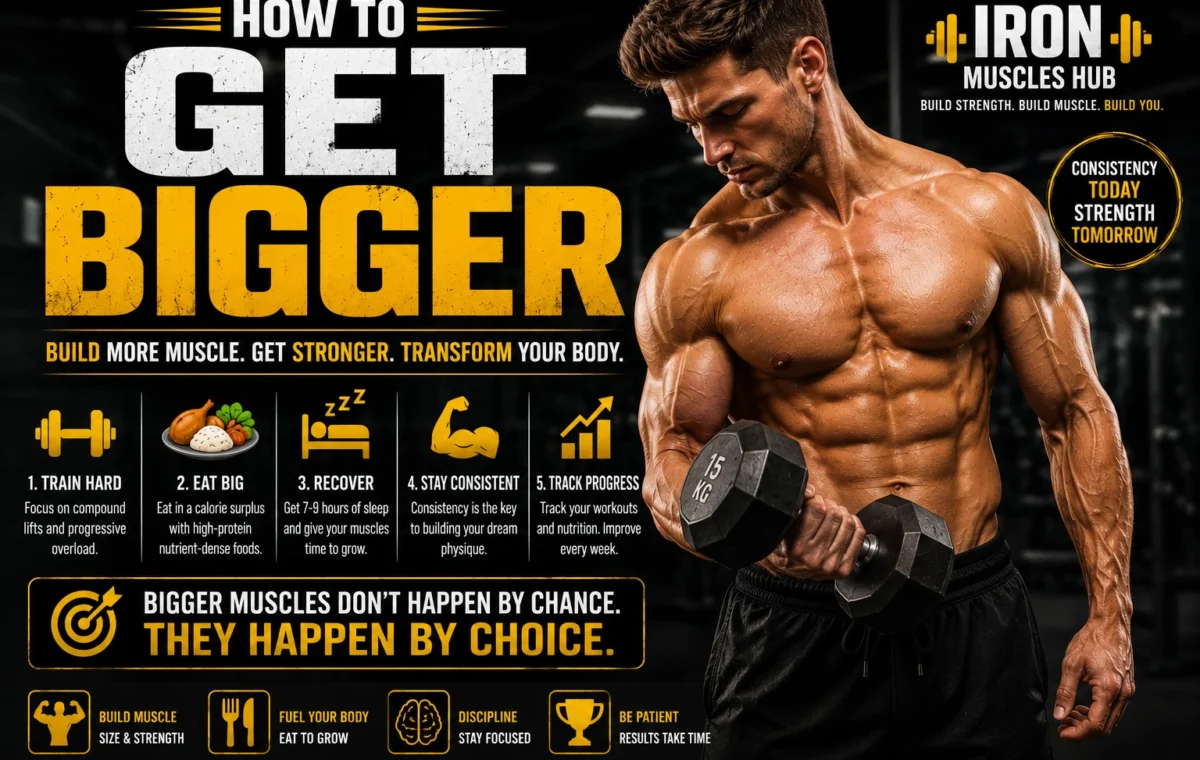
Building muscle isn’t about spending every day in the gym or buying expensive supplements. If you’re wondering how to get bigger, the answer is simple: train consistently, eat enough quality food, recover properly, and stay patient. Muscle growth takes time, but anyone can make impressive progress by following proven habits.
- Quick Answer
- Why Aren't You Getting Bigger?
- Best Exercises
- Step 2: Eat More Calories
- Good Foods for Muscle Gain
- Step 3: Eat Enough Protein
- Step 4: Progressive Overload
- Step 5: Prioritize Recovery
- Sample Beginner Workout
- Day 1 – Upper Body
- Day 2 – Lower Body
- Day 3 – Full Body
- Supplements That Can Help
- Common Mistakes
- Example Muscle-Gain Meal Plan
- How long does it take to get bigger?
- Can skinny people get bigger?
- Should I do cardio?
- Do I need supplements?
- Is it better to lift heavy or light?
- 1. Track Every Workout
- 2. Train Each Muscle Twice Per Week
- 3. Focus on Compound Lifts First
- 4. Increase Training Volume Gradually
- Lean Protein
- Healthy Carbohydrates
- Healthy Fats
- Dirty Bulking
- Ignoring Recovery
- Overtraining
- Not Eating Enough Protein
- Program Hopping
Whether you’re naturally skinny or you’ve struggled to gain size before, this guide explains exactly what you need to do. For more insights read here :-how do i build muscle quickly and lean muscle.
Quick Answer
| Goal | What to Do |
|---|---|
| Build Muscle | Strength train 3–5 days weekly |
| Eat More | Consume a calorie surplus with enough protein |
| Protein | 1.6–2.2 g per kg of body weight daily |
| Sleep | 7–9 hours every night |
| Progress | Increase weights or reps over time |
| Recovery | Rest muscles between workouts |
Why Aren’t You Getting Bigger?
Many beginners think they need better genetics or expensive supplements. In reality, most people fail because they make one or more of these mistakes:
- Not eating enough calories.
- Skipping protein.
- Changing workouts every week.
- Not lifting progressively heavier weights.
- Poor sleep.
- Expecting results in only a few weeks.
Muscle growth requires consistency more than perfection.
Step 1: Train for Muscle Growth
Resistance training is the foundation of building muscle.
Focus on compound exercises because they train several muscles at once.
Best Exercises
- Squats
- Deadlifts
- Bench Press
- Overhead Press
- Pull-ups
- Barbell Rows
- Romanian Deadlifts
- Lunges
- Dips
Aim for 8–12 repetitions for most exercises and complete 3–4 sets.
Step 2: Eat More Calories
If you’re not gaining weight, you probably aren’t eating enough.
To get bigger:
- Eat around 250–500 extra calories per day above maintenance.
- Choose whole foods whenever possible.
- Track your weight weekly.
Good Foods for Muscle Gain
| Protein | Carbohydrates | Healthy Fats |
|---|---|---|
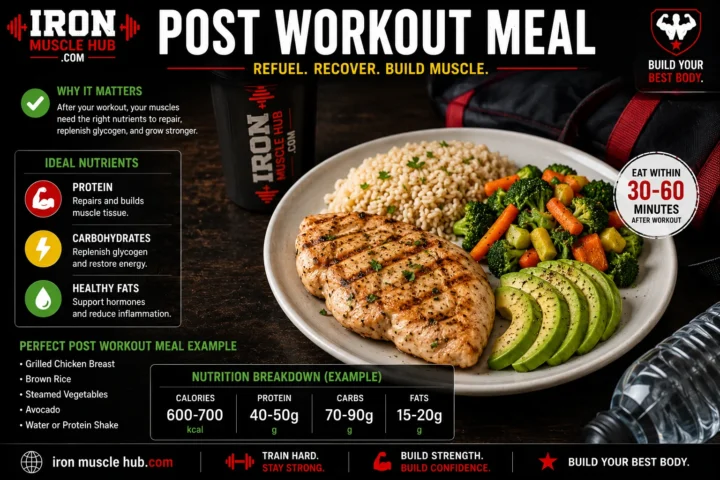
| Chicken | Rice | Avocados |
| Eggs | Potatoes | Olive Oil |
| Fish | Oats | Nuts |
| Greek Yogurt | Pasta | Peanut Butter |
| Lean Beef | Bread | Seeds |
Step 3: Eat Enough Protein
Protein provides the building blocks your muscles need after training.
Excellent protein sources include:
- Chicken breast
- Turkey
- Eggs
- Lean beef
- Fish
- Cottage cheese
- Greek yogurt
- Milk
- Whey protein
- Beans
- Lentils
Try to spread protein across 3–5 meals each day.
Step 4: Progressive Overload
If you always lift the same weights, your muscles have no reason to grow.
Each week try to improve by:
- Adding one repetition.
- Increasing the weight slightly.
- Performing an extra set.
- Improving exercise technique.
Small improvements add up over time.
Step 5: Prioritize Recovery
Muscles grow while recovering—not while you’re training.
Recovery checklist:
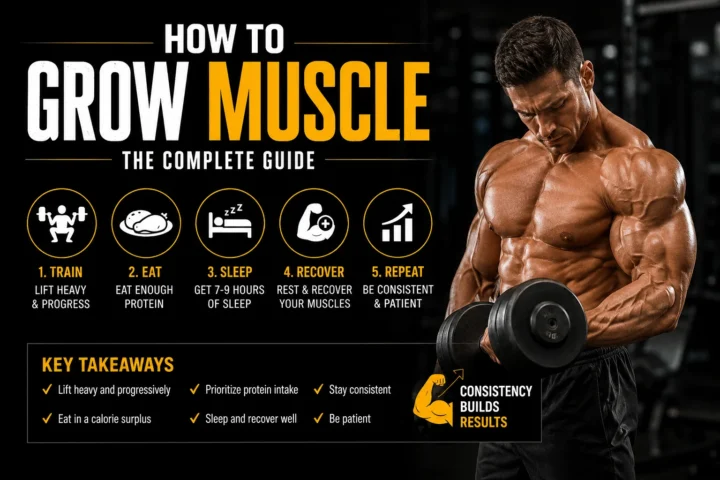
- Sleep 7–9 hours nightly.
- Drink plenty of water.
- Take at least one or two rest days each week.
- Avoid training the same muscle every day.
Sample Beginner Workout
Day 1 – Upper Body
- Bench Press – 4 × 8
- Barbell Row – 4 × 10
- Shoulder Press – 3 × 10
- Pull-ups – 3 sets
- Biceps Curls – 3 × 12
- Triceps Pushdowns – 3 × 12
Day 2 – Lower Body
- Squats – 4 × 8
- Romanian Deadlifts – 3 × 10
- Leg Press – 3 × 12
- Leg Curl – 3 × 12
- Calf Raises – 4 × 15
Day 3 – Full Body
- Deadlift – 3 × 5
- Incline Bench Press – 3 × 10
- Lat Pulldown – 3 × 10
- Dumbbell Lunges – 3 × 12
- Plank – 3 × 60 seconds
Supplements That Can Help
Supplements are optional.
The most useful ones are:
- Whey Protein
- Creatine Monohydrate
- Vitamin D (if deficient)
- Fish Oil (if your diet lacks oily fish)
Remember, food and training matter much more than supplements.
Common Mistakes
Avoid these beginner errors:
- Skipping leg day.
- Eating too little.
- Sleeping only 4–5 hours.
- Training every day without rest.
- Using poor exercise form.
- Constantly changing workout programs.
- Expecting huge gains in one month.
Example Muscle-Gain Meal Plan
| Meal | Example |
|---|---|
| Breakfast | Oatmeal, eggs, banana |
| Snack | Greek yogurt and almonds |
| Lunch | Chicken, rice, vegetables |
| Snack | Peanut butter sandwich |
| Dinner | Salmon, potatoes, broccoli |
| Before Bed | Cottage cheese or milk |
Frequently Asked Questions
How long does it take to get bigger?
Most beginners notice strength improvements within a few weeks. Visible muscle growth usually appears after 8–12 weeks of consistent training and proper nutrition.
Can skinny people get bigger?
Yes. Skinny individuals often gain muscle quickly during their first year of consistent resistance training, especially if they eat enough calories and protein.
Should I do cardio?
Yes. Moderate cardio supports heart health without preventing muscle growth. Two or three short sessions each week are enough for most people.
Do I need supplements?
No. Supplements can be convenient, but they cannot replace proper nutrition, progressive training, and adequate sleep.
Is it better to lift heavy or light?
Both can build muscle if you train close to failure with good technique. Most beginners see excellent results using moderate weights for 8–12 repetitions.
Final Thoughts
Learning how to get bigger doesn’t have to be complicated. Focus on lifting consistently, eating enough nutritious food, consuming plenty of protein, sleeping well, and gradually increasing your training intensity. Don’t chase shortcuts or miracle supplements. Small improvements repeated every week lead to impressive long-term muscle growth.also explore read here :- fastest way to gain muscle
Stay patient, trust the process, and measure your progress with photos, strength gains, and body weight instead of expecting overnight changes.
By Emily Carter
Sources
- American College of Sports Medicine (ACSM) – Resistance Training Guidelines
- International Society of Sports Nutrition (ISSN) Position Stand on Protein and Exercise
- National Institutes of Health (NIH) – Nutrition and Muscle Health
Last Updated: July 2026
Disclaimer: This article is for educational purposes only and should not replace professional medical or nutritional advice.
Once you’ve built a solid routine, these strategies can help you continue making progress without relying on shortcuts.
1. Track Every Workout
One of the biggest differences between beginners who grow consistently and those who plateau is tracking progress.
Write down:
- Exercises performed
- Sets and reps
- Weight lifted
- Rest time
- How difficult each set felt
If you’re lifting more weight or completing more reps over time, you’re giving your muscles a reason to grow.
2. Train Each Muscle Twice Per Week
Research shows that training a muscle group at least two times per week is effective for muscle growth.
A sample weekly schedule:
| Day | Workout |
|---|---|
| Monday | Push (Chest, Shoulders, Triceps) |
| Tuesday | Pull (Back, Biceps) |
| Wednesday | Legs |
| Thursday | Rest |
| Friday | Upper Body |
| Saturday | Lower Body |
| Sunday | Rest |
This provides enough training volume while allowing recovery.
3. Focus on Compound Lifts First
Start every workout with exercises that use multiple muscle groups.
Priority order:
- Squat
- Deadlift
- Bench Press
- Overhead Press
- Pull-Ups
- Barbell Row
Finish with isolation exercises such as curls, lateral raises, or leg extensions.
4. Increase Training Volume Gradually
Training volume means:
Sets × Reps × Weight
Example:
Week 1:
- Bench Press: 3 × 8 × 135 lb
Week 6:
- Bench Press: 4 × 10 × 155 lb
That increase in workload encourages new muscle growth.
Best Foods for Muscle Growth
Nutrition plays just as important a role as training.
Lean Protein
- Chicken breast
- Turkey
- Lean beef
- Tuna
- Salmon
- Eggs
- Cottage cheese
- Greek yogurt
Healthy Carbohydrates
Carbs fuel hard workouts.
Choose foods like:
- Rice
- Oats
- Sweet potatoes
- White potatoes
- Pasta
- Whole-grain bread
- Fruit
Healthy Fats
Healthy fats support hormone production.
Good options include:
- Avocados
- Olive oil
- Almonds
- Walnuts
- Natural peanut butter
- Mixed seeds
Sample 3,200-Calorie Muscle Gain Meal Plan
| Meal | Food |
|---|---|
| Breakfast | 5 eggs, oatmeal, banana, milk |
| Snack | Greek yogurt, almonds |
| Lunch | Chicken breast, rice, vegetables |
| Snack | Protein shake and peanut butter sandwich |
| Dinner | Steak, potatoes, broccoli |
| Evening Snack | Cottage cheese and berries |
Adjust portions based on your body weight and activity level.
How Long Does It Take to Get Bigger?
Consistency matters more than speed.
Typical progress for beginners:
| Time | Expected Progress |
|---|---|
| 2 Weeks | Better workout performance |
| 1 Month | Noticeable strength increases |
| 2–3 Months | Visible muscle growth |
| 6 Months | Significant physique changes |
| 12 Months | Major transformation with consistent training |
Remember that everyone responds differently based on genetics, nutrition, recovery, and training quality.
Signs Your Muscle-Building Plan Is Working
Watch for these positive indicators:
- You’re gradually getting stronger.
- Your body weight increases slowly.
- Shirts feel tighter around your shoulders and arms.
- Recovery improves.
- Progress photos show more muscle definition.
- Measurements of your chest, arms, and legs increase.
These are often more reliable than checking the mirror every day.
Common Bulking Mistakes to Avoid
Dirty Bulking
Eating unlimited junk food may increase body fat faster than muscle.
Instead, choose mostly whole, nutrient-dense foods while maintaining a moderate calorie surplus.
Ignoring Recovery
Training hard without enough sleep or rest slows progress and increases injury risk.
Overtraining
More workouts don’t always mean more muscle. Quality training and recovery are more important than spending hours in the gym.
Not Eating Enough Protein
Without enough protein, your body has fewer building blocks for repairing and growing muscle.
Program Hopping
Switching workout routines every week makes it difficult to measure progress. Follow one structured program for at least 8–12 weeks before making major changes.
Final Muscle-Building Checklist
Before asking why you’re not getting bigger, check these basics:
- ✓ Lift weights 3–5 times each week.
- ✓ Train with progressive overload.
- ✓ Eat enough calories to support growth.
- ✓ Get sufficient protein each day.
- ✓ Sleep 7–9 hours every night.
- ✓ Drink plenty of water.
- ✓ Stay consistent for several months.
- ✓ Measure progress with strength, body weight, and photos.
Final Thoughts
If you’re serious about learning how to get bigger, remember that there isn’t a single secret exercise, supplement, or diet that guarantees fast results. The people who build impressive physiques usually follow the same fundamentals for months and years: consistent strength training, a nutritious calorie surplus, adequate protein, quality sleep, and gradual progression.
Focus on improving a little each week instead of looking for shortcuts. Keep a training log, eat with purpose, recover well, and stay patient. Over time, those small daily habits add up to noticeable muscle growth and lasting results.