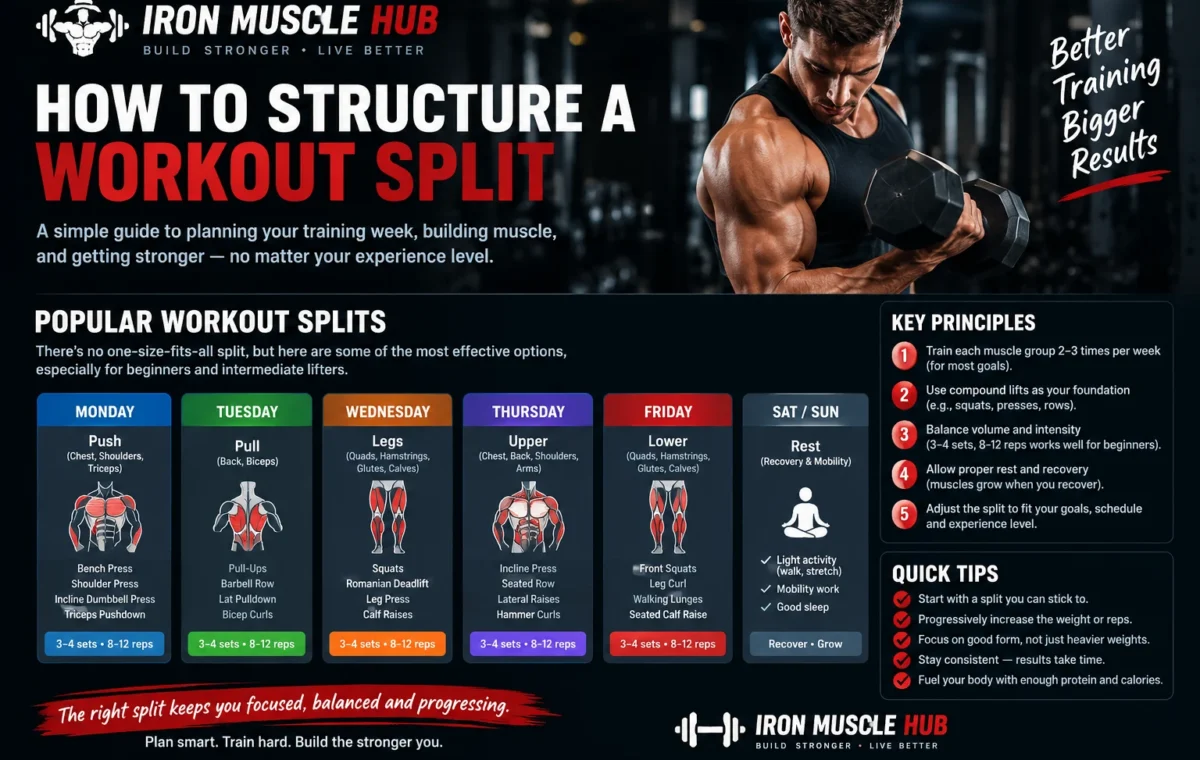
If you’re wondering how to structure a workout split, start with the days you can realistically train, then organize your exercises so each major muscle group gets enough productive work and recovery. You don’t need a complicated six-day routine.
- Quick Answer
- What Is a Workout Split?
- If you have 2 days
- If you have 3 days
- If you have 4 days
- If you have 5–6 days
- For general strength and fitness
- For muscle growth
- For general fitness
- Example
- Who should use it?
- Example
- Push
- Pull
- Legs
- Full-body session
- Monday — Full Body A
- Wednesday — Full Body B
- Friday — Full Body A
- Mistake 1: Choosing the split before checking your schedule
- Mistake 2: Copying an advanced lifter
- Mistake 3: Training one muscle only once per week because it sounds traditional
- Mistake 4: Adding more exercises whenever progress slows
- Mistake 5: Changing your program every week
- Mistake 6: Making every set a maximum effort set
- Mistake 7: Ignoring rest periods
- 1. How many days can I reliably train?
- 2. Am I recovering between sessions?
- 3. Am I progressing?
- Day 1
- Day 2
- What is the best workout split for beginners?
- How many days a week should I work out?
- Should I train each muscle twice a week?
- Is push pull legs good for beginners?
- How many sets should I do per muscle per week?
For most beginners, 2–3 full-body sessions per week are a practical starting point. If you can consistently train four days, an upper/lower split is another strong option. The 2026 ACSM resistance-training position stand emphasizes consistency, individualized programming, and training all major muscle groups regularly rather than chasing complicated routines. For more insights read here :- high protein and low calorie and most protein per calorie .
Quick Answer
- 2–3 days available: Start with a full-body split.
- 4 days available: Try an upper/lower split.
- 5–6 days available: PPL or another specialized split can work, but you don’t need it simply because you have more free days.
- Build the split around weekly training volume, recovery, progression, and consistency.
- Don’t assume a more complicated split produces better results.
What Is a Workout Split?
A workout split is simply the way you divide your resistance training across the week.
Instead of deciding what to train every time you enter the gym, you assign a purpose to each session.
For example:
Full body:
- Monday — Full body
- Wednesday — Full body
- Friday — Full body
Upper/lower:
- Monday — Upper
- Tuesday — Lower
- Thursday — Upper
- Friday — Lower
Push/pull/legs:
- Monday — Push
- Tuesday — Pull
- Wednesday — Legs
- Thursday — Rest
- Friday — Push
- Saturday — Pull
- Sunday — Legs
The split isn’t the thing that builds muscle by itself. It’s the framework that organizes the training that does the work.
The 2026 ACSM position stand found that resistance-training outcomes are influenced by factors such as consistency, effort, training volume and how the program is matched to the individual. It also moved away from rigid one-size-fits-all prescriptions.
That means you shouldn’t copy the routine of the biggest person in your gym.
Your schedule, experience, goals and ability to recover matter.
Step 1: Decide How Many Days You Can Actually Train
The first question isn’t:
“What’s the best workout split?”
It’s:
“How many days can I train consistently?”
Be honest.
If you can train three days every week, don’t build a six-day program because it looks impressive.
A four-week period where you complete 12 planned workouts is more useful than a six-day routine that you abandon after 10 days.
If you have 2 days
Use a full-body split.
Example:
| Day | Training |
|---|---|
| Monday | Full Body A |
| Tuesday | Rest |
| Wednesday | Rest |
| Thursday | Full Body B |
| Friday | Rest |
| Saturday | Optional cardio |
| Sunday | Rest |
If you have 3 days
Full body is still a very practical choice.
| Day | Training |
|---|---|
| Monday | Full Body A |
| Tuesday | Rest |
| Wednesday | Full Body B |
| Thursday | Rest |
| Friday | Full Body A |
| Saturday | Rest |
| Sunday | Rest |
You can alternate A and B the following week.
If you have 4 days
An upper/lower split becomes useful.
| Day | Training |
|---|---|
| Monday | Upper |
| Tuesday | Lower |
| Wednesday | Rest |
| Thursday | Upper |
| Friday | Lower |
| Saturday | Rest |
| Sunday | Rest |
If you have 5–6 days
You have more options, but don’t automatically add more exercises.
You could use:
- Push/pull/legs
- Upper/lower plus an accessory day
- Full body plus specialization
- A custom bodybuilding split
The important question is whether the additional sessions improve your training quality without making recovery and consistency worse.
Step 2: Choose Your Main Goal
Your goal changes how you organize the week.
A person training primarily for strength doesn’t necessarily need the same structure as someone whose main goal is muscle growth.
For general strength and fitness
Prioritize:
- Basic movement patterns
- Good technique
- Progressive loading
- Consistent training
- Recovery
You don’t need dozens of exercises.
For muscle growth
Your split needs to give you enough opportunities to accumulate productive work for each major muscle group.
The 2026 ACSM position stand reports that higher weekly resistance-training volume can support hypertrophy, with roughly 10 sets per muscle group per week identified as a useful general target in its evidence summary. That’s a programming reference point, not a mandatory starting number for every beginner.
A beginner may start below that level and build gradually.
For general fitness
You can use a simpler split.
You don’t need to organize your training like a competitive bodybuilder.
A full-body routine two or three times per week can cover the major movement patterns efficiently.
Step 3: Make Sure the Major Muscle Groups Are Covered
A good workout split should not accidentally become a chest-and-arms-only program.
Across the week, include work for:
- Chest
- Back
- Shoulders
- Biceps
- Triceps
- Quadriceps
- Hamstrings
- Glutes
- Calves
- Core
You don’t necessarily need a separate exercise for every muscle in every workout.
Compound exercises can train several muscles simultaneously.
For example:
Squat: primarily trains the quadriceps and glutes while involving other muscles.
Bench press: trains the chest, triceps and anterior shoulders.
Row: trains the back and involves the biceps.
Romanian deadlift: trains the hamstrings and glutes.
This is why a beginner can train the entire body effectively without spending two hours in the gym.
Step 4: Organize Your Movement Patterns
Instead of thinking only in terms of body parts, beginners can also think in terms of movement patterns.
A basic weekly structure can include:
| Movement pattern | Example |
|---|---|
| Squat | Goblet squat |
| Hinge | Romanian deadlift |
| Horizontal push | Bench press |
| Horizontal pull | Cable row |
| Vertical push | Dumbbell shoulder press |
| Vertical pull | Lat pulldown |
| Carry/core | Farmer carry or plank |
You don’t have to use these exact exercises.
The purpose is to make sure your program isn’t accidentally overloaded toward one movement.
Step 5: Choose the Right Split
Here’s a practical comparison.
| Split | Typical training days | Best starting use | Main advantage | Main limitation |
|---|---|---|---|---|
| Full body | 2–3 | Beginners | Simple and frequent practice | Sessions can become long |
| Upper/lower | 4 | Beginners to intermediates | Good volume distribution | Requires more weekly visits |
| PPL | 3–6 | Intermediate+ | More focus per session | Can require frequent training |
| Body-part split | 4–6 | Advanced/specialization | High focus on individual areas | Less convenient for beginners |
| Custom hybrid | 2–6 | Individual needs | Highly flexible | Easier to program poorly |
There’s no universal winner.
Research comparing resistance-training frequency suggests that weekly volume and how that volume is distributed matter more than simply choosing a particular split. A 2019 systematic review and meta-analysis found no significant difference in hypertrophy between higher and lower training frequencies when weekly volume was equated.
That’s an important point.
The name of your split doesn’t make the program effective.
Full-Body Split
A full-body routine means most major muscle groups are trained during each session.
Example
Monday — Full Body A
- Squat
- Bench press
- Row
- Romanian deadlift
- Lateral raise
- Curl
Wednesday — Full Body B
- Leg press
- Overhead press
- Lat pulldown
- Hip hinge
- Triceps exercise
- Calf raise
Friday — Full Body A
Repeat Monday or make small exercise variations.
Who should use it?
Full body is particularly useful if you:
- Are new to resistance training
- Can train only 2–3 days
- Want simple programming
- Want frequent practice with basic exercises
- Don’t want to spend five or six days in the gym
It’s also useful for people returning after a long training break.
Upper/Lower Split
An upper/lower split divides your training into upper-body and lower-body sessions.
Example
Monday — Upper
- Bench press
- Row
- Overhead press
- Lat pulldown
- Curl
- Triceps extension
Tuesday — Lower
- Squat
- Romanian deadlift
- Leg press
- Leg curl
- Calf raise
Thursday — Upper
- Incline dumbbell press
- Cable row
- Shoulder press
- Pulldown
- Curl
- Triceps exercise
Friday — Lower
- Deadlift variation
- Split squat
- Leg extension
- Hamstring curl
- Calf raise
This gives you more room for exercises without putting everything into one session.
For someone who can consistently train four days per week, it’s a straightforward structure.
Push/Pull/Legs
PPL divides exercises according to movement or muscle function.
Push
- Chest
- Shoulders
- Triceps
Pull
- Back
- Rear shoulders
- Biceps
Legs
- Quadriceps
- Hamstrings
- Glutes
- Calves
A three-day PPL routine can be done once through each week.
However, if your main goal is to train each muscle more frequently, you may use a longer rotation.
For a beginner, there’s no requirement to jump straight into six training days.
If three full-body sessions already fit your schedule and you’re progressing, you have no reason to add three more gym visits just because PPL is popular.
Step 6: Decide How Much Work to Put Into Each Session
This is where many beginners make their biggest mistake.
They create a split and then fill every day with 10–12 exercises.
More isn’t automatically better.
The 2026 ACSM review emphasizes that resistance-training programming should be individualized, and its evidence summary identifies weekly volume as one of the variables that can be adjusted according to goals.
For a beginner, start with a manageable amount of work.
For example:
Full-body session
Lower body
- Squat — 2–3 sets
Push
- Bench press — 2–3 sets
Pull
- Row — 2–3 sets
Hinge
- Romanian deadlift — 2 sets
Accessory
- Curl — 2 sets
- Triceps extension — 2 sets
That’s already a useful session.
You don’t need five chest exercises.
Step 7: Use a Sensible Rep Structure
You don’t need to obsess over one magic repetition range.
Different resistance-training loads can be useful when the program is appropriately designed.
For a beginner-friendly program, you can use practical ranges such as:
| Exercise type | Example rep range |
|---|---|
| Major compound | 5–10 |
| Secondary compound | 6–12 |
| Isolation | 8–15 |
| Smaller accessories | 10–20 |
These are programming examples, not hard physiological laws.
The more important goal is performing controlled repetitions with sound technique and gradually improving your performance.
Don’t sacrifice form just to put another 5 kg or 10 lb on the bar.
Step 8: Build Progression Into the Split
A workout split isn’t complete until you know how you’ll progress.
One simple method is double progression.
Suppose your dumbbell bench press target is:
3 sets × 8–12 reps
Your first workout might look like:
- 20 kg / 44 lb × 8
- 20 kg / 44 lb × 8
- 20 kg / 44 lb × 9
Next time, try to add a repetition while keeping the same load.
Eventually you might reach:
- 20 kg / 44 lb × 12
- 20 kg / 44 lb × 12
- 20 kg / 44 lb × 12
At that point, you can make a small load increase and build the repetitions again.
This is much easier to track than randomly changing exercises every workout.
Worked Example: Building a 3-Day Beginner Split
Imagine a beginner who weighs 75 kg / 165 lb, is around 175 cm / 5 ft 9 in, and can train Monday, Wednesday and Friday.
Their main goals are building general strength and muscle.
Instead of copying a six-day bodybuilding routine, we’d build around three sessions.
Monday — Full Body A
| Exercise | Sets | Reps |
|---|---|---|
| Squat | 3 | 6–10 |
| Bench press | 3 | 6–10 |
| Cable row | 3 | 8–12 |
| Romanian deadlift | 2 | 8–12 |
| Lateral raise | 2 | 10–15 |
| Curl | 2 | 10–15 |
Wednesday — Full Body B
| Exercise | Sets | Reps |
|---|---|---|
| Leg press | 3 | 8–12 |
| Dumbbell shoulder press | 3 | 6–12 |
| Lat pulldown | 3 | 8–12 |
| Hip hinge | 2 | 8–12 |
| Triceps extension | 2 | 10–15 |
| Calf raise | 2 | 10–15 |
Friday — Full Body A
Repeat Monday, then progress where appropriate.
The following week could be:
- Monday — B
- Wednesday — A
- Friday — B
This approach gives the beginner repeated practice without forcing every muscle into one giant session.
Common Mistakes → Why → Fix
Mistake 1: Choosing the split before checking your schedule
Why: You end up with a routine that doesn’t match your real life.
Fix: Decide your reliable training days first. Then choose the split.
Mistake 2: Copying an advanced lifter
Why: Advanced lifters often have years of training experience and different recovery needs.
A routine built around high specialization isn’t automatically appropriate for someone who started lifting two weeks ago.
Fix: Start with the simplest split that lets you train consistently and improve.
Mistake 3: Training one muscle only once per week because it sounds traditional
Why: You may concentrate a large amount of work into one session when it could be distributed more comfortably.
Research on frequency is nuanced: when volume is matched, frequency itself has little meaningful effect on hypertrophy.
Fix: For beginners, consider full-body training 2–3 times weekly or an upper/lower setup that regularly exposes each major muscle group to training.
Mistake 4: Adding more exercises whenever progress slows
Why: A plateau isn’t automatically caused by insufficient exercises.
You may instead need better technique, recovery, progression, or load management.
Fix: Track your lifts before adding more work.
Mistake 5: Changing your program every week
Why: You can’t properly judge progression if the exercises and structure constantly change.
Fix: Keep the core movements stable long enough to see whether your performance improves.
Mistake 6: Making every set a maximum effort set
Why: Constantly pushing every set to the limit can create unnecessary fatigue and make your weekly training harder to recover from.
Fix: Most beginner training should feel challenging while still allowing you to maintain good technique.
Mistake 7: Ignoring rest periods
Rest is part of the program.
For strength-oriented work, longer rests can help you maintain performance across sets. A PubMed-indexed systematic review found that longer rest periods, particularly beyond two minutes, may be useful for maximizing strength gains in trained individuals, while shorter-to-moderate rests can still work well for beginners.
For hypertrophy, the evidence doesn’t support a simple rule that shorter rest is always better. A 2024 systematic review found a small potential benefit to rests longer than 60 seconds, with little additional hypertrophy difference once rest exceeded roughly 90 seconds.
A practical starting point is:
- Big compound lifts: about 2–3+ minutes when needed
- Smaller isolation movements: about 1–2 minutes
- Take more time if your performance is dropping sharply
The clock shouldn’t be more important than the quality of your next set.
A 30-Second Workout Split Decision Rule
Ask yourself three questions.
1. How many days can I reliably train?
2–3 → Full body
4 → Upper/lower
5–6 → PPL or another specialized structure
2. Am I recovering between sessions?
If you’re repeatedly exhausted, constantly sore or watching your performance decline, don’t automatically add more training.
3. Am I progressing?
If your technique is improving and you’re gradually adding repetitions or load, your split may already be doing its job.
Simple rule:
Don’t change a workable split just because another one looks better online.
When Should You Change Your Workout Split?
You don’t need to change your routine simply because you’ve been using it for a certain number of weeks.
Change it when there’s a clear reason.
For example:
- Your sessions are consistently too long.
- Your available training days have changed.
- Your current volume is difficult to fit into each session.
- A movement repeatedly causes discomfort.
- Your goal has changed.
- You’re no longer progressing despite sensible adjustments.
- You need more specialization for a particular training goal.
A change should solve a problem.
It shouldn’t be made just to make training feel new.
Who This Is NOT For
This beginner framework isn’t designed as a complete program for:
- Competitive strength athletes
- Competitive bodybuilders
- High-level athletes with sport-specific demands
- People returning from a significant injury
- People with medical conditions that affect exercise safety
Those situations can require individualized programming from a qualified professional.
For a healthy beginner, however, the basic process is much simpler:
Choose your available days → select an appropriate split → cover major movement patterns → distribute manageable weekly work → recover → track progression.
How to Structure a Workout Split for Muscle Growth
If muscle growth is your primary goal, don’t judge your split by how many days it has.
Judge it by whether it lets you accumulate productive training while recovering.
The 2026 ACSM position stand reports approximately 10 weekly sets per muscle group as a useful general hypertrophy target, while also emphasizing individualization rather than rigid prescriptions.
That means a four-day upper/lower split might make it easier to distribute your work than trying to cram everything into two or three sessions.
For example, instead of:
Monday: 15 sets for chest
you might distribute your pressing work across:
Monday: 5–6 chest-focused sets
Thursday: 5–6 chest-focused sets
Then adjust based on your performance and recovery.
Remember that sets from compound exercises can contribute to the workload of multiple muscles.
You don’t need to count every set with mathematical precision.
Use the numbers as a starting framework, then watch what happens.
How to Structure a Workout Split for Strength
Strength training benefits from giving important lifts enough attention and recovery.
For example, you might prioritize:
- Squat
- Bench press
- Deadlift or hinge
- Overhead press
- Row
- Pull-up or pulldown
Put the most important exercise earlier in the session when you’re less fatigued.
If improving your squat is a major goal, don’t perform five exhausting exercises before squatting.
Your priority lift should get your best technical and physical effort.
How to Structure a Workout Split If You Only Have 2 Days
Don’t assume two days is too little.
Use full body.
Day 1
- Squat
- Bench press
- Row
- Romanian deadlift
- Lateral raise
- Curl
Day 2
- Leg press
- Overhead press
- Lat pulldown
- Hip hinge
- Triceps extension
- Calf raise
The key is making those two sessions productive rather than trying to squeeze a five-day bodybuilding program into two days.
How to Structure a Workout Split If You Have 3 Days
Three days is one of the easiest schedules to organize.
A simple pattern is:
Monday — Full body
Wednesday — Full body
Friday — Full body
You can alternate two workouts:
Week 1: A / B / A
Week 2: B / A / B
This gives you repeated practice while allowing rest days between sessions.
How to Structure a Workout Split If You Have 4 Days
An upper/lower split is a simple choice:
Monday — Upper A
Tuesday — Lower A
Thursday — Upper B
Friday — Lower B
This creates a predictable schedule while giving you room to distribute exercises and weekly volume.
It’s also easier to shorten an individual session compared with putting your entire body into every workout.
FAQ
What is the best workout split for beginners?
For most beginners, a 2–3 day full-body split is a practical starting point. It lets you practice fundamental movements regularly without requiring a large number of gym visits. However, the best split is ultimately the one that matches your schedule and allows you to train consistently. The 2026 ACSM guidance specifically emphasizes individualization and consistency rather than one universal routine.
How many days a week should I work out?
For resistance training, beginners can make good use of 2–3 sessions per week, particularly with a full-body structure. Four days can work well with an upper/lower split. The important point is that the number of training days should match what you can recover from and maintain. ACSM’s 2026 position stand emphasizes regular resistance training of the major muscle groups rather than prescribing one schedule for everyone.
Should I train each muscle twice a week?
Training a muscle twice weekly can be a useful way to distribute your weekly workload, but frequency isn’t magic. A 2019 systematic review found no meaningful hypertrophy advantage for higher frequency when total weekly volume was equated. For beginners, however, spreading training across multiple sessions can make the workload easier to manage and gives you more opportunities to practice exercises.
Is push pull legs good for beginners?
PPL can work for beginners, but it isn’t automatically better than full-body training. A traditional six-day PPL schedule may be unnecessary if you’re new to lifting. If you can train only three days, full body is often simpler. If you eventually train more frequently and need additional room for weekly volume, PPL becomes another option.
How many sets should I do per muscle per week?
There isn’t one perfect number for everyone. The 2026 ACSM evidence review identifies roughly 10 sets per muscle group per week as a useful general hypertrophy target, while emphasizing that training volume should be individualized. Beginners don’t need to start at a high volume immediately. Begin with manageable work, track performance and recovery, and increase training volume gradually when there’s a reason to do so.
Final Takeaway
Learning how to structure a workout split doesn’t require complicated programming.
Start with your real schedule. If you have two or three days, full-body training is a simple option. Four days gives you an easy opportunity to use upper/lower. More available days can support PPL or a customized structure, but extra gym days aren’t automatically better.
Your split should organize exercise selection, weekly volume, recovery and progression. Keep the main movements stable enough to track, increase training demands gradually, and adjust the plan when your circumstances or training needs actually change.
The best workout split isn’t the most complicated one.
It’s the one you can train consistently, recover from and progress with.
If you’re building your first routine, start simpler than you think you need.