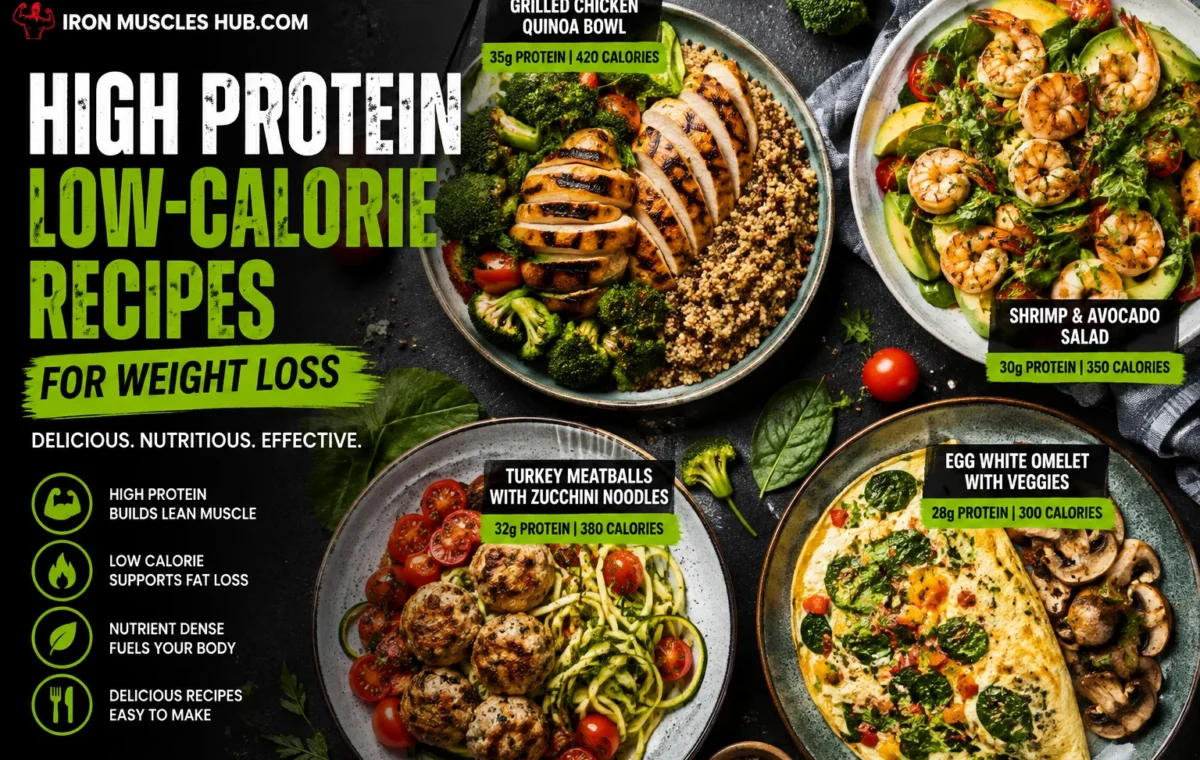
If you’re trying to lose body fat without living on tiny meals, high protein low-calorie recipes for weight loss can make your diet easier to manage. The basic idea is simple: build meals around a protein-rich food, add plenty of vegetables or fruit, and keep calorie-dense extras such as oils, cheese, sauces, nuts and dressings measured.
- Quick Answer
- What Makes a Recipe High Protein and Low Calorie?
- A useful beginner formula
- Recipe Comparison Table
- 1. Greek Yogurt Berry Protein Bowl
- Ingredients
- Method
- Coach tip
- 2. Egg and Vegetable Scramble
- Ingredients
- Method
- 3. Chicken Salsa Bowl
- Ingredients
- Method
- 4. Tuna and Cottage Cheese Bowl
- Ingredients
- Method
- Make it better
- 5. Turkey Lettuce Tacos
- Ingredients
- Method
- 6. Chicken Vegetable Soup
- Ingredients
- Method
- 7. Garlic Prawn/Shrimp Stir-Fry
- Ingredients
- Method
- Watch the oil
- 8. Lemon Cod and Potatoes
- Ingredients
- Method
- 9. Chicken Fajita Plate
- Ingredients
- Method
- 10. Lean Turkey Meatballs With Vegetables
- Ingredients
- Method
- 11. Tofu and Edamame Protein Bowl
- Ingredients
- Method
- 12. Cottage Cheese Omelet
- Ingredients
- Method
- 13. Salmon Salad Bowl
- Ingredients
- Method
- Why include it?
- 14. Chicken Greek Yogurt Wrap
- Ingredients
- Method
- 15. Lentil Chicken Curry
- Ingredients
- Method
- Step 1: Choose the protein
- Step 2: Add vegetables or fruit
- Step 3: Add carbohydrate according to your needs
- Step 4: Add a measured fat source
- Step 5: Add flavour
- Mistake 1: Making Every Meal Too Small
- Mistake 2: Assuming "High Protein" Means Unlimited Calories
- Mistake 3: Drinking Calories Without Realising It
- Mistake 4: Eating Only Chicken and Vegetables
- Mistake 5: Cutting Carbohydrates Too Aggressively
- Mistake 6: Chasing a Perfect Protein Number
- 1. Where's my protein?
- 2. Where's my volume?
- 3. What calorie-dense ingredients am I adding?
- Protein
- Carbohydrates
- Vegetables
- Instead of:
- Try:
- Instead of:
- Try:
- Instead of:
- Try:
- Instead of:
- Try:
- What are the best high protein low-calorie foods for weight loss?
- How much protein should I eat to lose weight?
- Can high protein foods help you lose belly fat?
- What is a good high-protein meal under 500 calories?
- Can I eat rice and still lose weight?
Protein can increase fullness and has a higher thermic effect than carbohydrate or fat, but protein alone doesn’t cause fat loss. A sustained calorie deficit is still the main requirement for losing body weight. For more insights read here :- lean build and fastest way to gain muscle .
Quick Answer
- Build each main meal around a lean protein source such as chicken, turkey, fish, prawns/shrimp, eggs, Greek yogurt, cottage cheese, tofu or beans.
- Add high-volume vegetables, fruit or broth-based foods to make the meal more satisfying without adding excessive calories.
- A practical meal can contain roughly 25–40+ g of protein, depending on your body size, daily target and meal schedule.
- Don’t make every meal extremely low calorie. A meal that’s too small can leave you hungry and make your overall diet harder to follow.
What Makes a Recipe High Protein and Low Calorie?
A high-protein, low-calorie recipe gives you a relatively large amount of protein for the calories it provides. There isn’t one official calorie or protein number that makes a recipe qualify, so the useful approach is to compare the recipe with your total daily needs.
For example, a 350-calorie meal containing 35 g of protein gives you considerably more protein per calorie than a 350-calorie meal containing 10 g.
The calorie deficit still matters most for weight loss. NHS guidance explains that weight loss occurs when energy expenditure is greater than energy intake over time.
Protein can make that process easier because research has found that higher-protein diets can increase satiety and reduce energy intake in some circumstances. The evidence isn’t a reason to treat protein as a magic fat-loss food.
A useful beginner formula
Think of your plate like this:
Protein anchor → vegetables/fruit → measured carbohydrate → measured fat/sauce
For example:
- 150–170 g cooked chicken
- 200–300 g vegetables
- 100–150 g cooked rice or potato
- Salsa, herbs and lemon
- A measured amount of oil if needed
That structure is much easier to repeat than trying to find a “perfect” diet.
15 High Protein Low-Calorie Recipes for Weight Loss
The nutrition figures below are practical estimates, not laboratory measurements. Your exact calories and protein will change with food brands, cooking methods, drained weights and portion sizes. Use the nutrition label of your ingredients if precise tracking matters.
Recipe Comparison Table
| Recipe | Approx. Calories | Approx. Protein | Prep | Best For |
|---|---|---|---|---|
| Greek Yogurt Berry Bowl | 300 kcal | 25 g | 5 min | Breakfast |
| Egg & Veggie Scramble | 320 kcal | 28 g | 10 min | Breakfast |
| Chicken Salsa Bowl | 390 kcal | 42 g | 15 min | Lunch |
| Tuna Cottage Cheese Bowl | 330 kcal | 40 g | 5 min | Lunch |
| Turkey Lettuce Tacos | 360 kcal | 35 g | 15 min | Lunch |
| Chicken Vegetable Soup | 350 kcal | 38 g | 25 min | Lunch/Dinner |
| Garlic Prawn Stir-Fry | 360 kcal | 38 g | 15 min | Dinner |
| Lemon Cod & Potatoes | 400 kcal | 39 g | 25 min | Dinner |
| Chicken Fajita Plate | 420 kcal | 43 g | 20 min | Dinner |
| Turkey Meatballs & Veg | 410 kcal | 37 g | 30 min | Meal Prep |
| Tofu Edamame Bowl | 390 kcal | 29 g | 20 min | Vegetarian |
| Cottage Cheese Omelet | 310 kcal | 30 g | 10 min | Breakfast |
| Salmon Salad Bowl | 430 kcal | 34 g | 15 min | Dinner |
| Chicken Greek Yogurt Wrap | 380 kcal | 37 g | 10 min | Lunch |
| Lentil Chicken Curry | 440 kcal | 38 g | 30 min | Dinner |
Information gain: Instead of choosing a recipe only by its title, you can compare calories, protein, cooking time and meal purpose in one place.
1. Greek Yogurt Berry Protein Bowl
This is one of the easiest high protein low-calorie recipes for weight loss because there is almost no cooking.
Ingredients
- 250 g / 8.8 oz low-fat or non-fat Greek yogurt
- 100 g / 3.5 oz berries
- 10 g / 0.35 oz chia seeds
- Cinnamon
- Optional small amount of honey
Method
Add the yogurt to a bowl, top with berries and chia seeds, then add cinnamon.
If you’re tracking calories, measure honey, granola and nut butter rather than pouring them freely.
Approximate nutrition: 300 kcal and 25 g protein.
Coach tip
Granola can turn a low-calorie bowl into a much higher-calorie meal quickly. Keep the portion measured.
2. Egg and Vegetable Scramble
Eggs are convenient, but using a mixture of whole eggs and egg whites lets you increase protein without making the meal excessively calorie dense.
Ingredients
- 2 whole eggs
- 150 g / 5.3 oz egg whites
- 100 g / 3.5 oz mushrooms
- 100 g / 3.5 oz spinach
- 80 g / 2.8 oz tomatoes
- Black pepper
- Garlic powder
Method
Cook the mushrooms and tomatoes in a non-stick pan. Add spinach, then add the eggs and egg whites. Stir until cooked.
Approximate nutrition: 320 kcal and 28 g protein.
Serve with a piece of toast or potato if you need additional carbohydrate.
3. Chicken Salsa Bowl
This is a strong option for beginners because the ingredients are familiar and the meal can be prepared in batches.
Ingredients
- 150 g / 5.3 oz cooked chicken breast
- 150 g / 5.3 oz cooked rice
- 150 g / 5.3 oz mixed vegetables
- 80 g / 2.8 oz salsa
- Lime juice
- Cumin
- Black pepper
Method
Warm the chicken, rice and vegetables. Add salsa, lime and seasoning.
Approximate nutrition: 390 kcal and 42 g protein.
For a lower-calorie version, reduce the rice slightly and increase the vegetables.
For a higher-calorie training-day version, increase the rice.
4. Tuna and Cottage Cheese Bowl
This no-cook meal works particularly well for busy lunches.
Ingredients
- 1 can tuna in water, drained
- 150 g / 5.3 oz low-fat cottage cheese
- 150 g / 5.3 oz cucumber
- 100 g / 3.5 oz tomatoes
- Mustard
- Lemon juice
- Black pepper
Method
Mix everything together.
Approximate nutrition: 330 kcal and 40 g protein.
Make it better
If the texture feels too dry, use Greek yogurt or a little mustard rather than a large amount of mayonnaise.
5. Turkey Lettuce Tacos
These give you the feel of tacos without requiring a large tortilla portion.
Ingredients
- 150 g / 5.3 oz lean turkey mince
- Large lettuce leaves
- 100 g / 3.5 oz tomatoes
- 50 g / 1.8 oz onion
- Salsa
- Cumin
- Smoked paprika
- Garlic powder
Method
Brown the turkey with the spices. Spoon it into lettuce leaves and add tomato, onion and salsa.
Approximate nutrition: 360 kcal and 35 g protein.
If you need more carbohydrate, add a measured serving of beans or a small tortilla.
6. Chicken Vegetable Soup
Soup is useful when you prefer a large bowl of food rather than a small dense meal.
Ingredients
- 140 g / 4.9 oz cooked chicken breast
- 300 g / 10.6 oz mixed vegetables
- 400 ml / 13.5 fl oz low-sodium chicken stock
- 100 g / 3.5 oz potatoes
- Garlic
- Black pepper
- Herbs
Method
Simmer the vegetables and potato in stock until tender. Add cooked chicken near the end and heat thoroughly.
Approximate nutrition: 350 kcal and 38 g protein.
You can increase the vegetable quantity if you want more food volume without adding much energy.
7. Garlic Prawn/Shrimp Stir-Fry
Prawns or shrimp are useful when you want plenty of protein from a relatively small calorie budget.
Ingredients
- 170 g / 6 oz cooked prawns/shrimp
- 250 g / 8.8 oz mixed stir-fry vegetables
- 100 g / 3.5 oz cooked rice
- Garlic
- Ginger
- Soy sauce
- Lime juice
Method
Cook the vegetables in a non-stick pan. Add garlic and ginger, then the prawns/shrimp. Add cooked rice and a measured amount of soy sauce.
Approximate nutrition: 360 kcal and 38 g protein.
Watch the oil
The prawns aren’t usually the problem. Unmeasured cooking oil can be.
8. Lemon Cod and Potatoes
White fish provides a simple protein base while potatoes provide carbohydrate and food volume.
Ingredients
- 170 g / 6 oz cod
- 180 g / 6.3 oz potatoes
- 200 g / 7 oz green beans
- Lemon
- Garlic
- Herbs
- Measured olive oil
Method
Bake or air-fry the cod and potatoes. Steam or roast the green beans. Finish with lemon and herbs.
Approximate nutrition: 400 kcal and 39 g protein.
9. Chicken Fajita Plate
You don’t need to remove carbohydrates to make a meal suitable for weight loss.
Ingredients
- 160 g / 5.6 oz cooked chicken
- 150 g / 5.3 oz peppers and onions
- 100 g / 3.5 oz cooked rice
- Salsa
- Lime
- Fajita seasoning
- Optional Greek-yogurt topping
Method
Cook the chicken with peppers and onions. Serve with rice and salsa.
Approximate nutrition: 420 kcal and 43 g protein.
The key is portion control, not banning rice.
10. Lean Turkey Meatballs With Vegetables
These are excellent for meal preparation.
Ingredients
- 150 g / 5.3 oz lean turkey mince
- 1 egg white
- Garlic
- Italian herbs
- Black pepper
- 250 g / 8.8 oz roasted vegetables
- Tomato sauce
Method
Mix the turkey with egg white and seasonings. Form small meatballs and bake until thoroughly cooked. Serve with vegetables and tomato sauce.
Approximate nutrition: 410 kcal and 37 g protein.
Prepare several portions at once and refrigerate them safely.
11. Tofu and Edamame Protein Bowl
You don’t need meat to make a high-protein meal.
Ingredients
- 150 g / 5.3 oz firm tofu
- 100 g / 3.5 oz shelled edamame
- 200 g / 7 oz cauliflower rice
- 100 g / 3.5 oz mixed vegetables
- Soy sauce
- Ginger
- Garlic
Method
Pan-cook the tofu until browned. Add vegetables and edamame, then season.
Approximate nutrition: 390 kcal and 29 g protein.
For a vegan meal, check the labels of sauces and other packaged ingredients.
12. Cottage Cheese Omelet
Cottage cheese can increase the protein content of an omelet without requiring a large amount of meat.
Ingredients
- 2 whole eggs
- 100 g / 3.5 oz cottage cheese
- 100 g / 3.5 oz spinach
- 100 g / 3.5 oz mushrooms
- Black pepper
Method
Cook the vegetables first. Add beaten eggs, then spoon cottage cheese over the omelet before folding.
Approximate nutrition: 310 kcal and 30 g protein.
13. Salmon Salad Bowl
Salmon is more calorie dense than white fish, but it can still fit a weight-loss diet.
Ingredients
- 120 g / 4.2 oz cooked salmon
- 200 g / 7 oz mixed salad vegetables
- 100 g / 3.5 oz boiled potatoes
- Lemon juice
- Greek yogurt
- Dill
- Black pepper
Method
Cook the salmon and potatoes. Combine with salad vegetables and a yogurt-dill dressing.
Approximate nutrition: 430 kcal and 34 g protein.
Why include it?
You don’t need every protein source to be ultra-lean. The overall meal and daily calorie intake matter.
14. Chicken Greek Yogurt Wrap
Ingredients
- 120 g / 4.2 oz cooked chicken
- 1 medium whole-wheat wrap
- 100 g / 3.5 oz salad vegetables
- 50 g / 1.8 oz Greek yogurt
- Lemon juice
- Garlic
- Herbs
Method
Mix yogurt with lemon, garlic and herbs. Add chicken and vegetables to the wrap and roll.
Approximate nutrition: 380 kcal and 37 g protein.
If your wrap is significantly larger than the one used in the estimate, your calories will be higher.
15. Lentil Chicken Curry
This recipe combines animal protein with a plant protein and fibre-rich lentils.
Ingredients
- 120 g / 4.2 oz cooked chicken
- 100 g / 3.5 oz cooked lentils
- 150 g / 5.3 oz tomatoes
- 100 g / 3.5 oz spinach
- Onion
- Garlic
- Curry powder
- Ginger
- Measured cooking oil
Method
Cook onion and spices using a measured amount of oil. Add tomatoes and lentils. Simmer, then add chicken and spinach.
Approximate nutrition: 440 kcal and 38 g protein.
How Much Protein Should You Eat While Losing Weight?
There isn’t one protein target that works for every beginner.
The adult Recommended Dietary Allowance commonly referenced in research is 0.8 g/kg/day, but research involving resistance training and energy restriction often examines higher intakes. A PubMed review of active athletes notes that protein requirements can rise during calorie restriction, while another meta-analysis found that protein supplementation during resistance training provided no additional lean-mass benefit beyond approximately 1.6 g/kg/day in its dataset.
For a beginner who lifts weights while trying to lose fat, a practical starting point can be around 1.2–1.6 g/kg/day, rather than assuming you need an extreme intake. This range should be adjusted for body size, training, food preferences and medical considerations.
For someone weighing 80 kg / 176 lb, that range would be approximately:
- 80 × 1.2 = 96 g/day
- 80 × 1.6 = 128 g/day
That doesn’t mean you must hit exactly 128 g every day.
It’s a planning range, not a prescription.
Some research in athletes under substantial energy restriction has investigated intakes above this level, including approximately 2.3–2.4 g/kg/day, but those studies involved specific athletic populations and shouldn’t automatically be applied to every beginner.
Worked Example: 80 kg / 176 lb Beginner
Here’s a simple example.
Imagine a beginner weighs:
80 kg / 176 lb
They decide to use a protein target of approximately:
1.4 g/kg/day
Calculation:
80 × 1.4 = 112 g protein/day
They could distribute that across four eating occasions:
| Meal | Example | Protein |
|---|---|---|
| Breakfast | Greek yogurt berry bowl | 25 g |
| Lunch | Chicken salsa bowl | 42 g |
| Snack | Cottage cheese + fruit | 20 g |
| Dinner | Lemon cod & potatoes | 39 g |
| Total | 126 g |
That’s slightly above the 112 g planning target, which is perfectly reasonable for an example.
Notice something important: the person doesn’t need protein powder to achieve a high-protein day.
They also don’t need to make every meal 200 calories.
The goal is to build a daily pattern that fits their calorie needs and is satisfying enough to repeat.
How to Build Your Own High Protein Low-Calorie Meal
Use this five-step system.
Step 1: Choose the protein
Pick one:
- Chicken breast
- Turkey
- Tuna
- Cod
- Prawns/shrimp
- Salmon
- Eggs
- Greek yogurt
- Cottage cheese
- Tofu
- Edamame
- Lentils
- Beans
Step 2: Add vegetables or fruit
Aim for foods that give you plenty of food volume for their calorie content.
Good choices include:
- Spinach
- Broccoli
- Cauliflower
- Mushrooms
- Cucumber
- Tomatoes
- Peppers
- Green beans
- Courgette/zucchini
- Berries
- Apples
- Melon
Step 3: Add carbohydrate according to your needs
You don’t have to eliminate carbohydrates.
Useful options include:
- Potatoes
- Rice
- Oats
- Whole-grain bread
- Whole-wheat wraps
- Beans
- Lentils
- Fruit
Step 4: Add a measured fat source
This is where many “healthy” recipes become calorie heavy.
Examples:
- Olive oil
- Nuts
- Seeds
- Avocado
- Cheese
- Nut butter
They’re nutritious foods, but calories still count.
Step 5: Add flavour
Use:
- Lemon
- Lime
- Vinegar
- Herbs
- Garlic
- Ginger
- Chilli
- Mustard
- Salsa
- Spices
- Greek-yogurt sauces
Common Mistakes → Why → Fix
Mistake 1: Making Every Meal Too Small
Why: You may save calories at lunch but become extremely hungry later.
Fix: Make meals satisfying enough to support your entire day. Add vegetables, fruit, potatoes, beans or another measured food if needed.
Mistake 2: Assuming “High Protein” Means Unlimited Calories
A meal can contain 40 g of protein and still be calorie dense.
Consider a meal containing chicken, cheese, avocado, nuts, dressing and oil.
Every ingredient may be nutritious, but the total can become much higher than expected.
Fix: Measure calorie-dense additions until you learn your normal portions.
Mistake 3: Drinking Calories Without Realising It
Coffee drinks, smoothies, juices and sugary drinks can contribute substantial calories without making you feel as full as a solid meal.
Fix: Check drink calories and use water, unsweetened tea, coffee or lower-calorie options when appropriate.
Mistake 4: Eating Only Chicken and Vegetables
Chicken and vegetables can work, but eating the same meal every day isn’t necessary.
Fix: Rotate chicken, fish, eggs, dairy, tofu, beans and lentils. Change the seasonings and cooking styles.
Mistake 5: Cutting Carbohydrates Too Aggressively
You don’t need to remove rice, potatoes, oats or bread simply because you’re trying to lose weight.
Fix: Measure portions and fit them into your overall calorie target.
Mistake 6: Chasing a Perfect Protein Number
Missing a target by a small amount doesn’t ruin your diet.
Fix: Look at your average intake and overall eating pattern rather than treating one meal as a pass/fail test.
30-Second Meal Decision Rule
When you’re hungry and don’t know what to eat, ask three questions:
1. Where’s my protein?
If you can’t identify the main protein source, add one.
2. Where’s my volume?
If the meal is mostly calorie-dense foods, add vegetables or fruit.
3. What calorie-dense ingredients am I adding?
Check:
- Oil
- Cheese
- Nuts
- Nut butter
- Mayo
- Dressing
- Avocado
- Large starch portions
If all three questions have reasonable answers, you’ve probably built a much more useful weight-loss meal.
Who This Approach Is NOT For
High-protein, calorie-controlled eating isn’t automatically appropriate for everyone.
You should speak with a doctor or registered dietitian before making major dietary changes if you have kidney disease, are pregnant or breastfeeding, have a history of an eating disorder, have a medical condition requiring a specific diet, or take medication affected by changes in food intake.
People with diagnosed kidney disease in particular shouldn’t assume that a high-protein diet is appropriate simply because it works for healthy people. Clinical guidance recommends caution with high-protein approaches in people with kidney disease and certain other conditions.
Children and teenagers also need age-appropriate nutrition rather than simply following an adult weight-loss template.
Meal Prep Tips for Beginners
You don’t need to spend your entire Sunday cooking 20 meals.
Start with two proteins and two carbohydrate sources.
For example:
Protein
- 1 kg / 2.2 lb chicken breast
- 500 g / 1.1 lb turkey mince
Carbohydrates
- Potatoes
- Rice
Vegetables
- Frozen mixed vegetables
- Fresh salad vegetables
Then create different meals with sauces and seasonings.
Chicken + rice + salsa becomes one meal.
Chicken + potatoes + vegetables + herbs becomes another.
Turkey + vegetables + tomato sauce becomes another.
This gives you variety without requiring a completely different recipe every night.
How to Keep Recipes Low Calorie Without Making Them Bland
The easiest approach is to control the ingredients that carry lots of calories while increasing flavour elsewhere.
Instead of:
Large amounts of mayonnaise
Try:
Greek yogurt + mustard + lemon.
Instead of:
Heavy creamy sauces
Try:
Tomato-based sauces, salsa or yogurt-based sauces.
Instead of:
Large amounts of oil
Try:
A measured teaspoon/tablespoon, non-stick cookware and cooking methods such as baking or air frying.
Instead of:
Large amounts of cheese
Try:
A smaller measured amount plus herbs, spices and a stronger-flavoured ingredient.
This isn’t about declaring any food “bad.”
It’s about getting more control over the calories that are easiest to underestimate.
Can You Eat These Recipes Every Day?
You can repeat meals if you enjoy them, but variety is useful.
Rotating protein sources gives you different nutrients and keeps your diet from becoming unnecessarily restrictive.
A simple weekly rotation could look like:
| Day | Main Protein | Example Meal |
|---|---|---|
| Monday | Chicken | Chicken salsa bowl |
| Tuesday | Fish | Cod and potatoes |
| Wednesday | Turkey | Turkey lettuce tacos |
| Thursday | Tuna | Tuna cottage cheese bowl |
| Friday | Prawns/shrimp | Garlic stir-fry |
| Saturday | Tofu | Tofu edamame bowl |
| Sunday | Salmon | Salmon salad |
You can repeat the meals you like most.
The best weight-loss recipe is usually the one you can prepare, enjoy and eat consistently.
FAQ: High Protein Low-Calorie Recipes for Weight Loss
What are the best high protein low-calorie foods for weight loss?
Good choices include chicken breast, turkey, tuna, prawns/shrimp, white fish, Greek yogurt, cottage cheese, eggs, tofu, edamame, beans and lentils. The best choice depends on your calorie needs and preferences. Lean proteins can make it easier to build meals with substantial protein without using a large percentage of your daily calories. Pair them with vegetables, fruit and appropriately portioned carbohydrates for a balanced meal.
How much protein should I eat to lose weight?
There isn’t one number for everyone. The basic adult protein RDA is around 0.8 g/kg/day, while research involving resistance training and energy restriction often examines higher intakes. A practical starting range for many active adults is around 1.2–1.6 g/kg/day, with individual needs depending on training, body size and circumstances. Some athletes dieting aggressively may use higher amounts under professional guidance.
Can high protein foods help you lose belly fat?
No individual food specifically burns belly fat. Fat loss occurs as part of an overall reduction in body fat, generally requiring a sustained calorie deficit. Higher-protein meals may help some people manage hunger and preserve lean tissue during weight loss, especially when combined with resistance training, but they don’t selectively remove abdominal fat.
What is a good high-protein meal under 500 calories?
Several options can work, including chicken salsa bowls, tuna and cottage cheese bowls, cod with potatoes and vegetables, turkey lettuce tacos and Greek yogurt bowls. The exact calorie total depends on the ingredients and portion sizes. Measuring oils, dressings, cheese, nuts and starches is particularly useful because these ingredients can change a recipe’s calories substantially.
Can I eat rice and still lose weight?
Yes. Rice can fit into a weight-loss diet. What matters is the total amount of energy you consume compared with what your body uses over time. A useful strategy is to pair a measured rice portion with a substantial protein source and plenty of vegetables. You don’t need to eliminate carbohydrates to create a calorie deficit.
A Simple 1-Day High-Protein Recipe Example
Here’s how the recipes could fit together without making the day unnecessarily restrictive.
Breakfast: Greek yogurt berry bowl
Lunch: Chicken salsa bowl
Snack: Cottage cheese with fruit
Dinner: Lemon cod, potatoes and vegetables
This gives you several protein-rich meals while still leaving room to adjust portions according to your calorie needs.
If you’re more active or training hard, you may need more total food.
If your meals leave you hungry, don’t automatically respond by cutting calories further. First look at food volume, protein distribution, fibre-rich foods, sleep and your overall meal structure.
Final Coach Takeaway
High protein low-calorie recipes for weight loss work best as part of a sensible calorie-controlled eating pattern, not as a collection of ultra-small meals. Build your meals around protein, add vegetables or fruit, include carbohydrates according to your needs, and measure calorie-dense extras. Protein can help with fullness and lean-mass retention, especially alongside resistance training, but it doesn’t replace the calorie deficit required for weight loss.
Start with three or four recipes you actually enjoy. Prep the ingredients, learn your portions and make small adjustments based on your progress and hunger. Consistency beats a perfect recipe.