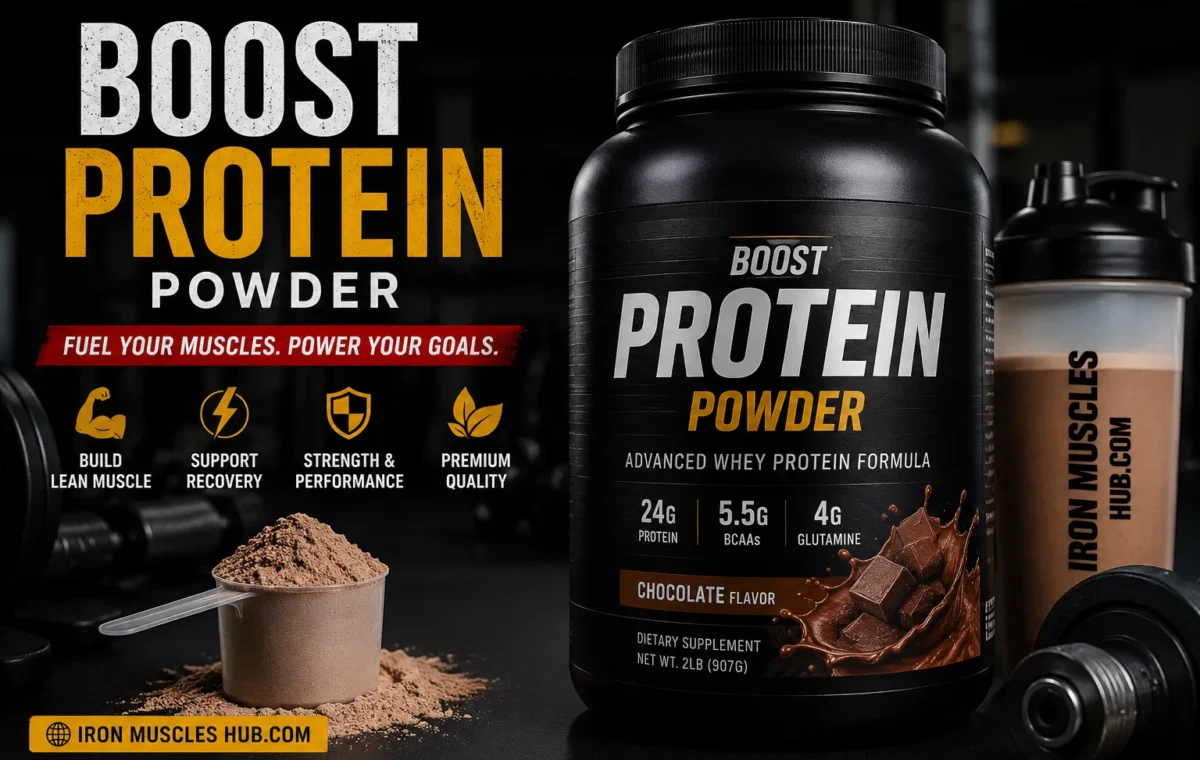
If you’re searching for boost protein powder, the first thing to know is that it isn’t the same as a typical gym protein powder. The BOOST powder formula is designed as an instant breakfast/nutritional drink mix, so it provides carbohydrates, fibre, vitamins and minerals along with protein. The current Canadian chocolate formula provides 7 g of protein from 40 g of powder, while preparing that serving with 250 mL of whole milk brings the drink to 15 g of protein.
- Quick Answer
- What Is BOOST Protein Powder?
- What does one serving contain?
- Is BOOST Protein Powder Good for Muscle Gain?
- A simple example
- What about protein per serving?
- BOOST Protein Powder vs a Typical Protein Powder
- How to Use BOOST Protein Powder
- Option 1: Breakfast
- Option 2: Post-workout
- Option 3: Smoothie
- Option 4: Recipe ingredient
- Worked Example: 70 kg / 154 lb Beginner
- Common Mistakes → Why → Fix
- Mistake 1: Treating BOOST as a pure protein powder
- Mistake 2: Counting the powder but forgetting the milk
- Mistake 3: Drinking it without checking your daily protein
- Mistake 4: Assuming more protein means faster muscle growth
- Mistake 5: Replacing every meal with shakes
- Mistake 6: Ignoring sugar and carbohydrate content
- Mistake 7: Assuming every BOOST product is the same
- 30-Second BOOST Decision Rule
- 1. Do I need more total protein?
- 2. Do I also need extra carbohydrates and calories?
- 3. Am I using it to support meals or replace them?
- Who Is BOOST Protein Powder NOT For?
- BOOST Protein Powder for Weight Gain
- BOOST Protein Powder for Fat Loss
- Is BOOST Protein Powder Healthy?
- Protein Timing: Does It Need to Be Post-Workout?
- How Much Protein Do You Really Need?
- Quick body-weight examples
- BOOST Powder Ingredients
- Can You Drink BOOST Protein Powder Every Day?
- Final Verdict: Is BOOST Protein Powder Worth Using?
- Frequently Asked Questions
- Is BOOST protein powder good for building muscle?
- How much protein is in BOOST protein powder?
- Can I use BOOST protein powder after a workout?
- Is BOOST protein powder the same as whey protein?
- Can BOOST protein powder help you gain weight?
For muscle gain, that distinction matters. BOOST powder can help you add protein and calories to your diet, but it isn’t automatically the best choice if your only goal is maximizing protein with the fewest calories. For more insights read here :- protein shake and Protein Breakfast.
Quick Answer
- BOOST protein powder is a nutritional drink mix, not a conventional whey protein powder.
- A 40 g serving contains 7 g protein before milk is added in the current Canadian chocolate formula.
- Prepared as directed with 250 mL whole milk, the product provides 15 g protein.
- For resistance training, your total daily protein intake matters more than simply adding one particular powder.
- If your goal is muscle growth, BOOST can be useful when it helps you consistently meet your nutrition needs, but a higher-protein food or protein supplement may be more efficient.
What Is BOOST Protein Powder?
BOOST protein powder is an instant nutritional drink mix made by Nestlé. The Canadian chocolate version is sold as an 880 g canister with 22 servings, with a recommended serving of 1/3 cup, or 40 g. The manufacturer recommends mixing it with 250 mL of whole milk, although it can also be added to smoothies and breakfast recipes.
That makes it different from a standard whey protein powder.
A conventional whey powder is usually designed to deliver a relatively concentrated dose of protein. BOOST powder is more of a nutritional beverage mix, with carbohydrates, fibre, vitamins and minerals included alongside its protein.
The distinction is important for beginners.
If you’re trying to gain weight and struggle to eat enough food, a product containing carbohydrates and additional calories may be useful.
If you’re already eating enough calories and simply need another 25–30 g of protein, a conventional protein powder or high-protein food may fit your goal better.
What does one serving contain?
The current Canadian chocolate BOOST powder label lists the following per 40 g serving of powder:
| Nutrient | 40 g powder |
|---|---|
| Calories | 150 kcal |
| Protein | 7 g |
| Carbohydrate | 30 g |
| Fibre | 3 g |
| Sugars | 21 g |
| Fat | 1 g |
| Sodium | 115 mg |
| Calcium | 225 mg |
| Iron | 7 mg |
| Potassium | 450 mg |
The vanilla version has a very similar structure, with 150 calories, 7 g protein, 30 g carbohydrate and 3 g fibre per 40 g serving.
Those figures are for the powder itself.
Once you add milk, the total nutrition changes.
The manufacturer lists preparation with 250 mL whole milk and reports 15 g protein for the prepared serving.
Always check the label on the exact product and flavour you buy because formulas can vary by country.
Is BOOST Protein Powder Good for Muscle Gain?
It can contribute to muscle growth, but it shouldn’t be treated as a muscle-building shortcut. The main question is whether it helps you reach an appropriate daily protein intake while supporting your training and overall calorie needs.
Research on resistance training shows that protein supplementation can modestly improve gains in muscle size and strength when combined with resistance exercise, particularly when total protein intake would otherwise be inadequate. A large meta-analysis covering 49 studies and 1,863 participants found benefits from protein supplementation, with no additional fat-free-mass benefit above roughly 1.6 g/kg/day in the analysed data.
For routinely active adults and athletes, an ACSM presentation gives a broader practical range of approximately 1.2–2.0 g/kg/day, depending on the individual and training demands.
That means the powder itself isn’t the target.
Your total daily protein intake is the target.
A simple example
Imagine a beginner weighs 70 kg (154 lb) and strength trains three or four times per week.
Using a practical training range of about 1.2–2.0 g/kg/day, that person would land somewhere around:
- 70 × 1.2 = 84 g/day
- 70 × 1.6 = 112 g/day
- 70 × 2.0 = 140 g/day
Those are not three mandatory targets. They illustrate how body weight can be used to estimate a useful range.
If the person already gets 110 g of protein from normal meals, adding BOOST simply because it says “protein” on the container may not be necessary.
If they’re struggling to eat enough and the drink makes it easier to reach their target, it can have a practical role.
What about protein per serving?
The International Society of Sports Nutrition position stand, indexed in PubMed, describes a general per-serving target around 0.25 g/kg of high-quality protein, or approximately 20–40 g, depending on the individual.
That gives us an important comparison.
A prepared BOOST powder serving with milk provides 15 g protein according to the current Canadian product information.
For a 60 kg (132 lb) beginner, 0.25 g/kg would be:
60 × 0.25 = 15 g
So 15 g happens to match that simple calculation.
For a 90 kg (198 lb) lifter:
90 × 0.25 = 22.5 g
The same BOOST serving would provide less protein than that example.
This doesn’t make BOOST “bad.” It simply shows why you need to look at the whole diet rather than judging a product by its name.
BOOST Protein Powder vs a Typical Protein Powder
This is one of the biggest areas of confusion.
BOOST powder is not designed in exactly the same way as a standard whey protein powder.
The current BOOST chocolate powder contains 30 g carbohydrate and 7 g protein per 40 g powder serving.
That ratio makes it more appropriate to think of it as a nutritional drink mix or breakfast supplement rather than a concentrated protein supplement.
| Feature | BOOST Powder | Typical Protein Powder |
| Main purpose | Nutritional drink/breakfast support | Concentrated protein |
| Protein concentration | Moderate | Usually much higher |
| Carbohydrates | Relatively high | Often lower |
| Fibre | 3 g in current Canadian powder | Varies |
| Vitamins/minerals | Added | Varies |
| Best fit | Breakfast, snack, extra nutrition | Filling protein gaps |
| Muscle gain use | Possible | Often more convenient |
| Calories from powder | 150 kcal | Varies by product |
The important point is not that one is universally better.
They’re different tools.
If you need more total nutrition, BOOST may make sense.
If you’re trying to add protein without adding many carbohydrates, a conventional protein powder may be more practical.
How to Use BOOST Protein Powder
The manufacturer’s basic preparation is straightforward: mix 1/3 cup (40 g) of BOOST powder with 1 cup (250 mL) of whole milk. It can also be added to smoothies or breakfast recipes.
For a beginner, I’d keep it simple.
Option 1: Breakfast
Mix the recommended serving with milk and have it alongside a normal breakfast.
For example:
- BOOST powder with milk
- Eggs
- Whole-grain toast
- Fruit
This gives you a broader meal than treating the powder as your entire diet.
Option 2: Post-workout
You can use it after resistance training if it fits your daily nutrition.
You don’t need to panic about drinking it immediately after your final set.
Protein can be consumed before or after training, and the overall daily intake is more important than chasing a tiny timing window. The evidence supports protein intake around exercise as a practical strategy, while the muscle-building response to exercise lasts well beyond the workout itself.
Option 3: Smoothie
You can blend the powder with milk, fruit and other ingredients.
A beginner-friendly smoothie might contain:
- 40 g BOOST powder
- 250 mL milk
- 1 banana
- Greek yogurt
- Ice
But remember that adding more ingredients also increases calories.
That’s useful if you’re trying to gain weight.
It may be unnecessary if you’re trying to control calorie intake.
Option 4: Recipe ingredient
BOOST powder can be added to breakfast recipes and smoothies, according to the manufacturer.
This can be useful if drinking a shake every day gets boring.
The key is to treat it as an ingredient rather than assuming more powder automatically means more muscle.
Worked Example: 70 kg / 154 lb Beginner
Let’s make this practical.
Suppose you’re:
- 70 kg (154 lb)
- 175 cm (5 ft 9 in)
- Resistance training three times per week
- Trying to build muscle
- Eating three main meals
A reasonable protein planning range for an active person could be around 1.2–2.0 g/kg/day, depending on training and individual circumstances.
At 1.6 g/kg:
70 kg × 1.6 = 112 g protein/day
Now imagine your food intake gives you:
- Breakfast: 25 g
- Lunch: 30 g
- Dinner: 35 g
- Snacks: 10 g
Total:
100 g/day
You’re already close.
A prepared BOOST serving providing 15 g protein would bring the day to roughly:
115 g protein
That puts you around 1.64 g/kg/day.
The lesson isn’t “drink BOOST every day.”
The lesson is:
Use a supplement to fill an actual gap.
If you were already eating 125 g of protein, the extra serving might simply add calories and nutrients you didn’t need.
Common Mistakes → Why → Fix
Mistake 1: Treating BOOST as a pure protein powder
Why: The word “protein” makes beginners assume the product is equivalent to a concentrated whey powder.
Fix: Check the nutrition panel. The current Canadian chocolate powder contains 7 g protein and 30 g carbohydrate per 40 g serving.
Mistake 2: Counting the powder but forgetting the milk
Why: People sometimes calculate the powder’s nutrition and forget that milk contributes additional calories and nutrients.
Fix: Track the complete prepared drink if you’re monitoring calories or macros.
Mistake 3: Drinking it without checking your daily protein
Why: More protein isn’t automatically better.
Fix: Estimate your daily protein from meals first. Then use BOOST if you have a genuine gap.
Mistake 4: Assuming more protein means faster muscle growth
Why: Muscle growth depends on more than protein. Training quality, recovery, energy intake and consistency all matter.
Fix: Build your routine around progressive resistance training, adequate food, sleep and sensible protein intake.
Mistake 5: Replacing every meal with shakes
Why: A powder or shake is convenient, but whole foods provide dietary variety and can make meals more satisfying.
Fix: Use BOOST as a supplement to a balanced diet unless a healthcare professional has given you a specific nutrition plan.
Mistake 6: Ignoring sugar and carbohydrate content
Why: A product can be useful for protein while still contributing substantial carbohydrate and sugar.
Fix: Look at the complete label. The current chocolate powder has 21 g sugar per 40 g serving.
Mistake 7: Assuming every BOOST product is the same
Why: BOOST has multiple products, including nutritional drinks, high-protein drinks, shakes and powders.
For example, the current BOOST High Protein drink provides 20 g protein and 250 calories per 237 mL bottle, while BOOST Max provides 30 g protein and 160 calories per 325 mL bottle.
Fix: Check the exact product name, serving size and country-specific label before calculating your macros.
30-Second BOOST Decision Rule
Before buying or using BOOST protein powder, ask yourself three questions.
1. Do I need more total protein?
If yes, continue.
If no, you may not need a protein supplement.
2. Do I also need extra carbohydrates and calories?
If yes, BOOST powder may fit better.
If no, a more concentrated protein powder could be more efficient.
3. Am I using it to support meals or replace them?
Supporting meals: usually makes more sense for a general fitness routine.
Replacing most meals: that’s a sign you should rethink your nutrition strategy and, if medically necessary, speak with a qualified professional.
This simple decision rule prevents a common beginner mistake: choosing a product based only on the word “protein.”
Who Is BOOST Protein Powder NOT For?
BOOST powder isn’t automatically appropriate for everyone.
You should be especially careful if you have a milk allergy, because the current chocolate formula contains milk. The product may also contain or potentially contain soy and wheat depending on the formulation.
People with diabetes, kidney disease, significant digestive problems, or medically prescribed dietary restrictions should discuss regular use with a doctor or registered dietitian.
That’s not because BOOST is inherently dangerous.
It’s because your nutritional requirements may be different from those of a healthy recreational lifter.
For example, someone managing a medical condition may need to consider carbohydrate, protein, sodium, potassium, phosphorus or fluid intake rather than simply looking at protein grams.
If you’re losing weight unintentionally, having persistent digestive symptoms, struggling to swallow, or unable to eat enough food, don’t use a nutritional powder to hide the underlying problem.
Get the cause assessed.
BOOST Protein Powder for Weight Gain
This is where the product may make more sense for some beginners.
Gaining body weight requires consistently taking in enough energy.
A powder mixed with milk can be easier to consume than another full plate of food.
The current Canadian chocolate powder provides 150 calories per 40 g powder serving, before the milk is added.
Prepared with whole milk, the total calorie intake is substantially higher.
That can be useful for someone who struggles with appetite.
But don’t make the mistake of thinking every calorie should come from shakes.
Build your diet around foods such as:
- Rice
- Potatoes
- Oats
- Eggs
- Dairy
- Fish
- Chicken
- Lean meat
- Beans
- Lentils
- Fruit
- Vegetables
- Nuts and seeds
Then use a shake when convenience helps you stay consistent.
BOOST Protein Powder for Fat Loss
The situation is different if you’re trying to lose body fat.
The powder itself isn’t a fat-loss supplement.
The current chocolate version supplies 150 calories and 30 g carbohydrate per 40 g serving, before preparation with milk.
Those calories can fit into a calorie-controlled diet, but you need to count them.
If your diet already provides enough protein and you have limited calories available, spending those calories on a relatively low-protein powder may not be the most efficient choice.
A higher-protein, lower-calorie option could make more sense.
Again, this is about matching the tool to the goal.
Is BOOST Protein Powder Healthy?
There isn’t a simple yes-or-no answer.
A product can be useful without being necessary.
BOOST powder supplies protein, carbohydrate, fibre and several added vitamins and minerals. The current chocolate formula contains 3 g fibre and 16 listed vitamins/minerals or nutrient additions in the manufacturer’s description.
At the same time, it contains a meaningful amount of sugar.
The chocolate version lists 21 g sugar per 40 g serving.
So judge it in context.
For someone who needs convenient nutrition, those carbohydrates may be perfectly reasonable.
For someone who wants a highly concentrated protein source with minimal carbohydrate, it may not be the best match.
There is no need to label the product simply “good” or “bad.”
Ask whether it solves your particular nutrition problem.
Protein Timing: Does It Need to Be Post-Workout?
No.
You can use BOOST before training, after training, at breakfast or as a snack.
Protein timing matters less than beginners often think.
A PubMed-indexed position stand recommends distributing protein doses across the day, with approximately 20–40 g of high-quality protein per feeding as a general practical range, while noting that individual needs vary.
A newer systematic review and network meta-analysis covering 116 trials and 4,711 participants found that protein supplementation after exercise was associated with improvements in fat-free mass and skeletal muscle mass compared with placebo, but it also examined different timing patterns and protein types rather than showing that one exact clock time is mandatory.
For a beginner, the practical approach is simple:
Eat enough protein throughout the day and place a convenient protein serving around training if that helps you meet your target.
You don’t need to race home from the gym to drink it within a few minutes.
How Much Protein Do You Really Need?
Protein needs depend on body size, activity, age, training and health status.
The general adult RDA is 0.8 g/kg/day, but that is not the same thing as an optimal target for someone regularly resistance training.
For active adults, ACSM material gives approximately 1.2–2.0 g/kg/day as a practical range.
The large resistance-training meta-analysis found that benefits from protein supplementation did not continue increasing beyond roughly 1.6 g/kg/day for fat-free mass in its analysis.
That gives beginners a useful framework.
You don’t need to chase extreme protein numbers.
You need enough protein to support your training while still eating enough carbohydrates, fats, fruits, vegetables and overall calories.
Quick body-weight examples
| Body weight | Approx. 1.2 g/kg | Approx. 1.6 g/kg | Approx. 2.0 g/kg |
| 60 kg / 132 lb | 72 g | 96 g | 120 g |
| 70 kg / 154 lb | 84 g | 112 g | 140 g |
| 80 kg / 176 lb | 96 g | 128 g | 160 g |
| 90 kg / 198 lb | 108 g | 144 g | 180 g |
These are planning examples, not prescriptions.
A healthy 70 kg beginner doesn’t automatically need exactly 112 g every day.
Your training volume, food intake, goals and health status all matter.
BOOST Powder Ingredients
The current chocolate formula contains ingredients including skim milk powder, sugars, cocoa, oligofructose, inulin, soy lecithin, carrageenan, vitamins and iron. It contains milk and soy and may contain wheat.
The vanilla formula uses skim milk powder, sugars, oligofructose, inulin, cellulose gum, flavouring, vitamins and iron, and contains milk with possible soy and wheat exposure according to the manufacturer’s label.
If you’re new to reading labels, don’t get stuck trying to judge every ingredient in isolation.
Start with the big picture:
- Protein
- Calories
- Carbohydrates
- Sugars
- Fibre
- Allergens
- Serving size
Those numbers tell you far more about whether the product fits your current goal.
Can You Drink BOOST Protein Powder Every Day?
For a healthy adult, the question isn’t simply whether the powder can be consumed daily.
The more useful question is whether daily use improves your overall diet.
If one serving helps you consistently meet your protein and calorie needs, it may be a convenient option.
If you’re already eating a complete diet and the powder simply adds unnecessary calories or sugar, there may be little reason to use it every day.
Your diet should still include a wide range of whole foods.
And if you have a medical condition or medically restricted diet, ask your healthcare professional before making regular use part of your routine.
Final Verdict: Is BOOST Protein Powder Worth Using?
BOOST protein powder can be useful, but it’s best viewed as a nutritional drink mix rather than a conventional high-protein gym powder.
The current Canadian chocolate formula provides 7 g protein per 40 g of powder, and the manufacturer reports 15 g protein when prepared with 250 mL whole milk.
That can help a beginner add nutrition to breakfast, a smoothie or a snack.
For muscle growth, though, the bigger picture matters.
Aim for a sensible daily protein intake, train consistently, eat enough calories for your goal, sleep well and use supplements to fill genuine gaps.
If your main goal is maximum protein per calorie, compare BOOST with a conventional protein powder.
If your goal is a convenient breakfast-style drink containing protein, carbohydrates, fibre and added micronutrients, BOOST may make more sense.
Use the product for what it actually is, not what the word “protein” makes you assume it is.
Frequently Asked Questions
Is BOOST protein powder good for building muscle?
It can contribute to your daily protein intake, which supports muscle growth when combined with resistance training. However, the current Canadian powder provides 7 g protein per 40 g serving before milk, so it’s less protein-dense than many conventional protein powders. Total daily protein, training quality and adequate recovery matter more than the product itself.
How much protein is in BOOST protein powder?
The current Canadian chocolate and vanilla powder formulas provide 7 g protein per 40 g serving of powder. When the recommended serving is prepared with 250 mL whole milk, the manufacturer reports 15 g protein for the prepared drink. Always check your local package because BOOST formulas differ by product and market.
Can I use BOOST protein powder after a workout?
Yes. It can be used after resistance training if it helps you meet your daily nutrition needs. You don’t have to consume it immediately after your final set. Protein intake around exercise can support recovery, but your total daily protein intake remains a major priority.
Is BOOST protein powder the same as whey protein?
No. BOOST powder is an instant nutritional drink mix containing ingredients such as skim milk powder, carbohydrates, fibre, vitamins and minerals. A conventional whey protein powder is generally designed to provide a more concentrated protein dose. The current BOOST chocolate powder contains 7 g protein and 30 g carbohydrate per 40 g serving.
Can BOOST protein powder help you gain weight?
It can help increase calorie intake when prepared with milk, which may be useful for someone who struggles to eat enough. However, weight gain depends on your overall energy intake rather than one product. Use it alongside a balanced diet and resistance training rather than relying on shakes as your primary source of nutrition.
Final Takeaway
BOOST protein powder isn’t a magic muscle-building supplement, and it isn’t meant to be.
It’s a convenient nutritional powder that can provide protein, carbohydrates, fibre, vitamins and minerals. The current Canadian chocolate version provides 7 g protein per 40 g powder serving and 15 g when prepared with the recommended whole milk.
For beginners, the smartest approach is to start with your food intake and training goal. Work out whether you actually need more protein or calories. Then choose a supplement that fills that gap.
If BOOST fits your needs, use it confidently.
If you need a much more concentrated protein source, choose something designed specifically for that job.
The best supplement is the one that solves a real problem in your diet without making the rest of your nutrition harder.