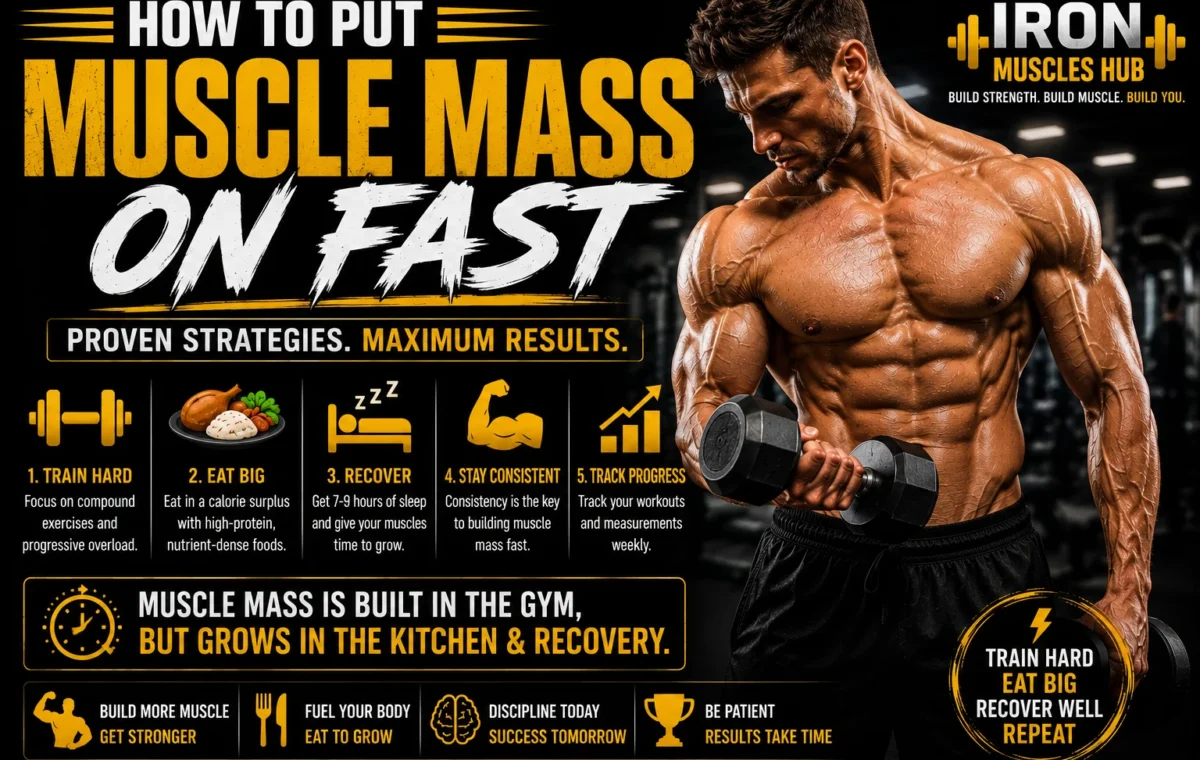
If you’re wondering how to put muscle mass on fast, the answer is surprisingly simple: train with progressive overload, eat enough calories and protein, recover properly, and stay consistent. There isn’t a magic workout or supplement that builds muscle overnight. Instead, the fastest muscle gains come from following proven habits every week.
- Quick Answer
- Key Takeaways
- Best Compound Exercises
- Weekly Training Frequency
- Step 2: Train for Hypertrophy
- Step 3: Progressive Overload Is Essential
- Example
- High-Calorie Foods That Support Muscle Growth
- Example Daily Eating Schedule
- Best Protein Foods for Muscle Growth
- Healthy Carbohydrate Sources
- Recovery Checklist
- Monday – Chest & Triceps
- Tuesday – Back & Biceps
- Wednesday – Legs
- Thursday – Shoulders
- Friday – Full Body
- Training Too Much
- Eating Too Little
- Ignoring Progressive Overload
- Using Poor Form
- Skipping Leg Day
- Expecting Overnight Results
- Can skinny people put muscle mass on fast?
- What's the best workout for muscle gain?
- Should I do cardio while trying to gain muscle?
- Do supplements help build muscle faster?
- Is eating more always better?
Many beginners waste months doing random workouts or eating too little. This guide explains exactly how to put muscle mass on fast using practical, beginner-friendly strategies that help maximize muscle growth while keeping body fat under control. For more insights read here: how to get bigger and lean muscle.
Quick Answer
| Goal | Best Approach |
|---|---|
| Build Muscle Fast | Strength train 3–5 days each week |
| Protein | Eat enough protein every day |
| Calories | Stay in a moderate calorie surplus |
| Recovery | Sleep 7–9 hours every night |
| Progress | Lift slightly heavier weights over time |
| Patience | Stay consistent for several months |
Key Takeaways
- Train every major muscle group at least twice each week.
- Eat enough calories to support muscle growth.
- Prioritize high-quality protein with every meal.
- Increase your workout intensity gradually.
- Sleep and recovery are just as important as training.
- Stay patient because muscle growth happens over weeks and months, not days.
Why Building Muscle Takes Time
Many people search for how to put muscle mass on fast because they want quick results. While it’s possible to make noticeable progress in your first few months of training, your muscles need time to adapt.
When you lift weights, tiny muscle fibers experience stress. During recovery, your body repairs these fibers, making them slightly larger and stronger than before. Repeating this process consistently is what leads to long-term muscle growth.
Rather than looking for shortcuts, focus on improving your training, nutrition, and recovery each week.
Step 1: Follow a Structured Strength Training Program
The most effective way to put muscle mass on fast is through resistance training. Your workouts should focus on compound exercises that recruit multiple muscle groups at once.
Best Compound Exercises
- Barbell Squats
- Deadlifts
- Bench Press
- Overhead Press
- Pull-Ups
- Chin-Ups
- Barbell Rows
- Romanian Deadlifts
- Dips
These exercises allow you to lift heavier weights and stimulate more muscle fibers compared with isolation exercises alone.
Weekly Training Frequency
For beginners:
- Train 3–4 days per week
- Rest between workouts
- Focus on learning proper technique before increasing weight
Intermediate lifters can often benefit from 4–5 training sessions per week with enough recovery.
Step 2: Train for Hypertrophy
Hypertrophy is the process of increasing muscle size.
For most exercises:
- Perform 3–4 sets
- Aim for 8–12 repetitions
- Rest 60–90 seconds between sets
- Finish each set close to muscular fatigue while maintaining good form
This training style provides enough volume to encourage muscle growth while reducing unnecessary fatigue.
Step 3: Progressive Overload Is Essential
One of the biggest reasons people stop growing is that they continue lifting the same weight every week.
Progressive overload means gradually increasing the challenge placed on your muscles.
You can do this by:
- Increasing the weight
- Adding one or two repetitions
- Completing an additional set
- Improving exercise technique
- Reducing rest time slightly
Example
| Week | Bench Press |
|---|---|
| Week 1 | 3 × 8 × 135 lb |
| Week 2 | 3 × 9 × 135 lb |
| Week 3 | 3 × 8 × 140 lb |
| Week 4 | 4 × 8 × 140 lb |
Small improvements each week lead to significant muscle gains over time.
Step 4: Eat Enough Calories
Even the best workout program won’t help if you’re consistently eating too little.
To put muscle mass on fast, your body needs extra energy to build new muscle tissue.
A moderate calorie surplus is usually more effective than dramatically increasing food intake because it helps support muscle growth while limiting unnecessary fat gain.
Choose mostly whole foods such as:
- Chicken breast
- Lean beef
- Eggs
- Fish
- Rice
- Oats
- Potatoes
- Whole-grain bread
- Fruit
- Vegetables
- Greek yogurt
- Cottage cheese
These foods provide the nutrients your body needs for training performance and recovery.
High-Calorie Foods That Support Muscle Growth
If you struggle to gain weight, include calorie-dense foods in your meals.
| Food | Why It Helps |
|---|---|
| Peanut Butter | High in healthy fats and calories |
| Mixed Nuts | Easy way to increase calorie intake |
| Olive Oil | Adds calories without large meal volume |
| Avocados | Rich in healthy fats and nutrients |
| Whole Milk | Provides protein and extra calories |
| Cheese | Protein and energy-dense |
| Oats | Excellent source of slow-digesting carbohydrates |
| Rice | Easy to eat in larger portions |
Adding these foods can make it easier to maintain the calorie surplus needed for muscle growth.
Example Daily Eating Schedule
Breakfast
- Scrambled eggs
- Oatmeal
- Banana
- Glass of milk
Snack
- Greek yogurt
- Mixed nuts
Lunch
- Grilled chicken
- Rice
- Steamed vegetables
Pre-Workout
- Peanut butter sandwich
- Apple
Dinner
- Salmon
- Sweet potatoes
- Broccoli
Before Bed
- Cottage cheese
- Berries
This meal pattern provides regular opportunities to consume protein and energy throughout the day, helping support recovery and muscle growth.
If you’re serious about learning how to put muscle mass on fast, protein should be a priority. Every workout creates tiny tears in your muscle fibers. Protein provides the amino acids your body uses to repair and grow those muscles stronger than before.
Try to include a quality protein source with every meal.
Best Protein Foods for Muscle Growth
| Food | Benefits |
|---|---|
| Chicken Breast | Lean, high-quality protein |
| Turkey | Low fat and rich in protein |
| Eggs | Complete protein with essential amino acids |
| Lean Beef | Protein plus iron and vitamin B12 |
| Salmon | Protein and heart-healthy fats |
| Tuna | High protein with minimal fat |
| Greek Yogurt | High protein and calcium |
| Cottage Cheese | Slow-digesting protein |
| Milk | Protein and carbohydrates for recovery |
| Whey Protein | Convenient after workouts |
Aim to spread your protein intake throughout the day rather than eating most of it in one meal.
Step 6: Don’t Skip Carbohydrates
Many beginners fear carbohydrates, but they’re one of your body’s main fuel sources during resistance training.
Without enough carbs, your workouts may suffer, making it harder to build muscle.
Healthy Carbohydrate Sources
- Oatmeal
- Brown rice
- White rice
- Sweet potatoes
- Potatoes
- Whole-grain bread
- Pasta
- Beans
- Fruits
- Vegetables
Eating carbohydrates before training can help improve workout performance, while including them after training helps replenish energy stores.
Step 7: Healthy Fats Support Muscle Growth
Healthy fats help support normal hormone production and make it easier to reach your daily calorie goal.
Good choices include:
- Avocados
- Olive oil
- Almonds
- Walnuts
- Cashews
- Peanut butter
- Chia seeds
- Flaxseeds
Balance is important. Include healthy fats as part of a well-rounded diet rather than relying on processed foods.
Step 8: Get Better Sleep
Many people focus only on workouts while ignoring recovery.
Your muscles recover and adapt between training sessions, especially while you sleep.
Recovery Checklist
- Sleep 7–9 hours each night.
- Drink enough water.
- Take at least one or two rest days each week.
- Stretch after training.
- Manage stress where possible.
Poor recovery can slow progress, reduce workout performance, and increase your risk of injury.
Sample 5-Day Muscle-Building Workout Plan
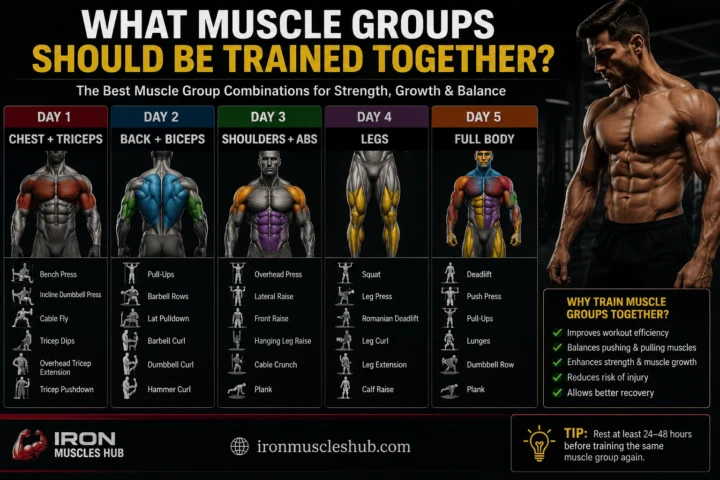
Monday – Chest & Triceps
- Bench Press – 4 × 8
- Incline Dumbbell Press – 3 × 10
- Chest Fly – 3 × 12
- Dips – 3 × 10
- Triceps Pushdowns – 3 × 12
Tuesday – Back & Biceps
- Deadlift – 4 × 6
- Pull-Ups – 3 sets
- Barbell Row – 4 × 8
- Lat Pulldown – 3 × 10
- Dumbbell Curl – 3 × 12
- Hammer Curl – 3 × 12
Wednesday – Legs
- Squats – 4 × 8
- Romanian Deadlift – 3 × 10
- Leg Press – 3 × 12
- Walking Lunges – 3 × 12
- Leg Curl – 3 × 12
- Standing Calf Raises – 4 × 15
Thursday – Shoulders
- Overhead Press – 4 × 8
- Dumbbell Shoulder Press – 3 × 10
- Lateral Raises – 3 × 15
- Rear Delt Fly – 3 × 15
- Shrugs – 4 × 12
Friday – Full Body
- Front Squat – 3 × 8
- Incline Bench Press – 3 × 10
- Pull-Ups – 3 sets
- Romanian Deadlift – 3 × 10
- Farmer’s Carry – 3 rounds
- Plank – 3 × 60 seconds
Saturday and Sunday can be used for rest, light walking, or mobility work.
Best Supplements for Muscle Gain
Supplements aren’t required, but a few can be convenient additions to a solid nutrition plan.
| Supplement | Purpose |
|---|---|
| Whey Protein | Helps increase daily protein intake |
| Creatine Monohydrate | Supports strength and training performance |
| Fish Oil | Useful if you rarely eat oily fish |
| Vitamin D | May help if your levels are low |
| Electrolytes | Helpful during long or intense workouts |
Remember, supplements work best when your diet and training are already consistent.
Common Mistakes That Slow Muscle Growth
Avoid these common problems if your goal is how to put muscle mass on fast.
Training Too Much
More isn’t always better. Muscles need time to recover before they’re trained again.
Eating Too Little
If your body doesn’t have enough energy, muscle growth becomes much more difficult.
Ignoring Progressive Overload
Doing the same workout with the same weights every week often leads to stalled progress.
Using Poor Form
Good technique helps target the right muscles and reduces injury risk.
Skipping Leg Day
Training your lower body contributes to balanced strength and overall muscle development.
Expecting Overnight Results
Building muscle takes time. Focus on steady progress rather than dramatic weekly changes.
How to Measure Your Progress
Instead of relying only on the scale, track several indicators:
- Weekly body weight
- Strength improvements
- Progress photos
- Arm, chest, waist, and thigh measurements
- Workout performance
- How your clothes fit
These measurements provide a clearer picture of muscle-building progress than weight alone.
Realistic Beginner Example
Imagine Alex starts resistance training three times each week while eating enough protein and maintaining a moderate calorie surplus.
After the first month, Alex notices improved strength and better workout endurance. By the third month, progress photos show more definition in the shoulders, chest, and arms. Six months later, consistent training, nutrition, and recovery lead to visible muscle gain and increased confidence.
This kind of gradual progress is much more realistic than expecting dramatic changes after only a few weeks.
If you train consistently, eat enough nutritious food, and recover well, many beginners notice strength improvements within the first month. Visible muscle growth often becomes noticeable after 8–12 weeks, while significant changes usually require 6–12 months of consistent effort.
Can skinny people put muscle mass on fast?
Yes. Many naturally skinny beginners experience what’s often called “newbie gains.” During the first year of proper resistance training, muscle growth can happen faster than it does later, provided you eat enough calories, prioritize protein, and follow a structured workout plan.
What’s the best workout for muscle gain?
A workout focused on compound movements is one of the most effective approaches. Exercises like squats, bench presses, deadlifts, overhead presses, rows, and pull-ups train multiple muscle groups at once and allow progressive overload, which is essential for building muscle.
Should I do cardio while trying to gain muscle?
Yes, but keep it balanced. Two or three moderate cardio sessions each week can improve heart health and recovery without interfering with muscle growth. Avoid excessive cardio if your main goal is to maximize muscle gain.
Do supplements help build muscle faster?
Supplements can support your routine, but they don’t replace good nutrition and training. Whey protein can help you reach your protein goal, while creatine monohydrate may improve strength and workout performance. Your results will depend far more on consistent training, eating enough calories, and quality sleep.
Is eating more always better?
No. A moderate calorie surplus is usually more effective than eating as much as possible. Overeating may lead to unnecessary fat gain instead of maximizing lean muscle growth. Focus on nutritious foods and steady progress rather than rapid weight gain.
30-Day Muscle Mass Action Plan
| Week | Focus | Goal |
|---|---|---|
| Week 1 | Learn proper exercise form | Build confidence |
| Week 2 | Increase workout intensity slightly | Improve strength |
| Week 3 | Add weight or repetitions | Progressive overload |
| Week 4 | Track body measurements and progress photos | Measure improvements |
Repeat this process while making gradual adjustments based on your progress.
Muscle-Building Checklist
Before asking why you’re not growing, make sure you can answer yes to these questions:
- ✅ I strength train at least 3–5 days every week.
- ✅ I eat enough calories to support muscle growth.
- ✅ I include protein in every meal.
- ✅ I drink enough water every day.
- ✅ I sleep 7–9 hours each night.
- ✅ I increase my weights or repetitions over time.
- ✅ I take recovery seriously.
- ✅ I stay consistent even when results feel slow.
If you consistently check every box, you’re giving yourself an excellent chance of building muscle successfully.
Final Thoughts
Learning how to put muscle mass on fast doesn’t require expensive equipment, complicated workout plans, or miracle supplements. The people who build the best physiques usually follow the same proven habits: they train with purpose, eat enough nutritious food, prioritize protein, recover well, and stay consistent for months rather than days.
If you’re just starting, don’t compare your progress with experienced lifters or social media influencers. Focus on becoming a little stronger every week, improving your nutrition, and sticking to a structured routine. Those small improvements add up over time and lead to noticeable muscle growth.
Remember, the fastest way to build muscle isn’t finding a shortcut—it’s following the fundamentals consistently. Stay patient, track your progress, and trust the process. Your future results will reflect the habits you build today.
Key Takeaways
- Progressive overload is the foundation of muscle growth.
- Eat enough calories and prioritize protein daily.
- Train each major muscle group at least twice per week.
- Compound exercises should be the core of your program.
- Sleep and recovery are essential for building muscle.
- Consistency beats perfection every time.