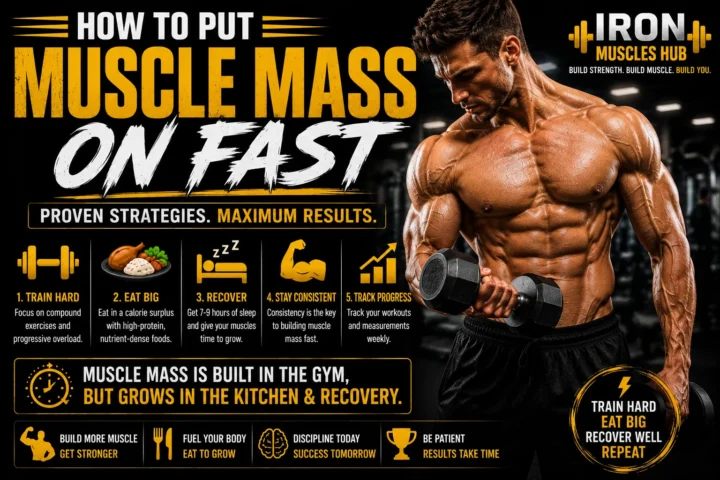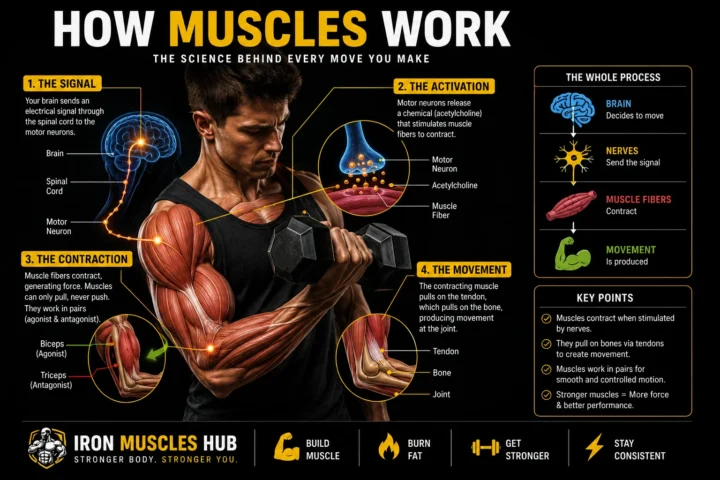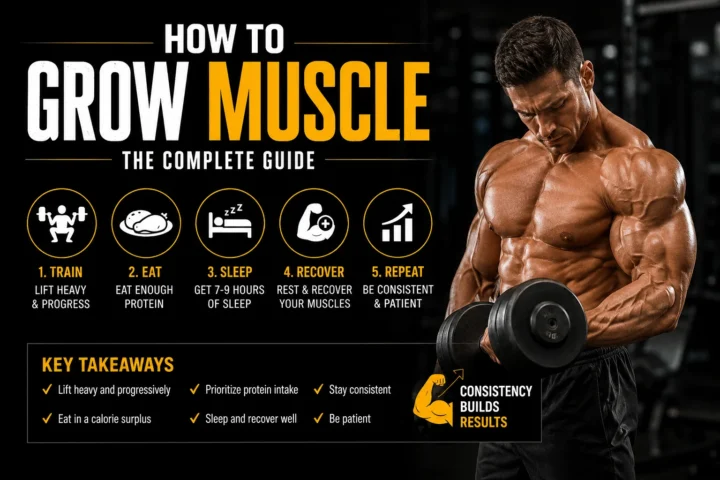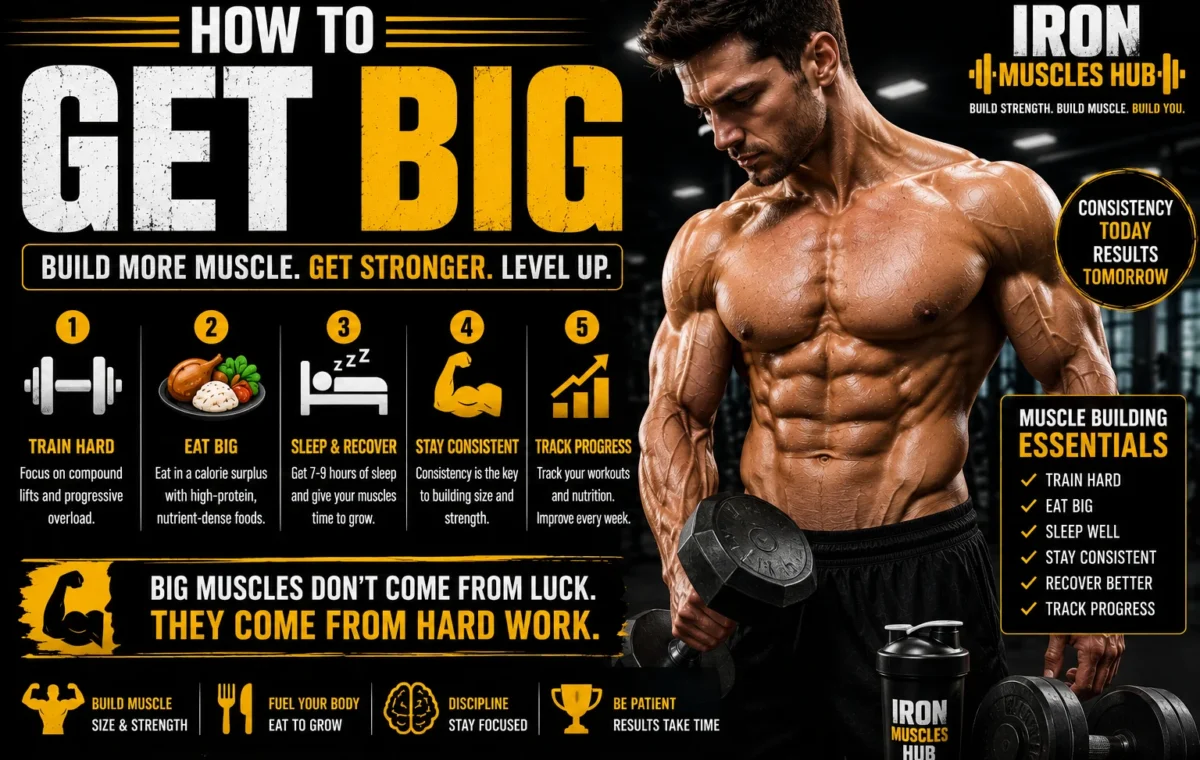
If you’re searching for how to get big, the good news is that building muscle isn’t as complicated as many people think. The fastest way to get bigger is by following a structured strength-training program, eating enough calories and protein, getting quality sleep, and staying consistent over time. There are no shortcuts or miracle supplements that replace hard work and smart training.
- Key Takeaways
- Best Compound Exercises
- Example Progress
- Best Foods for Muscle Growth
- Monday
- Tuesday
- Wednesday
- Thursday
- Friday
- Saturday
- Sunday
- Step 7: Eat the Right Foods to Get Big
- Breakfast
- Morning Snack
- Lunch
- Afternoon Snack
- Dinner
- Before Bed
- Monday – Chest & Triceps
- Tuesday – Back & Biceps
- Wednesday – Legs
- Thursday – Rest
- Friday – Shoulders
- Saturday – Full Body
- Sunday – Recovery
- How long does it take to get big?
- Can skinny people get big?
- Do I need to go to the gym to get big?
- What's the best workout split for muscle growth?
- Should I do cardio while trying to get big?
- What's more important: diet or training?
Whether you’re naturally skinny or simply want to add more muscle size, this guide explains how to get big step by step. You’ll learn what workouts to follow, what foods to eat, and which mistakes to avoid so you can build muscle safely and effectively. For more insight read here:- how to put muscle mass on fast and how to get bigger.
Quick Answer
| Goal | What You Should Do |
|---|---|
| Build Muscle | Lift weights 3–5 days weekly |
| Gain Size | Eat in a calorie surplus |
| Protein | Include protein in every meal |
| Recovery | Sleep 7–9 hours every night |
| Progress | Increase weights gradually |
| Consistency | Stay patient for several months |
Key Takeaways
- Lift heavy with proper technique.
- Train each muscle group at least twice every week.
- Eat nutritious, calorie-rich meals.
- Prioritize protein daily.
- Recover properly between workouts.
- Track your progress every week.
Why Most People Don’t Get Big
Many beginners spend months in the gym without seeing noticeable results. Usually, the problem isn’t a lack of effort—it’s following the wrong plan.
Common reasons include:
- Not eating enough calories.
- Skipping protein-rich meals.
- Changing workout programs too often.
- Using weights that are too light.
- Sleeping too little.
- Expecting instant results.
Building muscle is a gradual process. Improving your habits every week is much more effective than chasing quick fixes.
Step 1: Build Your Foundation with Compound Exercises
If your goal is how to get big, start every workout with compound movements. These exercises work several muscle groups at the same time, allowing you to lift heavier weights and stimulate more muscle growth.
Best Compound Exercises
- Squats
- Deadlifts
- Bench Press
- Overhead Press
- Pull-Ups
- Chin-Ups
- Barbell Rows
- Romanian Deadlifts
- Dips
These exercises should make up the majority of your training program.
Step 2: Train with Progressive Overload
Muscles grow because they’re challenged.
If you lift the same weight every week, your body quickly adapts and muscle growth slows down.
Progressive overload means gradually making your workouts more difficult.
You can do this by:
- Adding weight.
- Performing more repetitions.
- Completing extra sets.
- Improving your lifting technique.
- Reducing rest periods slightly.
Example Progress
| Week | Squat |
|---|---|
| Week 1 | 3 × 8 × 135 lb |
| Week 2 | 3 × 9 × 135 lb |
| Week 3 | 3 × 8 × 145 lb |
| Week 4 | 4 × 8 × 145 lb |
Those small improvements build significant muscle over time.
Step 3: Eat More Calories Than You Burn
One of the biggest reasons people fail to get big is that they don’t eat enough.
Building muscle requires energy. If you’re eating too little, your body has fewer resources available for muscle growth.
Focus on nutritious foods instead of highly processed junk food.
Best Foods for Muscle Growth
| Protein | Carbohydrates | Healthy Fats |
|---|---|---|
| Chicken | Rice | Olive Oil |
| Eggs | Oats | Avocados |
| Lean Beef | Potatoes | Almonds |
| Salmon | Pasta | Walnuts |
| Greek Yogurt | Bread | Peanut Butter |
| Cottage Cheese | Fruit | Mixed Nuts |
Choose foods that provide protein, complex carbohydrates, healthy fats, vitamins, and minerals.
Step 4: Prioritize Protein
Protein helps repair and rebuild muscle tissue after training.
Excellent protein sources include:
- Chicken breast
- Lean beef
- Turkey
- Eggs
- Fish
- Greek yogurt
- Cottage cheese
- Milk
- Whey protein
- Beans
- Lentils
Spread your protein intake across the day instead of eating most of it in one meal.
Step 5: Train Every Muscle Group
A balanced workout produces better long-term results than focusing only on chest and arms.
Train:
- Chest
- Back
- Legs
- Shoulders
- Biceps
- Triceps
- Core
Balanced training improves strength, posture, and overall muscle development.
Sample Beginner Weekly Routine
Monday
Chest & Triceps
Tuesday
Back & Biceps
Wednesday
Legs
Thursday
Rest
Friday
Shoulders & Arms
Saturday
Full Body
Sunday
Rest or Light Walking
This schedule gives each muscle enough work while allowing time to recover.
Step 6: Recovery Builds Muscle
Many people believe muscles grow while lifting weights.
Actually, muscle growth happens during recovery.
Recovery habits include:
- Sleeping 7–9 hours.
- Drinking enough water.
- Taking rest days.
- Managing stress.
- Eating balanced meals after workouts.
Without recovery, progress slows and injury risk increases.
End of Part 1
The next part will cover:
- Complete muscle-building meal plan
- 5-day hypertrophy workout
- Best supplements
- Common mistakes
- How long it takes to get big
- Progress tracking
- Expert muscle-building tips
Step 7: Eat the Right Foods to Get Big
If your goal is how to get big, your diet is just as important as your workouts. You can’t expect your muscles to grow if your body doesn’t have enough nutrients to repair and build new muscle tissue.
Aim to eat balanced meals that include:
- Lean protein
- Complex carbohydrates
- Healthy fats
- Fruits and vegetables
- Plenty of water
Avoid relying on fast food or sugary snacks for most of your calories. While they may increase calorie intake, they don’t provide the same nutritional value as whole foods.
Best Foods to Help You Get Big
| Food | Why It’s Good |
|---|---|
| Chicken Breast | High-quality lean protein |
| Lean Beef | Protein plus iron and vitamin B12 |
| Salmon | Protein and healthy omega-3 fats |
| Eggs | Complete protein with essential amino acids |
| Greek Yogurt | Protein and calcium |
| Cottage Cheese | Slow-digesting protein |
| Brown Rice | Long-lasting energy |
| Oats | High in fiber and carbohydrates |
| Sweet Potatoes | Rich in vitamins and complex carbs |
| Bananas | Great pre-workout carbohydrate source |
| Peanut Butter | Healthy fats and extra calories |
| Almonds | Healthy fats, protein, and minerals |
Sample Muscle-Building Meal Plan
Breakfast
- 4 scrambled eggs
- Bowl of oatmeal
- Banana
- Glass of milk
Morning Snack
- Greek yogurt
- Handful of almonds
Lunch
- Grilled chicken breast
- Brown rice
- Mixed vegetables
Afternoon Snack
- Peanut butter sandwich
- Apple
Dinner
- Grilled salmon
- Sweet potato
- Broccoli
Before Bed
- Cottage cheese
- Mixed berries
This type of meal plan provides protein throughout the day while supplying carbohydrates for training and healthy fats for overall nutrition.
Step 8: Drink Enough Water
Hydration affects workout performance and recovery.
Simple tips:
- Drink water before training.
- Sip water during workouts.
- Rehydrate after exercise.
- Increase water intake during hot weather or intense training.
Good hydration supports overall health and helps you perform better in the gym.
Step 9: Follow a Structured Workout Plan
One of the fastest ways to get big is to follow a consistent workout routine instead of changing exercises every week.
Monday – Chest & Triceps
- Bench Press – 4 × 8
- Incline Dumbbell Press – 3 × 10
- Chest Fly – 3 × 12
- Dips – 3 × 10
- Triceps Pushdown – 3 × 12
Tuesday – Back & Biceps
- Deadlift – 4 × 6
- Pull-Ups – 3 sets
- Barbell Row – 4 × 8
- Lat Pulldown – 3 × 10
- Dumbbell Curl – 3 × 12
- Hammer Curl – 3 × 12
Wednesday – Legs
- Squats – 4 × 8
- Romanian Deadlift – 3 × 10
- Leg Press – 3 × 12
- Walking Lunges – 3 × 12
- Leg Curl – 3 × 12
- Standing Calf Raise – 4 × 15
Thursday – Rest
Take a complete rest day or do light stretching and walking.
Friday – Shoulders
- Overhead Press – 4 × 8
- Dumbbell Shoulder Press – 3 × 10
- Lateral Raises – 3 × 15
- Rear Delt Fly – 3 × 15
- Shrugs – 4 × 12
Saturday – Full Body
- Front Squat – 3 × 8
- Incline Bench Press – 3 × 10
- Pull-Ups – 3 sets
- Romanian Deadlift – 3 × 10
- Farmer’s Carry – 3 rounds
- Plank – 3 × 60 seconds
Sunday – Recovery
Take the day off and focus on:
- Walking
- Stretching
- Mobility exercises
- Quality sleep
Step 10: Sleep for Better Muscle Growth
Training breaks muscles down.
Sleep helps rebuild them.
Aim for 7–9 hours every night.
Good sleep can help:
- Improve recovery
- Increase workout performance
- Support muscle repair
- Improve energy levels
Create a bedtime routine and try to keep a consistent sleep schedule.
Do You Need Supplements?
Supplements are optional. They can be convenient, but they don’t replace a solid diet or training plan.
Common choices include:
- Whey protein
- Creatine monohydrate
- Fish oil (if your diet is low in oily fish)
- Vitamin D (if recommended by a healthcare professional)
Whole foods should remain the foundation of your nutrition.
Common Mistakes That Stop Muscle Growth
Avoid these mistakes if you want to get big effectively:
- Skipping leg workouts
- Not eating enough protein
- Changing routines every week
- Ignoring recovery
- Using poor exercise form
- Expecting immediate results
- Missing workouts regularly
Consistency is far more important than finding the “perfect” workout.
Signs You’re Making Progress
Track your results instead of relying only on the mirror.
Look for:
- Increased strength
- Better workout performance
- Gradual body-weight gain
- Progress photos
- Larger arm, chest, or leg measurements
- Better-fitting shirts around your shoulders and arms
These signs often show progress before dramatic visual changes appear.
End of Part 2
Next: Part 3 will include:
- Frequently Asked Questions
- 30-Day Action Plan
- Final Conclusion
- Internal Linking Ideas
- Sources
- Author Bio
- Disclaimer
Frequently Asked Questions
How long does it take to get big?
If you’re consistent with strength training, proper nutrition, and recovery, you’ll likely notice strength gains within 3–4 weeks. Visible muscle growth often appears after 8–12 weeks, while significant size increases usually take 6–12 months of dedicated training.
Can skinny people get big?
Yes. People with a naturally slim body type can absolutely build muscle. The key is following a structured workout program, eating enough nutritious calories, consuming adequate protein, and staying consistent for several months.
Do I need to go to the gym to get big?
No. A gym offers more equipment, but you can still build muscle at home using dumbbells, resistance bands, or bodyweight exercises. Progressive overload remains the most important factor, regardless of where you train.
What’s the best workout split for muscle growth?
For beginners, a 3-day full-body routine or a 4–5 day upper/lower or push-pull-legs split works well. The best workout is one you can follow consistently while gradually increasing the difficulty over time.
Should I do cardio while trying to get big?
Yes, but keep it moderate. Two or three short cardio sessions each week can improve heart health and endurance without significantly affecting muscle growth. Balance is key.
What’s more important: diet or training?
Both matter. Great workouts can’t make up for poor nutrition, and eating well won’t build much muscle without resistance training. Combining effective workouts, enough protein, adequate calories, and quality sleep gives you the best chance of success.
Final Thoughts
If your goal is how to get big, remember that lasting muscle growth comes from combining effective training, balanced nutrition, and proper recovery. There’s no single exercise, meal, or supplement that will transform your body overnight.
Instead of chasing quick fixes, focus on improving a little every week. Lift with good technique, eat enough nutritious food, include protein in your meals, sleep well, and stay patient. Small improvements repeated consistently lead to impressive long-term results.
The best physique is built through discipline, smart planning, and persistence. Stay committed, track your progress, and enjoy the journey as you become stronger and healthier.