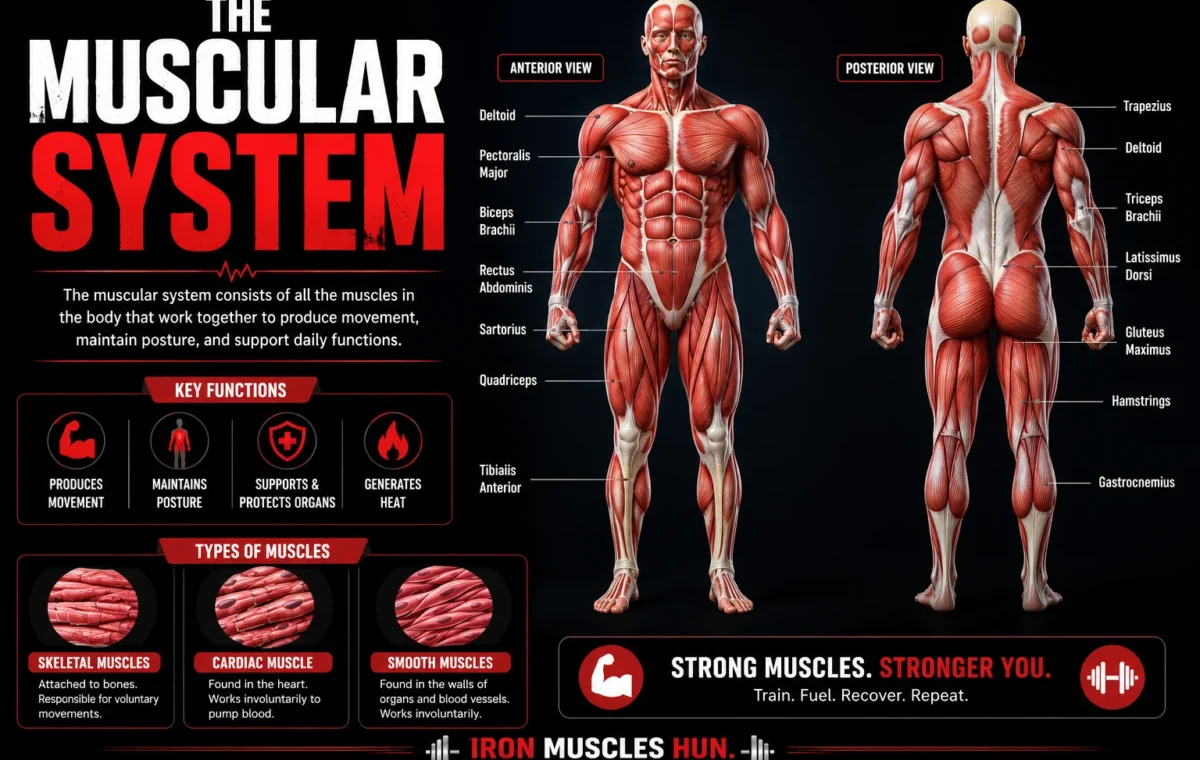
The muscular system is the body’s network of muscles that allows you to move, maintain posture, breathe, and perform countless automatic functions. It includes skeletal, cardiac, and smooth muscles, each with a specific role in keeping your body healthy and functioning properly.
- Quick Answer
- 1. Produces Body Movement
- 2. Maintains Posture
- 3. Stabilizes Joints
- 4. Generates Body Heat
- 5. Supports Internal Organ Function
- 1. Skeletal Muscle
- Main Functions
- 2. Cardiac Muscle
- 3. Smooth Muscle
- Chest Muscles (Pectorals)
- Back Muscles
- Shoulder Muscles (Deltoids)
- Arm Muscles
- Biceps
- Triceps
- Core Muscles
- Leg Muscles
- Quadriceps
- Hamstrings
- Gluteal Muscles
- Calf Muscles
- Skeletal System
- Nervous System
- Circulatory System
- Respiratory System
- Exercise Regularly
- Eat Enough Protein
- Stay Hydrated
- Prioritize Sleep
- Warm Up and Cool Down
- Avoid Overtraining
- What is the muscular system?
- What are the three types of muscles?
- How many muscles are in the human body?
- Why is the muscular system important?
- How can I keep my muscles healthy?
- Do muscles work without bones?
From taking your first step in the morning to your heart beating while you sleep, the muscular system works every second of your life. Understanding how it functions can help you appreciate the importance of exercise, nutrition, and overall muscle health.
Whether you’re studying anatomy, starting a fitness journey, or simply curious about your body, this guide explains the muscular system in simple, easy-to-understand language. Fore more insights read here :- are muscles organs and athletic muscular build.
Quick Answer
| Question | Answer |
|---|---|
| What is the muscular system? | The body’s system of muscles that enables movement and supports vital body functions. |
| How many muscle types are there? | Three: skeletal, cardiac, and smooth muscle. |
| Main job | Movement, posture, circulation, breathing, and heat production. |
| Controlled voluntarily? | Skeletal muscles are voluntary; cardiac and smooth muscles are involuntary. |
What Is the Muscular System?
The muscular system is one of the major organ systems in the human body. It consists of more than 600 muscles that work together to produce movement, stabilize joints, protect organs, and maintain posture.
Muscles do much more than move your arms and legs. They also help your heart pump blood, move food through your digestive tract, regulate blood vessel diameter, and assist with breathing.
The muscular system works closely with the:
- Skeletal system
- Nervous system
- Circulatory system
- Respiratory system
Together, these systems allow your body to perform both voluntary and involuntary activities every day.
Main Functions of the Muscular System
The muscular system performs several essential functions that keep your body alive and active.
1. Produces Body Movement
Movement is the muscular system’s most obvious function.
Muscles contract and pull on bones to create actions such as:
- Walking
- Running
- Jumping
- Sitting
- Standing
- Lifting
- Smiling
- Writing
Every voluntary movement depends on healthy skeletal muscles.
2. Maintains Posture
Even when you’re standing still, your muscles are working.
Muscles continuously make small adjustments that help you:
- Stand upright
- Sit comfortably
- Balance your body
- Support your spine
Without these constant contractions, maintaining posture would be impossible.
3. Stabilizes Joints
Muscles surround many joints throughout the body.
Strong muscles help stabilize:
- Knees
- Shoulders
- Hips
- Ankles
- Elbows
This stability reduces the risk of injury during everyday movement and exercise.
4. Generates Body Heat
Whenever muscles contract, they produce heat as a natural byproduct.
This heat helps maintain your normal body temperature, especially in cold environments.
Shivering is an example of rapid muscle contractions that generate additional body heat.
5. Supports Internal Organ Function
Not all muscles move your body.
Some muscles help:
- Pump blood
- Move food through digestion
- Empty the bladder
- Control breathing
- Regulate blood flow
These automatic actions happen without conscious effort.
The Three Types of Muscles
The muscular system contains three distinct types of muscle tissue, each with unique characteristics.
1. Skeletal Muscle
Skeletal muscles attach to bones through tendons.
They are voluntary muscles, meaning you control them consciously.
Examples include:
- Biceps
- Triceps
- Quadriceps
- Hamstrings
- Deltoids
- Calf muscles
- Abdominal muscles
Main Functions
- Walking
- Running
- Lifting
- Jumping
- Maintaining posture
- Facial expressions
These muscles become stronger with regular resistance training.
2. Cardiac Muscle
Cardiac muscle exists only in the heart.
Its job is simple but essential:
- Pump blood throughout the body
- Deliver oxygen
- Supply nutrients
- Remove waste products
Unlike skeletal muscles, cardiac muscle contracts automatically throughout life.
3. Smooth Muscle
Smooth muscle is found inside many internal organs.
Examples include:
- Stomach
- Intestines
- Blood vessels
- Bladder
- Airways
- Uterus
Smooth muscles perform automatic functions such as:
- Digestion
- Blood pressure regulation
- Moving food
- Emptying the bladder
These muscles work continuously without conscious control.
Comparison of the Three Muscle Types
| Feature | Skeletal Muscle | Cardiac Muscle | Smooth Muscle |
|---|---|---|---|
| Control | Voluntary | Involuntary | Involuntary |
| Location | Attached to bones | Heart | Internal organs |
| Appearance | Striated | Striated | Non-striated |
| Function | Body movement | Pumps blood | Controls organs |
| Fatigue | Can tire | Highly fatigue-resistant | Slow, sustained contractions |
How the Muscular System Works
The muscular system works by converting nerve signals into movement.
Here’s a simple breakdown:
- Your brain sends an electrical signal.
- The signal travels through nerves.
- Muscle fibers receive the message.
- Proteins inside the muscle fibers slide together.
- The muscle contracts.
- Tendons pull on bones.
- Your body moves.
This process happens in milliseconds and repeats thousands of times every day.
Muscles also rely on a constant supply of:
- Oxygen
- Water
- Glucose
- Amino acids
- Vitamins and minerals
Without these nutrients, muscles cannot function efficiently or recover properly.
Major Muscle Groups in the Human Body
Although the human body contains more than 600 muscles, several large muscle groups perform most everyday movements and are commonly targeted during exercise.
Chest Muscles (Pectorals)
The chest muscles help you:
- Push objects
- Lift your arms
- Perform push-ups and bench presses
- Stabilize the shoulder joint
These muscles play an important role in upper-body strength.
Back Muscles
The back contains several major muscles, including the latissimus dorsi, trapezius, and rhomboids.
Their main functions include:
- Pulling movements
- Supporting the spine
- Maintaining good posture
- Rotating the shoulders
Strong back muscles help reduce the risk of poor posture and back discomfort.
Shoulder Muscles (Deltoids)
The deltoid muscles surround the shoulder joint.
They allow you to:
- Raise your arms
- Reach overhead
- Push and pull
- Rotate your shoulders
Healthy shoulder muscles improve both strength and mobility.
Arm Muscles
Biceps
Located at the front of the upper arm.
Main functions:
- Bend the elbow
- Rotate the forearm
- Lift objects
Triceps
Located at the back of the upper arm.
Main functions:
- Straighten the elbow
- Push movements
- Stabilize the arm
Core Muscles
The core includes:
- Rectus abdominis
- Internal and external obliques
- Transverse abdominis
- Lower back muscles
These muscles help with:
- Balance
- Stability
- Posture
- Protecting the spine
A strong core supports nearly every movement you make.
Leg Muscles
The legs contain some of the body’s largest and strongest muscles.
Quadriceps
Located on the front of the thigh.
Functions:
- Straighten the knee
- Walk
- Run
- Jump
Hamstrings
Located on the back of the thigh.
Functions:
- Bend the knee
- Sprint
- Climb stairs
Gluteal Muscles
Often called the glutes.
Functions:
- Hip movement
- Standing
- Walking
- Running
- Maintaining balance
Calf Muscles
Located in the lower leg.
Functions:
- Walking
- Running
- Jumping
- Standing on your toes
Muscle Anatomy and Structure
Each muscle is much more than a simple bundle of tissue. It is an organ made of several structures that work together.
| Structure | Function |
|---|---|
| Muscle | The complete muscle organ. |
| Fascicle | A bundle of muscle fibers. |
| Muscle Fiber | A single muscle cell. |
| Myofibril | Contains the proteins responsible for contraction. |
| Sarcomere | The smallest functional unit of muscle contraction. |
| Tendon | Connects muscle to bone. |
Every movement begins when millions of tiny muscle fibers contract together.
How Muscles Grow
Muscles become stronger by adapting to physical activity.
During resistance training:
- Muscle fibers experience small amounts of stress.
- Tiny microscopic tears occur.
- The body repairs these fibers.
- The repaired fibers become stronger and often slightly larger.
This process is known as muscle hypertrophy.
Healthy muscle growth also depends on:
- Progressive strength training
- Enough dietary protein
- Adequate sleep
- Proper hydration
- Recovery between workouts
Consistency over time is more effective than occasional intense exercise.
How the Muscular System Works with Other Body Systems
The muscular system cannot function on its own. It relies on several other body systems.
Skeletal System
Bones provide structure while muscles pull on them to create movement.
Together they form the musculoskeletal system.
Nervous System
The nervous system sends electrical signals telling muscles when to contract and relax.
Without these signals, movement would not occur.
Circulatory System
Blood vessels deliver:
- Oxygen
- Nutrients
- Hormones
They also remove waste products from muscles during activity.
Respiratory System
The lungs provide oxygen needed for muscle contractions.
During exercise, breathing becomes faster so muscles receive more oxygen.
Common Disorders of the Muscular System
Like every body system, the muscular system can develop injuries or medical conditions.
| Condition | Description |
|---|---|
| Muscle strain | Overstretching or tearing of muscle fibers. |
| Muscle cramps | Sudden painful muscle contractions. |
| Tendinitis | Inflammation of a tendon connecting muscle to bone. |
| Muscular dystrophy | A group of inherited diseases that cause progressive muscle weakness. |
| Muscle atrophy | Loss of muscle size due to inactivity, aging, or illness. |
Many mild muscle problems improve with rest, hydration, and gradual return to activity. Persistent pain or weakness should be evaluated by a healthcare professional.
How to Keep Your Muscular System Healthy
Healthy muscles support mobility, strength, and overall quality of life.
Exercise Regularly
Aim for a mix of:
- Strength training
- Walking
- Swimming
- Cycling
- Flexibility exercises
Regular movement helps maintain muscle mass and joint health.
Eat Enough Protein
Protein supplies the amino acids your muscles need for repair and maintenance.
Good protein sources include:
- Chicken
- Fish
- Eggs
- Greek yogurt
- Beans
- Lentils
- Tofu
- Lean beef
Stay Hydrated
Water helps muscles function properly and supports normal muscle contractions.
Drink fluids consistently, especially during and after exercise.
Prioritize Sleep
Most muscle repair occurs while you sleep.
Adults should aim for 7–9 hours of quality sleep each night.
Warm Up and Cool Down
A proper warm-up prepares muscles for exercise, while cooling down helps your body recover afterward.
Both habits may reduce injury risk and improve flexibility.
Avoid Overtraining
Muscles need recovery time to repair and become stronger.
Include rest days in your routine and avoid training the same muscle groups intensely every day.
Interesting Facts About the Muscular System
- The human body contains more than 600 muscles.
- Skeletal muscles account for roughly 40% of an average adult’s body weight, though this varies among individuals.
- The gluteus maximus is the largest muscle in the body.
- The stapedius in the middle ear is the smallest skeletal muscle.
- The heart is made of specialized cardiac muscle that works continuously throughout life.
- Muscles produce heat, helping regulate body temperature.
What is the muscular system?
The muscular system is one of the major body systems responsible for movement, posture, stability, and many automatic functions. It includes skeletal, cardiac, and smooth muscles, which work together with the nervous and skeletal systems to keep your body functioning.
What are the three types of muscles?
The human body has three types of muscle tissue:
- Skeletal muscle – Moves your body and is under voluntary control.
- Cardiac muscle – Found only in the heart and pumps blood continuously.
- Smooth muscle – Located in internal organs and blood vessels, controlling involuntary functions such as digestion and blood flow.
How many muscles are in the human body?
The human body contains more than 600 muscles, with many anatomy references listing around 650 named skeletal muscles. Together, they allow movement, support posture, protect joints, and help regulate body temperature.
Why is the muscular system important?
The muscular system is essential because it allows you to move, maintain balance, breathe, circulate blood, digest food, and perform countless everyday tasks. Without healthy muscles, even simple actions such as walking or standing would be difficult.
How can I keep my muscles healthy?
You can support muscle health by:
- Exercising regularly
- Eating enough protein
- Staying hydrated
- Getting 7–9 hours of sleep
- Stretching before and after exercise
- Allowing muscles enough time to recover
These habits help maintain strength, flexibility, and long-term muscle function.
Do muscles work without bones?
Yes. While skeletal muscles rely on bones for movement, cardiac muscle keeps the heart beating, and smooth muscle moves food through the digestive system, controls blood vessels, and supports many automatic body functions without attaching to bones.
Key Takeaways
| Topic | Summary |
|---|---|
| Muscular System | A body system made up of skeletal, cardiac, and smooth muscles. |
| Main Functions | Movement, posture, stability, heat production, and organ function. |
| Muscle Types | Skeletal (voluntary), cardiac (heart), smooth (internal organs). |
| Works With | Skeletal, nervous, circulatory, and respiratory systems. |
| Healthy Habits | Exercise, balanced nutrition, hydration, sleep, and recovery. |
Final Thoughts
The muscular system is one of the most important systems in the human body. It allows you to move, maintain posture, breathe, circulate blood, digest food, and carry out hundreds of essential functions every day. Although many people think muscles are only for strength or exercise, they are involved in nearly every action your body performs.
Learning how the muscular system works gives you a better understanding of your overall health. By staying active, eating nutritious foods, drinking enough water, and allowing your body time to recover, you can help keep your muscles strong and functioning well throughout your life.