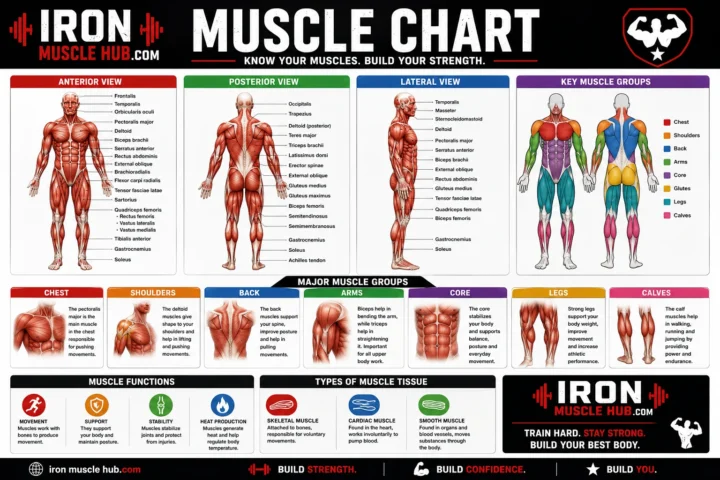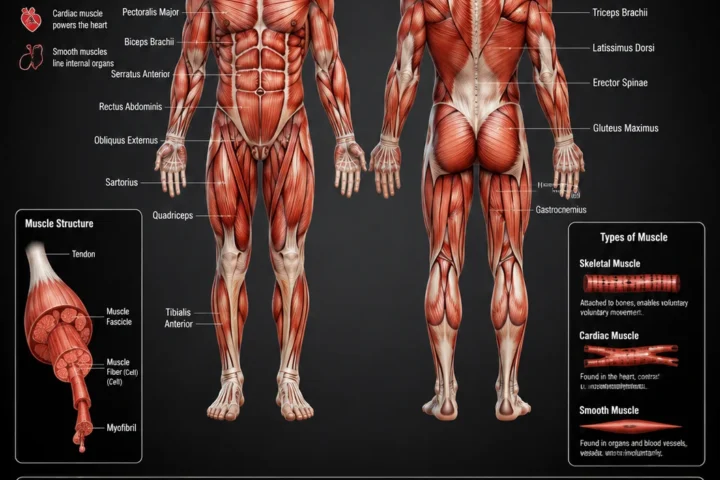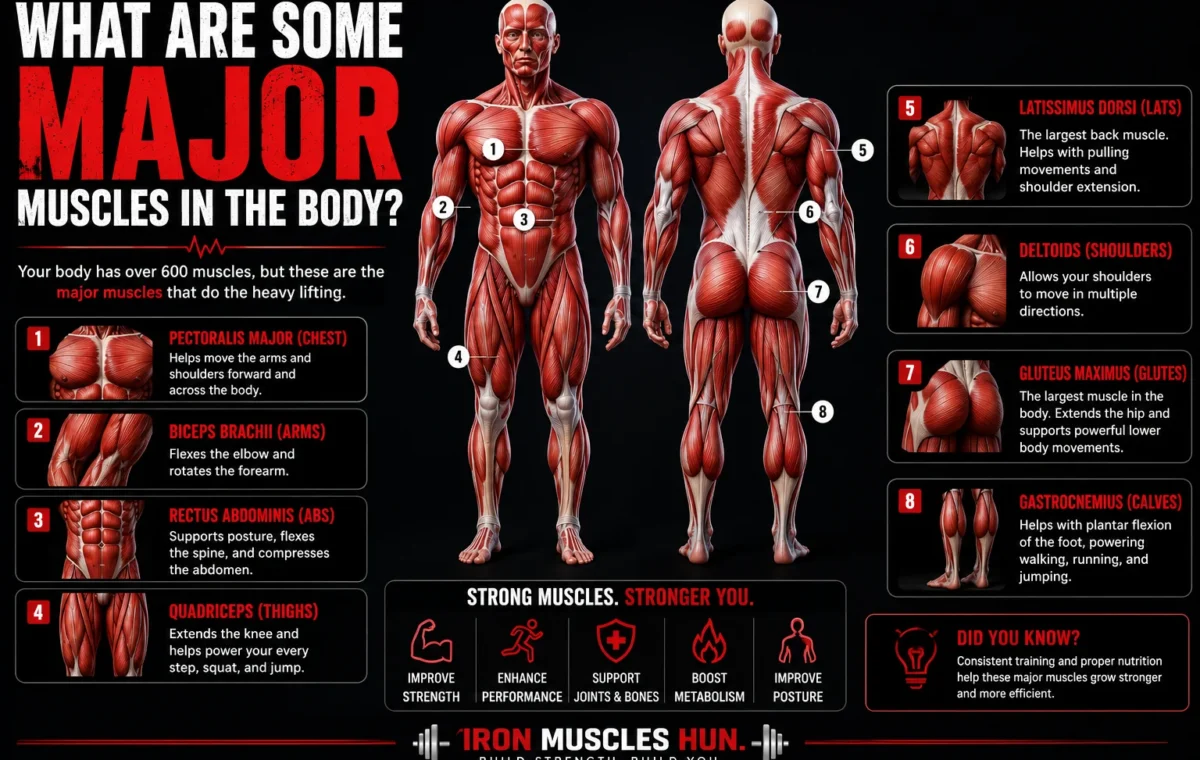
The human body has more than 600 muscles, and some of the most important ones are grouped into major areas such as the chest, back, shoulders, arms, core, and legs. These muscles help you move, maintain posture, protect joints, and perform everyday activities like walking, lifting, and breathing.
- Pectoralis Major
- Pectoralis Minor
- Latissimus Dorsi (Lats)
- Trapezius (Traps)
- Rhomboid Muscles
- Biceps
- Triceps
- Forearm Muscles
- Rectus Abdominis (Abdominal Muscles)
- Oblique Muscles
- Transverse Abdominis
- Gluteus Maximus
- Gluteus Medius and Minimus
- Quadriceps
- Hamstrings
- Calf Muscles
- Gluteus Maximus
- Quadriceps
- Latissimus Dorsi
- Mistake 1: Only Training Visible Muscles
- Mistake 2: Ignoring Leg Training
- Mistake 3: Thinking Bigger Muscles Always Mean Better Fitness
- Exercise Regularly
- Eat Enough Nutrients
- Recover Properly
- Use Proper Exercise Technique
- What are some major muscles in the body?
- What is the largest muscle in the human body?
- How many muscles are in the human body?
- Which muscles are most important for daily activities?
- What are the three main types of muscles?
- Can you strengthen all major muscle groups?
Understanding what are some major muscles in the body can help beginners learn basic anatomy, improve exercise knowledge, and understand how strength training affects different areas of the body.
From the powerful muscles in your legs to the muscles that help you move your arms and stabilize your spine, every major muscle group has a unique role. For more insights read here :- lean exercises and how do you get lean.
Quick Answer: Major Muscles in the Body
| Muscle Group | Major Muscles | Main Function |
|---|---|---|
| Chest | Pectoralis major, pectoralis minor | Pushing movements and arm control |
| Back | Latissimus dorsi, trapezius, rhomboids | Pulling movements and posture |
| Shoulders | Deltoids | Arm movement and shoulder stability |
| Arms | Biceps, triceps, forearm muscles | Bending, extending, and gripping |
| Core | Rectus abdominis, obliques, transverse abdominis | Balance and body stability |
| Legs | Quadriceps, hamstrings, glutes, calves | Walking, running, and jumping |
What Are Major Muscles in the Body?
Major muscles are the larger muscle groups that contribute significantly to movement and strength. While every muscle in your body has a purpose, certain groups perform many of the movements you use daily.
The major muscle groups include:
- Chest muscles
- Back muscles
- Shoulder muscles
- Arm muscles
- Core muscles
- Hip muscles
- Leg muscles
These muscles work together with your bones, joints, and nervous system to create coordinated movement.
Chest Muscles (Pectoral Muscles)
The chest muscles are located on the front of your upper body and are commonly called the pectorals.
The two main chest muscles are:
Pectoralis Major
The pectoralis major is the larger chest muscle.
It helps with:
- Pushing objects away from your body
- Moving your arms across your chest
- Rotating your upper arm
- Supporting shoulder movement
Common exercises that target this muscle include:
- Push-ups
- Bench presses
- Chest presses
Pectoralis Minor
The pectoralis minor sits underneath the pectoralis major.
Its functions include:
- Helping move the shoulder blade
- Supporting shoulder stability
- Assisting upper-body movement
Although smaller, it plays an important role in proper shoulder function.
Back Muscles
The back contains some of the body’s largest and strongest muscles. These muscles support posture and allow pulling movements.
Latissimus Dorsi (Lats)
The latissimus dorsi is a large muscle covering much of the middle and lower back.
It helps with:
- Pulling movements
- Arm rotation
- Climbing movements
- Shoulder extension
Exercises that work the lats include:
- Pull-ups
- Lat pulldowns
- Rows
Trapezius (Traps)
The trapezius extends across the upper back and neck area.
Its functions include:
- Moving the shoulder blades
- Supporting neck movement
- Maintaining posture
The traps are involved in many upper-body movements.
Rhomboid Muscles
The rhomboids are located between the shoulder blades.
They help:
- Pull the shoulder blades together
- Maintain upright posture
- Stabilize the shoulders
Strong rhomboids support healthy upper-back movement.
Shoulder Muscles (Deltoids)
The shoulder muscles are mainly made up of the deltoid muscles.
The deltoid has three sections:
| Section | Location | Function |
|---|---|---|
| Front deltoid | Front shoulder | Raises arm forward |
| Side deltoid | Outer shoulder | Raises arm sideways |
| Rear deltoid | Back shoulder | Moves arm backward |
The deltoids allow you to:
- Lift your arms
- Rotate your shoulders
- Perform pushing and pulling movements
Arm Muscles
The arms contain several important muscles responsible for movement and strength.
Biceps
The biceps are located on the front of the upper arm.
Main functions:
- Bending the elbow
- Turning the palm upward
- Helping lift objects
Common exercises:
- Bicep curls
- Chin-ups
Triceps
The triceps are located on the back of the upper arm.
They are responsible for:
- Straightening the elbow
- Pushing movements
- Supporting arm strength
Examples of exercises:
- Push-ups
- Dips
- Tricep extensions
The triceps actually make up a large portion of upper-arm muscle mass.
Forearm Muscles
The forearms contain many smaller muscles that control:
- Grip strength
- Wrist movement
- Finger movement
They are important for activities like:
- Carrying objects
- Writing
- Using tools
- Sports activities
Core Muscles (Midsection Muscles)
The core is a group of muscles around your abdomen, lower back, and pelvis. Many people think the core only means the “abs,” but it includes several muscles that work together to stabilize your body.
A strong core helps with:
- Balance
- Posture
- Spinal support
- Everyday movement
- Sports performance
Rectus Abdominis (Abdominal Muscles)
The rectus abdominis is the muscle commonly known as the “six-pack” muscle.
Its functions include:
- Bending the spine forward
- Supporting posture
- Helping stabilize the pelvis
It works during movements such as:
- Sit-ups
- Crunches
- Lifting movements
Oblique Muscles
The obliques are located on the sides of your abdomen.
There are two main groups:
- External obliques
- Internal obliques
They help with:
- Twisting movements
- Side bending
- Core stability
Activities like throwing, rotating, and changing direction rely on strong oblique muscles.
Transverse Abdominis
The transverse abdominis is a deeper abdominal muscle.
Its main role is:
- Stabilizing the spine
- Supporting the abdominal wall
- Helping control movement
It acts like a natural support belt around your midsection.
Hip and Glute Muscles
The hip area contains powerful muscles responsible for movement and stability.
Gluteus Maximus
The gluteus maximus is one of the largest and strongest muscles in the human body.
It helps with:
- Standing up
- Walking
- Running
- Jumping
- Hip extension
Exercises that target the glutes include:
- Squats
- Lunges
- Hip thrusts
Gluteus Medius and Minimus
These smaller glute muscles support:
- Hip stability
- Balance
- Side-to-side movement
They are especially important during walking and running because they help control the position of the hips.
Leg Muscles
The legs contain some of the strongest muscles because they support body weight and allow movement.
Quadriceps
The quadriceps are located at the front of the thigh.
They include four muscles that work together.
Main functions:
- Straightening the knee
- Walking
- Running
- Jumping
- Squatting
The quadriceps are heavily used in many daily activities.
Hamstrings
The hamstrings are located at the back of the thigh.
They help with:
- Bending the knee
- Moving the hips
- Running and jumping movements
Strong hamstrings help balance the strength of the front and back of the legs.
Calf Muscles
The main calf muscles are:
- Gastrocnemius
- Soleus
They help with:
- Walking
- Running
- Jumping
- Standing on your toes
The calf muscles also help push your body forward during movement.
Major Muscle Groups Comparison Table
| Muscle Group | Main Muscles | Primary Role |
|---|---|---|
| Chest | Pectoralis major, pectoralis minor | Pushing and arm movement |
| Back | Latissimus dorsi, trapezius, rhomboids | Pulling and posture |
| Shoulders | Deltoids | Arm lifting and stability |
| Arms | Biceps, triceps, forearms | Arm movement and grip |
| Core | Abs, obliques, transverse abdominis | Stability and balance |
| Glutes | Gluteus maximus, medius, minimus | Hip movement and power |
| Legs | Quadriceps, hamstrings, calves | Walking, running, jumping |
What Are the Largest Muscles in the Body?
Some muscles are larger because they perform powerful movements and support body weight.
Gluteus Maximus
The gluteus maximus is generally considered the largest muscle in the human body.
It creates force for:
- Standing
- Climbing stairs
- Sprinting
- Jumping
Quadriceps
The quadriceps are among the largest muscle groups.
They are essential for:
- Walking
- Squatting
- Rising from a chair
- Athletic movements
Latissimus Dorsi
The latissimus dorsi is one of the largest muscles in the upper body.
It provides strength for pulling movements and contributes to shoulder motion.
How Major Muscles Work Together
Muscles rarely work alone. Most movements require multiple muscle groups working together.
For example, during a squat:
- The quadriceps help straighten the knees.
- The glutes help extend the hips.
- The core muscles stabilize the body.
- The back muscles maintain posture.
- The nervous system coordinates the movement.
This teamwork allows your body to perform smooth and powerful actions.
Common Mistakes About Major Muscles
Mistake 1: Only Training Visible Muscles
Many beginners focus only on:
- Chest
- Arms
- Abs
However, the back, legs, and glutes are equally important for strength and balance.
Mistake 2: Ignoring Leg Training
Some people avoid leg exercises because they are challenging.
Strong legs support:
- Better movement
- Athletic ability
- Overall body strength
Mistake 3: Thinking Bigger Muscles Always Mean Better Fitness
Muscle size is only one part of fitness.
Other important factors include:
- Strength
- Flexibility
- Endurance
- Coordination
- Mobility
How to Keep Major Muscles Healthy
Healthy muscles require consistent care.
Exercise Regularly
A balanced routine should include:
- Strength training
- Cardiovascular activity
- Flexibility work
- Mobility exercises
Eat Enough Nutrients
Muscles need:
- Protein for repair
- Carbohydrates for energy
- Healthy fats for normal body functions
- Vitamins and minerals for overall health
Recover Properly
Recovery helps muscles repair and adapt.
Good recovery habits include:
- Sleeping enough
- Taking rest days
- Staying hydrated
- Managing exercise intensity
Use Proper Exercise Technique
Correct form helps:
- Improve results
- Reduce unnecessary strain
- Protect joints and muscles
Learning movements properly is more important than lifting heavier weights.
What are some major muscles in the body?
Some major muscles in the body include the pectoralis major (chest), latissimus dorsi (back), deltoids (shoulders), biceps, triceps, abdominal muscles, gluteus maximus, quadriceps, hamstrings, and calf muscles. These major muscle groups help with movement, posture, balance, and everyday activities.
What is the largest muscle in the human body?
The gluteus maximus, located in the buttocks, is generally recognized as the largest muscle in the human body. It plays an important role in hip movement, standing upright, climbing stairs, running, and powerful movements that require hip extension.
How many muscles are in the human body?
The human body contains more than 600 muscles. These muscles include skeletal muscles that create movement, cardiac muscle that pumps blood through the heart, and smooth muscle that controls automatic functions inside organs.
Which muscles are most important for daily activities?
Many muscles are important for everyday life, including the leg muscles, core muscles, back muscles, shoulder muscles, and arm muscles. Your legs help you walk and stand, your core supports balance, and your upper-body muscles help you lift, push, pull, and carry objects.
What are the three main types of muscles?
The three main types of muscle tissue are:
- Skeletal muscle: Attached to bones and responsible for voluntary movement.
- Cardiac muscle: Found only in the heart and responsible for pumping blood.
- Smooth muscle: Found in organs and blood vessels, controlling automatic processes.
Can you strengthen all major muscle groups?
Yes. A balanced exercise routine can strengthen major muscle groups through activities such as resistance training, bodyweight exercises, and functional movements. Training different areas of the body helps create better strength, stability, and movement balance.
Key Takeaways
| Topic | Important Point |
|---|---|
| Major muscle groups | Chest, back, shoulders, arms, core, glutes, and legs |
| Largest muscle | Gluteus maximus |
| Main purpose of muscles | Movement, posture, stability, and body functions |
| Number of muscles | More than 600 muscles in the human body |
| Best muscle care habits | Exercise, nutrition, hydration, sleep, and recovery |
Why Learning About Major Muscles Matters
Knowing what are some major muscles in the body gives you a better understanding of how your body moves and responds to exercise.
Every activity you do, from walking to lifting groceries, depends on different muscle groups working together. Strong muscles can support better movement, balance, and physical independence throughout life.
You don’t need to be an athlete to care about your muscles. Building healthy habits such as regular movement, proper nutrition, and enough recovery can help maintain muscle function at any age.
Final Thoughts
Understanding what are some major muscles in the body helps you see how complex and powerful the human body really is. Your muscles do far more than create movement. They support your posture, protect your joints, help you maintain balance, generate heat, and allow you to complete everyday activities.
The major muscle groups, including the chest, back, shoulders, arms, core, glutes, and legs, all work together as a connected system. A weakness in one area can affect how your body moves and performs.
Taking care of your muscles does not require extreme workouts. Consistent habits like regular strength training, staying active, eating a balanced diet, drinking enough water, and getting proper rest can support healthy muscles for years to come.
Whether you’re learning anatomy, improving your fitness knowledge, or starting your first workout routine, understanding your major muscles is a valuable step toward better body awareness and long-term health.