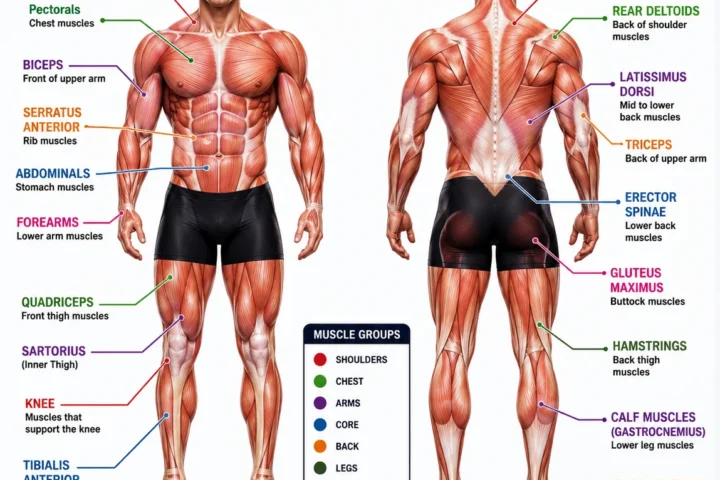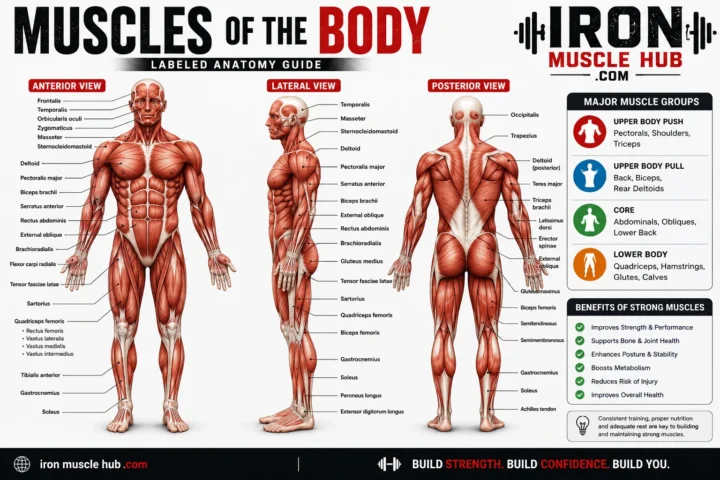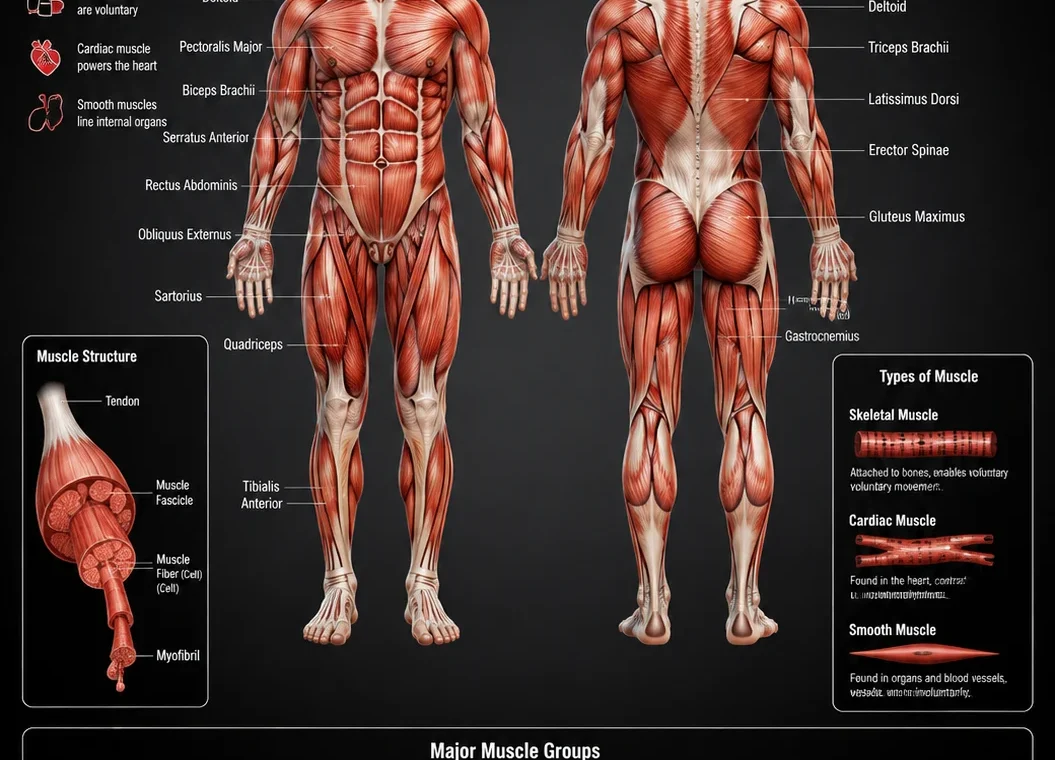
Picture of Muscular System is one of the easiest ways to understand how the muscles in your body are arranged and how they work together. A labeled muscular system diagram shows the location of the major muscles responsible for movement, posture, breathing, and everyday activities.
- Quick Answer
- Front View (Anterior)
- Back View (Posterior)
- 1. Deltoid
- 2. Pectoralis Major
- 3. Biceps Brachii
- 4. Triceps Brachii
- 5. Rectus Abdominis
- 6. Latissimus Dorsi
- 7. Trapezius
- 8. Gluteus Maximus
- 9. Quadriceps
- 10. Hamstrings
- 11. Gastrocnemius
- Why Learning Muscle Anatomy Matters
- How Muscles Work Together
- Head and Neck
- Shoulders
- Chest
- Back
- Arms
- Core
- Legs
- Thinking Every Muscle Is Voluntary
- Confusing Tendons With Muscles
- Believing Bigger Means Stronger
- Ignoring Smaller Stabilizing Muscles
- What is a picture of the muscular system?
- How many muscles are in the human body?
- What are the three types of muscles?
- Which muscle is the largest in the body?
- Why is learning muscle anatomy important?
Whether you’re a student, fitness beginner, personal trainer, or simply curious about human anatomy, learning from a muscular system picture makes it much easier to identify muscles and understand their functions. This guide explains the major muscle groups, what they do, and how to read a muscular system diagram in simple language. For more insights read here :- lean and muscle body and how do i build muscle quickly .
Quick Answer
| Feature | Description |
|---|---|
| System Name | Muscular System |
| Total Muscles | Over 600 skeletal muscles |
| Main Function | Produces movement, maintains posture, generates heat |
| Three Muscle Types | Skeletal, Cardiac, Smooth |
| Controlled By | Nervous System |
| Largest Muscle | Gluteus Maximus |
| Strongest Muscle | Masseter (jaw muscle) |
| Smallest Skeletal Muscle | Stapedius (inside the ear) |
Picture of Muscular System
The muscular system is a network of muscles that allows your body to move, maintain balance, protect organs, and perform essential functions like breathing and circulation.
Your muscles work closely with your:
- Bones
- Joints
- Tendons
- Nervous system
- Cardiovascular system
Without muscles, even simple actions such as walking, smiling, or lifting a cup would be impossible.
Main Types of Muscles
The human body contains three different types of muscles, each serving a unique purpose.
| Muscle Type | Location | Voluntary? | Function |
|---|---|---|---|
| Skeletal Muscle | Attached to bones | Yes | Body movement |
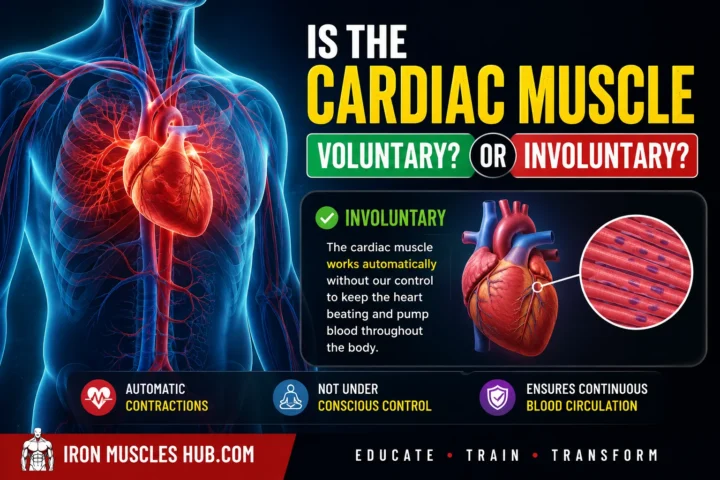
| Cardiac Muscle | Heart | No | Pumps blood |
| Smooth Muscle | Internal organs | No | Moves food, controls blood vessels |
Although most muscular system pictures focus on skeletal muscles, the heart and internal organs also contain specialized muscle tissue.
Understanding a Picture of the Muscular System
Most anatomy illustrations display the body from two different views:
Front View (Anterior)
This shows muscles located on the front of the body, including:
- Deltoids
- Pectoralis Major
- Biceps Brachii
- Rectus Abdominis
- Quadriceps
- Tibialis Anterior
These muscles are mainly responsible for pushing, lifting, bending, and stabilizing movements.
Back View (Posterior)
The back view highlights muscles such as:
- Trapezius
- Latissimus Dorsi
- Triceps Brachii
- Erector Spinae
- Gluteus Maximus
- Hamstrings
- Gastrocnemius
These muscles help with pulling, posture, balance, and powerful lower-body movements.
Major Muscles in a Labeled Muscular System Picture
1. Deltoid
Location: Shoulder
Function:
- Raises the arm
- Rotates the shoulder
- Stabilizes the shoulder joint
The deltoid gives the shoulder its rounded appearance.
2. Pectoralis Major
Location: Chest
Function:
- Pushes objects
- Rotates the arm inward
- Helps move the shoulder
It is one of the largest upper-body muscles.
3. Biceps Brachii
Location: Front of upper arm
Function:
- Bends the elbow
- Rotates the forearm
- Assists pulling movements
The biceps are heavily used during exercises like curls and pull-ups.
4. Triceps Brachii
Location: Back of upper arm
Function:
- Straightens the elbow
- Helps with pushing exercises
The triceps actually make up a larger portion of the upper arm than the biceps.
5. Rectus Abdominis
Often called the six-pack muscle, this muscle:
- Supports posture
- Protects internal organs
- Bends the spine forward
6. Latissimus Dorsi
Known as the “lats,” these broad back muscles:
- Pull the arms downward
- Improve posture
- Create a wider upper body appearance
They are heavily activated during rows and pull-ups.
7. Trapezius
The trapezius stretches from the neck to the middle of the back.
Functions include:
- Shoulder movement
- Neck support
- Posture control
8. Gluteus Maximus
The gluteus maximus is the body’s largest muscle.
It helps with:
- Standing
- Running
- Climbing stairs
- Hip extension
9. Quadriceps
Located on the front of the thigh, the quadriceps consist of four muscles.
Their primary job is to straighten the knee and assist with walking, jumping, and squatting.
10. Hamstrings
The hamstrings are found on the back of the thigh.
They:
- Bend the knee
- Extend the hip
- Support sprinting and running
11. Gastrocnemius
This large calf muscle helps:
- Walking
- Running
- Jumping
- Standing on your toes
Why Learning Muscle Anatomy Matters
Understanding muscle anatomy offers many benefits.
It helps you:
- Exercise with better form
- Reduce injury risk
- Improve posture
- Understand how movements work
- Communicate better with fitness professionals and healthcare providers
For athletes and gym beginners alike, recognizing muscle groups can make workouts more effective.
How Muscles Work Together
Although anatomy diagrams label muscles individually, your body rarely uses just one muscle at a time. Most movements involve several muscles working together in coordinated patterns.
For example:
| Activity | Primary Muscles Used |
|---|---|
| Walking | Gluteus maximus, hamstrings, quadriceps, calves |
| Running | Glutes, quadriceps, hamstrings, calves, core |
| Push-Up | Chest, shoulders, triceps, abdominals |
| Pull-Up | Latissimus dorsi, biceps, forearms, shoulders |
| Squat | Quadriceps, glutes, hamstrings, calves |
| Lifting a Box | Back muscles, core, legs, shoulders |
This teamwork allows your body to move efficiently while maintaining balance and stability.
How the Muscular System Works With Other Body Systems
The muscular system doesn’t work alone. It relies on several other body systems to function properly.
| Body System | How It Helps the Muscular System |
|---|---|
| Skeletal System | Provides attachment points and support for muscles |
| Nervous System | Sends signals that tell muscles when to contract |
| Cardiovascular System | Delivers oxygen and nutrients to muscle tissue |
| Respiratory System | Supplies oxygen and removes carbon dioxide |
| Digestive System | Provides nutrients needed for muscle growth and repair |
| Endocrine System | Releases hormones that influence muscle development |
Together, these systems allow your body to perform everything from breathing to running.
Common Muscle Groups by Body Region
Head and Neck
Major muscles include:
- Masseter
- Temporalis
- Sternocleidomastoid
These muscles help you chew, speak, swallow, and rotate your head.
Shoulders
Primary muscles:
- Deltoid
- Rotator cuff muscles
These provide shoulder stability and allow movement in multiple directions.
Chest
Main muscle:
- Pectoralis major
Functions include pushing movements and shoulder motion.
Back
Major muscles include:
- Trapezius
- Latissimus dorsi
- Rhomboids
- Erector spinae
These muscles help maintain posture and support pulling movements.
Arms
Important muscles:
- Biceps brachii
- Triceps brachii
- Brachialis
- Forearm muscles
These muscles enable gripping, lifting, pushing, and pulling.
Core
The core consists of:
- Rectus abdominis
- External obliques
- Internal obliques
- Transverse abdominis
A strong core improves posture, balance, and overall movement.
Legs
Major muscles include:
- Quadriceps
- Hamstrings
- Gluteus maximus
- Gastrocnemius
- Soleus
- Tibialis anterior
These muscles generate most of the force used for walking, running, and jumping.
Tips for Reading a Muscular System Picture
If you’re studying muscle anatomy, follow these simple tips:
- Start with the largest muscles first.
- Learn the front (anterior) view before the back (posterior).
- Group muscles by body region.
- Compare muscle location with its function.
- Practice identifying muscles without looking at labels.
- Review diagrams regularly to improve memory.
Learning a few muscles each day is much easier than trying to memorize the entire body at once.
Common Mistakes Beginners Make
Many people misunderstand muscular anatomy. Here are a few common mistakes:
Thinking Every Muscle Is Voluntary
Only skeletal muscles are under conscious control. Cardiac and smooth muscles work automatically.
Confusing Tendons With Muscles
Muscles create movement, while tendons connect muscles to bones.
Believing Bigger Means Stronger
Muscle size doesn’t always equal strength. Training, technique, and nervous system efficiency also play important roles.
Ignoring Smaller Stabilizing Muscles
Small muscles around the shoulders, hips, and spine are essential for balance and injury prevention.
How to Keep Your Muscles Healthy
Healthy muscles support better movement and overall well-being.
Here are a few simple habits:
- Exercise regularly with both strength and cardio training.
- Eat enough protein from quality food sources.
- Stay hydrated throughout the day.
- Stretch to maintain flexibility.
- Sleep 7–9 hours each night to support recovery.
- Warm up before exercise and cool down afterward.
Small, consistent habits can help maintain muscle function as you age.
Frequently Asked Questions
What is a picture of the muscular system?
A picture of the muscular system is an anatomical illustration showing the location and names of the body’s major muscles. It helps students, healthcare professionals, and fitness enthusiasts understand muscle structure and function.
How many muscles are in the human body?
The human body contains more than 600 skeletal muscles, along with cardiac muscle in the heart and smooth muscle in internal organs.
What are the three types of muscles?
The three muscle types are:
- Skeletal muscle
- Cardiac muscle
- Smooth muscle
Each type performs different functions, from voluntary movement to pumping blood and moving food through the digestive tract.
Which muscle is the largest in the body?
The gluteus maximus is the largest muscle in the human body. It plays a key role in standing, climbing, running, and maintaining posture.
Why is learning muscle anatomy important?
Understanding muscle anatomy improves exercise technique, helps prevent injuries, supports rehabilitation, and makes it easier to understand how the body moves during everyday activities and sports.
Final Thoughts
A picture of the muscular system is much more than a labeled diagram—it’s a valuable learning tool that helps you understand how your body moves, maintains posture, and performs daily activities. By studying the major muscle groups and their functions, you’ll build a stronger foundation in anatomy, whether you’re preparing for exams, improving your fitness knowledge, or simply satisfying your curiosity.
Learning muscle anatomy takes time, so focus on one body region at a time, review labeled diagrams regularly, and connect each muscle to the movement it performs. With consistent practice, identifying muscles becomes much easier.