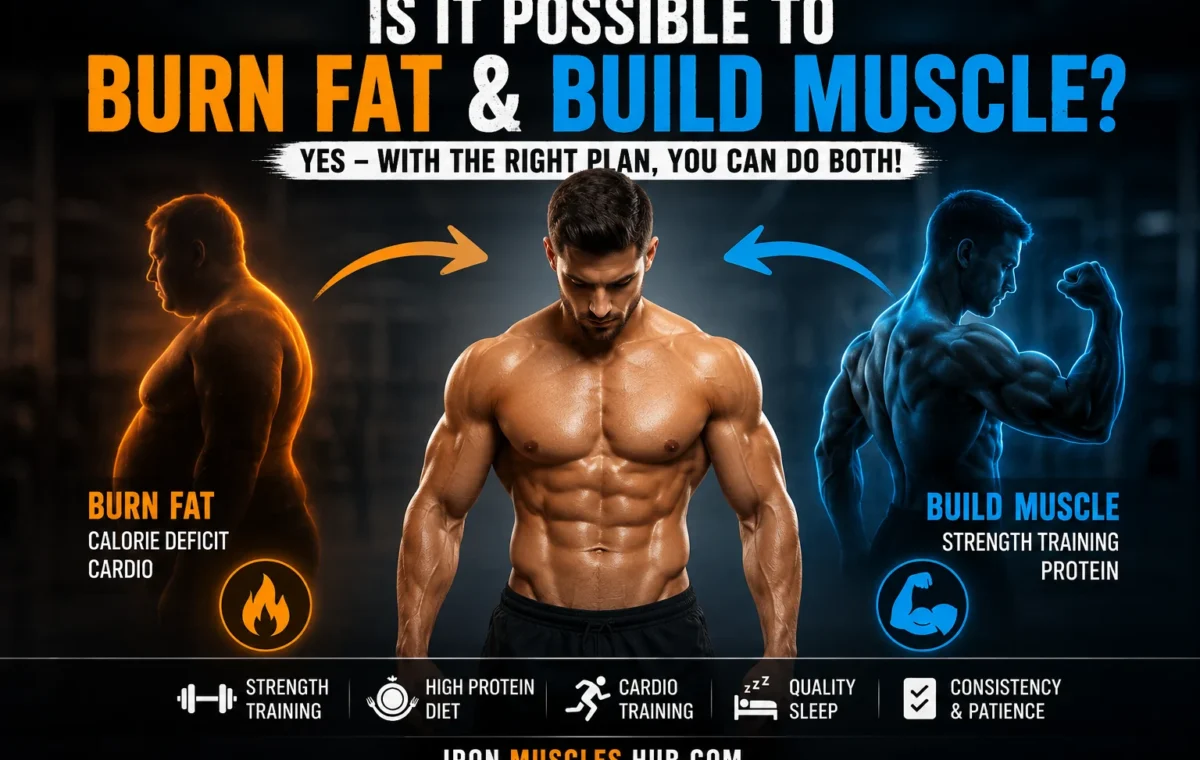
Yes. It is possible to lose body fat while building muscle at the same time, a process commonly called body recomposition. It tends to be easier for beginners, people returning to resistance training, and people carrying more body fat. It becomes harder as you become leaner and more experienced.
- Quick Answer
- is it possible to burn fat and build muscle
- Why It Can Work
- Who Is Most Likely to Build Muscle While Losing Fat?
- 1. Beginners
- 2. People Returning After a Training Break
- 3. People With More Body Fat to Lose
- 4. Beginners Who Previously Ate Very Little Protein
- When Is Body Recomposition Harder?
- How to Set Up Body Recomposition
- 1. Make Resistance Training Your Priority
- 2. Focus on Progressive Improvement
- 3. Eat Enough Protein
- 4. Don't Create an Extreme Calorie Deficit
- 5. Keep Cardio in Its Place
- Body Recomposition Comparison Table
- Worked Example: An 80 kg (176 lb) Beginner
- Protein
- Training
- Progress Tracking
- Common Mistakes → Why → Fix
- Mistake 1: Cutting Calories Too Hard
- Mistake 2: Doing Only Cardio
- Mistake 3: Treating Protein as Optional
- Mistake 4: Changing the Program Every Week
- Mistake 5: Only Watching the Scale
- Mistake 6: Expecting a Dramatic Transformation in a Few Weeks
- 30-Second Recomposition Self-Test
- Who Is This NOT For?
- How Do You Know If It's Working?
- Use a Simple Weekly Check-In
- What About Belly Fat?
- Does Building Muscle Help With Fat Loss?
- Frequently Asked Questions
- Can you lose fat and gain muscle at the same time?
- How much protein do you need to build muscle while losing fat?
- Can you build muscle in a calorie deficit?
- Does cardio burn muscle?
- How long does body recomposition take?
- The Bottom Line
- Final Thoughts
The key is not trying to force two extreme goals at once. You need enough protein, regular resistance training, sensible calorie control and adequate recovery. Research also shows that energy restriction can reduce the amount of lean mass gained from resistance training, so a very aggressive diet is usually a poor strategy for recomposition. For more insights read here :- types of bodybuilding and guys that workout .
Quick Answer
- Yes, fat loss and muscle gain can happen together, especially for beginners and people returning to training.
- Resistance training is the foundation because it gives your muscles a reason to stay and grow while you lose weight.
- Protein matters: around 1.6 g per kg (0.73 g per lb) of body weight per day is a useful evidence-based target for many people doing resistance training.
- Don’t chase rapid weight loss. Larger energy deficits make muscle gain harder and can increase the risk of losing lean mass.
is it possible to burn fat and build muscle
Yes, but the rate of each change matters. Your body doesn’t literally convert fat into muscle. Fat tissue and muscle tissue are different tissues. Instead, you can reduce stored body fat while your muscles receive enough training stimulus and nutrition to increase or maintain lean tissue.
That’s why the scale can sometimes stay fairly stable while your waist gets smaller and your strength improves.
A 2026 beginner doesn’t need a complicated “bulk and cut” cycle to start. If you’re new to lifting, returning after time away, or currently carrying substantial body fat, a well-designed recomposition phase can make sense.
Research supports the basic idea. A randomized trial found that young men following a substantial energy deficit while doing intense resistance and high-intensity training gained lean mass and lost fat when they consumed a higher-protein diet. The higher-protein group consumed 2.4 g/kg/day, compared with 1.2 g/kg/day in the control group.
That study used a demanding protocol and shouldn’t be treated as a prescription for beginners. You don’t need to copy its extreme calorie restriction or training volume.
The more useful lesson is simpler:
A calorie deficit doesn’t automatically mean you must lose muscle. Training and adequate protein can strongly influence what happens to your lean mass.
A separate review of weight-loss research concluded that resistance exercise helps preserve muscle during weight loss, while resistance training also improves strength.
Why It Can Work
Think of your body as having several competing demands.
You need an energy deficit to reduce stored body fat over time. At the same time, your muscles respond to resistance training by adapting to the workload.
Protein provides amino acids used for tissue repair and remodeling.
Your body can meet some of its energy needs by drawing on stored fat while dietary nutrients support other processes, including muscle repair.
This doesn’t mean a calorie deficit is ideal for maximum muscle growth. It isn’t.
A 2022 meta-analysis found that energy deficiency impaired lean-mass gains from resistance training, while strength gains were not significantly different between energy-deficient and control conditions. Its meta-regression also found that larger energy deficits were associated with poorer lean-mass outcomes.
So the goal of recomposition isn’t:
“Eat as little as possible and lift weights.”
It’s:
Create the smallest practical nutrition adjustment that moves you toward lower body fat while keeping training performance and recovery strong.
Who Is Most Likely to Build Muscle While Losing Fat?
Not everyone has the same starting point.
Your training history, current body composition, nutrition, recovery and genetics all influence how quickly your physique can change.
1. Beginners
This is the group I get most excited about as a coach.
If you’ve never followed structured resistance training, your body has a lot of room to adapt. Almost every properly performed resistance session provides a new stimulus.
You don’t need advanced programming.
You need consistency.
For a beginner, simply progressing from inconsistent workouts to regular resistance training can produce noticeable improvements in strength and muscle while better nutrition helps reduce body fat.
2. People Returning After a Training Break
If you previously trained seriously and then stopped for a significant period, returning to resistance training can produce rapid improvements.
You aren’t starting from exactly the same place as someone who has never trained.
Your previous training history can influence how quickly you regain lost performance and muscle.
This is one reason body recomposition can look very different between two people who weigh exactly the same.
3. People With More Body Fat to Lose
People carrying more stored body fat have a larger energy reserve available during a calorie deficit.
That doesn’t guarantee muscle gain, but it can make simultaneous fat loss and lean-mass improvement more realistic than it is for an already lean, highly trained lifter.
Research on weight loss consistently supports resistance exercise as a tool for preserving lean mass during calorie restriction.
4. Beginners Who Previously Ate Very Little Protein
If your previous diet contained relatively little protein, improving total protein intake while starting resistance training can improve the environment for muscle growth.
A large meta-analysis of resistance-training studies found that protein supplementation improved fat-free mass and strength, with benefits leveling off around a total protein intake of approximately 1.6 g/kg/day in the included analysis.
Another systematic review found that protein intakes of at least 1.6 g/kg/day were associated with additional lean-mass benefits in younger adults performing resistance exercise.
When Is Body Recomposition Harder?
Recomposition becomes less predictable when you’re already lean, highly trained and close to your muscular potential.
An experienced lifter has already received years of resistance-training stimulus.
There are fewer easy adaptations left.
That’s why a beginner might lose some fat and gain muscle during the same period, while an advanced lifter may need separate phases focused primarily on gaining muscle or reducing fat.
This doesn’t mean advanced lifters can never improve both measurements at once.
It means the expected rate of change is smaller, and trying to push fat loss quickly can make muscle gain more difficult.
The same principle applies to very aggressive dieting.
If your calories are drastically reduced, training quality can fall, recovery can suffer and lean-mass gains can become harder.
How to Set Up Body Recomposition
A successful recomp isn’t based on one magic food or workout.
It comes from getting several basic pieces right at the same time.
1. Make Resistance Training Your Priority
If building or preserving muscle is part of the goal, resistance training needs to be central.
ACSM’s current physical-activity guidance recommends that adults perform activities that maintain or increase muscular strength and endurance on at least 2 days per week. Its 2026 resistance-training guidance also emphasizes training all major muscle groups regularly and progressing gradually.
For a beginner, a simple full-body routine can work extremely well.
For example:
- Squat or leg press
- Romanian deadlift or hip hinge
- Bench press or push-up
- Row
- Overhead press
- Lat pulldown
- Optional arm or calf work
You don’t need every exercise in one workout.
You can train your whole body across two or more weekly sessions and gradually improve your technique, repetitions or resistance.
2. Focus on Progressive Improvement
Progressive overload doesn’t mean adding huge amounts of weight every week.
It means giving your muscles a reason to adapt.
Suppose you can perform a dumbbell press for 8 controlled repetitions with 20 kg (44 lb) in each hand.
Over time, you might reach 10 repetitions with the same weight.
Later, you might use slightly heavier dumbbells while maintaining good technique.
That’s progress.
For beginners, better technique, more controlled repetitions and gradually increasing resistance can all represent useful progression.
ACSM’s 2026 guidance emphasizes gradual progression and notes that complicated advanced techniques aren’t required for the average healthy adult to make progress.
3. Eat Enough Protein
Protein is one of the easiest nutrition variables to make practical.
A useful starting target for many resistance-training adults is around 1.6 g/kg/day.
For someone weighing 80 kg (176 lb):
80 kg × 1.6 g/kg = 128 g of protein per day.
That gives you a simple target without needing an elaborate diet.
You can obtain protein from foods such as:
- Eggs
- Greek yogurt
- Milk
- Cottage cheese
- Chicken
- Turkey
- Lean beef
- Fish
- Beans
- Lentils
- Tofu
- Soy foods
Protein powder is optional. It can be convenient, but it isn’t required.
The evidence supports total daily protein intake more strongly than chasing a complicated supplement schedule.
4. Don’t Create an Extreme Calorie Deficit
This is where many beginners make the biggest mistake.
They want fat loss to happen quickly, so they slash food intake.
Then their workouts become worse.
They feel tired.
Strength stops improving.
Recovery becomes harder.
The scale may fall, but that doesn’t mean the body composition outcome is ideal.
Research indicates that energy deficiency can impair lean-mass gains from resistance training.
Your goal is not to see the biggest possible drop in scale weight.
Your goal is to improve the ratio of muscle to fat.
For some beginners, eating around maintenance while improving food quality and training may be appropriate.
For others, a modest calorie deficit may make more sense if fat loss is the primary priority.
If you’re unsure how much to eat, start by observing your normal intake and body-weight trend rather than immediately making a dramatic cut.
5. Keep Cardio in Its Place
Cardio doesn’t automatically “burn muscle.”
That’s an oversimplification.
Aerobic exercise can support fitness, health and energy expenditure. The problem comes when you combine excessive cardio, aggressive calorie restriction and insufficient recovery.
A balanced plan might include walking, cycling, jogging or another activity you enjoy.
You don’t need to avoid cardio because you’re trying to build muscle.
You also don’t need to turn every workout into a long endurance session.
Strength training should remain the main muscle-building stimulus.
Body Recomposition Comparison Table
| Goal | Main Nutrition Approach | Training Priority | Best Fit |
|---|---|---|---|
| Lose fat while preserving muscle | Moderate calorie reduction with adequate protein | Resistance training | Most people cutting body fat |
| Build muscle | Maintenance or calorie surplus | Progressive resistance training | Lean beginners and lifters focused on size |
| Recomposition | Maintenance or modest deficit with adequate protein | Progressive resistance training | Beginners, returning lifters, people with more body fat |
| Rapid weight loss | Large calorie restriction | Often difficult to recover from | Usually poor choice when muscle retention is important |
| Advanced muscle gain | Adequate calories and high-quality nutrition | Structured hypertrophy training | Experienced lifters |
The important point is that these aren’t completely separate boxes.
A beginner may start with recomposition, then later switch to a dedicated muscle-gain phase.
An experienced lifter might decide that a dedicated fat-loss phase followed by a muscle-building phase is more efficient.
Your training age matters.
Worked Example: An 80 kg (176 lb) Beginner
Let’s make this practical.
Imagine a beginner weighs 80 kg (176 lb) and wants to become leaner while getting stronger.
Instead of starting with an aggressive diet, the person first establishes consistent resistance training.
Protein
Using the 1.6 g/kg/day evidence-based target:
80 kg × 1.6 = 128 g protein/day
So a reasonable starting target is approximately 128 g of protein per day.
That’s not a requirement to hit perfectly every single day.
Think of it as a practical target.
Training
The beginner performs resistance training on at least 2 days each week, covering all major muscle groups.
The goal is to gradually improve performance rather than destroy themselves during every session.
Progress Tracking
Instead of judging progress from the scale alone, the beginner tracks:
- Body weight trend
- Waist measurement
- Gym performance
- Progress photos
- How clothes fit
- Training consistency
Suppose body weight changes very little over several weeks, but the waist measurement decreases and strength improves.
That’s potentially a very good sign.
The scale alone wouldn’t tell the full story.
Common Mistakes → Why → Fix
Mistake 1: Cutting Calories Too Hard
Why: A large energy deficit can impair lean-mass gains and make resistance-training progress harder.
Fix: Use a more conservative approach and monitor training performance, hunger, recovery and body-composition trends.
Mistake 2: Doing Only Cardio
Why: Cardio can help increase energy expenditure and improve fitness, but resistance training provides the specific stimulus needed to maintain or build muscle.
Fix: Put resistance training at the center of the plan and use cardio as supporting work.
Mistake 3: Treating Protein as Optional
Why: Losing weight without adequate protein and resistance training can make preserving lean mass more difficult.
Fix: Build each meal around a reliable protein source and aim for a consistent daily intake.
Mistake 4: Changing the Program Every Week
Why: Constantly switching exercises makes it harder to see whether you’re actually progressing.
Fix: Keep a basic routine long enough to learn the movements and measure improvement.
Mistake 5: Only Watching the Scale
Why: Fat mass and lean mass can change in opposite directions.
Fix: Track several signals: waist, photos, strength, body weight and how your clothes fit.
Mistake 6: Expecting a Dramatic Transformation in a Few Weeks
Why: Body recomposition is generally slower and less predictable than focusing on one goal at a time.
Fix: Judge progress over a longer period and look for several indicators moving in the right direction.
30-Second Recomposition Self-Test
Ask yourself these five questions:
- Am I new to resistance training or returning after a long break?
- Do I have meaningful body fat to lose?
- Am I training my major muscle groups consistently?
- Am I eating enough protein?
- Can I recover from my current training and nutrition plan?
If most answers are yes, body recomposition may be a sensible goal.
If you’re already lean, highly trained and struggling to make progress, you may get better results from choosing one primary goal at a time.
That’s not failure.
It’s simply matching the strategy to your current situation.
Who Is This NOT For?
Body recomposition isn’t automatically the best approach for everyone.
It may not be ideal if:
- You’re already very lean and highly trained.
- Your primary goal is maximizing muscle gain as quickly as practical.
- Your primary goal is reducing body weight as quickly as practical.
- You’re preparing for a competition where precise body composition is required.
- Your current diet is already very restrictive.
- You have a medical condition that affects nutrition, body weight or exercise tolerance.
If you have a history of disordered eating, are pregnant, have a significant medical condition or take medication that affects your weight or exercise capacity, speak with an appropriate healthcare professional before changing your diet or training.
How Do You Know If It’s Working?
Don’t rely on one measurement.
A good recomposition phase can produce situations where the scale barely changes.
Imagine you start at 80 kg (176 lb).
After several weeks, you’re still close to 80 kg.
That doesn’t automatically mean nothing happened.
If your waist is smaller, your muscles look more developed and your lifts are improving, your body composition may be moving in the desired direction.
Use a Simple Weekly Check-In
Record:
Body weight: Use consistent conditions and look at the trend rather than one reading.
Waist: Measure at the same location and under similar conditions.
Strength: Record repetitions and resistance for major exercises.
Photos: Take front, side and back photos under similar lighting and positioning.
Recovery: Note sleep, soreness, energy and workout quality.
The goal is to identify a pattern.
One unusual weigh-in doesn’t tell you much.
What About Belly Fat?
You can’t choose exactly where your body removes fat.
Doing hundreds of crunches won’t force your body to take stored fat specifically from your stomach.
Core training can strengthen your abdominal muscles, but overall fat loss determines how much abdominal fat is eventually reduced.
That’s another reason recomposition should be viewed as a whole-body process.
Build muscle throughout the body.
Reduce overall body fat gradually.
Give the process enough time.
Does Building Muscle Help With Fat Loss?
Resistance training can improve body composition in several ways.
The most important reason for a person dieting is that it provides a stimulus to preserve lean tissue.
Research consistently supports resistance exercise as part of weight-loss strategies when maintaining muscle is important. A recent systematic review and meta-analysis found that adding exercise to calorie restriction helped preserve fat-free mass compared with calorie restriction alone.
Resistance training also improves strength and physical function.
So don’t think of lifting weights as something you do only after you’ve finished losing fat.
If preserving muscle matters, resistance training belongs in the fat-loss phase itself.
Frequently Asked Questions
Can you lose fat and gain muscle at the same time?
Yes. This is called body recomposition. It tends to be most achievable in beginners, people returning to resistance training and people carrying more body fat. Research also shows that resistance training can help preserve lean mass during calorie restriction. The process becomes harder for lean, advanced lifters, particularly when the calorie deficit is large.
How much protein do you need to build muscle while losing fat?
For many adults doing resistance training, around 1.6 g of protein per kg (0.73 g per lb) of body weight per day is a practical evidence-based target. A large meta-analysis found that benefits to fat-free mass from protein supplementation leveled off around 1.62 g/kg/day, while other systematic-review evidence supports at least 1.6 g/kg/day for younger adults performing resistance exercise.
Can you build muscle in a calorie deficit?
Yes, but the size of the deficit matters. Beginners and people with more body fat may have a better chance of gaining lean mass while losing fat. A large or prolonged energy deficit can reduce lean-mass gains from resistance training. For that reason, an aggressive crash diet is a poor choice if building or preserving muscle is also important.
Does cardio burn muscle?
Cardio doesn’t automatically cause muscle loss. The bigger concern is the combination of excessive training, inadequate nutrition and poor recovery. Resistance training should remain the primary muscle-building stimulus, while sensible aerobic exercise can support cardiovascular fitness and overall activity. ACSM recommends regular aerobic activity alongside muscle-strengthening activity for healthy adults.
How long does body recomposition take?
There isn’t one reliable timeline that applies to everyone. Beginners may notice changes sooner because their bodies are adapting to a new training stimulus, while experienced lifters generally progress more slowly. Rather than expecting a fixed number of weeks, track your waist, strength, body weight and photos over time. Look for a consistent trend instead of dramatic short-term changes.
The Bottom Line
Is it possible to burn fat and build muscle? Yes.
But don’t treat body recomposition like a shortcut.
The strongest approach for a beginner is surprisingly simple: perform consistent resistance training, eat enough protein, avoid extreme calorie restriction and give your body time to adapt.
Start with the basics before worrying about advanced supplements, complicated meal timing or elaborate workout systems.
If your waist is gradually decreasing while your strength and muscular development are improving, you’re moving in the right direction—even if your scale weight isn’t dropping quickly.
Final Thoughts
Yes, you can burn fat and build muscle at the same time, but the process works best when you keep your expectations realistic. Body recomposition is most achievable when you combine consistent resistance training with adequate protein, sensible calorie control and enough recovery. Research supports resistance exercise as a useful way to preserve lean mass while losing weight, and higher protein intake can support better body-composition outcomes.
For beginners, the biggest mistake is trying to rush the process. You don’t need an extreme diet or hours of cardio. Focus on getting stronger, eating enough protein, staying active and tracking your waist, strength and body-weight trends over time.