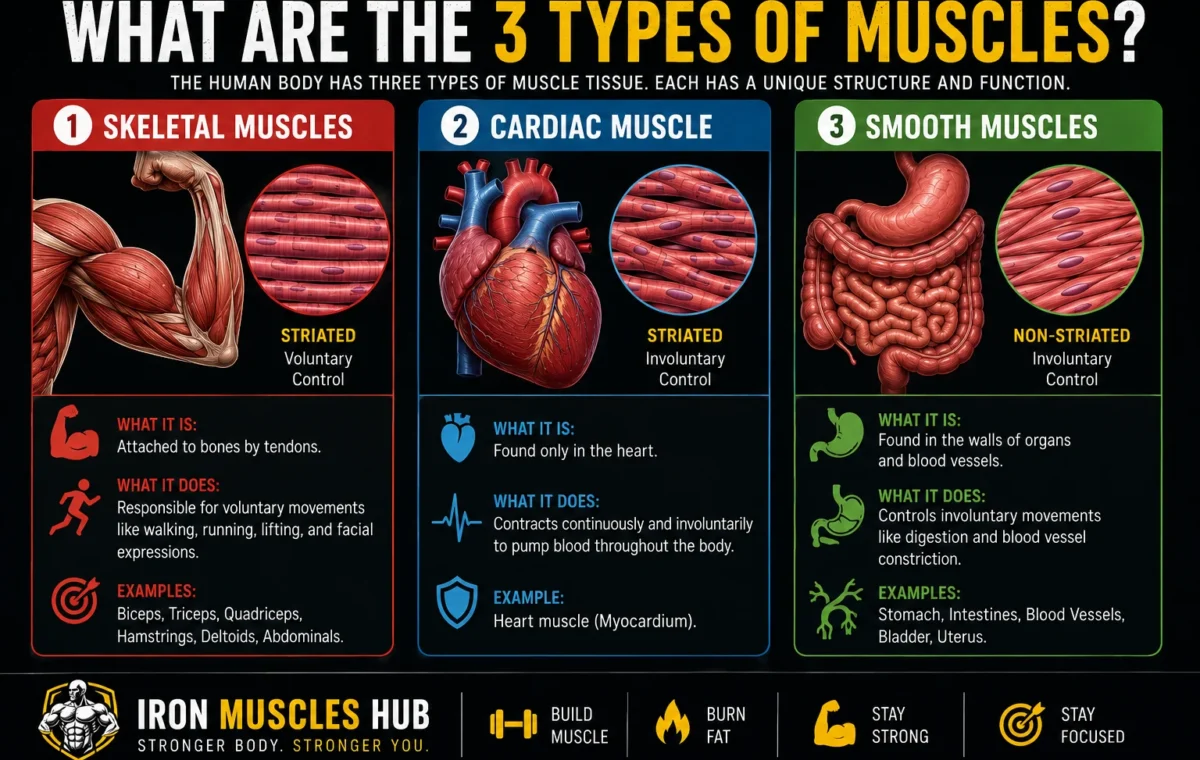
If you’ve ever wondered what are the 3 types of muscles, the short answer is simple: skeletal muscle, cardiac muscle, and smooth muscle. Each type has a different job, structure, and way of working, but together they keep your body moving, your heart beating, and your organs functioning.
- Quick Answer: What Are the 3 Types of Muscles?
- Key Takeaways
- Main Characteristics of Skeletal Muscle
- Examples of Skeletal Muscles
- Functions of Skeletal Muscle
- 1. Movement
- 2. Maintaining Posture
- 3. Joint Stability
- 4. Heat Production
- Voluntary vs. Involuntary Control
- Why Skeletal Muscle Matters
- Simple Real-Life Example
- At a Glance: Skeletal Muscle
- Cardiac Muscle: The Muscle That Keeps You Alive
- Main Characteristics of Cardiac Muscle
- What Does Cardiac Muscle Do?
- 1. Pumps Blood Around the Body
- 2. Maintains Blood Pressure
- 3. Works Continuously
- Why Doesn't Your Heart Get Tired?
- Real-Life Example
- At a Glance: Cardiac Muscle
- Main Characteristics of Smooth Muscle
- Where Is Smooth Muscle Found?
- Functions of Smooth Muscle
- 1. Moves Food Through the Digestive System
- 2. Controls Blood Vessel Size
- 3. Helps Empty the Bladder
- 4. Supports Breathing
- 5. Plays an Important Role During Childbirth
- Real-Life Example
- At a Glance: Smooth Muscle
- Mistake 1: Thinking All Muscles Are Under Your Control
- Mistake 2: Believing the Heart Is a Skeletal Muscle
- Mistake 3: Assuming Smooth Muscle Is Weak
- Memory Trick
- What are the 3 types of muscles in the human body?
- Which muscle type is voluntary?
- Why is cardiac muscle different from skeletal muscle?
- Where is smooth muscle found?
- Which type of muscle is the strongest?
- Why is it important to understand the three types of muscles?
- Easy Memory Formula
From lifting a grocery bag to breathing, digesting food, and pumping blood around your body, muscles are working every second of the day. Understanding these three muscle types helps you learn how your body functions and why staying active is so important for overall health. For more insights read here :- what are muscles and are muscles organs .
Quick Answer: What Are the 3 Types of Muscles?
| Muscle Type | Controlled By | Found In | Main Function |
|---|---|---|---|
| Skeletal Muscle | Voluntary | Attached to bones | Moves the body and maintains posture |
| Cardiac Muscle | Involuntary | Heart | Pumps blood throughout the body |
| Smooth Muscle | Involuntary | Internal organs and blood vessels | Moves substances through organs and controls organ functions |
Key Takeaways
- The human body has three types of muscle tissue.
- Skeletal muscles move your body and are under your conscious control.
- Cardiac muscle is found only in the heart and beats automatically.
- Smooth muscle lines organs like the stomach, intestines, bladder, and blood vessels.
- Each muscle type has a unique structure designed for its specific role.
Understanding Muscle Tissue
Muscle tissue is one of the four primary tissue types in the human body. Its main job is to create movement by contracting and relaxing.
Although all muscles contract, they don’t all work in the same way. Some muscles respond when you decide to move, while others work automatically without you even noticing.
Scientists classify muscle tissue into three categories based on:
- Appearance under a microscope
- Location in the body
- Whether you consciously control it
- How it contracts
- Its primary function
Let’s look at each one in detail.
Skeletal Muscle: The Muscle That Moves Your Body
Skeletal muscle is the largest and most familiar type of muscle. It makes up much of the body’s muscle mass and is responsible for nearly every movement you consciously perform.
These muscles attach to bones through tendons. When a skeletal muscle contracts, it pulls on the bone, creating movement at a joint.
Main Characteristics of Skeletal Muscle
- Voluntary muscle
- Attached to bones
- Long, cylindrical muscle fibers
- Appears striped (striated) under a microscope
- Usually works in pairs
- Controlled by the brain through the nervous system
Because you control skeletal muscles, you can decide when to:
- Walk
- Run
- Jump
- Smile
- Write
- Lift weights
- Stand up
- Wave your hand
Every one of these actions depends on skeletal muscles receiving signals from your brain.
Examples of Skeletal Muscles
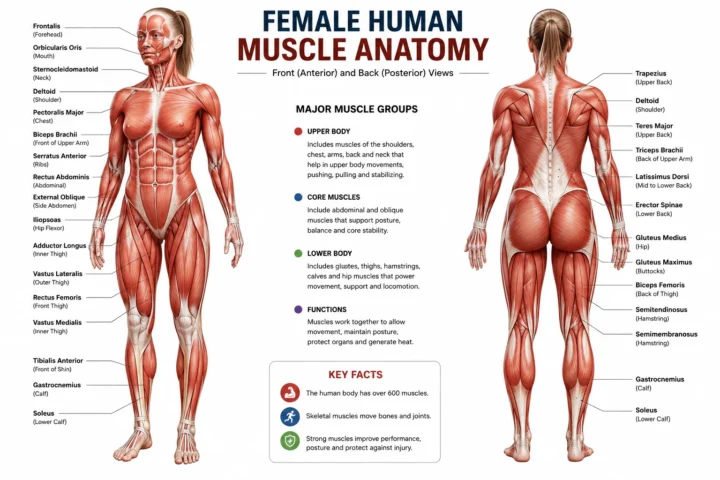
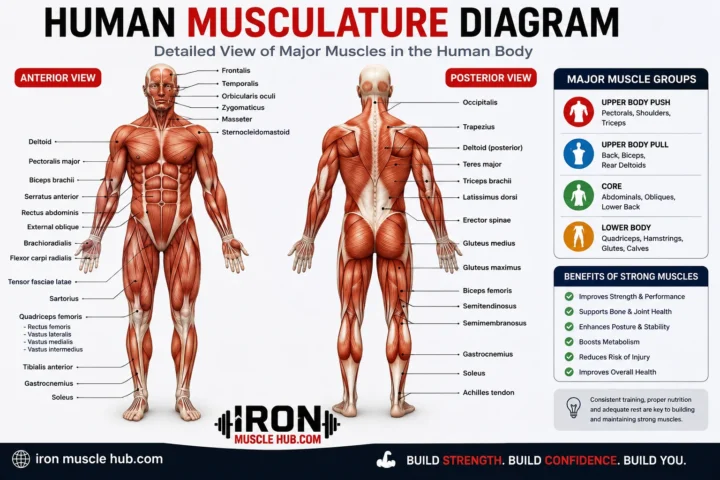
Some of the body’s best-known skeletal muscles include:
- Biceps
- Triceps
- Deltoids
- Quadriceps
- Hamstrings
- Calves
- Gluteal muscles
- Abdominal muscles
- Pectoral muscles
- Latissimus dorsi
Together, these muscles allow your body to perform thousands of different movements every day.
Functions of Skeletal Muscle
Skeletal muscles do much more than help you exercise.
Their major functions include:
1. Movement
This is their primary job.
Whether you’re typing on a keyboard or climbing stairs, skeletal muscles generate force to move your bones.
2. Maintaining Posture
Even when you’re standing still, many muscles are constantly making tiny adjustments to keep you balanced.
Without skeletal muscles, you wouldn’t be able to remain upright.
3. Joint Stability
Strong muscles help stabilize joints such as:
- Knees
- Shoulders
- Hips
- Ankles
This support reduces unnecessary movement and helps protect joints during daily activities.
4. Heat Production
Muscles also produce heat when they contract.
In fact, muscle activity helps maintain your normal body temperature. That’s why your body shivers when you’re cold—rapid muscle contractions generate extra heat.
Voluntary vs. Involuntary Control
One of the easiest ways to remember skeletal muscle is this:
You decide when it moves.
For example:
- Choosing to stand up
- Throwing a ball
- Picking up a cup
- Riding a bicycle
Your brain sends electrical signals through nerves to specific muscles, telling them exactly when and how strongly to contract.
Why Skeletal Muscle Matters
Healthy skeletal muscles improve much more than athletic performance.
They help with:
- Better balance
- Stronger bones
- Easier daily movement
- Reduced injury risk
- Healthy metabolism
- Independence as you age
Regular physical activity, resistance training, enough protein, quality sleep, and proper recovery all help maintain healthy skeletal muscles throughout life.
Simple Real-Life Example
Imagine you’re carrying a backpack to school.
Several skeletal muscles work together:
- Your shoulder muscles support the straps.
- Your leg muscles help you walk.
- Your abdominal and back muscles keep you upright.
- Your arm muscles adjust the backpack when it slips.
Every movement happens because skeletal muscles contract in a coordinated way under your control.
At a Glance: Skeletal Muscle
| Feature | Skeletal Muscle |
|---|---|
| Control | Voluntary |
| Appearance | Striated |
| Location | Attached to bones |
| Main Job | Body movement |
| Fatigue | Can become tired after activity |
| Examples | Biceps, quadriceps, hamstrings, deltoids |
Cardiac Muscle: The Muscle That Keeps You Alive
Cardiac muscle is a specialized type of muscle found only in the heart. Unlike skeletal muscle, you don’t have to think about using it. Your heart contracts automatically every second of your life, pumping blood to deliver oxygen and nutrients throughout your body.
This nonstop action is what keeps every organ functioning.
Main Characteristics of Cardiac Muscle
- Involuntary muscle (works automatically)
- Found only in the heart
- Striated (striped) under a microscope
- Short, branched muscle fibers
- Connected by specialized structures called intercalated discs
- Highly resistant to fatigue
Unlike skeletal muscles, cardiac muscle cells are designed to beat continuously without needing rest.
What Does Cardiac Muscle Do?
The primary job of cardiac muscle is simple but vital:
1. Pumps Blood Around the Body
Each heartbeat pushes blood through the circulatory system.
This blood carries:
- Oxygen
- Nutrients
- Hormones
- Immune cells
It also removes waste products such as carbon dioxide.
2. Maintains Blood Pressure
Every heartbeat helps maintain the pressure needed to move blood through arteries and veins.
Without healthy cardiac muscle, organs wouldn’t receive enough oxygen.
3. Works Continuously
One remarkable feature of cardiac muscle is that it never voluntarily stops.
Even while you sleep, your heart continues contracting rhythmically thanks to electrical signals generated within the heart itself.
Why Doesn’t Your Heart Get Tired?
Most skeletal muscles eventually fatigue after prolonged exercise.
Cardiac muscle is different because it has:
- A constant blood supply
- Large numbers of mitochondria (energy-producing structures)
- Efficient energy production
- Specialized muscle fibers
These adaptations allow it to work continuously throughout life.
Real-Life Example
Think about climbing a flight of stairs.
Your:
- Skeletal muscles move your legs.
- Cardiac muscle pumps faster to deliver more oxygen-rich blood.
- Smooth muscles adjust blood vessel diameter to improve circulation.
All three muscle types work together without you noticing.
At a Glance: Cardiac Muscle
| Feature | Cardiac Muscle |
|---|---|
| Control | Involuntary |
| Appearance | Striated |
| Location | Heart only |
| Main Job | Pumps blood |
| Fatigue | Extremely fatigue-resistant |
| Special Feature | Rhythmic contractions |
Smooth Muscle: The Muscle Inside Your Organs
Smooth muscle is found in the walls of many internal organs and blood vessels.
Unlike skeletal muscle, it isn’t attached to bones. Instead, it helps move substances through the body and controls the size of hollow organs and tubes.
You never have to think about using smooth muscle—it works automatically.
Main Characteristics of Smooth Muscle
- Involuntary muscle
- Non-striated (smooth appearance)
- Found in internal organs
- Slow, steady contractions
- Can maintain contractions for long periods
Its smooth appearance under a microscope gives this muscle tissue its name.
Where Is Smooth Muscle Found?
Smooth muscle is located in many parts of the body, including:
- Stomach
- Intestines
- Bladder
- Blood vessels
- Airways (lungs)
- Uterus
- Digestive tract
- Iris of the eye
These muscles perform different jobs depending on where they’re located.
Functions of Smooth Muscle
1. Moves Food Through the Digestive System
After you eat, smooth muscles create wave-like contractions called peristalsis.
These contractions push food through the:
- Esophagus
- Stomach
- Small intestine
- Large intestine
This process happens automatically.
2. Controls Blood Vessel Size
Smooth muscle in artery walls can:
- Narrow blood vessels
- Widen blood vessels
This helps regulate blood pressure and blood flow.
3. Helps Empty the Bladder
When it’s time to urinate, smooth muscles contract while other muscles relax to empty the bladder.
4. Supports Breathing
Smooth muscles surrounding the airways help control airflow into and out of the lungs.
5. Plays an Important Role During Childbirth
The uterus contains powerful smooth muscles.
During labor, these muscles contract rhythmically to help deliver a baby.
Real-Life Example
Imagine eating a sandwich.
After swallowing:
- Smooth muscles push food down your esophagus.
- Your stomach muscles churn food.
- Intestinal muscles move digested food forward.
- You don’t consciously control any of these actions.
Your digestive system simply keeps working.
At a Glance: Smooth Muscle
| Feature | Smooth Muscle |
|---|---|
| Control | Involuntary |
| Appearance | Non-striated |
| Location | Organs and blood vessels |
| Main Job | Moves substances through organs |
| Fatigue | Very fatigue-resistant |
| Examples | Stomach, intestines, bladder, arteries |
Comparing the Three Types of Muscles
| Feature | Skeletal Muscle | Cardiac Muscle | Smooth Muscle |
|---|---|---|---|
| Control | Voluntary | Involuntary | Involuntary |
| Appearance | Striated | Striated | Non-striated |
| Location | Attached to bones | Heart | Internal organs |
| Main Function | Body movement | Pumps blood | Moves substances through organs |
| Speed | Fast | Rhythmic | Slow |
| Fatigue | Can tire | Rarely tires | Highly fatigue-resistant |
How the Three Muscle Types Work Together
Although each muscle has a unique function, they constantly work as a team.
For example, during a brisk walk:
- Skeletal muscles move your legs and arms.
- Cardiac muscle increases your heart rate to deliver more oxygen.
- Smooth muscles widen blood vessels supplying active muscles and regulate digestion.
Without this coordination, everyday activities would be impossible.
Common Mistakes People Make
Many beginners confuse the three muscle types. Here are some common misconceptions:
Mistake 1: Thinking All Muscles Are Under Your Control
Only skeletal muscles are voluntary.
Your heart and internal organs keep working automatically.
Mistake 2: Believing the Heart Is a Skeletal Muscle
Although cardiac muscle appears striped like skeletal muscle, it is a completely different type of tissue found only in the heart.
Mistake 3: Assuming Smooth Muscle Is Weak
Smooth muscle isn’t designed for lifting heavy objects.
Instead, it excels at slow, controlled contractions that can continue for long periods without tiring.
Memory Trick
A simple way to remember the three muscle types:
- Skeletal = Skeleton = Move your body
- Cardiac = Cardio = Heart
- Smooth = Soft organs = Automatic movement
This quick association makes it easier to recall their locations and functions.
What are the 3 types of muscles in the human body?
The three types of muscles are skeletal muscle, cardiac muscle, and smooth muscle. Skeletal muscles move your body, cardiac muscle pumps blood through the heart, and smooth muscle controls movements inside organs such as the stomach, intestines, bladder, and blood vessels.
Which muscle type is voluntary?
Skeletal muscle is the only voluntary muscle type. You consciously control it whenever you walk, lift objects, write, smile, or exercise. Cardiac and smooth muscles work automatically without conscious effort.
Why is cardiac muscle different from skeletal muscle?
Although both are striated under a microscope, cardiac muscle is found only in the heart and contracts automatically throughout life. Skeletal muscle attaches to bones and only contracts when your brain sends voluntary signals through the nervous system.
Where is smooth muscle found?
Smooth muscle lines many hollow organs and tubes throughout the body, including the stomach, intestines, bladder, uterus, airways, and blood vessels. It helps move food, regulate blood flow, support breathing, and perform many other automatic functions.
Which type of muscle is the strongest?
The answer depends on what “strongest” means. Cardiac muscle is remarkable because it works continuously throughout your lifetime without stopping. Skeletal muscles generate the greatest force for body movement, while smooth muscles are highly efficient at maintaining long-lasting contractions inside organs.
Why is it important to understand the three types of muscles?
Learning what are the 3 types of muscles helps you understand how your body moves, breathes, digests food, and circulates blood. It also provides a solid foundation for studying anatomy, fitness, sports science, and overall health.
Quick Revision Summary
If you’re studying for school or simply want a fast recap, remember these key points:
| Muscle Type | Main Job | Voluntary? | Found In |
|---|---|---|---|
| Skeletal | Moves the body | ✅ Yes | Bones |
| Cardiac | Pumps blood | ❌ No | Heart |
| Smooth | Controls internal organs | ❌ No | Organs & blood vessels |
Easy Memory Formula
S = Skeleton = Skeletal Muscle = Movement
C = Cardio = Cardiac Muscle = Heart
S = Smooth = Stomach & Other Organs
This simple trick helps many beginners remember the three muscle types quickly.
Why This Knowledge Matters
Understanding what are the 3 types of muscles isn’t just useful for biology class—it also helps you make sense of how your body functions every day.
Whether you’re walking to work, exercising at the gym, eating lunch, or simply resting, skeletal, cardiac, and smooth muscles are working together. Skeletal muscles create movement, cardiac muscle keeps blood flowing, and smooth muscles quietly manage countless processes inside your organs.
Knowing the differences between these muscle types can also make fitness advice, anatomy lessons, and medical information much easier to understand. Once you learn their unique roles, you’ll have a stronger foundation for exploring how the human body works.
Final Thoughts: What Are the 3 Types of Muscles?
Understanding what are the 3 types of muscles gives you a clearer picture of how your body works every day. Skeletal muscle helps you move and perform activities like walking, exercising, and lifting. Cardiac muscle keeps your heart beating and delivers blood throughout your body. Smooth muscle manages automatic processes inside your organs, such as digestion and blood flow.
Although these muscles have different jobs, they depend on each other to keep your body functioning properly. Learning the basics of muscle tissue can help you better understand fitness, exercise, anatomy, and overall health.
The next time you move, breathe, or eat a meal, remember that all three muscle types are working behind the scenes to keep you going. Building knowledge about your body is one of the first steps toward making smarter choices for your health and fitness.