Female muscle anatomy refers to the muscles that make up and control movement in the female body. Women have the same fundamental types of muscle tissue as men: skeletal, cardiac and smooth muscle, although the amount, distribution and characteristics of skeletal muscle can differ between individuals and between the sexes.
- Female Muscle Anatomy at a Glance
- What Is Different About Female Muscle Anatomy?
- Why Muscle Distribution Matters
- Major Female Muscle Groups Explained
- 1. Shoulder Muscles
- 2. Chest Muscles
- 3. Back Muscles
- 4. Arm Muscles
- 5. Abdominal and Core Muscles
- 6. Glute Muscles
- 7. Quadriceps
- 8. Hamstrings
- 9. Calf Muscles
- Female Pelvic Floor Muscle Anatomy
- Why the Pelvic Floor Matters
- How Female Muscles Work Together
- Female Muscle Anatomy vs. Male Muscle Anatomy
- A Simple Way to Learn Female Muscle Anatomy
- Common Mistakes About Female Muscle Anatomy
- Mistake 1: Assuming women have different major muscles
- Mistake 2: Treating the pelvic floor as one tiny muscle
- Mistake 3: Assuming appearance tells you everything about muscle anatomy
- Mistake 4: Thinking stronger always means better
- Internal Link Ideas for Iron Muscle Hub
- Frequently Asked Questions
- What are the major muscles in the female body?
- Is female muscle anatomy different from male muscle anatomy?
- What are the most important muscles for women to know?
- Where are the pelvic floor muscles located in female anatomy?
- Can women build significant muscle?
- Does muscle mass change as women age?
- Understanding Your Muscles Starts With the Basics
- Female Muscle Anatomy: The Muscles You Should Know First
- Upper Body Muscle Groups
- Arm Muscles
- Female Core Muscle Anatomy
- Why the Transverse Abdominis Matters
- Female Hip and Glute Anatomy
- Female Thigh Muscle Anatomy
- Quadriceps
- Hamstrings
- Adductors
- Lower-Leg Muscle Anatomy
- Female Pelvic Floor Anatomy Explained Simply
- Does Female Anatomy Affect Muscle Building?
- A Simple Example
- A Beginner's Female Muscle Anatomy Checklist
- The Most Useful Anatomy Tip
- Final Takeaway
- How to Read a Female Muscle Anatomy Chart
- Front-View Female Muscle Anatomy
- Simple Front-View Map
- Back-View Female Muscle Anatomy
- Muscle Group vs. Individual Muscle
- Does Female Anatomy Change With Exercise?
- What Exercise Does Not Change
- Do women have the same muscles as men?
- What is the strongest muscle in a woman's body?
- What are the main female muscle groups?
- Where are women's abdominal muscles?
- Are glutes part of the core?
- What muscles should women strengthen?
- Day 1: Shoulders and Chest
- Day 2: Back
- Day 3: Arms
- Day 4: Core
- Day 5: Hips and Glutes
- Day 6: Legs
- Day 7: Review
- 1. Confusing muscles with body regions
- 2. Assuming visible muscles are the only important ones
- 3. Treating every exercise as an isolation exercise
- 4. Assuming anatomy determines appearance
- 5. Forgetting the pelvic floor
- Final Thoughts
For beginners, the easiest way to understand female muscle anatomy is to learn the major muscle groups from head to toe, then look at the special role of the core and pelvic floor. You don’t need to memorize hundreds of individual muscle names. Learning where the major muscles are and what they do gives you a useful foundation for exercise, movement and general anatomy. For more insights read here :- leaner physique and how to get bigger .
Quick answer: Female muscle anatomy includes the same major skeletal muscle groups found throughout the human body, including the chest, shoulders, arms, back, abdomen, hips, glutes and legs. Female anatomy also includes an important pelvic floor muscle system that supports pelvic organs and contributes to bladder and bowel control.
Female Muscle Anatomy at a Glance
| Muscle area | Important muscles | Main job |
|---|---|---|
| Shoulders | Deltoids | Raise and move the arms |
| Chest | Pectoralis major | Push and bring the arms across the body |
| Upper back | Trapezius, rhomboids | Move and stabilize the shoulder blades |
| Back | Latissimus dorsi | Pull and move the upper limbs |
| Arms | Biceps, triceps | Bend and straighten the elbow |
| Core | Rectus abdominis, obliques, transverse abdominis | Stabilize the trunk and assist movement |
| Hips | Iliopsoas and surrounding muscles | Flex and stabilize the hip |
| Glutes | Gluteus maximus, medius and minimus | Extend, abduct and stabilize the hip |
| Thighs | Quadriceps, hamstrings, adductors | Straighten, bend and move the leg |
| Lower leg | Gastrocnemius, soleus | Move the ankle and help with walking |
| Pelvic floor | Multiple pelvic-floor muscles | Support pelvic organs and assist bladder and bowel control |
This is a practical overview rather than a complete anatomical inventory. The human body contains many individual muscles that work together in coordinated movements. Skeletal muscles attach to bones through tendons and produce voluntary movement.
What Is Different About Female Muscle Anatomy?
The basic muscle map isn’t fundamentally different in women. A woman has a deltoid in her shoulder, a biceps in her upper arm, quadriceps in her thigh and gluteal muscles around the hip just as a man does.
The differences are more noticeable in muscle size, distribution, composition and physiological characteristics. Research comparing male and female skeletal muscle has found that men generally have greater absolute skeletal muscle mass, with the difference particularly noticeable in the upper body.
That doesn’t mean every woman has less muscle than every man. Body size, genetics, training history, age, nutrition and physical activity all influence an individual’s muscular development.
A large review of sex differences in skeletal muscle also found differences in muscle-fiber characteristics. Women, on average, showed a greater proportion of Type I fibers, while men generally had larger cross-sectional areas across fiber types.
Why Muscle Distribution Matters
One interesting finding from whole-body imaging research is that the distribution of muscle isn’t identical between men and women. In one study of young adults, the largest muscle-mass peak was located around the upper thigh in women and around the shoulder region in men.
So, when you’re looking at a female muscle anatomy chart, don’t assume that visible differences in body shape mean women have different muscles. The underlying muscle groups are largely the same; their relative size and distribution can vary.
Major Female Muscle Groups Explained
1. Shoulder Muscles
The deltoid is the large muscle covering the shoulder. It helps lift the arm and contributes to several shoulder movements.
Other muscles around the shoulder, including parts of the rotator cuff, help stabilize the shoulder joint. Together, these muscles allow your arm to move through a wide range of positions.
Everyday examples: reaching overhead, putting something on a shelf or lifting an object.
2. Chest Muscles
The pectoralis major is the large muscle across the front of the chest. It helps move the upper arm toward and across the body.
Women also have breast tissue overlying the chest muscles. Breast tissue itself isn’t skeletal muscle, so it shouldn’t be confused with the pectoral muscles underneath it.
3. Back Muscles
The back contains several important muscle groups.
The trapezius helps move and stabilize the shoulder blades and contributes to movements of the neck and upper back. The latissimus dorsi, often called the “lats,” is a large muscle on the back that helps pull the upper arm downward and backward.
The rhomboid muscles also contribute to movement and positioning of the shoulder blades.
These muscles matter for pulling movements, posture and controlling the upper body.
4. Arm Muscles
Two of the easiest arm muscles to recognize are the biceps brachii and triceps brachii.
The biceps sits at the front of the upper arm and helps bend the elbow. The triceps is at the back of the upper arm and helps straighten the elbow.
For example, lifting a grocery bag toward your shoulder involves elbow flexion, while pushing something away requires elbow extension.
5. Abdominal and Core Muscles
The abdominal area isn’t one single muscle. It includes several muscles that work together.
The rectus abdominis runs vertically along the front of the abdomen. The internal and external obliques sit along the sides, while the transverse abdominis is a deeper abdominal muscle.
These muscles contribute to trunk movement and stability. They also work with muscles in the back, hips and pelvic floor to help control the position and movement of the torso.
A common mistake is thinking that a visible six-pack represents the entire core. It doesn’t. Core function depends on a broader group of muscles working together.
6. Glute Muscles
The gluteal region contains three major muscles:
- Gluteus maximus: the largest of the three and an important hip extensor.
- Gluteus medius: helps move the thigh away from the body’s midline and stabilizes the pelvis.
- Gluteus minimus: assists hip movement and pelvic stability.
These muscles are important for walking, climbing stairs, running, standing up and many other movements.
Glute development also varies substantially between individuals, so there’s no single “normal” female glute shape.
7. Quadriceps
The quadriceps femoris is a group of four muscles on the front of the thigh.
Its primary role is extending the knee, which means straightening the lower leg. The quadriceps are heavily involved in activities such as walking uphill, squatting, jumping and rising from a chair.
Because they’re a large muscle group, they can contribute substantially to lower-body strength and movement.
8. Hamstrings
The hamstrings are a group of muscles located at the back of the thigh.
They help bend the knee and extend the hip. They work with the quadriceps and glutes during many lower-body movements.
Walking, running, climbing stairs and getting up from a seated position all involve coordinated action from several of these muscle groups rather than one muscle working alone.
9. Calf Muscles
Two major muscles in the calf are the gastrocnemius and soleus.
They contribute to plantar flexion, the movement that points the foot downward. This is important for walking, running, jumping and pushing off the ground.
The gastrocnemius is the more superficial calf muscle and is particularly visible when someone stands on their toes.
Female Pelvic Floor Muscle Anatomy
The pelvic floor deserves special attention in a guide to female muscle anatomy.
The pelvic floor is a group of muscles forming a supportive structure at the bottom of the pelvis. It stretches between the pubic bone toward the front and the coccyx toward the back, supporting pelvic organs such as the bladder, bowel and uterus.
These muscles also help control the openings involved in urination and bowel movements. They need to contract when appropriate and relax when the bladder or bowel needs to empty.
Why the Pelvic Floor Matters
Pelvic-floor function can be affected by factors including pregnancy, childbirth, menopause, pelvic surgery, repeated straining and inactivity.
A weak or poorly coordinated pelvic floor can contribute to symptoms such as urinary leakage or pelvic-organ prolapse.
Pelvic-floor exercises are commonly recommended to strengthen these muscles, but strength isn’t the only goal. The muscles also need to contract and relax appropriately. If you’re experiencing persistent pelvic-floor symptoms, a qualified healthcare professional or pelvic-health physiotherapist can provide individualized assessment.
How Female Muscles Work Together
A useful way to understand anatomy is to stop thinking of muscles as isolated parts.
Consider a simple squat. Your quadriceps help extend the knees, while your gluteal muscles contribute to hip extension. Your abdominal and back muscles help stabilize your trunk, while muscles around the hips and ankles help control your position.
The same principle applies to everyday activities. Walking isn’t simply a “leg exercise.” It requires coordinated work from the hips, thighs, calves, trunk and feet.
This is why anatomy is useful for understanding movement: muscles operate as a team.
Female Muscle Anatomy vs. Male Muscle Anatomy
There are biological differences between average male and female skeletal muscle, but those differences shouldn’t be exaggerated.
| Feature | General pattern in females | General pattern in males |
| Overall skeletal muscle mass | Lower average absolute mass | Higher average absolute mass |
| Upper-body muscle | Lower average mass | Higher average mass |
| Lower-body muscle | Substantial muscle mass; distribution varies | Higher average absolute mass |
| Muscle-fiber characteristics | Greater average Type I proportion in research samples | Greater average Type II proportion and fiber size |
| Individual variation | Very large | Very large |
| Training response | Muscles adapt to resistance training | Muscles adapt to resistance training |
These are population-level patterns, not rules for individual people. Studies consistently show biological sex differences in skeletal muscle, but individual muscle size and strength can vary enormously based on training, body size, age and other factors.
A Simple Way to Learn Female Muscle Anatomy
If you’re studying anatomy or simply trying to understand your body, don’t attempt to memorize every muscle at once.
Use this five-step approach:
- Learn the major regions: shoulders, chest, back, arms, core, hips and legs.
- Learn one or two major muscles in each region.
- Connect each muscle to its main movement.
- Use an original labeled anatomy illustration to reinforce location.
- Then learn smaller muscles and deeper structures.
For example, remember:
Biceps → front of upper arm → bends the elbow
Triceps → back of upper arm → straightens the elbow
Quadriceps → front of thigh → straightens the knee
Hamstrings → back of thigh → bends the knee and extends the hip
Gluteus maximus → buttock → powerful hip extension
Those simple movement connections make anatomy much easier to remember than memorizing isolated names.
Common Mistakes About Female Muscle Anatomy
Mistake 1: Assuming women have different major muscles
Women and men share the same basic skeletal-muscle system. The main differences involve average size, distribution and physiological characteristics rather than having completely different muscle groups.
Mistake 2: Treating the pelvic floor as one tiny muscle
The pelvic floor is a coordinated group of muscles and connective tissues. It plays roles in support, continence, pelvic stability and other functions.
Mistake 3: Assuming appearance tells you everything about muscle anatomy
Two women can have very different body shapes while having the same fundamental muscle groups. Muscle size, body-fat distribution, skeletal structure and genetics can all influence visible appearance.
Mistake 4: Thinking stronger always means better
Muscles need both strength and coordination. This is particularly important for the pelvic floor, which needs to contract effectively but also relax appropriately.
Internal Link Ideas for Iron Muscle Hub
Consider linking this article naturally to related educational articles such as:
- What Are Muscles? — explains the three major types of muscle tissue.
- Muscle Names: A Beginner’s Guide — expands on individual muscle names.
- Three Types of Muscle Tissue — explains skeletal, cardiac and smooth muscle.
These links can help readers move from a broad anatomy overview to more detailed muscle education.
Frequently Asked Questions
What are the major muscles in the female body?
The major muscle groups include the shoulders, chest, back, arms, abdominals, hips, glutes, quadriceps, hamstrings and calves. Women also have pelvic-floor muscles that support pelvic organs and contribute to bladder and bowel control. These muscle groups work together rather than operating independently.
Is female muscle anatomy different from male muscle anatomy?
The fundamental muscle groups are largely the same, but average muscle mass and some muscle characteristics differ between the sexes. Research generally finds greater absolute skeletal muscle mass in men, especially in the upper body, while women show some differences in muscle-fiber composition. Individual variation remains substantial.
What are the most important muscles for women to know?
For a beginner, start with the deltoids, pectorals, latissimus dorsi, biceps, triceps, abdominal muscles, gluteal muscles, quadriceps, hamstrings and calves. It’s also useful to understand the pelvic floor because of its role in supporting pelvic organs and controlling bladder and bowel function.
Where are the pelvic floor muscles located in female anatomy?
The pelvic floor sits at the bottom of the pelvis, extending broadly between the pubic bone at the front and the coccyx at the back. It forms a supportive muscular base beneath the pelvic organs.
Can women build significant muscle?
Yes. Female skeletal muscle adapts to physical training, including resistance exercise. Women can develop substantial muscle mass and strength, although average absolute muscle mass differs between men and women. Research on female athletes demonstrates that highly trained women can have considerably greater skeletal muscle mass than recreationally active women.
Does muscle mass change as women age?
Yes. Muscle mass and muscle quality can change with age. Hormonal changes around menopause are associated with changes in skeletal muscle, while inactivity and other factors can also contribute to age-related muscle loss. Recent research continues to examine how muscle mass and muscle quality change differently in women and men across aging.
Understanding Your Muscles Starts With the Basics
Female muscle anatomy is easier to understand once you stop viewing it as a giant list of unfamiliar names. Start with the major regions, learn what each group does, and then add smaller muscles as your knowledge grows.
The basic skeletal-muscle map is shared across humans, while average muscle size, distribution and some physiological characteristics differ between women and men. The pelvic floor is especially important in female anatomy because it supports pelvic organs and contributes to bladder and bowel control.
If you’re learning anatomy for fitness, study or general health, a labeled diagram plus simple movement examples is usually more useful than memorizing dozens of terms at once.
Female Muscle Anatomy: The Muscles You Should Know First
If you’re learning female muscle anatomy, you don’t need to memorize every muscle in the body immediately. A better starting point is to divide the body into major regions and learn the most important muscles within each one.
Upper Body Muscle Groups
Shoulders
The deltoid is the main visible muscle of the shoulder. It helps raise the arm and contributes to several shoulder movements.
The shoulder also depends on smaller stabilizing muscles, particularly the rotator cuff. These muscles help keep the upper arm positioned correctly within the shoulder joint.
Chest
The main chest muscle is the pectoralis major. It helps move the upper arm across the body and contributes to pushing movements.
In female anatomy, breast tissue lies over the chest muscles. Breast tissue itself isn’t skeletal muscle, so an anatomy diagram should distinguish between the breast and the underlying pectoral muscles.
Back
Several important muscles make up the back.
- Trapezius: helps move and stabilize the shoulder blades.
- Latissimus dorsi: contributes to pulling the upper arm downward and backward.
- Rhomboids: help position the shoulder blades.
- Erector spinae: helps extend and stabilize the spine.
Together, these muscles support posture and upper-body movement.
Arm Muscles
The upper arm contains two especially familiar muscles.
Biceps brachii: located at the front of the upper arm and involved in elbow flexion.
Triceps brachii: located at the back of the upper arm and involved in elbow extension.
The forearm contains many smaller muscles responsible for movements of the wrist and fingers. That’s why gripping, typing, carrying and opening objects can involve numerous muscles simultaneously.
Female Core Muscle Anatomy
The word “core” doesn’t refer to one muscle. It describes a group of muscles around the trunk that contribute to stability and movement.
Important muscles include:
- Rectus abdominis
- External obliques
- Internal obliques
- Transverse abdominis
- Multifidus
- Erector spinae
- Diaphragm
- Pelvic-floor muscles
The core works as an integrated system. For example, during lifting, abdominal and back muscles help control the trunk while the hips and legs generate much of the movement.
Why the Transverse Abdominis Matters
The transverse abdominis is a deeper abdominal muscle that wraps around the trunk. Rather than producing the obvious “six-pack” appearance associated with the rectus abdominis, it contributes to abdominal and trunk stability.
This is one reason a flat-looking abdomen doesn’t tell you exactly how strong someone’s core muscles are.
Female Hip and Glute Anatomy
The hip region connects the trunk and legs, so it contains muscles involved in both movement and stability.
The three major gluteal muscles are:
| Muscle | Location | Main role |
|---|---|---|
| Gluteus maximus | Largest buttock muscle | Hip extension |
| Gluteus medius | Upper/outer hip | Hip abduction and pelvic stability |
| Gluteus minimus | Deep to gluteus medius | Hip movement and stability |
The gluteus maximus is particularly important during powerful hip-extension movements such as standing from a squat, climbing stairs and running.
The gluteus medius also has an important stabilizing role. During walking, it helps prevent excessive dropping of the pelvis on the unsupported side.
Female Thigh Muscle Anatomy
The thigh contains three broad muscle regions: the quadriceps at the front, hamstrings at the back, and adductors on the inner thigh.
Quadriceps
The quadriceps are made up of four muscles:
- Rectus femoris
- Vastus lateralis
- Vastus medialis
- Vastus intermedius
Their primary shared action is knee extension.
Hamstrings
The hamstring group is located at the back of the thigh. It includes:
- Biceps femoris
- Semitendinosus
- Semimembranosus
These muscles contribute to knee flexion and hip extension.
Adductors
The adductor muscles are positioned along the inner thigh. Their primary function is bringing the thigh toward the body’s midline.
A useful way to remember the thigh is:
Front = quadriceps
Back = hamstrings
Inner thigh = adductors
That simple map gives beginners a strong foundation before studying individual muscles.
Lower-Leg Muscle Anatomy
Below the knee, the major muscle groups include the calf muscles and muscles that control the ankle and toes.
The gastrocnemius is the prominent superficial calf muscle. Beneath it is the soleus, another major muscle involved in plantar flexion.
These muscles are important during walking, running, jumping and standing.
Other muscles in the lower leg control movements of the foot and toes. Although they’re less visible, they’re essential for balance and efficient movement.
Female Pelvic Floor Anatomy Explained Simply
One of the most important areas to understand in female anatomy is the pelvic floor.
Think of the pelvic floor as a muscular support system at the bottom of the pelvis. It helps support pelvic organs and contributes to continence and sexual function.
The pelvic floor doesn’t simply need to be “strong.” Good function also requires the muscles to contract and relax at the appropriate times.
This distinction is important because repeatedly tightening a muscle isn’t automatically the right solution for every pelvic-floor problem. People experiencing pelvic pain, leakage, pressure or other persistent symptoms should seek appropriate medical or pelvic-health assessment rather than assuming weakness is the only issue.
Does Female Anatomy Affect Muscle Building?
Female skeletal muscle responds to resistance exercise in the same fundamental way that skeletal muscle responds in other humans: training provides a stimulus that can lead to adaptations in strength and muscle size.
However, the amount of muscle a woman can develop isn’t determined by sex alone.
Important influences include:
- Genetics
- Age
- Training experience
- Training consistency
- Nutrition
- Sleep and recovery
- Hormonal environment
- Overall physical activity
This is why two women following similar exercise programs can develop noticeably different physiques.
A Simple Example
Imagine two beginners who start resistance training at the same time.
One may naturally have more muscle mass in her legs, while the other may have more upper-body muscle. After several months of consistent training, both can become stronger and more muscular, but their final proportions may still look different.
That’s normal human variation—not evidence that one person is training incorrectly.
A Beginner’s Female Muscle Anatomy Checklist
If you’re studying for fitness or general anatomy, learn these first:
Upper body
- Deltoids
- Pectoralis major
- Trapezius
- Latissimus dorsi
- Biceps
- Triceps
Core
- Rectus abdominis
- External obliques
- Internal obliques
- Transverse abdominis
Lower body
- Gluteus maximus
- Gluteus medius
- Quadriceps
- Hamstrings
- Adductors
- Gastrocnemius
- Soleus
Pelvic region
- Pelvic-floor muscle group
Once these are familiar, you can move on to smaller muscles and deeper anatomical structures.
The Most Useful Anatomy Tip
Don’t study muscles as isolated vocabulary words.
Instead, learn each muscle using this three-part formula:
Where is it? → What does it do? → What movement uses it?
For example:
Quadriceps → front of thigh → extends the knee → standing from a chair
Biceps → front of upper arm → flexes the elbow → bringing an object toward your shoulder
Gluteus maximus → buttock → extends the hip → climbing stairs
This approach makes female muscle anatomy much easier to remember and apply to real movement.
Final Takeaway
The female muscular system contains the same fundamental skeletal-muscle groups found throughout the human body. The most useful starting point is to learn the major muscles of the shoulders, chest, back, arms, core, hips, thighs and lower legs, then study the pelvic floor separately because of its specialized functions.
Individual women can differ substantially in muscle size, strength and body shape. Anatomy gives you the map; training, genetics, lifestyle and individual biology determine much of how that map looks in a particular person.
How to Read a Female Muscle Anatomy Chart
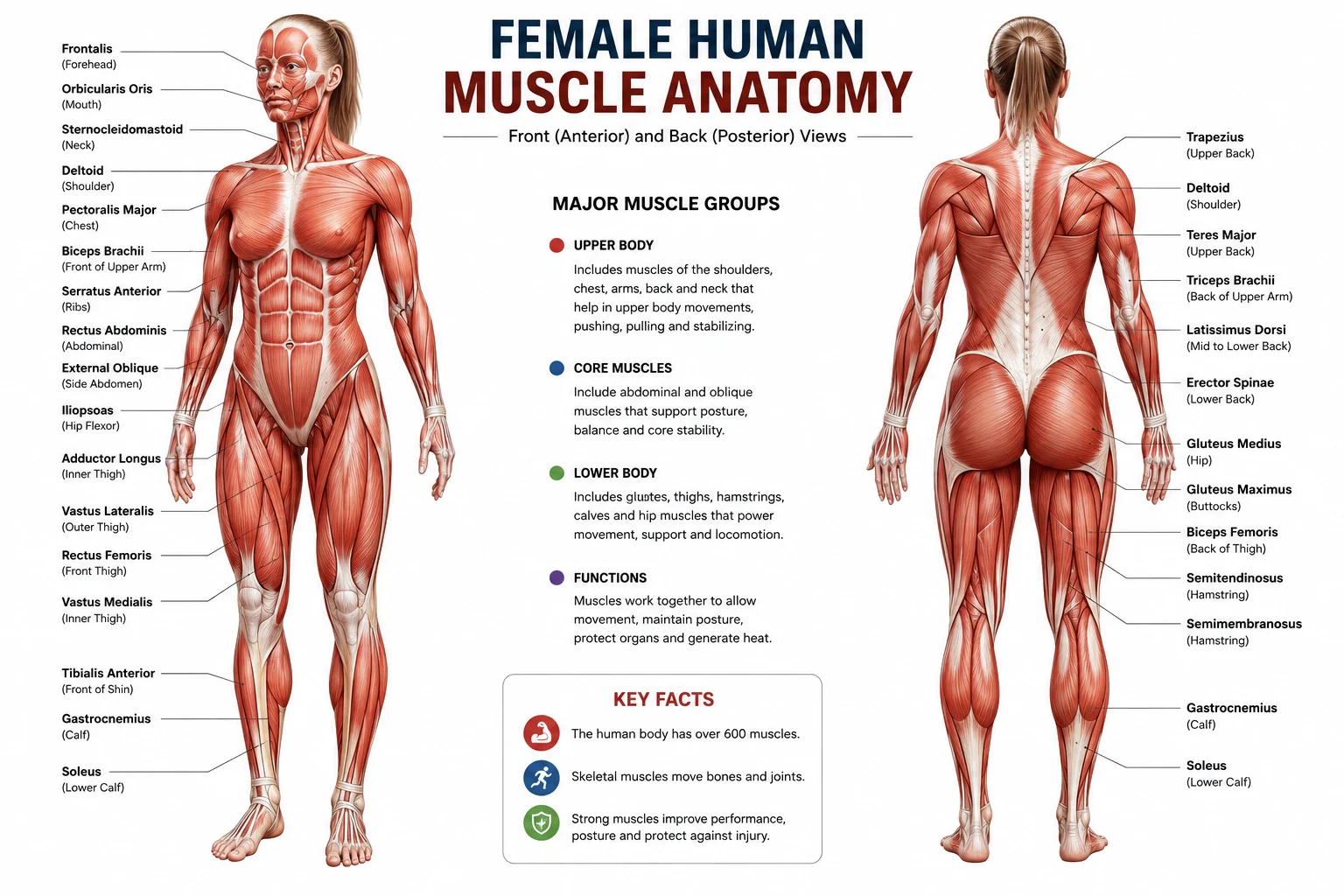
A female muscle anatomy chart can look complicated because it may show dozens of muscles at once. The easiest approach is to read it in layers rather than trying to identify everything immediately.
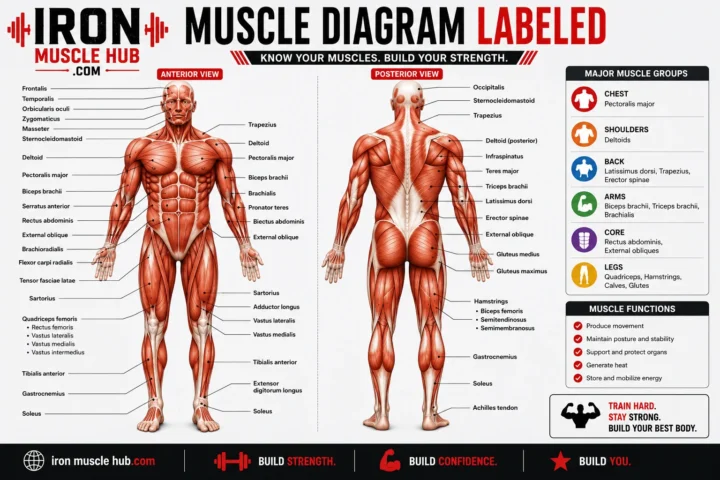
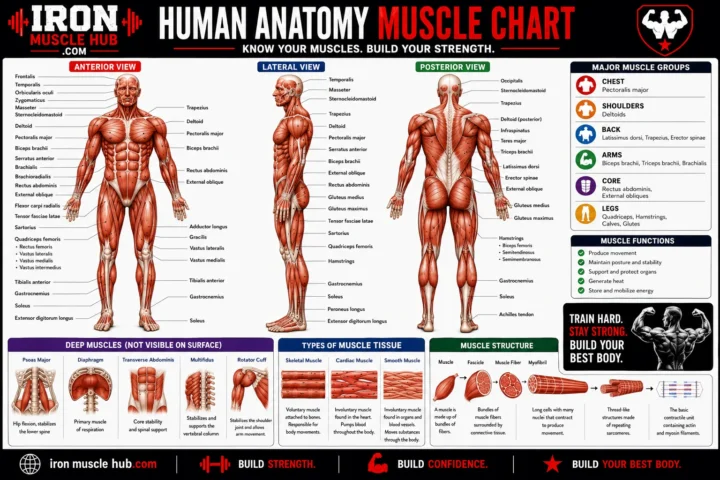
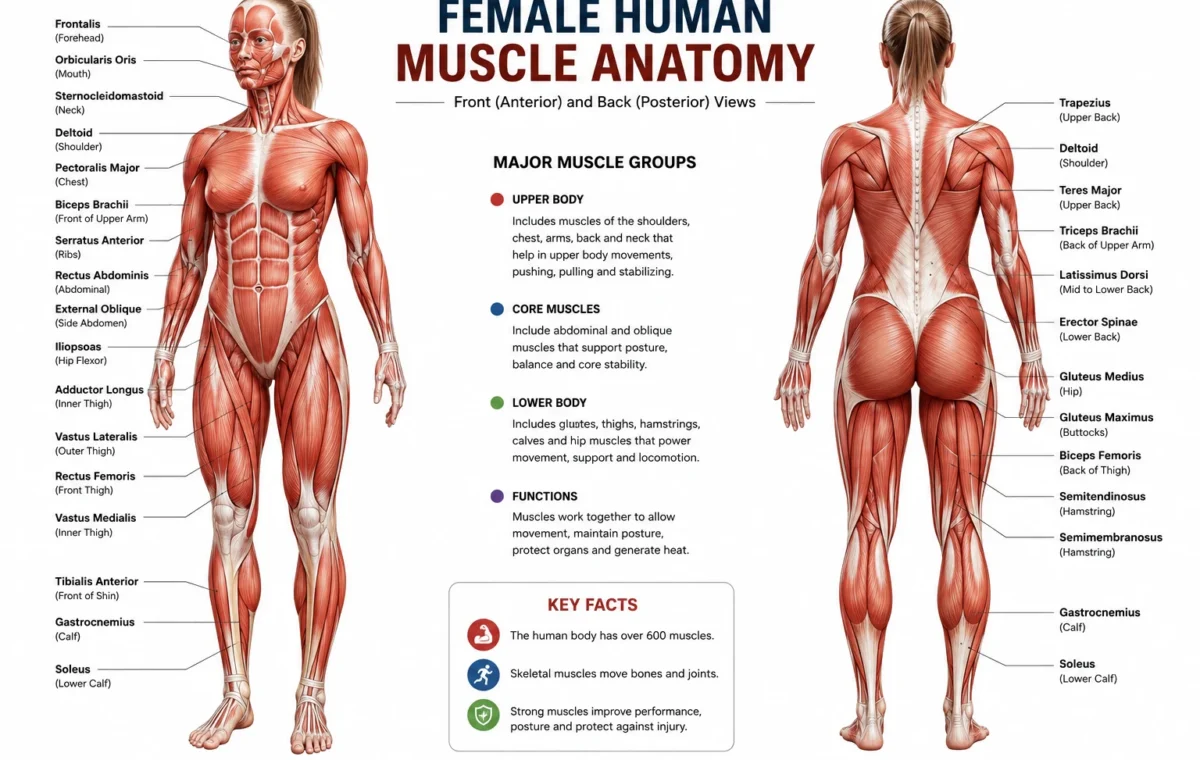
Start with the front view. Locate the shoulders, chest, abdominal muscles, quadriceps and shin muscles. Then switch to the back view and identify the trapezius, latissimus dorsi, gluteal muscles, hamstrings and calf muscles.
After you know the major surface muscles, you can begin learning deeper muscles.
A useful study order is:
- Head and neck
- Shoulders and chest
- Upper back
- Arms and forearms
- Abdomen and lower back
- Hips and glutes
- Thighs
- Calves and feet
- Pelvic-floor muscles
This prevents a common beginner problem: memorizing muscle names without understanding where they are or what they do.
Front-View Female Muscle Anatomy
From the front, some of the easiest muscles to identify are the deltoids, pectoralis major, biceps, rectus abdominis, external obliques and quadriceps.
The front of the thigh is dominated by the quadriceps group. Moving upward, the abdominal wall sits between the rib cage and pelvis, while the pectoral muscles cover much of the front of the chest.
The shoulders provide another useful landmark. The rounded muscle over each shoulder is the deltoid.
Simple Front-View Map
| Body region | Muscle to learn first | Basic function |
|---|---|---|
| Shoulder | Deltoid | Moves the arm |
| Chest | Pectoralis major | Moves the upper arm |
| Upper arm | Biceps | Bends the elbow |
| Abdomen | Rectus abdominis | Flexes the trunk |
| Side of abdomen | Obliques | Rotate and stabilize the trunk |
| Hip | Hip-flexor group | Helps raise the thigh |
| Front thigh | Quadriceps | Straightens the knee |
| Lower leg | Tibialis anterior | Helps lift the foot |
Back-View Female Muscle Anatomy
The back provides another useful set of landmarks.
The trapezius covers much of the upper back and extends toward the neck and shoulders. Below and to the sides are the large latissimus dorsi muscles.
Farther down, the gluteal muscles form the major muscle mass around the buttocks. The hamstrings sit underneath the gluteal region on the back of the thigh.
The calf muscles are found below the knee.
A simple back-view sequence is:
Trapezius → latissimus dorsi → spinal muscles → glutes → hamstrings → calves
Learning the body in this order makes an anatomy chart much easier to interpret.
Female Muscle Anatomy and Exercise
Understanding anatomy can make exercise terminology much less confusing.
For example, a squat isn’t simply a “quad exercise.” The movement involves coordinated activity from the quadriceps, glutes, hamstrings, trunk muscles and other supporting muscles.
Likewise, a rowing movement doesn’t isolate just one back muscle. Several muscles contribute to moving and stabilizing the shoulder and upper limb.
Muscle Group vs. Individual Muscle
This distinction is important.
A muscle group is a collection of muscles that share a region or function. The quadriceps, for example, contain four muscles.
An individual muscle is a specific anatomical structure, such as the rectus femoris.
When a fitness program says “train your legs,” it usually refers to multiple muscle groups rather than one specific muscle.
Does Female Anatomy Change With Exercise?
Yes. Skeletal muscle can adapt to regular physical training.
Resistance exercise can improve muscle strength and contribute to increases in muscle size. The degree of change varies from person to person.
A beginner may notice improvements in strength relatively quickly, while visible changes in muscle size can take longer. Consistency matters more than trying to find a single “perfect” exercise.
What Exercise Does Not Change
Exercise doesn’t rearrange your fundamental anatomical structure.
For example, training your glutes can increase their muscle size and strength, but it doesn’t change the basic location of the gluteal muscles.
Similarly, resistance training can develop the shoulders without creating a completely different skeletal structure.
This distinction helps explain why two people can follow similar training programs while maintaining different natural body proportions.
Female Muscle Anatomy and Body Shape
Body shape isn’t determined by muscles alone.
Several factors contribute to how the body looks, including:
- Skeletal structure
- Muscle mass
- Body-fat distribution
- Genetics
- Age
- Hormonal factors
- Training history
For this reason, there’s no single “female muscle shape.”
Two women with similar muscle mass can have noticeably different physiques because their skeletons, muscle distribution and other body characteristics differ.
This is one reason anatomy charts should be used for education, not as a definition of what a healthy or normal female body is supposed to look like.
Common Questions About Women’s Muscles
Do women have the same muscles as men?
Women and men have essentially the same major skeletal muscles. Differences between the sexes are more commonly seen in average muscle size, muscle distribution and some physiological characteristics. Individual differences can be much larger than a simple male-versus-female comparison suggests.
What is the strongest muscle in a woman’s body?
There isn’t one universally accepted answer to “strongest muscle.” Strength can be measured in different ways, including force, power and endurance. Different muscles are specialized for different jobs, so ranking one muscle as absolutely strongest can be misleading.
What are the main female muscle groups?
The main groups include the shoulders, chest, back, arms, abdominal muscles, hips, glutes, quadriceps, hamstrings and calves. The pelvic floor is another important muscle group in female anatomy because it supports pelvic organs and contributes to continence.
Where are women’s abdominal muscles?
The abdominal muscles are located in the front and sides of the trunk between the rib cage and pelvis. The rectus abdominis is positioned toward the front, while the internal and external obliques are positioned more laterally. The transverse abdominis is deeper within the abdominal wall.
Are glutes part of the core?
The glutes aren’t normally classified as core muscles in the narrow anatomical sense. However, they work closely with the trunk and hip muscles to control movement and stabilize the pelvis. That’s why many functional exercises train the glutes and core together.
What muscles should women strengthen?
There isn’t one universal list of muscles that every woman must strengthen. A balanced exercise program can include movements involving the major muscle groups of the upper body, trunk and lower body. Individual goals and health circumstances can determine which areas deserve more attention.
A Simple Female Muscle Anatomy Study Plan
If you’re learning anatomy from scratch, try this seven-day approach.
Day 1: Shoulders and Chest
Learn the deltoid and pectoralis major. Practice identifying them on a front-view anatomy illustration.
Day 2: Back
Learn the trapezius, latissimus dorsi and rhomboids.
Day 3: Arms
Learn the biceps and triceps, then add the main forearm muscle groups.
Day 4: Core
Study the rectus abdominis, internal and external obliques and transverse abdominis.
Day 5: Hips and Glutes
Learn the three major gluteal muscles and the main hip-flexor muscles.
Day 6: Legs
Study the quadriceps, hamstrings, adductors and calf muscles.
Day 7: Review
Use a blank anatomy diagram and try to label the muscles without looking at the answers.
This final step is especially useful. Testing yourself is generally more effective than repeatedly reading the same list.
Female Muscle Anatomy: Quick Revision Sheet
If you only have a few minutes to review, remember this:
Shoulder: deltoid
Chest: pectoralis major
Upper back: trapezius
Side/back: latissimus dorsi
Front upper arm: biceps
Back upper arm: triceps
Front abdomen: rectus abdominis
Side abdomen: obliques
Buttocks: gluteal muscles
Front thigh: quadriceps
Back thigh: hamstrings
Inner thigh: adductors
Calf: gastrocnemius and soleus
Pelvis: pelvic-floor muscle group
That short list covers many of the muscle names beginners encounter most often.
What Beginners Often Get Wrong
1. Confusing muscles with body regions
“Leg” isn’t one muscle. It’s a body region containing many muscles.
2. Assuming visible muscles are the only important ones
Some deep muscles aren’t easy to see but have important stabilizing or movement functions.
3. Treating every exercise as an isolation exercise
Most movements involve several muscles working together.
4. Assuming anatomy determines appearance
Muscle anatomy provides the basic structure, but individual body shape depends on many factors.
5. Forgetting the pelvic floor
The pelvic floor is an important part of female anatomy and deserves to be understood separately from general lower-body muscles.
Final Takeaway: Learn the Map Before the Details
Female muscle anatomy becomes much easier once you organize it into major regions instead of trying to memorize every anatomical term at once.
Start with the shoulders, chest, back, arms, core, hips, glutes and legs. Then learn how these muscles work together during everyday movements. Finally, study the pelvic floor as its own important part of female anatomy.
The biggest lesson is simple: there isn’t a separate set of “female muscles.” Women have the same fundamental skeletal-muscle system, while muscle size, distribution and other characteristics can vary between individuals and between the sexes.
For fitness, anatomy study or general body awareness, understanding location plus function is far more useful than memorizing names alone.
Final Thoughts
Female muscle anatomy is much easier to understand when you focus on the big picture first. The female body contains the same major skeletal muscle groups found throughout the human body, including the shoulders, chest, back, arms, core, glutes, thighs and calves. The pelvic floor is another especially important area because it supports pelvic organs and contributes to bladder and bowel control.
Individual women can have very different muscle size, strength and body proportions. Genetics, age, training, nutrition, activity levels and other biological factors all play a role.
If you’re just starting to learn anatomy, don’t try to memorize everything at once. Learn where a muscle is, what it does and which movements use it. Once those basics become familiar, the smaller and deeper muscles become much easier to understand.