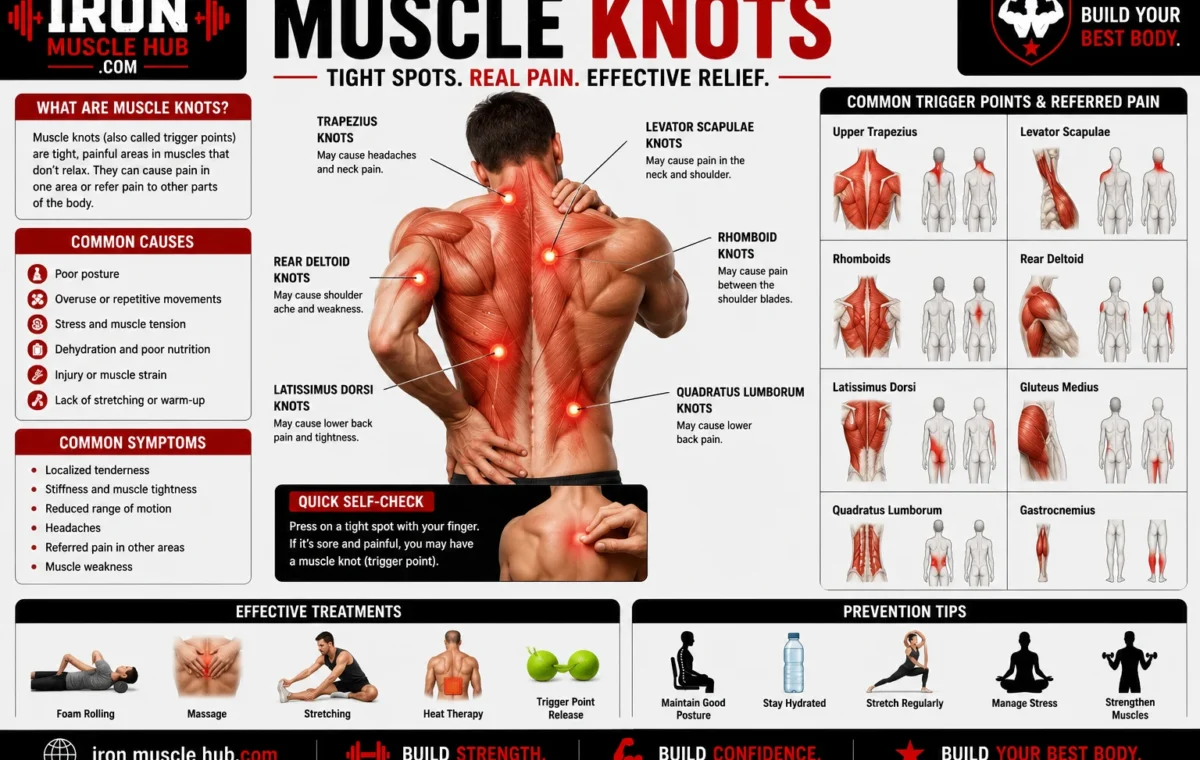
Muscle knots are small, tight or tender areas in a muscle that can hurt when pressed and sometimes cause pain elsewhere. They’re commonly associated with tight muscle fibers and are often described medically as trigger points. Repetitive activity, muscle strain, poor posture and stress-related muscle tension can contribute to them.
- Muscle Knots at a Glance
- What Are Muscle Knots?
- Where Do Muscle Knots Commonly Occur?
- What Causes Muscle Knots?
- What Do Muscle Knots Feel Like?
- How to Get Rid of Muscle Knots
- 1. Keep the Area Gently Moving
- 2. Try Gentle Stretching
- 3. Use Heat for Comfort
- 4. Try Gentle Massage
- 5. Consider a Foam Roller or Massage Tool Carefully
- 6. Fix the Reason the Knot Keeps Returning
- A Simple 10-Minute Muscle-Knot Routine
- Common Mistakes That Can Make Muscle Knots Worse
- Pressing Too Hard
- Stretching Aggressively
- Ignoring the Cause
- Assuming Every Lump Is a Muscle Knot
- When Should You See a Doctor About Muscle Knots?
- Muscle Knots vs. Myofascial Pain Syndrome
- Can a Physical Therapist Help?
- Can Muscle Knots Be Prevented?
- Internal Link Ideas for Iron Muscle Hub
- Reputable Sources for Further Reading
- Frequently Asked Questions
- What is the fastest way to get rid of muscle knots?
- Why do I keep getting muscle knots?
- Should you massage a muscle knot?
- Can stretching make a muscle knot worse?
- How long do muscle knots last?
- Are muscle knots a sign of dehydration?
- When a Simple Knot Needs More Attention
- Practical Ways to Manage Recurring Muscle Knots
- Check What Happens Before the Pain Starts
- Build Movement Into Your Day
- Adjust Your Workout Gradually
- Don't Confuse Soreness With an Injury
- A Beginner-Friendly Muscle Knot Checklist
- What If the Muscle Knot Is in Your Neck?
- What If the Muscle Knot Is in Your Back?
- What If a Foam Roller Makes the Pain Worse?
- Should You Use Pain Medication for Muscle Knots?
- What a Healthcare Professional May Look For
- A Simple Example
- What Not to Do With Muscle Knots
- Final Thoughts
The good news is that many uncomplicated muscle knots improve with simple measures such as gentle movement, stretching, heat and massage. But persistent or unusual pain shouldn’t automatically be blamed on a knot. Some symptoms need evaluation by a healthcare professional. For more insights read here :- lean build and how to gain muscle fast.
Quick answer: Muscle knots are tender, tight areas in muscle that may develop after overuse, injury, repetitive movement, prolonged positions or tension. Gentle stretching, heat, appropriate massage and addressing the activity that caused the irritation may help. Persistent, worsening or unusual symptoms deserve medical attention.
Muscle Knots at a Glance
| Question | Simple answer |
|---|---|
| What are muscle knots? | Tight, tender areas within a muscle, often associated with trigger points |
| Where do they occur? | Commonly around the neck, shoulders and back, although other muscles can be affected |
| What causes them? | Overuse, repetitive activity, injury, poor posture and muscle tension can contribute |
| Can you treat them at home? | Mild cases may improve with gentle self-care |
| Can massage help? | It may provide short-term relief and reduce tenderness for some people |
| When should you get help? | Persistent, worsening, swollen, hot, red or unusual areas should be assessed |
What Are Muscle Knots?
A muscle knot is the everyday term people often use for a painful or tight spot in muscle tissue. Healthcare sources commonly discuss these areas as myofascial trigger points.
They may feel like a small lump, firm band or tender spot under the skin. Pressing on the area can reproduce the pain, and in some cases pain may be felt somewhere nearby rather than exactly where the trigger point is located.
Muscle knots aren’t always visible. A painful bump that is clearly growing, swollen, red or otherwise changing shouldn’t simply be assumed to be a muscle knot.
Where Do Muscle Knots Commonly Occur?
Muscle knots can develop in different parts of the body. The neck, shoulders and upper or lower back are common locations, particularly for people who spend long periods in one position or repeatedly use the same muscles.
You might also notice a tender spot after exercising a muscle that’s not accustomed to the workload.
What Causes Muscle Knots?
There isn’t one single cause. Muscle knots can develop when muscle tissue is repeatedly stressed or held under tension.
Common contributing factors include:
- Overuse: Repeating the same movement can put ongoing stress on a muscle.
- Muscle injury: A strained or injured area can develop persistent tightness.
- Poor posture: Staying in an awkward position for long periods may increase muscle stress.
- Repetitive work or hobbies: Repeated movements can irritate particular muscle groups.
- Stress and tension: Stress can contribute to muscle tightening and repeated strain.
- Reduced activity: Long periods of inactivity can also affect muscle conditioning.
Mayo Clinic notes that repeated muscle tension, poor form, injury, poor posture and stress-related tension may contribute to trigger points.
That means a knot doesn’t necessarily mean you’ve exercised too hard. Someone who sits at a desk most of the day can experience muscle tightness just as an active person can.
What Do Muscle Knots Feel Like?
People describe them in different ways, but common sensations include:
- A dull or aching pain
- Tightness or stiffness
- Tenderness when you press the area
- A small firm or knot-like spot
- Reduced range of movement
- Muscle soreness
- Weakness around the affected area
Some trigger points can also produce referred pain, meaning pressure on one area contributes to pain somewhere else.
For example, a tight area around the upper shoulder may contribute to discomfort elsewhere around the neck or head.
How to Get Rid of Muscle Knots
If the problem is mild and there are no warning signs, start with simple measures rather than aggressively attacking the painful spot.
1. Keep the Area Gently Moving
Complete inactivity isn’t always the best response to ordinary muscle tightness.
Gentle movement can help you avoid becoming even stiffer. Try comfortable movements through your normal range rather than forcing a painful stretch.
If a movement produces sharp, electrical, or increasingly intense pain, stop rather than trying to push through it.
2. Try Gentle Stretching
A light stretch may help reduce the feeling of tightness.
For example, if your upper shoulders and neck feel tight after sitting, slow neck and shoulder movements may be more appropriate than aggressively pulling your head into a deep stretch.
The goal is comfortable tension, not pain.
Physical therapy treatment for myofascial pain can include stretching, massage and exercises designed around the person’s symptoms.
3. Use Heat for Comfort
A heating pad or another suitable source of gentle heat may help you feel less stiff.
Cleveland Clinic recommends heat as one option for managing muscle knots and explains that increased blood flow and relaxation may contribute to relief.
Use heat safely and avoid exposing your skin to excessive temperatures.
4. Try Gentle Massage
Massage can be useful for some people with tight, tender muscles.
You can gently massage a small area with your fingers, or a trained professional can work on the affected muscles. The pressure should be tolerable.
More pressure isn’t automatically better. Cleveland Clinic specifically advises reducing intensity if massage becomes painful and avoiding direct pressure over bones such as the spine when using percussive tools.
5. Consider a Foam Roller or Massage Tool Carefully
A foam roller or other massage tool can be useful for some large muscle areas.
Start gently and avoid repeatedly crushing a painful spot in an attempt to force it to disappear. If the area becomes more painful afterward, reduce the pressure or stop.
Massage and physical therapy have been studied for trigger-point symptoms, although research doesn’t mean every person will experience the same degree of relief.
6. Fix the Reason the Knot Keeps Returning
This is one of the most useful steps.
If your neck becomes tight every afternoon because you spend hours in the same position, repeatedly massaging the spot may only address the symptom.
Instead, consider what happens before the discomfort appears:
- Are you sitting for long periods without changing position?
- Did you suddenly increase your exercise?
- Are you repeating the same movement at work?
- Are you using poor exercise form?
- Are you holding your shoulders tense during stressful periods?
- Did the pain begin after an injury?
Finding the pattern can be more useful than constantly treating the same tender spot.
A Simple 10-Minute Muscle-Knot Routine
Here’s a practical starting routine for ordinary muscle tightness:
- Move gently for 2 minutes. Walk around or perform comfortable movements.
- Apply gentle heat for several minutes if heat feels soothing.
- Stretch lightly without forcing the painful area.
- Massage the surrounding muscle gently rather than attacking the most painful point.
- Return to normal activity gradually if movement feels comfortable.
If the pain gets noticeably worse rather than better, stop the routine and reassess what’s causing it.
Common Mistakes That Can Make Muscle Knots Worse
Pressing Too Hard
A tender muscle isn’t necessarily going to heal faster because you press harder.
Deep pressure that produces sharp pain, tingling or worsening symptoms is a reason to stop. Cleveland Clinic advises that discomfort can occur with trigger-point massage, but intense pain isn’t the goal.
Stretching Aggressively
A gentle stretch and an aggressive stretch aren’t the same thing.
Trying to force a muscle beyond a comfortable range can irritate an already sensitive area.
Ignoring the Cause
If the same knot returns after every workout, the answer may not be another massage session. Your training load, technique, recovery, posture or repetitive activity may need attention.
Assuming Every Lump Is a Muscle Knot
This is an important safety point.
Most ordinary muscle soreness isn’t an emergency, but a visible or growing lump, redness, warmth, swelling or drainage shouldn’t automatically be labelled a knot. Cleveland Clinic recommends medical evaluation for concerning changes like these.
When Should You See a Doctor About Muscle Knots?
Consider contacting a healthcare professional if your pain doesn’t improve with rest and basic self-care, keeps returning, or interferes with normal activities.
Mayo Clinic advises seeking medical evaluation when muscle pain doesn’t go away with rest, massage and other self-care measures.
You should also get an area checked if it:
- Becomes increasingly painful
- Is swollen or visibly enlarging
- Is red or hot
- Drains blood, pus or other fluid
- Causes significant weakness or restricted movement
- Produces unusual symptoms such as tingling or sharp pain
These symptoms can have causes other than a simple muscle knot.
Muscle Knots vs. Myofascial Pain Syndrome
The terms aren’t always interchangeable.
A temporary tight or tender spot is commonly called a muscle knot. Myofascial pain syndrome, on the other hand, is a longer-lasting pain condition involving muscles and fascia, with trigger points that can produce localized or referred pain.
If pain continues for a long time or repeatedly returns despite self-care, it’s better to get an appropriate assessment than to keep assuming the problem is just a knot.
Can a Physical Therapist Help?
Yes. Physical therapy may be useful when muscle pain or trigger points are persistent or affecting movement.
A physical therapist can assess how you move and may use a combination of stretching, strengthening, exercise and hands-on treatment. Mayo Clinic lists physical therapy and exercise among treatments used for myofascial pain syndrome.
A 2023 review in American Family Physician also reported beneficial effects from physical-therapy approaches studied for trigger points, including improvements in pain intensity, pressure tolerance and range of motion.
Can Muscle Knots Be Prevented?
You can’t guarantee that you’ll never get another muscle knot, but you can reduce some of the factors that contribute to muscle tension.
Try these habits:
- Increase exercise intensity gradually.
- Use appropriate technique during workouts.
- Take movement breaks during long periods of sitting.
- Avoid staying in one position for unnecessarily long periods.
- Build strength and mobility gradually.
- Give heavily used muscles adequate recovery.
- Pay attention to recurring pain rather than repeatedly masking it.
Think of prevention as reducing repeated irritation, not finding one magic stretch.
Internal Link Ideas for Iron Muscle Hub
Consider linking this article naturally to related beginner-friendly articles such as:
- How to Recover After a Workout: practical recovery habits for beginners.
- How to Start Strength Training: basic training principles and safe progression.
- Best Stretching Exercises for Beginners: simple mobility work for everyday tightness.
Reputable Sources for Further Reading
- Cleveland Clinic — Muscle Knots and How to Get Rid of Them
- Mayo Clinic — Myofascial Pain Syndrome: Symptoms and Causes
- Mayo Clinic — Myofascial Pain Syndrome: Diagnosis and Treatment
- American Family Physician — Trigger Point Management
Frequently Asked Questions
What is the fastest way to get rid of muscle knots?
There isn’t one guaranteed fastest treatment. For mild muscle tightness, gentle movement, comfortable stretching, heat and appropriate massage may provide relief. The better long-term approach is also to identify what is repeatedly irritating the muscle. Persistent pain should be assessed rather than repeatedly treated at home.
Why do I keep getting muscle knots?
Recurring muscle knots can be associated with repeated movements, muscle overuse, injury, poor posture, weakness or stress-related muscle tension. If the same area keeps becoming painful, look for a recurring trigger such as your work position, exercise technique or training load. Persistent symptoms deserve professional assessment.
Should you massage a muscle knot?
Gentle massage may help relieve tightness and pain for some people. However, harder pressure isn’t necessarily more effective. Avoid aggressive pressure if it causes sharp pain, tingling or worsening symptoms, and don’t use massage to ignore an unexplained or changing lump.
Can stretching make a muscle knot worse?
It can if you stretch aggressively or force an already irritated muscle. Gentle, comfortable movement is generally a better starting point than pushing through pain. If stretching consistently increases your symptoms, stop and consider getting professional guidance to identify the cause.
How long do muscle knots last?
There isn’t one fixed timeline because a tender muscle spot can have different causes. Mild muscle tightness may settle with appropriate self-care, while persistent trigger-point-related pain can require a broader treatment approach. If pain doesn’t improve with rest and self-care, Mayo Clinic recommends discussing it with a healthcare professional.
Are muscle knots a sign of dehydration?
A muscle knot shouldn’t automatically be blamed on dehydration. Muscle tightness and trigger points can have several contributing factors, including overuse, injury, posture and stress-related tension. Staying adequately hydrated is sensible for general health, but persistent or recurring knots deserve attention to the broader cause.
When a Simple Knot Needs More Attention
Most people experience muscle tension at some point, and many minor episodes can be managed with sensible self-care.
The important part is knowing the difference between ordinary tightness and symptoms that don’t fit the pattern. If a painful area keeps returning, doesn’t improve, changes visibly, or comes with significant weakness or unusual sensations, don’t keep treating it as a harmless knot without getting it assessed.
Start gently, pay attention to what triggers the discomfort, and give your body time to respond. That approach is usually more useful than trying to force a stubborn spot to disappear.
Practical Ways to Manage Recurring Muscle Knots
If you keep getting muscle knots in the same place, treating the painful spot every time may not solve the underlying problem. A better approach is to look at your daily habits, exercise routine, recovery and movement patterns.
Check What Happens Before the Pain Starts
Keep a simple note for a week or two. Write down when the discomfort appears and what you were doing beforehand.
For example, you might notice that your upper-back tightness appears after several hours at a desk, while a calf problem happens after suddenly increasing your running distance.
This pattern can give you useful clues.
Ask yourself:
- Did you recently increase your workout?
- Did you change an exercise?
- Are you sitting in one position for long periods?
- Are you repeating the same movement at work?
- Did the discomfort begin after an injury?
- Does the pain appear during stressful periods?
- Does the same activity consistently make it worse?
You don’t need a complicated tracking system. A few notes on your phone can be enough.
Build Movement Into Your Day
If you spend most of your day sitting, don’t wait until your muscles become uncomfortable before moving.
Stand up periodically, walk around and change positions. Gentle movement can be especially useful if stiffness tends to appear after long periods of inactivity.
You don’t need an elaborate routine. A short walk, a few comfortable shoulder movements or simply changing position can break up long periods of static posture.
The goal isn’t to eliminate every period of sitting. It’s to avoid spending most of the day in exactly the same position.
Adjust Your Workout Gradually
Muscle knots can become more likely when your body is suddenly asked to handle much more work than it’s accustomed to.
A common example is returning to the gym after several weeks away and immediately attempting your previous workload.
Instead, build back gradually.
If a particular exercise repeatedly causes pain or tightness, don’t simply keep increasing the weight. Reduce the workload temporarily and consider whether your technique, range of motion, recovery or exercise selection needs attention.
Don’t Confuse Soreness With an Injury
Muscle soreness after unfamiliar exercise can feel uncomfortable, but not every sore muscle has a knot.
Pain that is sharp, severe, associated with significant weakness, or begins suddenly after an injury is a different situation from ordinary post-exercise tightness.
If you’re unsure what you’re experiencing, it’s better to get professional advice than to repeatedly massage or stretch the area.
A Beginner-Friendly Muscle Knot Checklist
Use this quick checklist when a familiar area starts feeling tight:
- Stop the activity that clearly makes the pain worse.
- Keep the area moving gently if movement feels comfortable.
- Try mild heat if it feels soothing.
- Use gentle massage rather than aggressive pressure.
- Avoid forcing deep stretches.
- Think about what may have triggered the problem.
- Return to exercise gradually rather than immediately resuming maximum effort.
- Seek professional assessment if symptoms persist, worsen or seem unusual.
This isn’t a diagnosis. It’s simply a practical way to avoid turning a minor problem into a bigger one.
What If the Muscle Knot Is in Your Neck?
Neck tightness is especially common because the muscles around your neck and shoulders can stay active for long periods.
Working at a computer, looking down at a phone or holding your shoulders tense can contribute to discomfort.
For mild, familiar tightness, gentle neck movement, comfortable stretching and heat may help. Avoid aggressively pulling or twisting your neck to try to make a knot “release.”
If neck pain follows an injury, becomes severe, or occurs alongside concerning neurological symptoms, seek medical evaluation instead of treating it as an ordinary muscle knot.
What If the Muscle Knot Is in Your Back?
Back discomfort can have many causes, so it’s important not to assume every painful spot is a muscle knot.
For mild muscular tightness, staying gently active may be more useful than spending the entire day in bed. Comfortable movement, heat and appropriate self-care can help some people.
A persistent or severe back problem needs a more careful assessment, particularly if you experience symptoms such as significant weakness, numbness or other unusual changes.
What If a Foam Roller Makes the Pain Worse?
Stop or reduce the pressure.
Foam rolling shouldn’t feel like you’re trying to crush the muscle into submission. A little discomfort may occur, but increasing pain isn’t a useful target.
Try lighter pressure, work around the sensitive area rather than directly over it, or skip the tool altogether.
If the problem repeatedly worsens after self-treatment, professional guidance is more appropriate than continuing to experiment.
Should You Use Pain Medication for Muscle Knots?
Pain-relieving medicines may be appropriate for some people, but they’re not suitable for everyone and shouldn’t be treated as a universal solution.
Your age, medical history, other medicines and health conditions can affect which products are appropriate.
If you’re considering an over-the-counter pain reliever, follow the product label and ask a pharmacist or healthcare professional if you’re unsure whether it’s safe for you.
Medication also doesn’t address the reason a muscle keeps becoming irritated.
What a Healthcare Professional May Look For
If your symptoms don’t settle, a healthcare professional may look at more than the painful spot.
They may consider:
- Your symptoms and how long you’ve had them
- Recent injuries
- Your exercise routine
- Work and daily activities
- Movement and posture
- Muscle strength and flexibility
- Whether another condition could explain the pain
Depending on the situation, treatment may involve exercise, physical therapy, activity changes or other appropriate care.
That’s one reason recurring pain shouldn’t automatically be labelled a “stubborn knot.”
A Simple Example
Imagine you normally spend most of the day at a desk and recently notice a tender area around your upper shoulder.
Instead of repeatedly pressing the spot for several minutes each evening, take a broader approach.
You could start by changing positions more often, adding comfortable movement during the day, checking your workstation setup and reducing activities that clearly aggravate the area. Gentle heat or massage may be used for comfort if they help.
If the same pain continues despite these changes, that’s a reason to seek professional guidance rather than continuing the same routine indefinitely.
The key lesson is simple: treat the symptom, but also investigate the pattern.
What Not to Do With Muscle Knots
Some popular approaches sound convincing but aren’t necessarily better simply because they’re more intense.
Avoid:
- Forcing painful stretches
- Repeatedly applying extreme pressure
- Continuing an exercise that clearly causes sharp pain
- Ignoring a growing or visibly changing lump
- Assuming persistent pain is always a muscle knot
- Returning immediately to your previous maximum workout after an injury
- Using pain relief to repeatedly cover up symptoms without addressing the cause
Gentle and consistent usually makes more sense than aggressive and painful.
Final Thoughts
Muscle knots can be frustrating, especially when the same tight spot keeps coming back. For mild muscle tension, simple measures such as gentle movement, comfortable stretching, heat and appropriate massage may provide relief.
The bigger lesson is to pay attention to why the problem keeps returning. A change in training, repetitive movement, prolonged sitting, poor technique or ongoing muscle tension may be contributing to the discomfort.
Don’t assume every lump or persistent painful area is a muscle knot. If symptoms are severe, worsening, associated with unusual changes, or aren’t improving with basic self-care, getting professional medical advice is the safer choice.
Your goal isn’t to force a knot away. It’s to help the affected area recover while addressing the habits or activities that may be keeping it irritated.