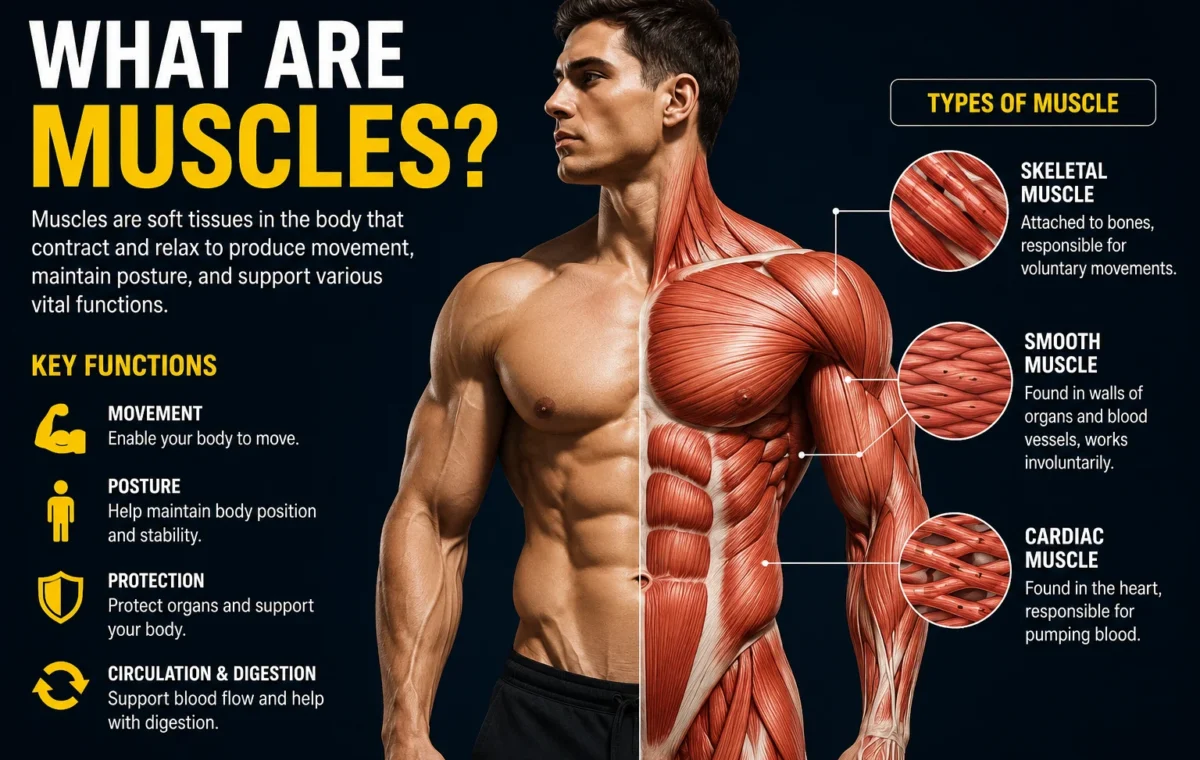
If you’ve ever wondered what are muscles, the simple answer is this: Muscles are soft tissues in your body that contract and relax to create movement, maintain posture, support your joints, and help many vital organs work properly. Without muscles, you couldn’t walk, breathe, smile, blink, or even keep your heart beating.
- Quick Answer
- Key Facts
- 1. Skeletal Muscle
- Main Functions
- 2. Cardiac Muscle
- Main Functions
- 3. Smooth Muscle
- Main Functions
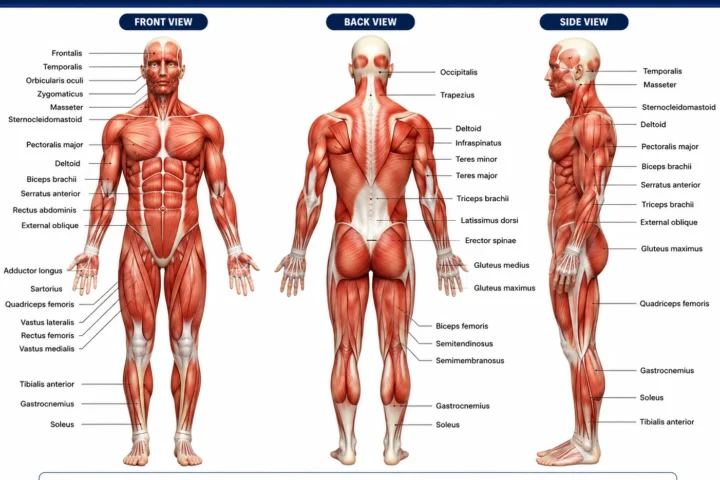
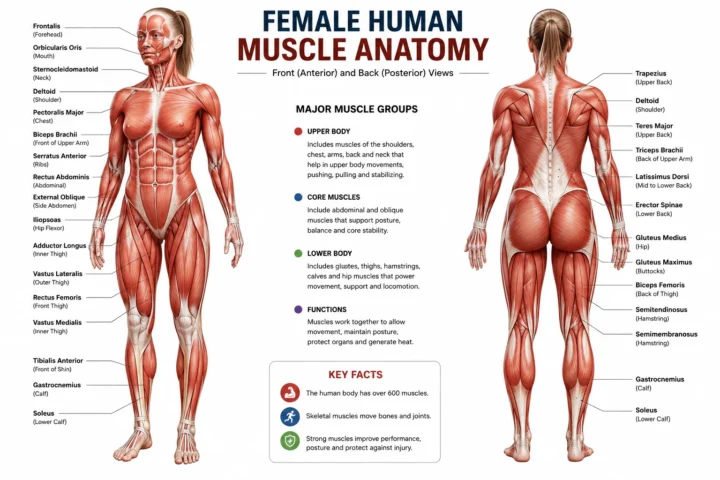
- Chest (Pectoral Muscles)
- Back Muscles
- Shoulder Muscles
- Arm Muscles
- Biceps
- Triceps
- Core Muscles
- Leg Muscles
- Quadriceps
- Hamstrings
- Gluteal Muscles
- Calf Muscles
- 1. Exercise Regularly
- 2. Eat Enough Protein
- 3. Stay Hydrated
- 4. Get Enough Sleep
- 5. Warm Up Before Exercise
- 6. Don't Skip Recovery
- 1. What are muscles in simple words?
- 2. What are the three types of muscles?
- 3. How many muscles are in the human body?
- 4. Why are muscles important?
- 5. How do muscles grow?
- 6. Can muscles get weaker without exercise?
The human body contains more than 600 muscles, and together they make up around 40% of an average adult’s body weight, although the exact percentage varies depending on age, sex, and fitness level. Your muscles work alongside bones, joints, nerves, and tendons to perform thousands of movements every single day.
Whether you’re starting your fitness journey or simply want to understand how your body works, learning about muscles is the first step toward better health. For more insights read here:- what are some major muscles in the human body and lean muscle physique.
Quick Answer
| Question | Answer |
|---|---|
| What are muscles? | Soft tissues that contract and relax to produce movement and support body functions. |
| How many muscle types are there? | Three: Skeletal, Cardiac, and Smooth muscle. |
| Which muscle is voluntary? | Skeletal muscle. |
| Which muscles work automatically? | Cardiac and Smooth muscles. |
| Why are muscles important? | They allow movement, protect joints, maintain posture, generate heat, and support essential organs. |
What Are Muscles?
Muscles are made from specialized cells called muscle fibers. These fibers contain proteins that slide past each other, allowing muscles to shorten (contract) and lengthen (relax). Every movement you make—from lifting a glass of water to taking a deep breath—depends on this process.
Your brain sends electrical signals through the nervous system to tell muscles when to contract. Once the task is complete, the muscles relax until they’re needed again.
Muscles don’t only move your arms and legs. They also help your heart pump blood, push food through your digestive system, control your breathing, and even help regulate body temperature.
Key Facts
- The human body has 600+ muscles.
- Muscles make up approximately 40% of total body weight in many adults.
- Muscles require oxygen and nutrients to produce energy.
- Healthy muscles support balance, mobility, and everyday activities.
- Muscle tissue constantly adapts to exercise, activity, and aging.
The Three Types of Muscles
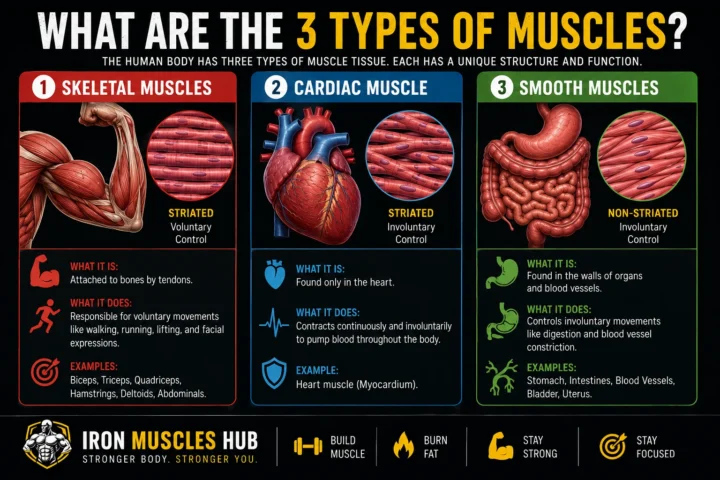
Although all muscles perform contractions, they aren’t all the same. The human body contains three different types of muscle tissue, each designed for specific jobs.
1. Skeletal Muscle
Skeletal muscles are the muscles most people think about when talking about fitness.
These muscles attach to bones through tendons, allowing your skeleton to move. They are called voluntary muscles because you control them consciously.
Examples include:
- Biceps
- Triceps
- Quadriceps
- Hamstrings
- Chest muscles
- Shoulder muscles
- Calf muscles
- Abdominal muscles
Main Functions
- Walking
- Running
- Lifting objects
- Jumping
- Maintaining posture
- Facial expressions
Skeletal muscles become stronger through resistance training and adequate protein intake.
2. Cardiac Muscle
Cardiac muscle exists only in one place—the heart.
Unlike skeletal muscles, cardiac muscle works automatically without conscious control. Every heartbeat is created by coordinated contractions of cardiac muscle tissue.
Main Functions
- Pumps blood throughout the body
- Delivers oxygen and nutrients
- Removes carbon dioxide and waste products
- Supports every organ’s function
Cardiac muscle is incredibly resistant to fatigue because it must work continuously from before birth until the end of life.
3. Smooth Muscle
Smooth muscles are found inside hollow organs throughout the body.
You don’t consciously control these muscles. Instead, they work automatically to keep essential body systems functioning.
Smooth muscles are found in the:
- Stomach
- Intestines
- Bladder
- Blood vessels
- Airways
- Uterus
- Eyes
Main Functions
- Moving food through digestion
- Controlling blood flow
- Helping the lungs expand and contract
- Emptying the bladder
- Supporting childbirth
Without smooth muscles, many automatic body processes would stop functioning properly.
Comparison of the Three Muscle Types
| Feature | Skeletal Muscle | Cardiac Muscle | Smooth Muscle |
|---|---|---|---|
| Control | Voluntary | Involuntary | Involuntary |
| Location | Attached to bones | Heart | Internal organs |
| Main Job | Movement | Pump blood | Move substances through organs |
| Appearance | Striated | Striated | Non-striated |
| Fatigue | Can tire | Highly fatigue-resistant | Slow, long-lasting contractions |
How Do Muscles Work?
Every muscle movement begins in the brain.
When you decide to move, your brain sends an electrical signal through nerves to specific muscle fibers. These fibers respond by shortening through a process involving the proteins actin and myosin. As the muscle contracts, it pulls on tendons, which then pull on bones to create movement.
For example, when you bend your arm:
- Your brain sends a signal.
- The biceps contracts.
- The triceps relaxes.
- Tendons pull the forearm upward.
- Your elbow bends smoothly.
This coordinated system happens in fractions of a second and repeats thousands of times every day.
Muscles also require a steady supply of:
- Oxygen
- Water
- Glucose
- Amino acids
- Vitamins and minerals
These nutrients help produce the energy needed for continuous muscle contractions.
Muscle Anatomy: What Are Muscles Made Of?
Although muscles may look like a single piece of tissue, they’re actually built from millions of tiny structures working together.
Each muscle has several layers:
| Muscle Structure | What It Does |
|---|---|
| Muscle | The entire muscle organ (such as the biceps). |
| Muscle Fascicle | A bundle of muscle fibers. |
| Muscle Fiber | A single muscle cell capable of contracting. |
| Myofibril | Tiny rods inside muscle fibers responsible for contraction. |
| Sarcomere | The smallest functional unit that creates muscle movement. |
| Actin & Myosin | Proteins that slide together to make muscles contract. |
When your brain tells a muscle to move, millions of sarcomeres shorten at the same time. This creates enough force to lift, pull, push, run, or jump.
Major Muscle Groups in the Human Body
The human body contains hundreds of muscles, but several large muscle groups do most of the work during everyday movement and exercise.
Chest (Pectoral Muscles)
Located at the front of your upper body, the chest muscles help you:
- Push objects
- Lift your arms
- Perform push-ups and bench presses
- Stabilize the shoulder joint
Back Muscles
The back contains several important muscles, including the latissimus dorsi and trapezius.
These muscles help with:
- Pulling movements
- Maintaining posture
- Supporting the spine
- Rotating the shoulders
Strong back muscles reduce the risk of poor posture and back pain.
Shoulder Muscles
The shoulders are mainly powered by the deltoid muscles.
Their functions include:
- Raising your arms
- Rotating your shoulders
- Lifting objects overhead
- Improving upper-body stability
Arm Muscles
The upper arms contain two well-known muscles:
Biceps
Located at the front of the upper arm.
Main jobs:
- Bend the elbow
- Rotate the forearm
- Lift objects
Triceps
Located at the back of the upper arm.
Main jobs:
- Straighten the elbow
- Push movements
- Stabilize the arm
Core Muscles
Your core includes:
- Rectus abdominis
- Obliques
- Transverse abdominis
- Lower back muscles
The core is responsible for:
- Balance
- Stability
- Protecting the spine
- Supporting nearly every movement
A strong core improves athletic performance and reduces injury risk.
Leg Muscles
The legs contain the largest muscles in the body.
Major muscle groups include:
Quadriceps
Located on the front of the thigh.
Functions:
- Straighten the knee
- Walk
- Run
- Jump
Hamstrings
Located at the back of the thigh.
Functions:
- Bend the knee
- Sprint
- Climb stairs
Gluteal Muscles
Commonly called the glutes.
Functions:
- Hip movement
- Standing
- Walking
- Running
- Maintaining balance
Calf Muscles
Located in the lower leg.
Functions:
- Walking
- Running
- Jumping
- Standing on your toes
How Muscles Become Stronger
One of the most interesting facts about muscles is their ability to adapt.
When you perform resistance exercises such as:
- Weight lifting
- Push-ups
- Squats
- Pull-ups
your muscle fibers experience tiny amounts of stress. During recovery, your body repairs these fibers, making them slightly stronger and often larger than before.
This process is known as muscle hypertrophy.
For muscles to grow efficiently, they need:
- Progressive strength training
- Enough dietary protein
- Adequate calories
- Proper hydration
- Quality sleep
- Recovery days between hard workouts
Consistency is far more important than occasional intense workouts.
Common Muscle Injuries and Problems
Muscles are strong, but they can still become injured or overworked.
Here are some of the most common muscle-related problems:
| Condition | Description |
|---|---|
| Muscle strain | Overstretching or tearing muscle fibers. |
| Muscle cramps | Sudden, painful muscle contractions. |
| Delayed Onset Muscle Soreness (DOMS) | Temporary soreness after unfamiliar or intense exercise. |
| Muscle fatigue | Reduced ability to produce force after prolonged activity. |
| Atrophy | Loss of muscle size due to inactivity, aging, or illness. |
Most mild muscle injuries improve with rest, hydration, gentle movement, and gradual return to activity. Severe pain, swelling, or loss of function should be assessed by a healthcare professional.
How to Keep Your Muscles Healthy
Healthy muscles support movement, protect joints, and improve quality of life. Fortunately, taking care of them doesn’t have to be complicated.
1. Exercise Regularly
Aim for a combination of:
- Strength training
- Walking
- Cycling
- Swimming
- Stretching
Adults should include muscle-strengthening activities at least twice per week, following current physical activity guidelines.
2. Eat Enough Protein
Protein provides the amino acids your body uses to repair and maintain muscle tissue.
Good protein sources include:
- Chicken
- Fish
- Eggs
- Greek yogurt
- Beans
- Lentils
- Tofu
- Lean beef
- Cottage cheese
3. Stay Hydrated
Water supports muscle function and helps reduce the risk of cramps and dehydration during exercise.
4. Get Enough Sleep
Most muscle repair happens while you sleep. Adults should aim for 7–9 hours of quality sleep each night.
5. Warm Up Before Exercise
A proper warm-up increases blood flow, prepares muscles for activity, and may reduce the risk of injury.
Simple warm-up ideas include:
- Brisk walking
- Light jogging
- Dynamic stretching
- Mobility exercises
6. Don’t Skip Recovery
Rest days allow muscles to repair and become stronger. Overtraining without recovery can increase the risk of injury and slow progress.
Muscle Health Tips for Beginners
If you’re new to fitness, keep these simple habits in mind:
- Focus on proper exercise technique before lifting heavier weights.
- Increase workout intensity gradually.
- Eat balanced meals that include protein, carbohydrates, and healthy fats.
- Stay consistent rather than chasing quick results.
- Listen to your body and rest if you’re injured or excessively sore.
- Make exercise a regular part of your weekly routine.
These small, sustainable habits can help you build stronger muscles and maintain good health over the long term.
1. What are muscles in simple words?
Muscles are soft tissues made of special fibers that contract and relax to create movement. They help you walk, run, breathe, swallow, maintain your posture, and even keep your heart beating. Without muscles, your body couldn’t perform everyday tasks or many automatic functions needed to stay alive.
2. What are the three types of muscles?
The human body has three types of muscle tissue:
- Skeletal muscle – Attached to bones and controlled voluntarily for movement.
- Cardiac muscle – Found only in the heart and pumps blood continuously.
- Smooth muscle – Located in organs like the stomach, intestines, bladder, and blood vessels. It works automatically without conscious control.
Each type has a unique structure and purpose, but all are essential for a healthy body.
3. How many muscles are in the human body?
The human body contains more than 600 muscles. Depending on how muscles are classified, some anatomy references list around 650 named muscles. Together, they make up roughly 40% of an average adult’s body weight, though this varies with age, sex, and fitness level.
4. Why are muscles important?
Muscles do much more than help you move. They:
- Allow movement and physical activity.
- Maintain posture and balance.
- Protect joints and support bones.
- Generate heat to help regulate body temperature.
- Help your heart pump blood.
- Move food through the digestive system.
- Assist with breathing and many automatic body functions.
Healthy muscles are essential for strength, mobility, and long-term independence.
5. How do muscles grow?
Muscles grow through a process called muscle hypertrophy. During strength training, tiny tears occur in muscle fibers. As your body repairs these fibers, they become stronger and slightly larger.
To support muscle growth, you need:
- Progressive resistance training.
- Enough protein in your diet.
- Quality sleep and recovery.
- Adequate hydration.
- Consistent exercise over time.
Muscles don’t grow overnight—steady training and good nutrition are the keys to long-term progress.
6. Can muscles get weaker without exercise?
Yes. When muscles aren’t used regularly, they gradually lose size and strength through a process called muscle atrophy. Long periods of inactivity, bed rest, or aging can all contribute to muscle loss.
Regular physical activity, even simple walking or bodyweight exercises, helps maintain muscle strength and function.
Final Thoughts
Understanding what are muscles is the first step toward appreciating how incredible the human body really is. Muscles allow every movement you make—from lifting a shopping bag to taking your next breath. They also support your heart, digestive system, posture, and overall health.
Learning about the three types of muscles, how they work, and how to care for them can help you make smarter decisions about exercise, nutrition, and healthy living. Whether your goal is to build strength, stay active as you age, or simply understand your body better, healthy muscles are a foundation for lifelong wellness.
Small habits—such as regular exercise, balanced nutrition, staying hydrated, and getting enough sleep—can make a lasting difference in keeping your muscles strong and functioning well.