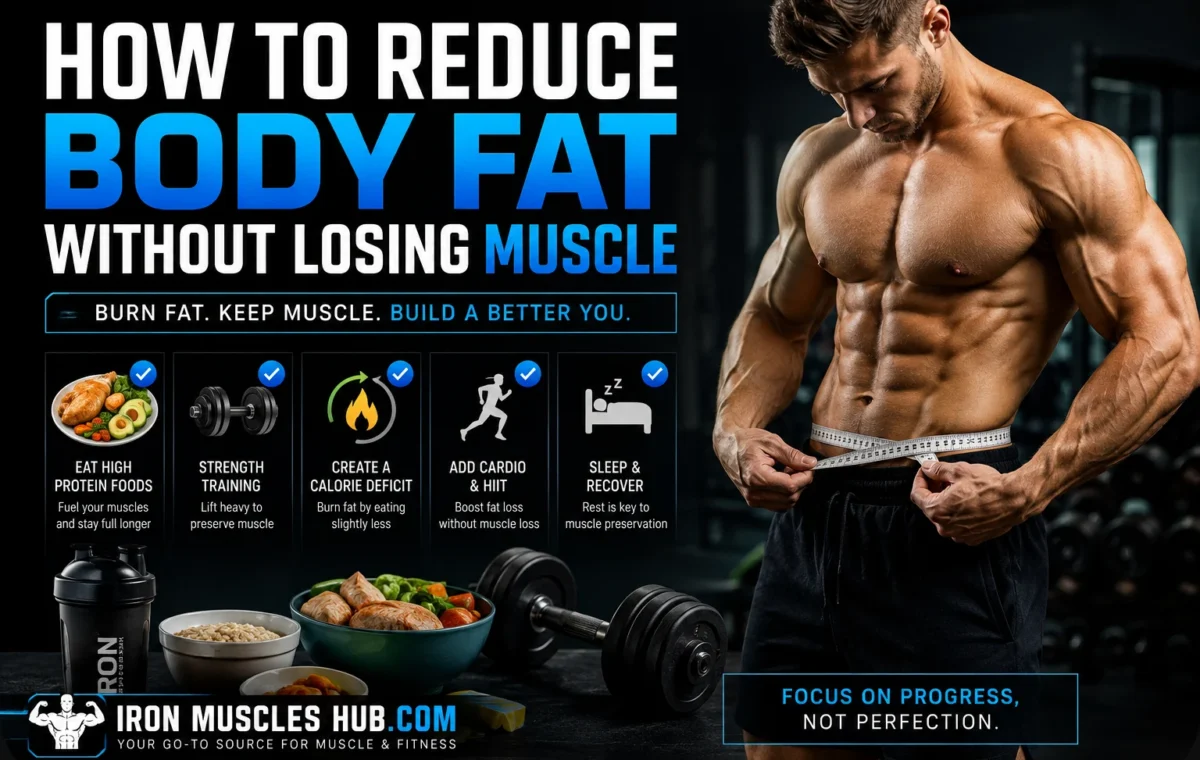
If you want to know how to reduce body fat without losing muscle, focus on a moderate calorie deficit, keep lifting weights, eat enough protein, and recover properly. You don’t need an extreme diet or hours of cardio.
- Quick Answer
- 1. how to reduce body fat without losing muscle
- A practical starting point
- Why extreme dieting can backfire
- 2. Keep Strength Training During Fat Loss
- Don't turn every workout into a calorie-burning session
- What should change?
- 3. Eat Enough Protein
- What does that look like?
- Spread protein across the day
- 4. Don't Eliminate Carbohydrates
- Put carbohydrates around training if useful
- 5. Keep Dietary Fat at a Sensible Level
- 6. Use Cardio as a Tool, Not the Main Muscle-Preservation Strategy
- Walking is underrated
- 7. Protect Your Strength
- Don't chase personal records every week
- 8. Prioritize Sleep and Recovery
- Recovery checklist
- 9. Track More Than Scale Weight
- Track these four things
- 10. Original Comparison: Which Fat-Loss Approach Protects Muscle Best?
- 11. Worked Example: A 180 lb / 81.6 kg Beginner
- 12. Common Mistakes → Why → Fix
- Mistake 1: Cutting calories too aggressively
- Mistake 2: Replacing lifting with cardio
- Mistake 3: Eating "healthy" but ignoring calories
- Mistake 4: Eating very little protein
- Mistake 5: Trying to maintain maximum training volume
- Mistake 6: Panicking over daily scale changes
- Mistake 7: Chasing visible abs at any cost
- 13. The 30-Second Muscle-Preservation Self-Test
- 14. Who This Approach Is NOT For
- How much protein should I eat to lose fat without losing muscle?
- How fast should I lose weight without losing muscle?
- Can I lose belly fat without losing muscle?
- Does cardio cause muscle loss?
- Should I lift weights while trying to lose body fat?
- Closing Summary
The goal isn’t simply to make the scale move. It’s to lose fat mass while giving your body strong reasons to keep its muscle. Research consistently supports combining calorie restriction with resistance training, while adequate protein can further support lean-mass retention.
For beginners, that means making a few controlled changes rather than completely rebuilding your lifestyle. For more insights read here :- main muscle groups and naming of muscles .
Quick Answer
- Create a moderate calorie deficit instead of drastically cutting food.
- Keep resistance training and continue giving your muscles a meaningful training stimulus.
- Prioritize protein at meals and across the day.
- Use cardio and daily activity as tools, not punishment.
- Track your weight, waist, strength, and recovery so you can adjust before muscle loss becomes a problem.
1. how to reduce body fat without losing muscle
The basic requirement for losing body fat is a sustained energy deficit, but the size of that deficit matters if preserving muscle is a priority. A very aggressive diet can make weight fall quickly, but faster isn’t automatically better for maintaining lean tissue. Research on resistance-trained athletes suggests that slower weight loss can better protect lean mass, particularly as someone becomes leaner.
Think of your calorie deficit as a dial, not an on/off switch.
If your maintenance intake is around 2,500 calories per day, dropping immediately to 1,500 may create a large deficit that makes training, recovery, hunger, and adherence harder.
A smaller reduction can be easier to maintain.
A practical starting point
For many beginners, a reasonable starting approach is to reduce daily intake modestly and monitor the trend for two to three weeks.
For example:
| Starting maintenance | Example daily intake | Approx. daily deficit |
|---|---|---|
| 2,200 kcal | 1,800–2,000 kcal | 200–400 kcal |
| 2,500 kcal | 2,100–2,300 kcal | 200–400 kcal |
| 2,800 kcal | 2,400–2,600 kcal | 200–400 kcal |
| 3,000 kcal | 2,600–2,800 kcal | 200–400 kcal |
These are examples, not universal prescriptions. Your actual energy needs depend on body size, activity, age, sex, training, and other factors.
A useful principle is to start conservatively, collect data, then adjust.
Why extreme dieting can backfire
When calories fall sharply, you have less energy available for training and recovery. You may also experience greater hunger, fatigue, reduced performance, and difficulty maintaining your normal routine.
The objective is not to lose the maximum possible weight every week.
The objective is to create enough of a deficit to reduce fat while maintaining the behaviors and training that protect muscle.
A review of fat-loss strategies for resistance-trained athletes recommends targeting approximately 0.5–1.0% of body weight per week, with slower rates particularly useful for leaner individuals.
For a 180 lb (81.6 kg) person, 0.5% is about 0.9 lb (0.4 kg) per week.
You don’t have to hit that number perfectly every week. Water, glycogen, sodium, food volume, and digestion can all move the scale.
Look at the trend, not one morning’s weigh-in.
2. Keep Strength Training During Fat Loss
If your main goal is to preserve muscle, resistance training should remain a major part of your plan.
This is one of the clearest findings in the research. A 2025 systematic review and meta-analysis found that adding resistance exercise to dietary weight loss helped protect fat-free mass and increased fat-mass loss compared with diet alone.
ACSM also highlights the importance of resistance training for maintaining lean tissue during weight loss. In the evidence it discusses, diet plus resistance training produced substantially better lean-mass preservation than dieting alone.
Don’t turn every workout into a calorie-burning session
A common mistake is changing a muscle-building program into a circuit of endless lightweight exercises because you’re trying to burn more calories.
That’s usually unnecessary.
Your lifting program should still provide a meaningful stimulus.
You can continue squatting, pressing, rowing, pulling, hinging, and doing isolation exercises while dieting.
What should change?
You may eventually need to reduce training volume if recovery suffers.
For example, imagine you’re doing:
- 4 sets of squats
- 4 sets of Romanian deadlifts
- 4 sets of leg presses
- 4 sets of leg curls
- 4 sets of calf raises
If your recovery is good, you may not need to change anything immediately.
But if your strength is dropping, soreness is lasting for days, and every workout feels harder, trimming a few sets can make sense.
A 2022 study in resistance-trained men found that both moderate- and higher-volume resistance training preserved lean mass during energy restriction, suggesting that simply adding more training volume isn’t necessarily the answer.
Coach’s rule: If you need to make an adjustment during a cut, don’t automatically make the weights lighter and the workouts longer. First consider reducing unnecessary volume while keeping a strong training stimulus.
3. Eat Enough Protein
Protein matters because you’re trying to maintain muscle while your body has less energy available.
Research involving resistance-trained athletes supports relatively high protein intakes during energy restriction, particularly for leaner athletes and more aggressive deficits.
A practical target for active adults cutting body fat is often around 1.6–2.2 g of protein per kg of body weight per day. For people who are already quite lean and training hard, higher intakes may sometimes be appropriate, but that doesn’t mean everyone needs extremely high protein intake.
What does that look like?
| Body weight | 1.6 g/kg | 2.0 g/kg | 2.2 g/kg |
| 140 lb / 63.5 kg | 102 g | 127 g | 140 g |
| 160 lb / 72.6 kg | 116 g | 145 g | 160 g |
| 180 lb / 81.6 kg | 131 g | 163 g | 180 g |
| 200 lb / 90.7 kg | 145 g | 181 g | 200 g |
| 220 lb / 99.8 kg | 160 g | 200 g | 220 g |
These numbers are planning examples, not medical requirements.
If you have significant kidney disease or another medical condition affected by dietary protein, speak with your healthcare professional before deliberately increasing protein intake.
Spread protein across the day
You don’t need to eat six meals.
Three or four protein-rich meals can work well for many people.
For example:
Breakfast: eggs + Greek yogurt
Lunch: chicken + rice + vegetables
Snack: cottage cheese + fruit
Dinner: salmon + potatoes + vegetables
This approach is usually easier than trying to consume most of your daily protein in one enormous meal.
ACSM’s educational guidance also emphasizes adequate protein intake for muscle maintenance, particularly alongside regular exercise.
4. Don’t Eliminate Carbohydrates
You don’t need to remove carbohydrates to lose body fat.
Fat loss is primarily driven by maintaining an energy deficit over time. Different dietary patterns can work if they allow you to maintain that deficit consistently.
Carbohydrates can also be useful for training performance.
Foods such as:
- oats
- potatoes
- rice
- whole-grain bread
- fruit
- beans
- pasta
can fit into a fat-loss diet.
If removing carbohydrates makes your workouts worse, there’s little reason to eliminate them simply because you’re cutting.
Put carbohydrates around training if useful
A meal containing carbohydrates and protein before training can help you feel fueled.
After training, another balanced meal can help you replace energy and provide protein.
You don’t need to obsess over a tiny post-workout window.
Your total daily intake and consistency matter much more.
5. Keep Dietary Fat at a Sensible Level
Fat is energy-dense, so reducing portions of high-fat foods can make it easier to create a calorie deficit.
But that doesn’t mean you should eliminate dietary fat.
Include sensible portions of foods such as:
- olive oil
- nuts
- seeds
- avocado
- eggs
- oily fish
- dairy foods
The key is portion control.
A tablespoon of oil, a handful of nuts, or a large spoonful of nut butter can contain substantially more calories than a beginner might expect.
You don’t have to remove these foods.
You simply need to account for them.
6. Use Cardio as a Tool, Not the Main Muscle-Preservation Strategy
Cardio can help you increase energy expenditure and improve cardiovascular fitness.
But if your goal is fat loss with muscle retention, cardio shouldn’t replace resistance training.
A recent study of adults following a calorie-restricted diet found that resistance training helped protect fat-free mass while supporting fat loss.
You can use several forms of cardio:
- brisk walking
- cycling
- swimming
- rowing
- jogging
- incline treadmill walking
The best choice is the one you can perform consistently without interfering with your lifting.
Walking is underrated
You don’t necessarily need exhausting cardio sessions.
Adding regular walking can increase daily activity without creating the same recovery demands as repeated high-intensity sessions.
For example, if you’re currently very sedentary, adding a daily walk can be a simple first step.
Don’t assume you need a particular step count to lose fat.
Instead, establish your normal activity level and gradually increase it if needed.
7. Protect Your Strength
Your strength isn’t a perfect measurement of muscle mass, but it can provide useful feedback during a fat-loss phase.
Suppose you normally perform:
Bench press: 185 lb / 84 kg for 6 reps
After several weeks of dieting, you’re still performing around:
180–185 lb / 82–84 kg for 5–6 reps
That’s not necessarily a problem.
But if your performance changes to:
155 lb / 70 kg for 5 reps
and this decline continues across several exercises, it’s worth examining your recovery, calorie deficit, sleep, training volume, and nutrition.
One bad workout means very little.
A persistent downward trend deserves attention.
Don’t chase personal records every week
During a calorie deficit, your main goal is often maintaining performance, not setting a new personal record every session.
If you maintain similar loads and reps while your body weight decreases, that’s a useful sign that your training stimulus remains productive.
8. Prioritize Sleep and Recovery
Fat loss doesn’t happen in a vacuum.
You still need to recover from your workouts.
If you’re consistently sleeping poorly, training hard, eating less, and adding large amounts of cardio, the total stress can become difficult to manage.
Your plan should be sustainable enough that you can repeat it next week.
A good fat-loss phase should fit around your life rather than forcing every part of your life to revolve around dieting.
Recovery checklist
Aim to:
- maintain a consistent sleep schedule
- keep resistance training manageable
- avoid unnecessary extra workouts
- eat enough protein
- stay hydrated
- include rest days
- manage work and lifestyle stress where possible
If you’re constantly exhausted, irritable, cold, hungry, and unable to train normally, don’t automatically respond by cutting another 300 calories.
That can make the problem worse.
9. Track More Than Scale Weight
Scale weight is useful, but it doesn’t tell you exactly what you’re losing.
A better beginner tracking system uses several measurements.
Track these four things
1. Body weight
Take several morning weigh-ins per week under similar conditions and look at the weekly average.
2. Waist measurement
Measure around the waist consistently, using the same location and conditions.
For reference, 1 inch = 2.54 cm.
3. Gym performance
Record major lifts and repetitions.
4. Progress photos
Take photos under similar lighting, distance, clothing, and posture.
Together, these give you much more information than the scale alone.
10. Original Comparison: Which Fat-Loss Approach Protects Muscle Best?
| Approach | Fat loss potential | Muscle-preservation potential | Beginner-friendly? |
| Crash diet + lots of cardio | High short-term scale loss | Poorer | No |
| Moderate calorie deficit + lifting | High | High | Yes |
| Moderate deficit + lifting + adequate protein | High | Very high | Yes |
| Diet alone | Moderate to high | Lower | Yes, but not ideal for muscle |
| Maintenance calories + lifting | Low fat loss | High | Yes |
| Extreme restriction + minimal training | High short-term weight loss | Poor | No |
The most useful combination for a beginner is generally moderate energy restriction + resistance training + adequate protein + appropriate activity.
This isn’t just gym folklore. A systematic review found that energy restriction combined with resistance exercise and higher protein was among the strongest combinations for improving body composition in the populations studied.
11. Worked Example: A 180 lb / 81.6 kg Beginner
Let’s say a beginner weighs:
180 lb / 81.6 kg
Their estimated maintenance intake is approximately:
2,500 calories/day
They want to reduce body fat while keeping as much muscle as possible.
Instead of immediately adopting an extreme diet, they might begin with an example intake of:
2,100–2,300 calories/day
For protein, a practical target around 2.0 g/kg would be:
81.6 × 2.0 = 163 g protein/day
They could divide that across four meals:
- Breakfast: 35–40 g
- Lunch: 40 g
- Snack: 30–35 g
- Dinner: 45–50 g
Their training might remain centered on resistance exercises three or four days per week.
Cardio could be added through walking or a few manageable sessions if needed.
After two or three weeks, they would review:
- average body weight
- waist measurement
- gym performance
- hunger
- energy
- recovery
If body weight and waist measurements are gradually moving down while strength remains reasonably stable, there may be no reason to make a major change.
If progress has stalled for several weeks, they can make a small adjustment rather than immediately slashing calories.
This is the key idea: make the smallest change that gets the desired response.
12. Common Mistakes → Why → Fix
Mistake 1: Cutting calories too aggressively
Why: A very large deficit can increase fatigue and make training and recovery harder.
Fix: Start with a moderate deficit and monitor your progress before making further reductions. Slower loss can be particularly useful for leaner people trying to preserve muscle.
Mistake 2: Replacing lifting with cardio
Why: Cardio increases energy expenditure, but resistance training provides the direct training stimulus needed to help preserve muscle.
Fix: Keep strength training as the foundation and use cardio as a supporting tool.
Mistake 3: Eating “healthy” but ignoring calories
Why: Nutritious foods can still provide enough energy to prevent a calorie deficit.
Fix: Learn your approximate portions and track intake temporarily if you’re unsure where your calories are coming from.
Mistake 4: Eating very little protein
Why: Energy restriction can increase the challenge of retaining lean tissue.
Fix: Build every major meal around a quality protein source.
Mistake 5: Trying to maintain maximum training volume
Why: A calorie deficit can reduce your recovery resources.
Fix: Keep useful exercises and training intensity while trimming unnecessary volume if recovery deteriorates.
Mistake 6: Panicking over daily scale changes
Why: Body weight changes with hydration, sodium, glycogen, digestion, and food volume.
Fix: Compare weekly averages instead of reacting to individual weigh-ins.
Mistake 7: Chasing visible abs at any cost
Why: Extremely low body-fat targets can require increasingly restrictive behavior and may not be appropriate for everyone.
Fix: Set a realistic goal based on health, performance, appearance, and sustainability.
13. The 30-Second Muscle-Preservation Self-Test
Ask yourself these five questions:
1. Am I losing weight gradually?
2. Am I still resistance training consistently?
3. Am I eating enough protein?
4. Is my strength mostly stable?
5. Can I recover well enough to repeat my routine next week?
If the answer is yes to most of these, your plan is probably moving in a sensible direction.
If several answers are no, don’t automatically add more cardio or remove more food.
First look at your calorie deficit, protein intake, training volume, sleep, and overall recovery.
14. Who This Approach Is NOT For
A self-directed fat-loss plan isn’t appropriate for everyone.
You should speak with a qualified healthcare professional before intentionally restricting calories if you:
- are pregnant or breastfeeding
- are under 18
- have a history of an eating disorder
- have significant kidney, liver, heart, or metabolic disease
- take medications that affect appetite, blood glucose, or body weight
- are significantly underweight
- have unexplained rapid weight changes
Competitive athletes, people preparing for physique competitions, and individuals trying to reach very low body-fat levels may also benefit from professional supervision.
This article is designed for general education, not individualized medical or nutritional treatment.
FAQ
How much protein should I eat to lose fat without losing muscle?
For active adults, around 1.6–2.2 g/kg of body weight per day is a practical range often used when trying to preserve muscle during fat loss. Research in lean, resistance-trained athletes has examined higher intakes, particularly during aggressive calorie restriction. Your ideal intake depends on body composition, training, calorie deficit, and health status.
How fast should I lose weight without losing muscle?
A commonly cited target for resistance-trained people is roughly 0.5–1.0% of body weight per week, although slower loss may be preferable as you become leaner. For someone weighing 180 lb (81.6 kg), 0.5% is about 0.9 lb (0.4 kg) per week. Don’t treat this as a mandatory weekly quota; monitor your overall trend and gym performance.
Can I lose belly fat without losing muscle?
Yes, you can reduce overall body fat while working to preserve muscle, but you can’t reliably choose exactly where your body removes fat first. The basic strategy remains a controlled calorie deficit, resistance training, adequate protein, and appropriate physical activity. Your waist measurement may decrease as total body fat falls, but individual fat-loss patterns vary considerably.
Does cardio cause muscle loss?
Cardio itself isn’t automatically responsible for muscle loss. Problems are more likely when excessive cardio is combined with inadequate food intake, poor recovery, and insufficient resistance training. Cardio can be useful for increasing activity and improving cardiovascular fitness. Keep it at a level that supports your fat-loss goal without consistently interfering with your lifting and recovery.
Should I lift weights while trying to lose body fat?
Yes. If preserving muscle is a priority, resistance training should remain part of your plan. Evidence shows that resistance exercise during dietary weight loss helps protect fat-free mass compared with diet alone. You don’t necessarily need more and more training volume; the goal is to provide a consistent, productive stimulus while managing recovery.
Your Practical Fat-Loss Checklist
If you’re a beginner, keep the plan simple:
- Estimate your maintenance calories.
- Start with a moderate calorie reduction.
- Aim for gradual weight loss rather than the fastest possible result.
- Eat enough protein every day.
- Keep resistance training in your routine.
- Maintain useful training intensity.
- Reduce unnecessary volume if recovery drops.
- Use walking or moderate cardio to increase activity.
- Sleep and recover consistently.
- Track weight trends, waist size, and gym performance.
- Make small adjustments instead of drastic changes.
- Stop chasing faster results if your health or training performance is deteriorating.
Closing Summary
Learning how to reduce body fat without losing muscle is less about finding a perfect diet and more about managing the basics well. Use a moderate calorie deficit, eat enough protein, continue resistance training, stay active, and give yourself enough recovery to perform.
Don’t judge the plan by one weigh-in or one workout. Look at the trend over several weeks. If your waist is gradually getting smaller, body weight is moving at a sensible pace, and your strength is reasonably stable, you’re likely doing many of the important things right.
For beginners, consistency beats extreme dieting. Build a plan you can repeat, monitor the results, and make small adjustments when the evidence tells you to.