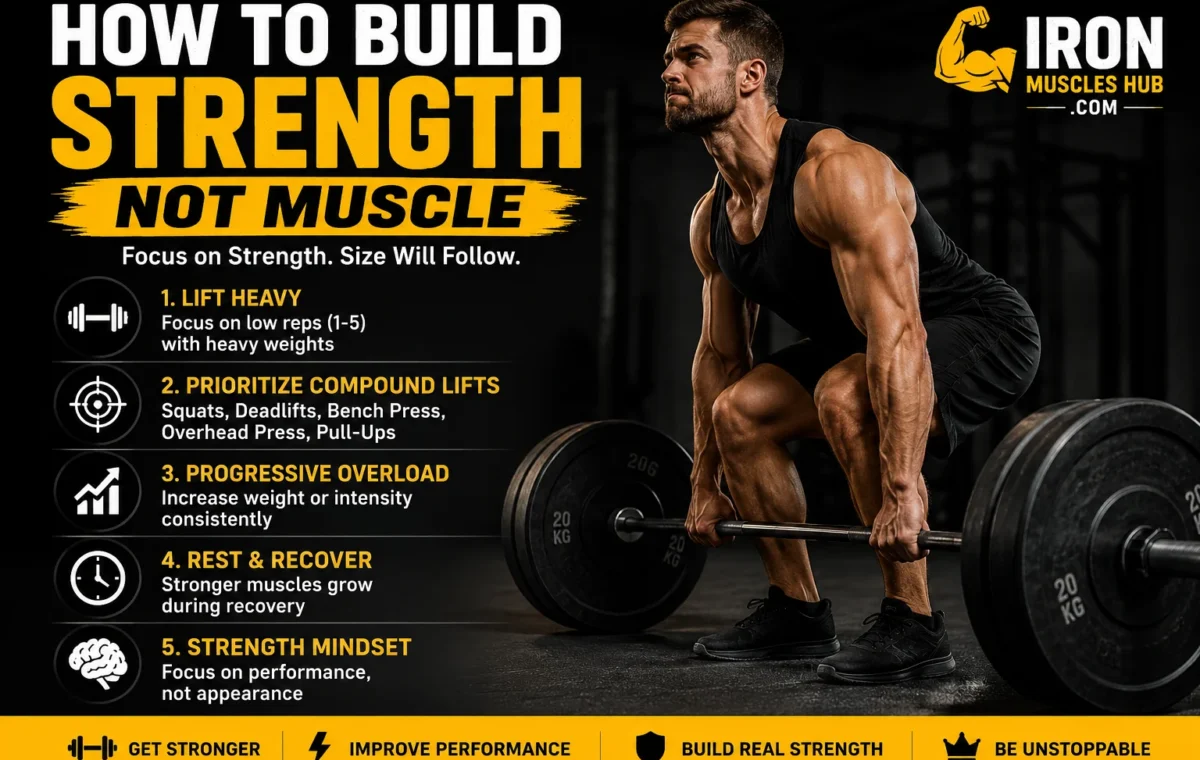
If your goal is to build strength not muscle, you need to train for force production rather than maximum muscle growth. Use relatively heavy loads, low-to-moderate training volume, longer rest periods, and highly consistent technique.
- Quick Answer: How to Build Strength Without Getting Bigger
- how to build strength not muscle ?
- A practical strength-first setup
- Strength-focused session
- High-volume bodybuilding-style session
- Squat support
- Bench support
- Deadlift support
- Day 1 — Squat + Upper Body
- Day 2 — Deadlift + Press
- Day 3 — Technique + Strength
- Mistake 1: Thinking Heavy Weight Automatically Prevents Muscle Growth
- Mistake 2: Maxing Out Every Workout
- Mistake 3: Adding Too Many Accessories
- Mistake 4: Training Until You Can't Move
- Mistake 5: Eating Too Little
- Mistake 6: Changing Exercises Constantly
- Can I get stronger without gaining muscle?
- What is the best rep range for strength without getting bigger?
- Can I build strength without gaining weight?
- Should I lift heavy if I don't want big muscles?
- Do I need to train to failure to get stronger?
You can become noticeably stronger without adding a large amount of muscle, particularly when you’re new to resistance training. Early strength improvements can come from better motor-unit recruitment, coordination, technique, and other neural adaptations.
The important catch is that strength and muscle size overlap. You can’t completely separate them. Over months and years, some muscle growth can accompany strength training, especially if training volume and food intake are high.
The aim, then, isn’t to prevent every gram of muscle gain. It’s to bias your training toward strength while avoiding unnecessary hypertrophy-focused work. For more insights read here :- muscle growth fat loss diet and reduce body fat gain muscle .
Quick Answer: How to Build Strength Without Getting Bigger
- Prioritize heavy strength work rather than high-volume bodybuilding sessions.
- Use roughly 2–3 working sets for your main exercises and keep unnecessary accessory volume low.
- Favor low repetitions, especially on major lifts, while avoiding constant maximum attempts.
- Rest long enough to perform your next set with good technique rather than chasing a muscle pump.
- Keep food intake around your normal maintenance needs if you don’t want to intentionally gain body weight.
- Focus on specific lifts and technical practice, because strength is partly a skill.
The 2026 ACSM resistance-training position stand specifically identifies heavier loading around 80% of 1RM with 2–3 sets per exercise as an effective strength-oriented prescription, while higher weekly volume is more strongly associated with hypertrophy.
how to build strength not muscle ?
Yes, but there are limits.
Strength isn’t simply a measurement of how much muscle you have. It’s also your ability to coordinate that muscle and produce force efficiently.
When you learn to squat, bench press, deadlift, press, or perform another resistance exercise, your nervous system becomes better at organizing the movement. You improve coordination, learn the correct positions, become more efficient at recruiting motor units, and become more comfortable producing high force.
Research supports the role of neural adaptations in strength development. A systematic review and meta-analysis found evidence of neural changes following resistance training that contribute to increases in muscle strength.
That’s one reason a beginner can add weight to the bar without seeing a dramatic change in body size.
Think about it this way:
Muscle size is hardware. Strength is hardware plus software.
You can improve the software substantially before you need a major hardware upgrade.
However, muscle still matters. Larger muscles generally have greater potential to produce force, so completely avoiding hypertrophy isn’t a realistic requirement for long-term strength development.
The better goal is strength-first programming.
Strength vs. Muscle Growth: What’s the Difference?
Strength and hypertrophy are related, but they’re not identical adaptations.
A hypertrophy-focused program is designed to provide enough training stimulus and volume to encourage increases in muscle size.
A strength-focused program puts more emphasis on:
- Heavy resistance
- Specific exercises
- Low repetitions
- Technical consistency
- Longer rest periods
- High-quality repetitions
- Controlled training volume
- Progressive increases in performance
This distinction is supported by resistance-training research.
A systematic review and meta-analysis found that higher-load training produced greater improvements in 1RM strength, while lower- and higher-load approaches could produce similar muscle hypertrophy when other factors were controlled.
Another large systematic review found that higher-load resistance training was particularly effective for strength, while multiple loading approaches could stimulate hypertrophy.
That gives you an important programming principle:
If strength is your priority, don’t simply train harder. Train more specifically for strength.
The Best Training Approach for Strength Without Much Muscle Gain
The biggest mistake beginners make is assuming that heavier weights automatically mean more muscle.
They don’t.
Training volume, effort, exercise selection, nutrition, and recovery all matter.
If you want to emphasize strength while limiting unnecessary muscle growth, manipulate those variables together.
A practical strength-first setup
| Training Variable | Strength Priority | Hypertrophy Priority |
|---|---|---|
| Main load | Relatively heavy | Moderate to heavy |
| Repetitions | Usually low | Moderate or varied |
| Sets | Moderate | Often higher |
| Rest | Longer | Moderate |
| Exercise selection | Specific compounds | Wider exercise selection |
| Accessory work | Limited and purposeful | More extensive |
| Training goal | Force + skill | Muscle stimulus |
| Failure training | Usually unnecessary | Can be used selectively |
| Nutrition | Around maintenance if weight stability matters | Often higher energy intake |
This doesn’t mean every strength program has to look identical. Individual training age, exercise selection, injury history, and recovery capacity all matter.
The point is to create a different overall training dose from someone whose primary goal is maximizing muscle size.
1. Use Heavy Loads for Your Main Strength Exercises
If you want to get stronger without spending your entire workout accumulating muscle-building volume, put most of your effort into heavy, technically sound compound exercises.
Examples include:
- Squat
- Bench press
- Deadlift
- Overhead press
- Trap-bar deadlift
- Weighted pull-up
- Barbell or machine row
The 2026 ACSM guidance recommends heavier loading for strength, with around 80% of 1RM and 2–3 sets per exercise as a practical evidence-based prescription for healthy adults.
NSCA material also describes basic strength work using roughly 80–95% of 1RM with lower repetitions and moderate volume.
For a beginner, however, you don’t need to jump straight into extremely heavy lifting.
Start with a load you can control.
For example, if you eventually establish a bench-press 1RM of 100 lb (45.4 kg), 80% would be approximately 80 lb (36.3 kg). NSCA gives the same basic calculation principle when explaining percentage-based loading.
You don’t need to test your true maximum every week.
A better beginner strategy is to use a challenging weight that allows technically clean repetitions.
2. Keep Repetitions Relatively Low
High-repetition training can build strength, but if your specific goal is strength with minimal size gain, low-repetition work is a useful way to keep the session focused.
For major lifts, you might use:
- 2–3 reps
- 3–5 reps
- Occasionally a controlled single
You don’t need to perform all your work at the lowest possible repetition count.
In fact, beginners often benefit from spending time learning the movement before attempting very heavy singles.
The principle is simple:
Use enough repetitions to practice the movement, but don’t turn every exercise into a high-volume muscle-building session.
Research comparing resistance-training loads shows that heavier loading tends to produce better 1RM strength improvements, while hypertrophy can occur across a much wider range of loads.
That makes heavier, lower-repetition training a sensible tool for someone whose main objective is strength.
3. Control Your Total Training Volume
This is one of the most important parts of learning how to build strength not muscle.
If you perform heavy lifting plus a large amount of accessory work, you can still create a substantial hypertrophy stimulus.
For example, compare these two sessions.
Strength-focused session
- Squat: 3 × 3
- Bench press: 3 × 4
- Row: 3 × 5
- Optional core exercise: 2 controlled sets
High-volume bodybuilding-style session
- Squat: 4 × 10
- Leg press: 4 × 12
- Lunges: 3 × 12
- Leg extension: 3 × 15
- Hamstring curl: 3 × 15
- Calf raise: 4 × 15
Both can make you stronger.
The second session simply provides considerably more work directed toward the muscles.
Research has repeatedly identified training volume as an important factor in hypertrophy. A meta-analysis found a dose-response relationship between weekly resistance-training volume and muscle growth.
So if you don’t want to maximize muscle size, don’t maximize training volume.
You still need enough work to improve.
You just don’t need to add every possible set.
4. Rest Longer Between Heavy Sets
Rest periods are another easy way to change the character of your workout.
When you’re performing heavy strength work, your objective is to produce force again on the next set.
You aren’t trying to make your muscles burn.
Longer rest allows you to approach the next set with better physical and technical readiness.
ACSM’s established resistance-training guidance has used longer rest periods for heavier strength-oriented work, while shorter rests are more common in muscular-endurance or higher-repetition training.
As a practical beginner rule, give yourself enough time that:
- Your breathing has settled.
- You feel mentally ready.
- Your grip has recovered.
- Your technique feels stable.
- The next set doesn’t feel limited primarily by fatigue.
You may need several minutes after a demanding heavy set.
That’s not wasted time.
Rest is part of strength training.
5. Don’t Train Every Set to Failure
You don’t need to grind every set until you physically cannot complete another repetition.
Strength training is usually better when the majority of your work remains technically controlled.
A systematic review comparing resistance training to failure versus non-failure training found no significant overall difference in strength or hypertrophy between the conditions in the studies reviewed.
That doesn’t mean effort is irrelevant.
It means failure isn’t mandatory.
For a strength-focused beginner, finishing a set while knowing you could have performed another clean repetition can be perfectly productive.
This is especially useful with heavy compound lifts.
A technically ugly final repetition may provide less useful practice than a clean repetition performed with control.
6. Practice the Same Main Lifts Consistently
Strength is specific.
If you want to become stronger at the squat, practice squatting.
If you want to increase your bench press, practice the bench press.
Don’t replace every major movement with a different exercise each week.
Your nervous system needs repeated exposure to the movement pattern.
Consistent practice improves:
- Setup
- Balance
- Bracing
- Bar path
- Timing
- Coordination
- Confidence
- Force production
Research on resistance training shows that neural adaptations contribute to strength improvements and that some adaptations are specific to the trained task.
This is one of the easiest ways to gain strength without relying entirely on adding muscle.
Get better at the lift.
7. Use Accessories as Support, Not the Main Event
Accessory exercises aren’t bad.
They can help address weak points, improve movement balance, and support your main lifts.
The problem is excessive accessory volume.
If your workout already contains heavy squats, you don’t necessarily need a huge collection of additional quad exercises.
If you’re trying to improve bench strength, you don’t need to turn every session into a chest-and-triceps bodybuilding workout.
Choose accessories based on purpose.
For example:
Squat support
- Hamstring curl
- Romanian deadlift
- Core/bracing work
Bench support
- Row
- Triceps exercise
- Upper-back work
Deadlift support
- Hamstring work
- Row
- Bracing work
Keep the amount reasonable.
Your accessories should help your strength goal rather than quietly turning your program into a hypertrophy routine.
8. Keep Nutrition Around Maintenance If You Don’t Want to Gain Weight
Training isn’t the only factor controlling body size.
Your energy intake matters too.
If you consistently eat more calories than your body needs, body weight can rise. Some of that gain may be muscle, some fat, and some changes in stored carbohydrate and water.
If your goal is to become stronger without deliberately gaining size, you don’t need a traditional bodybuilding bulk.
Instead, aim to maintain a relatively stable body weight while eating enough to support training and recovery.
That doesn’t mean starving yourself.
Aggressive calorie restriction is a poor match for strength development.
You still need adequate food, protein, carbohydrates, fats, fluids, and micronutrients.
The target is adequate nutrition without deliberately pushing body weight upward.
9. Don’t Fear Carbohydrates
Some beginners trying to stay small make the mistake of cutting carbohydrates aggressively.
That’s unnecessary.
Strength training requires energy.
Carbohydrate-containing foods can be useful before and after demanding training sessions, especially when you’re performing repeated high-intensity work.
Good options include:
- Rice
- Potatoes
- Oats
- Whole-grain bread
- Fruit
- Pasta
- Beans
You don’t need a bodybuilding-style eating plan to become stronger.
You need enough food to train well and recover.
10. Sleep and Recovery Still Matter
Getting stronger isn’t just about what happens inside the gym.
Recovery determines whether you can repeat high-quality training.
If you constantly train while exhausted, your technique can deteriorate and your performance can stagnate.
Pay attention to:
- Sleep quality
- Rest days
- Stress
- Joint discomfort
- Training motivation
- Changes in performance
If your normal working weight suddenly feels unusually heavy for several sessions, don’t automatically respond by adding more training.
Sometimes the correct move is to reduce fatigue.
Strength development is a long-term process.
A Beginner Strength Program Without Excessive Hypertrophy
Here’s a simple example.
Day 1 — Squat + Upper Body
| Exercise | Sets | Reps |
|---|---|---|
| Back squat | 3 | 3 |
| Bench press | 3 | 4 |
| Row | 2 | 5 |
| Core exercise | 2 | 6–10 |
Day 2 — Deadlift + Press
| Exercise | Sets | Reps |
|---|---|---|
| Deadlift | 2 | 3 |
| Overhead press | 3 | 4 |
| Pull-up | 2 | 4–6 |
| Core exercise | 2 | 6–10 |
Day 3 — Technique + Strength
| Exercise | Sets | Reps |
|---|---|---|
| Squat variation | 3 | 3 |
| Bench press | 3 | 3 |
| Romanian deadlift | 2 | 5 |
| Row | 2 | 5 |
This is an example framework, not a prescription that every beginner must follow.
The loads should be selected according to your current ability.
Don’t copy somebody else’s kilogram or pound numbers.
Worked Example: Building Strength Without Chasing Size
Imagine a beginner who currently squats:
60 kg / 132 lb for 5 technically sound repetitions.
Instead of immediately adding lots of exercises, the lifter could focus on improving the squat itself.
A progression might look like:
| Training Phase | Example Working Weight | Reps |
|---|---|---|
| Starting point | 60 kg / 132 lb | 5 |
| Later session | 62.5 kg / 138 lb | 5 |
| Later phase | 65 kg / 143 lb | 4 |
| Later phase | 67.5 kg / 149 lb | 3 |
| Later phase | 70 kg / 154 lb | 3 |
These numbers are illustrative rather than guaranteed progression targets.
The important point is what isn’t happening.
The lifter isn’t adding five extra leg exercises.
They’re not doing hundreds of repetitions.
They’re not chasing a huge pump.
They’re gradually becoming more capable at producing force in the squat.
That is the basic idea behind strength-focused programming.
Common Mistakes → Why → Fix
Mistake 1: Thinking Heavy Weight Automatically Prevents Muscle Growth
Why: Heavy resistance can still stimulate hypertrophy. Load alone doesn’t determine muscle growth.
Fix: Control your total volume, not just the weight.
Research shows that hypertrophy can occur across different loading ranges, while heavier loading has an advantage for maximal strength.
Mistake 2: Maxing Out Every Workout
Why: Constant maximum attempts create unnecessary fatigue and can make technique inconsistent.
Fix: Use challenging submaximal sets most of the time. Treat heavy lifting as skill practice rather than a weekly test.
Mistake 3: Adding Too Many Accessories
Why: Extra sets add training volume. More volume can increase the hypertrophy stimulus.
Fix: Ask yourself: “Does this exercise directly support my strength goal?”
If not, you probably don’t need much of it.
Mistake 4: Training Until You Can’t Move
Why: Being exhausted isn’t the same thing as becoming stronger.
Fix: Prioritize high-quality repetitions and finish most sets before technical failure.
Evidence does not show that taking every resistance-training set to failure is necessary for improving strength.
Mistake 5: Eating Too Little
Why: Trying to prevent muscle gain by severely restricting food can hurt training performance and recovery.
Fix: Aim for stable body weight rather than aggressive dieting.
Mistake 6: Changing Exercises Constantly
Why: You lose the opportunity to practice the exact movement you want to improve.
Fix: Keep your major lifts consistent long enough to learn them properly.
30-Second Self-Test: Are You Training for Strength or Size?
Ask yourself these five questions:
- Am I doing mostly heavy, technically focused sets?
- Am I keeping total training volume controlled?
- Do I take adequate rest between demanding sets?
- Am I spending more time practicing major lifts than chasing a pump?
- Is my body weight relatively stable rather than intentionally increasing?
If you answered yes to most of these, your program is probably biased toward strength rather than maximum hypertrophy.
If your sessions contain lots of high-repetition sets, short rests, many isolation exercises, drop sets, supersets, and frequent failure training, you’re moving closer to a muscle-growth-focused program.
Who Is This Approach NOT For?
A strength-with-minimal-size approach isn’t ideal if your main goal is:
- Maximum muscle growth
- Bodybuilding
- Increasing body mass quickly
- Building a specific muscular physique
- Maximizing muscle size in every body part
Those goals require a different training and nutrition strategy.
It’s also not ideal to copy advanced strength programming if you’re brand new to lifting.
Beginners should first learn safe technique and establish consistent training habits.
If you have an injury, significant joint pain, a medical condition, or you’re returning to exercise after a long period away, get appropriate professional advice before beginning heavy resistance training.
How Strong Can You Get Without Getting Bigger?
This is where expectations matter.
You can make meaningful strength improvements without dramatic increases in body size, especially when you’re new to resistance training.
Early improvements can come from:
- Better technique
- Improved coordination
- Increased motor-unit recruitment
- Better bracing
- Improved confidence
- Greater skill with the movement
- Neural adaptations
Research has documented strength increases associated with neural adaptations, including changes involving cortical and subcortical systems.
But you shouldn’t expect the same relationship forever.
As you become highly trained, further increases in maximal strength can become harder to achieve without some increase in muscle mass.
That’s normal.
A stronger muscle has greater potential to produce force.
So the realistic goal isn’t:
“I will never gain muscle.”
It’s:
“I will prioritize strength and avoid unnecessary muscle-building volume.”
That’s a much more practical target.
Strength Training With kg and lb: How to Choose Your Weight
If you’re new to percentage-based training, you don’t have to calculate your exact 1RM.
You can use a weight that allows you to perform your planned repetitions with clean technique.
For example:
- 40 kg / 88 lb
- 50 kg / 110 lb
- 60 kg / 132 lb
- 70 kg / 154 lb
- 80 kg / 176 lb
The number itself isn’t important.
Your current strength determines the appropriate training load.
A 60 kg / 132 lb squat could be extremely challenging for one beginner and relatively easy for another.
That’s why copying someone else’s program weight is a poor strategy.
Use your own performance.
What About Height and Body Size?
You may also notice that two people lifting the same weight can experience very different levels of difficulty.
Body dimensions influence exercise mechanics.
For example, someone who is 180 cm (5 ft 11 in) tall and someone who is 165 cm (5 ft 5 in) tall may have different limb lengths and movement mechanics.
That doesn’t mean one person is naturally stronger.
It means the movement may have different mechanical demands.
Your program should therefore be based on your technique, your current ability, and your progression, not somebody else’s numbers.
The Biggest Lesson: Strength Is a Skill
If I were coaching a beginner who told me, “I want to get stronger, but I don’t want to get much bigger,” I’d keep the advice simple.
Don’t turn your gym sessions into bodybuilding workouts.
Pick a small number of major movements.
Practice them consistently.
Use relatively heavy loads.
Keep repetitions controlled.
Don’t add unnecessary volume.
Rest properly.
Eat enough to recover, but don’t intentionally push body weight upward.
Then measure your progress by performance, not by how exhausted you feel.
Your goal isn’t to leave the gym unable to lift your arms.
Your goal is to come back next session and perform better.
FAQ: How to Build Strength Not Muscle
Can I get stronger without gaining muscle?
Yes. Strength can improve through neural and technical adaptations, especially early in resistance training. Research shows that resistance training can improve strength through changes in how the nervous system activates and coordinates muscles.
However, completely separating strength from muscle growth isn’t realistic. Over time, some hypertrophy may occur, particularly as training becomes more advanced. The practical goal is to emphasize strength while keeping unnecessary training volume under control.
What is the best rep range for strength without getting bigger?
Lower repetitions are commonly used for strength-focused training because they allow you to work with heavier loads while keeping total repetitions relatively low. A practical beginner approach is to use low repetitions on major lifts rather than relying on high-repetition pump work.
The 2026 ACSM position stand recommends heavier loading around 80% of 1RM and 2–3 sets per exercise for strength development.
Can I build strength without gaining weight?
Yes. Strength can improve without a significant increase in body weight, particularly through improved technique and neural adaptations. Keeping food intake around maintenance rather than deliberately eating in a calorie surplus can help limit body-weight gain.
That doesn’t mean you should severely restrict food. You still need adequate nutrition to train and recover effectively.
Should I lift heavy if I don’t want big muscles?
Heavy lifting can be useful for strength, but heavy weight doesn’t automatically prevent muscle growth. Hypertrophy can occur with a wide range of resistance-training loads.
The better strategy is to combine relatively heavy strength work with controlled training volume. Avoid turning the rest of your workout into high-volume bodybuilding training.
Do I need to train to failure to get stronger?
No. Training to failure isn’t required for strength development. A systematic review found no significant overall advantage of failure training over non-failure training for strength.
For beginners, leaving some room before technical failure can help you maintain better form and manage fatigue. Heavy compound movements especially don’t need to become all-out tests every session.
Final Takeaway
Learning how to build strength not muscle starts with understanding that strength isn’t simply a matter of having bigger muscles. Your nervous system, movement skill, coordination, technique, and ability to produce force all contribute.
Build your program around a few important lifts. Use relatively heavy loads, lower repetitions, controlled volume, adequate rest, and consistent practice. Keep accessory exercises purposeful rather than turning every session into a high-volume bodybuilding workout. If maintaining body weight matters to you, avoid deliberately eating in a calorie surplus.
You may still gain some muscle. That’s normal. The goal is not to eliminate hypertrophy completely; it’s to make strength the main adaptation you’re chasing.
Track your lifts, improve your technique, recover properly, and let your performance—not the size of your pump—tell you whether the program is working.