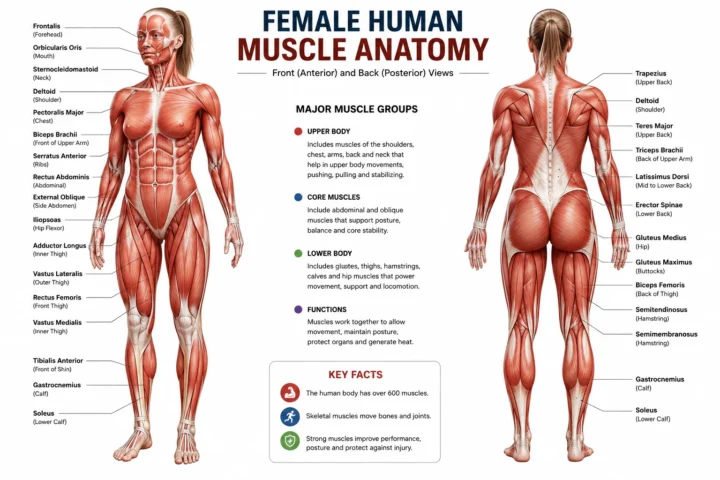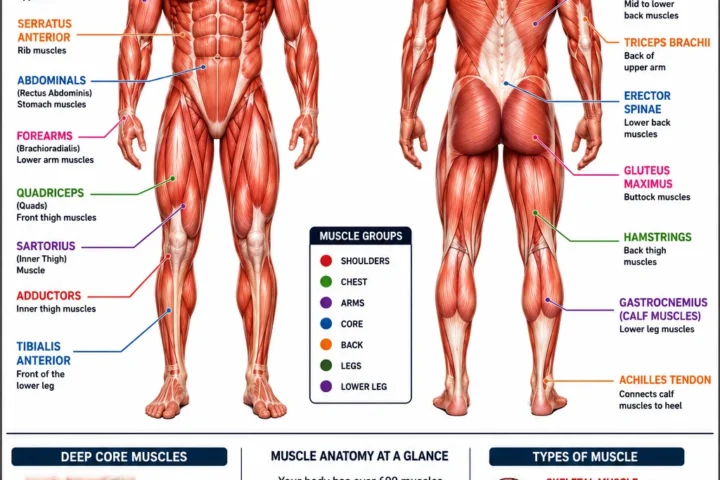
If you want a male gym body, start with a simple resistance-training program, eat enough nutritious food and protein, and progressively make your workouts harder. You don’t need complicated exercises or extreme diets.
- Quick Answer
- 1. Resistance Training
- 2. Progressive Overload
- Workout A
- Workout B
- Weekly Schedule
- Simple rule
- Chest
- Back
- Shoulders
- Legs
- Arms
- My coaching choice for most beginners
- Worked example
- If you're relatively lean and want more muscle
- If you're carrying more body fat
- If you're somewhere in the middle
- Mistake 1: Changing Your Workout Every Week
- Mistake 2: Training Only Chest and Arms
- Mistake 3: Going Too Heavy Too Soon
- Mistake 4: Taking Every Set to Failure
- Mistake 5: Ignoring Legs
- Mistake 6: Eating Almost Nothing to Get Abs
- Mistake 7: Expecting a Different Body in a Few Weeks
- The decision rule
- 1. What is the best workout for a male gym body?
- 2. How many days a week should a man go to the gym to build muscle?
- 3. How much protein does a man need to build muscle?
- 4. Can you build a male gym body without steroids?
- 5. Can skinny men build a muscular gym body?
- Final Thoughts
For beginners, the goal isn’t to look like a professional bodybuilder as quickly as possible. It’s to build muscle, strength, movement skill and sustainable habits. Current ACSM evidence supports resistance training for increasing muscle size and strength, with training consistency and sufficient weekly volume being more important than chasing a perfect exercise routine. For more insights read here :- types of bodybuilding and different types of bodybuilding.
Quick Answer
- Train each major muscle group at least twice weekly as a practical starting point for muscle growth.
- Use mostly compound movements such as squats, presses, rows and hinges, then add a few isolation exercises.
- Progress gradually: add repetitions, improve technique or increase resistance when your current workload becomes manageable.
- Eat enough protein and total food to support training rather than relying on extreme bulking or cutting.
- Give your muscles time to recover. More training isn’t automatically better.
What Does a Male Gym Body Actually Mean?
A male gym body usually means a physique with developed shoulders, chest, back, arms and legs combined with a level of body fat that allows some muscular definition.
There’s no single correct male gym body.
One beginner may want a lean athletic appearance. Another may want more overall muscle. Someone else may care primarily about strength and fitness.
The training principles are similar, but the amount of muscle and body fat you eventually carry will vary with genetics, training history, nutrition, sleep, age and consistency.
The useful target is therefore not a particular celebrity’s physique.
Aim to become stronger, more muscular and fitter than your previous self.
The 2026 ACSM position stand reviewed 137 systematic reviews involving more than 30,000 participants and found that resistance training improves muscle strength and size compared with no exercise. It also found that higher training volume tends to support hypertrophy, while heavier loads are particularly useful for strength.
The 6 Things That Build a Better Male Gym Body
Your physique isn’t created by one magic exercise.
Think of it as six pieces working together:
- Resistance training
- Progressive overload
- Adequate protein
- Appropriate calorie intake
- Recovery
- Consistency
If one piece is missing, progress can become harder.
1. Resistance Training
Resistance training gives your muscles a reason to adapt.
For a beginner, this can include:
- Barbell exercises
- Dumbbells
- Machines
- Cables
- Resistance bands
- Bodyweight exercises
You don’t need to use a barbell to build muscle.
The important part is that the exercise provides enough resistance and that you gradually improve your performance.
The latest ACSM review found that resistance training consistently improves muscle size and strength, while many individual programming variables have less influence than beginners often assume.
2. Progressive Overload
Progressive overload means gradually increasing the challenge placed on your muscles.
That doesn’t always mean adding weight.
You can progress by:
- Adding a repetition
- Adding a small amount of weight
- Performing the same reps with better technique
- Increasing range of motion
- Adding a set when appropriate
- Improving control of the movement
For example, suppose your dumbbell bench press looks like this:
Week 1: 20 kg / 44 lb × 8 reps
Week 2: 20 kg / 44 lb × 9 reps
Week 3: 20 kg / 44 lb × 10 reps
Once you can perform the top of your chosen rep range with good technique, you could increase the dumbbells slightly and begin building the repetitions again.
That’s progressive training.
You don’t need to add weight every workout.
A Beginner Male Gym Body Workout Plan
A simple 3-day full-body program works well for someone who is new to resistance training.
You can train on Monday, Wednesday and Friday, for example.
The exact days aren’t important. Having recovery between sessions matters more.
Workout A
| Exercise | Sets | Reps |
|---|---|---|
| Goblet squat or leg press | 3 | 6–10 |
| Dumbbell bench press | 3 | 6–10 |
| Lat pulldown | 3 | 8–12 |
| Romanian deadlift | 2 | 8–12 |
| Dumbbell lateral raise | 2 | 10–15 |
| Dumbbell curl | 2 | 10–15 |
| Plank | 2 | 20–45 sec |
Workout B
| Exercise | Sets | Reps |
|---|---|---|
| Leg press or squat variation | 3 | 6–10 |
| Incline dumbbell press | 3 | 8–12 |
| Seated cable row | 3 | 8–12 |
| Hip thrust | 2 | 8–12 |
| Cable or dumbbell lateral raise | 2 | 10–15 |
| Triceps pressdown | 2 | 10–15 |
| Cable crunch | 2 | 10–15 |
Weekly Schedule
Monday — Workout A
Tuesday — Rest or light activity
Wednesday — Workout B
Thursday — Rest or light activity
Friday — Workout A
Saturday — Rest or light activity
Sunday — Rest
The following week, switch the order:
Monday — Workout B
Wednesday — Workout A
Friday — Workout B
This gives you repeated exposure to the major movement patterns without requiring a complicated bodybuilding split.
Health guidance also recommends muscle-strengthening activity involving the major muscle groups on at least 2 days per week for adults.
How Heavy Should You Lift?
Don’t choose a weight simply because it looks impressive.
Choose a load that allows you to complete the target repetitions with controlled technique.
For example, if your target is 8–12 reps, a useful starting weight is one where you can perform your repetitions without your technique falling apart.
You don’t need to take every set to absolute muscular failure.
Research examining proximity to failure hasn’t shown a clear hypertrophy advantage to taking every set to momentary failure compared with stopping short.
For a beginner, leaving roughly a couple of good repetitions in reserve on many sets can be a practical way to learn technique while still training hard.
Simple rule
If you finish your set and feel you could easily perform another five or six clean repetitions, the exercise may be too easy.
If you can’t maintain proper technique before reaching the bottom of your rep range, the weight may be too heavy.
Good form comes first.
What Rep Range Is Best for a Male Gym Body?
You don’t have to live inside a magical 8–12-rep zone.
Evidence shows that muscle hypertrophy can occur across a fairly broad range of resistance-training loads when training is sufficiently challenging. Heavier loads tend to have a stronger advantage for maximal strength.
For beginners, however, moderate rep ranges are convenient.
A practical starting framework is:
- Large compound exercises: 6–10 reps
- Secondary exercises: 8–12 reps
- Isolation exercises: 10–15 reps
- Core exercises: roughly 8–15 controlled reps or timed holds
These aren’t strict scientific boundaries.
They’re coaching guidelines that make it easier to learn exercises, track progress and avoid constantly changing your program.
The Muscle Groups You Shouldn’t Ignore
A common beginner mistake is building a routine around chest and arms while barely training the lower body and back.
A balanced male gym body needs more than big biceps.
Chest
Useful exercises include:
- Dumbbell bench press
- Barbell bench press
- Machine chest press
- Incline dumbbell press
- Push-ups
Back
Prioritize movements such as:
- Lat pulldowns
- Pull-ups
- Seated cable rows
- Chest-supported rows
- One-arm dumbbell rows
Shoulders
For balanced shoulder development:
- Overhead presses
- Lateral raises
- Rear-delt flyes
The lateral and rear-delt work can be particularly useful for developing the appearance of broader shoulders.
Legs
Don’t skip:
- Squats
- Leg presses
- Romanian deadlifts
- Lunges
- Split squats
- Leg curls
- Calf raises
Strong legs also give your physique better overall proportion.
Arms
Direct arm work can include:
Biceps
- Dumbbell curls
- Cable curls
- Preacher curls
Triceps
- Cable pressdowns
- Overhead extensions
- Machine extensions
You don’t need ten different exercises.
A small number performed consistently can work very well.
Male Gym Body: Beginner Training Comparison
Here’s a practical comparison of three common approaches.
| Approach | Weekly Sessions | Beginner Friendly | Muscle-Building Potential | Main Problem |
|---|---|---|---|---|
| Full body | 3 | Excellent | High | Sessions can become longer |
| Upper/lower | 4 | Good | High | Requires more weekly commitment |
| Body-part split | 5–6 | Fair | High when well programmed | Often unnecessary for beginners |
My coaching choice for most beginners
Start with 3 full-body sessions per week.
Why?
You get frequent practice with the major movements while keeping the schedule manageable.
A 4-day upper/lower routine can become useful later when you want more weekly training volume and can consistently recover from it.
The goal isn’t to choose the most complicated routine.
It’s to choose the routine you can execute well for months.
Worked Example: Turning a Beginner Workout Into Progress
Let’s say you’re a beginner who weighs:
75 kg / 165 lb
You’re performing dumbbell bench presses with:
20 kg / 44 lb per dumbbell
Your first session looks like:
- Set 1: 8 reps
- Set 2: 8 reps
- Set 3: 7 reps
Don’t immediately jump to heavier dumbbells.
Your next target could simply be:
8, 9, 8
Then:
9, 9, 8
Then:
10, 10, 9
Eventually:
10, 10, 10
At that point, if the exercise feels controlled, you could make a small weight increase.
The exact progression won’t be identical every week.
Some sessions will feel better than others.
Sleep, stress, nutrition, exercise order and accumulated fatigue can all affect performance.
That’s normal.
The objective is a long-term upward trend, not perfect weekly progress.
How Much Protein Do You Need?
Protein provides amino acids used in the construction and maintenance of body tissues, including muscle.
For people who exercise regularly, evidence-based recommendations commonly fall around 1.4–2.0 g of protein per kg of body weight per day. A separate meta-analysis found that increases above approximately 1.6 g/kg/day did not provide additional resistance-training-related gains in fat-free mass in its analysis.
You don’t need to obsess over hitting a perfect number.
Worked example
At:
75 kg / 165 lb
A target of:
1.6 g/kg/day
would equal:
75 × 1.6 = 120 g protein per day
That is an example, not a medical prescription.
You can obtain protein from foods such as:
- Eggs
- Chicken
- Fish
- Lean meat
- Milk
- Greek yogurt
- Cottage cheese
- Beans
- Lentils
- Tofu
- Other protein-rich foods
Protein powder can be convenient, but it isn’t required.
A normal balanced diet can provide protein without supplements.
Do You Need to Bulk to Build a Male Gym Body?
No.
You don’t have to perform an aggressive bulk to build muscle.
For a beginner carrying a significant amount of body fat, an aggressive calorie surplus may simply make the process of getting leaner later more difficult.
A better approach is to match your food intake to your current goal.
If you’re relatively lean and want more muscle
A modest increase in food intake may make sense.
If you’re carrying more body fat
You may prefer to focus on improving food quality, controlling overall intake and getting stronger while gradually reducing body fat.
If you’re somewhere in the middle
You can often focus on consistent training and adequate protein while allowing your body composition to change gradually.
There is no requirement to alternate between extreme bulking and extreme cutting.
How Much Cardio Should You Do?
Cardio isn’t the enemy of muscle.
Walking, cycling, running and other aerobic activities can support general fitness and cardiovascular health.
The US Physical Activity Guidelines recommend adults accumulate 150–300 minutes of moderate-intensity aerobic activity per week, or 75–150 minutes of vigorous activity, alongside muscle-strengthening activity on at least 2 days.
You don’t necessarily need to hit the upper end immediately.
If you’re new to exercise, build your activity gradually.
For a muscle-focused beginner, a simple combination could include:
- Strength training 3 days per week
- Regular walking
- Optional easy cardio on recovery days
- More demanding cardio according to your fitness goals
You should still be able to recover from your strength sessions.
Recovery: The Part Beginners Often Ignore
Muscle-building training creates a stimulus.
Recovery allows your body to adapt to that stimulus.
If you’re constantly exhausted, adding more workouts isn’t automatically the answer.
Pay attention to:
- Sleep quality
- Appetite
- Training performance
- Muscle soreness
- Motivation
- General fatigue
- Stress outside the gym
You don’t need to turn recovery into another complicated project.
Keep your training consistent, eat a balanced diet and give repeatedly trained muscles adequate recovery time.
NIDDK guidance also recommends allowing at least a day of rest before working the same muscle groups again when structuring strength-training activity.
Common Mistakes → Why → Fix
Mistake 1: Changing Your Workout Every Week
Why: You never give yourself enough time to learn movements or measure progression.
Fix: Keep your main exercises stable for several weeks and track your sets, reps and loads.
Mistake 2: Training Only Chest and Arms
Why: The mirror encourages beginners to focus on the muscles they see from the front.
Fix: Train your back and legs with the same seriousness as your chest and biceps.
A developed back, shoulders and legs contribute significantly to overall physique balance.
Mistake 3: Going Too Heavy Too Soon
Why: Beginners sometimes confuse heavier weight with better training.
Fix: Use a load you can control through the intended range of motion.
The goal is to train the target muscles, not impress someone standing next to you.
Mistake 4: Taking Every Set to Failure
Why: It feels productive, but maximum effort isn’t required for every set.
Fix: Most working sets can stop before technical failure. Push hard while keeping your technique controlled.
Research hasn’t demonstrated a consistent hypertrophy benefit from taking every set to momentary failure.
Mistake 5: Ignoring Legs
Why: Beginners often associate a gym body with visible upper-body muscles.
Fix: Treat lower-body training as a permanent part of your program.
Mistake 6: Eating Almost Nothing to Get Abs
Why: Beginners sometimes assume being extremely lean automatically means looking muscular.
Fix: Build the muscle first while using a sensible approach to body-fat management.
Extreme dieting isn’t necessary for creating a strong physique.
Mistake 7: Expecting a Different Body in a Few Weeks
Why: Social media compresses years of training into a few photographs.
Fix: Judge progress through multiple measurements:
- Strength
- Repetitions
- Body weight trend
- Waist measurement
- Progress photos
- Gym performance
- How clothes fit
Don’t rely on the mirror alone.
A 30-Second Male Gym Body Self-Test
Ask yourself these five questions:
1. Am I training all major muscle groups?
If no, fix your exercise selection.
2. Am I recording my workouts?
If no, start tracking weights, reps and sets.
3. Am I gradually improving?
If no, examine technique, recovery, nutrition and programming.
4. Am I eating enough protein?
If you’re consistently far below a reasonable protein target, improve your food choices.
5. Can I repeat this routine for the next several months?
If no, simplify it.
The decision rule
If your answer is yes to at least four, you’re probably doing the important things right.
If you answer no to two or more, fix the basics before adding advanced techniques.
Who This Male Gym Body Plan Is NOT For
This beginner plan isn’t designed as a personalized program for:
- Competitive bodybuilders
- Competitive powerlifters
- Elite athletes
- People recovering from significant injuries
- People with medical conditions requiring exercise restrictions
- Anyone seeking rapid extreme body transformations
If you have a medical condition, persistent pain, recent surgery or another health concern, speak with an appropriately qualified healthcare professional before starting or substantially increasing exercise.
How Long Does It Take to Build a Male Gym Body?
There is no honest universal deadline.
Beginners can often make noticeable improvements in strength relatively quickly because they are learning new movements and adapting to resistance training.
Muscle growth is slower and varies substantially between individuals.
Your results depend on:
- Starting body composition
- Genetics
- Age
- Training history
- Program quality
- Protein intake
- Total calorie intake
- Sleep
- Stress
- Consistency
Research in healthy adult males shows that resistance training can significantly increase muscle mass, but the response varies between individuals and training programs.
So don’t ask:
“How fast can I get a gym body?”
A better question is:
“What can I consistently improve over the next 6–12 months?”
That question puts your attention where it belongs.
Male Gym Body: What Should You Track?
You don’t need a sophisticated body-composition scanner.
Track a few useful variables.
| Metric | How Often | Why |
|---|---|---|
| Workout performance | Every session | Shows training progression |
| Body weight | Several readings across the week | Shows overall trend |
| Waist measurement | Every few weeks | Useful body-composition indicator |
| Progress photos | Every few weeks | Shows visual changes |
| Exercise technique | Every session | Helps prevent bad habits |
Don’t panic over a single day’s body weight.
Hydration, food, sodium and other factors can change scale weight.
Look at trends rather than individual readings.
What About Supplements?
You don’t need a cupboard full of supplements to build muscle.
Start with:
- Consistent training
- Adequate food
- Adequate protein
- Good sleep
- Progressive training
Only after those basics are handled should you consider whether a supplement offers meaningful convenience or value for you.
Protein supplements can be useful when food alone makes it difficult to reach your protein intake, but they’re not mandatory. Evidence supports adequate total protein intake as the more important consideration.
Avoid products making dramatic claims about instant muscle growth or guaranteed physique transformations.
FAQ: Male Gym Body
1. What is the best workout for a male gym body?
For most beginners, a full-body routine performed about three times per week is a practical starting point. It allows you to practice major movement patterns regularly while leaving recovery time between sessions. Focus on exercises for the legs, chest, back, shoulders, arms and core. As you become more experienced, you can adjust training frequency and volume according to your goals and recovery.
2. How many days a week should a man go to the gym to build muscle?
You don’t need to train every day. A beginner can make excellent use of three strength-training sessions per week. Current evidence indicates that resistance training improves muscle size and strength, while the 2026 ACSM position stand found hypertrophy benefits from higher weekly training volume. Health guidelines also recommend muscle-strengthening activity involving all major muscle groups on at least two days each week.
3. How much protein does a man need to build muscle?
For people who exercise regularly, approximately 1.4–2.0 g of protein per kg of body weight per day is a commonly supported range. A large meta-analysis found that resistance-training-related gains in fat-free mass generally did not continue increasing beyond roughly 1.6 g/kg/day in its protein-supplementation analysis. Individual needs can differ, particularly with medical conditions or different dietary situations.
4. Can you build a male gym body without steroids?
Yes. Resistance training, adequate nutrition and recovery can increase muscle size and strength without anabolic steroids or other performance-enhancing drugs. The rate and amount of progress differ between individuals, and natural muscle development takes time. A sensible beginner program should focus on progressive training, adequate protein, recovery and long-term consistency rather than attempting to reproduce the physiques of enhanced professional athletes.
5. Can skinny men build a muscular gym body?
Yes. A naturally thin beginner can increase muscle and strength through progressive resistance training and adequate nutrition. The important point is to provide your body with enough food and protein to support training rather than relying on an extreme eating plan. Start with manageable training volume, monitor your body-weight trend and gym performance, and gradually adjust food intake if you’re not progressing.
Your Simple Male Gym Body Checklist
Before worrying about advanced training methods, make sure you can check these boxes:
- Train consistently
- Train the whole body
- Practice good technique
- Track workouts
- Progress gradually
- Eat enough nutritious food
- Get adequate protein
- Don’t fear carbohydrates or healthy dietary fats
- Stay physically active outside the gym
- Give your muscles time to recover
- Avoid extreme diets
- Avoid steroids and PEDs
- Measure progress over months, not days
That’s the foundation.
You don’t need a complicated bodybuilding system to begin.
Build Your Male Gym Body One Session at a Time
A strong male gym body is built through repeated training sessions, not one perfect workout. Start with three manageable full-body sessions, learn the major movement patterns and gradually increase your training challenge. Keep your nutrition sensible and provide enough protein to support your activity. Recovery matters just as much as effort, so don’t turn every workout into a test of maximum intensity.
Most importantly, stop comparing your first months in the gym with someone else’s years of training. Track your own strength, technique, body measurements and consistency. If you’re getting better at the basics, you’re moving in the right direction. Keep the plan simple enough that you can actually follow it.
Final Thoughts
Building a male gym body doesn’t require a complicated routine, extreme diet, or shortcuts. Start with consistent resistance training, focus on proper technique, eat enough protein and nutritious food, and give your body time to recover.
Your progress won’t look the same every week. Some weeks you’ll add weight, while other weeks you’ll simply improve your technique or complete more repetitions. That’s still progress.
Focus on becoming stronger, fitter and more consistent rather than chasing someone else’s physique. Track your workouts, stay patient and make small improvements over time. If you keep showing up and follow the basics, you’ll give yourself the best foundation for building a muscular, balanced and healthy physique.