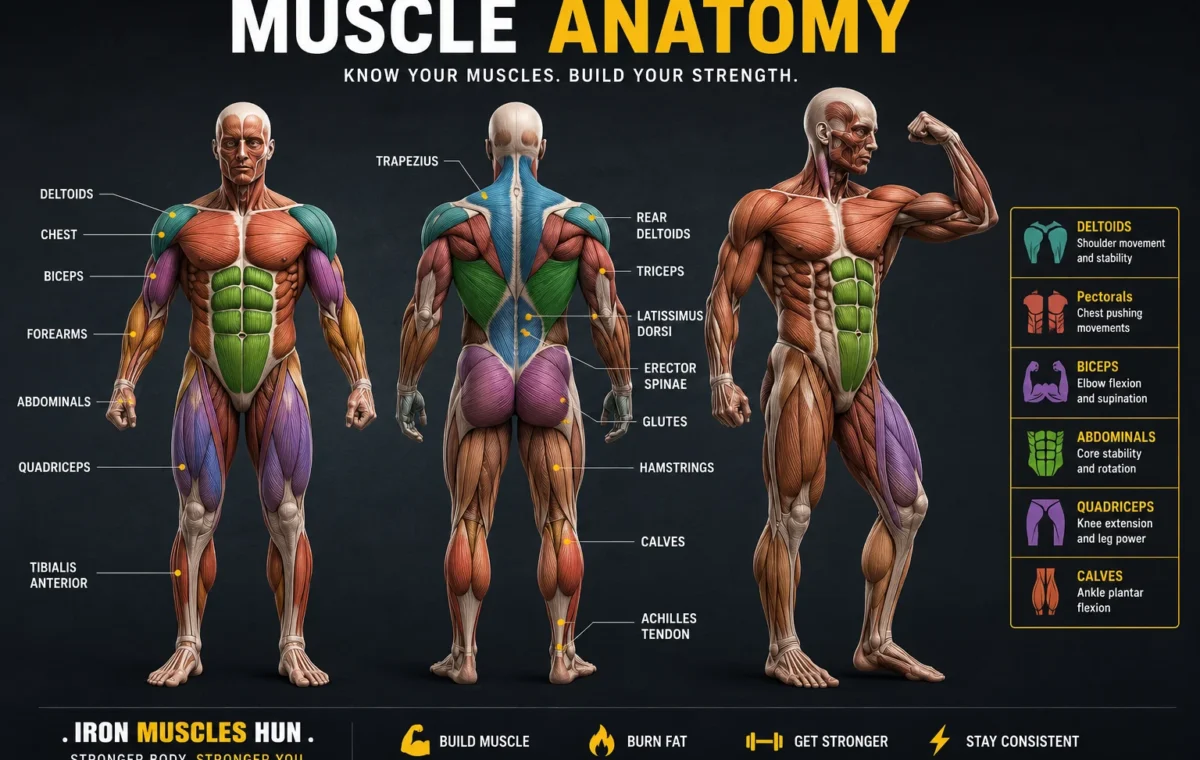
Muscle anatomy is the study of how muscles are structured, where they’re located, and how they work together to move your body. Understanding muscle anatomy helps you exercise more effectively, improve strength, reduce injury risk, and better understand how your body functions.
- Quick Answer
- 1. Skeletal Muscle
- 2. Cardiac Muscle
- 3. Smooth Muscle
- Main Functions
- Common Exercises
- Latissimus Dorsi (Lats)
- Functions
- Exercises
- Trapezius (Traps)
- Functions
- Exercises
- Rhomboids
- Functions
- Exercises
- Biceps
- Functions
- Exercises
- Triceps
- Functions
- Exercises
- Forearm Muscles
- Everyday Tasks
- Exercises
- Rectus Abdominis
- Functions
- Exercises
- Obliques
- Functions
- Exercises
- Transverse Abdominis
- Functions
- Exercises
- Main Functions
- Exercises
- Quadriceps
- Functions
- Exercises
- Hamstrings
- Functions
- Exercises
- Calf Muscles
- Functions
- Exercises
- 1. Focusing Only on Visible Muscles
- 2. Ignoring Recovery
- 3. Using Incorrect Form
- 4. Skipping Warm-Ups
- 5. Training the Same Muscle Every Day
- What is muscle anatomy in simple terms?
- How many muscles are in the human body?
- Which is the largest muscle in the body?
- Which muscle is the strongest?
- Why is learning muscle anatomy important?
- Can you build muscle without knowing anatomy?
- Muscle Anatomy at a Glance
- Practical Tips for Learning Muscle Anatomy
- Common Terms You'll See
- Final Thoughts
Whether you’re new to fitness, studying anatomy, or simply curious about how your muscles work, this guide explains everything in clear, beginner-friendly language. By the end, you’ll know the major muscle groups, their functions, and why each one matters in everyday life. For more insights read here :- how to become buff and how to become lean .
Quick Answer
| Topic | Quick Explanation |
|---|---|
| What is muscle anatomy? | The study of the body’s muscles, including their structure, location, and function. |
| How many muscles are in the body? | More than 600 skeletal muscles help create movement. |
| Main muscle types | Skeletal, cardiac, and smooth muscle. |
| Largest muscle | Gluteus maximus. |
| Strongest muscle (by force) | Masseter (jaw muscle). |
| Purpose of muscles | Movement, posture, stability, heat production, and protection of organs. |
Why Muscle Anatomy Matters
Many beginners jump into workouts without understanding which muscles they’re training. Learning basic muscle anatomy can make every workout more effective.
Knowing muscle anatomy helps you:
- Train muscles more efficiently.
- Improve exercise technique.
- Reduce injury risk.
- Build balanced strength.
- Understand how movements work.
- Recover smarter after exercise.
- Improve posture and mobility.
For example, during a push-up you’re not just using your chest. You’re also using your shoulders, triceps, abdominal muscles, and even your glutes to stabilize your body.
Understanding this helps explain why compound exercises build strength so effectively.
What Is Muscle Anatomy?
Muscle anatomy refers to the structure and organization of muscles throughout the human body.
It includes learning:
- Where muscles are located
- What each muscle does
- How muscles connect to bones
- How muscles work together
- How nerves control muscle movement
Think of muscles like the engine that powers your body. Your skeleton provides the frame, but muscles create movement.
Without muscles, you couldn’t:
- Walk
- Smile
- Lift groceries
- Breathe
- Blink
- Stand upright
Even your heartbeat depends on specialized muscle tissue.
The Three Types of Muscle Tissue
Although most people think only about muscles they can see, the body actually contains three different muscle types.
| Muscle Type | Found In | Controlled By | Main Job |
|---|---|---|---|
| Skeletal Muscle | Attached to bones | Voluntary | Body movement |
| Cardiac Muscle | Heart | Involuntary | Pumps blood |
| Smooth Muscle | Organs and blood vessels | Involuntary | Moves food, controls blood flow |
Each type has a unique structure and performs a specific role.
1. Skeletal Muscle
Skeletal muscles are the muscles most people focus on during exercise.
These muscles attach to bones using strong connective tissues called tendons.
Examples include:
- Biceps
- Quadriceps
- Hamstrings
- Deltoids
- Pectorals
- Glutes
- Calves
Characteristics:
- Voluntary control
- Creates body movement
- Supports posture
- Produces heat
- Can become stronger through resistance training
2. Cardiac Muscle
Cardiac muscle exists only in the heart.
Unlike skeletal muscle, it works automatically without conscious thought.
Its job is simple but essential:
Pump blood continuously throughout your body.
This specialized muscle contracts approximately thousands of times every day, supplying oxygen and nutrients to every organ.
3. Smooth Muscle
Smooth muscle lines many internal organs, including:
- Stomach
- Intestines
- Bladder
- Blood vessels
- Airways
Unlike skeletal muscle, smooth muscle works automatically.
Examples include:
- Moving food through digestion
- Controlling blood pressure
- Expanding airways
- Helping the bladder empty
Most people never notice smooth muscles working because they function without conscious effort.
Basic Structure of a Skeletal Muscle
A skeletal muscle isn’t one solid piece.
Instead, it’s built in several layers that work together.
Here’s a simplified breakdown:
Whole Muscle
      │
 Muscle Fascicles
      │
 Muscle Fibers (Cells)
      │
 Myofibrils
      │
 Sarcomeres
      │
 Actin + Myosin
Each level becomes progressively smaller.
The interaction between actin and myosin proteins allows muscles to shorten (contract), creating movement.
How Muscles Attach to Bones
Muscles cannot push.
They only pull.
Here’s how movement works:
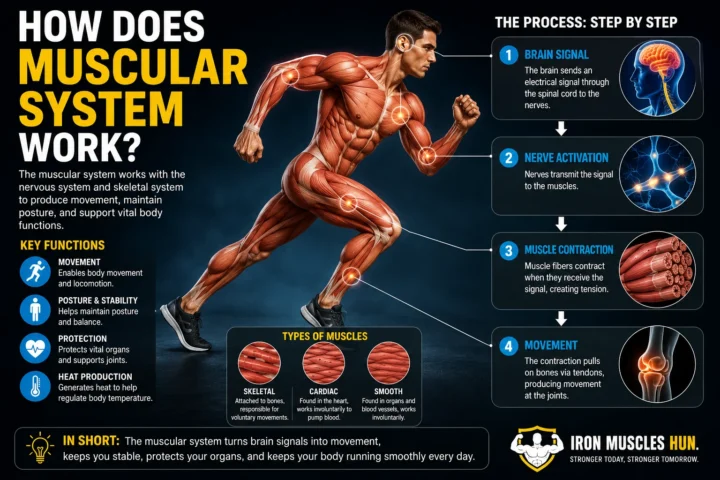
- The brain sends a signal through nerves.
- Muscle fibers contract.
- Tendons pull on bones.
- Bones move around joints.
- The opposite muscle relaxes.
For example:
When you bend your elbow:
- Your biceps contract.
- Your triceps relax.
When you straighten your arm:
- Your triceps contract.
- Your biceps relax.
This partnership is called an agonist-antagonist relationship.
Muscle Contractions Explained
Muscles create movement by contracting.
There are three primary contraction types.
| Type | What Happens | Example |
|---|---|---|
| Concentric | Muscle shortens | Lifting a dumbbell |
| Eccentric | Muscle lengthens under tension | Lowering a dumbbell |
| Isometric | Muscle length stays the same | Holding a plank |
Many beginners focus only on lifting weights, but the lowering (eccentric) phase is equally important for muscle growth and strength development.
How Muscles Work Together
Very few muscles work alone.
Instead, muscles cooperate in groups.
During a squat, for example, your body recruits several major muscle groups simultaneously:
- Quadriceps
- Hamstrings
- Gluteus maximus
- Core muscles
- Lower back muscles
- Calves
This coordinated effort helps you move safely and efficiently while maintaining balance and stability.
Key Takeaways So Far
- Muscle anatomy is the study of muscle structure, location, and function.
- The body contains over 600 skeletal muscles.
- There are three types of muscle tissue: skeletal, cardiac, and smooth.
- Skeletal muscles move the body by pulling on bones through tendons.
- Muscles work in pairs and groups rather than individually.
- Understanding anatomy helps improve exercise technique, strength, posture, and injury prevention.
Major Muscle Groups of the Human Body
Knowing where each muscle is located and what it does makes it much easier to choose the right exercises and understand how your body moves. While the human body contains more than 600 skeletal muscles, most workouts focus on a handful of major muscle groups.
The sections below explain the primary muscles beginners should know.
Chest Muscles (Pectorals)
The chest is mainly made up of two muscles:
- Pectoralis Major
- Pectoralis Minor
The pectoralis major is the large, visible chest muscle responsible for pushing movements and moving the arm across the body. The smaller pectoralis minor sits underneath it and helps stabilize the shoulder blade.
Main Functions
- Push objects away from the body
- Move the arms inward
- Assist shoulder movement
- Support upper-body strength
Common Exercises
- Push-ups
- Bench press
- Chest press
- Chest fly
- Incline press
Back Muscles
The back contains several large muscles that help maintain posture and produce pulling movements.
Latissimus Dorsi (Lats)
Often called the lats, these broad muscles create the familiar V-shaped upper body.
Functions
- Pull the arms downward
- Assist climbing
- Improve posture
- Stabilize the shoulders
Exercises
- Pull-ups
- Lat pulldowns
- Straight-arm pulldowns
- Rows
Trapezius (Traps)
The trapezius extends from the neck to the middle of the back.
Functions
- Raise the shoulders
- Retract the shoulder blades
- Support neck movement
- Improve upper-back stability
Exercises
- Shrugs
- Face pulls
- Farmer’s carries
- Upright rows
Rhomboids
Located between the shoulder blades, the rhomboids play an important role in posture.
Functions
- Pull shoulder blades together
- Stabilize the upper back
- Improve posture
Exercises
- Seated rows
- Reverse flyes
- Face pulls
Shoulder Muscles (Deltoids)
The shoulder consists mainly of the deltoid muscle, which has three sections.
| Deltoid Head | Primary Function | Exercise Examples |
|---|---|---|
| Front (Anterior) | Raise arm forward | Front raises, overhead press |
| Side (Lateral) | Lift arm sideways | Lateral raises |
| Rear (Posterior) | Move arm backward | Reverse flyes, face pulls |
Strong shoulders improve nearly every upper-body movement.
Arm Muscles
Biceps
The biceps sit on the front of the upper arm.
Functions
- Bend the elbow
- Rotate the forearm
- Assist pulling movements
Exercises
- Dumbbell curls
- Barbell curls
- Chin-ups
- Hammer curls
Triceps
The triceps make up roughly two-thirds of the upper arm.
Functions
- Straighten the elbow
- Assist pushing movements
Exercises
- Dips
- Close-grip bench press
- Triceps pushdowns
- Overhead extensions
Forearm Muscles
The forearms contain many smaller muscles responsible for grip strength and wrist movement.
Everyday Tasks
- Holding objects
- Typing
- Carrying bags
- Opening jars
- Pulling exercises
Exercises
- Wrist curls
- Reverse curls
- Farmer’s carries
- Dead hangs
Core Muscles
The core is much more than visible abdominal muscles. It includes several muscles that stabilize the spine and pelvis.
Rectus Abdominis
Often called the six-pack muscle, it runs down the front of the abdomen.
Functions
- Bend the spine
- Stabilize the torso
- Assist breathing
Exercises
- Crunches
- Leg raises
- Reverse crunches
Obliques
These muscles run along the sides of the abdomen.
Functions
- Rotate the torso
- Bend sideways
- Improve balance
- Support spinal stability
Exercises
- Russian twists
- Side planks
- Wood chops
Transverse Abdominis
This deep core muscle acts like a natural weightlifting belt.
Functions
- Stabilize the spine
- Protect the lower back
- Maintain posture
Exercises
- Planks
- Dead bugs
- Bird dogs
- Hollow holds
Glute Muscles
The glutes are the body’s largest and strongest muscle group.
They consist of:
- Gluteus Maximus
- Gluteus Medius
- Gluteus Minimus
Main Functions
- Hip extension
- Standing up
- Running
- Climbing stairs
- Maintaining balance
Exercises
- Squats
- Hip thrusts
- Lunges
- Romanian deadlifts
- Step-ups
Leg Muscles
Quadriceps
Located on the front of the thigh, the quadriceps include four separate muscles.
Functions
- Straighten the knee
- Walk
- Jump
- Climb stairs
Exercises
- Squats
- Leg press
- Lunges
- Leg extensions
Hamstrings
The hamstrings run along the back of the thigh.
Functions
- Bend the knee
- Extend the hip
- Sprint
- Jump
Exercises
- Romanian deadlifts
- Leg curls
- Good mornings
- Glute bridges
Calf Muscles
The calves contain two primary muscles:
- Gastrocnemius
- Soleus
Functions
- Point the toes
- Walk
- Run
- Jump
- Maintain balance
Exercises
- Standing calf raises
- Seated calf raises
- Jump rope
- Hill walking
Major Muscle Anatomy Reference Table
| Muscle Group | Main Muscles | Primary Function | Beginner Exercises |
|---|---|---|---|
| Chest | Pectorals | Push | Push-ups, Bench Press |
| Back | Lats, Traps, Rhomboids | Pull | Rows, Pull-ups |
| Shoulders | Deltoids | Lift & Rotate Arms | Shoulder Press, Lateral Raises |
| Arms | Biceps, Triceps | Bend & Straighten Elbows | Curls, Pushdowns |
| Core | Abs, Obliques, Transverse Abdominis | Stability | Planks, Crunches |
| Glutes | Gluteus Maximus, Medius, Minimus | Hip Movement | Squats, Hip Thrusts |
| Legs | Quadriceps, Hamstrings | Walking & Running | Squats, Lunges |
| Calves | Gastrocnemius, Soleus | Ankle Movement | Calf Raises |
How Muscle Groups Work Together
The body rarely uses a single muscle in isolation. Everyday movements and exercises rely on multiple muscles working as a team.
For example:
| Activity | Main Muscles Used |
|---|---|
| Push-up | Chest, shoulders, triceps, core |
| Pull-up | Lats, biceps, forearms, core |
| Squat | Quadriceps, glutes, hamstrings, calves |
| Deadlift | Glutes, hamstrings, lower back, traps, forearms |
| Walking | Glutes, quadriceps, hamstrings, calves, core |
This coordination is why compound exercises are highly effective for improving overall strength and fitness.
Common Muscle Anatomy Mistakes Beginners Make
Understanding anatomy can help you avoid common training errors.
1. Focusing Only on Visible Muscles
Many beginners train the chest and arms frequently while neglecting the back, legs, and core. This can create muscle imbalances and poor posture.
2. Ignoring Recovery
Muscles grow and repair during rest, not while you’re exercising. Adequate sleep, hydration, and nutrition are essential for recovery.
3. Using Incorrect Form
Poor exercise technique places unnecessary stress on joints instead of targeting the intended muscles. Learning proper form is more important than lifting heavy weights.
4. Skipping Warm-Ups
A proper warm-up increases blood flow to muscles, improves mobility, and prepares your body for exercise, helping reduce the risk of injury.
5. Training the Same Muscle Every Day
Most muscle groups need time to recover after resistance training. Alternating workouts or incorporating rest days supports better performance and muscle development.
What is muscle anatomy in simple terms?
Muscle anatomy is the study of where muscles are located, how they are built, and what they do. It explains how muscles work with bones, joints, tendons, and nerves to help you move, maintain posture, breathe, and perform everyday activities.
How many muscles are in the human body?
The human body has more than 600 skeletal muscles. In addition to skeletal muscles, the body also contains cardiac muscle (found only in the heart) and smooth muscle (found in organs and blood vessels). Together, these muscle types keep your body functioning every day.
Which is the largest muscle in the body?
The gluteus maximus is the largest muscle in the human body. Located in the buttocks, it plays a major role in walking, running, climbing stairs, standing up, and maintaining balance. It’s also one of the body’s strongest muscles because it generates significant force during movement.
Which muscle is the strongest?
The answer depends on how “strongest” is measured. By the force it can generate, the masseter, the jaw muscle used for chewing, is considered one of the strongest muscles in the body relative to its size. The heart is the hardest-working muscle because it beats continuously throughout your life.
Why is learning muscle anatomy important?
Understanding muscle anatomy helps you exercise more effectively, improve your technique, reduce the risk of injury, and develop balanced strength. It also helps students, healthcare professionals, and fitness enthusiasts understand how the body moves and functions.
Can you build muscle without knowing anatomy?
Yes, but learning basic muscle anatomy can improve your results. Knowing which muscles each exercise targets helps you create balanced workout routines, avoid overtraining certain areas, and recognize movement patterns that support better performance.
Muscle Anatomy at a Glance
| Topic | Key Point |
|---|---|
| Number of skeletal muscles | 600+ |
| Main muscle types | Skeletal, Cardiac, Smooth |
| Largest muscle | Gluteus Maximus |
| Main function | Produce movement and maintain posture |
| Controlled voluntarily | Skeletal muscles |
| Controlled automatically | Cardiac and Smooth muscles |
| Best way to learn anatomy | Study muscle groups and relate them to everyday movements and exercises |
Practical Tips for Learning Muscle Anatomy
If you’re just starting out, these habits can make learning muscle anatomy much easier:
- Learn one muscle group at a time. Focus on the chest, back, shoulders, arms, core, or legs before moving to the next.
- Connect muscles with exercises. For example, remember that squats work the quadriceps, glutes, and hamstrings, while pull-ups target the lats and biceps.
- Use anatomy diagrams. Visual references help reinforce muscle names and locations.
- Practice good exercise form. Feeling the correct muscle working is often the best way to understand its function.
- Review regularly. Repetition helps you remember muscle names and their roles over time.
Common Terms You’ll See
| Term | Meaning |
|---|---|
| Muscle Fiber | A single muscle cell |
| Tendon | Connects muscle to bone |
| Ligament | Connects bone to bone |
| Fascicle | A bundle of muscle fibers |
| Sarcomere | The smallest functional unit of a muscle |
| Flexion | Decreasing the angle of a joint |
| Extension | Increasing the angle of a joint |
| Contraction | Muscle shortening to create force |
Final Thoughts
Muscle anatomy may seem complex at first, but understanding the basics makes a big difference whether you’re exercising, studying, or simply trying to stay healthy. Learning where muscles are located, how they work together, and what movements they produce gives you a stronger foundation for fitness and everyday life.
You don’t need to memorize every muscle immediately. Start with the major muscle groups, learn the movements they control, and connect that knowledge to the exercises you perform. Over time, your understanding of muscle anatomy will grow naturally, helping you train smarter, move better, and appreciate how remarkable the human body really is.