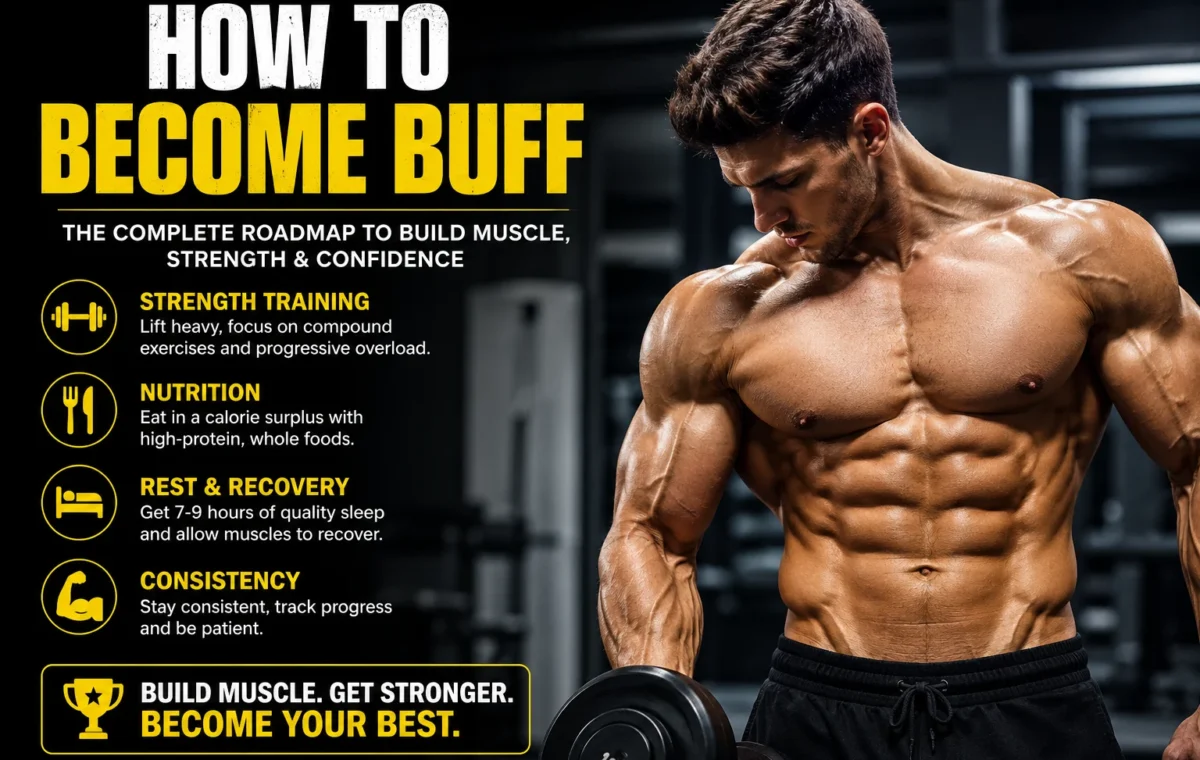
Becoming buff means building noticeable muscle while keeping body fat under control. The fastest way to achieve this is by following a structured strength-training program, eating enough protein and calories to support muscle growth, sleeping well, and staying consistent for months—not just weeks.
- Key Takeaways
- Step 1: Start Strength Training
- Best Compound Exercises
- Step 2: Train With Progressive Overload
- Example
- Step 3: Follow a Structured Workout Plan
- Example Weekly Schedule
- Step 4: Focus on the Right Rep Range
- Step 5: Never Skip Leg Day
- Common Beginner Workout Mistakes
- Prioritize a Small Calorie Surplus
- How Much Protein Do You Need?
- Protein Examples
- Protein Sources
- Healthy Carbohydrates
- Healthy Fats
- 1. Whey Protein
- 2. Creatine Monohydrate
- 3. Caffeine
- Supplements You Don't Need
- Week 1
- Week 2
- Week 3
- Week 4
- 1. Not Eating Enough
- 2. Changing Workouts Too Often
- 3. Ignoring Progressive Overload
- 4. Training With Poor Form
- 5. Sleeping Too Little
- 6. Depending on Supplements
- How long does it take to become buff?
- Can I become buff without going to the gym?
- How many days a week should I work out?
- What should I eat after a workout?
- Can I lose fat and build muscle at the same time?
- Do I need supplements to become buff?
If you’ve ever wondered why some people gain muscle quickly while others struggle, the answer usually isn’t genetics alone. Most beginners simply don’t follow a complete plan. They train without progression, eat too little protein, or change workouts every week.
The good news is that you don’t need expensive supplements or complicated workout routines. With the right approach, almost anyone can build an impressive physique naturally.
This guide explains exactly how to become buff, even if you’re starting from scratch. For more insights read here :- muscle building tips over 08 and how to put on muscle fast .
Quick Answer
| Goal | What You Should Do |
|---|---|
| Build Muscle | Lift weights 3–5 days per week |
| Eat Enough | Maintain a slight calorie surplus |
| Protein | Aim for 1.6–2.2 g of protein per kg of body weight daily |
| Recovery | Sleep 7–9 hours every night |
| Progress | Increase weight or reps over time |
| Time | Expect visible changes in 8–12 weeks with consistency |
Key Takeaways
✔ Train each major muscle group at least twice every week.
✔ Focus on compound exercises like squats, bench press, rows, and deadlifts.
✔ Eat enough calories to support muscle growth.
✔ Consume plenty of protein throughout the day.
✔ Recovery is just as important as training.
✔ Stay consistent for several months before expecting dramatic results.
What Does “Buff” Actually Mean?
Being buff doesn’t simply mean being heavy or bulky.
A buff physique combines:
- Noticeable muscle size
- Good overall strength
- Balanced proportions
- Moderate body fat
- Visible muscle definition
You don’t have to become a professional bodybuilder. Most people simply want broader shoulders, bigger arms, a stronger chest, muscular legs, and a more athletic appearance.
Why Most Beginners Fail to Get Buff
Many people spend months in the gym without seeing much progress.
Here are the biggest reasons.
| Mistake | Why It Slows Progress |
|---|---|
| Skipping workouts | Muscles need consistent training. |
| Eating too little | Muscle cannot grow without enough energy. |
| Low protein intake | Protein repairs and builds muscle tissue. |
| Changing routines constantly | Progress requires consistency. |
| Ignoring sleep | Most muscle recovery happens during rest. |
| Poor exercise technique | Limits muscle activation and increases injury risk. |
Avoiding these mistakes alone can dramatically improve your results.
How to Become Buff: Step-by-Step
Step 1: Start Strength Training
Resistance training is the foundation of muscle growth.
Your muscles grow because they adapt to increasing challenges over time.
The best exercises recruit multiple muscle groups at once, allowing you to lift heavier weights and stimulate more muscle fibers.
Best Compound Exercises
| Exercise | Main Muscles Worked |
|---|---|
| Squat | Legs, glutes, core |
| Deadlift | Entire posterior chain |
| Bench Press | Chest, shoulders, triceps |
| Overhead Press | Shoulders, triceps |
| Pull-Ups | Back, biceps |
| Bent-Over Row | Back, rear shoulders |
| Dips | Chest and triceps |
These exercises should form the foundation of nearly every beginner muscle-building program.
Step 2: Train With Progressive Overload
Simply lifting weights isn’t enough.
To become buff, your muscles need a reason to grow.
That’s where progressive overload comes in.
This means gradually making your workouts harder by:
- Increasing weight
- Performing more repetitions
- Adding another set
- Improving exercise technique
- Reducing rest time (occasionally)
Example
Week 1
Bench Press
3 × 8 at 100 lb
Week 4
3 × 10 at 100 lb
Week 6
3 × 8 at 110 lb
Small improvements add up over time.
Step 3: Follow a Structured Workout Plan
Random workouts produce random results.
Instead, follow a program that trains every major muscle group consistently.
Example Weekly Schedule
| Day | Workout |
|---|---|
| Monday | Upper Body |
| Tuesday | Lower Body |
| Wednesday | Rest or light cardio |
| Thursday | Upper Body |
| Friday | Lower Body |
| Saturday | Optional arms or core |
| Sunday | Rest |
This schedule allows muscles enough recovery while providing frequent stimulation for growth.
Step 4: Focus on the Right Rep Range
Different rep ranges produce different training effects.
For muscle growth, most exercises work best between:
6–12 repetitions
This range balances strength and muscle-building volume.
A typical workout looks like:
- 3–4 sets
- 6–12 reps
- 60–120 seconds rest
Heavy compound lifts can use slightly lower reps, while isolation exercises often benefit from higher repetitions.
Step 5: Never Skip Leg Day
Many beginners focus only on arms and chest.
That’s a mistake.
Training your legs:
- Builds total-body strength
- Increases overall muscle mass
- Improves athletic performance
- Creates better body proportions
- Helps stimulate full-body muscle development
Prioritize exercises such as:
- Squats
- Romanian deadlifts
- Leg press
- Walking lunges
- Bulgarian split squats
- Leg curls
- Standing calf raises
Strong legs support a stronger upper body and create a balanced, athletic physique.
Common Beginner Workout Mistakes
Avoid these habits if your goal is to become buff:
- Training the same muscles every day
- Using weights that are too light
- Copying advanced bodybuilding routines
- Skipping warm-ups
- Poor exercise form
- Not tracking progress
- Doing excessive cardio
- Quitting after only a few weeks
Remember, muscle growth takes patience. Small improvements each week lead to major changes over time.
Training builds the stimulus for muscle growth, but nutrition provides the materials your body needs to repair and grow stronger. If your diet doesn’t support your workouts, your progress will be slower.
Prioritize a Small Calorie Surplus
To build muscle efficiently, most beginners should eat slightly more calories than they burn each day. A modest calorie surplus helps your body recover and create new muscle tissue while limiting unnecessary fat gain.
A good approach is to:
- Gain about 0.25–0.5% of your body weight per week
- Monitor your weight every week
- Increase food slightly if your weight isn’t changing after two to three weeks
Avoid eating huge amounts of junk food just because you’re “bulking.” Quality nutrition still matters.
How Much Protein Do You Need?
Protein is the building block of muscle.
Research consistently shows that people trying to maximize muscle growth benefit from consuming approximately:
1.6–2.2 grams of protein per kilogram of body weight per day
Protein Examples
| Body Weight | Daily Protein Goal |
|---|---|
| 60 kg (132 lb) | 96–132 g |
| 70 kg (154 lb) | 112–154 g |
| 80 kg (176 lb) | 128–176 g |
| 90 kg (198 lb) | 144–198 g |
| 100 kg (220 lb) | 160–220 g |
Instead of eating all your protein in one meal, spread it across 3–5 meals throughout the day.
Best Foods for Building Muscle
Choose mostly whole, nutrient-dense foods that provide protein, carbohydrates, healthy fats, vitamins, and minerals.
Protein Sources
- Chicken breast
- Turkey
- Lean beef
- Eggs
- Greek yogurt
- Cottage cheese
- Tuna
- Salmon
- Shrimp
- Tofu
- Tempeh
- Lentils
- Beans
- Whey protein powder
Healthy Carbohydrates
Carbs fuel your workouts and support recovery.
Good choices include:
- Oats
- Rice
- Potatoes
- Sweet potatoes
- Whole-grain bread
- Whole-wheat pasta
- Fruits
- Vegetables
- Quinoa
Healthy Fats
Healthy fats support hormone production and overall health.
Include foods such as:
- Avocados
- Olive oil
- Nuts
- Seeds
- Peanut butter
- Almond butter
- Fatty fish
Sample Muscle-Building Meal Plan
Here’s a simple example for a beginner.
| Meal | Example |
|---|---|
| Breakfast | Oatmeal, berries, Greek yogurt |
| Snack | Banana and whey protein shake |
| Lunch | Chicken breast, rice, broccoli |
| Snack | Cottage cheese with almonds |
| Dinner | Salmon, sweet potato, vegetables |
| Evening Snack | Greek yogurt or eggs |
Drink water consistently throughout the day, especially before and after workouts.
Should You Count Calories?
You don’t have to count every calorie forever, but tracking your food for a few weeks can help you understand how much you’re really eating.
Many beginners think they’re eating “a lot,” but they’re actually consuming too few calories to support muscle growth.
Apps like MyFitnessPal or Cronometer can make tracking easier.Also explore Lean and Muscular
The Best Supplements for Muscle Growth
Supplements can help, but they should never replace a solid diet and training plan.
1. Whey Protein
Whey protein is simply an easy way to increase your daily protein intake if you’re struggling to eat enough through food.
Best for:
- Busy schedules
- Post-workout meals
- Meeting protein goals
2. Creatine Monohydrate
Creatine is one of the most researched sports supplements available.
Potential benefits include:
- Increased training performance
- Better strength gains
- Improved power output
- Support for muscle growth over time
Many healthy adults use 3–5 grams daily. If you have kidney disease or another medical condition, speak with your healthcare provider before using creatine.
3. Caffeine
Caffeine may improve workout performance and focus when used responsibly.
Remember that too much caffeine can interfere with sleep, and poor sleep hurts muscle growth.
Supplements You Don’t Need
Save your money.
Many products promise massive muscle gains but offer little evidence.
These include:
- Testosterone boosters
- Fat-burning pills
- BCAA supplements (if you already eat enough protein)
- “Muscle-building” gummies
- Most detox products
A good diet will outperform expensive supplements every time.
How Much Cardio Should You Do?
Cardio supports heart health, endurance, and overall fitness.
You don’t need to eliminate it to become buff.
A balanced routine might include:
- 2–3 sessions per week
- 20–30 minutes each
- Walking, cycling, swimming, or light jogging
Avoid doing long, exhausting cardio sessions every day if your primary goal is muscle growth.
Recovery: The Secret Most Beginners Ignore
Muscles don’t grow while you’re lifting weights.
They grow while your body recovers afterward.
Recovery should include:
- Sleeping 7–9 hours every night
- Drinking enough water
- Managing stress
- Taking at least one or two rest days every week
- Eating enough calories and protein
If you’re constantly sore and exhausted, you may need more recovery—not more workouts.
How Long Does It Take to Become Buff?
Everyone progresses at a different pace depending on:
- Age
- Genetics
- Diet
- Training consistency
- Recovery
- Starting fitness level
Here’s a realistic timeline for beginners.
| Time | What You May Notice |
|---|---|
| 2–4 weeks | Improved strength and workout confidence |
| 6–8 weeks | Slight muscle definition and better endurance |
| 8–12 weeks | Noticeable muscle growth with proper nutrition |
| 6 months | Significant improvements in size and strength |
| 12 months | Major body transformation with consistency |
The biggest mistake is expecting dramatic changes after only a few weeks. Stay patient and focus on steady progress.
30-Day Beginner Muscle-Building Action Plan
Week 1
- Learn proper exercise form
- Complete three full-body workouts
- Increase daily protein intake
- Track your workouts
Week 2
- Add small amounts of weight where possible
- Stay consistent with meals
- Sleep at least 7–9 hours nightly
Week 3
- Continue progressive overload
- Improve workout technique
- Add mobility work after training
Week 4
- Compare progress photos
- Measure strength improvements
- Adjust calories if body weight hasn’t changed
- Plan the next month of training
By the end of the first month, you’ll have built the habits that matter most for long-term muscle growth.
Even with a good workout plan, a few common mistakes can prevent you from becoming buff. Avoid these habits to keep making progress.
1. Not Eating Enough
Many beginners underestimate how much food they need. If you’re training hard but not consuming enough calories and protein, your body won’t have the resources to build new muscle.
Fix: Increase your daily calories gradually and prioritize protein at every meal.
2. Changing Workouts Too Often
Switching programs every week makes it difficult to measure progress.
Fix: Follow one well-designed routine for at least 8–12 weeks before making major changes.
3. Ignoring Progressive Overload
Using the same weights month after month gives your muscles no reason to grow.
Fix: Aim to increase the weight, repetitions, or training volume over time while maintaining proper form.
4. Training With Poor Form
Lifting heavier isn’t always better if your technique suffers.
Fix: Master proper movement patterns first. Controlled repetitions are more effective than sloppy ones.
5. Sleeping Too Little
Recovery is where muscle growth happens. Consistently getting less than seven hours of sleep can reduce recovery quality and training performance.
Fix: Aim for 7–9 hours of quality sleep every night.
6. Depending on Supplements
Supplements can support your routine, but they can’t replace consistent training and good nutrition.
Fix: Build your foundation with workouts, food, hydration, and recovery before spending money on supplements.
Frequently Asked Questions
How long does it take to become buff?
Most beginners notice increased strength within 4–6 weeks. Visible muscle growth often appears after 8–12 weeks of consistent training and proper nutrition. A significant transformation usually takes 6–12 months, depending on your starting point and dedication.
Can I become buff without going to the gym?
Yes. You can build muscle at home using resistance bands, adjustable dumbbells, pull-up bars, or bodyweight exercises. However, access to heavier resistance over time makes progressive overload easier, so many people eventually benefit from gym equipment.
How many days a week should I work out?
For beginners, 3–5 strength-training sessions per week is enough to build muscle effectively. Focus on quality workouts, proper recovery, and consistent progression rather than training every day.
What should I eat after a workout?
A meal containing both protein and carbohydrates helps support recovery. Examples include grilled chicken with rice, Greek yogurt with fruit, eggs on whole-grain toast, or a protein shake with a banana if you’re short on time.
Can I lose fat and build muscle at the same time?
Yes, especially if you’re new to resistance training or returning after a break. Eating enough protein, following a structured strength program, and maintaining a slight calorie deficit (if fat loss is your priority) can allow body recomposition, though muscle gain is generally slower than during a calorie surplus.
Do I need supplements to become buff?
No. Supplements are optional. Most people can build an impressive physique through consistent training, balanced nutrition, adequate sleep, and patience. If you choose supplements, stick with evidence-based options like whey protein (if needed to meet protein goals) and creatine monohydrate after confirming they’re appropriate for you.
Final Thoughts
Learning how to become buff isn’t about finding a secret workout or buying expensive supplements. The real formula is surprisingly simple: train consistently, eat enough nutritious food with plenty of protein, recover well, and gradually challenge your muscles over time.
Don’t compare your progress with someone who’s been training for years. Instead, focus on becoming a little stronger every week. Small improvements in your workouts, nutrition, and recovery compound into impressive results over the months.
Building muscle naturally takes patience, but the reward is more than just a better-looking physique. You’ll gain strength, confidence, improved fitness, and healthy habits that can last a lifetime. Stay consistent, trust the process, and let your progress motivate you to keep going.