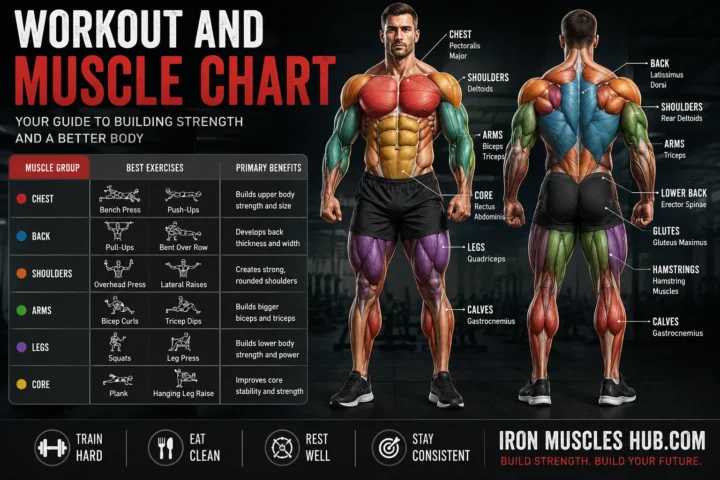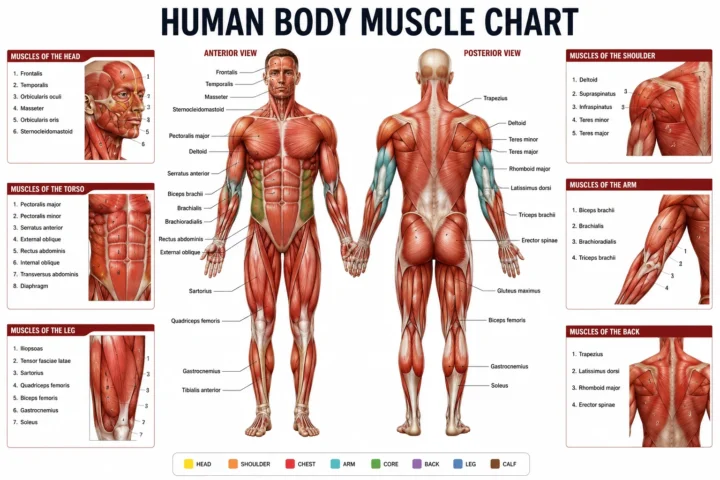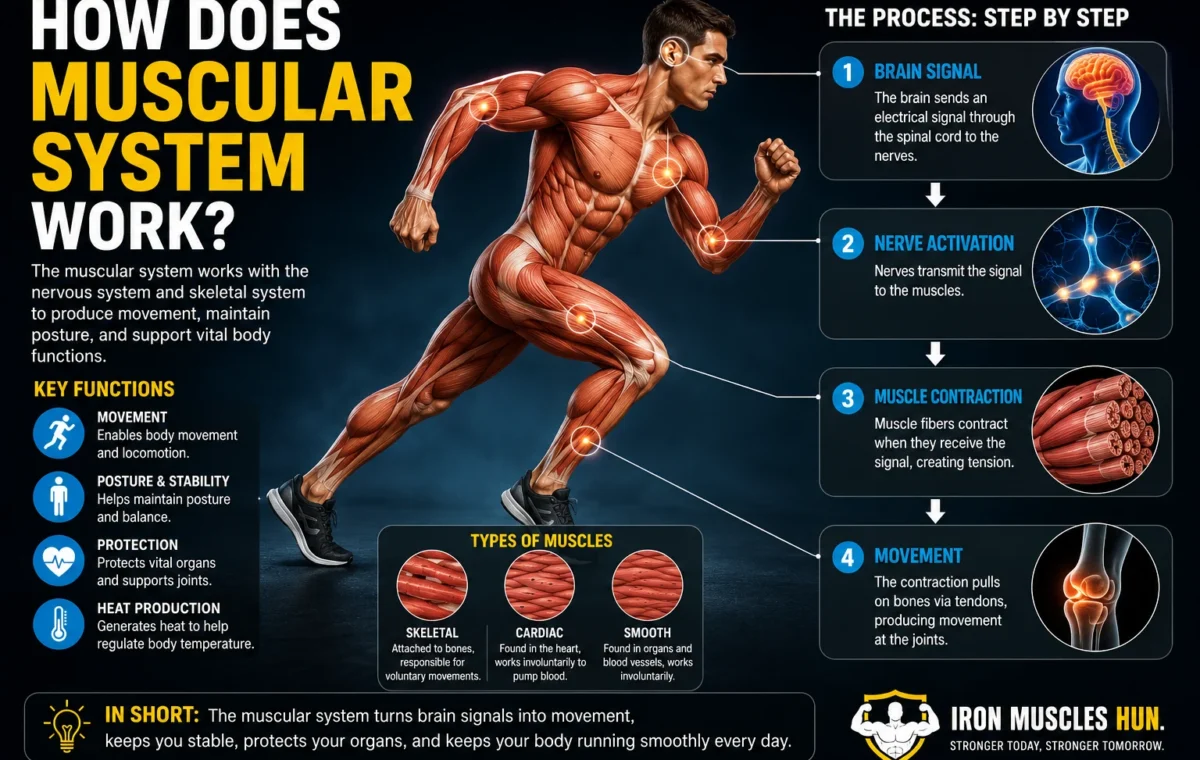
The muscular system works by contracting and relaxing muscles to create movement, maintain posture, stabilize joints, produce body heat, and support essential body functions such as breathing, digestion, and pumping blood. Your brain sends electrical signals through nerves, telling muscles when to contract and when to relax. These muscle contractions pull on bones or move internal organs, depending on the type of muscle involved.
- Quick Answer
- How Does Muscular System Work
- Step 1: Your Brain Creates a Command
- Step 2: Nerves Carry the Signal
- Step 3: Muscle Fibers Contract
- Step 4: Tendons Pull the Bones
- Step 5: Opposite Muscles Relax
- 1. Skeletal Muscle
- 2. Smooth Muscle
- 3. Cardiac Muscle
- How the Muscular System Works with the Nervous System
- 1. Creates Body Movement
- 2. Maintains Good Posture
- 3. Stabilizes Joints
- 4. Produces Body Heat
- 5. Supports Breathing
- 6. Helps Digestion
- 7. Pumps Blood Throughout the Body
- During Exercise
- After Exercise
- Exercise Regularly
- Eat Enough Protein
- Stay Hydrated
- Get Quality Sleep
- Warm Up and Cool Down
- How does the muscular system work with the skeletal system?
- What controls the muscular system?
- Why do muscles get tired?
- What are the three types of muscles?
- Can muscles repair themselves?
- How can I keep my muscular system healthy?
- Key Takeaways
- Final Thoughts
Every movement you make—from blinking and smiling to running and lifting weights—depends on your muscular system working together with your nervous and skeletal systems. Once you understand this teamwork, it’s much easier to appreciate how your body performs thousands of actions every single day without you even thinking about most of them. For more insights read here :- how to build muscle and how to gain muscle fast.
Quick Answer
| Question | Answer |
|---|---|
| What is the muscular system? | A network of muscles that allows movement and supports vital body functions. |
| How many muscle types are there? | Three: skeletal, smooth, and cardiac muscles. |
| What controls muscles? | The brain and nervous system send electrical signals through nerves. |
| Why do muscles contract? | To create movement, stabilize the body, and perform essential functions. |
| Which muscle works nonstop? | The heart (cardiac muscle). |
How Does Muscular System Work
The muscular system is made up of more than 600 muscles throughout the human body. Together, these muscles account for roughly 40% of an adult’s body weight, although this varies depending on age, sex, and fitness level.
Muscles do much more than help you exercise. They also:
- Help you walk and move
- Keep your body upright
- Allow you to breathe
- Pump blood through your body
- Move food through your digestive system
- Produce heat to maintain body temperature
- Protect joints and support bones
Without muscles, your heart couldn’t beat, your lungs couldn’t breathe, and even simple actions like speaking or swallowing would be impossible.
How Does the Muscular System Work?
The muscular system functions through a carefully coordinated process involving your:
- Brain
- Nervous system
- Muscles
- Bones
- Tendons
- Joints
Here’s what happens whenever you move.
Step 1: Your Brain Creates a Command
Everything starts in your brain.
Suppose you decide to pick up a glass of water. Your brain generates an electrical signal telling your arm muscles to move.
This process happens almost instantly.
Step 2: Nerves Carry the Signal
The electrical signal travels through your spinal cord and peripheral nerves until it reaches the correct muscle.
These nerves communicate with muscle cells at tiny connection points called neuromuscular junctions.
At these junctions, a chemical messenger called acetylcholine helps transfer the signal from the nerve to the muscle.
Step 3: Muscle Fibers Contract
Once the signal reaches the muscle, millions of tiny muscle fibers begin contracting.
Inside every muscle fiber are microscopic proteins called:
- Actin
- Myosin
These proteins slide past each other using energy from ATP (adenosine triphosphate).
This sliding action shortens the muscle, creating a contraction.
Step 4: Tendons Pull the Bones
Muscles are attached to bones by strong connective tissues called tendons.
When a muscle contracts, it pulls on the tendon.
The tendon then pulls the bone, producing movement around a joint.
For example:
- Your biceps contract
- The tendon pulls the forearm
- Your elbow bends
Because muscles can only pull—not push—they work in opposing pairs.
Step 5: Opposite Muscles Relax
When one muscle contracts, its opposite muscle relaxes.
For example:
| Action | Contracting Muscle | Relaxing Muscle |
|---|---|---|
| Bend the elbow | Biceps | Triceps |
| Straighten the elbow | Triceps | Biceps |
This teamwork allows movements to remain smooth and controlled.
The Three Types of Muscles
Not every muscle in your body performs the same job.
Scientists classify muscles into three major types.
1. Skeletal Muscle
Skeletal muscles attach to bones and are under voluntary control, meaning you decide when they move.
Examples include:
- Biceps
- Quadriceps
- Hamstrings
- Chest muscles
- Shoulder muscles
- Abdominal muscles
These muscles help you:
- Walk
- Run
- Jump
- Lift weights
- Smile
- Write
- Stand upright
Skeletal muscles are also the muscles that grow stronger through resistance training and regular exercise.
2. Smooth Muscle
Smooth muscles work automatically without conscious control.
They are found inside organs such as the:
- Stomach
- Intestines
- Bladder
- Blood vessels
- Airways
- Uterus
Their job is to move substances throughout the body.
For example:
- Food moves through your digestive tract.
- Blood vessels widen and narrow.
- The bladder empties.
- Airways adjust during breathing.
Most people never notice these muscles working because they operate continuously in the background.
3. Cardiac Muscle
Cardiac muscle is found only in the heart.
Unlike skeletal muscle, cardiac muscle contracts automatically throughout your entire life.
Special electrical cells within the heart generate rhythmic signals that keep your heartbeat steady.
This muscle is incredibly resistant to fatigue, allowing it to beat continuously from before birth until the end of life under normal conditions.
How Muscle Contraction Actually Happens
Muscle contraction depends on three essential ingredients:
| Requirement | Why It’s Needed |
|---|---|
| Brain signal | Starts the contraction |
| Calcium | Activates muscle proteins |
| ATP (energy) | Powers the movement of actin and myosin |
How the Muscular System Works with the Nervous System
Your muscles can’t move on their own. They rely on the nervous system to tell them what to do. The brain, spinal cord, and nerves constantly communicate with muscles using electrical signals.
Here’s a simple breakdown of the process:
- The brain decides to move.
- An electrical signal travels down the spinal cord.
- Peripheral nerves carry the signal to the correct muscle.
- The muscle contracts.
- The body completes the movement.
- Sensory nerves send feedback to the brain about muscle position and force.
This two-way communication allows you to perform movements with speed, balance, and precision.
How Muscles Work Together
Most movements require several muscles working as a team rather than one muscle doing all the work.
The main roles include:
| Muscle Role | Function | Example |
|---|---|---|
| Agonist (Prime Mover) | Produces the main movement | Biceps during a curl |
| Antagonist | Relaxes or opposes the movement | Triceps during a curl |
| Synergist | Assists the prime mover | Forearm muscles during gripping |
| Stabilizer | Keeps joints steady | Shoulder muscles while lifting |
Without this teamwork, movements would be jerky, weak, and difficult to control.
Major Functions of the Muscular System
The muscular system does much more than help you exercise. It supports nearly every activity your body performs.
1. Creates Body Movement
This is the most obvious function.
Muscles allow you to:
- Walk
- Run
- Sit
- Stand
- Lift objects
- Write
- Smile
- Blink
- Speak
Even small facial expressions depend on coordinated muscle contractions.
2. Maintains Good Posture
Standing upright isn’t effortless.
Your back, neck, abdominal, and leg muscles continuously make tiny adjustments to keep your body balanced.
Without these constant contractions, you’d quickly lose your posture and stability.
3. Stabilizes Joints
Muscles help protect joints by keeping bones properly aligned during movement.
For example:
- Shoulder muscles stabilize the shoulder joint.
- Quadriceps and hamstrings support the knee.
- Core muscles stabilize the spine.
Strong muscles reduce stress on joints and help lower the risk of certain injuries.
4. Produces Body Heat
Muscles generate heat whenever they contract.
During exercise, muscles work harder and produce more heat, which helps maintain your body’s normal temperature.
When you’re cold, your body may trigger shivering—rapid, involuntary muscle contractions that create extra heat.
5. Supports Breathing
Breathing depends on muscles, especially the:
- Diaphragm
- Intercostal muscles (between the ribs)
When these muscles contract, your lungs expand and fill with air.
When they relax, air leaves the lungs.
This process repeats automatically thousands of times each day.
6. Helps Digestion
Smooth muscles move food through your digestive tract using wave-like contractions called peristalsis.
These contractions help:
- Move food from the esophagus to the stomach.
- Push food through the intestines.
- Move waste through the colon.
Without smooth muscle contractions, digestion would not function properly.
7. Pumps Blood Throughout the Body
The heart is made of specialized cardiac muscle.
It contracts rhythmically to pump oxygen-rich blood to organs and tissues while returning oxygen-poor blood to the lungs.
This process happens continuously without conscious effort.
How Muscles Get the Energy to Work
Every muscle contraction requires energy, which comes from ATP (adenosine triphosphate).
Your body produces ATP from the food you eat.
Key nutrients include:
- Carbohydrates
- Healthy fats
- Protein (supports muscle repair and growth)
Oxygen also plays a major role in energy production during longer periods of activity.
During short, intense exercise, muscles can produce energy quickly without enough oxygen, but this method can’t be sustained for long.
What Happens During Exercise?
Exercise challenges your muscles to work harder than usual.
Here’s what happens:
During Exercise
- Muscle fibers contract repeatedly.
- Blood flow to muscles increases.
- Heart rate rises.
- Breathing becomes faster.
- More oxygen and nutrients reach working muscles.
After Exercise
Your body begins repairing tiny muscle fiber damage caused by exercise.
With proper:
- Nutrition
- Rest
- Hydration
- Progressive training
muscles adapt by becoming stronger and, in many cases, larger over time.
Common Problems That Affect the Muscular System
Although muscles are strong and adaptable, they can be affected by injury, disease, or aging.
| Condition | Description |
|---|---|
| Muscle strain | Overstretching or tearing of muscle fibers |
| Muscle cramps | Sudden, painful involuntary contractions |
| Tendinitis | Inflammation of a tendon |
| Muscular dystrophy | A group of inherited diseases causing progressive muscle weakness |
| Sarcopenia | Age-related loss of muscle mass and strength |
Early diagnosis and appropriate treatment can improve outcomes for many muscle-related conditions.
Healthy Habits That Support Strong Muscles
Keeping your muscles healthy doesn’t require complicated routines. Consistent daily habits make the biggest difference.
Exercise Regularly
Aim to include:
- Strength training
- Walking
- Cycling
- Swimming
- Flexibility exercises
Strength exercises performed at least twice a week can help maintain muscle mass and function.
Eat Enough Protein
Protein provides the amino acids your body needs to repair and build muscle tissue.
Good sources include:
- Chicken
- Fish
- Eggs
- Greek yogurt
- Beans
- Lentils
- Tofu
- Lean beef
Stay Hydrated
Water supports muscle function and helps regulate body temperature.
Dehydration may contribute to fatigue and muscle cramps during physical activity.
Get Quality Sleep
Most muscle recovery happens while you sleep.
Adults generally benefit from 7–9 hours of sleep each night to support recovery, hormone regulation, and overall health.
Warm Up and Cool Down
Before exercise:
- Perform light aerobic activity.
- Use dynamic stretches.
After exercise:
- Walk slowly.
- Stretch gently.
These habits can improve flexibility and may reduce post-exercise soreness.
Common Myths About the Muscular System
| Myth | Reality |
|---|---|
| Muscles turn into fat if you stop exercising. | Muscle and fat are different tissues. One cannot become the other. |
| Only athletes need strong muscles. | Everyone benefits from healthy muscles for daily movement and long-term health. |
| Bigger muscles always mean stronger muscles. | Muscle size and strength are related but not identical. Training quality and nervous system adaptations also matter. |
| Muscle soreness always means a good workout. | Mild soreness can occur, but progress doesn’t depend on being sore after every session. |
How does the muscular system work with the skeletal system?
The muscular and skeletal systems work together to create movement. Muscles attach to bones through tendons. When a muscle contracts, it pulls on the attached bone, causing it to move at a joint. This partnership is known as the musculoskeletal system, and it allows you to walk, lift objects, and perform everyday activities.
What controls the muscular system?
The brain and nervous system control the muscular system. Your brain sends electrical signals through the spinal cord and nerves to specific muscles. Voluntary muscles, such as those in your arms and legs, move when you decide to use them. Involuntary muscles, including smooth and cardiac muscles, work automatically without conscious effort.
Why do muscles get tired?
Muscles become tired when they use energy faster than the body can replace it. During prolonged or intense activity, energy stores decrease, and waste products build up within muscle cells. Rest, hydration, proper nutrition, and adequate sleep help muscles recover and perform better over time.
What are the three types of muscles?
The human body has three types of muscles:
- Skeletal muscles – Move bones and are under voluntary control.
- Smooth muscles – Found in organs such as the stomach, intestines, and blood vessels; they work automatically.
- Cardiac muscle – Found only in the heart and contracts continuously to pump blood throughout the body.
Each type has a unique role but works together to keep the body functioning properly.
Can muscles repair themselves?
Yes. Muscles have a natural ability to repair after minor damage caused by exercise or everyday activities. The repair process depends on getting enough protein, staying hydrated, exercising appropriately, and allowing time for recovery. Severe muscle injuries, however, may require medical treatment and rehabilitation.
How can I keep my muscular system healthy?
You can support a healthy muscular system by:
- Exercising regularly with strength and aerobic activities.
- Eating a balanced diet with enough protein.
- Drinking plenty of water.
- Getting 7–9 hours of sleep each night.
- Warming up before exercise and cooling down afterward.
- Avoiding smoking and limiting excessive alcohol intake.
These habits help maintain muscle strength, flexibility, and overall health throughout life.
Keeping Your Muscular System Strong
Understanding how does muscular system work makes it easier to appreciate how much your body accomplishes every day. From taking your first steps in the morning to your heart beating while you sleep, muscles are constantly working behind the scenes. They rely on close teamwork with your brain, nerves, bones, and tendons to produce movement, maintain posture, support breathing, aid digestion, and keep blood circulating.
Looking after your muscular system doesn’t require extreme workouts or complicated routines. Consistent exercise, balanced nutrition, good hydration, quality sleep, and regular movement are the foundations of healthy muscles. By building these habits into your daily life, you’ll support not only stronger muscles but also better overall health and mobility for years to come.
Key Takeaways
| Topic | Summary |
|---|---|
| Main job of the muscular system | Creates movement and supports vital body functions |
| Number of muscle types | Three: skeletal, smooth, and cardiac |
| Muscle control | Brain and nervous system send electrical signals |
| Energy source | ATP powers muscle contraction |
| Main movement proteins | Actin and myosin |
| Muscle connection | Tendons attach muscles to bones |
| Health tips | Exercise regularly, eat enough protein, stay hydrated, and get quality sleep |
Final Thoughts
The muscular system is one of the hardest-working systems in your body. Every movement you make—from walking across a room to taking a deep breath—depends on muscles working together with your bones, nerves, and joints. Even when you’re resting, your heart continues beating and your digestive system keeps food moving, all thanks to specialized muscles doing their job.
Learning how does muscular system work isn’t just useful for students or fitness enthusiasts. It can help you make smarter choices about exercise, nutrition, recovery, and overall health. Regular physical activity, a balanced diet with enough protein, proper hydration, and quality sleep all play an important role in keeping your muscles strong and functioning well.
Whether your goal is to improve fitness, understand human anatomy, or simply take better care of your body, knowing how the muscular system works gives you a solid foundation. Small, consistent healthy habits today can help protect your muscles, maintain mobility, and support a healthier, more active life for years to come.