If you’re new to strength training, a workout and muscle chart can make the gym much easier to understand. Instead of randomly choosing exercises, you can see which movements train your chest, back, shoulders, arms, legs, glutes, and core.
- Quick Answer
- What Is a Workout and Muscle Chart?
- Workout and Muscle Chart: Exercises by Muscle Group
- Chest: Build Your Push Pattern
- Good beginner choices
- Coaching cue
- Back: Train the Muscles You Can’t See
- Beginner exercises
- Coaching cue
- Shoulders: Train More Than Just the Front Delts
- Useful exercises
- Biceps and Triceps: Train the Arms Efficiently
- Biceps
- Triceps
- Legs: Think Quads, Hamstrings, Glutes and Calves
- Quadriceps
- Hamstrings
- Glutes
- Calves
- How to schedule it
- Mistake 1: Training Only Mirror Muscles
- Mistake 2: Changing Exercises Every Workout
- Mistake 3: Adding Weight Too Quickly
- Mistake 4: Doing Too Many Exercises
- Mistake 5: Ignoring Recovery
- Mistake 6: Treating the Chart as a Perfect Anatomy Map
- Step 1: Pick one exercise for each major pattern
- Step 2: Record your workout
- Step 3: Repeat the movements
- Step 4: Progress gradually
- Step 5: Review the whole week
- Day 1
- Day 2
- Day 3
- What is the best workout chart for beginners?
- How many times a week should I work each muscle?
- What exercises work the most muscles at once?
- How many exercises should a beginner do per workout?
- Can I build muscle with a workout chart at home?
The simplest approach is to build your routine around major movement patterns, use controlled technique, and train consistently. The American College of Sports Medicine recommends resistance training that covers the major muscle groups, commonly using 2–3 sets of 8–12 repetitions and training 2–3 times per week for general resistance-training benefits. For more insights read here :- muscle man labeled and protein shake .
Quick Answer
- Chest: Push-ups, bench press, dumbbell chest press
- Back: Rows, lat pulldowns, assisted pull-ups
- Shoulders: Overhead press, lateral raises
- Arms: Curls for biceps and extensions or pressdowns for triceps
- Legs: Squats, lunges, leg presses, Romanian deadlifts
- Glutes: Squats, hip thrusts, lunges, Romanian deadlifts
- Core: Planks, dead bugs, cable crunches
- For a beginner, a full-body routine 2–3 days per week is a practical starting point.
What Is a Workout and Muscle Chart?
A workout and muscle chart connects an exercise with the main muscles involved in that movement.
For example, a bench press primarily trains the chest while also involving the triceps and front portion of the shoulders. A squat places substantial demand on the quadriceps and glutes, with other muscles helping stabilize and produce movement.
This distinction matters because an exercise rarely works only one muscle.
Think of your chart as a map:
Exercise → Primary muscle → Supporting muscles → Movement pattern
That gives you a much better starting point than simply asking, “Which exercise builds this muscle?”
A good chart should also help you avoid training only the muscles you can easily see in the mirror. Beginners often spend plenty of time on chest, biceps, and abs while giving the upper back, hamstrings, glutes, and calves much less attention.
A balanced plan should cover the major areas of the body.
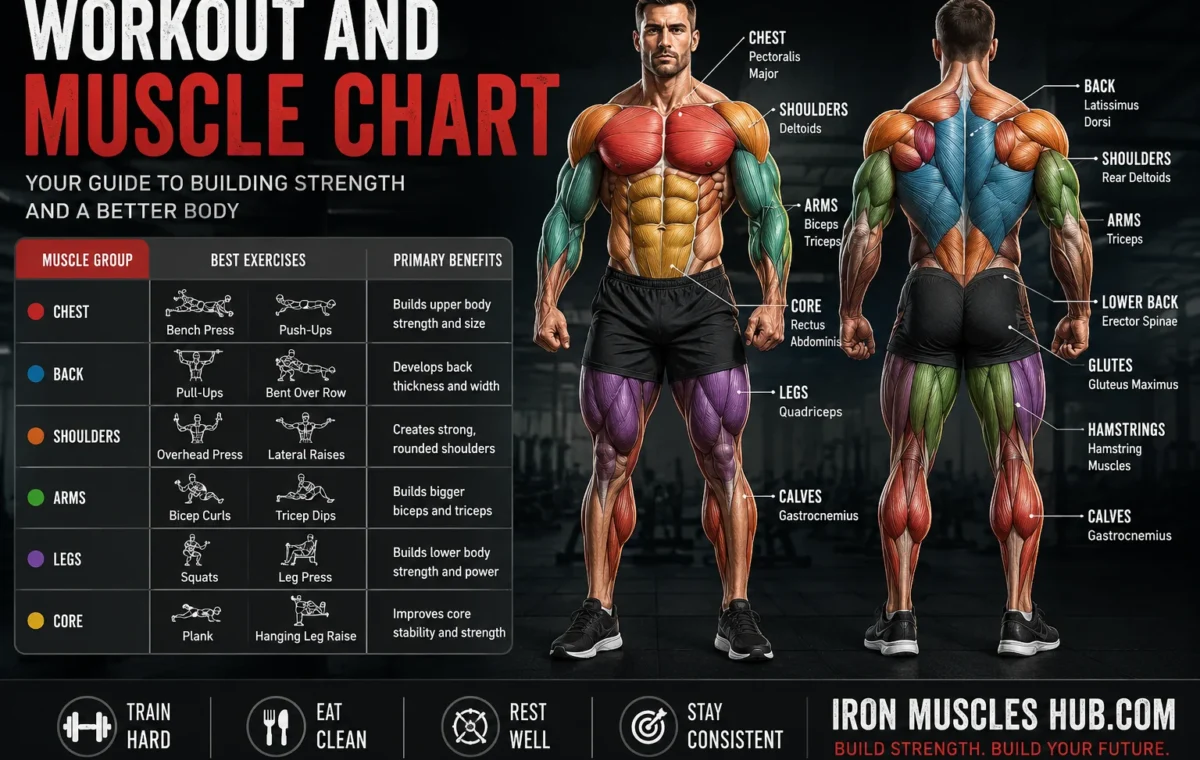
Workout and Muscle Chart: Exercises by Muscle Group
Here’s a beginner-friendly reference you can save and use during your workouts.
| Muscle group | Beginner exercises | Main muscles involved | Useful movement pattern |
|---|---|---|---|
| Chest | Push-up, bench press, dumbbell press | Pectorals, triceps, front deltoids | Horizontal push |
| Upper back | Seated row, dumbbell row | Rhomboids, trapezius, rear shoulder muscles | Horizontal pull |
| Lats | Lat pulldown, assisted pull-up | Latissimus dorsi, biceps | Vertical pull |
| Shoulders | Overhead press, lateral raise | Deltoids, triceps | Vertical push / shoulder abduction |
| Biceps | Dumbbell curl, hammer curl | Biceps, brachialis, forearm muscles | Elbow flexion |
| Triceps | Cable pressdown, overhead extension | Triceps | Elbow extension |
| Quadriceps | Squat, leg press, split squat | Quadriceps, glutes | Knee-dominant |
| Hamstrings | Romanian deadlift, leg curl | Hamstrings, glutes | Hip hinge / knee flexion |
| Glutes | Hip thrust, squat, lunge | Gluteus maximus and other hip muscles | Hip extension |
| Calves | Standing calf raise, seated calf raise | Gastrocnemius, soleus | Ankle plantar flexion |
| Core | Plank, dead bug, cable crunch | Abdominals and trunk stabilizers | Bracing / trunk movement |
The table is a practical training reference, not a claim that each movement isolates one muscle.
Exercise selection can change depending on technique, range of motion, equipment, body proportions, and the specific variation you perform.
For beginners, that’s actually good news. You don’t need dozens of exercises.
You need a small group of movements that you can perform safely and progressively.
Chest: Build Your Push Pattern
The chest is dominated by the pectoral muscles. Pressing exercises also involve the triceps and anterior deltoids.
Good beginner choices
- Push-ups
- Machine chest press
- Dumbbell chest press
- Barbell bench press
If you’re completely new, a machine chest press or incline push-up can make learning the movement easier.
Once you’re comfortable, you can progress toward standard push-ups or free-weight pressing.
Coaching cue
Keep your shoulder blades controlled and avoid turning every repetition into a race. Lower the weight under control, maintain a stable position, and press smoothly.
You don’t need an enormous number of chest exercises.
One or two well-performed pressing movements can provide plenty of practice for a beginner.
Back: Train the Muscles You Can’t See
A balanced workout needs pulling movements.
Your back includes several important muscle groups, including the latissimus dorsi, trapezius, rhomboids, and spinal erectors.
Instead of thinking about “back” as one muscle, divide your training into two simple patterns:
Horizontal pulling: rows
Vertical pulling: pulldowns and pull-ups
Beginner exercises
- Seated cable row
- One-arm dumbbell row
- Lat pulldown
- Assisted pull-up
Rows are particularly useful for learning how to pull resistance toward your body while maintaining control.
Lat pulldowns teach the vertical pulling pattern without requiring you to lift your entire body.
Coaching cue
Don’t turn rows into a full-body rocking exercise.
Keep the movement controlled and let the target muscles contribute rather than relying on momentum.
Shoulders: Train More Than Just the Front Delts
The shoulders are commonly divided into the anterior, lateral, and posterior portions of the deltoid.
Pressing exercises already train the front delts.
That means your workout doesn’t necessarily need a huge collection of front-raise variations.
Useful exercises
- Dumbbell overhead press
- Machine shoulder press
- Dumbbell lateral raise
- Cable lateral raise
- Rear-delt fly
A beginner can keep this simple.
Use an overhead press for general pressing strength, then add a lateral or rear-delt movement if your program needs more direct shoulder work.
Biceps and Triceps: Train the Arms Efficiently
Your arms already work during compound movements.
Rows and pulldowns involve the biceps. Pressing exercises involve the triceps.
Direct arm exercises can then provide additional work.
Biceps
Good options include:
- Dumbbell curls
- Cable curls
- Hammer curls
Triceps
Good options include:
- Cable pressdowns
- Dumbbell overhead extensions
- Machine extensions
You don’t need five different curl variations in one session.
Pick one biceps exercise and one triceps exercise, learn them well, and progress gradually.
Legs: Think Quads, Hamstrings, Glutes and Calves
Leg training is where a muscle chart becomes especially useful.
“Legs” isn’t one muscle group.
You need movements that challenge the front of the thighs, the back of the thighs, the hips, and the lower leg.
Quadriceps
The quadriceps work strongly during knee-dominant movements.
Beginner options:
- Bodyweight squat
- Goblet squat
- Leg press
- Split squat
Hamstrings
The hamstrings contribute to both knee flexion and hip extension.
Useful exercises include:
- Romanian deadlift
- Seated leg curl
- Lying leg curl
Glutes
The glutes contribute strongly to hip extension and other hip movements.
Good choices include:
- Squats
- Hip thrusts
- Glute bridges
- Lunges
- Romanian deadlifts
Calves
Calf raises are the simplest way to train the lower leg directly.
Use:
- Standing calf raise
- Seated calf raise
You don’t need every exercise listed above.
Choose movements that fit your equipment, experience, and goals.
A Beginner Full-Body Workout and Muscle Chart
If you’re training two or three days per week, a full-body structure is often easier to manage than creating a separate day for every muscle.
Here’s a simple template.
| Exercise | Main muscles | Sets | Reps |
| Goblet squat | Quads, glutes | 2 | 8–12 |
| Dumbbell chest press | Chest, triceps, front delts | 2 | 8–12 |
| Seated cable row | Upper back, lats, biceps | 2 | 8–12 |
| Romanian deadlift | Hamstrings, glutes | 2 | 8–12 |
| Dumbbell overhead press | Shoulders, triceps | 2 | 8–12 |
| Lat pulldown | Lats, biceps | 2 | 8–12 |
| Plank | Core | 2 | Controlled holds |
This template follows the broad resistance-training structure recommended by ACSM: major muscle groups, multiple exercises, controlled repetitions, and training on roughly two to three days per week.
Mayo Clinic guidance also emphasizes learning proper technique, using controlled movements, training major muscle groups, and allowing recovery between strength sessions.
How to schedule it
You could use:
Monday: Full body
Wednesday: Full body
Friday: Full body
Or:
Tuesday: Full body
Thursday: Full body
Saturday: Full body
The exact days aren’t important.
Consistency is.
Worked Example: Choosing Your Starting Weight
Suppose you weigh 70 kg (154 lb) and you’re learning the goblet squat.
Your body weight does not tell you exactly how much dumbbell weight you should use.
Instead, choose a resistance that lets you perform your target repetitions with good technique.
For example:
Exercise: Goblet squat
Starting dumbbell: 10 kg (22 lb)
Target: 2 sets of 8–12 reps
Imagine your first session looks like this:
- Set 1: 10 kg × 10 reps
- Set 2: 10 kg × 9 reps
Your technique stays controlled, and you could probably perform another repetition or two.
Keep the same weight next session.
If you eventually reach:
- Set 1: 10 kg × 12 reps
- Set 2: 10 kg × 12 reps
with good technique, you have a reason to consider a small increase.
For example, you might move to a 12 kg (26.5 lb) dumbbell if that option is available.
The important lesson is this:
Don’t choose weights based only on what another person lifts.
Your starting resistance depends on your training history, technique, exercise variation, and current strength.
How Often Should You Train Each Muscle?
For beginners, the question isn’t simply “How many days should I go to the gym?”
The better question is:
How can I train consistently while recovering well enough to perform the next session?
ACSM’s general resistance-training guidance uses 2–3 training sessions per week for a basic program.
Research also shows that training frequency needs to be considered alongside total training volume. A systematic review and meta-analysis found that when total volume is matched, training frequency by itself has little meaningful effect on muscle hypertrophy.
That means you don’t need to obsess over whether a muscle is trained exactly twice, three times, or another number of times.
A schedule you can recover from and follow consistently is more useful.
For many beginners, full-body training two or three times per week is a simple solution.
How Many Sets Should You Do?
ACSM’s general resistance-training resource gives 2–3 sets of 8–12 repetitions as one practical framework for resistance exercise.
Research also suggests that training volume matters for muscle growth. A systematic review and meta-analysis found a dose-response relationship between weekly resistance-training volume and increases in muscle mass, although the exact amount that works best varies between people and training levels.
For a beginner, this doesn’t mean you should immediately perform a huge amount of work.
Start with enough training to learn the movements and recover.
Then increase your workload gradually as your technique, strength, and tolerance improve.
What Rep Range Should Beginners Use?
The classic 8–12 rep range is useful because it gives beginners enough repetitions to practice a movement without requiring maximal loads.
But it isn’t a magical muscle-building range.
Research comparing different resistance-training loads has found that muscle hypertrophy can occur across a broad range of loads, while heavier loads tend to have an advantage for developing maximal strength.
For practical beginner training, the better question is:
Can I perform the movement with good technique and appropriate effort?
If yes, you’re on the right track.
Common Mistakes → Why → Fix
Mistake 1: Training Only Mirror Muscles
Why: Beginners naturally focus on chest, abs, shoulders, and biceps because those muscles are easy to see.
Fix: Use your chart to check whether every session includes pushing, pulling, knee-dominant, hip-dominant, and core work.
Mistake 2: Changing Exercises Every Workout
Why: Constant exercise changes make it difficult to tell whether you’re actually improving.
Fix: Keep the main exercises stable for long enough to learn their technique and track your repetitions and resistance.
You don’t need a completely new workout every week.
Mistake 3: Adding Weight Too Quickly
Why: Beginners can become focused on the number printed on the dumbbell rather than movement quality.
Fix: Increase resistance only when you can perform your target repetitions with controlled technique.
Mistake 4: Doing Too Many Exercises
Why: More exercises can feel like more progress.
Fix: Start with a small selection covering the major muscle groups. Add exercises only when you have a reason.
Mistake 5: Ignoring Recovery
Why: More training can look productive on paper, but your performance can suffer if you don’t recover.
Fix: Schedule non-consecutive training days when using a beginner full-body routine. Mayo Clinic guidance recommends allowing recovery between strength-training sessions.
Mistake 6: Treating the Chart as a Perfect Anatomy Map
Why: An exercise can involve several muscles, and technique can change how much different muscles contribute.
Fix: Use the chart as a training guide, not a promise that one exercise isolates one muscle.
30-Second Muscle-Balance Self-Test
Before finishing your weekly plan, ask yourself five questions:
- Did I train a pushing movement?
- Did I train a pulling movement?
- Did I train my quads?
- Did I train my hamstrings and glutes?
- Did I include some form of core work?
If you can answer yes to all five, your routine probably has a much better foundation than a random collection of exercises.
Then check your training log.
Are your repetitions, resistance, or technique gradually improving?
If yes, you’re getting useful feedback from your program.
Who This Workout and Muscle Chart Is NOT For
This chart is not a substitute for individualized medical or rehabilitation guidance.
It is also not designed to diagnose pain, correct an existing injury, or prescribe training around a medical condition.
If you have persistent pain, a recent injury, a medical condition, or you’re unsure whether resistance training is appropriate for you, speak with a qualified healthcare professional before starting or changing your program.
It also isn’t intended for advanced lifters looking for highly specialized programming.
An experienced lifter may need more detailed decisions about exercise selection, training volume, fatigue management, intensity, and progression.
For a beginner, simplicity is usually a better starting point.
How to Use a Muscle Chart at the Gym
You can turn this article into a simple workout-planning process.
Step 1: Pick one exercise for each major pattern
Start with:
- Squat or leg press
- Chest press
- Row
- Hip hinge
- Vertical pull
- Shoulder press
- Core exercise
Step 2: Record your workout
Write down:
Exercise — weight — reps — sets
For example:
Goblet squat — 10 kg (22 lb) — 10, 9
This gives you something concrete to improve.
Step 3: Repeat the movements
Don’t judge your progress from one workout.
Look for trends over multiple sessions.
Step 4: Progress gradually
When you can perform your planned repetitions with good form, consider a small increase in resistance or repetitions.
Step 5: Review the whole week
Look at your chart and make sure you’re not repeatedly training the same muscles while ignoring others.
Workout Splits vs. Full-Body Training
A workout and muscle chart can also help you understand different training splits.
| Training style | Basic idea | Beginner usefulness |
| Full body | Train most major muscle groups each session | Excellent for 2–3 days/week |
| Upper/lower | Alternate upper-body and lower-body sessions | Useful when training more frequently |
| Push/pull/legs | Group exercises by movement or muscle emphasis | Can work, but may be unnecessary for a new lifter |
| Body-part split | Give individual muscles their own sessions | Usually more complicated than needed initially |
There isn’t one perfect split for everyone.
Research on resistance-training frequency suggests that when weekly training volume is equivalent, frequency itself has a relatively small effect on hypertrophy.
So choose the structure that fits your schedule and allows you to train consistently.
A Simple 3-Day Workout and Muscle Chart
Here is another practical option for someone who wants a clear weekly plan.
Day 1
| Exercise | Target |
| Goblet squat | Quads, glutes |
| Dumbbell chest press | Chest, triceps |
| Seated row | Upper back, biceps |
| Romanian deadlift | Hamstrings, glutes |
| Plank | Core |
Day 2
| Exercise | Target |
| Leg press | Quads, glutes |
| Lat pulldown | Lats, biceps |
| Dumbbell shoulder press | Shoulders, triceps |
| Leg curl | Hamstrings |
| Calf raise | Calves |
Day 3
| Exercise | Target |
| Split squat | Quads, glutes |
| Push-up or chest press | Chest, triceps |
| One-arm dumbbell row | Back, biceps |
| Hip thrust | Glutes |
| Dead bug | Core |
You don’t have to perform every exercise exactly as written.
Machines, cables, dumbbells, barbells, and bodyweight variations can all be useful.
ACSM specifically notes that free weights, machines, and resistance bands can be used for resistance exercise.
How to Progress Without Guessing
Progressive training doesn’t mean adding weight every single workout.
You can progress through several variables:
- More repetitions with the same weight
- Slightly more resistance
- Better control
- Improved range of motion
- More consistent technique
- Additional training volume when appropriate
For example:
Week 1: 10 kg × 8 reps
Week 2: 10 kg × 9 reps
Week 3: 10 kg × 10 reps
Week 4: 10 kg × 11 reps
That is progress even though the dumbbell never changed.
Eventually, you may reach your planned repetition range and increase the resistance.
The goal is not to make every workout harder at any cost.
The goal is to create a training stimulus that you can repeat and build on.
Why a Muscle Chart Is Better Than a Random Exercise List
A random exercise list tells you what to do.
A muscle chart tells you why the exercise is in your program.
That difference is important.
If your routine contains bench presses, curls, lateral raises, and crunches, you may feel like you’ve completed a serious workout.
But your chart might reveal that you haven’t included enough pulling or lower-body work.
The chart gives you a way to audit your routine.
You can ask:
What does this exercise train?
What other muscles assist it?
What movement pattern does it represent?
Where does it fit in my week?
Those questions turn a list of exercises into an actual training plan.
FAQ: Workout and Muscle Chart
What is the best workout chart for beginners?
A full-body chart covering the major muscle groups is a strong starting point for most beginners. Include a squat or leg press, a horizontal push, a row, a hip-hinge movement, a vertical pull, and a core exercise. ACSM recommends resistance programs that cover the major muscle groups and commonly use 2–3 sets of 8–12 repetitions.
How many times a week should I work each muscle?
There isn’t one mandatory frequency for every person. A beginner can use full-body training on two or three non-consecutive days and train the major muscle groups during those sessions. Research indicates that when total training volume is matched, frequency alone has little meaningful effect on muscle hypertrophy.
What exercises work the most muscles at once?
Compound exercises such as squats, rows, presses, lunges, and Romanian deadlifts involve several muscles simultaneously. For example, a squat can train the quadriceps and glutes while other muscles contribute to stability. Compound movements are useful for beginners because they let you train multiple areas without needing a long exercise list.
How many exercises should a beginner do per workout?
There is no universal number. A beginner full-body workout can be built around roughly five to seven movements that collectively cover the major movement patterns. The priority should be learning technique, completing useful work, and recovering well enough to train again. Adding more exercises isn’t automatically better.
Can I build muscle with a workout chart at home?
Yes. A home workout can use bodyweight movements, resistance bands, dumbbells, or other appropriate resistance. The key is that the muscles must face enough resistance and the training needs to be progressive over time. ACSM notes that free weights, machines, and bands can all be used for resistance exercise.
Final Summary
A workout and muscle chart gives beginners a simple way to connect exercises with the muscles and movement patterns they train. Start with the major areas: chest, back, shoulders, arms, quads, hamstrings, glutes, calves, and core.
You don’t need an enormous exercise library.
Choose a manageable group of movements, learn good technique, record your sets and repetitions, and gradually improve. A full-body routine performed two or three days per week can be a practical starting structure, supported by general resistance-training guidance from ACSM.
Use this chart as your reference, keep your training simple, and let your workout log show you where you’re improving.
For more beginner-friendly anatomy and strength-training guides, explore the related resources on Iron Muscle Hub.