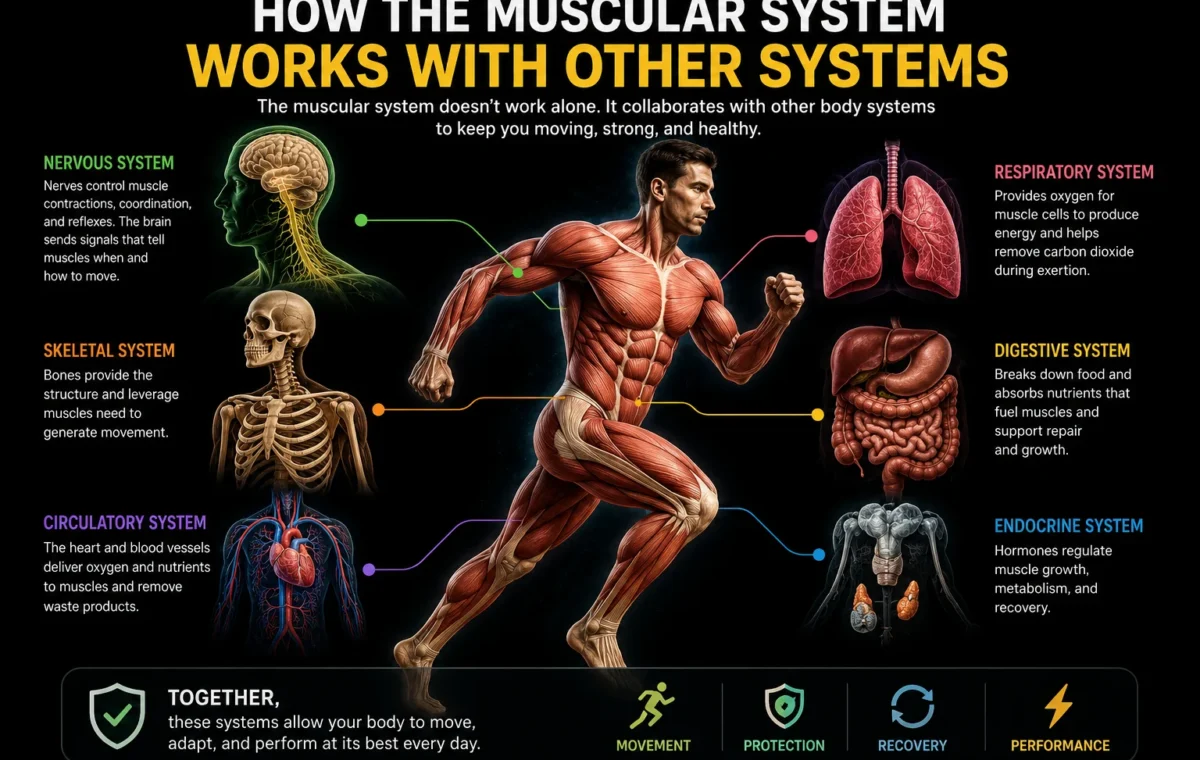
The muscular system works with every major body system to keep you alive, moving, and healthy. Muscles don’t work on their own. They rely on the nervous system for instructions, the skeletal system for movement, the circulatory system for oxygen and nutrients, the respiratory system for breathing, and several other systems to perform everyday tasks.
- Quick Answer
- Everyday Example
- Why Healthy Bones Matter for Strong Muscles
- Muscle Contraction Made Simple
- What Happens When Communication Breaks Down?
- Example: What Happens During a Jog?
- Did You Know?
- Myth 1: Muscles Work by Themselves
- Myth 2: Only Exercise Builds Healthy Muscles
- Myth 3: The Heart Isn't a Muscle
- Myth 4: Breathing Has Nothing to Do With Muscles
- How does the muscular system work with the skeletal system?
- Why does the muscular system need the circulatory system?
- Which body system controls muscles?
- Can muscles work without oxygen?
- Which nutrients are most important for healthy muscles?
- Why is it important that body systems work together?
- Table of Contents
- Walking
- Playing Football
- Lifting Groceries
- Muscles + Bones
- Muscles + Brain
- Muscles + Heart
- Muscles + Lungs
- Muscles + Digestive System
- Muscles + Hormones
- Muscles + Immune System
- Muscles + Skin
- What body systems help muscles move?
- Why can't muscles work alone?
- Which body system supplies oxygen to muscles?
- How do muscles help other body systems?
- What happens if one body system fails?
- Final Thoughts
Whether you’re walking upstairs, smiling at a friend, lifting groceries, or simply breathing while asleep, multiple body systems are working together behind the scenes. Understanding these connections helps explain why keeping your muscles healthy also benefits your entire body. For more insights read here:- lean build and lean muscle.
Quick Answer
| Body System | How It Works with the Muscular System |
|---|---|
| Skeletal System | Bones provide attachment points so muscles can create movement. |
| Nervous System | Sends electrical signals that tell muscles when to contract or relax. |
| Circulatory System | Delivers oxygen and nutrients while removing waste products. |
| Respiratory System | Supplies oxygen needed for muscle activity and removes carbon dioxide. |
| Digestive System | Provides nutrients and energy from food to fuel muscles. |
| Endocrine System | Hormones regulate muscle growth, repair, and metabolism. |
| Immune System | Helps repair damaged muscle tissue after exercise or injury. |
| Integumentary System | Skin regulates body temperature during muscle activity through sweating. |
How the muscular system works with other systems
Your body functions like a well-organized team rather than a collection of separate parts. Every movement depends on communication between different organs and systems.
For example, picking up a glass of water may seem simple, but it actually involves:
- Your brain deciding to move.
- Nerves carrying electrical messages.
- Muscles contracting.
- Bones acting as levers.
- Your heart pumping oxygen-rich blood.
- Your lungs supplying fresh oxygen.
- Your digestive system providing energy from food.
If just one of these systems stopped working properly, movement would become difficult—or even impossible.
The Muscular System at a Glance
The muscular system consists of more than 600 muscles that make up around 40% of an average adult’s body weight. These muscles perform far more than exercise and sports.
Their main jobs include:
- Producing body movement
- Maintaining posture
- Stabilizing joints
- Generating body heat
- Helping blood circulate
- Assisting breathing
- Moving food through the digestive tract
- Protecting internal organs
There are three main types of muscle tissue:
| Muscle Type | Location | Main Job |
|---|---|---|
| Skeletal Muscle | Attached to bones | Voluntary movement |
| Cardiac Muscle | Heart | Pumps blood continuously |
| Smooth Muscle | Internal organs | Moves substances through organs automatically |
Each type depends on support from other body systems to perform its specific role.
How the Muscular System Works With the Skeletal System
The skeletal and muscular systems are so closely connected that they’re often called the musculoskeletal system.
Bones provide a solid framework, while muscles generate the force needed for movement.
Here’s how it works:
- A muscle attaches to bones using strong tendons.
- Your brain sends a signal through nerves.
- The muscle contracts (shortens).
- The tendon pulls on the bone.
- The joint moves.
Without bones, muscles would have nothing to pull against. Likewise, bones couldn’t move without muscles.
Everyday Example
Imagine opening a heavy door.
Your:
- Shoulder muscles stabilize your arm.
- Biceps bend your elbow.
- Forearm muscles grip the handle.
- Hand muscles hold it firmly.
- Bones provide leverage for every movement.
Multiple muscles and bones work together in perfect coordination.
Why Healthy Bones Matter for Strong Muscles
Strong muscles need healthy bones for proper support.
Nutrients such as:
- Calcium
- Vitamin D
- Magnesium
- Protein
help maintain both muscle performance and bone strength.
Regular resistance exercise also strengthens muscles and bones at the same time.
How the Muscular System Works With the Nervous System
If muscles are the body’s engines, the nervous system is the control center.
Every voluntary movement begins in the brain.
The process happens incredibly quickly:
- The brain decides to move.
- Electrical impulses travel through the spinal cord.
- Motor neurons carry the message to muscle fibers.
- Muscle fibers contract.
- Movement occurs.
This communication happens within fractions of a second.
Without nerve signals, muscles cannot contract properly.
Muscle Contraction Made Simple
Here’s an easy way to picture it:
Think of your body like a remote-controlled car.
- The brain is the driver.
- The nervous system is the remote signal.
- The muscles are the motor.
- The bones are the wheels and frame.
All four must work together for smooth movement.
What Happens When Communication Breaks Down?
Damage to nerves can affect muscle function.
Examples include:
- Muscle weakness
- Loss of coordination
- Reduced reflexes
- Paralysis in severe cases
- Muscle shrinking (atrophy) from lack of nerve stimulation
This is why both healthy muscles and healthy nerves are essential for movement.
How the Muscular System Works With the Circulatory System
Muscles require a constant supply of oxygen and nutrients to keep working.
That’s the job of the circulatory system.
Your heart pumps oxygen-rich blood through arteries to muscles throughout your body.
Blood delivers:
- Oxygen
- Glucose
- Amino acids
- Electrolytes
- Hormones
At the same time, it removes:
- Carbon dioxide
- Heat
- Lactic acid and other metabolic waste products
During exercise, your muscles demand much more oxygen than when you’re resting. In response, your heart beats faster and blood vessels widen to deliver more blood to working muscles.
Example: What Happens During a Jog?
When you begin jogging:
- Leg muscles contract repeatedly.
- Your heart rate increases.
- Blood flow to active muscles rises.
- Oxygen delivery improves.
- Waste products are carried away more quickly.
- Your body produces heat, causing you to sweat.
This coordinated response allows you to keep moving efficiently instead of tiring immediately.
How the Muscular System Works With the Respiratory System
Your muscles cannot work for long without oxygen. The respiratory system provides the oxygen muscles need to produce energy and removes carbon dioxide, a waste product created during muscle activity.
The two systems constantly work together:
- You inhale oxygen into your lungs.
- Oxygen passes into your bloodstream.
- The circulatory system carries oxygen to your muscles.
- Muscle cells use oxygen to produce energy (ATP).
- Carbon dioxide travels back through the blood to the lungs.
- You exhale the carbon dioxide.
The harder you exercise, the more oxygen your muscles require. That’s why your breathing becomes faster and deeper during activities like running, cycling, or lifting weights.
Did You Know?
Your diaphragm—the main muscle used for breathing—is itself a muscle. Every breath you take depends on muscle contractions.
How the Muscular System Works With the Digestive System
Muscles need fuel, and the digestive system supplies it.
When you eat, your digestive system breaks food into nutrients that your muscles can use for energy, growth, and repair.
Important nutrients include:
- Protein for building and repairing muscle fibers.
- Carbohydrates for producing quick energy.
- Healthy fats for long-lasting energy.
- Vitamins and minerals that support muscle contractions and recovery.
- Water for hydration and normal muscle function.
The digestive system also relies on muscles. Smooth muscles in the digestive tract create wave-like movements (called peristalsis) that push food through the stomach and intestines.
This means the muscular and digestive systems support each other every day.
How the Muscular System Works With the Endocrine System
The endocrine system produces hormones that help muscles grow, recover, and adapt.
Some important hormones include:
| Hormone | How It Helps Muscles |
|---|---|
| Growth Hormone | Supports muscle growth and tissue repair |
| Testosterone | Helps increase muscle size and strength |
| Insulin | Moves glucose into muscle cells for energy |
| Cortisol | Helps manage energy during stress but may slow muscle growth if levels stay high for long periods |
| Thyroid Hormones | Help regulate metabolism and energy production |
Hormones don’t make muscles stronger by themselves. They work alongside proper nutrition, physical activity, sleep, and recovery.
How the Muscular System Works With the Immune System
Exercise places small amounts of stress on muscle fibers. After a workout, the immune system helps repair this tiny damage.
It does this by:
- Removing damaged cells.
- Starting the healing process.
- Supporting tissue repair.
- Helping muscles recover and become stronger over time.
When you’re sick or injured, the immune system also protects muscles from infections while supporting recovery.
How the Muscular System Works With the Integumentary System (Skin)
Your skin helps muscles function safely by controlling body temperature.
As muscles work, they produce heat.
To prevent overheating:
- Sweat glands release sweat.
- Sweat evaporates and cools the skin.
- Blood vessels near the skin widen to release extra heat.
Without this cooling system, your body temperature could rise to dangerous levels during physical activity.
The skin also protects muscles from cuts, bacteria, and environmental damage.
How All Body Systems Work Together: A Simple Example
Imagine you’re climbing a flight of stairs.
Here’s what happens behind the scenes:
| Body System | What It’s Doing |
|---|---|
| Nervous System | Sends signals telling your leg muscles to move. |
| Skeletal System | Provides the bones and joints needed for movement. |
| Muscular System | Contracts to lift your body upward. |
| Respiratory System | Brings in extra oxygen. |
| Circulatory System | Delivers oxygen and nutrients to working muscles. |
| Digestive System | Supplies stored energy from food. |
| Endocrine System | Releases hormones that help regulate energy use. |
| Integumentary System | Cools your body through sweating. |
| Immune System | Repairs tiny muscle fibers after the activity. |
This example shows that no body system works alone. Every movement depends on teamwork.
Common Mistakes People Make
Understanding how body systems interact can clear up several common misconceptions.
Myth 1: Muscles Work by Themselves
Reality: Every muscle movement depends on signals from the nervous system, support from bones, oxygen from the lungs, and nutrients carried by the blood.
Myth 2: Only Exercise Builds Healthy Muscles
Reality: Exercise is important, but muscles also need quality sleep, balanced nutrition, hydration, and recovery.
Myth 3: The Heart Isn’t a Muscle
Reality: The heart is made of cardiac muscle, a specialized muscle tissue that works continuously throughout life.
Myth 4: Breathing Has Nothing to Do With Muscles
Reality: Breathing depends on muscles like the diaphragm and intercostal muscles, making respiration a muscular process.
Tips for Keeping Your Muscular System Healthy
Healthy muscles depend on healthy habits.
Try to:
- Eat enough protein from quality food sources.
- Stay physically active most days of the week.
- Include strength training at least two days each week.
- Stretch regularly to maintain flexibility.
- Drink enough water throughout the day.
- Sleep 7–9 hours each night if you’re an adult.
- Avoid smoking, which reduces oxygen delivery to muscles.
- Allow time for recovery after intense workouts.
Small daily habits can make a big difference over time.
Frequently Asked Questions
How does the muscular system work with the skeletal system?
Muscles attach to bones using tendons. When muscles contract, they pull on bones, creating movement at joints. Without bones, muscles would have nothing to pull against, and without muscles, bones couldn’t move.
Why does the muscular system need the circulatory system?
The circulatory system delivers oxygen, nutrients, hormones, and water to muscles while removing carbon dioxide and waste products. This support allows muscles to contract efficiently and recover after activity.
Which body system controls muscles?
The nervous system controls muscle movement by sending electrical signals from the brain and spinal cord to muscle fibers. Voluntary movements and many automatic muscle actions rely on these nerve signals.
Can muscles work without oxygen?
Muscles can produce a small amount of energy without oxygen during very short, intense activities. However, they quickly rely on oxygen for efficient energy production during longer periods of exercise.
Which nutrients are most important for healthy muscles?
Protein supports muscle repair and growth, carbohydrates provide energy, healthy fats support overall health, and minerals like calcium, potassium, and magnesium help muscles contract normally.
Why is it important that body systems work together?
No body system can perform its job completely on its own. Movement, breathing, digestion, circulation, and temperature control all depend on different systems communicating and supporting one another.
Understanding the Body’s Teamwork
The muscular system is much more than the muscles you see in the mirror. Every movement, heartbeat, breath, and even digestion depends on muscles working alongside other body systems.
When the nervous, skeletal, circulatory, respiratory, digestive, endocrine, immune, and integumentary systems all do their part, your body can move efficiently, recover from activity, and maintain overall health.
Understanding these connections also highlights why healthy habits—such as regular exercise, balanced nutrition, quality sleep, staying hydrated, and managing stress—benefit your entire body, not just your muscles. By taking care of one system, you’re supporting them all.
Table of Contents
How the Muscular System Works With Other Systems

1. Quick Answer
2. Why Body Systems Work Together
3. The Muscular System at a Glance
4. Muscular System and Skeletal System
5. Muscular System and Nervous System
6. Muscular System and Circulatory System
7. Muscular System and Respiratory System
8. Muscular System and Digestive System
9. Muscular System and Endocrine System
10. Muscular System and Immune System
11. Muscular System and Integumentary System
12. Real-Life Example
13. Common Myths
14. Healthy Muscle Tips
15. Frequently Asked Questions
16. Final Thoughts
Key Takeaways Box
Quick Summary
- The muscular system depends on every major body system.
- Bones provide support while muscles create movement.
- Nerves control every muscle contraction.
- Blood supplies oxygen and nutrients.
- Lungs provide oxygen needed to produce energy.
- The digestive system fuels muscles through nutrients.
- Hormones regulate muscle growth and recovery.
- The immune system repairs damaged muscle fibers.
- Healthy muscles require exercise, nutrition, hydration, and rest.
How All Body Systems Work Together (Flowchart)
Brain
   ↓
Nervous System
   ↓
Muscles Contract
   ↓
Bones Move
   ↓
Heart Pumps More Blood
   ↓
Lungs Supply Oxygen
   ↓
Digestive System Provides Energy
   ↓
Hormones Support Performance
   ↓
Immune System Repairs Muscle Tissue
Muscle System Interaction Table
| System | Main Function | Why It Matters |
|---|---|---|
| Skeletal | Supports movement | Muscles pull bones |
| Nervous | Controls muscles | Sends electrical signals |
| Circulatory | Delivers oxygen | Provides nutrients |
| Respiratory | Supplies oxygen | Produces energy |
| Digestive | Digests food | Fuels muscles |
| Endocrine | Releases hormones | Growth and repair |
| Immune | Repairs tissue | Recovery after exercise |
| Skin | Controls temperature | Prevents overheating |
Daily Life Examples
Walking
- Brain sends signal.
- Leg muscles contract.
- Bones move.
- Heart pumps faster.
- Lungs increase breathing.
- Skin cools the body.
Playing Football
- Eyes locate the ball.
- Brain processes information.
- Leg muscles sprint.
- Heart delivers oxygen.
- Lungs work harder.
- Sweat cools the body.
Lifting Groceries
- Hand muscles grip.
- Arm muscles lift.
- Back muscles stabilize posture.
- Bones support weight.
- Blood delivers oxygen.
- Hormones help muscles recover afterward.
Muscle Health Checklist
✔ Eat enough protein
✔ Drink plenty of water
✔ Exercise regularly
✔ Strength train twice weekly
✔ Stretch after activity
✔ Sleep 7–9 hours
✔ Manage stress
✔ Avoid smoking
✔ Maintain a healthy body weight
Common Signs Your Muscles Need Attention
- Frequent cramps
- Muscle weakness
- Poor balance
- Constant fatigue
- Slow recovery
- Muscle pain lasting several days
If these symptoms persist, consult a healthcare professional.
Fun Facts
- Your heart beats about 100,000 times every day.
- More than 600 muscles help your body move.
- The largest muscle is the gluteus maximus.
- The smallest skeletal muscle is the stapedius in the ear.
- Your diaphragm contracts thousands of times daily as you breathe.
- Even smiling uses multiple facial muscles.
Quick Revision
Muscles + Bones
Movement
Muscles + Brain
Control
Muscles + Heart
Blood supply
Muscles + Lungs
Oxygen
Muscles + Digestive System
Energy
Muscles + Hormones
Growth
Muscles + Immune System
Repair
Muscles + Skin
Temperature control
People Also Ask (Extra SEO Questions)
What body systems help muscles move?
The skeletal, nervous, circulatory, respiratory, digestive, endocrine, immune, and integumentary systems all support muscle movement in different ways.
Why can’t muscles work alone?
Muscles need nerve signals, oxygen, nutrients, bones for leverage, and hormones for growth and repair.
Which body system supplies oxygen to muscles?
The respiratory system provides oxygen, while the circulatory system transports it to muscle cells.
How do muscles help other body systems?
Muscles help pump blood through the heart, move food through the digestive tract, assist breathing, maintain posture, and generate body heat.
What happens if one body system fails?
When one system doesn’t function properly, muscle performance declines. For example, poor circulation reduces oxygen delivery, while nerve damage can prevent muscles from contracting.
Final Thoughts
The muscular system is not an isolated part of your body—it is a key player in a connected network of systems that work together every second of the day. Your muscles depend on your brain for instructions, your bones for support, your heart and lungs for oxygen, your digestive system for fuel, and your hormones and immune system for growth and repair.
Understanding how the muscular system works with other systems helps you see why overall health matters. Building stronger muscles is not only about lifting weights or exercising. It also depends on eating nutritious foods, getting enough sleep, staying hydrated, and giving your body time to recover.
When you take care of your entire body, your muscles can perform better, recover faster, and support everyday activities—from walking and working to sports and exercise. A healthy body is a team effort, and every system plays an important role.