If you’re searching for a map muscle guide, you probably want one simple thing: a clear picture of where the major muscles are, what they do, and which exercises train them. A muscle map turns the body into an easy reference, showing areas such as the chest, back, shoulders, arms, abs, glutes, thighs, and calves. Learning these regions makes exercise selection much easier because you can connect an exercise to the movement and muscles it uses. Skeletal muscles help produce movement, maintain posture, and stabilize the body, so understanding the basic layout is useful for both gym beginners and anyone studying human anatomy. For more insights read here :- protein shake and Muscle Knots .
- Quick Answer: What Is a Map Muscle Chart?
- What Is a Map Muscle Guide?
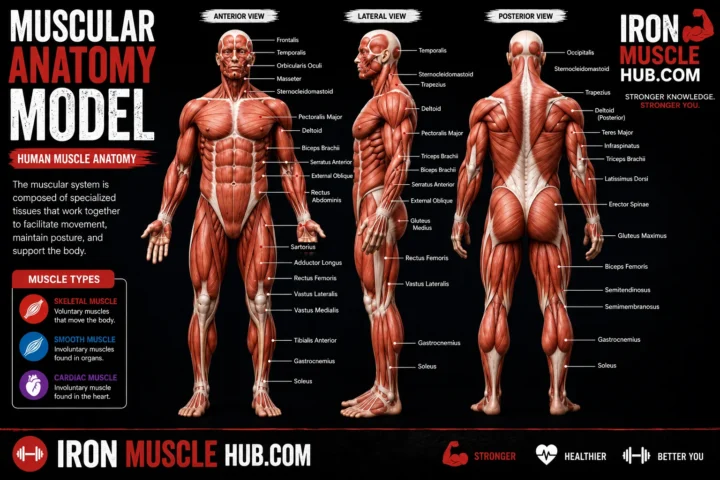
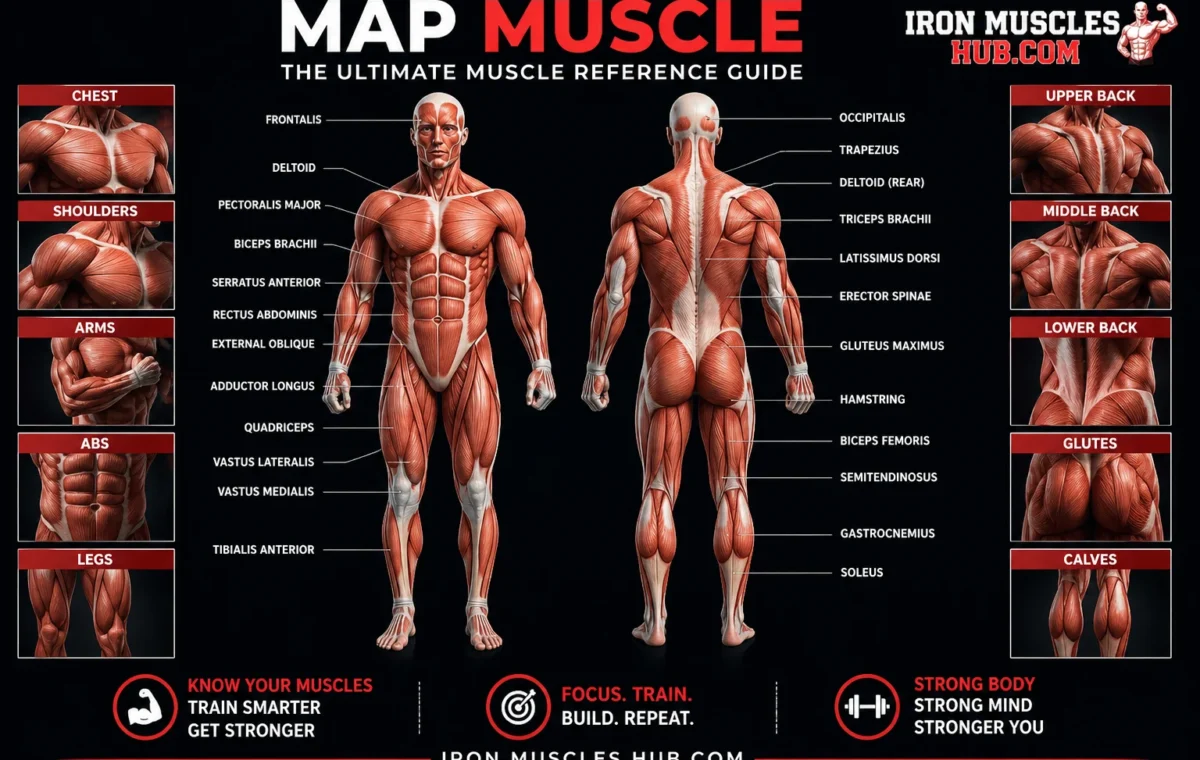
- Front and Back Muscle Map: The Major Areas
- 1. Chest
- 2. Back
- 3. Shoulders
- 4. Biceps
- 5. Triceps
- 6. Forearms
- 7. Core and Abdominals
- 8. Glutes
- 9. Quadriceps
- 10. Hamstrings
- 11. Calves
- How to Read a Muscle Map Correctly
- Step 1: Find the body region
- Step 2: Learn the basic action
- Step 3: Find movements that match
- Step 4: Check secondary muscles
- Map Muscle to Exercise: A Simple Training Reference
- Push
- Pull
- Squat
- Hinge
- Carry and Brace
- A Beginner Muscle Map Workout
- Worked Example: Using a Muscle Map to Plan a Week
- Monday
- Wednesday
- Friday
- How Much Training Does Each Muscle Need?
- Common Mistakes → Why → Fix
- Mistake 1: Treating every muscle on the map as an isolated target
- Mistake 2: Choosing exercises only because the map highlights a muscle
- Mistake 3: Ignoring the back view
- Mistake 4: Assuming soreness equals a good workout
- Mistake 5: Using too many exercises
- Mistake 6: Confusing anatomy with diagnosis
- 30-Second Muscle Map Self-Test
- A Better Way to Think About Muscle Maps
- Muscle Map vs. Muscle Anatomy Chart
- Who This Is NOT For
- FAQ: Common Muscle Map Questions
- What are the major muscle groups in the human body?
- How many muscles are in the human body?
- How do I use a muscle map for workouts?
- What muscles should beginners train together?
- Is a muscle map useful for building muscle?
- Final Takeaway
Quick Answer: What Is a Map Muscle Chart?
- A muscle map is a visual guide showing the location and names of muscles or major muscle groups.
- The easiest beginner map uses front and back views of the body.
- Major training regions include the chest, back, shoulders, arms, core, glutes, thighs, and calves.
- Use the map to connect muscle location → function → movement → exercise rather than trying to memorize dozens of anatomical names.
What Is a Map Muscle Guide?
A map muscle chart is basically a road map for your muscular system.
Instead of looking at an exercise and guessing which muscles are working, you can start with the body region and work backward. Find the muscle, learn its basic function, then choose movements that challenge that function.
That approach is especially useful for beginners because exercise names can be confusing. A bench press, for example, isn’t simply an “arm exercise.” It involves the chest as a major contributor while the triceps and front portion of the shoulders also assist.
The same idea applies to lower-body movements. A squat involves several muscles around the hips and knees rather than one isolated muscle.
Skeletal muscle attaches to bones through tendons and produces movement when it contracts. It also contributes to posture, balance and joint stability.
A good muscle map should therefore answer three questions:
- Where is the muscle?
- What movement does it help produce?
- Which exercises train that movement?
That is more useful than simply memorizing anatomical labels.
Front and Back Muscle Map: The Major Areas
The simplest way to learn a muscle map is to divide the body into regions.
| Body region | Major muscles or groups | Basic role | Beginner exercises |
|---|---|---|---|
| Chest | Pectorals | Pressing the arm forward and inward | Push-up, bench press |
| Back | Lats, trapezius, rhomboids, spinal erectors | Pulling, shoulder-blade control, trunk support | Row, pulldown |
| Shoulders | Deltoids | Moving and controlling the upper arm | Shoulder press, lateral raise |
| Arms | Biceps, triceps | Bending and extending the elbow | Curl, triceps extension |
| Forearms | Wrist and finger flexors/extensors | Grip and wrist movement | Carries, curls, grip work |
| Core | Abdominals, obliques, deep trunk muscles | Trunk control and force transfer | Plank, dead bug |
| Glutes | Gluteus maximus, medius, minimus | Hip movement and pelvic control | Squat, hip thrust |
| Thighs | Quadriceps, hamstrings, adductors | Knee and hip movement | Squat, lunge, leg curl |
| Lower legs | Gastrocnemius, soleus, tibialis anterior | Ankle and foot movement | Calf raise, tibialis raise |
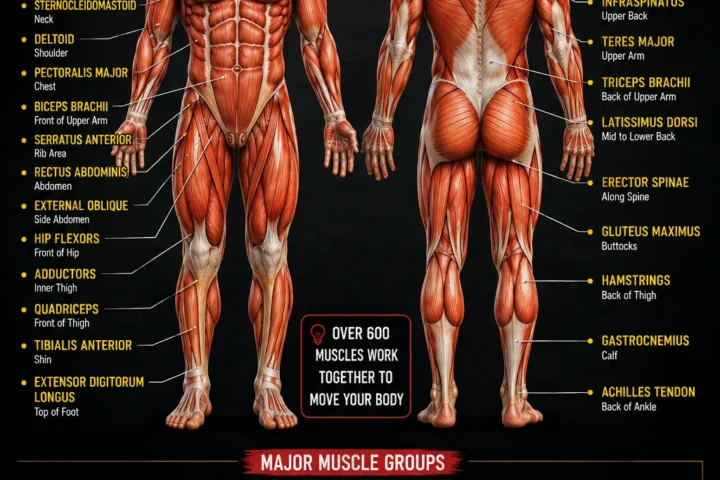
This table is a training map, not a complete medical anatomy chart. The human body contains hundreds of muscles, and individual muscles can have several parts or heads. Cleveland Clinic notes that the body has more than 600 muscles, while anatomical counting can vary depending on how muscles are classified.
For gym training, you usually don’t need to memorize all of them.
Start with the major regions.
1. Chest
The chest is dominated by the pectoralis major, with the pectoralis minor positioned deeper underneath it.
For a beginner, think of the chest as one of the major muscles involved in pushing.
Exercises such as push-ups and bench presses train the chest while also involving the triceps and anterior deltoids.
Map it: front of the upper torso.
Main training pattern: horizontal pushing.
Simple exercises: push-ups, machine chest press, dumbbell bench press.
2. Back
The back is not one single muscle.
A basic muscle map will commonly show the latissimus dorsi, trapezius and other muscles that control the shoulder blades and spine.
The lats are the large muscles running along the sides of the back. They contribute to pulling the upper arm down and toward the body.
The trapezius covers a large area across the upper and middle back.
Map it: posterior torso.
Main training patterns: horizontal pulling and vertical pulling.
Simple exercises: seated row, one-arm dumbbell row, lat pulldown.
3. Shoulders
The deltoid forms much of the rounded appearance of the shoulder.
It has three commonly discussed portions:
- Anterior deltoid
- Lateral deltoid
- Posterior deltoid
A beginner doesn’t need to treat these as three completely separate muscles.
Instead, understand that different arm movements place different demands on the three portions.
Map it: top and outer part of the upper arm.
Main training pattern: raising and pressing the arm.
Simple exercises: shoulder press, lateral raise, reverse fly.
4. Biceps
The biceps brachii sits on the front of the upper arm.
Its best-known job is elbow flexion, meaning it helps bring the forearm toward the upper arm. It also contributes to supination of the forearm.
For gym training, curls are the obvious example.
Pulling exercises also involve the biceps, which is why your arms may become tired during rows and pulldowns even though your back is the main target.
Map it: front of upper arm.
Simple exercises: dumbbell curl, cable curl, hammer curl.
5. Triceps
The triceps brachii occupies the back of the upper arm.
Its main function is elbow extension.
That makes it a major contributor to pressing movements.
Push-ups, bench presses and overhead presses can all involve the triceps.
Map it: rear of upper arm.
Simple exercises: cable pressdown, overhead extension, close-grip pressing.
6. Forearms
The forearm contains many muscles rather than one large muscle.
These muscles control the wrist, fingers and grip.
That’s why exercises such as rows, deadlifts and loaded carries can challenge your grip even though your forearms aren’t always the primary target.
Map it: between elbow and wrist.
Simple exercises: farmer carries, wrist curls, reverse curls and grip-focused work.
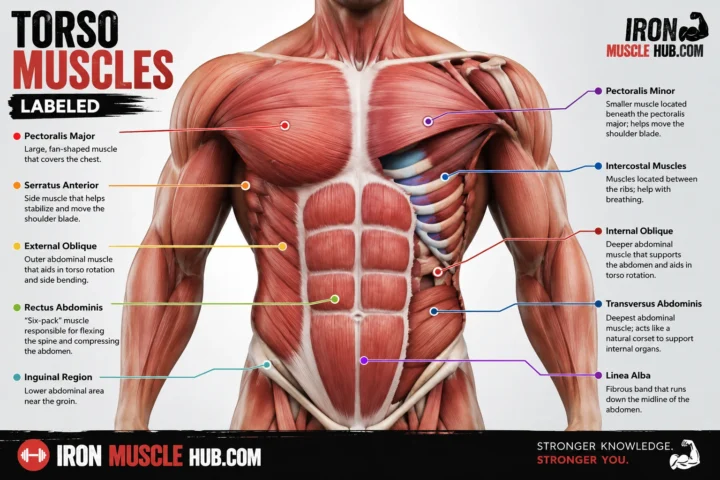
7. Core and Abdominals
A beginner muscle map often labels the visible abdominal muscles as “abs,” but the core is larger than the six-pack area.
The rectus abdominis is the prominent muscle on the front of the abdomen.
The obliques are positioned along the sides.
Other deeper muscles contribute to trunk stability and movement.
Think of the core as a system that helps control the trunk rather than simply a muscle you train with crunches.
Map it: center and sides of the torso.
Main training roles: resisting unwanted movement, transferring force and controlling the trunk.
Simple exercises: plank, dead bug, side plank and controlled carries.
8. Glutes
The gluteal region includes the gluteus maximus, gluteus medius and gluteus minimus.
The gluteus maximus is a major hip extensor and contributes strongly to movements such as standing up from a squat.
The smaller gluteal muscles also help control the pelvis and hip.
Map it: back and side of the hips.
Simple exercises: squat, hip thrust, split squat and step-up.
9. Quadriceps
The quadriceps are a group of four muscles at the front of the thigh.
They are major contributors to knee extension.
If you look at a front-view muscle map, the quadriceps occupy a large portion of the thigh.
Map it: front of thigh.
Simple exercises: squat, split squat, lunge, leg press and leg extension.
10. Hamstrings
The hamstrings sit at the back of the thigh.
They cross the knee and contribute to hip extension and knee flexion.
This is why a balanced lower-body program shouldn’t focus only on squat-type exercises.
Map it: rear of thigh.
Simple exercises: Romanian deadlift, leg curl, hip hinge and controlled split-stance work.
11. Calves
The calf region contains several muscles, with the gastrocnemius and soleus being especially important in basic gym discussions.
They contribute to movements around the ankle.
Standing calf raises and seated calf raises change the position of the knee and can shift the emphasis between calf muscles.
Map it: lower rear leg.
Simple exercises: standing calf raise, seated calf raise and controlled single-leg calf raise.
How to Read a Muscle Map Correctly
A common beginner mistake is to look at a coloured body diagram and assume that every highlighted muscle is being trained equally.
That’s not how exercise works.
An exercise can involve several muscles at once, but those muscles don’t necessarily contribute to the same degree.
Use this four-step method.
Step 1: Find the body region
Start with the muscle you want to understand.
For example, if your goal is to learn about the lats, locate them on the back-view diagram.
Step 2: Learn the basic action
Don’t try to memorize every anatomical attachment immediately.
Ask what the muscle generally helps you do.
For the lats, think about pulling the upper arm down and back toward the torso.
Step 3: Find movements that match
Now look for exercises that contain that movement.
Lat pulldowns and pull-ups are obvious examples.
Rows can also involve the lats, although the exact contribution changes with technique, grip and body position.
Step 4: Check secondary muscles
Finally, identify the muscles helping the main target.
A pulldown doesn’t isolate the lats. The biceps and other muscles contribute too.
This distinction between primary contributors and assisting muscles is one of the most useful things a beginner can learn from a muscle map.
Map Muscle to Exercise: A Simple Training Reference
Once you understand the anatomy, you can use a muscle map to build a basic workout.
Think in movement patterns rather than trying to give every tiny muscle its own exercise.
Push
Push exercises generally train the chest, shoulders and triceps.
Examples:
- Push-up
- Dumbbell bench press
- Machine chest press
- Overhead press
Pull
Pull exercises commonly train the back and biceps.
Examples:
- Lat pulldown
- Seated cable row
- One-arm dumbbell row
- Assisted pull-up
Squat
Squatting patterns involve the quadriceps, glutes and other supporting muscles around the hips and trunk.
Examples:
- Bodyweight squat
- Goblet squat
- Split squat
- Leg press
Hinge
Hinge movements place substantial demands on the posterior chain.
Examples:
- Romanian deadlift
- Hip hinge
- Dumbbell deadlift
- Hip thrust
Carry and Brace
Loaded carries and core exercises challenge the trunk while often involving the shoulders, grip and lower body.
Examples:
- Farmer carry
- Suitcase carry
- Dead bug
- Plank
This movement-based approach prevents a common beginner problem: creating a workout that contains lots of exercises but misses important movement patterns.
A Beginner Muscle Map Workout
You don’t need 10 exercises just because a muscle chart has 10 regions.
For a beginner, a smaller routine is often easier to learn and progress.
Try this example:
| Exercise | Sets | Reps | Main areas |
| Goblet squat | 2 | 8–12 | Quads, glutes |
| Dumbbell bench press | 2 | 8–12 | Chest, triceps, shoulders |
| Lat pulldown | 2 | 8–12 | Lats, upper back, biceps |
| Romanian deadlift | 2 | 8–12 | Hamstrings, glutes |
| Dumbbell shoulder press | 2 | 8–12 | Shoulders, triceps |
| Plank | 2 | 20–40 sec | Core |
The exact load should be appropriate for your ability and technique.
For example, a beginner might use a 10 kg (22 lb) dumbbell for an exercise, while another person may need a lighter or heavier load. The number itself isn’t the goal. The goal is to select a load that allows controlled, technically sound repetitions.
The 2026 ACSM position stand reviewed more than 30,000 participants across 137 systematic reviews and found that resistance training improves strength, muscle size and physical function. It also reported that higher weekly training volume can support hypertrophy, while heavier loads are particularly useful for strength development.
That gives us a useful coaching rule:
Start with manageable training, learn the movements, then gradually increase the challenge.
You don’t need to start with advanced programming.
Worked Example: Using a Muscle Map to Plan a Week
Suppose you’re a beginner who weighs 75 kg (165 lb) and you’re around 175 cm (5 ft 9 in) tall.
Your goal is general strength and muscle development.
Instead of creating a separate “chest day,” “arm day,” “calf day” and “back day,” you could train the whole body three times per week.
Monday
- Goblet squat: 2 × 8–12
- Dumbbell bench press: 2 × 8–12
- Lat pulldown: 2 × 8–12
- Romanian deadlift: 2 × 8–12
- Plank: 2 sets
Wednesday
Repeat the main patterns with small exercise variations:
- Leg press: 2 × 8–12
- Machine chest press: 2 × 8–12
- Seated row: 2 × 8–12
- Hip thrust: 2 × 8–12
- Side plank: 2 sets
Friday
- Split squat: 2 × 8–12 each side
- Dumbbell bench press: 2 × 8–12
- Lat pulldown: 2 × 8–12
- Dumbbell Romanian deadlift: 2 × 8–12
- Farmer carry: 2 sets
The purpose of the example isn’t to claim that every beginner must use these exact numbers.
It’s to show how a muscle map becomes a training map.
You identify the major regions, choose movement patterns that cover them, then repeat those patterns consistently.
Research reviews support resistance training across a range of loads for hypertrophy, while heavier loads tend to have an advantage for maximal strength.
How Much Training Does Each Muscle Need?
This is where beginners often overcomplicate things.
There isn’t one magical number of sets that guarantees muscle growth.
The 2026 ACSM position stand found that muscle hypertrophy was enhanced by higher training volumes, with 10 or more sets per week identified as a useful benchmark in the evidence synthesis. Other systematic reviews have reported benefits from increasing weekly resistance-training volume, while also showing that responses vary.
For a beginner, don’t immediately interpret that as “do 10 hard sets for every muscle on Monday.”
That’s an easy way to turn a simple workout into a recovery problem.
Instead, begin with a modest amount of productive work and increase it when your technique, recovery and schedule can support more.
For example, two sets of several compound exercises can already expose multiple muscle groups to training.
The key is to count the work sensibly.
A set of bench press directly challenges the chest but also contributes work for the triceps and front delts. You shouldn’t automatically count that as a full direct set for every assisting muscle.
Common Mistakes → Why → Fix
Mistake 1: Treating every muscle on the map as an isolated target
Why: Human movement is coordinated. Most resistance exercises use multiple muscles.
Fix: Identify the main movement first, then note the secondary muscles.
A row isn’t just a “biceps exercise” because your biceps feel tired.
Mistake 2: Choosing exercises only because the map highlights a muscle
Why: A coloured region doesn’t tell you whether an exercise is appropriate for your current ability.
Fix: Choose exercises you can perform safely and consistently with controlled technique.
A machine exercise can be a perfectly good beginner choice.
Mistake 3: Ignoring the back view
Why: Beginners often focus on muscles they can see in the mirror.
Fix: Check both front and back views.
Your back, hamstrings and glutes are major parts of the muscular system and shouldn’t disappear from your training plan.
Mistake 4: Assuming soreness equals a good workout
Why: Soreness is not a reliable measurement of muscle growth or training quality.
Fix: Track performance, technique and gradual progression.
If your repetitions become cleaner or you can eventually handle a slightly greater training challenge with good form, that’s more useful information.
Mistake 5: Using too many exercises
Why: More exercises create more fatigue, take more time and can make it harder to see which movements are actually helping.
Fix: Start with a few movements covering the major patterns.
A simple program that you follow consistently beats a complicated program you abandon.
Mistake 6: Confusing anatomy with diagnosis
Why: A muscle chart can show where structures are located, but it can’t tell you why something hurts.
Fix: Use anatomy charts for education. If you have persistent pain, weakness, numbness or an injury, get assessed by an appropriate healthcare professional.
30-Second Muscle Map Self-Test
Here’s a quick test you can use the next time you look at a muscle chart.
Pick an exercise and answer these four questions:
1. What body region is moving?
Example: upper arm.
2. What joint action is happening?
Example: elbow flexion.
3. Which muscle is a major contributor?
Example: biceps brachii.
4. Which other muscles assist or stabilize?
Example: brachialis, brachioradialis and other supporting structures.
If you can answer those four questions, you’re no longer just memorizing a diagram.
You’re starting to understand how anatomy relates to movement.
A Better Way to Think About Muscle Maps
The biggest gap in many basic muscle charts is that they show where a muscle is but don’t explain how to use that information.
That’s where your training becomes more practical.
Think of the process like this:
Muscle location → muscle function → movement pattern → exercise → progression
For example:
Quadriceps → knee extension → squat pattern → squat or leg press → gradually increase training challenge
Or:
Lats → shoulder movement and pulling → vertical pull → lat pulldown → improve technique and progress resistance
This method works better than trying to memorize a huge list of muscle names.
Muscle Map vs. Muscle Anatomy Chart
These terms are often used interchangeably, but there’s a useful distinction.
A muscle map is usually designed for quick visual identification.
A muscle anatomy chart may provide more detailed labels, including smaller muscles, attachment points and deeper structures.
For general gym use, a simplified map is usually easier.
For anatomy study, you may want a detailed chart showing superficial and deeper muscles.
The right level of detail depends on your goal.
If you’re trying to decide whether a Romanian deadlift trains the hamstrings, you don’t need to memorize every structure around the pelvis.
If you’re studying anatomy formally, the simplified chart won’t be enough.
Who This Is NOT For
A basic map muscle guide is not a replacement for formal anatomy education, medical evaluation or individualized coaching.
It also isn’t the right tool for diagnosing:
- Persistent joint pain
- Muscle tears
- Nerve symptoms
- Significant weakness
- Swelling
- Acute injuries
- Movement limitations that are getting worse
A diagram can help you understand anatomy, but it can’t examine your movement or determine the cause of a symptom.
For those situations, speak with a qualified healthcare professional.
FAQ: Common Muscle Map Questions
What are the major muscle groups in the human body?
For beginner fitness purposes, the major regions are commonly grouped into the chest, back, shoulders, arms, forearms, core, glutes, thighs and lower legs. Each region contains multiple individual muscles. This simplified approach is useful for planning workouts, but it isn’t a complete anatomical classification of every muscle in the human body.
How many muscles are in the human body?
There isn’t one universally accepted number because different anatomical references classify and count muscles differently. Cleveland Clinic states that humans have more than 600 muscles. For beginners, the exact total matters much less than learning the major muscle groups and understanding how they contribute to movement.
How do I use a muscle map for workouts?
Start by choosing a body region or movement you want to train. Identify the major muscle involved, learn its basic function, and then select an exercise that produces that movement. After that, check the secondary muscles so you don’t accidentally create a workout with excessive overlap or leave major areas untrained.
What muscles should beginners train together?
A full-body approach is usually simple for beginners because compound exercises can train several regions in one session. You can also organize training around movement patterns such as push, pull, squat, hinge and core work. The best structure depends on your schedule, experience, recovery and goals. There is no requirement to give every muscle its own training day.
Is a muscle map useful for building muscle?
Yes. A muscle map can help you understand which regions you’re training and identify gaps in a workout. However, the map itself doesn’t build muscle. Consistent resistance training, appropriate progression, adequate recovery and suitable nutrition are what matter. Research shows that resistance training can increase muscle size and strength, with training volume being one of the variables that influences hypertrophy.
Final Takeaway
A map muscle chart is most useful when you treat it as a starting point rather than a list to memorize. Learn the major body regions, understand what each area does, then connect those functions to basic movement patterns and exercises. Start with the chest, back, shoulders, arms, core, glutes, thighs and calves. Check both the front and back of the body so you don’t overlook posterior muscles. For training, keep the plan simple, use controlled technique and progress gradually. You don’t need to know every anatomical structure before you can train effectively. Learn the map, understand the movement, then practice the exercise.