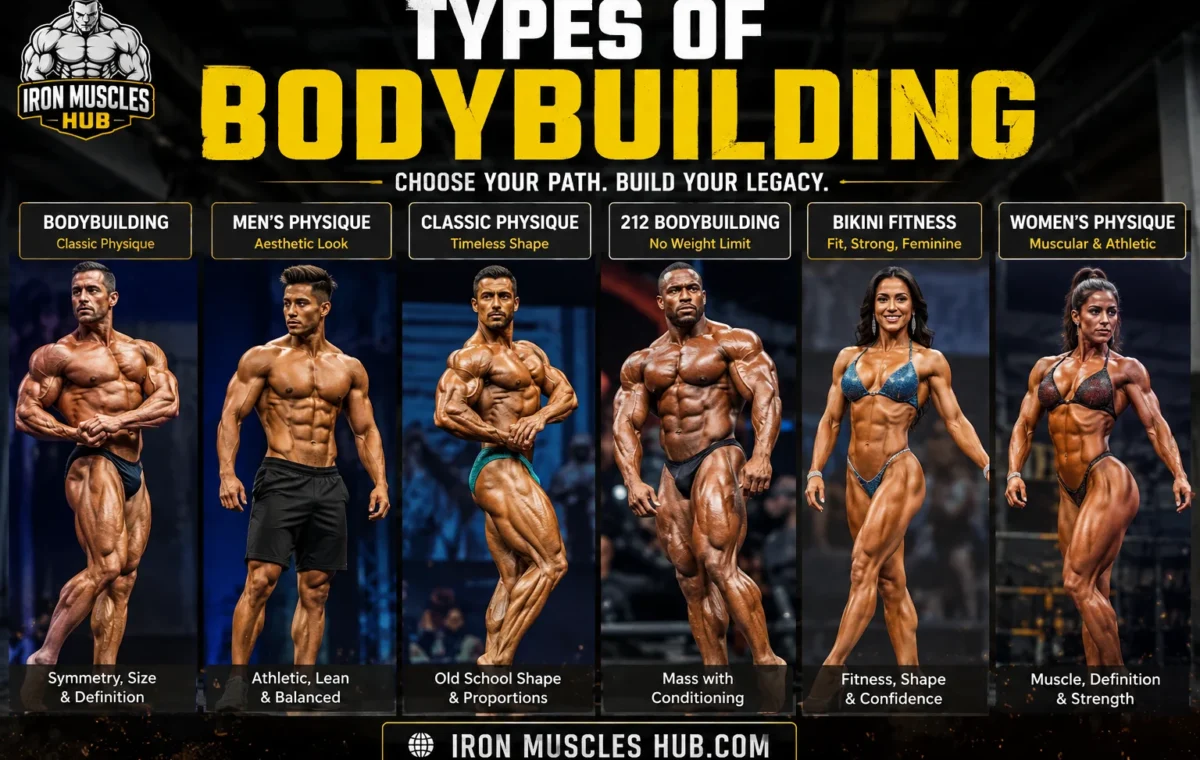
If you’re searching for the types of bodybuilding, start with one important distinction: bodybuilding can mean the sport of building muscle, or the competitive divisions used to judge different physiques. The major competitive categories include Open Bodybuilding, Men’s 212, Classic Physique, Men’s Physique, Women’s Bodybuilding, Women’s Physique, Figure, Bikini, Wellness, Fitness, and Fit Model in the current IFBB Pro structure.
- Quick Answer: What Are the Main Types of Bodybuilding?
- 1. What Are the Types of Bodybuilding?
- The main categories beginners should know
- 2. Open Bodybuilding
- Who is Open Bodybuilding suited to?
- 3. Men’s 212 Bodybuilding
- 4. Classic Physique
- Classic Physique vs Open Bodybuilding
- 5. Men’s Physique
- 6. Women’s Bodybuilding
- 7. Women’s Physique
- 8. Figure
- 9. Bikini
- 10. Wellness
- 11. Fitness
- 12. Fit Model
- 13. Natural Bodybuilding Is a Different Question
- 14. Competitive Bodybuilding vs Bodybuilding-Style Training
- 15. How Should a Beginner Train for Bodybuilding?
- Three-day beginner bodybuilding template
- 16. Worked Example: Understanding Training Volume
- 17. Common Mistakes → Why → Fix
- Mistake 1: Choosing a division because it looks easy
- Mistake 2: Training like a professional immediately
- Mistake 3: Thinking more muscle is always better
- Mistake 4: Ignoring legs
- Mistake 5: Treating a body-fat target as the entire goal
- Mistake 6: Changing programs every week
- 18. A 30-Second Decision Rule
- 19. Who Is Competitive Bodybuilding NOT For?
- 20. Types of Bodybuilding: Which One Is Best?
- Quick Comparison for Beginners
- FAQ: Types of Bodybuilding
- 1. What are the main types of bodybuilding?
- 2. What is the difference between Classic Physique and Men’s Physique?
- 3. Which type of bodybuilding is best for beginners?
- 4. Is bodybuilding the same as weightlifting or powerlifting?
- 5. Can you build a bodybuilding physique without competing?
- Final Takeaway
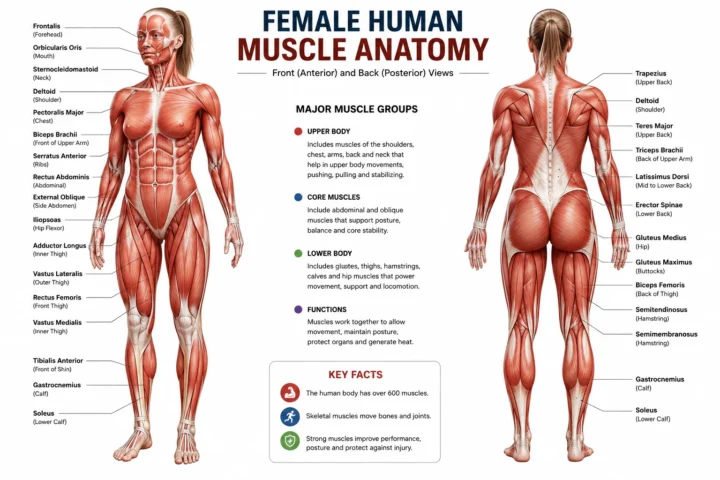
For a beginner, you don’t need to memorize every rule. What matters is understanding what each division rewards, how much muscularity it generally emphasizes, and what kind of physique you want to build. For more insights read here :-muscular body chart and different kinds of bodybuilding .
Quick Answer: What Are the Main Types of Bodybuilding?
- Open Bodybuilding: Maximum muscular development, symmetry, proportion, and conditioning.
- Classic Physique: Muscularity combined with proportion, shape, symmetry, and a classic aesthetic.
- Men’s Physique: Athletic upper-body development, V-taper, conditioning, and presentation.
- Women’s divisions: Bikini, Wellness, Figure, Fitness, Women’s Physique, and Women’s Bodybuilding each emphasize different levels of muscularity, proportions, presentation, or performance.
- Men’s 212 and Wheelchair Bodybuilding: Specialized competitive divisions with their own eligibility and judging rules.
The exact categories can vary by federation and individual contest, so always check the rules for the show you plan to enter.
1. What Are the Types of Bodybuilding?
The simplest way to understand the types of bodybuilding is to separate everyday bodybuilding training from competitive bodybuilding divisions.
Everyday bodybuilding is resistance training performed with the goal of developing muscle size, strength, symmetry, or appearance. You can train this way without ever stepping on a competition stage.
Competitive bodybuilding is different. Athletes are placed into divisions where judges compare specific characteristics such as muscularity, symmetry, proportion, conditioning, posing, and overall presentation.
The current IFBB Pro League lists multiple divisions, including Men’s Open Bodybuilding, Men’s 212 Bodybuilding, Men’s Classic Physique, Men’s Physique, Men’s Wheelchair, Women’s Bodybuilding, Women’s Fitness, Women’s Figure, Women’s Bikini, Women’s Physique, Women’s Wellness, and Women’s Fit Model.
That means there isn’t one universal list that applies to every federation or local contest.
The main categories beginners should know
| Bodybuilding type | Main emphasis | General physique direction | Beginner-friendly goal? |
|---|---|---|---|
| Open Bodybuilding | Muscle size, symmetry, conditioning | Very muscular | Long-term goal |
| Men’s 212 | Muscularity and conditioning within division rules | Highly muscular | Advanced competition goal |
| Classic Physique | Proportion, symmetry, shape, muscularity | Classic V-taper | Long-term goal |
| Men’s Physique | Upper-body aesthetics and presentation | Athletic V-taper | Possible future goal |
| Women’s Bodybuilding | Muscularity, symmetry, conditioning | Highly muscular | Advanced goal |
| Women’s Physique | Muscularity, balance, conditioning | Muscular and athletic | Advanced goal |
| Figure | Muscle development, symmetry, proportions | Muscular X-frame | Competition goal |
| Bikini | Shape, balance, presentation, conditioning | Lean and athletic | Competition goal |
| Wellness | Lower-body development and overall balance | Lower-body dominant | Competition goal |
| Fitness | Physique plus fitness performance | Athletic and muscular | Performance-focused |
| Fit Model | Model-like physique and presentation | Lean and balanced | Depends on federation |
Important: “Beginner-friendly” here means easier to understand as a goal, not easy to achieve competitively. Stage competition requires substantial preparation, posing practice, and careful management of training and nutrition.
2. Open Bodybuilding
Open Bodybuilding is the traditional high-muscularity division most people picture when they hear the word bodybuilding.
Competitors aim to display a highly developed physique while maintaining balance between muscle groups. Judges assess characteristics such as muscular development, symmetry, proportion, conditioning, and presentation.
There is no simple “get as big as possible” rule.
A bodybuilder can have enormous muscles, but poor balance between body parts can hurt the overall presentation. Chest, back, shoulders, arms, legs, and midsection all need to work together visually.
Who is Open Bodybuilding suited to?
This is generally an advanced competitive goal rather than a starting point for someone who has just joined a gym.
If your goal is simply to become stronger and more muscular, you can use bodybuilding-style resistance training without trying to reach competitive Open Bodybuilding levels.
That distinction is important.
You can train like a bodybuilder without becoming a competitive bodybuilder.
3. Men’s 212 Bodybuilding
Men’s 212 is a specialized bodybuilding division within the IFBB Pro League.
The name refers to its historical 212-pound upper weight limit for the division, which is about 96.2 kg. Competition rules should always be checked for the specific event because eligibility and weigh-in procedures are governed by the federation.
The division gives shorter or lighter athletes a separate competitive category from the Open division.
The judging focus remains bodybuilding-oriented: muscularity, symmetry, proportion, conditioning, and presentation.
For a beginner, however, the important lesson isn’t the number on the scale.
Your height, frame, training history, and competitive federation matter more than trying to force yourself into a particular division early in your training career.
4. Classic Physique
Classic Physique sits between Men’s Physique and the highest-muscularity bodybuilding divisions in the way many beginners think about the sport.
The goal is not simply maximum bodyweight.
Classic Physique emphasizes proportion, symmetry, shape, muscular development, and a classic aesthetic. Legs are important because the division presents more of the lower body than Men’s Physique.
Competition rules can include height-to-weight restrictions, so athletes must build their physique within the rules of their particular class.
This makes Classic Physique especially interesting for lifters who like:
- Broad shoulders
- A pronounced V-taper
- A developed chest and back
- Strong leg development
- A controlled waistline
- Balanced rather than disproportionate muscularity
- Classic posing and presentation
Classic Physique can look very impressive without pursuing the same extreme muscularity associated with Open Bodybuilding.
Classic Physique vs Open Bodybuilding
| Feature | Classic Physique | Open Bodybuilding |
| Main goal | Shape and proportion with substantial muscle | Maximum competitive muscular development |
| Symmetry | Very important | Very important |
| Muscularity | High | Extremely high at elite level |
| Weight restrictions | Division-specific restrictions may apply | No Classic-style height-to-weight cap |
| Legs | Important | Important |
| Aesthetic emphasis | Very high | High, alongside muscularity and conditioning |
| Best for | Lifters who value classic proportions | Lifters pursuing maximum bodybuilding development |
The important takeaway is that Classic Physique isn’t simply “smaller bodybuilding.” It has its own judging standards and presentation.
5. Men’s Physique
Men’s Physique is designed around an athletic, aesthetic appearance rather than the extreme muscularity of Open Bodybuilding.
The upper body receives particular visual attention. Broad shoulders, developed chest and back, visible abdominal development, and a strong V-taper are commonly associated with the division.
Competitors wear board shorts, which changes how the physique is presented on stage.
This creates a major difference from divisions where the legs are fully displayed.
For someone who likes the look of an athletic, muscular body but doesn’t want the visual target of Open Bodybuilding, Men’s Physique may be more appealing.
However, competitive standards are still demanding. A stage-ready physique isn’t the same thing as being generally fit.
6. Women’s Bodybuilding
Women’s Bodybuilding represents the higher-muscularity end of the women’s physique divisions.
The focus is on substantial muscular development, symmetry, proportion, conditioning, and presentation.
It is important not to confuse muscularity with health.
A competition physique represents a specific sporting goal and judging standard. It shouldn’t be treated as the definition of what a healthy woman “should” look like.
If your goal is general fitness, strength, or muscle development, you don’t need to pursue competitive levels of conditioning.
7. Women’s Physique
Women’s Physique generally occupies a position between Figure and Women’s Bodybuilding in terms of muscular development.
Competitors display significant muscle development while judges also consider proportion, balance, symmetry, conditioning, and presentation.
Compared with Figure, the physique typically carries more muscularity and definition.
Compared with Women’s Bodybuilding, the overall competitive look and muscular development are different.
The exact judging language and requirements can vary between organizations, so competitors should read the official rulebook rather than relying on social-media comparisons.
8. Figure
Figure is a physique division centered on muscular development, symmetry, proportion, and presentation.
Compared with Bikini, Figure generally requires more visible muscular development.
Compared with Women’s Physique, the emphasis is generally less toward the higher levels of muscularity and separation seen in that division.
A typical Figure-focused physique emphasizes:
- Developed shoulders
- Back width
- Defined arms
- Developed legs
- A balanced waist-to-shoulder appearance
- Overall symmetry
- Controlled conditioning
The goal isn’t simply to have the lowest possible body fat.
The judging standard is the complete physique, not one measurement.
9. Bikini
Bikini is one of the most recognizable women’s physique divisions.
The category emphasizes overall shape, balance, conditioning, presentation, and a lean athletic appearance rather than the muscularity expected in Women’s Physique or Women’s Bodybuilding.
For a beginner researching bodybuilding competitions, Bikini can seem easier because competitors generally carry less muscle than athletes in the higher-muscularity divisions.
That doesn’t mean preparation is easy.
Competition preparation can involve demanding training, nutrition management, posing practice, and psychological pressure. Anyone considering a show should work with qualified professionals and avoid extreme approaches.
10. Wellness
Wellness is a women’s division that places greater emphasis on lower-body development relative to the upper body.
A Wellness competitor typically aims to show substantial development through the glutes and legs while maintaining an appropriately balanced upper body.
That makes the division visually different from Figure, where overall muscular balance and an X-frame are central to the presentation.
If you naturally enjoy lower-body training, Wellness may be a division worth researching.
But don’t choose a division based only on which body part you like training.
Your current muscular development, proportions, competition rules, posing ability, and long-term goals all matter.
11. Fitness
Fitness is different because it combines physique presentation with a performance component.
Competitors need a developed physique, but they also perform a fitness routine that can include elements such as strength, flexibility, dance, or gymnastics-style movements depending on the federation’s rules.
That makes Fitness a better fit for someone who enjoys both physique development and performance.
If you dislike performance routines and only want to develop your physique, another division may make more sense.
12. Fit Model
Fit Model is a newer category in the current IFBB Pro structure.
The concept places greater emphasis on a lean, athletic, balanced appearance and presentation rather than the extreme muscularity associated with bodybuilding.
Because divisions and contest offerings can vary, beginners should check whether Fit Model is actually offered by the organization and show they’re considering.
Don’t assume that a category available at one event will automatically exist at another.
13. Natural Bodybuilding Is a Different Question
You may also see the phrase natural bodybuilding when researching the types of bodybuilding.
Natural bodybuilding generally refers to competition or training conducted under rules that prohibit specified performance-enhancing substances and may involve drug testing.
But “natural” is not a universal standard.
Different organizations have different banned-substance lists, testing procedures, testing windows, and enforcement systems.
So don’t assume two competitions use identical definitions simply because both advertise themselves as natural.
If competing drug-free matters to you, read the exact federation’s rules before entering.
14. Competitive Bodybuilding vs Bodybuilding-Style Training
This distinction can save beginners years of confusion.
You don’t need to choose a competition division to benefit from bodybuilding training.
A beginner might train three days per week, perform exercises for all major muscle groups, gradually increase resistance, and eat a balanced diet.
That person can build substantial strength and muscle without ever entering a contest.
The 2026 ACSM resistance-training position stand reviewed 137 systematic reviews involving more than 30,000 participants and found that resistance training improves muscle strength, hypertrophy, power, endurance, and physical function in healthy adults.
For hypertrophy, the evidence supports using sufficient weekly training volume, with the ACSM summary highlighting approximately 10 sets per muscle group per week as a useful target for many adults.
That doesn’t mean every beginner should immediately perform exactly 10 sets for every muscle.
Start with a manageable workload, learn technique, recover, and increase training demands gradually.
15. How Should a Beginner Train for Bodybuilding?
If you’re new to resistance training, don’t copy an elite competitor’s routine.
Your first goal is to establish consistent training and good exercise technique.
A simple example might look like this:
Three-day beginner bodybuilding template
Day 1 — Full Body
- Squat or leg press: 2–3 sets
- Bench press or machine chest press: 2–3 sets
- Row: 2–3 sets
- Romanian deadlift: 2 sets
- Lateral raise: 2 sets
- Biceps curl: 2 sets
Day 2 — Full Body
- Deadlift variation: 2 sets
- Overhead press: 2–3 sets
- Lat pulldown: 2–3 sets
- Split squat: 2 sets
- Chest-supported row: 2 sets
- Triceps extension: 2 sets
Day 3 — Full Body
- Leg press or squat: 2–3 sets
- Incline press: 2–3 sets
- Pulldown or assisted pull-up: 2–3 sets
- Hip hinge: 2 sets
- Lateral raise: 2 sets
- Curl: 2 sets
This is an example, not a prescription.
You can build muscle with full-body routines or split routines. A 2024 systematic review and meta-analysis found similar strength and muscle-growth outcomes between split and full-body routines when training volume was equated.
The best routine is therefore often the one you can perform consistently while recovering well.
16. Worked Example: Understanding Training Volume
Suppose you’re a beginner weighing 75 kg (165 lb).
You decide to train your chest twice each week.
On Monday, you perform:
- Bench press: 3 sets
- Incline dumbbell press: 2 sets
That’s 5 chest-focused sets.
On Thursday:
- Machine chest press: 3 sets
- Incline press: 2 sets
That’s another 5 sets.
Your weekly total is:
5 + 5 = 10 sets
That matches the approximate weekly volume highlighted in the 2026 ACSM summary for hypertrophy.
It doesn’t mean 10 sets guarantees growth.
Your results also depend on exercise execution, effort, progression, nutrition, sleep, training history, and individual response.
The number is a useful planning reference—not a magic threshold.
17. Common Mistakes → Why → Fix
Mistake 1: Choosing a division because it looks easy
Why: Photos only show the final stage appearance. They don’t show the years of training, dieting, posing, and preparation behind it.
Fix: Choose based on the actual judging criteria and your current physique, not one competitor’s photograph.
Mistake 2: Training like a professional immediately
Why: Advanced athletes have years of training history and can tolerate workloads that may overwhelm a beginner.
Fix: Start with manageable volume and increase gradually.
Mistake 3: Thinking more muscle is always better
Why: Different divisions reward different combinations of muscularity, symmetry, proportion, conditioning, and presentation.
Fix: Learn the judging criteria for your chosen category.
Mistake 4: Ignoring legs
Why: Some beginners focus almost entirely on chest and arms.
Fix: Train the entire body. Even divisions where the legs receive less visual emphasis require balanced development.
Mistake 5: Treating a body-fat target as the entire goal
Why: Competition conditioning is temporary and highly specific to the sport.
Fix: Focus on building muscle, improving strength, developing technique, and maintaining sensible nutrition before worrying about stage-level conditioning.
Mistake 6: Changing programs every week
Why: You can’t properly evaluate progression if your exercises, volume, and schedule constantly change.
Fix: Keep a training log and give a sensible program enough time to demonstrate whether you’re progressing.
18. A 30-Second Decision Rule
Ask yourself these four questions:
1. Do I want maximum muscular development?
If yes, research Open Bodybuilding or another higher-muscularity division.
2. Do I prefer proportion and classic aesthetics over maximum size?
Classic Physique may be worth researching.
3. Do I prefer a lean, athletic appearance with strong upper-body development?
Men’s Physique may fit your preferences.
4. Am I a woman choosing a competition category?
Compare Bikini, Wellness, Figure, Fitness, Women’s Physique, and Women’s Bodybuilding based on the exact judging standards of your federation.
If you’re not planning to compete, you don’t actually need a division.
You can simply use bodybuilding-style training to build the physique you want.
19. Who Is Competitive Bodybuilding NOT For?
Competitive bodybuilding may not be a good choice if you dislike strict preparation, posing practice, appearance-based judging, or the lifestyle demands of competition.
It’s also not necessary for someone whose goal is simply to become stronger, healthier, or more muscular.
You can build an excellent physique without entering a contest.
If you have a history of disordered eating, body-image concerns, or medical conditions that could be affected by intense training or dieting, speak with an appropriate healthcare professional before pursuing competition preparation.
The goal should be a sustainable relationship with training—not sacrificing your wellbeing for a stage result.
20. Types of Bodybuilding: Which One Is Best?
There is no universally best bodybuilding division.
The best category depends on your goals, physique, training history, proportions, preferences, and the rules of the federation where you plan to compete.
For most beginners, the smartest first step isn’t picking a division.
It’s building the foundation:
- Learn basic resistance-training technique.
- Train all major muscle groups.
- Develop consistency.
- Progress gradually.
- Eat enough nutritious food to support training.
- Get adequate sleep and recovery.
- Learn how your body responds over time.
- Research competition divisions only when competition becomes a serious goal.
The 2026 ACSM evidence review also reinforces a useful principle: consistency matters more than unnecessary complexity. Advanced methods aren’t automatically better for the average healthy adult.
Quick Comparison for Beginners
| Your goal | Type to research |
| Maximum competitive muscle | Open Bodybuilding |
| Classic proportions and aesthetics | Classic Physique |
| Athletic upper-body look | Men’s Physique |
| Highly muscular female physique | Women’s Bodybuilding |
| Muscular female physique with different presentation | Women’s Physique |
| Muscular X-frame | Figure |
| Lean, balanced physique | Bikini |
| Greater lower-body emphasis | Wellness |
| Physique + performance routine | Fitness |
| Lean athletic model-style presentation | Fit Model |
| No competition planned | Bodybuilding-style training |
FAQ: Types of Bodybuilding
1. What are the main types of bodybuilding?
The major competitive divisions include Open Bodybuilding, Men’s 212, Classic Physique, Men’s Physique, Men’s Wheelchair, Women’s Bodybuilding, Women’s Physique, Figure, Bikini, Wellness, Fitness, and Fit Model in the current IFBB Pro structure. Other federations may use different categories or names. Always check the rules of the organization and contest you’re considering.
2. What is the difference between Classic Physique and Men’s Physique?
Men’s Physique emphasizes an athletic upper-body appearance, V-taper, conditioning, and presentation, with competitors wearing board shorts. Classic Physique displays more of the full body, including the legs, and places strong emphasis on muscularity, symmetry, proportion, classic shape, and posing. Classic Physique also has division-specific height and weight rules.
3. Which type of bodybuilding is best for beginners?
There isn’t one best division for every beginner. If you’re new to lifting, focus first on building strength, learning technique, developing muscle, and establishing consistent training. You can decide on a competition category later. If you already want to compete, study the judging criteria of several divisions and compare them with your current physique and long-term goals.
4. Is bodybuilding the same as weightlifting or powerlifting?
No. Bodybuilding primarily focuses on developing muscular size, proportion, symmetry, and physique presentation. Powerlifting centers on performance in the squat, bench press, and deadlift. Olympic weightlifting focuses on the snatch and clean and jerk. All use resistance training, but their competitive goals are different.
5. Can you build a bodybuilding physique without competing?
Absolutely. You can use bodybuilding-style resistance training to develop muscle, strength, and a balanced physique without entering a competition. The 2026 ACSM position stand supports resistance training for improving muscle size and strength in healthy adults. You don’t need stage-level conditioning or a competitive division to benefit from structured strength training.
Final Takeaway
The types of bodybuilding are best understood as different competitive paths rather than completely different ways of exercising. Open Bodybuilding prioritizes exceptional muscular development, Classic Physique emphasizes classic proportions and shape, and Men’s Physique focuses on an athletic upper-body appearance. Women’s divisions such as Bikini, Wellness, Figure, Fitness, Women’s Physique, and Women’s Bodybuilding each have their own standards.
If you’re a beginner, don’t rush to imitate an advanced competitor. Build muscle gradually, learn sound lifting technique, train consistently, and choose a competition division only when you understand what that division actually rewards.
For more beginner-friendly muscle and fitness guides, explore the related anatomy and training resources on Iron Muscle Hub.