A muscle model is a simplified representation of how a muscle is built, moves, or produces force. Depending on the context, it can mean a physical anatomy model, a computer-based musculoskeletal simulation, or a mathematical model used to describe muscle contraction.
- Muscle Model at a Glance
- What Is a Muscle Model?
- Why Use a Model Instead of the Real Muscle?
- How a Basic Muscle Model Works
- The Anatomy Behind a Muscle Model
- How Muscle Contraction Fits Into the Model
- What Is a Hill-Type Muscle Model?
- Physical vs. Digital Muscle Models
- Musculoskeletal Models: Muscles Plus Bones and Joints
- A Simple Example of a Muscle Model
- Benefits and Limitations of Muscle Models
- Benefits
- Limitations
- Common Mistake: Confusing a Muscle Model With a Muscle Diagram
- How to Choose the Right Muscle Model for Learning
- Related Topics to Explore
- Frequently Asked Questions
- What is a muscle model?
- What is a muscle model used for?
- What is a Hill-type muscle model?
- Is a muscle model the same as a muscle diagram?
- How does a muscle model show contraction?
- Can a muscle model predict human movement?
- A Clear Way to Think About Muscle Models
- Different Types of Muscle Models Explained
- 1. Anatomical Muscle Model
- 2. 3D Muscle Model
- 3. Computational Muscle Model
- 4. Physiological Muscle Model
- Muscle Models Can Work at Different Scales
- The Role of Muscle Length
- The Role of Contraction Speed
- Active and Passive Muscle Force
- What Is a Muscle-Tendon Unit?
- Muscle Models in Human Movement Research
- Muscle Modeling and Exercise Science
- Why Muscle Models Are Useful in Education
- How to Study With a Muscle Model
- Step 1: Identify the Muscle
- Step 2: Identify What It Connects
- Step 3: Connect Structure to Movement
- A Simple Muscle Model Study Table
- Common Problems With Muscle Models
- Oversimplification
- Incorrect Inputs
- Assumptions About Muscle Behavior
- Individual Differences
- How Researchers Improve Muscle Models
- Muscle Model vs. Real Human Muscle
- A Practical Example: Modeling a Knee Movement
- What Makes a Good Muscle Model?
- Final Takeaway
- How a Muscle Model Is Built
- 1. Define the Question
- 2. Add Anatomical Information
- 3. Represent Muscle Properties
- From Anatomy to Mathematics
- Muscle Activation in a Model
- Forward and Inverse Muscle Modeling
- Forward Modeling
- Inverse Modeling
- What Is a Hill Muscle Model Used For?
- The Force-Length Relationship
- The Force-Velocity Relationship
- Tendons in Muscle Models
- Muscle Moment Arms
- Why Joint Geometry Matters
- Muscle Models and Motion Capture
- Muscle Models in Rehabilitation Research
- Muscle Models in Prosthetics and Assistive Technology
- Muscle Models in Robotics
- Subject-Specific Muscle Models
- Generic vs. Subject-Specific Models
- Sensitivity Analysis
- Model Validation vs. Model Verification
- How to Read a Muscle Model Study
- What does the model represent?
- What data went into it?
- What assumptions were made?
- How was it validated?
- What population was studied?
- A Beginner's Muscle Modeling Workflow
- The Most Important Things to Remember
- Final Thoughts on Muscle Models
For a beginner, the easiest way to think about a muscle model is as a working map of a real muscle. Instead of studying every cell and chemical reaction at once, a model focuses on the parts needed to understand a particular question, such as how a muscle pulls on a bone or how force changes as a muscle contracts. For more insights read here :- lean body women and lean exercises .
Quick answer: A muscle model represents important features of real muscle structure or function so students, researchers, clinicians, and engineers can study movement, force, contraction, or anatomy without having to observe every process directly.
Muscle Model at a Glance
| Type of muscle model | What it represents | Common use |
|---|---|---|
| Physical anatomy model | Visible muscles, bones and connective structures | Learning anatomy |
| 3D digital model | Computer-generated muscle structures | Education, visualization and research |
| Musculoskeletal model | Muscles, bones, joints and movement | Biomechanics and movement analysis |
| Mathematical muscle model | Muscle force and mechanical behavior | Research and simulation |
| Physiological model | Biological processes inside muscle | Studying contraction and muscle function |
The important point is that there isn’t one universal muscle model. Researchers choose a model based on the question they’re trying to answer.
What Is a Muscle Model?
A muscle model is a simplified representation of a real muscle or the way muscle behaves.
A physical model might show the major muscles attached to a skeleton. A digital model might reproduce the shape and position of muscles in three dimensions. A mathematical model can instead represent relationships between muscle length, contraction speed, activation, and force.
That distinction matters because a model isn’t necessarily meant to reproduce every detail of human biology.
For example, a researcher studying how the knee moves may not need to model every individual protein inside a muscle fiber. A simpler representation of the muscle’s location, attachment points and force-producing behavior could be more useful.
Why Use a Model Instead of the Real Muscle?
Real human movement is complicated. Muscles interact with bones, tendons, joints, nerves and other muscles.
A model allows researchers to isolate particular variables and test situations that could be difficult, expensive, or impractical to measure directly.
Computer-based musculoskeletal models can help researchers investigate movement, muscle coordination, injury mechanisms, rehabilitation, prosthetic design and other biomechanical questions.
How a Basic Muscle Model Works
At its simplest, a muscle model connects muscle activation with force and movement.
Here’s a useful way to picture it:
Nervous-system signal → muscle activation → muscle force → tendon tension → movement of a bone
Skeletal muscles attach to bones either directly or through connective tissues such as tendons. When muscle fibers contract, the resulting tension can be transferred through the tendon to the bone, producing movement around a joint.
A computer model can represent those relationships using mathematical equations.
For instance, a model might estimate how much force a muscle can produce at a particular length or contraction speed. Another model may concentrate on the geometry of a joint and predict how several muscles contribute to a movement.
The model becomes more useful when its complexity matches the question being studied.
The Anatomy Behind a Muscle Model
To understand muscle models, it helps to know the basic organization of skeletal muscle.
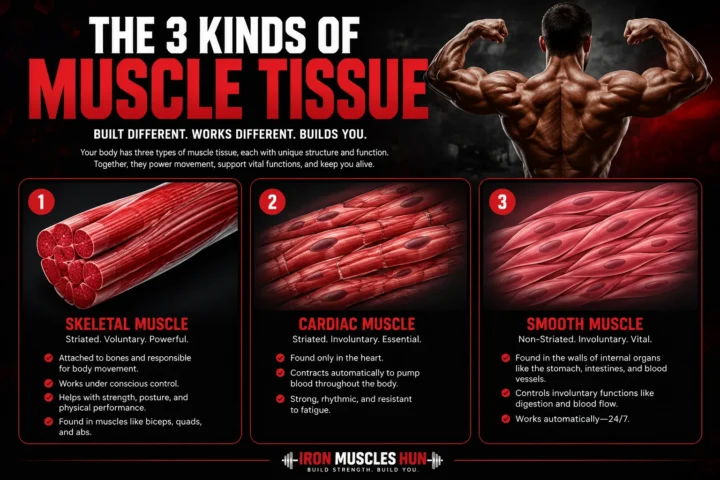
A skeletal muscle contains bundles called fascicles. Fascicles contain individual muscle fibers, and those fibers contain myofibrils. Myofibrils are organized into repeating units called sarcomeres, which are the basic contractile units of skeletal muscle.
The hierarchy can be simplified like this:
Whole muscle → fascicles → muscle fibers → myofibrils → sarcomeres → actin and myosin
The connective tissue surrounding these structures also matters because forces generated inside the muscle ultimately need to be transmitted through the muscle and associated connective tissues.
This is one reason a useful muscle model may include more than the muscle itself. Depending on its purpose, it can also include tendons, bones, joints and other anatomical structures.
How Muscle Contraction Fits Into the Model
A skeletal muscle doesn’t simply “turn on” like a motor.
A motor neuron sends a signal to a muscle fiber at the neuromuscular junction. This produces an electrical response in the muscle fiber, which leads to calcium release inside the cell. Calcium allows the contractile proteins actin and myosin to interact, producing the force associated with contraction.
The process can be simplified into five stages:
- A neural signal reaches the muscle.
- The muscle fiber generates an electrical response.
- Calcium is released inside the muscle fiber.
- Actin and myosin interact.
- The sarcomeres generate tension and shorten.
This is known as excitation-contraction coupling.
A detailed physiological model can attempt to represent several of these stages. A simpler biomechanical model may skip most of the cellular chemistry and focus only on the resulting muscle force.
What Is a Hill-Type Muscle Model?
One important type of mathematical muscle model is the Hill-type model.
Hill-type models are commonly used to represent muscle mechanics. They simplify muscle behavior into mechanical components that can represent active force production and passive elastic behavior. These models have been incorporated into larger musculoskeletal simulations.
You don’t need advanced mathematics to understand the basic idea.
Think of a muscle model as trying to answer questions such as:
- How much force can the muscle produce?
- What happens when the muscle changes length?
- How does contraction speed affect force?
- What happens when the muscle is stretched?
- How does the muscle’s force affect a joint?
A Hill-type model is useful because it gives researchers a practical way to represent these relationships without reproducing every biological event inside the muscle.
Physical vs. Digital Muscle Models
A physical muscle model is something you can see and handle, such as an anatomical teaching model.
A digital muscle model exists inside software. It may show muscles in three dimensions or represent them mathematically so a computer can simulate movement.
NIH 3D, for example, provides anatomical 3D models derived from human imaging datasets. One published NIH model represents the muscles of a human arm using structures segmented from Visible Human cryo and CT datasets.
That makes digital models particularly useful for visual learning. Instead of looking at a flat illustration, a student can examine anatomical structures from different angles.
Musculoskeletal Models: Muscles Plus Bones and Joints
A muscle model becomes a musculoskeletal model when it is incorporated into a larger representation of the body’s movement system.
Such a model can include:
- Bones
- Joints
- Muscles
- Tendons
- Muscle attachment points
- Joint movement
- Muscle activation
- Force production
Researchers can then use the model to study how these parts work together.
For example, a computer simulation might estimate how different muscles contribute to movement at the spine or another joint. Research models have combined anatomical information from medical imaging with muscle representations to study predicted loading and muscle tension.
A Simple Example of a Muscle Model
Imagine you’re studying how the elbow bends.
The biceps produces force that is transmitted through its attachment to the forearm. The elbow joint provides the point around which the forearm moves.
A simplified computer model could represent:
Biceps activation → muscle force → force at attachment → elbow movement
The real body is much more complicated. Other muscles contribute, joint geometry matters, and the behavior of muscles and tendons changes during movement.
The model doesn’t need to copy every detail to be useful. Its job is to represent enough of the system to answer the particular research question.
That’s a key lesson for beginners: a good model is not necessarily the most complicated model.
Benefits and Limitations of Muscle Models
Benefits
Muscle models can:
- Make complicated anatomy easier to understand.
- Allow researchers to simulate movement.
- Help estimate variables that are difficult to measure directly.
- Support biomechanics and rehabilitation research.
- Help investigate muscle coordination and force production.
- Provide visual tools for anatomy education.
Limitations
A model is still an approximation.
A computer simulation may depend on assumptions about anatomy, muscle properties, joint movement, or neural activation. If those assumptions don’t represent the real situation well, the model’s predictions can also be limited.
This is why researchers validate models against experimental or measured data where possible. A sophisticated-looking simulation isn’t automatically more accurate simply because it contains more detail.
Common Mistake: Confusing a Muscle Model With a Muscle Diagram
The phrases muscle model, muscle diagram, and muscle anatomy chart can sound interchangeable, but they aren’t always the same.
A diagram is generally a visual explanation. A physical model is a three-dimensional representation. A computational model may actually calculate forces or simulate movement.
| Term | Main purpose |
| Muscle diagram | Shows anatomy visually |
| Muscle chart | Helps identify muscles and locations |
| Physical muscle model | Provides a three-dimensional anatomy reference |
| 3D digital model | Allows interactive visualization |
| Computational muscle model | Represents muscle behavior mathematically |
| Musculoskeletal model | Simulates muscles working with bones and joints |
If you’re a student looking for an anatomy study aid, a physical or 3D model may be what you need. If you’re researching biomechanics, the phrase “muscle model” may refer to a mathematical or computational representation instead.
How to Choose the Right Muscle Model for Learning
If you’re studying anatomy, start simple.
Look for a model that clearly identifies major structures and shows how muscles relate to bones and joints. A 3D model can be particularly helpful because you can see structures from multiple directions.
For biomechanics or research, the selection criteria are different. You’ll want to know what the model represents, what assumptions it makes, what measurements were used to build or validate it, and whether it is appropriate for your specific research question.
A useful checklist is:
- What question am I trying to answer?
- Do I need anatomy, movement, force, or cellular detail?
- What structures does the model include?
- What assumptions does it make?
- Has it been compared with experimental or anatomical data?
Those questions can prevent a common mistake: choosing a highly detailed model that doesn’t actually solve the problem you’re studying.
Related Topics to Explore
If you’re building an anatomy or biomechanics resource, useful related topics include:
- Muscle anatomy chart: a visual guide to major muscles and their locations.
- Skeletal muscle structure: how muscle fibers, fascicles and connective tissues are organized.
- Sliding filament model: how actin and myosin interact during contraction.
- Musculoskeletal system: how muscles, bones and joints work together.
- Muscle force: the mechanical output produced during contraction.
For a deeper anatomy reference, OpenStax provides detailed educational material on skeletal muscle structure and contraction. OpenStax: Skeletal Muscle
For interactive anatomical references, the NIH 3D collection is another useful starting point.
Internal-link ideas for iron muscle hub.com:
- Muscle Anatomy Chart: Major Muscles Explained
- Skeletal Muscle Structure: A Beginner’s Guide
- Sliding Filament Model Explained Simply
Frequently Asked Questions
What is a muscle model?
A muscle model is a simplified representation of muscle anatomy, mechanics, or physiology. It can be a physical teaching model, a 3D computer model, or a mathematical representation used to simulate muscle behavior. The appropriate type depends on whether the goal is learning anatomy, studying movement, or analyzing muscle force.
What is a muscle model used for?
Muscle models are used for anatomy education, biomechanics research, movement analysis, rehabilitation research, and computer simulation. More advanced models can represent muscle force, activation, length changes, or interactions between muscles, tendons, bones and joints. Researchers use different levels of detail depending on the question they want to investigate.
What is a Hill-type muscle model?
A Hill-type muscle model is a mathematical representation of muscle mechanics. It uses simplified mechanical components to represent features such as active muscle force and passive elastic behavior. Hill-type approaches are widely used in computational musculoskeletal modeling because they provide a practical way to simulate muscle behavior without modeling every biological process inside a muscle cell.
Is a muscle model the same as a muscle diagram?
No. A muscle diagram is usually a two-dimensional illustration used to show anatomical structures. A physical or digital muscle model can represent those structures in three dimensions, while a computational muscle model can go further by representing movement or force mathematically. The terms are related, but they describe different kinds of tools.
How does a muscle model show contraction?
A basic model can represent contraction as muscle activation producing force, with that force transmitted through connective tissue and tendons to influence bones and joints. More detailed physiological models can represent events such as calcium release and actin-myosin interaction.
Can a muscle model predict human movement?
Some computational musculoskeletal models can estimate or simulate aspects of human movement, but their results depend on the model’s structure, input data, assumptions and validation. A simulation should therefore be treated as a model-based estimate rather than a perfect reproduction of an individual person’s body.
A Clear Way to Think About Muscle Models
The easiest way to understand a muscle model is to see it as a useful simplification.
A physical model helps you see anatomy. A 3D digital model helps you explore structures. A mathematical model helps describe muscle mechanics. A musculoskeletal model brings muscles, bones and joints together to study movement.
The best model isn’t necessarily the one with the most detail. It’s the one that contains the right information for the question you’re asking.
If you’re learning anatomy, start with structure and function. Once those basics make sense, concepts such as muscle force, the sliding filament model and Hill-type muscle models become much easier to understand.
Different Types of Muscle Models Explained
Not every muscle model is designed to answer the same question. Some models focus on anatomy, while others focus on force, movement, or the biological processes behind contraction.
Understanding the differences makes it easier to choose the right model for learning or research.
1. Anatomical Muscle Model
An anatomical muscle model focuses on where muscles are located and how they connect to surrounding structures.
A classroom model may show:
- Major skeletal muscles
- Bones
- Tendons
- Muscle attachment points
- Joint locations
- Different layers of muscle
These models are especially useful for beginners because they turn a complicated anatomical system into something easier to visualize.
2. 3D Muscle Model
A 3D muscle model gives you a three-dimensional representation of anatomical structures.
Instead of seeing only the front or side of a muscle, you can examine its shape and position from different angles.
Digital 3D models are useful in anatomy education and research because structures can be displayed, isolated, rotated, and examined individually.
3. Computational Muscle Model
A computational model uses mathematical equations and computer software to represent muscle behavior.
Rather than simply showing what a muscle looks like, it can attempt to estimate things such as:
- Muscle force
- Muscle activation
- Muscle length
- Contraction behavior
- Joint loading
- Movement
The exact variables depend on the model being used.
4. Physiological Muscle Model
A physiological model focuses more closely on how muscle works biologically.
It may represent processes involved in excitation-contraction coupling, calcium handling, cross-bridge activity, or force production.
These models can become much more complicated than an anatomy model because muscle contraction involves multiple biological processes occurring at different scales.
Muscle Models Can Work at Different Scales
One useful way to understand muscle modeling is to think about scale.
A model might examine a single protein interaction, a muscle fiber, an entire muscle, or a complete movement involving several joints.
For example:
Molecular level → muscle fiber → whole muscle → muscle-tendon unit → joint → whole-body movement
Each level answers different questions.
A researcher interested in cellular contraction needs a very different model from someone studying how a person walks.
This is also why adding more detail isn’t automatically better. A model that is too complicated for the question can make analysis harder without providing useful additional information.
The Role of Muscle Length
Muscle length is an important variable in many muscle models.
A muscle’s ability to produce force changes with its length. This relationship is often represented using a force-length relationship.
In simplified terms, there is a range of muscle lengths where active force production can be relatively strong. Moving away from that range can alter the amount of active force the muscle can produce.
A model can represent this relationship mathematically.
This becomes important in movement analysis because a muscle doesn’t stay at one fixed length while you move. Its length changes as joints change position.
For example, the length of muscles crossing the elbow changes as the forearm bends and straightens.
The Role of Contraction Speed
Muscle models may also account for the relationship between force and contraction velocity.
In many simplified muscle models, the amount of force a muscle can produce during active shortening depends on how quickly it is shortening.
This is commonly represented through a force-velocity relationship.
The relationship isn’t simply “faster means stronger.” Muscle behavior depends on whether the muscle is shortening, remaining approximately the same length, or lengthening while producing force.
These categories are often described as:
- Concentric: the muscle shortens while producing force.
- Isometric: muscle force is produced without substantial change in muscle-tendon length.
- Eccentric: the muscle produces force while lengthening.
A useful model can distinguish between these different mechanical situations.
Active and Passive Muscle Force
Another important distinction is between active force and passive force.
Active force comes from the muscle’s contractile machinery. Passive force can develop when muscle or associated tissues are stretched.
A mathematical model may represent both.
This helps explain why a muscle isn’t necessarily mechanically “inactive” simply because it isn’t actively contracting.
Passive properties of muscle and connective tissues can influence movement, joint mechanics, and the total force produced by a muscle-tendon system.
What Is a Muscle-Tendon Unit?
Many biomechanical models don’t treat the muscle as an isolated object.
Instead, they represent the muscle-tendon unit, because muscle force is transmitted through tendons and other connective structures.
A simplified system looks like this:
Muscle fibers → muscle tissue → tendon → bone → joint movement
This matters because changes in muscle length aren’t always identical to changes in fiber length.
The tendon and other elastic structures can change how movement and force are transferred through the system.
Muscle Models in Human Movement Research
Researchers can use musculoskeletal models to study how muscles contribute to human movement.
A model may combine:
- Anatomical measurements
- Joint positions
- Movement data
- Muscle properties
- Muscle attachment locations
- External forces
- Mathematical equations
The software can then estimate variables that may be difficult to measure directly.
For example, researchers can investigate which muscles may contribute to a particular movement and how changes in movement affect estimated muscle forces.
However, these results depend on the assumptions and input data used by the model.
Muscle Modeling and Exercise Science
Muscle models can also help explain basic exercise and movement concepts.
Suppose you’re performing a squat.
Several joints move simultaneously, including the hips, knees, and ankles. Multiple muscles contribute to controlling those movements.
A simplified model can represent the body as connected segments and estimate how muscle forces contribute to joint movement.
That doesn’t mean the model can tell you exactly what every muscle in a particular person’s body is doing at every instant.
Human anatomy, technique, movement strategy, fatigue, and individual differences can all affect real-world movement.
The model is best viewed as a structured way of studying those relationships.
Why Muscle Models Are Useful in Education
For students, one of the biggest advantages of a model is visual understanding.
It’s easier to understand muscle attachment and movement when you can see the structures in relation to one another.
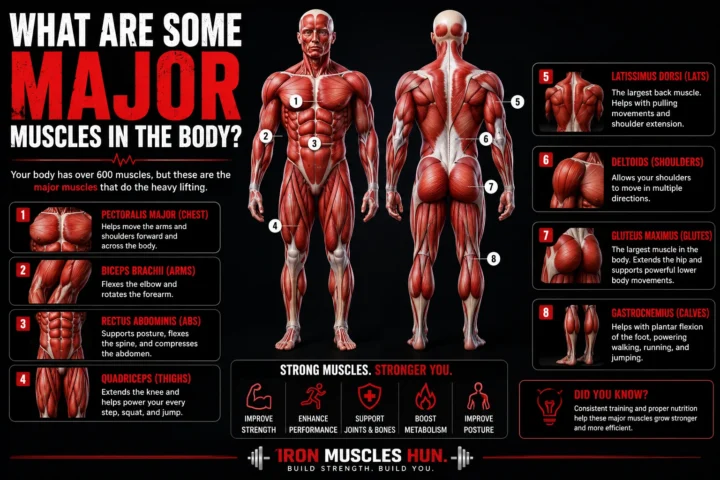
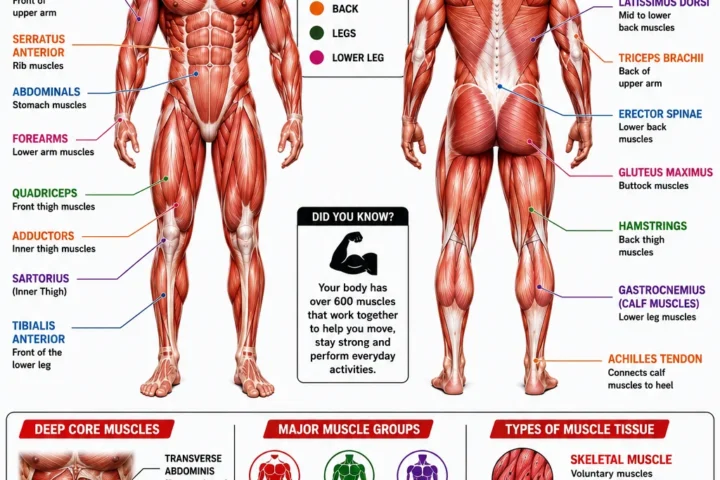
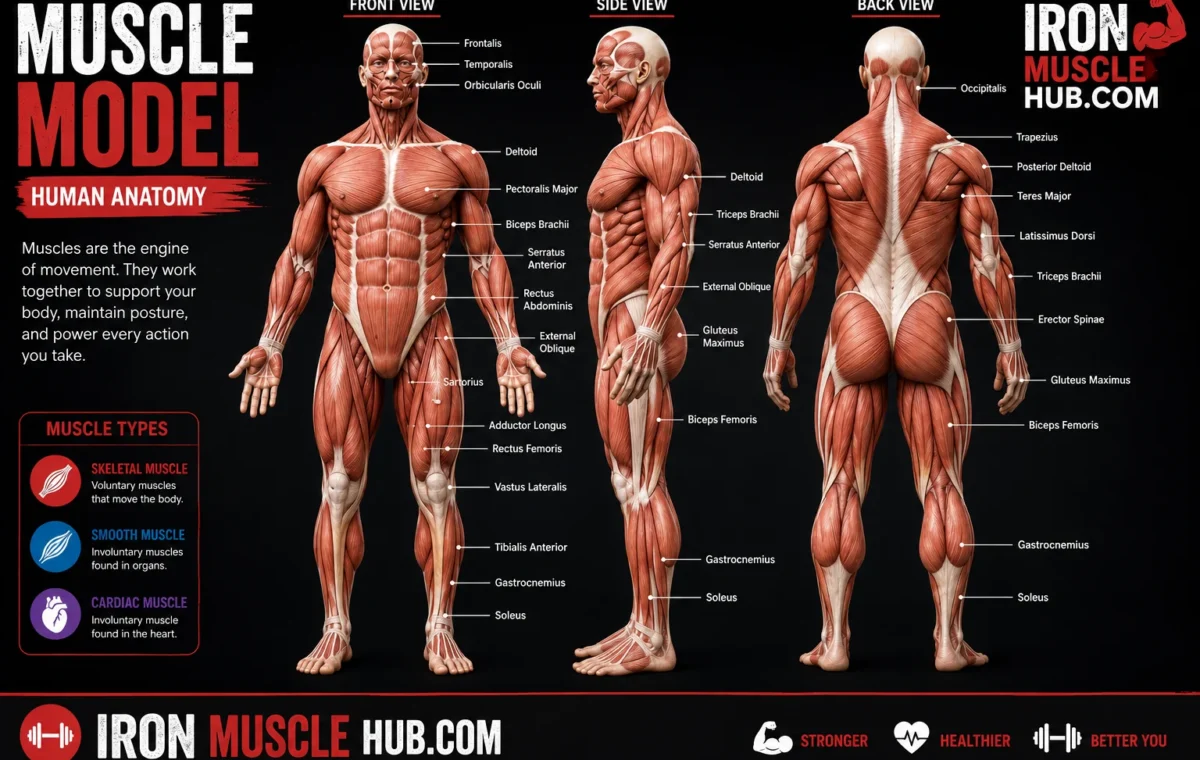
For example, a labeled muscle diagram can show the location of the biceps, triceps, deltoid, quadriceps, hamstrings, and other major muscles.
A 3D model can take this one step further by allowing you to view structures from different perspectives.
The model doesn’t replace learning anatomy. It gives you a practical visual framework for understanding it.
How to Study With a Muscle Model
If you’re using a physical or digital muscle model for anatomy, don’t try to memorize everything at once.
Use a simple three-step approach.
Step 1: Identify the Muscle
Start by learning the muscle’s name and location.
For example, locate the biceps brachii on the front of the upper arm.
Step 2: Identify What It Connects
Look at the bones and joints associated with the muscle.
Understanding where a muscle attaches can help you understand why it can create a particular movement.
Step 3: Connect Structure to Movement
Ask a simple question:
“What happens to the joint when this muscle produces force?”
This turns memorization into understanding.
You can repeat the process for other major muscles and gradually build a mental map of the muscular system.
A Simple Muscle Model Study Table
| What to study | Question to ask |
|---|---|
| Muscle location | Where is it? |
| Attachments | What structures does it connect to? |
| Joint | Which joint does it influence? |
| Action | What movement can it contribute to? |
| Structure | What type of muscle tissue is involved? |
| Force | How does contraction produce movement? |
This approach is often more useful than trying to memorize long lists of muscle names without understanding their relationships.
Common Problems With Muscle Models
Even useful models have weaknesses.
Oversimplification
A model may leave out important biological details.
That’s intentional in many cases, but it means you shouldn’t assume that a simplified model represents every aspect of real human physiology.
Incorrect Inputs
A computer model depends on its input data.
If anatomical measurements, movement data, or other inputs are inaccurate, the resulting estimates can also be affected.
Assumptions About Muscle Behavior
Muscle models make assumptions about how muscles produce force.
Different models may use different representations, which can produce different results.
Individual Differences
A generic model doesn’t necessarily represent one particular person’s anatomy.
Muscle size, attachment locations, limb proportions, movement patterns, and other characteristics can vary between individuals.
How Researchers Improve Muscle Models
Researchers can improve models by comparing predictions with experimental observations.
This process is commonly associated with model validation.
The goal is not simply to make a model more complicated. Instead, researchers want to determine whether it behaves appropriately for the intended purpose.
A model designed to estimate movement may need different validation evidence from a model designed to represent cellular muscle contraction.
That distinction is important whenever you see claims based on computer simulations.
Muscle Model vs. Real Human Muscle
A model should never be confused with the biological system itself.
| Real muscle | Muscle model |
| Living biological tissue | Simplified representation |
| Contains complex cellular processes | Includes selected processes |
| Changes with fatigue and physiological conditions | May represent only selected variables |
| Individual anatomy varies | May use generic or subject-specific anatomy |
| Responds to many biological signals | Often uses defined inputs |
| Exists in a complete biological system | Usually isolates specific relationships |
The purpose of a model isn’t to become the muscle.
Its purpose is to help us understand, visualize, measure, or simulate aspects of muscle behavior.
A Practical Example: Modeling a Knee Movement
Imagine a researcher wants to study how the knee behaves during a particular movement.
The model might contain:
- The bones forming the joint.
- The joint geometry.
- Major muscles crossing the knee.
- Muscle attachment locations.
- Muscle activation inputs.
- Muscle force relationships.
- External forces acting on the body.
The model can then calculate or estimate how those components interact.
This provides a structured way to study movement without directly measuring every internal force inside the body.
What Makes a Good Muscle Model?
A useful muscle model should match the purpose for which it is being used.
Look for five characteristics:
1. Appropriate complexity:
It contains enough detail to answer the question without unnecessary complications.
2. Clear assumptions:
The user can understand what the model includes and leaves out.
3. Relevant inputs:
The model uses information appropriate to the situation being studied.
4. Validation:
Its predictions or behavior have been evaluated against suitable evidence.
5. Reproducibility:
Where appropriate, other researchers can understand and repeat the modeling approach.
These qualities matter more than simply making a model visually impressive.
Final Takeaway
A muscle model is best understood as a simplified tool for representing muscle structure or behavior.
A physical model can help you learn anatomy. A 3D digital model can help you visualize structures. A mathematical model can represent muscle force and mechanical behavior, while a musculoskeletal model can examine how muscles, bones, and joints work together.
For beginners, the smartest starting point is simple: learn the anatomy first, connect muscles to movement, and then explore more advanced models such as force-length, force-velocity, and Hill-type representations.
Once you understand what a model is designed to represent, complicated muscle simulations become much easier to interpret.
How a Muscle Model Is Built
Creating a useful muscle model starts with a clear research or learning goal. A model designed to teach anatomy will look very different from one designed to estimate muscle forces during walking.
The general process can be understood as a sequence:
Question → anatomical data → muscle properties → mathematical representation → simulation → validation
Each stage affects the quality of the final model.
1. Define the Question
The first step is deciding what the model needs to explain.
For example, a researcher might want to study:
- How a joint moves
- How muscles contribute to a movement
- How muscle force changes with length
- How a tendon affects force transmission
- How multiple muscles coordinate
- How an injury could affect movement
A model should be built around the question rather than around complexity for its own sake.
2. Add Anatomical Information
The model then needs information about the structures being represented.
Depending on the project, this could include:
- Bone geometry
- Joint positions
- Muscle locations
- Muscle attachment points
- Muscle-tendon paths
- Muscle lengths
- Anatomical dimensions
Medical imaging, anatomical measurements, motion-capture information, and published research can all contribute to model development.
3. Represent Muscle Properties
The model needs a way to describe how the muscle behaves.
This can include relationships involving:
- Muscle activation
- Muscle length
- Contraction velocity
- Active force
- Passive force
- Tendon behavior
A simple model may use only a few of these variables. A more detailed model may represent many interacting properties.
From Anatomy to Mathematics
A computational muscle model converts biological concepts into mathematical relationships.
That doesn’t mean the body itself follows a simple equation. Instead, equations give the computer a practical way to approximate selected parts of muscle behavior.
For example, a model might represent muscle force as depending on activation and muscle length.
A simplified conceptual relationship could look like:
Muscle force = activation × force capacity × length-related effect
The exact equation used in research can be much more detailed.
This distinction is important: the equation is a representation of the biological system, not the biological system itself.
Muscle Activation in a Model
Muscle activation is another major part of many computational models.
In simple terms, activation describes how strongly a muscle is being recruited for a particular task.
A model can use activation as an input and then estimate the resulting force.
For example:
Low activation → lower predicted active force
Higher activation → greater predicted active force
That relationship is simplified because real muscle recruitment depends on many physiological and mechanical factors.
Still, activation provides an important bridge between nervous-system control and mechanical output.
Forward and Inverse Muscle Modeling
Two useful concepts in biomechanics are forward modeling and inverse modeling.
Forward Modeling
In forward modeling, the model starts with inputs and predicts an outcome.
For example:
Muscle activation + anatomy + muscle properties → predicted movement
The researcher provides the inputs and observes what the model predicts.
Inverse Modeling
Inverse modeling works in the opposite direction.
The researcher starts with observed movement or external measurements and tries to estimate internal variables.
For example:
Observed movement → estimated muscle forces or activations
This can be useful because some internal biological variables are difficult to measure directly.
However, inverse problems can have multiple possible solutions, which means researchers may need additional assumptions or constraints.
What Is a Hill Muscle Model Used For?
The Hill-type muscle model is one of the most familiar approaches to representing muscle mechanics.
A traditional Hill-style representation uses simplified mechanical components to describe relationships between muscle force, length, and contraction velocity.
Modern implementations can be considerably more sophisticated than the original concept.
Hill-type approaches remain useful because they provide a practical connection between physiological muscle behavior and mechanical simulation.
They are commonly incorporated into larger musculoskeletal models rather than being used in isolation.
The Force-Length Relationship
One of the most important ideas in muscle modeling is the relationship between muscle length and force.
A muscle’s active force-producing ability varies with its length.
A simplified representation can be pictured like this:
Very short → favorable range → very long
The middle portion represents a range where active force production can be relatively effective.
This concept helps explain why changing joint position can influence how effectively a muscle contributes to movement.
For instance, moving a joint can place a muscle at a different length, which can change its mechanical contribution.
The Force-Velocity Relationship
Muscle force can also depend on how quickly the muscle changes length.
During shortening, the relationship between force and velocity generally differs from the relationship observed during lengthening.
This is one reason muscle models distinguish between:
- Concentric actions
- Isometric actions
- Eccentric actions
A model that ignores contraction velocity may be appropriate for one simplified problem but insufficient for another.
The right choice depends on the purpose of the simulation.
Tendons in Muscle Models
Tendons are important because they transmit muscle force to bones.
A model can represent a tendon as a simple connection or as a more detailed elastic structure.
In more advanced models, tendon properties can influence how force and movement are distributed between the muscle fibers and the surrounding tissues.
This becomes especially important during movements where muscles and tendons change length differently.
Muscle Moment Arms
Another important concept is the moment arm.
A moment arm describes the perpendicular distance between a force’s line of action and the joint’s axis of rotation.
In simplified terms:
Joint torque ≈ muscle force × moment arm
This relationship helps explain why the same muscle force can have different effects depending on the joint position and muscle’s line of action.
For example, as a joint moves, the muscle’s moment arm can change. A musculoskeletal model can account for these geometric changes when estimating joint torque.
Why Joint Geometry Matters
Muscles don’t operate independently of bones and joints.
The shape of a joint influences movement. The path a tendon follows affects its line of action. The location where a muscle attaches influences the mechanical advantage it can produce.
A useful musculoskeletal model therefore needs more than a list of muscles.
It needs a representation of how those muscles interact with the body’s geometry.
Muscle Models and Motion Capture
Motion-capture systems can provide information about how the body moves.
Researchers can combine movement data with a musculoskeletal model to estimate internal variables that aren’t directly visible.
For example, a model can use observed joint motion to help estimate how muscle lengths change during a movement.
The resulting estimates still depend on the quality of the model and its assumptions.
Motion capture tells you what movement occurred. A muscle model can help investigate what may have contributed to that movement.
Muscle Models in Rehabilitation Research
Musculoskeletal modeling can also be useful in rehabilitation research.
Researchers may use models to study how movement changes after an injury or how altered mechanics affect muscle loading.
A model can help compare different movement strategies or examine hypothetical changes.
However, a computer model should not be treated as a substitute for a clinical assessment.
Real patients have individual anatomy, symptoms, movement patterns, and biological factors that may not be represented fully in a generic model.
Muscle Models in Prosthetics and Assistive Technology
Muscle and musculoskeletal models can also contribute to the development of assistive technologies.
Engineers can use models to study how changes in movement or external assistance could affect the body’s mechanics.
For example, a model may help investigate how an assistive device interacts with a joint or changes the forces required from muscles.
The model provides a testing environment before researchers move to physical experiments.
Muscle Models in Robotics
The human muscular system can also inspire robotic designs.
Muscles generate force through biological structures that differ from conventional electric motors and rigid mechanical systems.
Researchers can use simplified muscle models to study biological movement principles and explore ways of reproducing some of those principles in robotic systems.
This is another example of how a model can be useful without being a perfect copy of the original biological system.
Subject-Specific Muscle Models
A generic model represents an average or standardized anatomical structure.
A subject-specific model is adjusted using measurements from a particular person.
Subject-specific modeling may incorporate information such as:
- Individual bone geometry
- Muscle attachment locations
- Body dimensions
- Measured movement
- Other relevant anatomical information
This can make the model more representative of the person being studied.
However, subject-specific models can require more data, processing, and validation.
More personalization also doesn’t automatically guarantee perfect predictions.
Generic vs. Subject-Specific Models
| Feature | Generic model | Subject-specific model |
|---|---|---|
| Anatomy | Standardized | Adjusted to an individual |
| Data requirements | Usually lower | Usually higher |
| Setup | Simpler | More involved |
| Personalization | Limited | Greater |
| Typical use | General research and education | Individualized research questions |
The best choice depends on the purpose, available data, and required level of accuracy.
Sensitivity Analysis
A model can contain variables whose values are uncertain.
Researchers may perform a sensitivity analysis to see how changes in those variables affect the results.
For example, suppose a model contains an uncertain muscle property.
Researchers can change that value within a reasonable range and observe whether the predicted result changes substantially.
If a small input change produces a large output change, the model may be particularly sensitive to that parameter.
This can reveal which assumptions deserve closer attention.
Model Validation vs. Model Verification
These terms are related but not identical.
Verification asks whether the model was implemented correctly according to its mathematical or computational design.
Validation asks whether the model is suitable for representing the real-world system or behavior it is intended to represent.
A model can be mathematically implemented correctly and still be a poor representation of a particular biological situation.
For that reason, both ideas matter in serious modeling work.
How to Read a Muscle Model Study
If you encounter a research paper using a muscle model, don’t focus only on the final graph.
Look for these details:
What does the model represent?
Does it simulate anatomy, muscle force, movement, activation, or something else?
What data went into it?
Find out whether the model uses imaging, motion data, experimental measurements, published parameters, or assumptions.
What assumptions were made?
Every model simplifies reality.
The assumptions tell you where the model may have limitations.
How was it validated?
Look for comparisons with experimental measurements or other appropriate evidence.
What population was studied?
A model developed from one population may not represent every person equally well.
These questions help you judge the strength of a modeling result without needing to understand every equation.
A Beginner’s Muscle Modeling Workflow
If you’re learning the subject, use this simple framework:
1. Learn anatomy.
Know the muscles, bones, joints, and major attachment points.
2. Learn basic mechanics.
Understand force, movement, torque, and moment arms.
3. Learn muscle physiology.
Understand activation, contraction, actin, myosin, and calcium’s role.
4. Learn muscle mechanics.
Study force-length and force-velocity relationships.
5. Explore computational models.
Once the fundamentals make sense, software-based simulations become easier to understand.
This order prevents a common problem: trying to learn advanced equations before understanding the biological system they’re supposed to represent.
The Most Important Things to Remember
A muscle model is a tool, not a perfect copy of the human body.
The most useful lessons are:
- Different models serve different purposes.
- Anatomy models focus on structure.
- Mathematical models focus on relationships and behavior.
- Musculoskeletal models connect muscles with bones and joints.
- Muscle force can depend on activation, length, and contraction velocity.
- Tendons and joint geometry can influence movement.
- Generic models and subject-specific models have different strengths.
- Validation matters before treating model predictions as evidence about real human behavior.
- More complexity doesn’t automatically mean better results.
Final Thoughts on Muscle Models
Learning about muscle models becomes much easier once you stop thinking of them as mysterious computer simulations.
At their core, models are ways of simplifying a complicated biological system so that a particular question can be studied.
An anatomy model helps you see structure. A mathematical model helps describe mechanical behavior. A musculoskeletal model connects muscles, tendons, bones, and joints so researchers can study movement.
If you’re new to the topic, focus first on the basics: muscle anatomy, contraction, force, length, velocity, and joint mechanics. Those building blocks give you the foundation needed to understand more advanced muscle simulations and research models.