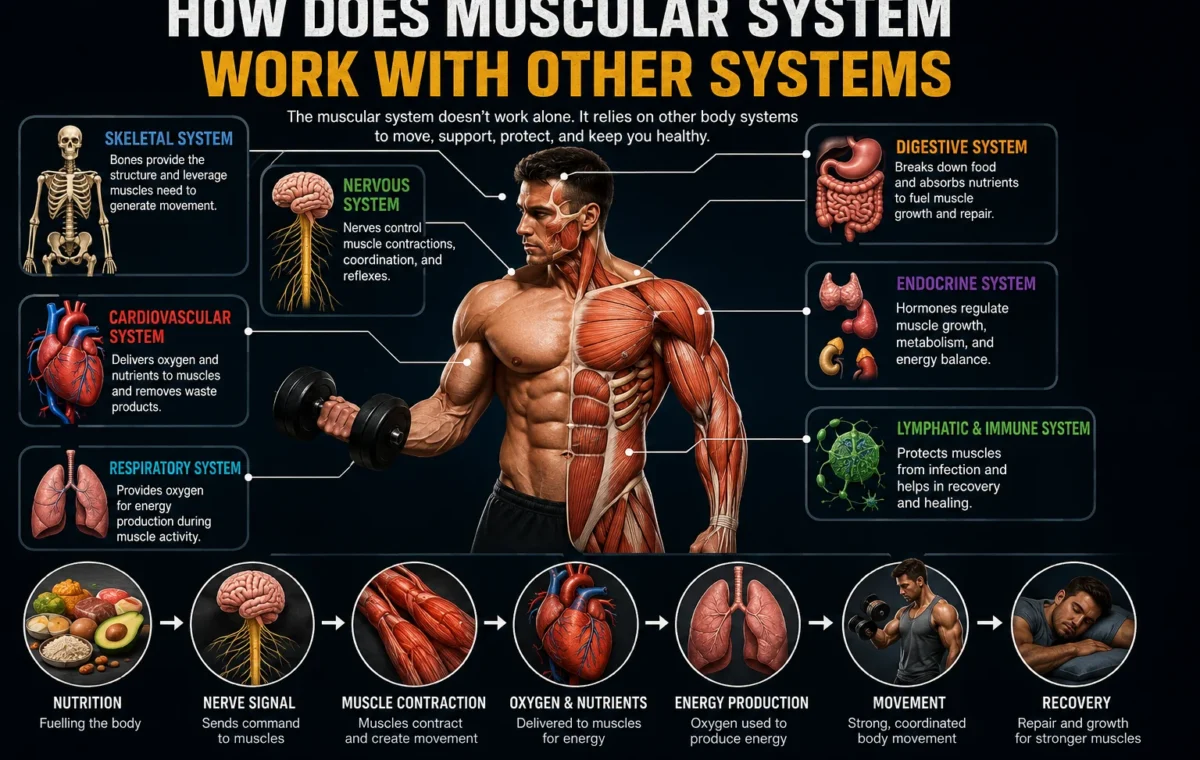
how does muscular system work with other systems The muscular system works with nearly every major body system to help you move, breathe, digest food, circulate blood and maintain your body’s normal functions. The nervous system sends signals to muscles, the skeletal system provides support and leverage, while the circulatory and respiratory systems supply muscles with oxygen and nutrients. Muscles also work with the digestive, endocrine and other systems to keep the body functioning properly.
- Quick Answer: How Does the Muscular System Work With Other Systems?
- How Does the Muscular System Work With the Skeletal System?
- What does this partnership control?
- How Does the Muscular System Work With the Nervous System?
- How Does the Muscular System Work With the Circulatory System?
- How Does the Muscular System Work With the Respiratory System?
- A simple exercise example
- How Does the Muscular System Work With the Digestive System?
- How Does the Muscular System Work With the Endocrine System?
- How the Muscular System Works With Other Systems During Exercise
- A useful way to remember it
- Three Types of Muscle Work Across the Body
- Common Mistake: Thinking Muscles Only Work With Bones
- Why These Connections Matter
- Suggested internal links for Iron Muscle Hub
- Frequently Asked Questions
- How does the muscular system work with the skeletal system?
- How does the muscular system work with the nervous system?
- How do muscles help the respiratory system?
- How does the muscular system help digestion?
- Does the muscular system work with the circulatory system?
- Why do all body systems need to work together?
- Understanding the Body as One Connected System
- How the Muscular System Works With the Nervous System
- The basic communication process
- How the Muscular System Works With the Skeletal System
- A simple example: bending your arm
- How the Muscular System Works With the Circulatory System
- Why this connection matters
- How the Muscular System Works With the Respiratory System
- What happens during exercise?
- How the Muscular System Works With the Digestive System
- From food to muscle activity
- How the Muscular System Works With the Endocrine System
- How Muscles Help Maintain Body Temperature
- How the Muscular System Supports Posture
- What Happens When You Exercise?
- Exercise system checklist
- Voluntary vs. Involuntary Muscle Activity
- Voluntary muscle activity
- Involuntary muscle activity
- A Real-Life Example: Walking Up Stairs
- The Easiest Way to Remember How Body Systems Connect
- 1. Nervous system = communication
- 2. Skeletal system = structure
- 3. Respiratory system = gas exchange
- 4. Circulatory system = transportation
- 5. Digestive system = nutrient processing
- 6. Endocrine system = hormonal regulation
- 7. Muscular system = movement and force
- Common Questions Students Ask
- Does the muscular system work with every body system?
- Which two systems work most closely with the muscular system?
- Why do muscles need the circulatory system?
- Can you breathe without muscles?
- Final Takeaway
- How the Muscular System Works With the Nervous System
- The basic communication process
- How the Muscular System Works With the Skeletal System
- A simple example: bending your arm
- How the Muscular System Works With the Circulatory System
- Why this connection matters
- How the Muscular System Works With the Respiratory System
- What happens during exercise?
- How the Muscular System Works With the Digestive System
- From food to muscle activity
- How the Muscular System Works With the Endocrine System
- How Muscles Help Maintain Body Temperature
- How the Muscular System Supports Posture
- What Happens When You Exercise?
- Exercise system checklist
- Voluntary vs. Involuntary Muscle Activity
- Voluntary muscle activity
- Involuntary muscle activity
- A Real-Life Example: Walking Up Stairs
- The Easiest Way to Remember How Body Systems Connect
- 1. Nervous system = communication
- 2. Skeletal system = structure
- 3. Respiratory system = gas exchange
- 4. Circulatory system = transportation
- 5. Digestive system = nutrient processing
- 6. Endocrine system = hormonal regulation
- 7. Muscular system = movement and force
- Common Questions Students Ask
- Does the muscular system work with every body system?
- Which two systems work most closely with the muscular system?
- Why do muscles need the circulatory system?
- Can you breathe without muscles?
- Final Takeaway
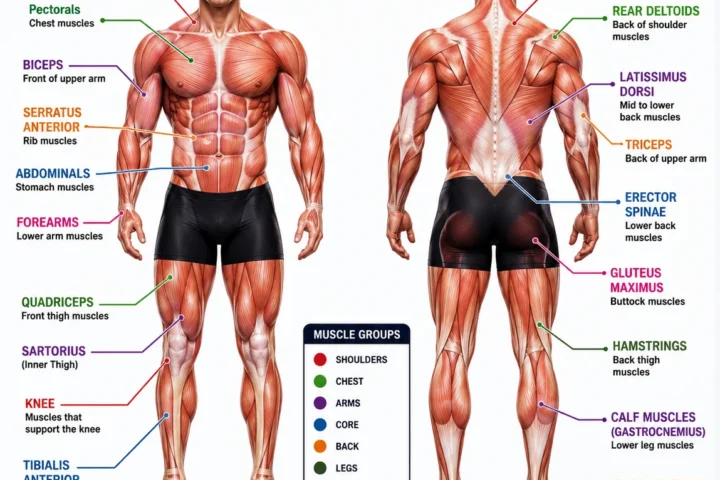
If you think of muscles as something used only for lifting, walking or exercise, there’s much more going on. Your heart is muscle, your digestive tract contains smooth muscle, and breathing depends on muscles such as the diaphragm. For more insights read here :- main muscle groups and muscular humans .
Quick Answer: How Does the Muscular System Work With Other Systems?
| Body system | How it works with the muscular system |
|---|---|
| Skeletal system | Bones and muscles work together to create movement, posture and support. |
| Nervous system | Nerves send signals that tell muscles when and how to contract. |
| Circulatory system | Blood delivers oxygen and nutrients to working muscles and carries away waste. |
| Respiratory system | Breathing muscles help move air, while the lungs provide oxygen needed by working tissues. |
| Digestive system | Smooth muscles move food through the digestive tract. |
| Endocrine system | Hormones influence metabolism, growth and other processes involving muscles. |
| Integumentary system | Muscles beneath the skin help produce movement and contribute to heat production. |
The key idea is simple: body systems don’t operate independently. They constantly exchange signals, materials and energy so the body can maintain normal function.
How Does the Muscular System Work With the Skeletal System?
The muscular and skeletal systems form the foundation of the musculoskeletal system.
Skeletal muscles attach to bones through tendons. When a skeletal muscle contracts, it pulls on a bone, helping move a joint. This allows everyday actions such as walking, standing, reaching and picking something up.
Think about bending your elbow. Your upper-arm and forearm muscles contract in coordinated ways, while your bones and elbow joint provide the structure that allows the movement to happen.
The relationship also works in reverse: bones provide the framework that muscles pull against. Without the skeleton, skeletal muscles couldn’t produce normal body movement in the same way.
What does this partnership control?
The muscular-skeletal partnership helps you:
- Walk and run
- Lift and carry objects
- Maintain posture
- Bend and straighten joints
- Stabilize the body
- Perform precise movements such as writing
How Does the Muscular System Work With the Nervous System?
The nervous system acts as a major control and communication network for muscles.
When you decide to move your arm, your brain and spinal cord help coordinate signals that travel through nerves to the appropriate skeletal muscles. Those muscles then contract and produce movement.
This isn’t limited to deliberate movement. Your nervous system also helps regulate involuntary muscle activity, including functions involved in breathing and digestion.
For example, touching something hot can trigger a rapid nervous-system response that causes muscles to move your hand away.
Simple chain:
Brain/spinal cord → nerves → muscle → contraction → movement
This communication is one reason the nervous and muscular systems are so closely connected.
How Does the Muscular System Work With the Circulatory System?
The circulatory system transports blood throughout your body, while muscles depend on that circulation to receive substances they need to function.
Blood carries oxygen and nutrients to tissues and transports carbon dioxide and other waste products away. This becomes especially important when muscles are active because their demands increase.
There’s another important connection: the heart itself is made of cardiac muscle. Its repeated contractions pump blood through the body’s blood vessels.
So the relationship goes in both directions:
- Blood circulation supports working muscles.
- Cardiac muscle creates the pumping action that keeps blood moving.
- Blood vessels deliver oxygen and nutrients throughout the body.
- Waste products are transported away from tissues.
This is one reason physical activity involves much more than your leg or arm muscles.
How Does the Muscular System Work With the Respiratory System?
Your respiratory and muscular systems work together every time you breathe.
The lungs don’t actively expand themselves like a muscle. Instead, breathing depends on muscles that change the pressure around the lungs. The diaphragm is the main muscle used for breathing, while muscles between the ribs also contribute.
During inhalation, the diaphragm contracts and helps create space for the lungs to expand. During exhalation, it relaxes, allowing the lungs to deflate under normal conditions.
During exercise, breathing usually becomes faster and deeper because your body’s demand for oxygen and removal of carbon dioxide changes. Sensors and the nervous system help adjust breathing to the body’s needs.
A simple exercise example
Imagine climbing a flight of stairs.
Your leg muscles are contracting repeatedly. Your heart pumps faster, your breathing changes, and your blood transports oxygen and other materials around your body.
Muscles + lungs + heart + blood vessels + nervous system = coordinated physical activity.
How Does the Muscular System Work With the Digestive System?
Muscles also play an important role in digestion.
Your digestive tract contains smooth muscle, which isn’t under your conscious control. These muscles contract and relax to help move food and digestive contents through the gastrointestinal tract.
For example, after you swallow food, coordinated muscle activity helps move it through the digestive tract. The intestines also use muscular contractions to move their contents along.
This means you don’t have to consciously tell your intestines to contract after every meal. The digestive system uses its own local controls along with signals from the nervous and hormonal systems.
So the muscular system isn’t only about visible skeletal muscles. Smooth muscle performs essential automatic jobs inside your organs.
How Does the Muscular System Work With the Endocrine System?
The endocrine system communicates using hormones released into the bloodstream.
Hormones can influence processes related to metabolism, growth and the body’s response to physical demands. The cardiovascular system helps transport these chemical signals to tissues throughout the body.
For example, during a stressful situation, nervous-system signals can stimulate the adrenal glands to release hormones that help prepare the body for increased activity. These changes can affect heart rate, breathing and blood flow to support the body’s response.
The important point is that muscles don’t work separately from chemical signals. Their activity is influenced by a wider network of nervous, hormonal and metabolic processes.
How the Muscular System Works With Other Systems During Exercise
Exercise is a useful way to see several systems working at once.
Suppose you go for a brisk run:
- Nervous system: Helps coordinate your movement and sends signals to skeletal muscles.
- Muscular system: Contracts muscles to move your legs, arms and torso.
- Skeletal system: Provides bones and joints that muscles pull against.
- Respiratory system: Moves air into and out of the lungs.
- Circulatory system: Moves blood throughout the body.
- Digestive system: Provides nutrients that your body can absorb and use.
- Endocrine system: Uses hormones to help regulate body processes.
None of these steps happens in isolation. The body coordinates them continuously to keep internal conditions within workable limits, a process called homeostasis.
A useful way to remember it
Think of the muscular system as part of a team:
Nervous system = instructions
Skeletal system = framework
Respiratory system = oxygen supply
Circulatory system = transportation
Digestive system = nutrient supply
Endocrine system = chemical regulation
The muscular system then uses these inputs to perform its many jobs.
Three Types of Muscle Work Across the Body
Understanding the three major types of muscle tissue makes the connections easier to understand.
| Muscle type | Main location | How it works |
|---|---|---|
| Skeletal muscle | Attached mainly to bones | Usually under conscious control; produces body movement |
| Cardiac muscle | Heart | Contracts automatically to pump blood |
| Smooth muscle | Digestive tract, blood vessels and other organs | Usually involuntary; moves or controls contents within organs |
All three create force through contraction, but they have different locations and roles.
This distinction matters because saying “the muscular system moves the body” is true, but incomplete. Muscles also help with breathing, blood circulation, digestion and other internal functions.
Common Mistake: Thinking Muscles Only Work With Bones
One of the easiest mistakes is to treat the muscular system and skeletal system as if they’re the only two systems involved in movement.
They’re not.
A simple voluntary movement requires communication from the nervous system. Active muscles need support from circulation and respiration, while nutrients used by the body ultimately depend on digestion. The endocrine system also participates in regulating many body processes.
So a better mental model is:
Movement is a team effort, not a muscle-only process.
Why These Connections Matter
Understanding how body systems interact can make basic anatomy much easier.
If you’re learning about muscles for school, exercise or general health, don’t memorize each system as a completely separate unit. Instead, ask three questions:
- What does this system provide to muscles?
- What do muscles provide to this system?
- What happens if their communication or support is disrupted?
That approach helps you understand the body rather than simply memorizing definitions.
Suggested internal links for Iron Muscle Hub
Consider linking this article to related articles such as:
- What Are Muscles? A Beginner’s Guide to Muscle Function
- What Are the Major Muscles in the Human Body?
- How the Muscular System Works During Exercise
For trustworthy anatomy references, readers can also consult NIH/National Institute of Arthritis and Musculoskeletal and Skin Diseases muscle education and Cleveland Clinic’s muscle overview.
Frequently Asked Questions
How does the muscular system work with the skeletal system?
The muscular and skeletal systems work together to create movement and provide support. Skeletal muscles attach to bones through tendons. When muscles contract, they pull on bones and cause joints to move. The skeleton also provides the framework that allows muscles to maintain posture and produce controlled movement.
How does the muscular system work with the nervous system?
The nervous system communicates with muscles through nerve signals. The brain and spinal cord coordinate movement, while peripheral nerves carry signals to and from different parts of the body. This allows you to intentionally move skeletal muscles and also helps regulate involuntary muscle activity.
How do muscles help the respiratory system?
Muscles help the respiratory system move air in and out of the lungs. The diaphragm is the main muscle involved in breathing, while the intercostal muscles between the ribs also contribute. During physical activity, breathing muscles help accommodate changes in the body’s breathing demands.
How does the muscular system help digestion?
Smooth muscle in the digestive tract contracts and relaxes to move food and digestive contents through the gastrointestinal system. These contractions are largely involuntary and are coordinated by local digestive mechanisms as well as nervous and hormonal signals.
Does the muscular system work with the circulatory system?
Yes. Blood circulation supplies muscles with oxygen and nutrients and carries away carbon dioxide and other waste products. The relationship also includes cardiac muscle because the heart contracts continuously to pump blood through the body’s circulation.
Why do all body systems need to work together?
Body systems have different jobs, but they depend on one another. For example, muscles need nervous-system signals, oxygen supplied through the respiratory and circulatory systems, and structural support from the skeleton. This cooperation helps maintain the body’s internal balance, known as homeostasis.
Understanding the Body as One Connected System
The answer to how does muscular system work with other systems becomes much clearer when you stop looking at muscles in isolation.
Skeletal muscles work with bones and nerves to create movement. Breathing muscles work with the respiratory system to move air. Cardiac muscle pumps blood, while smooth muscle helps control processes such as digestion. At the same time, circulation, hormones and the nervous system provide the communication and resources these muscles need.
The big takeaway is simple: your muscular system is part of a connected network of body systems that constantly support one another. Learning those connections gives you a much stronger foundation for understanding anatomy, exercise and everyday movement.
How the Muscular System Works With the Nervous System
The muscular system and nervous system have a close working relationship. Your nervous system provides the signals that tell muscles when to contract, relax, or change the amount of force they produce.
For example, when you decide to pick up a cup, your brain helps organize the movement. Nerve signals travel to the muscles involved in moving your arm and hand. Those muscles contract in a coordinated way, allowing you to reach, grip, and lift the cup.
This communication also happens without conscious thought. Many muscle actions involved in breathing, digestion, blood vessel control, and heart function are regulated automatically.
The basic communication process
You can think of muscle control as a simple chain:
Brain or spinal cord → nerve signal → muscle activation → contraction → movement
This connection explains why problems affecting nerves can sometimes interfere with normal muscle movement or strength.
How the Muscular System Works With the Skeletal System
The skeletal and muscular systems are often described together because they depend heavily on each other.
Bones provide the body’s framework, while skeletal muscles provide the pulling force that creates movement. Muscles attach to bones through strong connective tissues called tendons.
When a muscle contracts, it pulls on the bone connected to it. Because bones meet at joints, this pulling force can create movement.
A simple example: bending your arm
When you bend your elbow, several structures work together:
- Your nervous system sends movement instructions.
- Relevant muscles receive nerve signals.
- A muscle contracts and pulls on a tendon.
- The tendon pulls on a bone.
- The elbow joint allows the bones to change position.
- Other muscles help control and stabilize the movement.
This is why movement isn’t simply a matter of having strong muscles. Your bones, joints, nerves, tendons, and muscles all need to cooperate.
How the Muscular System Works With the Circulatory System
Working muscles require a continuous supply of materials from the blood.
The circulatory system moves blood through the body, delivering oxygen and nutrients to tissues and carrying certain waste products away.
This becomes particularly noticeable during exercise. As muscles become more active, the body’s demand for oxygen and energy-related resources changes. Your cardiovascular system responds by adjusting circulation to meet the body’s needs.
The heart is also directly connected to the muscular system because it is made primarily of cardiac muscle. Unlike skeletal muscles, cardiac muscle contracts automatically and continuously to pump blood.
Why this connection matters
The relationship can be summarized like this:
Heart → blood vessels → working tissues → waste removal
At the same time, the heart itself depends on a steady supply of oxygen and nutrients through the coronary circulation.
So the circulatory system doesn’t just support skeletal muscles. It also supports the muscle responsible for keeping blood moving.
How the Muscular System Works With the Respiratory System
Every breath involves muscular activity.
The diaphragm, a large muscle located below the lungs, plays the main role in normal breathing. Muscles between the ribs also contribute to changing the size of the chest during breathing.
When the diaphragm contracts, it moves downward, helping create conditions that allow air to enter the lungs. When it relaxes during normal quiet breathing, the chest returns toward its resting position.
The respiratory system then allows oxygen to enter the bloodstream and helps remove carbon dioxide.
What happens during exercise?
Imagine you’re jogging.
Your skeletal muscles are working harder, so your body needs to adjust its supply of oxygen and removal of carbon dioxide. Your breathing becomes faster and usually deeper, while your cardiovascular system increases its activity.
This gives you a useful picture:
Muscles need oxygen → lungs bring oxygen in → blood transports it → muscles use it
The systems are working together rather than operating separately.
How the Muscular System Works With the Digestive System
Muscles are involved in digestion too, although this isn’t always obvious.
The digestive tract contains smooth muscle. These muscles contract automatically to help move food and digestive contents through the gastrointestinal tract.
This movement is commonly called peristalsis when referring to coordinated wave-like contractions that move material through the digestive tract.
You don’t normally have to consciously control these contractions. Your digestive system coordinates them automatically with help from local control mechanisms, nerves, and chemical signals.
From food to muscle activity
The connection can be viewed as a chain:
Food → digestion → nutrients absorbed → nutrients transported by blood → tissues use those nutrients
The digestive system therefore helps provide the raw materials and energy sources your body needs, while the muscular system uses energy to perform its many functions.
How the Muscular System Works With the Endocrine System
The endocrine system uses hormones to communicate with different tissues throughout the body.
Hormones can influence processes such as metabolism, growth, development, and the body’s response to physical demands.
Muscle tissue is affected by several hormonal signals. Hormonal communication doesn’t usually work like a simple on-and-off switch. Instead, hormones can influence how cells respond to changing conditions.
For example, during physical stress or exercise, hormonal changes can help the body adjust energy availability and other physiological processes.
This is another reason muscles should be viewed as part of a larger body network rather than as isolated tissues.
How Muscles Help Maintain Body Temperature
The muscular system also has an important connection with temperature regulation.
When you’re cold, skeletal muscles can contract rapidly and involuntarily, producing shivering. These repeated contractions generate heat.
Your nervous system detects changes in body temperature and coordinates responses that help maintain a suitable internal temperature.
This gives another example of several systems working together:
Temperature sensors → nervous system → muscle contractions → heat production
Muscle activity therefore contributes to the body’s ability to maintain internal stability.
How the Muscular System Supports Posture
Standing upright may look effortless, but your body is constantly making small adjustments.
Postural muscles contract to help maintain the alignment and stability of your body. The nervous system continuously receives information about body position and helps coordinate muscle activity.
Your skeletal system provides the physical framework, while muscles provide the forces needed to stabilize joints and maintain position.
That’s why posture is another example of cooperation between the muscular, skeletal, and nervous systems.
What Happens When You Exercise?
Exercise provides one of the clearest examples of body-system cooperation.
Suppose you cycle for 30 minutes.
Your skeletal muscles repeatedly contract to turn the pedals. Your nervous system coordinates the movement, your heart pumps blood, and your lungs exchange gases. Blood vessels transport oxygen and nutrients while carrying away metabolic waste.
At the same time, your digestive and endocrine systems contribute to the body’s ability to manage and use energy.
Exercise system checklist
| System | Main contribution during activity |
|---|---|
| Muscular | Produces force and movement |
| Skeletal | Provides structure, joints, and leverage |
| Nervous | Coordinates movement and muscle activity |
| Circulatory | Transports blood around the body |
| Respiratory | Brings oxygen into the body and removes carbon dioxide |
| Digestive | Digests food and absorbs nutrients |
| Endocrine | Uses hormones to regulate body processes |
The important lesson is that exercise is a whole-body activity. Even when one muscle group seems to be doing most of the work, many other systems are supporting it.
Voluntary vs. Involuntary Muscle Activity
Another useful way to understand the muscular system is to separate voluntary and involuntary activity.
Voluntary muscle activity
Skeletal muscles are generally under conscious control. You can intentionally decide to walk, raise your arm, or kick a ball.
However, once you start a movement, the nervous system coordinates many details automatically.
Involuntary muscle activity
Cardiac and smooth muscles perform many functions without conscious control.
Your heart continues beating without you having to think about each contraction. Smooth muscle helps control activities inside organs, including movement through parts of the digestive tract.
This distinction shows why the muscular system is involved in far more than exercise.
A Real-Life Example: Walking Up Stairs
Walking upstairs brings almost all these connections together.
Your brain decides to climb the stairs and your nervous system coordinates the required movements. Skeletal muscles in your legs and hips contract to move your body upward.
Your bones and joints provide the framework and leverage for each step.
As the activity continues, your breathing and heart activity adjust. Blood transports oxygen and nutrients to active tissues and carries waste products away.
At the same time, your body regulates temperature and energy use through multiple coordinated processes.
One simple action can involve many body systems at the same time.
The Easiest Way to Remember How Body Systems Connect
If you’re studying anatomy, use this simple framework:
1. Nervous system = communication
It helps send instructions and coordinate muscle activity.
2. Skeletal system = structure
Bones and joints provide the framework that allows muscles to create movement.
3. Respiratory system = gas exchange
The lungs bring oxygen into the body and help remove carbon dioxide.
4. Circulatory system = transportation
Blood moves oxygen, nutrients, hormones, and waste products around the body.
5. Digestive system = nutrient processing
Food is broken down and nutrients are absorbed for use by the body.
6. Endocrine system = hormonal regulation
Hormones help regulate many processes that affect tissues, including muscles.
7. Muscular system = movement and force
Muscles produce movement, stabilize the body, help move substances through organs, pump blood, and contribute to heat production.
Common Questions Students Ask
Does the muscular system work with every body system?
The muscular system interacts directly or indirectly with many body systems. Its strongest obvious connections include the nervous, skeletal, circulatory, and respiratory systems, but muscles also participate in digestion, temperature regulation, hormonal responses, and other body functions.
Which two systems work most closely with the muscular system?
The muscular system has an especially close relationship with the skeletal and nervous systems. The skeletal system provides the bones and joints that muscles move, while the nervous system provides signals that coordinate muscle contractions.
Why do muscles need the circulatory system?
Muscles depend on blood circulation to transport oxygen and nutrients and to carry away waste products. The circulatory system also supplies the heart muscle itself, allowing the heart to keep pumping blood throughout the body.
Can you breathe without muscles?
Normal breathing depends on respiratory muscles, particularly the diaphragm. Other muscles, including muscles between the ribs, also contribute. The lungs themselves don’t actively pull air in like a muscle; changes in pressure produced by respiratory movements allow air to flow.
Final Takeaway
The muscular system doesn’t work alone. It functions as part of a connected network in which muscles, nerves, bones, blood vessels, lungs, digestive organs, and hormones constantly interact.
The nervous system provides control, the skeletal system provides structure, the respiratory system helps supply oxygen, and the circulatory system transports materials throughout the body. The digestive and endocrine systems also contribute by providing nutrients and regulating important body processes.
Once you understand these connections, anatomy becomes much easier to remember. Instead of memorizing isolated facts, think of the body as one coordinated system where every major part has a job and supports the others.
How the Muscular System Works With the Nervous System
The muscular system and nervous system have a close working relationship. Your nervous system provides the signals that tell muscles when to contract, relax, or change the amount of force they produce.
For example, when you decide to pick up a cup, your brain helps organize the movement. Nerve signals travel to the muscles involved in moving your arm and hand. Those muscles contract in a coordinated way, allowing you to reach, grip, and lift the cup.
This communication also happens without conscious thought. Many muscle actions involved in breathing, digestion, blood vessel control, and heart function are regulated automatically.
The basic communication process
You can think of muscle control as a simple chain:
Brain or spinal cord → nerve signal → muscle activation → contraction → movement
This connection explains why problems affecting nerves can sometimes interfere with normal muscle movement or strength.
How the Muscular System Works With the Skeletal System
The skeletal and muscular systems are often described together because they depend heavily on each other.
Bones provide the body’s framework, while skeletal muscles provide the pulling force that creates movement. Muscles attach to bones through strong connective tissues called tendons.
When a muscle contracts, it pulls on the bone connected to it. Because bones meet at joints, this pulling force can create movement.
A simple example: bending your arm
When you bend your elbow, several structures work together:
- Your nervous system sends movement instructions.
- Relevant muscles receive nerve signals.
- A muscle contracts and pulls on a tendon.
- The tendon pulls on a bone.
- The elbow joint allows the bones to change position.
- Other muscles help control and stabilize the movement.
This is why movement isn’t simply a matter of having strong muscles. Your bones, joints, nerves, tendons, and muscles all need to cooperate.
How the Muscular System Works With the Circulatory System
Working muscles require a continuous supply of materials from the blood.
The circulatory system moves blood through the body, delivering oxygen and nutrients to tissues and carrying certain waste products away.
This becomes particularly noticeable during exercise. As muscles become more active, the body’s demand for oxygen and energy-related resources changes. Your cardiovascular system responds by adjusting circulation to meet the body’s needs.
The heart is also directly connected to the muscular system because it is made primarily of cardiac muscle. Unlike skeletal muscles, cardiac muscle contracts automatically and continuously to pump blood.
Why this connection matters
The relationship can be summarized like this:
Heart → blood vessels → working tissues → waste removal
At the same time, the heart itself depends on a steady supply of oxygen and nutrients through the coronary circulation.
So the circulatory system doesn’t just support skeletal muscles. It also supports the muscle responsible for keeping blood moving.
How the Muscular System Works With the Respiratory System
Every breath involves muscular activity.
The diaphragm, a large muscle located below the lungs, plays the main role in normal breathing. Muscles between the ribs also contribute to changing the size of the chest during breathing.
When the diaphragm contracts, it moves downward, helping create conditions that allow air to enter the lungs. When it relaxes during normal quiet breathing, the chest returns toward its resting position.
The respiratory system then allows oxygen to enter the bloodstream and helps remove carbon dioxide.
What happens during exercise?
Imagine you’re jogging.
Your skeletal muscles are working harder, so your body needs to adjust its supply of oxygen and removal of carbon dioxide. Your breathing becomes faster and usually deeper, while your cardiovascular system increases its activity.
This gives you a useful picture:
Muscles need oxygen → lungs bring oxygen in → blood transports it → muscles use it
The systems are working together rather than operating separately.
How the Muscular System Works With the Digestive System
Muscles are involved in digestion too, although this isn’t always obvious.
The digestive tract contains smooth muscle. These muscles contract automatically to help move food and digestive contents through the gastrointestinal tract.
This movement is commonly called peristalsis when referring to coordinated wave-like contractions that move material through the digestive tract.
You don’t normally have to consciously control these contractions. Your digestive system coordinates them automatically with help from local control mechanisms, nerves, and chemical signals.
From food to muscle activity
The connection can be viewed as a chain:
Food → digestion → nutrients absorbed → nutrients transported by blood → tissues use those nutrients
The digestive system therefore helps provide the raw materials and energy sources your body needs, while the muscular system uses energy to perform its many functions.
How the Muscular System Works With the Endocrine System
The endocrine system uses hormones to communicate with different tissues throughout the body.
Hormones can influence processes such as metabolism, growth, development, and the body’s response to physical demands.
Muscle tissue is affected by several hormonal signals. Hormonal communication doesn’t usually work like a simple on-and-off switch. Instead, hormones can influence how cells respond to changing conditions.
For example, during physical stress or exercise, hormonal changes can help the body adjust energy availability and other physiological processes.
This is another reason muscles should be viewed as part of a larger body network rather than as isolated tissues.
How Muscles Help Maintain Body Temperature
The muscular system also has an important connection with temperature regulation.
When you’re cold, skeletal muscles can contract rapidly and involuntarily, producing shivering. These repeated contractions generate heat.
Your nervous system detects changes in body temperature and coordinates responses that help maintain a suitable internal temperature.
This gives another example of several systems working together:
Temperature sensors → nervous system → muscle contractions → heat production
Muscle activity therefore contributes to the body’s ability to maintain internal stability.
How the Muscular System Supports Posture
Standing upright may look effortless, but your body is constantly making small adjustments.
Postural muscles contract to help maintain the alignment and stability of your body. The nervous system continuously receives information about body position and helps coordinate muscle activity.
Your skeletal system provides the physical framework, while muscles provide the forces needed to stabilize joints and maintain position.
That’s why posture is another example of cooperation between the muscular, skeletal, and nervous systems.
What Happens When You Exercise?
Exercise provides one of the clearest examples of body-system cooperation.
Suppose you cycle for 30 minutes.
Your skeletal muscles repeatedly contract to turn the pedals. Your nervous system coordinates the movement, your heart pumps blood, and your lungs exchange gases. Blood vessels transport oxygen and nutrients while carrying away metabolic waste.
At the same time, your digestive and endocrine systems contribute to the body’s ability to manage and use energy.
Exercise system checklist
| System | Main contribution during activity |
|---|---|
| Muscular | Produces force and movement |
| Skeletal | Provides structure, joints, and leverage |
| Nervous | Coordinates movement and muscle activity |
| Circulatory | Transports blood around the body |
| Respiratory | Brings oxygen into the body and removes carbon dioxide |
| Digestive | Digests food and absorbs nutrients |
| Endocrine | Uses hormones to regulate body processes |
The important lesson is that exercise is a whole-body activity. Even when one muscle group seems to be doing most of the work, many other systems are supporting it.
Voluntary vs. Involuntary Muscle Activity
Another useful way to understand the muscular system is to separate voluntary and involuntary activity.
Voluntary muscle activity
Skeletal muscles are generally under conscious control. You can intentionally decide to walk, raise your arm, or kick a ball.
However, once you start a movement, the nervous system coordinates many details automatically.
Involuntary muscle activity
Cardiac and smooth muscles perform many functions without conscious control.
Your heart continues beating without you having to think about each contraction. Smooth muscle helps control activities inside organs, including movement through parts of the digestive tract.
This distinction shows why the muscular system is involved in far more than exercise.
A Real-Life Example: Walking Up Stairs
Walking upstairs brings almost all these connections together.
Your brain decides to climb the stairs and your nervous system coordinates the required movements. Skeletal muscles in your legs and hips contract to move your body upward.
Your bones and joints provide the framework and leverage for each step.
As the activity continues, your breathing and heart activity adjust. Blood transports oxygen and nutrients to active tissues and carries waste products away.
At the same time, your body regulates temperature and energy use through multiple coordinated processes.
One simple action can involve many body systems at the same time.
The Easiest Way to Remember How Body Systems Connect
If you’re studying anatomy, use this simple framework:
1. Nervous system = communication
It helps send instructions and coordinate muscle activity.
2. Skeletal system = structure
Bones and joints provide the framework that allows muscles to create movement.
3. Respiratory system = gas exchange
The lungs bring oxygen into the body and help remove carbon dioxide.
4. Circulatory system = transportation
Blood moves oxygen, nutrients, hormones, and waste products around the body.
5. Digestive system = nutrient processing
Food is broken down and nutrients are absorbed for use by the body.
6. Endocrine system = hormonal regulation
Hormones help regulate many processes that affect tissues, including muscles.
7. Muscular system = movement and force
Muscles produce movement, stabilize the body, help move substances through organs, pump blood, and contribute to heat production.
Common Questions Students Ask
Does the muscular system work with every body system?
The muscular system interacts directly or indirectly with many body systems. Its strongest obvious connections include the nervous, skeletal, circulatory, and respiratory systems, but muscles also participate in digestion, temperature regulation, hormonal responses, and other body functions.
Which two systems work most closely with the muscular system?
The muscular system has an especially close relationship with the skeletal and nervous systems. The skeletal system provides the bones and joints that muscles move, while the nervous system provides signals that coordinate muscle contractions.
Why do muscles need the circulatory system?
Muscles depend on blood circulation to transport oxygen and nutrients and to carry away waste products. The circulatory system also supplies the heart muscle itself, allowing the heart to keep pumping blood throughout the body.
Can you breathe without muscles?
Normal breathing depends on respiratory muscles, particularly the diaphragm. Other muscles, including muscles between the ribs, also contribute. The lungs themselves don’t actively pull air in like a muscle; changes in pressure produced by respiratory movements allow air to flow.
Final Takeaway
The muscular system doesn’t work alone. It functions as part of a connected network in which muscles, nerves, bones, blood vessels, lungs, digestive organs, and hormones constantly interact.
The nervous system provides control, the skeletal system provides structure, the respiratory system helps supply oxygen, and the circulatory system transports materials throughout the body. The digestive and endocrine systems also contribute by providing nutrients and regulating important body processes.
Once you understand these connections, anatomy becomes much easier to remember. Instead of memorizing isolated facts, think of the body as one coordinated system where every major part has a job and supports the others.