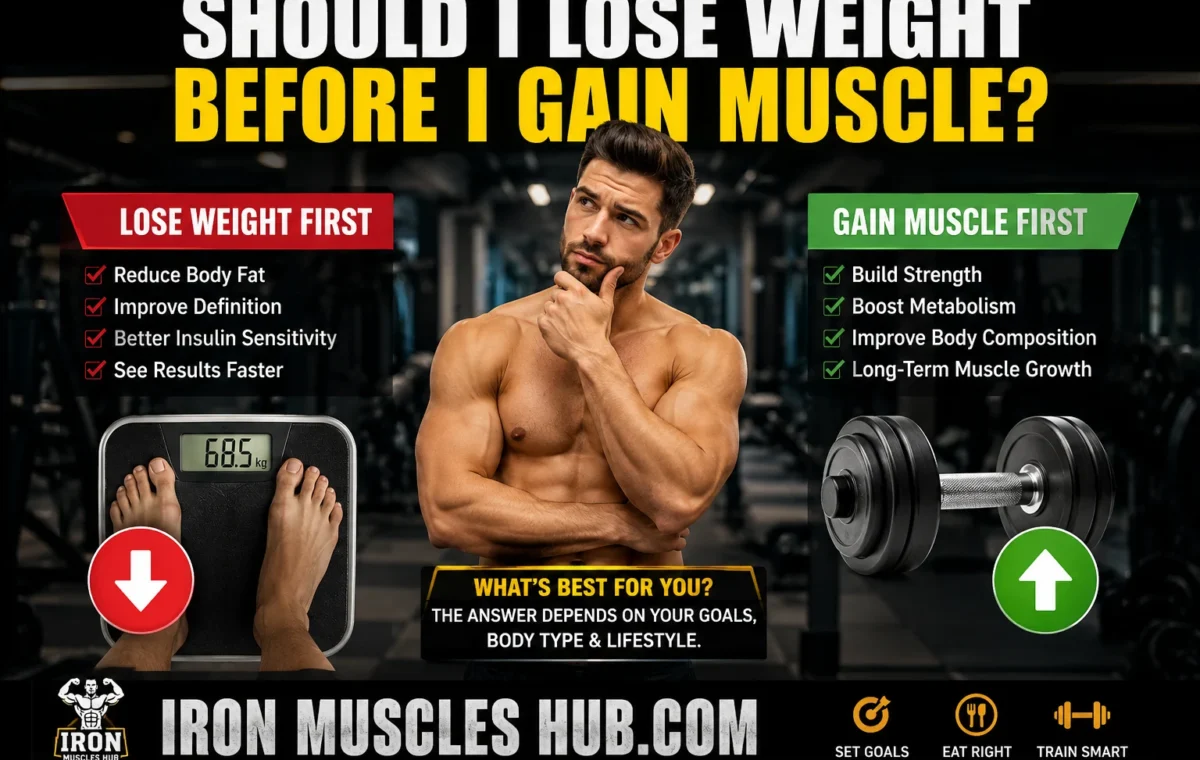
If you’re asking “should I lose weight before I gain muscle?”, you don’t necessarily need to choose one goal at a time. For many beginners, especially people carrying noticeable extra body fat, a period of fat loss while starting resistance training can make more sense than deliberately gaining weight.
- Quick Answer
- Should I Lose Weight Before I Gain Muscle?
- Think about your goal in this order
- Example
- Step 1: Look at your waist and overall body composition
- Step 2: Look at your training experience
- Step 3: Look at your main visual goal
- Step 4: Check your progress for 4–8 weeks
- 1. Start resistance training
- 2. Prioritize protein
- Starting priorities
- Mistake 1: “I'm overweight, so I shouldn't lift yet.”
- Mistake 2: Starting an aggressive bulk because you're a beginner
- Mistake 3: Cutting calories extremely low
- Mistake 4: Only watching the scale
- Mistake 5: Changing programs every two weeks
- Mistake 6: Treating protein like a magic muscle builder
- 1. Should I lose belly fat before building muscle?
- 2. Should I bulk or cut first if I'm overweight?
- 3. Can I lose fat and gain muscle at the same time?
- 4. How much weight should I lose before building muscle?
- 5. Should skinny beginners bulk immediately?
- If you have significant extra body fat:
- If you're relatively lean:
- If you're somewhere in the middle:
You can build or preserve muscle while losing fat when your training, food intake, protein, sleep, and recovery are appropriate. Research in previously untrained people has even demonstrated increases in lean mass alongside substantial fat loss during an energy deficit.
The key is knowing which approach fits your starting point. For more insights read here :- Lean and Muscular and lean body women .
Quick Answer
- If you have substantial extra body fat: generally start with fat loss while lifting, rather than intentionally bulking.
- If you’re relatively lean and want more size: a muscle-building phase may make more sense.
- If you’re a beginner: you may be able to lose fat and gain muscle at the same time.
- If you’re unsure: use your waist, body weight trend, gym performance, and progress photos together rather than relying only on the scale.
Should I Lose Weight Before I Gain Muscle?
Not necessarily. If you’re a beginner with extra body fat, I’d usually start resistance training now while creating a sensible calorie deficit rather than waiting until you’re “thin enough” to lift. If you’re already fairly lean, a muscle-building phase can be more appropriate.
The mistake is thinking that every person has to follow the same bulk-then-cut cycle.
Your starting body composition, training experience, nutrition, and goal all matter.
Strength training is useful during weight loss because it can help maintain or increase lean muscle while also supporting weight management. Mayo Clinic specifically identifies strength training as a way to improve body composition, manage weight, and increase or maintain muscle mass.
Think about your goal in this order
Instead of asking:
“Should I bulk or cut?”
Ask:
- How much body fat am I carrying?
- Am I new to resistance training?
- Do I want to look smaller, more muscular, or both?
- Can I consistently train and eat well?
- Would gaining additional body weight actually help my current goal?
Those questions give you a much better starting point.
When Losing Weight First Makes More Sense
If you have a significant amount of excess body fat, deliberately entering a calorie surplus to gain muscle isn’t usually the first move I’d recommend for a beginner.
Why?
Because you already have stored energy available in the form of body fat.
Your first job can be to train your muscles, eat enough protein, and gradually reduce excess body fat.
That doesn’t mean starving yourself.
It means creating a manageable energy deficit while giving your body a strong reason to retain muscle through resistance training.
For people with overweight or obesity, NIH guidance notes that losing around 5% to 10% of starting body weight can provide meaningful health benefits.
That isn’t a magic bodybuilding threshold. It’s a health-oriented reference point, not a rule saying you must lose exactly 5% or 10% before you can build muscle.
Example
Suppose someone weighs:
200 lb / 90.7 kg
A 5% reduction is:
10 lb / 4.5 kg
A 10% reduction is:
20 lb / 9.1 kg
So an initial range of roughly:
180–190 lb / 81.6–86.2 kg
could represent a meaningful weight-loss milestone for that person.
But the scale isn’t the only thing that matters.
If waist measurements are falling while gym performance is improving, that’s useful information even if body weight doesn’t move perfectly every week.
NIH/NIDDK guidance also gives 5% to 10% of starting weight over roughly six months as a reasonable general weight-loss goal for people who need to lose weight.
When You Probably Don’t Need to Lose Weight First
Now flip the situation.
Imagine you’re already relatively lean, have little excess body fat, and your main objective is to add muscle.
In that case, continuing to push body weight downward may not make sense.
You may benefit more from eating enough to support training and gradually increasing your body mass.
This is where the traditional muscle-building phase becomes more relevant.
The important point is that “gain muscle” doesn’t automatically mean “eat as much as possible.”
A beginner doesn’t need an aggressive bulk.
You can build a solid foundation with:
- Progressive resistance training
- Adequate protein
- Enough total food to recover
- Quality sleep
- Consistent training
- Patience
Mayo Clinic recommends strength training as part of an overall fitness program and notes that it can help preserve and increase muscle mass.
What If I’m Overweight and Want More Muscle?
This is where body recomposition becomes particularly interesting.
Body recomposition means improving your ratio of muscle to fat rather than focusing exclusively on scale weight.
For a beginner carrying extra body fat, you may be able to:
lose fat + maintain or gain muscle
at the same time.
A 2016 randomized trial involving young men undergoing a substantial calorie deficit found that the higher-protein group performing intense exercise increased lean body mass while losing fat. The higher-protein group consumed 2.4 g/kg/day compared with 1.2 g/kg/day in the control group, but the study used a very demanding exercise and calorie-restriction protocol, so those exact numbers should not be treated as a beginner prescription.
That’s an important distinction.
The study demonstrates that recomposition can happen. It doesn’t mean you should copy its aggressive diet or training schedule.
For most beginners, a simpler approach is better.
Body Recomposition vs Cutting vs Bulking
| Approach | Main Goal | Best Fit | What Happens to Scale Weight? |
|---|---|---|---|
| Fat-loss phase | Reduce body fat | Higher body-fat beginner | Usually decreases |
| Body recomposition | Lose fat while gaining/maintaining muscle | Many beginners | May decrease slowly or stay similar |
| Muscle-building phase | Add muscle and size | Relatively lean lifters | Usually increases gradually |
| Maintenance training | Improve strength/body composition without chasing scale change | Beginners unsure of direction | Often relatively stable |
There isn’t one universally superior option.
The right strategy depends on where you are starting.
The 30-Second Cut, Recomp or Build Decision Rule
Here’s a simple decision rule you can use.
Step 1: Look at your waist and overall body composition
If you’re carrying a noticeable amount of excess body fat, don’t rush into a bulk.
Start with fat loss or recomposition.
Step 2: Look at your training experience
If you’ve never trained seriously before, you have an important advantage:
You have plenty of room to improve.
New lifters can often make rapid strength improvements and can potentially add muscle without needing a traditional calorie surplus.
Step 3: Look at your main visual goal
If your main goal is:
“I want to look leaner and more muscular.”
Start with recomposition or fat loss.
If your main goal is:
“I’m already lean and I mainly want more size.”
A controlled muscle-building phase may be more appropriate.
Step 4: Check your progress for 4–8 weeks
Don’t change strategy every few days.
Track:
- Average body weight
- Waist circumference
- Gym performance
- Progress photos
- Training consistency
If your waist is decreasing and your strength is improving, your plan is probably doing something useful.
How to Lose Fat While Building Muscle
1. Start resistance training
Don’t wait until you’ve lost all your unwanted weight before lifting.
Resistance training provides the stimulus your muscles need to adapt.
For a beginner, focus on basic movement patterns:
- Squat or leg press
- Hip hinge
- Horizontal push
- Horizontal pull
- Vertical push
- Vertical pull
- Loaded carry or trunk work
You don’t need an advanced bodybuilding split.
You need a routine you can perform consistently.
Mayo Clinic notes that strength training can help with muscle mass, body composition, and weight management.
2. Prioritize protein
Protein matters during both muscle building and fat loss.
A large systematic review and meta-analysis of resistance-training studies found that protein supplementation increased gains in strength and fat-free mass, with the analysis finding no additional resistance-training-related fat-free-mass benefit beyond total protein intake of roughly 1.6 g/kg/day.
That doesn’t mean everyone needs exactly 1.6 g/kg.
Your total protein needs depend on your circumstances, including body size, diet, training, and energy intake.
For a practical beginner approach, make protein-rich foods a regular part of your meals:
- Eggs
- Greek yogurt
- Milk
- Chicken
- Turkey
- Fish
- Lean beef
- Cottage cheese
- Tofu
- Beans and lentils
You don’t need a supplement to build muscle.
Worked Example: 90 kg / 198 lb Beginner
Let’s make this practical.
Imagine a beginner weighs:
90 kg / 198 lb
They have noticeable excess body fat and want to look leaner while becoming stronger.
Instead of saying:
“I need to bulk first.”
I’d consider a recomposition or fat-loss phase.
Starting priorities
Training:
Regular full-body resistance training.
Nutrition:
A modest calorie deficit rather than an extreme diet.
Protein:
A consistently high-protein diet appropriate to the person’s needs.
Progress tracking:
Body-weight trend + waist + strength + photos.
Suppose their weight gradually trends down while their main lifts improve.
After several weeks, they might be:
86 kg / 190 lb
but noticeably stronger with a smaller waist.
That is a better outcome than simply chasing a lower scale number.
And remember: this is a worked example, not a prediction that every beginner will lose exactly 4 kg / 8.8 lb or gain a specific amount of muscle.
Individual results vary.
How Big Should Your Calorie Deficit Be?
This is one place where beginners often make a mistake.
They assume:
Bigger deficit = faster results = better.
That’s not necessarily true for someone who also wants to build or preserve muscle.
Research has shown that energy restriction can affect lean tissue, while resistance exercise and adequate protein can help protect muscle.
So don’t turn fat loss into a crash diet.
You still need enough energy to:
- Train
- Recover
- Sleep well
- Perform normal daily activities
- Get adequate nutrients
For someone with obesity or other health concerns, the appropriate weight-loss strategy may need to be planned with a healthcare professional. NIH guidance specifically recommends working with a healthcare provider when treating overweight or obesity.
What About Cardio?
Cardio can be useful, but you don’t need to turn every workout into a marathon.
Walking, cycling, swimming, jogging, and other aerobic activities can help increase physical activity and support health.
Your main muscle-building stimulus should still come from resistance training.
A simple beginner combination could be:
Resistance training: several sessions each week
Walking/cardio: regular activity you can recover from
Don’t use cardio as punishment for eating.
Build a routine you can maintain.
Common Mistakes → Why → Fix
Mistake 1: “I’m overweight, so I shouldn’t lift yet.”
Why:
Some beginners think they need to lose fat before resistance training becomes worthwhile.
Fix:
Start lifting now. Resistance training can support muscle retention and improve body composition during weight management.
Mistake 2: Starting an aggressive bulk because you’re a beginner
Why:
You hear that beginners need lots of calories to gain muscle.
Fix:
If you’re already carrying substantial extra body fat, consider fat loss or maintenance/recomposition first rather than intentionally adding more body weight.
Mistake 3: Cutting calories extremely low
Why:
You want results quickly.
Fix:
Use a sustainable approach. Severe restriction can make training and recovery harder, and excessive energy restriction can increase the challenge of preserving lean tissue.
Mistake 4: Only watching the scale
Why:
Scale weight is easy to measure.
Fix:
Track at least three things:
- Waist
- Strength
- Body-weight trend
Progress photos can add another useful reference.
Mistake 5: Changing programs every two weeks
Why:
You don’t see dramatic changes immediately.
Fix:
Give your training enough time to produce measurable trends. Record exercises, sets, reps, and loads so you can see whether performance is moving forward.
Mistake 6: Treating protein like a magic muscle builder
Why:
Fitness content often makes protein sound like the main ingredient.
Fix:
Think of protein as one part of the system. You still need progressive resistance training, adequate energy, recovery, and consistency.
Who Is This Advice NOT For?
This general beginner framework isn’t appropriate for everyone.
You should get professional guidance before deliberately changing your calorie intake or starting a demanding training program if you:
- Are pregnant or recently gave birth
- Have a diagnosed eating disorder or history of disordered eating
- Have significant heart, kidney, liver, metabolic, or musculoskeletal disease
- Are taking medication that affects weight, appetite, blood sugar, or exercise tolerance
- Have unexplained rapid weight changes
- Are under 18
- Have been advised by your clinician to follow a specific diet or exercise restriction
For people with overweight or obesity, NIH recommends discussing an appropriate weight-management plan with a healthcare professional.
Should You Bulk After Losing Weight?
Potentially, yes.
But you don’t have to jump straight from dieting into a large calorie surplus.
Once you’ve reached a body-composition point you’re comfortable with, you can spend some time around maintenance while continuing to train.
Then, if increasing muscle size becomes the priority, you can consider a gradual calorie increase.
The goal isn’t to see how quickly you can make the scale move.
The goal is to give your training enough nutrition to support muscle growth without unnecessarily accumulating large amounts of body fat.
What If My Weight Doesn’t Change?
Don’t panic.
Body recomposition can make scale changes harder to interpret.
For example, imagine this happens over time:
- Fat mass decreases
- Muscle mass increases
- Water and glycogen fluctuate
- Scale weight barely changes
You might think:
“Nothing is working.”
But your waist could be smaller and your lifts could be stronger.
That’s why a good coach doesn’t evaluate a body-composition goal using one measurement.
Use multiple signals.
FAQ: Should I Lose Weight Before I Gain Muscle?
1. Should I lose belly fat before building muscle?
No. You don’t need to eliminate belly fat before beginning resistance training. If you have excess body fat, you can start strength training while working toward gradual fat loss. For beginners, this can create an opportunity to improve body composition without first completing a separate “fat-loss only” phase. Strength training can help preserve and increase muscle while supporting weight management.
2. Should I bulk or cut first if I’m overweight?
If you’re significantly overweight, I wouldn’t automatically recommend a bulk. A fat-loss or body-recomposition approach is often more sensible because intentionally gaining additional body weight may move you farther from your immediate goal. NIH guidance supports gradual weight loss for people with overweight or obesity, while resistance training can help support muscle during the process.
3. Can I lose fat and gain muscle at the same time?
Yes, particularly in some beginners and people returning to training. A randomized trial found that young men performing intense exercise during a substantial calorie deficit gained lean mass while losing fat when consuming the higher-protein diet used in that study. However, that was a controlled research protocol, not a recommendation to copy its aggressive calorie deficit or six-day training schedule.
4. How much weight should I lose before building muscle?
There isn’t a universal body-weight number at which you suddenly become ready to build muscle. If you have overweight or obesity, losing around 5% to 10% of starting weight is associated with meaningful health benefits, but that is a health-management target rather than a bodybuilding requirement.
5. Should skinny beginners bulk immediately?
Not necessarily. A beginner can often make substantial strength and muscle progress without an aggressive bulk. If you’re already relatively lean and your primary goal is gaining size, eating enough to support training and using a controlled muscle-building phase may make sense. If you’re very new to training, however, simply eating well and following a consistent resistance program can produce significant early progress without deliberately pushing calories very high.
The Simple Beginner Plan
If you still don’t know what to do, here’s the approach I’d use as a starting framework.
If you have significant extra body fat:
Start lifting + eat for gradual fat loss + prioritize protein.
Don’t wait until you’re lean to start building muscle.
If you’re relatively lean:
Start lifting + eat enough to recover + consider a controlled muscle-building phase.
Don’t be afraid of gaining some body weight if size is the goal.
If you’re somewhere in the middle:
Start lifting + eat around maintenance or use a modest deficit + monitor your results.
You may be a good candidate for body recomposition.
The important thing is that your strategy should match your starting point.
Final Takeaway
So, should you lose weight before you gain muscle?
For many beginners, the answer is no—you can start building muscle while losing fat.
If you have substantial excess body fat, I’d generally prioritize gradual fat loss while beginning resistance training rather than deliberately bulking. If you’re already fairly lean, a muscle-building phase may be more appropriate. And if you’re somewhere between those extremes, body recomposition can be a sensible starting strategy.
Don’t make the scale your only judge. Track your waist, strength, body-weight trend, photos, training consistency, and how you feel.
Start with the simplest plan you can follow consistently. Then adjust based on what your body and performance are actually doing.