If you want to reduce body fat and gain muscle, you don’t necessarily need to bulk first and cut later. Beginners, people returning to training, and people carrying more body fat can sometimes improve both at the same time through body recomposition.
- Quick Answer
- reduce body fat gain muscle
- Can beginners really do both?
- A practical beginner approach
- Don't automatically eat less when the scale stalls
- Example
- A simple beginner schedule
- Example three-day structure
- Example four-day structure
- Mistake 1: Cutting calories too aggressively
- Mistake 2: Doing lots of cardio but barely lifting
- Mistake 3: Eating very little protein
- Mistake 4: Changing workouts every week
- Mistake 5: Judging everything by scale weight
- Mistake 6: Expecting fast muscle growth while dieting
- The decision rule
- Body weight
- Waist measurement
- Strength
- You want maximum fat loss speed
- You're already very lean and highly trained
- You hate slow progress
- You're using extreme dieting methods
- Weeks 1–4: Establish the routine
- Weeks 5–8: Build performance
- Weeks 9–12: Review
- Can you lose belly fat and gain muscle at the same time?
- What should I eat to lose fat and gain muscle?
- How much protein do I need to gain muscle while losing fat?
- Should I bulk or cut first?
- How often should I lift weights to lose fat and gain muscle?
- Final Thoughts
The basic formula is straightforward: perform progressive resistance training, eat enough protein, keep your calorie deficit modest rather than aggressive, stay active, and recover properly. Research shows that resistance training can support muscle retention during weight loss, while adequate protein can improve body-composition outcomes. For more insights read here :- lean build and how to build muscle.
Quick Answer
- Lift weights consistently and train the major muscle groups regularly.
- Eat enough protein to support muscle repair and growth.
- Use a modest calorie deficit, rather than crash dieting.
- Track waist size, body weight, strength and photos, not the scale alone.
- Expect body recomposition to be slower than focusing exclusively on fat loss or muscle gain.
reduce body fat gain muscle
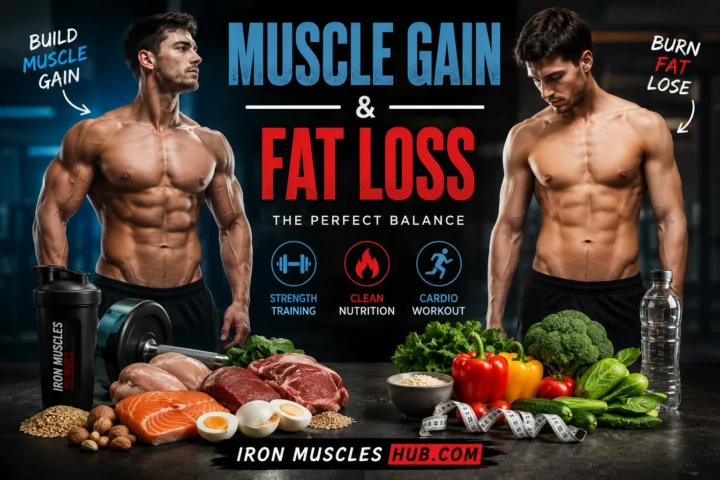
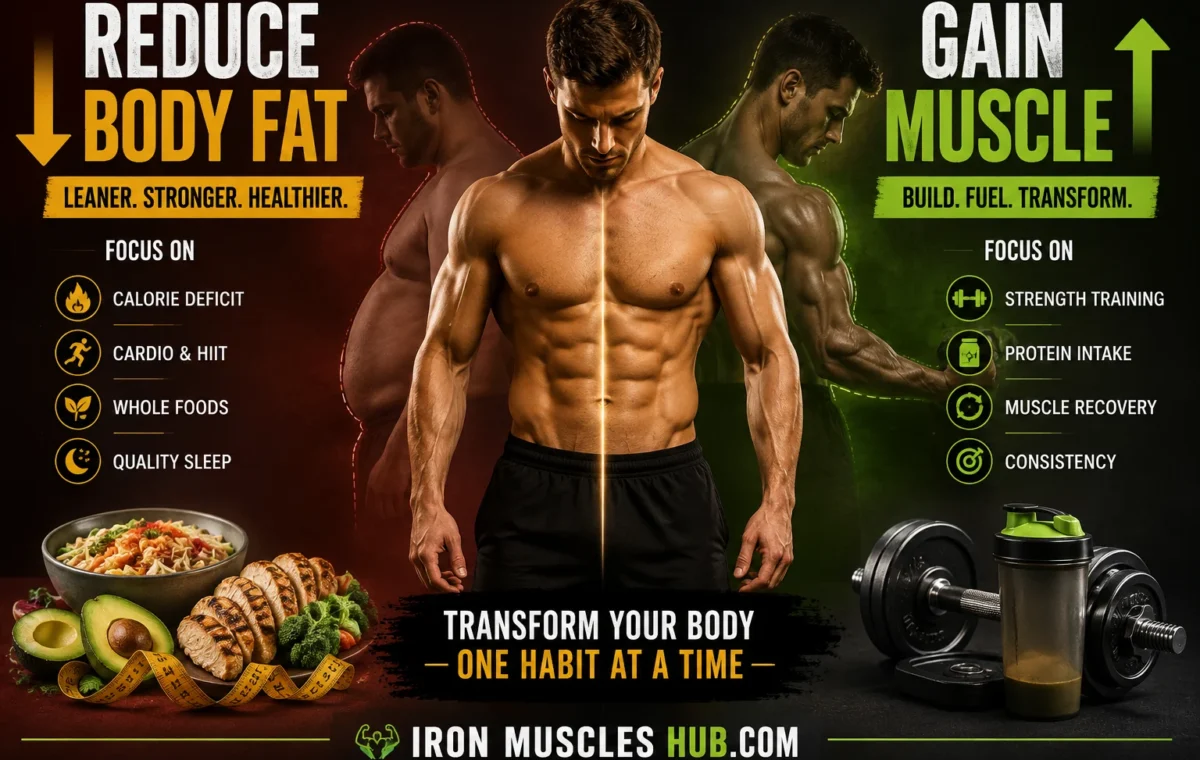
Reducing body fat while gaining muscle is commonly called body recomposition.
You are trying to change what your body is made of rather than simply making the number on the scale as small as possible. Ideally, fat mass decreases while lean tissue, including skeletal muscle, increases or is maintained.
That distinction matters.
If you lose 10 lb (4.5 kg) but also lose a substantial amount of muscle, the scale may look impressive while your strength and muscle mass suffer. A better outcome can be losing fat while maintaining or increasing lean mass.
Mayo Clinic notes that strength training can help preserve and increase lean muscle while also helping with weight and body composition.
Research also shows that simultaneous changes in fat mass and muscle mass are possible under the right conditions. In one study of previously untrained older women performing resistance training for 24 weeks, the groups consuming moderate or higher protein had greater increases in skeletal muscle than the low-protein group.
Can beginners really do both?
Yes, but don’t interpret that as a promise.
Your starting point matters.
A beginner has plenty of room to improve strength and muscle because the body is being exposed to resistance training for the first time. Someone returning after a long training break may also respond well.
On the other hand, an experienced lifter who is already muscular and relatively lean generally has less room for rapid muscle growth while dieting.
That’s one reason body recomposition shouldn’t be treated as a magic formula.
Your goal is to create conditions that make muscle retention and muscle growth more likely while body fat gradually falls.
1. Start With a Small, Sustainable Calorie Deficit
To reduce body fat, your overall energy intake has to be lower than your energy expenditure over time.
That doesn’t mean you should slash calories as aggressively as possible.
In fact, if gaining or preserving muscle is also important, an unnecessarily large calorie deficit can work against you. A meta-analysis examining energy deficiency during resistance training concluded that prolonged energy deficits impair lean-mass gains and specifically advised avoiding deficits greater than about 500 kcal per day when the goal is to preserve lean mass during weight loss.
So don’t turn fat loss into starvation.
A practical beginner approach
First estimate your normal maintenance intake.
Then create a modest reduction.
For example:
| Example | Calories |
|---|---|
| Estimated maintenance | 2,400 kcal/day |
| Moderate reduction | 300 kcal |
| Starting intake | 2,100 kcal/day |
| Difference | 300 kcal/day |
This is a worked example, not a prescription for every person.
Your real maintenance intake may be higher or lower depending on your body size, activity, job, training, age and other factors.
The important principle is that the deficit should be large enough to support gradual fat loss without making training, recovery and nutrition unnecessarily difficult.
Don’t automatically eat less when the scale stalls
Body recomposition makes scale weight harder to interpret.
You might lose some fat while gaining or maintaining muscle. Your body weight could therefore move slowly even though your waist measurement is improving.
Before cutting another 200–300 calories, check:
- Has your waist circumference changed?
- Are your gym lifts improving?
- Do your clothes fit differently?
- Are your progress photos changing?
- Have you actually followed the plan consistently?
A flat scale doesn’t automatically mean a failed plan.
2. Make Protein a Daily Priority
Protein provides amino acids needed for muscle tissue repair and adaptation.
If you’re trying to build or preserve muscle while reducing body fat, protein deserves attention.
The American College of Sports Medicine provides a general range of 1.2–1.7 g of protein per kg of body weight per day, equivalent to about 0.5–0.8 g per lb for people who regularly lift or train.
A large meta-analysis of resistance-training studies found that increases in fat-free mass generally did not continue beyond approximately 1.6 g/kg/day from additional protein supplementation in healthy adults.
These figures give you a useful starting framework rather than a reason to obsess over the final decimal.
Example
Suppose you weigh:
75 kg / 165 lb
Using the ACSM range:
- 75 × 1.2 = 90 g/day
- 75 × 1.7 = 128 g/day
So approximately 90–128 g of protein per day falls within the ACSM range for this example.
If you’re dieting and want to make protein a major priority, choosing a point toward the upper portion of the range can be practical.
You don’t need to drink multiple protein shakes every day to achieve this.
Food works perfectly well.
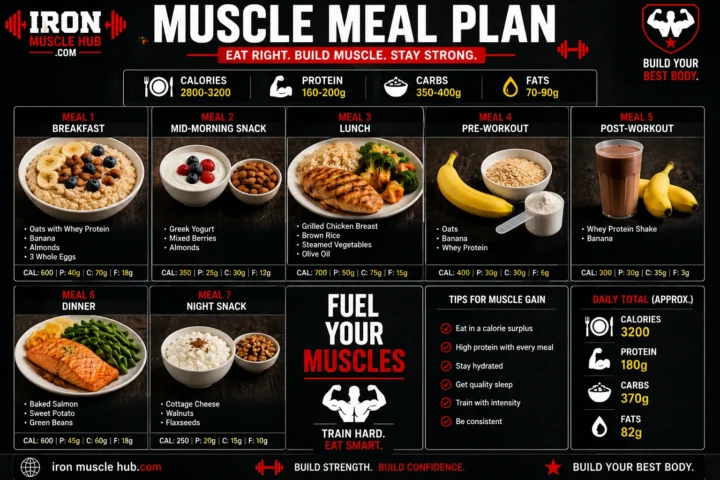
Good options include:
- Chicken
- Turkey
- Eggs
- Greek yogurt
- Cottage cheese
- Fish
- Lean beef
- Milk
- Lentils
- Beans
- Tofu
- Soy foods
Mayo Clinic also emphasizes that protein-rich foods can be part of a healthy weight-loss diet and that protein shakes aren’t a magic solution for fat loss.
3. Build Your Training Around Resistance Exercise
If your goal is to reduce body fat and gain muscle, resistance training should be the foundation of your exercise plan.
Walking, cycling and other cardiovascular activities can be useful for health and increasing energy expenditure. But lifting gives your body a direct reason to maintain and develop muscle.
Mayo Clinic recommends strength training for all major muscle groups at least twice weekly for general fitness.
Research also consistently supports resistance training as an effective stimulus for muscle growth. A large 2023 systematic review and network meta-analysis found that resistance-training prescriptions were superior to no resistance training for both strength and hypertrophy.
A simple beginner schedule
You don’t need six gym days.
Try three full-body sessions:
Monday — Full Body A
- Squat or leg press
- Bench press or push-up
- Seated row
- Romanian deadlift
- Lateral raise
- Plank
Wednesday — Full Body B
- Split squat
- Lat pulldown
- Dumbbell bench press
- Hip thrust
- Cable or dumbbell curl
- Triceps pressdown
Friday — Full Body A
Repeat the first session while attempting to improve technique or performance.
The following week, you could begin with B.
The exercises themselves aren’t magical.
The key is that you’re consistently training the major movement patterns and gradually giving your muscles a reason to adapt.
4. Focus on Progressive Overload
A common beginner mistake is simply repeating the same workout forever.
Your muscles need an adequate training stimulus.
Progressive overload doesn’t mean adding weight every single workout.
Progress can mean:
- More repetitions with the same weight
- More weight with the same repetitions
- Better technique
- Greater range of motion
- More controlled repetitions
- More productive sets
- Better consistency
For example, if you perform dumbbell presses with 20 kg / 44 lb in each hand for 8 repetitions, your next target might be 9 repetitions with the same weight.
Once you can comfortably reach the top of your planned repetition range with good technique, you can increase the load.
That’s much more useful than randomly changing exercises every week.
A 2026 meta-regression of resistance-training dose-response research also examined the relationship between weekly training volume, frequency, strength and hypertrophy, reinforcing the importance of structured training rather than simply exercising more.
5. Don’t Turn Every Workout Into Cardio
Cardio can help you increase fitness and energy expenditure.
The problem starts when cardio becomes so demanding that it interferes with your lifting and recovery.
You don’t need to destroy yourself with daily HIIT sessions to lose fat.
For beginners, a combination of:
- Resistance training
- Walking
- Some moderate cardiovascular exercise
- Normal daily activity
can be much easier to maintain.
Mayo Clinic recommends regular aerobic activity alongside strength training as part of a complete fitness routine.
Think of cardio as a tool.
It shouldn’t automatically become the centerpiece of a muscle-building plan.
6. Use This Body-Recomposition Comparison Table
| Approach | Main Goal | Calories | Resistance Training | Expected Scale Change | Best Use |
|---|---|---|---|---|---|
| Fat-loss phase | Reduce fat | Deficit | High priority | Usually down | Fat loss is the main goal |
| Muscle-gain phase | Add muscle | Usually maintenance/surplus | High priority | Often up | Muscle gain is the main goal |
| Body recomposition | Lose fat + maintain/gain muscle | Small deficit or near maintenance | High priority | May change slowly | Beginners and suitable intermediate lifters |
| Crash diet | Rapid weight loss | Large deficit | Often poorly supported | Rapidly down | Not recommended |
| Cardio-only plan | Increase energy expenditure | Variable | Low/none | Variable | General fitness, not ideal for maximizing muscle |
The key difference is what you’re prioritizing.
If your only goal is to lose weight as quickly as reasonably possible, body recomposition may not be the fastest approach.
If your goal is to look leaner while becoming stronger and more muscular, recomp can make sense.
7. Train Each Major Muscle Group Consistently
You don’t need to follow one specific split.
Full body, upper/lower and other schedules can all work.
The important part is that your weekly training is organized and sustainable.
A 2019 systematic review and meta-analysis found that when training volume is equated, resistance-training frequency itself does not appear to have a meaningful effect on hypertrophy. In other words, you don’t have to train a muscle on a specific number of days simply because someone online says it’s optimal.
For a beginner, training each major muscle group around two times per week can be an easy structure because it distributes the workload across several sessions.
You can also adjust based on your schedule.
Example three-day structure
Monday: Full body
Wednesday: Full body
Friday: Full body
Example four-day structure
Monday: Upper body
Tuesday: Lower body
Thursday: Upper body
Friday: Lower body
Choose the schedule you’ll actually follow.
Consistency beats the perfect program you abandon after two weeks.
8. Don’t Let Your Diet Become Too Restrictive
A good fat-loss diet still needs to provide enough nutrition to support training.
Build meals around:
Protein: chicken, fish, eggs, dairy, beans, lentils, tofu
Carbohydrates: potatoes, rice, oats, whole grains, fruit
Vegetables: leafy greens, peppers, carrots, broccoli and other vegetables
Healthy fats: nuts, seeds, olive oil, avocado and oily fish
You don’t need to eliminate carbohydrates.
You don’t need to eliminate dietary fat.
And you don’t need to live on salads.
The goal is to create a diet you can repeat for months without feeling like every meal is punishment.
Mayo Clinic similarly recommends a balanced diet containing fruits, vegetables, whole grains and protein-rich foods rather than relying on protein products alone.
9. What About Protein Timing?
Total daily protein is more important than trying to find a magical five-minute window after your workout.
Research in resistance-trained adults undergoing energy restriction found that the distribution of protein across meals did not significantly change body-composition outcomes when total protein intake was controlled.
That doesn’t mean meal timing is irrelevant.
It simply means you shouldn’t worry about it before you’ve handled the basics.
A practical approach is to include a protein source in your main meals.
For example:
Breakfast: Eggs + Greek yogurt
Lunch: Chicken + rice + vegetables
Snack: Milk + fruit
Dinner: Fish + potatoes + vegetables
That’s far more useful than worrying about whether your post-workout shake was consumed at exactly 17 or 27 minutes.
10. Common Mistakes → Why → Fix
Mistake 1: Cutting calories too aggressively
Why: A large energy deficit can make resistance-training progress and lean-mass retention harder.
Fix: Use a modest deficit and monitor your waist, body weight, strength and recovery. Evidence suggests avoiding prolonged deficits above roughly 500 kcal/day when lean-mass preservation is important.
Mistake 2: Doing lots of cardio but barely lifting
Why: Cardio increases activity, but it doesn’t replace the muscle-building stimulus of resistance training.
Fix: Make resistance training the foundation and add cardio around it.
Mistake 3: Eating very little protein
Why: A calorie deficit already creates a challenging environment for maintaining lean tissue.
Fix: Use a practical protein target based on body weight. ACSM lists approximately 1.2–1.7 g/kg/day for people regularly training.
Mistake 4: Changing workouts every week
Why: You lose the ability to measure whether you’re actually progressing.
Fix: Keep your core exercises long enough to improve them.
Mistake 5: Judging everything by scale weight
Why: Body recomposition can produce relatively small changes in total body weight even while body composition improves.
Fix: Track several measurements.
Use:
- Weekly average body weight
- Waist circumference
- Progress photos
- Gym performance
- Clothing fit
Mistake 6: Expecting fast muscle growth while dieting
Why: Muscle gain is generally slower when you’re trying to lose fat at the same time.
Fix: Set a longer time horizon and judge trends rather than individual days.
11. Your 30-Second Body-Recomposition Self-Test
Before changing your diet, ask yourself these five questions:
- Am I resistance training consistently?
- Am I eating enough protein?
- Am I using a modest rather than extreme calorie deficit?
- Is my waist measurement trending down over time?
- Am I maintaining or improving my gym performance?
The decision rule
If waist is decreasing + strength is stable/improving, stay the course.
If waist isn’t changing + body weight isn’t changing for several weeks + adherence is good, review your calorie intake and daily activity.
If strength, recovery and energy are falling rapidly, your deficit or overall workload may be too demanding.
This is a decision framework, not a medical diagnostic test.
12. Worked Example: 75 kg / 165 lb Beginner
Let’s make the process practical.
Imagine a beginner who weighs:
75 kg / 165 lb
Their estimated maintenance intake is:
2,400 calories/day
They choose a starting intake of:
2,100 calories/day
That’s a 300-calorie daily reduction.
For protein, using the ACSM range of 1.2–1.7 g/kg:
- 75 × 1.2 = 90 g
- 75 × 1.7 = 127.5 g
So their general protein range is approximately:
90–128 g/day
They choose a practical target of around 120 g/day.
Their training schedule:
- Monday: Full body
- Wednesday: Full body
- Friday: Full body
They also add regular walking and keep daily activity reasonably consistent.
Now imagine that after several weeks:
- Body weight has changed only modestly.
- Waist circumference is lower.
- Their squat has improved.
- Their pressing strength has improved.
- Their clothes fit better.
That can represent meaningful progress even if the scale isn’t dropping rapidly.
The goal isn’t to win a competition against the bathroom scale.
The goal is to improve your body composition while maintaining performance.
13. How to Track Progress Correctly
Body weight naturally moves up and down because of food, water, sodium, glycogen and other factors.
Don’t panic because Tuesday’s number is higher than Monday’s.
Instead, collect consistent measurements.
Body weight
If you weigh yourself, use similar conditions each time.
For example:
- Morning
- After using the bathroom
- Before breakfast
- Similar clothing
Then look at the trend rather than one reading.
Waist measurement
Measure around the same location each time.
Use either:
- Centimetres (cm), or
- Inches (in)
For example, you might record:
Week 1: 92 cm / 36.2 in
Week 4: 89 cm / 35.0 in
That change can be meaningful even if your body weight has barely moved.
Strength
Record your exercises, sets, repetitions and loads.
If you can perform more quality repetitions or use more weight over time, that’s useful evidence that your training is working.
14. Sleep and Recovery Matter
Muscle isn’t built during the set itself.
Training provides the stimulus.
Recovery allows your body to adapt.
That means you shouldn’t treat sleep as an optional extra.
Build a routine that gives you enough opportunity to sleep and recover between training sessions.
Also pay attention to:
- Persistent soreness
- Falling gym performance
- Low motivation
- Poor sleep
- Excessive fatigue
- Irritability
If these become persistent, don’t automatically respond by adding more training.
Sometimes the smarter move is to reduce unnecessary workload and improve recovery.
15. Who Is Body Recomposition NOT For?
Body recomposition isn’t the perfect strategy for everyone.
It may be a poor fit if:
You want maximum fat loss speed
If your only priority is reducing body fat as quickly as reasonably possible, a dedicated fat-loss phase may make more sense.
You’re already very lean and highly trained
The more advanced you become, the harder it generally is to add meaningful muscle while simultaneously reducing calories.
You hate slow progress
Recomposition can be difficult psychologically because your scale weight may not change much.
If you need the scale to move quickly to stay motivated, a clearly defined goal may be easier to manage.
You’re using extreme dieting methods
That’s not the approach recommended here.
If a plan requires severe restriction, dehydration, dangerous exercise volumes or unapproved substances, it’s not a beginner body-recomposition strategy.
16. Do You Need Supplements?
No.
Supplements can be convenient, but they’re not the foundation.
Protein powder is simply a convenient way to consume protein.
Creatine is another widely studied sports supplement, but you don’t need supplements to begin improving your body composition.
Start with:
- Calories
- Protein
- Resistance training
- Daily activity
- Sleep
- Consistency
Then decide whether you actually need anything else.
Mayo Clinic specifically cautions against relying on supplements marketed as metabolism boosters for weight loss.
17. What About Cardio for Fat Loss?
Cardio can absolutely be part of your plan.
Walking is particularly easy to add without creating a huge recovery burden.
Other options include:
- Cycling
- Swimming
- Jogging
- Rowing
- Hiking
- Sports
The mistake is thinking you need increasingly brutal cardio sessions whenever fat loss slows.
Instead, make your overall activity consistent.
If you currently sit most of the day, simply becoming more active can be useful.
Mayo Clinic recommends regular aerobic activity alongside strength training as part of a complete exercise program.
18. A Simple 12-Week Beginner Framework
You don’t need to redesign your program every Monday.
Weeks 1–4: Establish the routine
Focus on:
- Three resistance sessions each week
- Consistent protein intake
- A modest calorie deficit
- Regular walking
- Recording workouts
- Establishing consistent sleep
Don’t chase exhaustion.
Learn the movements.
Weeks 5–8: Build performance
Now focus on gradual progression.
Try to improve:
- Repetitions
- Load
- Technique
- Range of motion
Keep nutrition consistent.
Look at your waist and weight trends.
Weeks 9–12: Review
Ask:
- Is my waist smaller?
- Is my strength stable or improving?
- Has my body weight changed?
- Are my clothes fitting differently?
- Am I recovering well?
If several markers are improving, there’s no reason to constantly change the plan.
FAQ: Real People Also Ask Questions
Can you lose belly fat and gain muscle at the same time?
Yes, overall body fat can decrease while muscle increases, but you cannot choose exactly where your body removes fat first. Your genetics, sex, age and individual fat distribution influence where fat is stored and lost. The practical strategy is to reduce overall body fat through nutrition and activity while using resistance training and adequate protein to support muscle. Avoid programs promising spot reduction from specific exercises.
What should I eat to lose fat and gain muscle?
Build most meals around a protein source, vegetables or fruit, a useful carbohydrate source and an appropriate amount of dietary fat. Chicken, eggs, fish, Greek yogurt, lean meat, beans, lentils and tofu can provide protein. Rice, potatoes, oats and whole grains can supply carbohydrates for training. You don’t need to eliminate carbohydrates or follow an extreme diet to improve body composition.
How much protein do I need to gain muscle while losing fat?
ACSM gives people who regularly train a general range of approximately 1.2–1.7 g/kg/day, or about 0.5–0.8 g/lb/day. For a 75 kg (165 lb) person, that’s approximately 90–128 g per day. Research also indicates that increasing protein beyond around 1.6 g/kg/day does not necessarily produce additional resistance-training gains in fat-free mass for healthy adults.
Should I bulk or cut first?
It depends on your starting point and primary goal. If you’re a beginner carrying noticeable body fat, body recomposition can be a sensible option because you can prioritize strength training while eating around maintenance or in a modest deficit. If you’re already lean and highly trained, gaining substantial muscle while losing fat becomes more difficult. Your training history, body composition and goal should determine the strategy rather than a universal bulk-or-cut rule.
How often should I lift weights to lose fat and gain muscle?
For beginners, three full-body resistance sessions per week can be an effective and manageable starting point. Mayo Clinic recommends strength training all major muscle groups at least twice weekly for general health and fitness. Research also suggests that when total training volume is controlled, frequency itself isn’t the main determinant of muscle growth. Choose a schedule that lets you train consistently and recover properly.
A Beginner’s Body-Recomposition Checklist
Before you start, save this checklist:
Nutrition
- Use a modest calorie deficit if fat loss is the priority
- Avoid prolonged aggressive restriction
- Eat enough protein
- Build meals around mostly nutrient-dense foods
- Keep carbohydrates and fats in your diet
Training
- Resistance train consistently
- Train all major muscle groups
- Record your workouts
- Gradually improve performance
- Don’t add endless cardio
Recovery
- Prioritize sleep
- Allow recovery between hard sessions
- Monitor fatigue
- Don’t train through persistent pain
Progress
- Track body weight trends
- Measure your waist
- Take progress photos
- Track strength
- Judge progress over weeks, not days
How to Reduce Body Fat and Gain Muscle: The Bottom Line
If your goal is to reduce body fat and gain muscle, don’t make the plan unnecessarily complicated. Start with resistance training, adequate protein, a manageable calorie deficit and consistent daily activity. Then give your body enough time to respond.
For beginners, body recomposition can be a realistic goal, especially when training quality improves at the same time as nutrition becomes more consistent. Research supports resistance training for improving muscle and preserving lean mass during weight loss, while adequate protein can support better body-composition outcomes.
Your scale weight doesn’t have to crash for the plan to work. If your waist is getting smaller, your strength is holding steady or improving, and your habits are becoming more consistent, you’re moving in the right direction.
Final Thoughts
If your goal is to reduce body fat and gain muscle, don’t chase a perfect diet or an exhausting workout plan. Focus on the fundamentals: progressive resistance training, adequate protein, a sensible calorie deficit, regular activity, and consistent recovery.
Current evidence supports resistance training during weight loss because it can help preserve fat-free mass while improving fat loss and strength.
For beginners, the biggest advantage is consistency. You don’t need to transform your body in a few weeks. Give yourself enough time to build strength, improve your eating habits, and let your body composition change gradually.