Yes, beginners can often build muscle while losing body fat at the same time. This approach is commonly called body recomposition. It works best when you combine progressive resistance training, adequate protein, sensible calorie control, and enough recovery.
- Quick AnswerQuick Answer
- muscle gain fat loss
- muscle gain fat lossmuscle gain fat loss
- The 5-Part Muscle Gain Fat Loss Formula
- 1. muscle gain fat loss
- A Simple Beginner Workout
- What Does Progressive Overload Mean?
- Protein for Muscle Gain Fat Loss
- Worked Protein Example
- Easy Ways to Reach Your Target
- How Many Calories Should You Eat?
- A Simple Decision Rule
- Muscle Gain Fat Loss: Bulk, Cut, or Recomp?
- Who Is This NOT For?
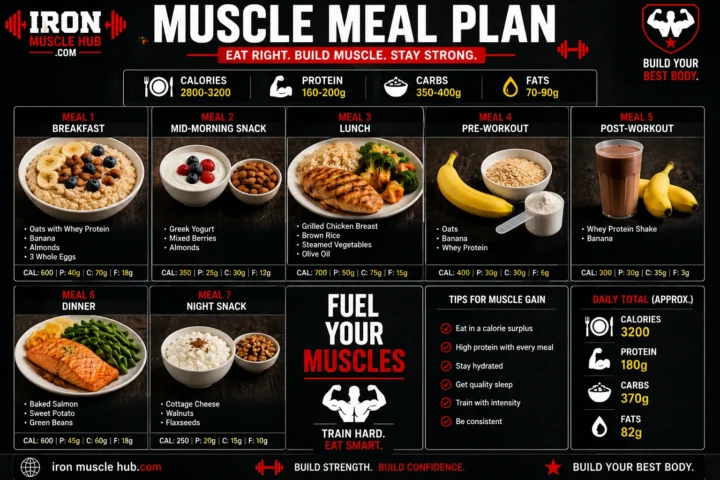
- What Should Your Meals Look Like?
- Don't Fear Carbohydrates
- Don't Make Dietary Variety Too Small
- Cardio for Muscle Gain Fat Loss
- Recovery Matters More Than Beginners Think
- Mistake 1: Cutting Calories Too Hard
- Mistake 2: Doing Lots of Cardio but Little Strength Training
- Mistake 3: Eating "Healthy" but Not Enough Protein
- Mistake 4: Changing Your Program Every Week
- Mistake 5: Judging Everything by the Scale
- Mistake 6: Training to Failure on Every Set
- Mistake 7: Expecting Visible Results in Two Weeks
- A Beginner 4-Week Muscle Gain Fat Loss Plan
- Monday — Full Body A
- Tuesday — Activity
- Wednesday — Full Body B
- Thursday — Recovery
- Friday — Full Body A
- Saturday — Optional Cardio
- Sunday — Rest
- How to Track Your Progress
- 1. Body Weight
- 2. Waist Measurement
- 3. Strength
- 4. Progress Photos
- Can you build muscle and lose fat at the same time?
- How much protein should I eat for muscle gain and fat loss?
- Should I bulk or cut as a beginner?
- How big should my calorie deficit be to lose fat without losing muscle?
- How long does body recomposition take?
- Your Simple Muscle Gain Fat Loss Checklist
- The Bottom Line
- Final Thoughts
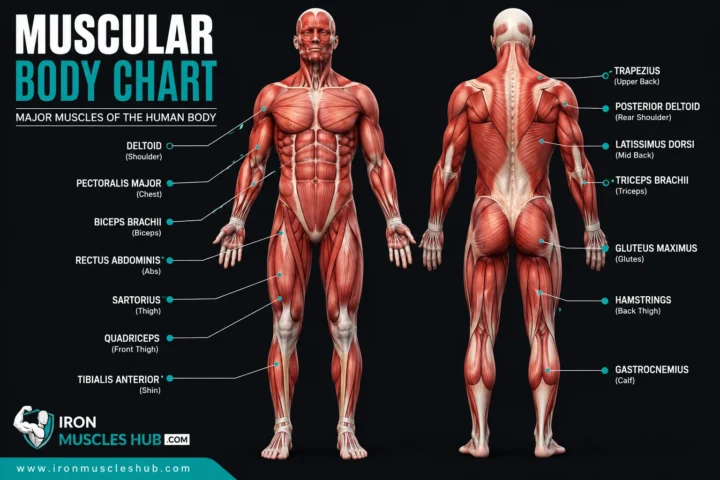
The goal isn’t to make the scale fall as quickly as possible. You want your waist measurement and body-fat level to trend down while your strength, muscle size, or training performance improves. Research supports resistance training during weight loss because it helps protect lean mass and can improve strength. For more insights read here :- muscle chart and human muscle chart .
Quick AnswerQuick Answer
- Train with weights consistently. Resistance training is the foundation for keeping or building muscle while losing fat.
- Eat enough protein. Around 1.6 g/kg/day is a useful evidence-based reference point for many adults doing resistance training; more isn’t automatically better.
- Use a modest calorie deficit if fat loss is the priority. Avoid aggressive dieting that makes training and recovery worse.
- Track more than body weight. Use your waist, progress photos, gym performance, and body weight together.
- Give it time. Body recomposition is normally a weeks-to-months process, not a two-week transformation.
muscle gain fat loss
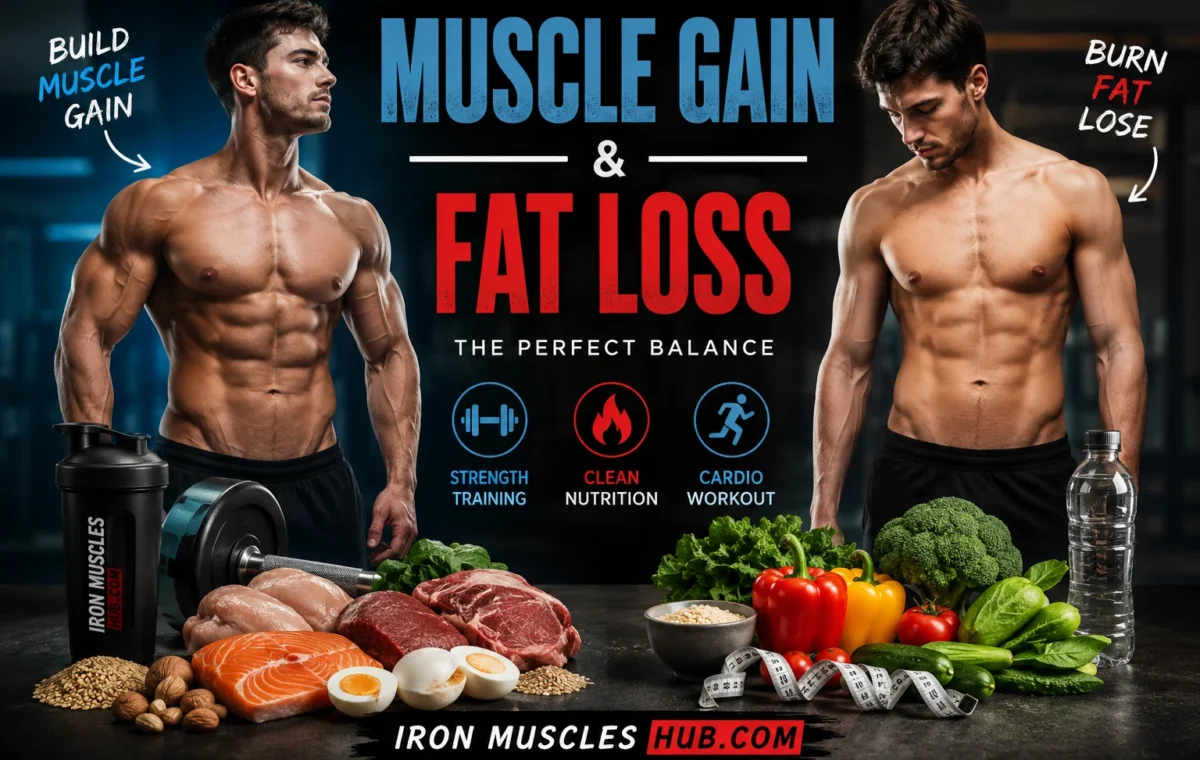
Muscle gain fat loss means improving body composition by increasing or maintaining lean muscle while reducing body fat. You don’t necessarily need your body weight to change dramatically.
Imagine a beginner who weighs 80 kg (176 lb). After several months of consistent training and nutrition, that person might still weigh close to 80 kg while having a smaller waist, more muscle definition, and better strength.
That’s why body recomposition is different from simply trying to lose weight.
Your scale measures total body mass. It doesn’t tell you whether a change came from fat, muscle, water, glycogen, food in your digestive system, or other tissues.
A recent systematic review and meta-analysis found that adding resistance exercise to dietary weight loss helped protect fat-free mass, increased fat loss, and improved strength compared with diet-only approaches in people with overweight or obesity.
Mayo Clinic also identifies strength training as a useful tool for improving body composition, managing weight, and increasing or maintaining muscle mass.
muscle gain fat lossmuscle gain fat loss
Yes, but your starting point matters.
Beginners have a particularly useful advantage because their bodies can respond strongly to a new resistance-training stimulus. People returning to training after a long break may also have a good opportunity to regain previously developed muscle.
People carrying more body fat may also have more flexibility with energy availability than already-lean, highly trained lifters.
That doesn’t mean an experienced bodybuilder can expect rapid muscle growth while dieting hard. The more advanced you become, the more difficult simultaneous muscle gain and fat loss generally becomes.
For a beginner, however, there’s usually no need to rush into an aggressive bulk-and-cut cycle.
Start by building the habits that support both goals.
The 5-Part Muscle Gain Fat Loss Formula
A successful beginner recomp usually comes down to five pieces:
- Progressive resistance training
- Adequate protein
- A sensible calorie target
- Enough daily movement and cardiovascular activity
- Recovery and consistency
Miss one occasionally and you’ll still make progress.
Ignore several of them for months and results become much harder to predict.
1. muscle gain fat loss
If your goal is muscle gain fat loss, don’t build your entire plan around cardio.
Cardio is useful for cardiovascular fitness, health, and increasing activity. But resistance training provides the specific stimulus your muscles need to adapt.
A large 2026 ACSM overview of reviews examined more than 30,000 participants and found that resistance training improves muscle strength and hypertrophy compared with no exercise.
Mayo Clinic recommends strength training for all major muscle groups at least twice per week for healthy adults.
For a beginner, a practical starting point is:
| Training approach | Beginner target |
|---|---|
| Full-body resistance training | 2–4 sessions/week |
| Major muscle groups | At least 2 times/week |
| Cardio | Add according to fitness and goals |
| Walking/daily activity | Increase gradually |
| Rest | At least some easier days each week |
You don’t need seven gym sessions.
Three well-planned full-body workouts can be more useful than six rushed sessions that you can’t recover from.
A Simple Beginner Workout
You could structure a full-body session around:
- Squat or leg press
- Romanian deadlift or hip hinge
- Bench press or push-up
- Row or pulldown
- Shoulder press
- Optional biceps, triceps, calves, or core work
Start with manageable weights.
Your first objective isn’t to prove how much you can lift. It’s to learn technique, establish consistency, and gradually improve.
What Does Progressive Overload Mean?
Progressive overload means gradually giving your body a reason to adapt.
That can mean:
- Adding a small amount of weight.
- Performing another repetition.
- Adding a set when appropriate.
- Improving technique.
- Increasing your range of motion.
- Making the same workload easier and more controlled.
You don’t need to increase weight every workout.
If you perform 3 sets of 8 repetitions with good technique this week, you might aim for 9 repetitions next time rather than immediately adding 10 kg (22 lb).
Research shows that different resistance-training loads can produce muscle growth, while heavier loads have an advantage for maximal strength.
So don’t become obsessed with one magic rep range.
Protein for Muscle Gain Fat Loss
Protein is one of the most important nutrition variables for body recomposition.
A major systematic review and meta-analysis of 49 studies involving 1,863 participants found that protein supplementation improved gains in strength and fat-free mass during prolonged resistance training. Its analysis found no additional fat-free-mass benefit beyond approximately 1.62 g/kg/day of total protein intake.
For practical purposes, around 1.6 g/kg/day is a useful target for many beginners.
Worked Protein Example
Suppose you weigh:
80 kg = 176 lb
At approximately 1.6 g/kg, your daily protein target would be:
80 × 1.6 = 128 g protein/day
So a reasonable starting target could be around 125–130 g per day.
You don’t have to hit exactly 128 g every day.
Think in terms of a consistent daily range rather than treating one gram as a pass-or-fail test.
Easy Ways to Reach Your Target
A simple four-meal structure might look like:
| Meal | Example protein |
| Breakfast | Eggs + Greek yogurt |
| Lunch | Chicken, rice and vegetables |
| Snack | Cottage cheese or yogurt |
| Dinner | Fish, lean beef, chicken or beans |
| Daily total | Adjust portions to your target |
Protein powder can be convenient, but it isn’t required.
You can reach a high-protein diet through ordinary foods such as:
- Eggs
- Chicken
- Turkey
- Fish
- Lean beef
- Greek yogurt
- Cottage cheese
- Milk
- Lentils
- Beans
- Tofu
- Soy foods
The important point is your overall daily intake, not finding a special supplement.
How Many Calories Should You Eat?
This is where muscle gain fat loss becomes more individual.
Muscle growth is supported by adequate energy, while reducing body fat generally requires an energy deficit over time.
You don’t need to solve this perfectly on day one.
If you’re a beginner with significant fat to lose, a small calorie deficit combined with resistance training and adequate protein can be a sensible starting strategy.
Avoid crash diets.
A meta-analysis examining energy deficiency during resistance training found that prolonged energy deficiency can impair lean-mass gains and concluded that people trying to preserve lean mass during weight loss should avoid deficits greater than 500 kcal/day.
That doesn’t mean everyone should automatically use a 500 kcal deficit.
It means that bigger isn’t necessarily better.
A Simple Decision Rule
Use this 30-second check:
If your waist is gradually decreasing, your gym performance is stable or improving, and you’re recovering reasonably well → keep going.
If your weight is falling rapidly, strength is dropping across several sessions, hunger is extreme, and recovery is poor → your deficit may be too aggressive.
If your waist and body weight haven’t changed for several weeks and fat loss is your priority → review portions, tracking accuracy, and daily activity before making a small adjustment.
This is more useful than changing calories every few days.
Muscle Gain Fat Loss: Bulk, Cut, or Recomp?
This is one of the biggest decisions beginners face.
| Situation | Usually sensible starting approach |
| New to lifting + wants less fat | Recomp or modest fat-loss phase |
| Returning after a long training break | Recomp can work well |
| Higher body-fat level + wants more muscle | Recomp or gradual fat loss |
| Already lean + experienced lifter | Separate muscle-gain and fat-loss phases may work better |
| Mainly wants to get stronger | Maintenance or a small surplus may be useful |
| Mainly wants to reduce waist size | Modest calorie deficit |
There isn’t one correct strategy for every person.
Body recomposition is particularly attractive for beginners because you can focus on building your training foundation rather than constantly switching between bulking and cutting.
Healthline’s review of body recomposition similarly describes the approach as combining strength training and higher protein intake while focusing on body composition rather than scale weight alone.
Who Is This NOT For?
A recomp approach may not be the best choice if:
- You’re already very lean and highly trained.
- You need rapid weight loss for a medically supervised reason.
- You’re preparing for a competitive bodybuilding event.
- You have a history of disordered eating and calorie tracking makes symptoms worse.
- You have a medical condition requiring a specific diet or exercise plan.
In those cases, a qualified healthcare professional or appropriately credentialed sports professional should help determine the safest approach.
What Should Your Meals Look Like?
You don’t need a complicated bodybuilding meal plan.
Build most meals around four components:
Protein + vegetables or fruit + carbohydrate + healthy fat
For example:
Breakfast: Eggs, whole-grain toast, fruit and Greek yogurt.
Lunch: Chicken, rice, mixed vegetables and olive oil.
Snack: Greek yogurt, berries and nuts.
Dinner: Fish or lean beef, potatoes and vegetables.
This gives you protein, carbohydrates for training, fats for dietary needs, and plenty of nutrient-dense foods.
Don’t Fear Carbohydrates
Carbohydrates can support training performance.
If you’re lifting several times per week, completely eliminating carbohydrates isn’t necessary for fat loss.
Rice, potatoes, oats, fruit, whole-grain bread and pasta can all fit into a body-recomposition diet.
The key is the total amount you eat and whether your overall intake supports your goal.
Don’t Make Dietary Variety Too Small
A common beginner mistake is eating the same three foods every day because they’re considered “clean.”
You don’t need an extremely restrictive diet.
A wider selection of protein sources, vegetables, fruits, whole grains and other nutrient-rich foods can make the diet easier to maintain.
Cardio for Muscle Gain Fat Loss
You don’t have to choose between lifting and cardio.
The trick is using cardio as a supplement rather than allowing it to interfere with your resistance training.
Mayo Clinic recommends at least 150 minutes of moderate aerobic activity per week or 75 minutes of vigorous activity for most healthy adults, alongside muscle-strengthening work at least twice weekly.
Those are general health guidelines, not a mandatory body-recomposition prescription.
For a beginner, start where you are.
If you currently do almost no cardio, adding several hours overnight isn’t necessary.
Try:
- More walking
- Short cycling sessions
- Brisk walks
- Easy incline treadmill sessions
- Recreational sports
Then adjust based on recovery and your main goal.
If your legs are constantly exhausted and your squat performance is falling, adding even more cardio probably isn’t the answer.
Recovery Matters More Than Beginners Think
Training creates the stimulus.
Recovery gives your body the opportunity to adapt.
That means you need enough sleep, food, rest, and manageable training stress.
You don’t need to be perfect.
But consistently sleeping poorly while dieting aggressively and training hard is a poor combination.
Research on resistance exercise and sleep suggests that chronic resistance training can improve several aspects of sleep, while inadequate sleep is an important consideration for resistance-training performance and recovery.
Build a routine you can repeat.
For many beginners, that means:
- Consistent bedtime and wake time
- Regular meals
- Two to four resistance sessions per week
- Daily movement
- Rest days
- Reasonable training volume
The best plan isn’t the one that looks hardest on paper.
It’s the one you can execute for months.
Common Mistakes → Why → Fix
Mistake 1: Cutting Calories Too Hard
Why: A large energy deficit can make training harder and may reduce your ability to gain or preserve lean mass.
Fix: Use a modest deficit when fat loss is the priority. Monitor your strength, recovery, hunger, and waist measurement.
Mistake 2: Doing Lots of Cardio but Little Strength Training
Why: Cardio can help fitness and energy expenditure, but it doesn’t replace the muscle-building stimulus of resistance training.
Fix: Make resistance training the foundation and use cardio to support overall fitness and activity.
Mistake 3: Eating “Healthy” but Not Enough Protein
Why: A diet can contain nutritious foods while still providing too little protein to support your training goal.
Fix: Include a meaningful protein source at each main meal and check your approximate daily intake.
Mistake 4: Changing Your Program Every Week
Why: Constantly switching exercises makes it difficult to know whether you’re actually progressing.
Fix: Keep your main movements consistent for several weeks and record your repetitions, sets and loads.
Mistake 5: Judging Everything by the Scale
Why: Body weight doesn’t distinguish between fat and lean tissue.
Fix: Track at least three measures: body weight trend, waist measurement, and gym performance.
Mistake 6: Training to Failure on Every Set
Why: Taking every set to absolute failure can create unnecessary fatigue, especially for beginners.
Fix: Most working sets can be challenging without requiring an all-out final repetition every time. Focus on controlled technique and progressive performance.
Evidence doesn’t show that every resistance-training set needs to reach failure to produce muscle growth.
Mistake 7: Expecting Visible Results in Two Weeks
Why: Early changes in body weight can come from water, glycogen, food volume and other factors rather than meaningful changes in muscle or fat.
Fix: Think in terms of months, not days. Use multiple progress measures.
A Beginner 4-Week Muscle Gain Fat Loss Plan
Here’s a simple starting framework.
Monday — Full Body A
- Squat: 3 sets
- Bench press or push-ups: 3 sets
- Row: 3 sets
- Romanian deadlift: 2–3 sets
- Optional core: 2 sets
Tuesday — Activity
- Walking or easy cardio
- Normal daily movement
- Recovery
Wednesday — Full Body B
- Leg press or squat variation: 3 sets
- Overhead press: 3 sets
- Lat pulldown: 3 sets
- Hip hinge: 2–3 sets
- Optional arms: 2 sets
Thursday — Recovery
Easy walking and normal activity.
Friday — Full Body A
Repeat Monday’s basic movements and try to improve a repetition, technique, or small amount of load where appropriate.
Saturday — Optional Cardio
Choose an activity you enjoy.
Sunday — Rest
Use the day to recover and prepare for the next week.
You don’t need this exact routine.
The important principles are consistent resistance training, progressive improvement, sufficient protein, sensible calorie control, and recovery.
How to Track Your Progress
Use a simple system.
1. Body Weight
Weigh yourself under similar conditions when possible.
Instead of reacting to one reading, look at the trend over multiple readings.
A single morning can be misleading.
2. Waist Measurement
Measure around the same location under similar conditions.
Your waist can provide useful information when the scale is relatively stable.
3. Strength
Record major lifts.
For example:
| Exercise | Week 1 | Week 4 |
| Squat | 50 kg / 110 lb × 8 | 55 kg / 121 lb × 8 |
| Bench press | 40 kg / 88 lb × 8 | 45 kg / 99 lb × 8 |
| Row | 45 kg / 99 lb × 10 | 50 kg / 110 lb × 10 |
These numbers are illustrative examples, not guaranteed beginner progress.
If your waist is trending down while your training performance is stable or improving, that’s a strong sign that your approach is working.
4. Progress Photos
Take photos under similar lighting, distance, clothing, and posture.
Don’t take one photo every day and obsess over tiny changes.
Compare several weeks apart.
FAQ: Muscle Gain Fat Loss
Can you build muscle and lose fat at the same time?
Yes. This is generally called body recomposition. It tends to be more achievable for beginners, people returning to resistance training, and people with more body fat to lose. Resistance training and adequate protein are central because they provide a muscle-building stimulus while helping preserve lean tissue during fat loss.
How much protein should I eat for muscle gain and fat loss?
A practical evidence-based reference point for many adults doing resistance training is around 1.6 g/kg/day. For someone weighing 80 kg (176 lb), that’s about 128 g of protein daily. The research doesn’t show that continually pushing protein higher automatically produces more muscle growth, so more isn’t necessarily better.
Should I bulk or cut as a beginner?
You don’t automatically need to bulk. If you’re new to lifting and also want to reduce body fat, a recomp or modest fat-loss approach can make sense. Build a consistent resistance-training habit, eat enough protein, and use a manageable calorie target. If you’re already lean and experienced, separating muscle-gain and fat-loss phases may be more practical.
How big should my calorie deficit be to lose fat without losing muscle?
Avoid aggressive deficits. A 2021 meta-analysis found that prolonged energy deficiency can impair lean-mass gains during resistance training and suggested avoiding deficits above 500 kcal/day when the goal is lean-mass preservation during weight loss. Individual needs differ, so use your body-weight trend, waist, training performance and recovery to judge whether your approach is appropriate.
How long does body recomposition take?
There isn’t one reliable timeline. Beginners may notice changes in strength and measurements before major visual changes. Your starting body composition, training experience, nutrition, sleep, genetics and consistency all affect the pace. Think in terms of weeks to months, not a fixed number of days. A slow trend with improving performance is usually more useful than chasing dramatic short-term changes.
Your Simple Muscle Gain Fat Loss Checklist
If you’re starting from scratch, focus on these basics:
- Lift weights 2–4 times per week.
- Train all major muscle groups consistently.
- Record your exercises, sets, repetitions and loads.
- Aim for roughly 1.6 g/kg/day of protein as a practical starting reference.
- Use a modest calorie deficit if reducing body fat is the main goal.
- Keep carbohydrates and fats in your diet rather than unnecessarily eliminating food groups.
- Walk and perform cardio according to your fitness and recovery.
- Sleep consistently.
- Track your waist and strength alongside body weight.
- Don’t change your plan every few days.
- Give the process enough time to work.
The goal is not to make every day perfect.
The goal is to make enough good decisions often enough that your body composition gradually changes.
The Bottom Line
Muscle gain fat loss is possible, particularly for beginners, but it requires patience and a balanced approach. Resistance training should sit at the center of the plan because it gives your muscles a reason to adapt while helping preserve lean mass during weight loss. Protein supports that process, while a modest calorie deficit can help reduce body fat without turning your diet into a crash cut.
Track your waist, body-weight trend, photos and gym performance instead of relying on the scale alone. If you’re new to training, start simple, progress gradually, eat enough protein, recover properly, and give yourself several months to judge the result.
Final Thoughts
Muscle gain fat loss is less about finding a perfect diet and more about consistently executing the basics. Resistance training gives your muscles a reason to grow, adequate protein helps support lean tissue, and sensible calorie control helps move body fat in the direction you want. Current research continues to support combining resistance exercise with dietary weight loss to better preserve lean mass and improve strength.
If you’re a beginner, don’t worry about making your plan complicated. Train consistently, eat enough protein, keep your calorie deficit reasonable, stay active, recover well, and track your progress over time. Your waist, strength, photos, and body-weight trend together will tell you much more than the scale alone.
Body recomposition takes patience. Focus on building habits you can maintain for months, not chasing dramatic changes in a few weeks.