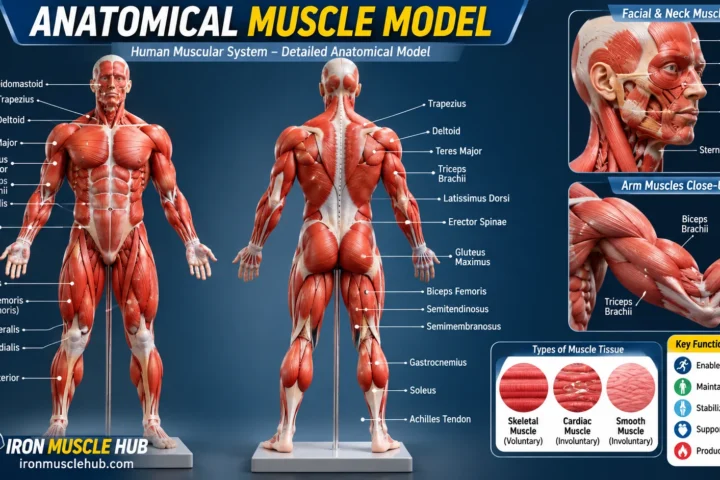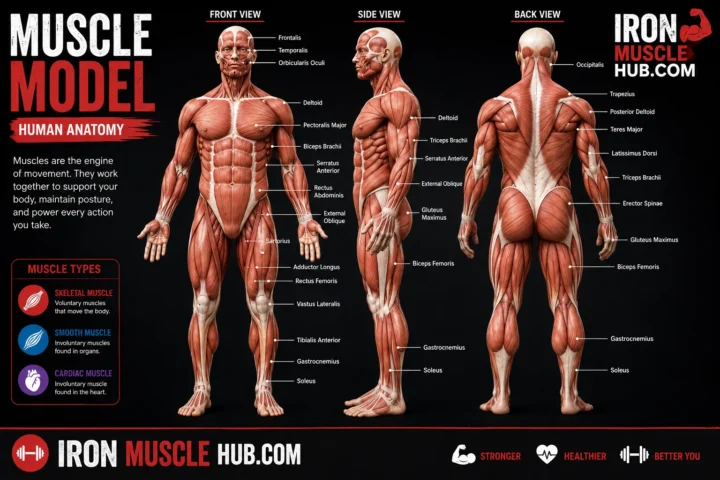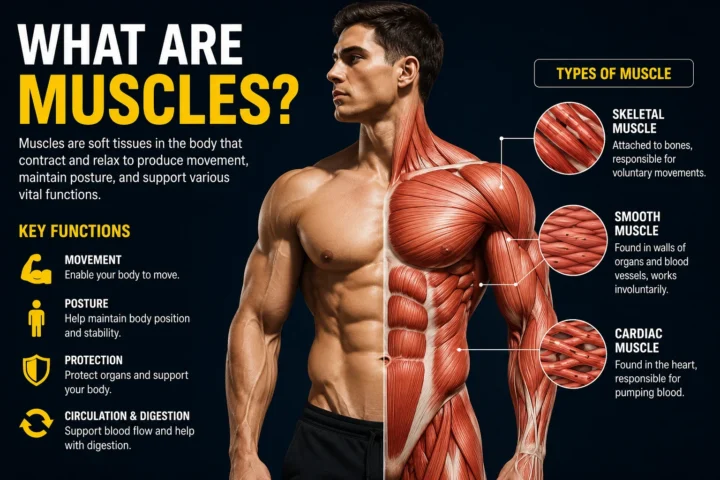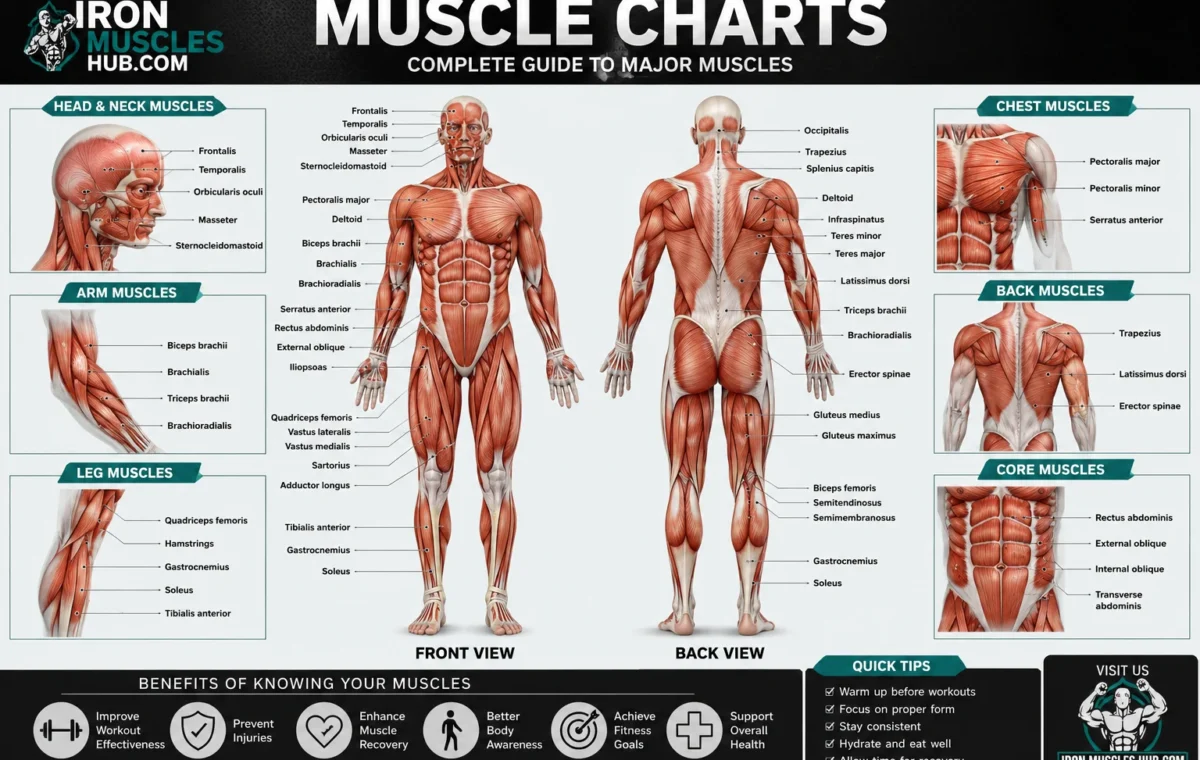
Muscle charts give you a simple visual map of the body so you can identify major muscles, understand their basic actions, and connect anatomy with exercises. You don’t need to memorize hundreds of muscles to start strength training. For most beginners, learning the major muscle groups—chest, back, shoulders, arms, core, glutes, thighs, and calves—is enough to understand a basic workout.
- Quick Answer: What Are Muscle Charts?
- What Are Muscle Charts Used For?
- Why Muscle Charts Help Beginners
- Major Muscle Groups on a Human Muscle Chart
- 1. Chest: Pectoral Muscles
- 2. Back: Lats, Traps and Rhomboids
- 3. Shoulders: The Deltoids
- 4. Arms: Biceps and Triceps
- 5. Core: Abs and Obliques
- 6. Glutes: Gluteus Maximus and Gluteus Medius
- 7. Thighs: Quadriceps, Hamstrings and Adductors
- 8. Calves and Lower Leg
- Front vs. Back Muscle Charts: Which Should You Use?
- A Simple Rule
- How to Read a Muscle Chart Step by Step
- Step 1: Learn the Body Region
- Step 2: Learn One or Two Important Muscles
- Step 3: Learn the Basic Movement
- Step 4: Match the Muscle to an Exercise
- Step 5: Test Yourself Without Looking
- Muscle Chart + Workout: How to Connect Anatomy to Training
- Worked Example: A 70 kg / 154 lb Beginner
- How Much Training Does Each Muscle Need?
- Common Mistakes → Why → Fix
- Mistake 1: Trying to Memorize Every Muscle
- Mistake 2: Assuming One Exercise Trains Only One Muscle
- Mistake 3: Training Only the Muscles You Can See in the Mirror
- Mistake 4: Adding More Exercises Because the Chart Has More Muscles
- Mistake 5: Treating a Muscle Chart as Medical Advice
- 30-Second Muscle Chart Self-Test
- Who Is This Muscle Chart Guide NOT For?
- How to Use Muscle Charts for a Balanced Workout
- 1. Pick a Push
- 2. Pick a Pull
- 3. Pick a Knee-Dominant Lower-Body Movement
- 4. Pick a Hip-Dominant Movement
- 5. Add Core or Calf Work if Needed
- Muscle Charts vs. Muscle Diagrams vs. Anatomy Charts
- How to Choose a Good Muscle Chart
- A Beginner Muscle Chart You Can Memorize
- Front
- Back
- FAQ: Common Questions About Muscle Charts
- What are the major muscle groups in the human body?
- What is the best way to learn muscles from a chart?
- How many muscles are in the human body?
- Should I use a front or back muscle chart?
- Can muscle charts help me build muscle?
- Final Takeaway
A good muscle chart can also help you spot gaps in your training. If you know where the quadriceps, hamstrings, glutes, lats, pectorals, deltoids, and triceps are located, exercise selection becomes much easier.
This guide shows you how to read muscle charts, which muscles matter most for beginners, what exercises train them, and how to use an anatomy chart without turning your workout into a biology exam. For more insights read here :- cardiac vs skeletal muscle and muscles of the body.
Quick Answer: What Are Muscle Charts?
- Muscle charts are visual diagrams that identify muscles by location, name, and sometimes function.
- A beginner should first learn the major muscle groups, rather than trying to memorize every individual muscle.
- Front and back views are useful because many important muscles, such as the lats, glutes, hamstrings, and trapezius, are easier to see from behind.
- You can use a muscle chart to connect muscle → movement → exercise, which makes workout planning easier.
- A chart is a learning tool, not a substitute for professional assessment if you have pain, an injury, or a medical condition.
What Are Muscle Charts Used For?
Muscle charts are mainly used to identify where muscles are located and understand their basic functions. For beginners, the most useful approach is to start with regional charts showing the chest, back, shoulders, arms, abdomen, hips, thighs, and lower legs.
An anatomy chart can become much more useful when you stop treating it as a list of names.
Instead, ask three questions:
- Where is the muscle?
- What movement does it help produce?
- Which exercises train that movement?
That gives you a practical way to learn anatomy.
Detailed anatomy resources often divide the body into regions such as the upper limb, lower limb, head and neck, and trunk. More advanced charts may also include muscle origins, insertions, innervation, and functions.
You don’t need that level of detail on your first day in the gym.
For a beginner, a chart showing major superficial muscles is usually enough.
Why Muscle Charts Help Beginners
Imagine you’re told to perform a lat pulldown.
If you’ve never studied anatomy, “train your back” can sound vague.
A muscle chart lets you see that the latissimus dorsi, commonly called the lats, occupies a large portion of the back. You can then connect the exercise with the general movement of pulling the upper arm toward the body.
The same idea applies throughout your workout:
- Push-ups → chest, triceps and shoulders
- Rows → back muscles and biceps
- Squats → quadriceps, glutes and other lower-body muscles
- Hip hinges → glutes, hamstrings and spinal erectors
- Calf raises → calf muscles
This isn’t a claim that an exercise isolates one muscle. Most resistance exercises involve several muscles working together.
Major Muscle Groups on a Human Muscle Chart
A useful beginner muscle chart can be divided into eight broad areas.
| Muscle group | Important muscles to recognize | Basic role | Beginner exercises |
|---|---|---|---|
| Chest | Pectoralis major | Pushing and moving the upper arm | Push-ups, bench press |
| Back | Latissimus dorsi, trapezius, rhomboids | Pulling and controlling the shoulder blades | Rows, pulldowns |
| Shoulders | Deltoids | Moving the arm in different directions | Overhead press, lateral raise |
| Arms | Biceps, triceps | Bending and straightening the elbow | Curls, extensions |
| Core | Rectus abdominis, obliques | Trunk movement and stabilization | Planks, loaded carries |
| Glutes | Gluteus maximus, gluteus medius | Hip extension and hip stability | Squats, bridges |
| Thighs | Quadriceps, hamstrings, adductors | Knee and hip movement | Squats, lunges, hinges |
| Lower leg | Gastrocnemius, soleus, tibialis anterior | Ankle movement and lower-leg control | Calf raises, controlled ankle work |
This is a training-oriented summary, not a complete anatomical classification. Human anatomy contains many more muscles, including smaller muscles that aren’t normally the focus of a beginner workout.
1. Chest: Pectoral Muscles
The large chest muscle you’re most likely to see on a basic muscle chart is the pectoralis major.
It contributes to movements involving the upper arm and is heavily involved in pressing exercises.
Common beginner exercises include:
- Push-ups
- Dumbbell bench press
- Barbell bench press
- Machine chest press
The pectoralis minor is deeper and smaller, so it may appear on more detailed anatomy charts.
Beginner takeaway: If your workout includes pressing movements, your chest is likely doing substantial work.
2. Back: Lats, Traps and Rhomboids
The back contains many muscles, so don’t expect one simple label to tell the whole story.
The latissimus dorsi is the large muscle covering much of the side and middle back. The trapezius covers a broad area from the neck toward the upper and middle back. The rhomboids sit between the shoulder blades.
You’ll commonly see these names on a muscle anatomy chart.
Exercises include:
- Lat pulldowns
- Pull-ups
- Seated rows
- Dumbbell rows
- Cable rows
A row doesn’t simply “work the lats.” Depending on the movement and technique, several muscles contribute.
3. Shoulders: The Deltoids
The deltoid forms much of the rounded appearance of the shoulder.
Charts often divide it into:
- Anterior deltoid
- Lateral deltoid
- Posterior deltoid
These sections contribute differently to shoulder movement.
Beginner exercises include:
- Overhead presses
- Lateral raises
- Rear-delt raises
A common mistake is to assume that one shoulder exercise completely trains every part of the deltoid equally.
A chart makes the distinction easier to see.
4. Arms: Biceps and Triceps
The biceps brachii is located on the front of the upper arm.
The triceps brachii is on the back.
Their basic functions at the elbow are different, which is why curls and extensions feel different.
Common exercises include:
Biceps
- Dumbbell curls
- Cable curls
- Hammer curls
Triceps
- Cable pushdowns
- Overhead extensions
- Close-grip pressing movements
A useful muscle chart will help you identify these muscles quickly because they’re among the most familiar superficial muscles.
5. Core: Abs and Obliques
A beginner muscle chart often highlights the rectus abdominis, which is the vertical abdominal muscle commonly associated with the “six-pack.”
You’ll also see the external obliques on the sides of the abdomen.
But the core isn’t simply a collection of muscles you train by doing endless crunches.
Your trunk muscles also help stabilize your body during movements such as squats, deadlifts, carries, rows, and presses.
Useful beginner exercises include:
- Planks
- Dead bugs
- Side planks
- Loaded carries
- Controlled abdominal flexion exercises
The goal isn’t to make every workout an ab workout. Your core can receive substantial work during full-body resistance training.
6. Glutes: Gluteus Maximus and Gluteus Medius
The gluteus maximus is the large muscle forming much of the buttock.
The gluteus medius sits more toward the outside of the hip and contributes to hip movement and stability.
Common exercises include:
- Squats
- Split squats
- Lunges
- Hip thrusts
- Glute bridges
A chart can help you distinguish the gluteal muscles from nearby muscles of the thigh and hip.
7. Thighs: Quadriceps, Hamstrings and Adductors
The front of the thigh contains the quadriceps femoris group.
The back contains the hamstrings, which include the biceps femoris, semitendinosus, and semimembranosus.
The inner thigh contains several adductor muscles.
This is one of the most useful areas to understand from both front and back muscle charts.
A simplified view is:
Front thigh
→ Quadriceps
Back thigh
→ Hamstrings
Inner thigh
→ Adductors
Exercises such as squats, lunges, split squats, leg presses, and hip-hinge movements can involve several of these muscles.
8. Calves and Lower Leg
The gastrocnemius is the prominent superficial calf muscle.
The soleus lies underneath it and also contributes to plantar flexion of the ankle.
You’ll often see both on detailed posterior muscle charts.
The tibialis anterior is located toward the front of the lower leg.
Beginner exercises include:
- Standing calf raises
- Seated calf raises
- Controlled ankle movements
- Walking and other weight-bearing activities
The lower leg contains more muscles than these three examples, but they’re useful starting points for reading a general muscle chart.
Front vs. Back Muscle Charts: Which Should You Use?
Use both. A front-only muscle chart leaves out important muscles that are easier to identify from behind.
A front view is particularly useful for learning:
- Pectorals
- Biceps
- Anterior deltoids
- Rectus abdominis
- Quadriceps
- Tibialis anterior
A back view makes it easier to identify:
- Trapezius
- Latissimus dorsi
- Rear deltoids
- Triceps
- Gluteus maximus
- Hamstrings
- Gastrocnemius
Standard educational anatomy diagrams commonly present anterior and posterior views together because the two perspectives give a more complete picture of major superficial muscles.
A Simple Rule
If a muscle seems to “disappear” from the front chart, check the back view before assuming it isn’t important.
For example, you can see the arms from the front, but the triceps are much easier to understand from the posterior view.
The same applies to the hamstrings and much of the back.
How to Read a Muscle Chart Step by Step
You don’t need to memorize the entire chart.
Use this five-step method instead.
Step 1: Learn the Body Region
Start with:
- Chest
- Back
- Shoulders
- Arms
- Core
- Hips
- Thighs
- Lower legs
Don’t begin by memorizing Latin names.
First learn where the major regions are.
Step 2: Learn One or Two Important Muscles
For the chest, learn pectoralis major.
For the back, learn latissimus dorsi and trapezius.
For the front thigh, learn quadriceps.
For the back of the thigh, learn hamstrings.
This creates a mental map without overwhelming you.
Step 3: Learn the Basic Movement
Ask what the muscle generally helps you do.
For example:
- Chest → pressing/upper-arm movement
- Lats → pulling the upper arm toward the body
- Quadriceps → extending the knee
- Hamstrings → knee flexion and hip extension roles
- Glutes → hip extension and hip stability
- Calves → ankle plantar flexion
These are simplified training descriptions. Individual muscles often perform several actions.
Step 4: Match the Muscle to an Exercise
Now connect anatomy to the gym.
Quadriceps → squat
Lats → pulldown
Chest → push-up
Biceps → curl
Calves → calf raise
This is where a chart becomes practical.
Step 5: Test Yourself Without Looking
Turn the chart away.
Point to the front of your thigh and ask:
“What major muscle group is here?”
Then point to the side of your back.
Then your upper arm.
Then your calf.
If you can identify the region without looking, you’re learning rather than simply recognizing an image.
Muscle Chart + Workout: How to Connect Anatomy to Training
A muscle chart shouldn’t become an excuse to create an unnecessarily complicated workout.
Beginners can cover the major muscle groups with a relatively small selection of well-chosen resistance exercises.
The 2026 ACSM Position Stand reviewed 137 systematic reviews involving more than 30,000 participants and found that progressive resistance training improves muscle strength, hypertrophy, power, endurance and several measures of physical function in healthy adults. It also reported that higher training volume was associated with greater hypertrophy, while strength responded particularly well to heavier loading and training at least twice weekly.
That doesn’t mean you need a huge exercise menu.
A simple full-body session might look like this:
| Movement | Main muscles involved |
| Squat | Quadriceps, glutes |
| Romanian deadlift | Hamstrings, glutes, spinal erectors |
| Push-up | Chest, triceps, shoulders |
| Row | Back, biceps |
| Overhead press | Shoulders, triceps |
| Calf raise | Gastrocnemius, soleus |
| Plank | Trunk muscles |
The exact muscle contribution changes with technique, range of motion, equipment, load, and individual anatomy.
Worked Example: A 70 kg / 154 lb Beginner
Suppose a beginner weighs 70 kg (154 lb).
Body weight alone doesn’t tell you what load you should use for an exercise.
For a beginner learning a dumbbell goblet squat, the goal shouldn’t be to find a magical percentage of body weight.
Instead, choose a manageable load and focus on:
- Stable foot position
- Controlled movement
- Comfortable range of motion
- Consistent technique
- Gradual progression
For example, someone might begin with a 10 kg (22 lb) dumbbell.
If they can perform their planned repetitions with good technique and the exercise feels appropriately challenging, they can continue practicing before gradually increasing the load.
The 10 kg / 22 lb figure is an example, not a prescription. A suitable starting load varies greatly between people.
The latest ACSM review supports progressive resistance training but also emphasizes that training prescriptions can be varied according to the desired adaptation.
How Much Training Does Each Muscle Need?
This is where beginners often get confused by muscle charts.
You may see a chart with dozens of muscles and think:
“Do I need an exercise for every muscle?”
No.
Many exercises train multiple muscles at the same time.
A squat doesn’t train only one muscle.
A row doesn’t train only one muscle.
A press doesn’t train only one muscle.
Research also doesn’t support one universal workout prescription that works identically for every person.
A 2023 systematic review and network meta-analysis found that different resistance-training prescriptions improved strength and hypertrophy compared with no training, with higher loads tending to maximize strength while multiple-set approaches ranked well for both outcomes.
A 2026 meta-regression also found that increasing weekly training volume was associated with increasing strength and hypertrophy, while the returns became smaller as volume increased.
So the practical lesson is simple:
Start with enough training to make progress, then adjust based on your results and recovery.
You don’t need to begin with the highest possible volume.
Common Mistakes → Why → Fix
Mistake 1: Trying to Memorize Every Muscle
Why: A complete anatomy chart can contain a huge amount of information.
Fix: Start with the major muscle groups and learn the smaller muscles later.
Anatomy resources often divide the body into regions specifically because learning the body region by region is easier than trying to memorize everything simultaneously.
Mistake 2: Assuming One Exercise Trains Only One Muscle
Why: Muscle charts show individual muscles, while exercises involve coordinated movement.
Fix: Think in terms of primary muscles plus supporting muscles.
For example, a push-up strongly involves the chest but also uses the triceps and shoulder muscles.
Mistake 3: Training Only the Muscles You Can See in the Mirror
Why: Beginners often focus on chest, arms and abs because those muscles are visually obvious.
Fix: Use a front-and-back chart and make sure your program includes pulling and lower-body movements.
Mistake 4: Adding More Exercises Because the Chart Has More Muscles
Why: Seeing a long list of muscles can make you think every muscle needs its own exercise.
Fix: Start with compound movements that train multiple muscle groups. Add targeted exercises when there’s a clear reason.
Mistake 5: Treating a Muscle Chart as Medical Advice
Why: An anatomy diagram is educational. It can’t tell you why a particular area hurts or whether an exercise is appropriate for an injury.
Fix: If you have persistent pain, an injury, neurological symptoms, or a medical condition affecting exercise, seek assessment from an appropriate healthcare professional.
30-Second Muscle Chart Self-Test
Here’s a quick test you can use before your next workout.
Without looking at a chart, identify these five locations:
- Front of upper arm
- Front of thigh
- Side of upper back
- Back of upper arm
- Back of lower leg
Your answers should be approximately:
- Biceps
- Quadriceps
- Latissimus dorsi
- Triceps
- Gastrocnemius/calf region
If you can identify four or five, you’re ready to start connecting anatomy with exercises.
If you can’t, spend another few minutes with a labeled chart.
You don’t need perfect recall.
Who Is This Muscle Chart Guide NOT For?
This guide isn’t designed to replace detailed anatomy education for:
- Medical students
- Physiotherapy students
- Athletic training students
- Healthcare professionals
- People preparing for an anatomy examination requiring detailed origins, insertions, innervation and actions
A general fitness muscle chart is useful for learning major muscle locations, but advanced anatomy requires more detailed resources.
For example, professional anatomy charts may identify individual muscles alongside their origins, insertions, nerve supply and actions.
If you’re studying anatomy formally, use the terminology and resources required by your course.
How to Use Muscle Charts for a Balanced Workout
Here’s a simple method you can repeat each week.
1. Pick a Push
Choose an exercise that involves pressing.
Examples:
- Push-up
- Dumbbell bench press
- Machine chest press
- Overhead press
2. Pick a Pull
Choose an exercise involving pulling.
Examples:
- Row
- Lat pulldown
- Assisted pull-up
3. Pick a Knee-Dominant Lower-Body Movement
Examples:
- Squat
- Split squat
- Step-up
- Leg press
4. Pick a Hip-Dominant Movement
Examples:
- Romanian deadlift
- Hip thrust
- Glute bridge
5. Add Core or Calf Work if Needed
Examples:
- Plank
- Side plank
- Loaded carry
- Calf raise
This approach lets a handful of exercises cover many of the major muscle groups shown on a general muscle chart.
The goal is coverage, progression and consistency, not collecting exercises.
Muscle Charts vs. Muscle Diagrams vs. Anatomy Charts
These terms are often used almost interchangeably.
| Term | Usually means | Best use |
| Muscle chart | Visual list or map of muscles | Quick reference |
| Muscle diagram | Illustrated body showing muscles | Learning location |
| Muscle anatomy chart | More detailed anatomical reference | Study |
| Labeled muscle chart | Diagram with muscle names | Identification |
| Muscle group chart | Groups muscles by body region | Workout planning |
There can be overlap between these categories.
A basic labeled diagram may be enough for a beginner.
A detailed anatomy chart becomes more useful as your knowledge improves.
How to Choose a Good Muscle Chart
Look for a chart that:
- Shows front and back views
- Uses readable labels
- Separates major muscle groups clearly
- Doesn’t overcrowd the illustration
- Uses anatomically appropriate terminology
- Distinguishes superficial muscles from deeper structures when relevant
- Comes from a credible educational source
For beginners, readability is more important than having every tiny muscle on one page.
A chart with 20 clearly labeled muscles may teach you more than a crowded diagram with hundreds of labels.
OpenStax-based educational diagrams, for example, provide anterior and posterior views of major skeletal muscles, while more detailed anatomy resources can divide the body into regional charts.
A Beginner Muscle Chart You Can Memorize
If you want the shortest possible study list, start here:
Front
Shoulder
- Deltoid
Chest
- Pectoralis major
Upper arm
- Biceps
Abdomen
- Rectus abdominis
- Obliques
Thigh
- Quadriceps
- Sartorius
Lower leg
- Tibialis anterior
Back
Upper back
- Trapezius
- Rhomboids
Side back
- Latissimus dorsi
Upper arm
- Triceps
Hips
- Gluteus maximus
- Gluteus medius
Back of thigh
- Hamstrings
Calf
- Gastrocnemius
- Soleus
Once you know these, you have a useful foundation for reading most beginner-focused muscle charts.
FAQ: Common Questions About Muscle Charts
What are the major muscle groups in the human body?
For beginner strength training, major muscle groups commonly include the chest, back, shoulders, arms, core, glutes, quadriceps, hamstrings, adductors and calves. These are broad training categories rather than a complete anatomical classification. A detailed human anatomy chart contains many additional individual muscles and smaller structures.
What is the best way to learn muscles from a chart?
Start region by region instead of trying to memorize the entire body. Learn the chest, back, shoulders, arms, core, hips, thighs and lower legs. Then connect each region to a basic movement and exercise. Finally, cover the labels and test yourself. Active recall is more useful than repeatedly staring at the same diagram.
How many muscles are in the human body?
The commonly cited figure is more than 600 muscles, although the exact count depends on how individual muscles and muscle parts are classified. For beginners, there is little value in trying to memorize all of them. A major-muscle chart gives you a much more manageable starting point.
Should I use a front or back muscle chart?
Use both. The front view makes muscles such as the pectorals, biceps, abdominals and quadriceps easier to identify. The back view is especially useful for learning the trapezius, latissimus dorsi, triceps, glutes, hamstrings and calves. Using both views gives you a more complete visual map of the body.
Can muscle charts help me build muscle?
Yes, indirectly. A muscle chart can help you understand which areas exercises involve and can help you create a more balanced exercise selection. However, muscle growth depends on the overall training program, progressive resistance, recovery, nutrition and individual factors. Research supports resistance training for increasing muscle size, but there is no single exercise or chart that guarantees a particular result.
Final Takeaway
Muscle charts are one of the easiest ways for beginners to understand the human body and make sense of strength training. You don’t need to memorize every muscle before entering the gym. Start with the major groups, learn where they are, understand their basic movements, and connect them with simple exercises.
Use both front and back views, test yourself instead of only looking at labels, and remember that most exercises train several muscles together.
As your training experience grows, you can move from a simple muscle group chart to more detailed anatomy covering individual muscles, actions and deeper structures.
The best muscle chart is the one you can actually understand and use.
Soft CTA: Save this guide as a quick reference, then use a labeled muscle chart beside your workout log until the major muscle groups become familiar.