If you’re considering a Muscle & Fitness magazine subscription, the main question isn’t simply whether the magazine is still around. It’s whether the current subscription option gives you enough useful training content to justify paying for it.
- What Is a Muscle & Fitness Magazine Subscription?
- What type of content can you expect?
- Is a Muscle & Fitness Magazine Subscription Worth It?
- The beginner value test
- Don't confuse information with results
- Muscle & Fitness Print vs Digital: Which Is Better?
- Choose print if…
- Choose digital if…
- Choose neither if…
- How to Decide if the Subscription Is Good Value
- The 30-second subscription test
- A Worked Example: How a Beginner Could Use the Magazine
- What Does the Science Say About the Training Advice?
- Common Mistakes → Why → Fix
- Mistake 1: Treating every magazine workout as a prescription
- Mistake 2: Chasing advanced workouts as a beginner
- Mistake 3: Assuming heavier always means better
- Mistake 4: Buying a subscription without checking the current offer
- Mistake 5: Thinking more information means better results
- Who Is a Muscle & Fitness Subscription NOT For?
- What Should Beginners Look for in Fitness Magazine Advice?
- Look for these qualities
- Be cautious with these signals
- Muscle & Fitness Magazine Subscription vs Free Online Content
- Subscription makes more sense if:
- Free content may be enough if:
- Muscle & Fitness Magazine Subscription: US vs UK Buyers
- Before paying, check:
- Frequently Asked Questions
- Is Muscle & Fitness magazine still published in 2026?
- How can I subscribe to Muscle & Fitness magazine?
- Is Muscle & Fitness magazine good for beginners?
- Is a Muscle & Fitness subscription worth the money?
- Is Muscle & Fitness better than free fitness websites?
- Final Verdict: Should You Get a Muscle & Fitness Magazine Subscription?
- Final Thoughts
For a beginner, Muscle & Fitness can be useful as a source of workout ideas, exercise education, interviews, and fitness motivation, but it shouldn’t replace a properly structured training program or qualified professional advice. The publication also has a substantial online presence, so you should compare what you actually get from a subscription with the free material available online before paying. For more insights read here :- how to build muscle and how to gain muscle fast.
Quick Answer
- Yes, Muscle & Fitness remains an active fitness media brand in 2026.
- A subscription can make sense if you enjoy magazine-style reading and regularly use its training content.
- Don’t buy based on an old subscription price or offer. Current deals and availability can change by country and format.
- Beginners should use magazine workouts as ideas, not as a substitute for sensible progression, recovery, and individual programming.
- The best subscription choice depends on whether you prefer print, digital reading, or simply using the free website.
What Is a Muscle & Fitness Magazine Subscription?
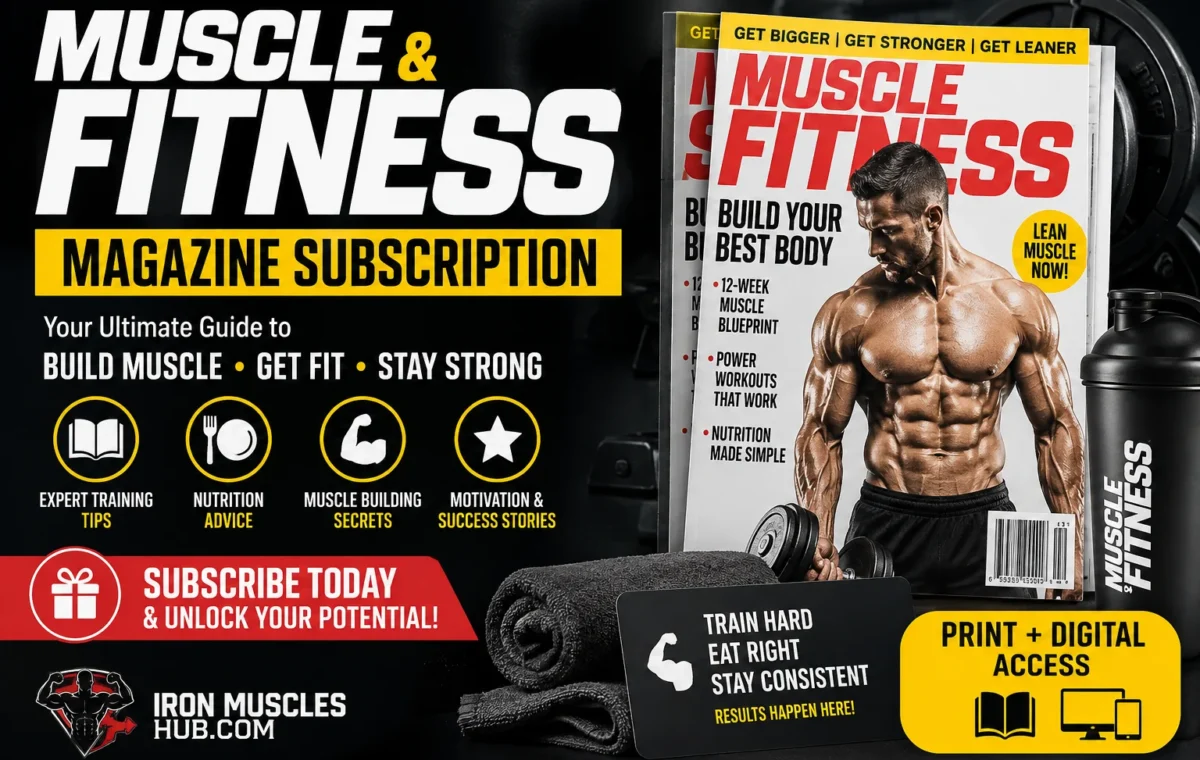
A Muscle & Fitness magazine subscription gives you recurring access to the publication rather than buying individual copies. Depending on the market and current offer, access may involve a physical magazine, digital editions, or another subscription arrangement.
The important point in 2026 is that you shouldn’t assume an old offer still applies.
Search results still show third-party subscription pages for Muscle & Fitness, but some currently display the title as unavailable. That means old pages quoting a specific annual price aren’t reliable enough to use as a current buying recommendation.
The official Muscle & Fitness website remains active and continues to publish workouts, nutrition material, fitness news, and other training content.
What type of content can you expect?
Muscle & Fitness has traditionally covered areas such as:
- Resistance training
- Muscle-building workouts
- Exercise technique
- Nutrition
- Fitness and health
- Interviews
- Bodybuilding
- Training motivation
- Fitness lifestyle
That broad focus is one reason the publication can appeal to beginners as well as experienced lifters.
But there’s an important distinction:
A fitness magazine is an information source, not a personalised training plan.
A workout printed in a magazine may have been designed for a particular goal, experience level, schedule, or training environment. You may need to modify exercise selection, volume, loading, or frequency to make it appropriate for you.
That’s especially important if you’re new to resistance training.
The 2026 American College of Sports Medicine position stand found that resistance training improves strength, muscle size, power, endurance, and several measures of physical function in healthy adults. It also found that the details of programming matter less than many beginners are led to believe.
Is a Muscle & Fitness Magazine Subscription Worth It?
It can be worth it if you enjoy the magazine format and consistently use the training and educational material. It may be poor value if you’re mainly buying it because you think you need a subscription to build muscle.
You don’t.
Your results will come primarily from your training, nutrition, recovery, consistency, and ability to progressively adapt your program.
A magazine can support those habits. It can’t perform them for you.
The beginner value test
Before subscribing, ask yourself:
- Do I actually enjoy reading fitness magazines?
- Will I use the workouts and educational articles?
- Do I prefer print or digital content?
- Could I get most of the information I need from free, reputable sources?
- Am I buying it for useful education or simply motivation?
If you genuinely enjoy reading the publication and regularly put the information into practice, a subscription may have good personal value.
If you already have a well-designed program and rarely read magazines, spending the money elsewhere may make more sense.
Don’t confuse information with results
This is one of the biggest mistakes beginners make.
You can read dozens of articles about squats, presses, rows, protein, recovery, and muscle growth without getting stronger.
The ACSM’s 2026 evidence review found that consistency is a major factor in successful resistance training. It also concluded that healthy adults can benefit from different forms of resistance training rather than needing one perfect style of program.
So if a magazine motivates you to train consistently, that’s useful.
If reading another workout keeps you from actually following the workout you already have, it’s not helping.
Muscle & Fitness Print vs Digital: Which Is Better?
There isn’t one universally better format.
The right choice depends on how you consume information.
| Feature | Digital | |
|---|---|---|
| Physical reading experience | Excellent | Limited |
| Easy to carry | Less convenient | Excellent |
| Reading at the gym | Possible | Very convenient |
| Saving physical copies | Yes | Depends on platform |
| Searchable content | No | Usually better |
| Screen-free reading | Yes | No |
| Best for collectors | Yes | No |
| Best for quick access | Moderate | Excellent |
| Dependence on current subscription platform | Lower | Higher |
Choose print if…
You like sitting down and reading a physical magazine.
Print also works well if you enjoy keeping particular issues, marking pages, or building a small collection of fitness material.
For some lifters, that physical experience is part of the appeal.
Choose digital if…
You want convenient access on a phone, tablet, or computer.
Digital reading can also make sense if you’re more interested in individual articles than collecting physical magazines.
Muscle & Fitness has historically offered digital content, and its current website provides a large amount of online fitness material.
Choose neither if…
You’re only interested in basic beginner training information.
You can learn the foundations of resistance training without paying for a magazine subscription.
The 2026 ACSM guidance is particularly useful here. It supports simple, progressive resistance training and notes that equipment type and several advanced methods don’t consistently change outcomes for the average healthy adult.
In other words, you don’t need an expensive or complicated setup to start getting stronger.
How to Decide if the Subscription Is Good Value
Here’s a simple decision rule.
The 30-second subscription test
Give yourself three questions:
1. Will I read it?
If the answer is no, don’t subscribe.
2. Will I use what I read?
If you regularly turn useful information into better training decisions, that’s a positive.
3. Does the current offer make sense for my budget?
If paying for it would take money away from gym access, basic equipment, food, or other priorities, reconsider.
If you answer yes to all three, the subscription may be reasonable.
If you answer no to two or more, you’re probably paying for information you won’t use.
This decision rule is deliberately simple. A beginner doesn’t need a complicated cost-benefit calculation to decide whether a magazine is useful.
A Worked Example: How a Beginner Could Use the Magazine
Imagine a beginner who weighs 70 kg (154 lb) and wants to build muscle.
They read a Muscle & Fitness article suggesting several chest exercises.
The beginner’s mistake would be to copy every exercise immediately.
Instead, they could use the article as an education tool and build a manageable session around a few movements.
For example:
- A pressing movement
- A rowing or pulling movement
- A lower-body movement
- A simple accessory exercise
- A gradual progression plan
The exact exercises aren’t the important part.
The important part is that the beginner can consistently train and gradually improve.
The 2026 ACSM position stand reports that muscle growth responds particularly well to sufficient training volume, while strength benefits from heavier loading. It also emphasizes progressive resistance training rather than one rigid exercise prescription.
For example, if your dumbbell bench press starts at 20 kg (44 lb) per hand, don’t assume you need to jump immediately to a much heavier weight because a magazine features someone doing it.
Your next useful step may simply be performing the same exercise with better technique, more controlled repetitions, or a small increase in resistance when appropriate.
The magazine provides ideas.
Your training log provides the evidence that you’re progressing.
What Does the Science Say About the Training Advice?
This is where beginners should separate useful fitness education from marketing language.
A magazine may present a particular workout as highly effective, but scientific research generally gives us a broader picture.
The 2026 ACSM position stand reviewed 137 systematic reviews involving more than 30,000 participants and concluded that resistance training improves muscle strength, hypertrophy, power, endurance, and physical function.
It also found that different training variables can be adjusted depending on the goal.
For strength, the position stand identified benefits from heavier loads, complete range of motion, multiple sets, and regular training.
For hypertrophy, higher weekly training volume was associated with better outcomes.
That doesn’t mean every beginner should immediately chase high volume.
It means you have room to build your program gradually.
A separate systematic review and meta-analysis also found that different resistance-training loads can produce similar muscle hypertrophy, while heavier loads tend to have an advantage for maximal strength.
That’s useful context when reading magazine workouts.
You don’t need to assume that one special repetition range is the only way to build muscle.
Common Mistakes → Why → Fix
Mistake 1: Treating every magazine workout as a prescription
Why: A published workout isn’t automatically designed for your experience, schedule, injury history, equipment, or goals.
Fix: Use workouts as templates. Adjust them to your needs and progress gradually.
Mistake 2: Chasing advanced workouts as a beginner
Why: More exercises, complicated techniques, and huge sessions can make consistency harder.
Fix: Start with a manageable routine and focus on good technique, regular training, and progressive improvement.
The current ACSM guidance specifically emphasizes that complicated programming isn’t automatically better for healthy adults.
Mistake 3: Assuming heavier always means better
Why: Heavy training is useful for strength, but muscle growth isn’t dependent on one specific load.
Fix: Use loads that allow you to train safely and consistently while maintaining appropriate technique. Research suggests hypertrophy can occur across a range of loads, while heavier loads have a stronger advantage for maximal strength.
Mistake 4: Buying a subscription without checking the current offer
Why: Search engines can surface old subscription pages, expired promotions, or third-party listings that no longer have stock.
Fix: Check the current official Muscle & Fitness site or the current subscription provider before entering payment details.
This is particularly important in August 2026, because third-party pages currently show conflicting availability and historical offers.
Mistake 5: Thinking more information means better results
Why: You can spend hours consuming fitness content without increasing your training quality.
Fix: For every useful article you read, ask: What will I actually change in my training?
If the answer is nothing, close the article and train.
Who Is a Muscle & Fitness Subscription NOT For?
A subscription probably isn’t a priority if:
- You’re on a very tight fitness budget.
- You don’t enjoy reading magazines.
- You already have a program you consistently follow.
- You mainly want basic beginner information.
- You expect the magazine to create your results for you.
- You’re looking for medical or rehabilitation advice.
- You want a personalised program based on your injury history or health conditions.
If you have a medical condition, persistent pain, or a previous injury, general magazine content isn’t a substitute for professional assessment.
What Should Beginners Look for in Fitness Magazine Advice?
A good beginner doesn’t need to reject every magazine workout.
Instead, learn to evaluate it.
Look for these qualities
Clear exercise instructions: You should understand what the movement is supposed to accomplish.
A sensible progression: There should be some way to make training gradually more challenging.
Appropriate exercise selection: The routine should match your equipment, ability, and goal.
Manageable volume: More work isn’t automatically better.
Technique guidance: The article should explain how to perform exercises rather than simply naming them.
Realistic expectations: Be cautious of promises suggesting dramatic results in an unusually short period.
Be cautious with these signals
- “Secret” exercises
- Guaranteed transformations
- Extreme diets
- Claims that one workout works for everyone
- Supplement-heavy recommendations
- Advice that encourages unsafe training
- Before-and-after claims without useful context
A magazine can contain valuable information and still include material that isn’t appropriate for every reader.
Your job as the reader is to separate general education from individual prescription.
Muscle & Fitness Magazine Subscription vs Free Online Content
This is probably the most important comparison for a beginner in 2026.
The official Muscle & Fitness website already provides a substantial collection of articles, workouts, recipes, fitness news, and other content.
So ask what the subscription adds.
Subscription makes more sense if:
- You prefer a magazine format.
- You enjoy having regular issues.
- You want a physical copy.
- You read fitness content regularly.
- The current subscription offer provides clear value for your needs.
Free content may be enough if:
- You only search for occasional workout advice.
- You primarily use your phone or computer.
- You don’t care about owning physical issues.
- You’re still learning basic training principles.
- You already have enough quality information to follow your program.
This is an important information gap in many subscription articles: the real alternative isn’t always another magazine. Sometimes it’s simply free, reputable fitness education.
Muscle & Fitness Magazine Subscription: US vs UK Buyers
US and UK readers should be especially careful about assuming that the same subscription offer applies to both countries.
Magazine distribution, pricing, taxes, delivery, digital platforms, currency, and availability can differ by market.
Older UK issues show subscription arrangements that are no longer suitable for judging a 2026 purchase. Current third-party US listings also show inconsistent availability.
So don’t rely on an old article that says:
“Subscribe today for £X.”
That could be a historical promotion rather than a current offer.
Before paying, check:
- Country eligibility
- Print vs digital format
- Current price
- Renewal terms
- Cancellation terms
- Delivery arrangements
- Taxes or shipping
- Whether the offer is from the publisher or a third-party seller
If the page doesn’t clearly explain those points, pause before buying.
Frequently Asked Questions
Is Muscle & Fitness magazine still published in 2026?
Yes, the Muscle & Fitness brand remains active in 2026, with an established website publishing fitness, workout, nutrition, and lifestyle content. However, print availability and subscription arrangements can vary by market. Don’t assume that an older subscription page or historical magazine offer reflects the current situation. Check the current publisher or subscription provider before purchasing.
How can I subscribe to Muscle & Fitness magazine?
Start by checking the current official Muscle & Fitness website and any subscription option it currently presents for your country. If you find a third-party subscription page, verify that it is currently available and clearly states the format, renewal conditions, delivery arrangements, and cancellation policy. Avoid relying on old search results that advertise historical prices or promotions.
Is Muscle & Fitness magazine good for beginners?
It can be useful for beginners because the publication covers workouts, exercise information, nutrition, and general fitness. The key is how you use the information. A beginner shouldn’t copy advanced routines blindly. Use magazine content for ideas and education while following a sensible, progressive program suited to your experience and goals. Current ACSM guidance supports regular resistance training without requiring unnecessarily complicated programming.
Is a Muscle & Fitness subscription worth the money?
It depends on how much you use it. If you enjoy reading fitness magazines, regularly use the information, and like the format, a subscription can be worthwhile. If you mainly need basic training information, the free Muscle & Fitness website and other reputable resources may provide enough material. Compare the current subscription terms with what you would actually use before paying.
Is Muscle & Fitness better than free fitness websites?
Not automatically. A paid magazine can offer a curated reading experience and regular issues, while free websites can provide faster access to specific topics. For training results, the quality and consistency of your actual program matter much more than whether the information came from a magazine or website. Research supports many forms of progressive resistance training for improving strength and muscle size.
Final Verdict: Should You Get a Muscle & Fitness Magazine Subscription?
A Muscle & Fitness magazine subscription can be a good purchase for the right reader, especially if you enjoy magazine-style fitness content and regularly turn what you learn into better training habits.
But beginners don’t need a subscription to build muscle or become stronger.
Your priorities should be straightforward: train consistently, use sensible progression, recover properly, and choose nutrition that supports your goals. The 2026 ACSM evidence review reinforces the value of regular resistance training and shows that you don’t need a complicated program to make progress.
If you enjoy Muscle & Fitness, check the current offer for your country before paying rather than trusting an old price from a search result. If you don’t enjoy magazines, save your money and focus on a good training plan.
Final Thoughts
A Muscle & Fitness magazine subscription can still be useful in 2026, especially if you enjoy fitness journalism, workout ideas, bodybuilding coverage, and learning from experienced athletes and coaches. The current Muscle & Fitness website continues to publish workout, nutrition, exercise, and fitness content, so the brand remains active online.
For beginners, though, a subscription should be treated as a supplement to your training—not the foundation of it. You don’t need a magazine to build muscle. Consistent resistance training, sensible progression, adequate recovery, and a suitable diet matter far more.
Before paying, check the current subscription format, price, availability, and renewal terms, particularly if you’re in the UK. The publication has gone through significant changes in its digital and print presence over the years, so older subscription information can be misleading.
Bottom line: If you genuinely enjoy reading Muscle & Fitness and will use its content, a subscription may be worth the money. If you only need basic beginner workout advice, its free online resources may already give you plenty to work with.