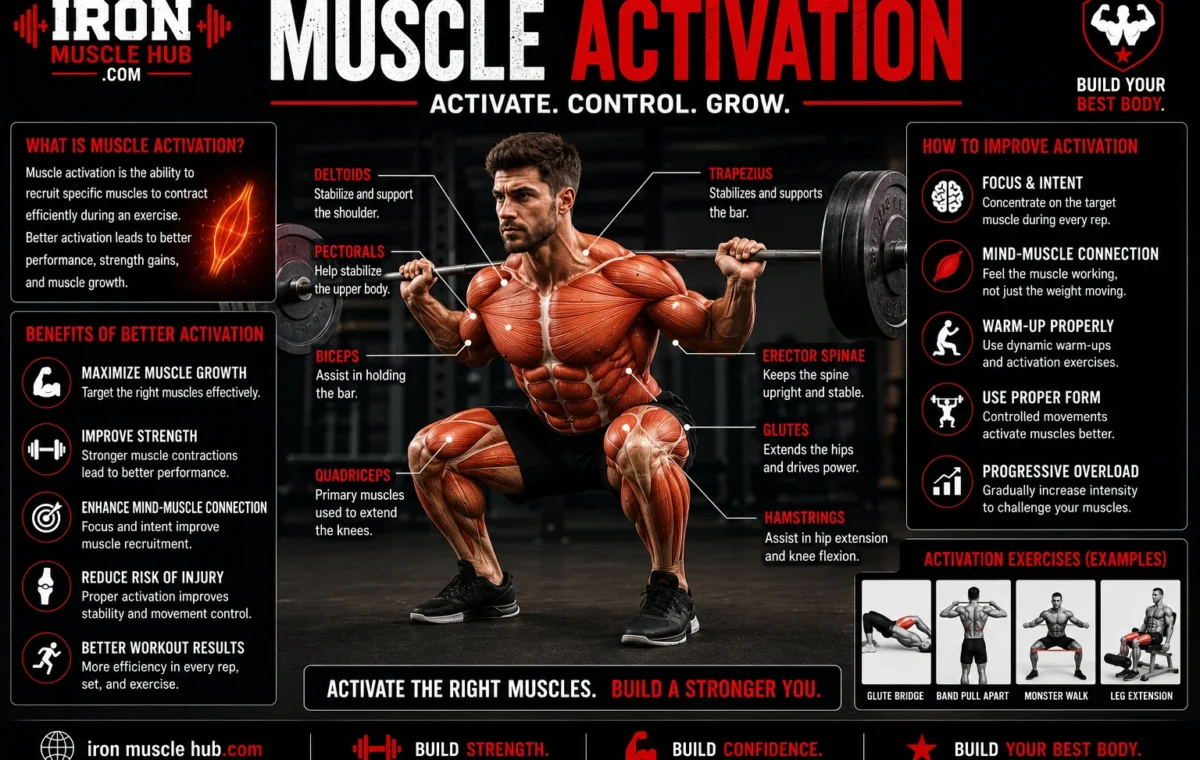
Muscle activation is the process of your nervous system telling muscle fibers to produce force during movement or exercise. In simple terms, a muscle is activated when it contributes to the work you’re asking your body to perform. The amount of activation can change depending on the exercise, load, technique, fatigue, and where you direct your attention.
- Muscle Activation at a Glance
- What Is Muscle Activation?
- Why Does Muscle Activation Matter?
- How to Improve Muscle Activation
- 1. Choose an Exercise That Fits Your Goal
- 2. Use a Controlled Technique
- 3. Try the Mind-Muscle Connection
- 4. Reduce the Weight If You Can't Control It
- 5. Use a Full, Comfortable Range of Motion
- 6. Track Performance Instead of Chasing a Pump
- A Simple Muscle Activation Example
- Muscle Activation vs. Muscle Growth
- Common Muscle Activation Mistakes
- Mistake 1: Using the Heaviest Weight Possible
- Mistake 2: Chasing the Burn
- Mistake 3: Changing Exercises Every Workout
- Mistake 4: Treating EMG Numbers as a Ranking System
- Mistake 5: Forgetting Progressive Training
- Does a Better Mind-Muscle Connection Build More Muscle?
- Internal Links to Add on Iron Muscle Hub
- Frequently Asked Questions
- What is muscle activation?
- How do you activate a muscle during exercise?
- Does muscle activation mean you're building muscle?
- Is the mind-muscle connection important for beginners?
- Should I use lighter weights for better muscle activation?
- Can you improve muscle activation with training?
- Build Better Training Habits, Not Just Better Sensations
- How Muscle Activation Changes During a Workout
- Muscle Activation and Exercise Technique
- A Simple Technique Check
- Muscle Activation During Compound Exercises
- Muscle Activation During Isolation Exercises
- Should You Feel the Muscle Working?
- A Beginner Muscle Activation Routine
- Upper Body
- Lower Body
- A Practical 5-Minute Activation Approach
- What About Activation Bands?
- Activation vs. Warm-Up
- How to Know If Your Training Is Working
- When More Activation Isn't Better
- The Best Way to Improve Muscle Activation
- Final Takeaway
For beginners, the useful question isn’t simply, “How do I activate a muscle?” It’s “How can I perform an exercise so the muscle I’m trying to train actually does its share of the work?” That’s where exercise technique, appropriate resistance, controlled repetitions, and the mind-muscle connection can help. For more insights read here :- protein shake and human muscle chart .
Quick answer: Muscle activation is the active involvement of a muscle in producing force. You can often improve your ability to target a muscle by using good technique, controlling the movement, choosing an appropriate exercise, and intentionally focusing on the working muscle.
Muscle Activation at a Glance
| Factor | What it can do |
|---|---|
| Exercise selection | Changes which muscles contribute most to a movement |
| Resistance | Changes the force demands placed on the muscles |
| Technique | Can change how much a particular muscle contributes |
| Attention | May increase activity in a muscle you’re deliberately focusing on |
| Training experience | Can improve neural adaptations and voluntary activation |
| Fatigue | Changes how muscles contribute as a set becomes harder |
| Progressive training | Builds strength, muscle size, and physical capacity over time |
The important point is that higher muscle activation on its own isn’t a guarantee of greater muscle growth. Muscle activation is one part of resistance training, not the entire equation.
What Is Muscle Activation?
Your muscles don’t simply “turn on” like a light switch.
Your nervous system controls muscle contraction by activating motor units, which consist of a motor neuron and the muscle fibers it controls. During exercise, your body adjusts this neural drive according to the force and movement demands.
Researchers commonly study muscle activity using surface electromyography (sEMG). EMG records electrical signals associated with muscle activity, which can help researchers compare how muscles behave under different exercise conditions. However, an EMG reading shouldn’t be treated as a direct measurement of how much muscle growth an exercise will produce.
This distinction matters because gym advice sometimes treats “more activation” as automatically meaning “better exercise.” Real training outcomes are more complicated.
Why Does Muscle Activation Matter?
Good muscle activation can help you understand whether an exercise is doing what you intended.
Imagine you’re performing a dumbbell row to train your upper back. If you rush every repetition and use excessive body movement, you may still move the dumbbell, but your technique may not give you the same training stimulus as a controlled repetition.
That doesn’t mean you need to make every repetition extremely slow. It means the movement should be deliberate enough that you can maintain the intended position and range of motion.
Resistance training itself has strong evidence behind it. A 2026 American College of Sports Medicine position stand based on an overview of 137 systematic reviews involving more than 30,000 participants found that resistance training improves outcomes including strength and muscle size.
Muscle activation is therefore best viewed as one mechanism within effective resistance training, rather than a magic technique.
How to Improve Muscle Activation
You don’t need complicated equipment or advanced bodybuilding techniques. Start with these practical steps.
1. Choose an Exercise That Fits Your Goal
Exercise selection matters.
If your goal is to train a particular muscle, choose movements that actually involve that muscle and allow you to perform the exercise comfortably with consistent technique.
For example:
- Chest: presses and fly variations
- Back: rows and pulldown variations
- Quadriceps: squat and knee-extension patterns
- Hamstrings: hip-hinge and leg-curl patterns
- Glutes: hip-extension and squat patterns
- Biceps: curl variations
- Triceps: extension and pressing movements
You don’t need to isolate a muscle completely for it to receive useful training.
2. Use a Controlled Technique
Control doesn’t mean making every repetition painfully slow.
Instead, avoid letting momentum completely take over the movement. Keep the load manageable enough that you can repeat the same basic technique throughout the set.
A simple beginner test is this:
Could you explain exactly what moved during your last repetition?
If the answer is no because the weight was bouncing, swinging, or forcing you into a different position, reducing the load may help.
3. Try the Mind-Muscle Connection
The mind-muscle connection refers to intentionally directing your attention toward the muscle you’re trying to use.
Research suggests that this strategy can increase activity in selected muscles during some resistance exercises. For example, studies of the bench press found that specific instructions could increase activation of the triceps, while another study found that focusing on the target muscle increased activity in the pectoralis major or triceps at certain loads.
More recent research published in 2026 also found that deliberately focusing on the deltoids or triceps during a machine shoulder press increased activity in the targeted muscle among previously untrained participants.
A simple cue is:
“Move the weight with the muscle I’m trying to train.”
Don’t turn this into an obsession. If focusing on a muscle makes your technique worse or dramatically reduces the amount of weight you can control, prioritize good movement.
4. Reduce the Weight If You Can’t Control It
A heavier dumbbell isn’t automatically a better choice.
If increasing the weight causes you to shorten the movement, swing the load, or lose your position, the extra resistance may not provide the benefit you expect.
Try lowering the load and performing several clean repetitions. Once the movement feels consistent, gradual progression can make more sense.
5. Use a Full, Comfortable Range of Motion
Range of motion can affect the training stimulus.
The 2026 ACSM position stand found that strength benefits were enhanced by performing resistance exercises through a complete range of motion, while higher training volume was associated with greater hypertrophy.
That doesn’t mean every person should force an identical range of motion. Your mobility, exercise, training experience, and physical limitations matter.
The goal is a controlled range that you can perform safely and consistently.
6. Track Performance Instead of Chasing a Pump
A muscle pump can feel satisfying, but it isn’t the best scorecard for your training.
Track things such as:
- Exercise
- Weight used
- Repetitions
- Sets
- Technique
- How difficult the set felt
- Whether you completed the intended range of motion
Over time, being able to perform more work with good technique is usually more useful than trying to create the biggest possible sensation in the muscle.
A Simple Muscle Activation Example
Suppose you’re learning dumbbell lateral raises.
You start with a weight that lets you perform controlled repetitions without swinging your torso.
Instead of thinking only about getting the dumbbells upward, you focus on raising your arms through the intended movement while keeping the exercise controlled.
Your goal isn’t to make your shoulders burn as much as possible. Your goal is to consistently perform the movement while allowing the intended muscles to contribute.
If you can do that for several workouts, you can gradually adjust the resistance or repetitions as your training progresses.
That’s a more useful approach than constantly changing exercises because one workout didn’t produce a dramatic sensation.
Muscle Activation vs. Muscle Growth
These terms are related, but they aren’t interchangeable.
Muscle activation describes muscle activity during a task.
Muscle hypertrophy means an increase in muscle size.
A laboratory study can show that one exercise produces greater EMG activity than another without proving that it will build more muscle over months of training.
This is one reason you shouldn’t choose exercises based solely on an “activation chart.”
A 2026 systematic review and meta-analysis comparing variable-resistance and free-weight training found no significant overall difference in muscle activation between the two methods, although some differences appeared during specific contraction phases and resistance conditions.
The practical lesson is simple: don’t confuse one measurement with the whole training outcome.
Common Muscle Activation Mistakes
Mistake 1: Using the Heaviest Weight Possible
If the load changes your technique, it may stop being the exercise you intended to perform.
Fix: Use a resistance that allows consistent, controlled repetitions.
Mistake 2: Chasing the Burn
A burning sensation can happen during hard exercise, but the sensation itself doesn’t prove that you’ve maximized muscle growth.
Fix: Judge your training by technique, progression, consistency, and overall programming.
Mistake 3: Changing Exercises Every Workout
If you constantly switch movements, it becomes harder to determine whether you’re actually improving.
Fix: Keep useful exercises in your program long enough to learn them and measure progress.
Mistake 4: Treating EMG Numbers as a Ranking System
An EMG result doesn’t automatically tell you which exercise is “best” for everyone.
Fix: Consider the exercise’s technique, comfort, range of motion, progression potential, and how well it fits your overall program.
Mistake 5: Forgetting Progressive Training
Feeling a muscle work is useful feedback, but your program still needs an appropriate training stimulus.
The latest ACSM overview supports progressive resistance training for improving muscle function, size, and physical performance.
Does a Better Mind-Muscle Connection Build More Muscle?
It may help in some situations, but the evidence isn’t strong enough to say that simply thinking about a muscle guarantees greater growth.
One 2018 randomized trial found greater elbow-flexor thickness after an eight-week training program using an internal attentional focus compared with an external focus, while other research has raised important questions about how attentional focus affects performance and strength.
The sensible approach is to use the mind-muscle connection as a technique tool, not as a replacement for effective resistance training.
Internal Links to Add on Iron Muscle Hub
For a broader fitness content cluster, consider linking this article to:
- How to Build Muscle for Beginners
- Best Resistance Training Exercises for Beginners
- How Progressive Overload Works
These links can help readers move from understanding muscle activation to building a complete training routine.
Frequently Asked Questions
What is muscle activation?
Muscle activation is the active involvement of a muscle in producing force during a movement. Your nervous system controls this process by recruiting and coordinating motor units. Researchers can estimate muscle activity using tools such as surface EMG, but an EMG measurement doesn’t directly predict muscle growth.
How do you activate a muscle during exercise?
Use an exercise that trains the muscle, select a manageable resistance, maintain controlled technique, and pay attention to the intended muscle during the movement. A mind-muscle connection can increase activity in some target muscles during certain exercises, although its effects vary by exercise and training situation.
Does muscle activation mean you’re building muscle?
Not necessarily. Muscle activation describes activity during a movement, while muscle growth is a longer-term adaptation to training. Exercise selection, training volume, resistance, progression, recovery, nutrition, and individual factors all influence results. Higher EMG activity by itself shouldn’t be treated as proof that an exercise will produce more muscle growth.
Is the mind-muscle connection important for beginners?
It can be useful, especially for learning how an exercise should feel and improving awareness of technique. However, beginners shouldn’t become so focused on feeling a specific muscle that they sacrifice good form or useful resistance. Learning the movement correctly should come first.
Should I use lighter weights for better muscle activation?
Not automatically. The right resistance depends on the exercise and your training goal. Research shows that muscle activity can change with resistance and repetition conditions, while current resistance-training guidance supports using different loading strategies depending on whether your priority is strength, hypertrophy, power, or other outcomes.
Can you improve muscle activation with training?
Yes. Resistance training can produce neuromuscular adaptations that improve how the body produces force. Research has found improvements in muscle activation and strength following resistance training, although the exact adaptations vary according to the person, exercise, and training program.
Build Better Training Habits, Not Just Better Sensations
Muscle activation is useful because it helps explain what happens between your brain, nervous system, and muscles during exercise. But you don’t need to chase the highest possible activation reading or the strongest muscle burn.
Start with exercises you can perform well. Use a resistance that lets you maintain your technique, practice a controlled range of motion, and gradually make your training more challenging. If focusing on a target muscle helps you perform an exercise better, use that cue.
The bigger picture matters most: consistent resistance training, sensible progression, good technique, recovery, and an appropriate overall program are more important than any single activation trick.
How Muscle Activation Changes During a Workout
Muscle activation isn’t necessarily identical from the first repetition to the last. As a set becomes more difficult, your body has to produce enough force to keep the movement going.
This is one reason the final repetitions of a challenging set can feel very different from the first few. Fatigue changes how your body coordinates the movement and can alter which muscles contribute most.
For beginners, the practical takeaway is simple: don’t judge an exercise only by how strongly you feel the target muscle during the first few repetitions. Look at the entire set and whether you can maintain appropriate technique as fatigue builds.
Muscle Activation and Exercise Technique
Small changes in technique can influence which muscles contribute to an exercise.
Consider a squat. Changing your stance, depth, torso position, or other movement characteristics can alter the demands placed on different muscles. The same principle applies to pressing, pulling, rowing, lunging, and isolation exercises.
That doesn’t mean there is one perfect technique for everyone.
Your body structure, mobility, training experience, and exercise goal all matter. A useful starting point is to choose a technique that feels stable and allows you to perform the intended movement consistently.
A Simple Technique Check
Before adding more weight, ask yourself:
- Can I control the weight?
- Can I repeat the same basic movement?
- Am I using the intended range of motion?
- Am I avoiding unnecessary momentum?
- Can I breathe normally and stay focused?
- Does the exercise feel appropriate for my current ability?
If several answers are no, increasing resistance probably isn’t the solution.
Muscle Activation During Compound Exercises
Compound exercises involve multiple joints and muscles at the same time.
Examples include:
- Squats
- Deadlifts
- Lunges
- Bench presses
- Overhead presses
- Rows
- Pull-ups and pulldowns
You don’t need to isolate every muscle to train it effectively.
A bench press, for example, involves more than the chest. The triceps and shoulders also contribute. A row similarly requires coordinated work from several muscles around the upper back and arms.
This is useful for beginners because compound movements can train several muscle groups within a relatively simple training session.
Muscle Activation During Isolation Exercises
Isolation exercises generally place greater emphasis on a particular muscle or muscle group.
Examples include:
- Biceps curls
- Triceps extensions
- Leg curls
- Leg extensions
- Calf raises
- Lateral raises
These exercises can be useful when you want additional work for a specific muscle.
They don’t have to replace compound movements. A balanced resistance-training program can use both types of exercises according to the individual’s goals and preferences.
Should You Feel the Muscle Working?
Feeling a muscle work can provide useful feedback, but it shouldn’t become your only measure of an effective exercise.
Some movements naturally produce a strong sensation in the target muscle. Others may feel less dramatic while still providing meaningful resistance.
For example, a heavy compound exercise might feel challenging throughout your body rather than producing a strong localized burn.
Sensation is information, not proof.
If an exercise is comfortable, technically sound, progressively challenging, and appropriate for your goal, you don’t necessarily need to replace it simply because another exercise produces a stronger pump.
A Beginner Muscle Activation Routine
If your main goal is learning how to better control your muscles during resistance training, you can keep the approach simple.
Upper Body
Choose one pushing movement, one pulling movement, and one optional isolation movement.
For example:
- Dumbbell or machine chest press
- Seated cable or machine row
- Dumbbell curl
During each exercise, concentrate on maintaining a repeatable movement rather than trying to create an extreme muscle sensation.
Lower Body
A basic lower-body session might include:
- Squat or leg press
- Hip-hinge movement
- Leg curl
- Calf raise
The exact exercises aren’t mandatory. The important part is learning the movement, choosing an appropriate resistance, and gradually improving.
A Practical 5-Minute Activation Approach
Some people like to perform a few lighter repetitions before their main working sets.
The purpose isn’t to exhaust the muscle.
Instead, use the lighter movement as a chance to rehearse your technique.
For example, before a heavier pressing exercise:
Step 1: Use a very manageable resistance.
Step 2: Perform several controlled repetitions.
Step 3: Pay attention to your body position and movement path.
Step 4: Stop before fatigue becomes significant.
Step 5: Move into your planned working sets.
This can help you mentally prepare for the exercise without turning your warm-up into another workout.
What About Activation Bands?
Resistance bands are sometimes marketed specifically for “activating” muscles before training.
They can be useful resistance-training tools, but you don’t have to use bands to make a muscle participate in an exercise.
A short band exercise can be appropriate if it helps you practice a movement or prepare for a particular session. But there’s no need to assume that every workout requires a special activation circuit.
For many beginners, the main exercise itself is already enough to train the relevant muscles.
Activation vs. Warm-Up
These terms are sometimes used as though they mean the same thing, but they aren’t identical.
A warm-up generally prepares you for physical activity by gradually increasing activity and rehearsing movement.
An “activation” drill is often intended to make you consciously use a particular muscle or movement pattern.
You can combine the two, but you don’t need a long sequence of specialized exercises before every workout.
If a warm-up makes you tired before your main exercises, it may be doing too much.
How to Know If Your Training Is Working
Instead of asking only, “Can I feel my muscle?”
Track objective progress.
A simple training log can include:
| What to track | Example |
|---|---|
| Exercise | Dumbbell row |
| Resistance | 20 lb per dumbbell |
| Repetitions | 10 |
| Sets | 3 |
| Technique | Controlled |
| Range of motion | Consistent |
| Difficulty | Challenging but manageable |
| Next goal | Add repetitions before increasing weight |
The exact numbers in the example aren’t a recommendation. They’re simply an illustration of how a beginner could record training.
Over several weeks, look for improvements in performance, technique, or the amount of work you can handle.
When More Activation Isn’t Better
There’s an important distinction between more muscle activity and better training.
Suppose an exercise creates a very strong sensation but prevents you from using a reasonable resistance or maintaining your technique.
Another exercise might feel less dramatic but allow you to train consistently and progress over time.
The second option may be more useful for your overall program.
That’s why exercise selection shouldn’t be based on a single EMG result, a social-media “activation ranking,” or how painful a workout feels.
The Best Way to Improve Muscle Activation
If you want a simple formula, use this:
Choose the right exercise → learn the movement → control the resistance → focus on the target when useful → train consistently → progress gradually.
You don’t need dozens of activation drills.
You don’t need to chase an intense burn.
And you don’t need to completely isolate a muscle during every exercise.
Good resistance training is built around repeatable movements and gradual improvement.
Final Takeaway
Muscle activation is useful for understanding how your nervous system and muscles work together during exercise. It can also help you think more carefully about exercise selection and technique.
For beginners, the biggest improvement usually comes from keeping things simple. Learn the movement, use manageable resistance, maintain good technique, and pay attention to the muscle you’re trying to train without becoming obsessed with the sensation.
Over time, consistent resistance training can improve strength, muscle size, and physical function. Muscle activation is part of that process, not a shortcut around it.
Final Thoughts on Muscle Activation
Muscle activation can sound more complicated than it really is. At its core, it simply describes how your nervous system recruits muscles to produce force during movement.
For beginners, you don’t need to spend every workout trying to maximize activation. Focus on the basics first: choose exercises that fit your goals, learn proper technique, use a manageable resistance, control your repetitions, and gradually make your training more challenging.
The mind-muscle connection can be a useful tool when you have trouble feeling or controlling a particular muscle, but it shouldn’t replace good programming or progressive resistance training. Likewise, a strong burn or pump can be useful feedback, but neither one automatically proves that an exercise is producing better long-term results.
A better way to think about muscle activation is as one piece of the bigger training picture.
If your technique is improving, your exercises are becoming more manageable, and your performance is gradually progressing, you’re building useful habits. Give those habits time to work rather than constantly switching exercises in search of a perfect activation technique.
Most importantly, consistency beats complexity. You don’t need an elaborate activation routine before every workout. A well-structured resistance-training program, sensible progression, adequate recovery, and patience will take you much further than chasing the biggest possible muscle sensation.