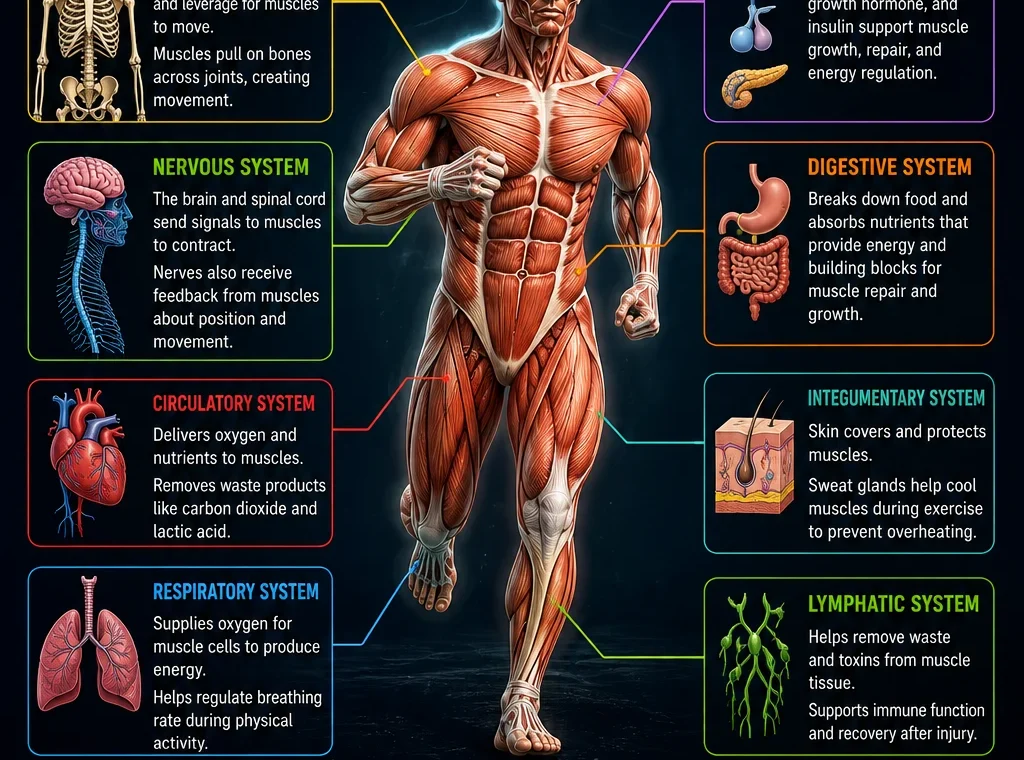
how does the muscular system interact with other systemsdoes not work by itself. It depends on every major body system to help you move, breathe, digest food, maintain body temperature, and stay alive. In return, your muscles support many of those systems by producing movement, protecting organs, and helping blood circulate throughout your body.
- Quick Answer
- How They Work Together
- Common Examples
- How the Process Works
- Voluntary and Involuntary Muscles
- Voluntary Muscles
- Involuntary Muscles
- During Exercise
- How Muscles Help the Circulatory System
- How They Work Together
- Breathing Muscles
- How Food Becomes Muscle Fuel
- Nutrients That Support Healthy Muscles
- Important Hormones for Muscles
- Muscle Recovery
- Why Hydration Matters
- Myth 1: Muscles Only Work With Bones
- Myth 2: Only Athletes Need Healthy Muscles
- Myth 3: Bigger Muscles Mean Better Health
- Myth 4: Muscles Work Without Oxygen
- How does the muscular system interact with the skeletal system?
- Why is the nervous system important for muscle movement?
- How does the circulatory system help muscles?
- How does the respiratory system support muscles during exercise?
- What happens if one body system stops working properly?
- Why is it important to understand how body systems work together?
- Final Thoughts
Think of your body as a team. Every system has a different job, but none can function properly without the others. When one system struggles, the muscular system is affected too. Understanding these connections helps explain how the human body stays healthy and why exercise, nutrition, and rest are all important.
Whether you’re studying anatomy, preparing for an exam, or simply curious about how your body works, this guide explains everything in simple language. For more insights read here :- how do i build muscle quickly and how to get bigger .
Quick Answer
| Body System | How It Works with the Muscular System |
|---|---|
| Skeletal System | Bones provide attachment points so muscles can create movement. |
| Nervous System | Sends electrical signals that tell muscles when to contract and relax. |
| Circulatory System | Delivers oxygen and nutrients to muscles while removing waste. |
| Respiratory System | Supplies oxygen needed for muscle activity and removes carbon dioxide. |
| Digestive System | Breaks down food into nutrients that fuel muscle cells. |
| Endocrine System | Hormones regulate muscle growth, repair, and metabolism. |
| Immune System | Helps repair injured muscles and fights infections. |
| Urinary System | Maintains water and mineral balance needed for muscle contractions. |
Key takeaway: Every movement—from blinking your eyes to running a marathon—depends on several body systems working together.
Why the Muscular System Cannot Work Alone
Your muscles are powerful, but they cannot function independently.
For example, imagine trying to lift a backpack.
Your muscles provide the force needed to lift it, but they also need:
- Bones to support the movement
- Nerves to tell the muscles what to do
- Oxygen from your lungs
- Nutrients from food
- Blood to transport oxygen and energy
- Hormones to regulate muscle performance
Without any one of these systems, even simple movements become difficult or impossible.
This teamwork is what keeps your body functioning every second of the day.
The Muscular System and the Skeletal System
The muscular and skeletal systems work so closely together that they are often called the musculoskeletal system.
Bones act as a framework for the body, while muscles pull on bones to create movement.
Without bones, muscles would have nothing to pull against.
Without muscles, bones could not move.
How They Work Together
When a muscle contracts, it becomes shorter and pulls on a tendon attached to a bone.
This movement causes joints to bend or straighten.
For example:
- Your biceps contract.
- The tendon pulls on your forearm.
- Your elbow bends.
- You lift an object.
This process happens thousands of times every day without you thinking about it.
Common Examples
| Activity | Bones | Muscles |
|---|---|---|
| Walking | Support body weight | Move the legs |
| Smiling | Facial bones | Facial muscles create expressions |
| Jumping | Leg bones provide leverage | Leg muscles generate force |
| Writing | Hand bones stabilize fingers | Small muscles control movement |
The Muscular System and the Nervous System
The nervous system acts like the body’s communication network.
Your brain constantly sends electrical messages through nerves telling muscles when to move.
Without these signals, muscles cannot contract.
How the Process Works
- Your brain decides to move.
- A nerve impulse travels through the spinal cord.
- Motor neurons carry the message.
- Muscle fibers receive the signal.
- The muscle contracts.
- Movement occurs.
This entire process takes only a fraction of a second.
Voluntary and Involuntary Muscles
The nervous system controls muscles in different ways.
Voluntary Muscles
These muscles are under conscious control.
Examples include:
- Walking
- Writing
- Lifting weights
- Typing
- Running
These movements involve skeletal muscles.
Involuntary Muscles
These muscles work automatically without you thinking about them.
Examples include:
- Heartbeat
- Digestion
- Blood vessel movement
- Blinking (partly automatic)
These muscles keep your body functioning even while you sleep.
The Muscular System and the Circulatory System
Your muscles constantly need oxygen and nutrients to produce energy.
The circulatory system delivers both through your bloodstream.
It also removes waste products like carbon dioxide and lactic acid.
Without healthy circulation, muscles tire quickly.
During Exercise
When you begin running:
- Your heart beats faster.
- Blood vessels widen.
- More oxygen reaches your muscles.
- Nutrients arrive more quickly.
- Waste products are carried away.
This allows muscles to keep working for longer periods.
How Muscles Help the Circulatory System
The relationship works both ways.
When skeletal muscles contract, they squeeze nearby veins.
This helps push blood back toward the heart.
Doctors often call this the muscle pump, and it plays an important role in maintaining healthy circulation, especially in your legs.
Why These Interactions Matter
Understanding how body systems work together explains many everyday experiences.
For example:
- Feeling tired after poor sleep because muscles don’t recover properly.
- Feeling weak when you haven’t eaten enough because muscles lack fuel.
- Breathing harder during exercise because muscles need more oxygen.
- Recovering slowly after illness because multiple body systems are healing together.
Instead of thinking about muscles as isolated body parts, it’s more accurate to see them as one piece of a much larger system that keeps you alive and active.
How the Muscular System Interacts With the Respiratory System
The respiratory system and muscular system work together every second of your life. While the respiratory system brings oxygen into your body and removes carbon dioxide, your muscles use that oxygen to produce the energy needed for movement.
Without enough oxygen, muscles become tired much more quickly. That’s why breathing rate increases during physical activity.
How They Work Together
Here’s a simple breakdown:
- You inhale oxygen through your nose or mouth.
- The lungs transfer oxygen into your bloodstream.
- The circulatory system carries oxygen-rich blood to your muscles.
- Muscle cells use oxygen to produce energy (ATP).
- Carbon dioxide is created as a waste product.
- Blood carries carbon dioxide back to the lungs.
- You exhale the carbon dioxide.
This cycle repeats continuously, even while you’re sleeping.
Breathing Muscles
Breathing itself depends on muscles.
| Muscle | Function |
|---|---|
| Diaphragm | Main muscle responsible for breathing |
| Intercostal Muscles | Expand and contract the rib cage |
| Abdominal Muscles | Help force air out during heavy breathing |
During exercise, these muscles work harder so your body can deliver more oxygen to working muscles.
How the Muscular System Interacts With the Digestive System
Your digestive system supplies the nutrients your muscles need to grow, repair, and produce energy.
Without food, muscles wouldn’t have the fuel required for daily activities.
How Food Becomes Muscle Fuel
After eating:
- Food is broken down in the stomach.
- Nutrients are absorbed in the small intestine.
- Glucose enters the bloodstream.
- Proteins are broken into amino acids.
- Healthy fats provide long-lasting energy.
- Blood carries these nutrients to muscle cells.
Your muscles then use these nutrients for movement, repair, and growth.
Nutrients That Support Healthy Muscles
| Nutrient | Why Muscles Need It |
|---|---|
| Protein | Repairs and builds muscle tissue |
| Carbohydrates | Main energy source during activity |
| Healthy Fats | Long-term energy and hormone production |
| Calcium | Supports muscle contraction |
| Potassium | Helps nerves communicate with muscles |
| Magnesium | Assists muscle relaxation and energy production |
A balanced diet helps muscles recover faster after exercise and supports everyday movement.
How the Muscular System Interacts With the Endocrine System
The endocrine system controls hormones that influence muscle growth, repair, strength, and metabolism.
Hormones act as chemical messengers, telling muscles how to respond to exercise, stress, and recovery.
Important Hormones for Muscles
| Hormone | Main Role |
|---|---|
| Growth Hormone | Supports muscle repair and development |
| Testosterone | Helps increase muscle size and strength |
| Insulin | Moves glucose into muscle cells for energy |
| Cortisol | Helps during stress but can break down muscle if levels stay high |
| Thyroid Hormones | Regulate metabolism and energy production |
A healthy balance of hormones allows muscles to function efficiently.
How the Muscular System Interacts With the Immune System
The immune system protects muscles from infection and helps repair damaged tissue after exercise or injury.
Whenever muscle fibers experience tiny tears during strength training, the immune system starts the healing process.
Muscle Recovery
After exercise:
- Damaged muscle fibers are identified.
- Immune cells remove damaged tissue.
- New muscle proteins are produced.
- Muscle fibers become stronger during recovery.
This is one reason rest days are just as important as workouts.
Without proper recovery, muscles cannot rebuild effectively.
How the Muscular System Interacts With the Urinary System
The urinary system helps maintain the balance of water, minerals, and waste products in the body.
Muscles rely on the correct levels of fluids and electrolytes to contract normally.
Why Hydration Matters
The kidneys help regulate:
- Water balance
- Sodium
- Potassium
- Calcium
- Magnesium
If these minerals become too low, muscle cramps, weakness, or fatigue may occur.
Staying hydrated supports normal muscle performance, especially during exercise or hot weather.
Complete Summary Table
| Body System | Main Role | How It Supports the Muscular System |
|---|---|---|
| Skeletal | Provides structure | Bones and joints allow muscles to create movement |
| Nervous | Controls communication | Sends signals that trigger muscle contractions |
| Circulatory | Transports blood | Delivers oxygen and nutrients while removing waste |
| Respiratory | Supplies oxygen | Provides oxygen needed for energy production |
| Digestive | Provides nutrients | Supplies proteins, carbohydrates, vitamins, and minerals |
| Endocrine | Releases hormones | Controls muscle growth, repair, and metabolism |
| Immune | Protects and repairs | Heals damaged muscle tissue |
| Urinary | Maintains fluid balance | Regulates water and electrolytes needed for contractions |
Real-Life Example: What Happens When You Go for a Run?
Running may seem simple, but nearly every body system is involved.
| Body System | What Happens During Running |
|---|---|
| Nervous System | Brain sends signals to leg muscles. |
| Skeletal System | Bones and joints support movement. |
| Muscular System | Leg muscles contract to move your body. |
| Respiratory System | Breathing speeds up to supply more oxygen. |
| Circulatory System | Heart pumps more blood to working muscles. |
| Digestive System | Stored nutrients provide energy. |
| Endocrine System | Hormones help regulate energy use and performance. |
| Immune System | Begins repairing tiny muscle fibers after exercise. |
| Urinary System | Helps maintain fluid and electrolyte balance. |
This example shows that movement depends on all body systems working together as one coordinated unit.
Common Mistakes and Misconceptions
Myth 1: Muscles Only Work With Bones
Fact: Muscles interact with every major body system, not just the skeletal system.
Myth 2: Only Athletes Need Healthy Muscles
Fact: Everyone relies on muscles for breathing, posture, digestion, circulation, and daily movement.
Myth 3: Bigger Muscles Mean Better Health
Fact: Healthy muscle function is more important than muscle size. Strength, flexibility, endurance, and proper recovery all contribute to overall health.
Myth 4: Muscles Work Without Oxygen
Fact: Muscles can produce small amounts of energy without oxygen for short periods, but they rely primarily on a steady oxygen supply for sustained activity.
Why Understanding These Interactions Is Important
Learning how the muscular system interacts with other systems helps explain why healthy habits matter.
Regular exercise strengthens muscles, while good nutrition provides the fuel they need. Quality sleep supports muscle repair, hydration keeps muscles functioning properly, and healthy lungs and heart ensure muscles receive enough oxygen and nutrients.
Rather than viewing body systems as separate parts, it’s better to think of them as one interconnected network. When one system becomes unhealthy, the others often feel the effects as well.
How does the muscular system interact with the skeletal system?
The muscular and skeletal systems work together to create movement. Muscles are attached to bones by tendons. When muscles contract, they pull on bones, causing joints to move. Without bones for support, muscles would not be able to produce controlled body movements.
Why is the nervous system important for muscle movement?
The nervous system controls every muscle contraction by sending electrical signals from the brain and spinal cord to muscle fibers. These signals tell muscles when to contract, relax, and adjust their force. Without nerve communication, muscles cannot function properly.
How does the circulatory system help muscles?
The circulatory system delivers oxygen, nutrients, and hormones to muscle cells through the bloodstream. It also removes carbon dioxide and other waste products produced during muscle activity. Healthy circulation allows muscles to perform efficiently and recover after exercise.
How does the respiratory system support muscles during exercise?
The respiratory system supplies oxygen that muscles use to produce energy. During physical activity, breathing becomes faster and deeper so more oxygen reaches working muscles. At the same time, the lungs remove carbon dioxide, helping maintain normal body function.
What happens if one body system stops working properly?
Because body systems depend on one another, a problem in one system can affect the muscular system. For example, poor circulation can reduce oxygen delivery to muscles, nerve damage can limit muscle movement, and poor nutrition can slow muscle growth and recovery.
Why is it important to understand how body systems work together?
Understanding how body systems interact helps explain why exercise, healthy eating, hydration, and adequate sleep are all essential. Keeping every system healthy allows muscles to function effectively and supports overall health and well-being.
Key Takeaways
- The muscular system relies on every major body system to function properly.
- The skeletal system provides support and attachment points for muscles.
- The nervous system controls muscle contractions through electrical signals.
- The circulatory and respiratory systems deliver oxygen and nutrients while removing waste products.
- The digestive system supplies proteins, carbohydrates, vitamins, and minerals that fuel muscle activity.
- The endocrine system regulates muscle growth and metabolism through hormones.
- The immune system helps repair damaged muscle tissue after exercise or injury.
- The urinary system maintains water and electrolyte balance, which is essential for normal muscle contractions.
Bringing It All Together
The answer to “how does the muscular system interact with other systems?” is simple: it works with every major body system to keep you alive, moving, and healthy.
Your muscles depend on the skeleton for support, the nervous system for communication, the circulatory and respiratory systems for oxygen, the digestive system for nutrients, the endocrine system for hormones, the immune system for repair, and the urinary system for maintaining the right balance of fluids and minerals.
Whether you’re walking, lifting groceries, exercising, or simply breathing, these systems are constantly working together. Understanding these connections not only makes anatomy easier to learn but also highlights why a healthy lifestyle—including regular exercise, balanced nutrition, hydration, and adequate rest—is important for maintaining strong muscles and overall health.
Final Thoughts
The muscular system is much more than a collection of muscles that help you move. It works closely with every major body system to keep your body functioning efficiently every day. From the nervous system sending signals for movement to the circulatory and respiratory systems delivering oxygen and nutrients, each system plays an essential role in supporting healthy muscles.
Understanding these connections makes it easier to appreciate how your body works as one coordinated unit. Simple habits like staying active, eating a balanced diet, drinking enough water, getting quality sleep, and allowing time for recovery all help your muscle—and the rest of your body—perform at their best.
Whether you’re learning anatomy for school, improving your fitness knowledge, or simply curious about the human body, knowing how the muscular system interacts with other systems provides a strong foundation for understanding overall health. By taking care of every body system, you’re also supporting stronger muscles, better movement, and long-term well-being.