Have you ever wondered how muscles work every time you walk, smile, lift a bag, or even breathe? Muscles work by receiving signals from your nervous system, shortening (contracting), and pulling on bones or other tissues to create movement. They never push—they only pull.
- The Complete Muscle Contraction Process
- Step 1: Your Brain Sends a Command
- Step 2: The Signal Reaches the Muscle
- Step 3: Calcium Is Released
- Step 4: Actin and Myosin Work Together
- Step 5: ATP Provides Energy
- Step 6: The Muscle Pulls the Bone
- Step 7: The Muscle Relaxes
- Skeletal Muscle
- Cardiac Muscle
- Smooth Muscle
- Walking
- Lifting a Box
- Smiling
- Breathing
- Stay Active
- Eat Enough Protein
- Stay Hydrated
- Get Quality Sleep
- Strength Train Regularly
- Don't Skip Recovery
- How do muscles actually move your body?
- Why do muscles need ATP?
- Do muscles push or pull bones?
- What are the three types of muscles?
- Why do muscles get sore after exercise?
- Can muscles become stronger without exercise?
- Common Myths About How Muscles Work
- Key Points to Remember
Although muscle movement happens almost instantly, it’s actually a carefully coordinated process involving your brain, nerves, muscles, tendons, bones, oxygen, and energy. Understanding this process helps you appreciate how your body functions every second of the day and why proper exercise, nutrition, and recovery are important for healthy muscles.
Whether you’re learning anatomy, starting your fitness journey, or simply curious about the human body, this guide explains everything in clear, beginner-friendly language. For more insights read here :- athletic muscular build and lean muscle physique .
Quick Answer: How Do Muscles Work?
| Question | Quick Answer |
|---|---|
| What do muscles do? | They create movement by contracting and relaxing. |
| Do muscles push? | No. Muscles only pull. |
| What tells muscles to move? | Signals from the brain and nervous system. |
| What do muscles pull on? | Bones through strong connective tissues called tendons. |
| What provides muscle energy? | ATP (adenosine triphosphate), made from food and oxygen. |
| Can muscles work alone? | No. They work with bones, joints, nerves, and tendons. |
Why Muscles Matter
Your body contains more than 600 muscles, making up around 40% of an average adult’s body weight. Together, they allow you to:
- Walk and run
- Lift objects
- Maintain posture
- Blink and smile
- Speak and swallow
- Pump blood through your body
- Breathe without thinking
- Control body temperature through heat production
Without muscles, even the simplest daily activities would be impossible.
The Main Job of Muscles
The primary role of muscles is to create movement.
Muscles achieve this by contracting, which means they shorten and generate force. That force is transferred through tendons to bones, causing joints to move.
Think of muscles like a rope.
When you pull one end of a rope, the object attached to the other end moves closer. Muscles work in much the same way.
Because muscles only pull, they usually work in pairs.
For example:
- One muscle bends your arm.
- Another muscle straightens it.
This teamwork allows smooth, controlled movement.
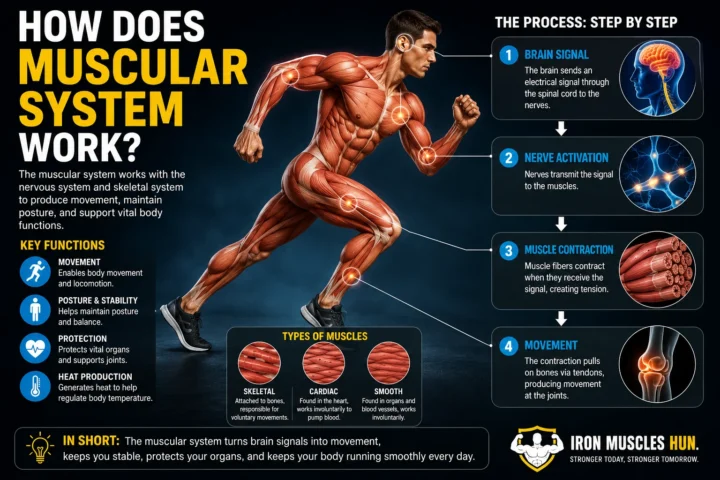
How Muscles Work Step by Step
Every movement follows a sequence that takes only fractions of a second.
| Step | What Happens |
|---|---|
| 1 | Your brain decides to move. |
| 2 | A nerve sends an electrical signal. |
| 3 | The signal reaches the muscle fibers. |
| 4 | Muscle fibers contract using ATP. |
| 5 | Tendons pull on bones. |
| 6 | The joint moves. |
| 7 | The muscle relaxes after the movement is complete. |
This entire process repeats thousands of times every day.
The Teamwork Behind Every Movement
Muscles never work alone.
Several body systems cooperate to produce every movement you make.
| Body Part | Role |
|---|---|
| Brain | Starts the movement command. |
| Nervous system | Carries electrical signals. |
| Muscles | Produce force by contracting. |
| Tendons | Attach muscles to bones. |
| Bones | Act as levers. |
| Joints | Allow movement. |
| Heart and lungs | Deliver oxygen and nutrients needed for energy. |
If any part of this system is injured or damaged, movement becomes more difficult.
What Happens Inside a Muscle?
A muscle isn’t one solid piece of tissue.
Instead, it’s built from several layers.
From largest to smallest:
- Muscle
- Fascicle (bundle)
- Muscle fiber (cell)
- Myofibril
- Sarcomere (the smallest contracting unit)
The sarcomere is where actual muscle contraction occurs.
Inside every sarcomere are two important proteins:
- Actin
- Myosin
These proteins slide past one another during contraction, shortening the muscle and producing force.
This process is known as the sliding filament theory, one of the fundamental concepts in muscle physiology.
How the Brain Controls Muscles
Your muscles don’t decide when to move.
The process begins in your brain.
Here’s what happens:
- Your brain creates a movement command.
- The spinal cord carries the signal.
- Motor neurons transmit the message.
- The muscle receives the electrical impulse.
- Muscle fibers contract almost immediately.
For voluntary movements—such as lifting a weight or typing on a keyboard—you consciously initiate the action.
For involuntary movements—like your heartbeat or digestion—the brain and nervous system regulate muscle activity automatically without conscious effort.
Muscles Need Energy to Work
Every muscle contraction requires energy.
The body’s immediate energy source is ATP (adenosine triphosphate).
Your body continually produces ATP from:
- Carbohydrates
- Fats
- Oxygen
- Stored glycogen
- Creatine phosphate (for short bursts of intense activity)
When ATP levels decrease during prolonged exercise, muscles begin to fatigue, making movement feel harder until energy stores are replenished.
Key Takeaways
| Key Point | Explanation |
|---|---|
| Muscles create movement by contracting. | They shorten to generate force. |
| Muscles only pull. | They never push bones. |
| The brain controls muscle movement. | Electrical signals travel through nerves. |
| Tendons connect muscles to bones. | They transfer force for movement. |
| ATP powers every contraction. | Without energy, muscles cannot function. |
| Muscles work in pairs. | One contracts while the opposing muscle relaxes. |
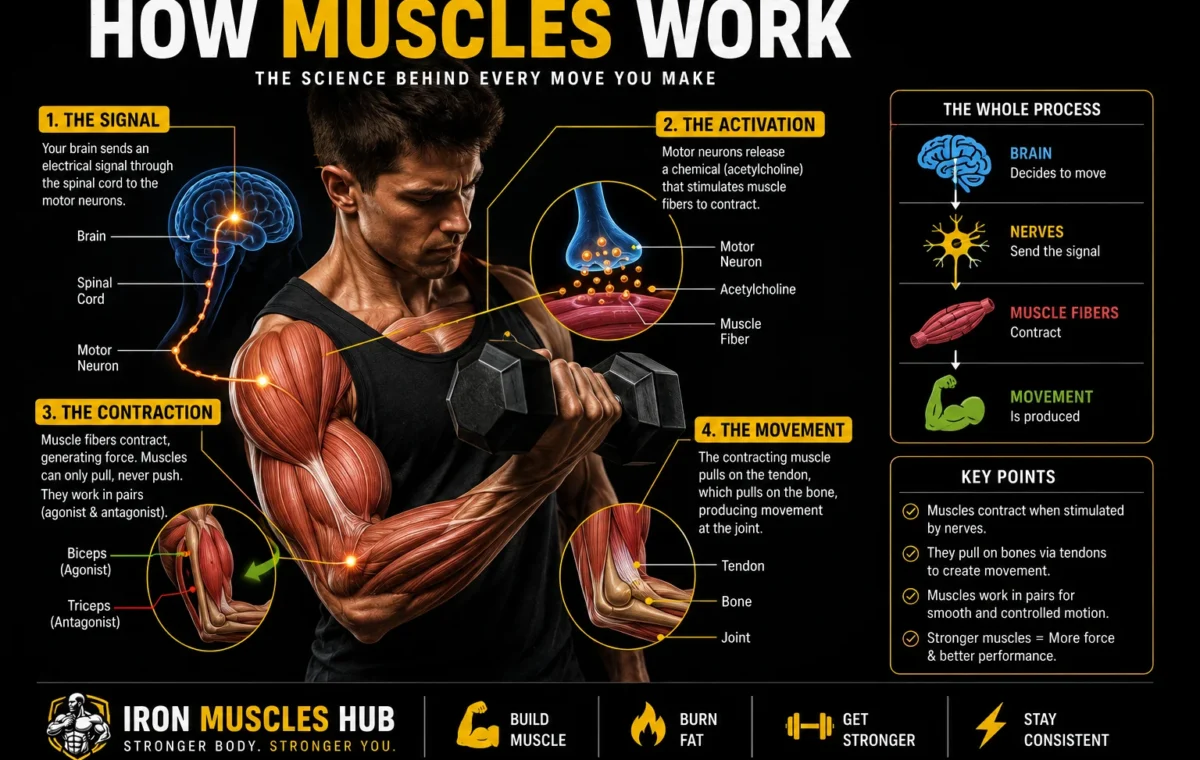
The Complete Muscle Contraction Process
Muscle contraction may seem simple from the outside, but inside your body it involves a series of carefully coordinated steps. The entire process takes only milliseconds and happens every time you move.
Step 1: Your Brain Sends a Command
Every voluntary movement starts in the brain. Whether you’re standing up, waving to a friend, or lifting a grocery bag, your brain sends an electrical signal through the spinal cord.
The signal travels along specialized nerve cells called motor neurons.
Step 2: The Signal Reaches the Muscle
The motor neuron connects with a muscle fiber at a location called the neuromuscular junction.
Here, the nerve releases a chemical messenger called acetylcholine (ACh).
This neurotransmitter tells the muscle fiber that it’s time to contract.
Step 3: Calcium Is Released
Once the muscle receives the signal, calcium stored inside the muscle cell is released.
Calcium is one of the most important minerals for muscle contraction because it allows the contractile proteins to interact.
Without calcium, muscles cannot contract normally.
Step 4: Actin and Myosin Work Together
Inside every muscle fiber are tiny protein filaments:
- Actin (thin filament)
- Myosin (thick filament)
Myosin heads attach to actin and pull it inward using energy from ATP.
This repeated pulling action shortens the muscle.
Scientists call this the sliding filament mechanism.
Step 5: ATP Provides Energy
ATP (adenosine triphosphate) fuels every contraction.
It helps:
- Power myosin movement
- Release myosin from actin
- Reset the muscle for another contraction
Without ATP, muscles would remain locked in place. This is why ATP is essential for both contraction and relaxation.
Step 6: The Muscle Pulls the Bone
As millions of muscle fibers shorten together, the whole muscle contracts.
The tendon transfers this force to the attached bone, causing movement at the joint.
For example:
- Your biceps contracts.
- The tendon pulls on the forearm.
- Your elbow bends.
Step 7: The Muscle Relaxes
After the movement is complete:
- Brain signals stop.
- Calcium returns to storage.
- Actin and myosin separate.
- Muscle fibers return to their resting length.
The muscle is now ready for the next movement.
The Three Types of Muscle Tissue
Although all muscles produce force, they aren’t all the same. The human body has three distinct muscle types.
| Muscle Type | Location | Voluntary? | Main Function |
|---|---|---|---|
| Skeletal Muscle | Attached to bones | Yes | Body movement and posture |
| Cardiac Muscle | Heart | No | Pumps blood continuously |
| Smooth Muscle | Organs and blood vessels | No | Moves food, controls blood flow, supports organ function |
Skeletal Muscle
Skeletal muscles are the muscles most people think about when exercising.
Examples include:
- Biceps
- Triceps
- Quadriceps
- Hamstrings
- Chest muscles
- Shoulder muscles
- Calves
These muscles allow you to control your movements consciously.
Cardiac Muscle
Cardiac muscle is found only in the heart.
Unlike skeletal muscle, it contracts automatically without conscious thought.
It works continuously throughout your life, pumping blood to every organ.
Smooth Muscle
Smooth muscles line many internal organs, including the:
- Stomach
- Intestines
- Bladder
- Blood vessels
- Airways
These muscles perform essential tasks automatically, such as moving food through the digestive tract and regulating blood vessel diameter.
How Muscles Work Together
Most body movements require several muscles to work as a team.
Different muscles have different roles during movement.
| Muscle Role | Function | Example |
|---|---|---|
| Agonist (Prime Mover) | Produces the main movement | Biceps during a curl |
| Antagonist | Opposes the movement | Triceps while bending the elbow |
| Synergist | Assists the main muscle | Forearm muscles during gripping |
| Stabilizer | Holds joints steady | Core muscles during lifting |
This coordination makes movements smooth, balanced, and efficient.
Real-Life Examples of How Muscles Work
Walking
Walking activates dozens of muscles simultaneously.
Major muscles involved include:
- Glutes
- Quadriceps
- Hamstrings
- Calves
- Hip flexors
- Core muscles
Each muscle contracts and relaxes in sequence to keep you balanced while moving forward.
Lifting a Box
When lifting a heavy object:
- Leg muscles generate power.
- Core muscles stabilize the spine.
- Back muscles support posture.
- Shoulder muscles position the arms.
- Biceps and forearms grip and lift.
This coordinated effort helps reduce strain on individual muscles.
Smiling
Even a simple smile involves multiple facial muscles working together.
The brain sends signals to facial muscles, which contract in specific patterns to create different expressions.
Breathing
Breathing depends on muscles too.
The diaphragm contracts and moves downward, expanding the lungs and drawing air in.
When it relaxes, air naturally flows back out.
You repeat this process thousands of times every day without thinking.
What Happens During Exercise?
Exercise places greater demand on your muscles.
In response, muscles:
- Use more ATP
- Consume more oxygen
- Increase blood flow
- Produce more heat
- Recruit additional muscle fibers
With regular strength training, muscles gradually adapt by becoming stronger and more efficient.
Why Do Muscles Get Tired?
Muscle fatigue occurs when muscles can no longer generate the same amount of force.
Common causes include:
- Reduced energy availability
- Build-up of metabolic by-products
- Temporary changes in nerve signaling
- Dehydration
- Lack of rest
Fatigue is a normal protective response and usually improves after adequate recovery.
Common Muscle Problems
Several conditions can affect normal muscle function.
| Problem | Description |
|---|---|
| Muscle strain | Overstretching or tearing muscle fibers |
| Muscle cramps | Sudden, painful involuntary contractions |
| Tendinitis | Inflammation of a tendon |
| Muscle weakness | Reduced ability to generate force |
| Delayed Onset Muscle Soreness (DOMS) | Temporary soreness after unfamiliar exercise |
Most minor muscle issues improve with rest, hydration, proper nutrition, and gradual return to activity. Persistent pain or weakness should be evaluated by a healthcare professional.
Tips for Keeping Your Muscles Healthy
Healthy muscles depend on consistent daily habits.
Stay Active
Regular movement helps maintain muscle strength, flexibility, and endurance.
Aim to include:
- Walking
- Resistance training
- Stretching
- Balance exercises
Eat Enough Protein
Protein supplies the amino acids your muscles use for repair and maintenance.
Good sources include:
- Fish
- Chicken
- Eggs
- Greek yogurt
- Beans
- Lentils
- Tofu
- Lean beef
Stay Hydrated
Water supports muscle contractions and helps regulate body temperature during activity.
Even mild dehydration can reduce physical performance.
Get Quality Sleep
Most muscle recovery occurs while you sleep.
Adults generally benefit from 7–9 hours of quality sleep each night to support recovery and overall health.
Strength Train Regularly
Resistance exercises encourage muscles to adapt over time.
Beginners should focus on proper technique and gradually increase intensity rather than lifting heavy weights immediately.
Don’t Skip Recovery
Muscles need time to repair after exercise.
Include:
- Rest days
- Light activity
- Stretching
- Good nutrition
- Adequate sleep
Recovery is an essential part of building stronger muscles.
How do muscles actually move your body?
Muscles move your body by contracting (shortening) and pulling on bones through tendons. Your brain sends electrical signals through nerves, telling specific muscles when to contract and relax. Because muscles can only pull—not push—they usually work in opposing pairs to create smooth, controlled movement.
Why do muscles need ATP?
ATP (adenosine triphosphate) is the body’s immediate source of energy for muscle contraction. It powers the interaction between the proteins actin and myosin, allowing muscles to shorten and produce force. Without ATP, muscles couldn’t contract or relax properly.
Do muscles push or pull bones?
Muscles only pull on bones. They never push. For example, when you bend your elbow, your biceps contracts to pull the forearm upward while the triceps relaxes. To straighten the arm, the triceps contracts and the biceps relaxes.
What are the three types of muscles?
The human body has three types of muscle tissue:
- Skeletal muscle – Moves bones and allows voluntary movement.
- Cardiac muscle – Found only in the heart and pumps blood continuously.
- Smooth muscle – Lines organs and blood vessels, controlling automatic body functions such as digestion and blood flow.
Each type has a specialized role, but all rely on muscle contraction to perform their function.
Why do muscles get sore after exercise?
Muscle soreness after a new or intense workout is commonly called Delayed Onset Muscle Soreness (DOMS). It usually develops 12 to 48 hours after exercise and is thought to result from tiny amounts of muscle damage that occur as your muscles adapt to new physical demands. Mild soreness is normal and generally improves within a few days.
Can muscles become stronger without exercise?
Daily activities help maintain basic muscle function, but regular resistance training is the most effective way to increase muscle strength and size. Combining exercise with adequate protein, good nutrition, hydration, and quality sleep supports healthy muscle growth and recovery.
Common Myths About How Muscles Work
Many misconceptions about muscles continue to circulate. Here are a few of the most common.
| Myth | Reality |
|---|---|
| Muscles push bones. | Muscles only pull on bones through tendons. |
| Bigger muscles always mean greater strength. | Strength also depends on technique, nervous system efficiency, and training. |
| Muscle turns into fat if you stop exercising. | Muscle and fat are different tissues. One cannot transform into the other. |
| Soreness means you had a better workout. | Effective workouts don’t always cause soreness. Progress comes from consistent training, not pain. |
| Only athletes need strong muscles. | Healthy muscles benefit everyone by improving balance, posture, mobility, and everyday function. |
Key Points to Remember
- Muscles work by contracting and relaxing to create movement.
- The brain and nervous system control every voluntary movement.
- ATP supplies the energy needed for muscle contraction.
- Actin and myosin are the proteins responsible for producing force.
- Muscles work together with tendons, bones, and joints.
- Regular exercise, balanced nutrition, hydration, and recovery help keep muscles healthy.
Final Thoughts
Understanding how muscles work makes it easier to appreciate the incredible coordination happening inside your body every day. From taking your first step in the morning to breathing while you sleep, your muscles are constantly working alongside your brain, nerves, bones, and joints.
The basic idea is surprisingly simple: your brain sends a signal, muscles contract using energy from ATP, tendons pull on bones, and movement happens. Behind that simple process is an amazing system designed for strength, balance, endurance, and precision.
Whether your goal is to improve your fitness, study anatomy, recover from an injury, or simply learn more about your body, knowing how muscles work gives you a solid foundation. Pair that knowledge with regular physical activity, nutritious eating, proper hydration, and enough rest, and you’ll be supporting your muscles for years to come.