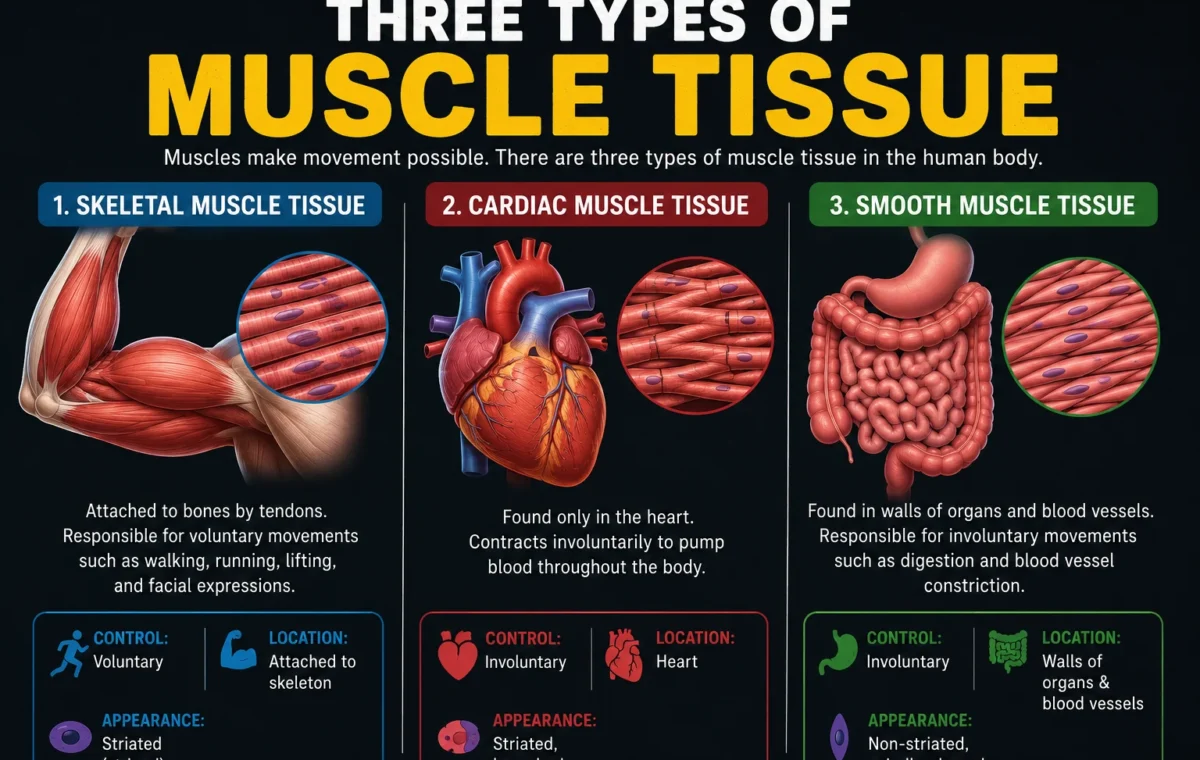
Muscle tissue allows your body to move, maintain posture, circulate blood, and perform many automatic functions that keep you alive. The three types of muscle tissue are skeletal muscle, cardiac muscle, and smooth muscle. Each has a unique structure, location, and job, but they all work by contracting and relaxing to create movement.
- Quick Answer
- Key Takeaways
- Structure of Skeletal Muscle
- Voluntary Control
- Main Functions of Skeletal Muscle
- 1. Produces Body Movement
- 2. Maintains Posture
- 3. Stabilizes Joints
- 4. Generates Heat
- Examples of Skeletal Muscles
- Why Skeletal Muscle Is Important
- Structure of Cardiac Muscle
- Involuntary Control
- Main Functions of Cardiac Muscle
- 1. Pumps Blood Throughout the Body
- 2. Maintains Blood Pressure
- 3. Supplies Oxygen and Nutrients
- 4. Removes Waste Products
- Why Cardiac Muscle Is Unique
- Where Is Smooth Muscle Found?
- Structure of Smooth Muscle
- Involuntary Control
- Main Functions of Smooth Muscle
- 1. Moves Food Through the Digestive System
- 2. Controls Blood Vessel Diameter
- 3. Controls Airflow
- 4. Supports Reproductive and Urinary Functions
- Examples of Smooth Muscle in Daily Life
- "All muscles are under conscious control."
- "The heart is made of skeletal muscle."
- "Smooth muscle is weak."
- "Exercise strengthens every muscle equally."
- What are the three types of muscle tissue?
- Which muscle tissue is voluntary?
- Where is cardiac muscle found?
- Why is smooth muscle called "smooth"?
- Which muscle tissue is the strongest?
- Can muscle tissue repair itself?
- Common Mistakes Beginners Make
- Why Understanding Muscle Tissue Matters
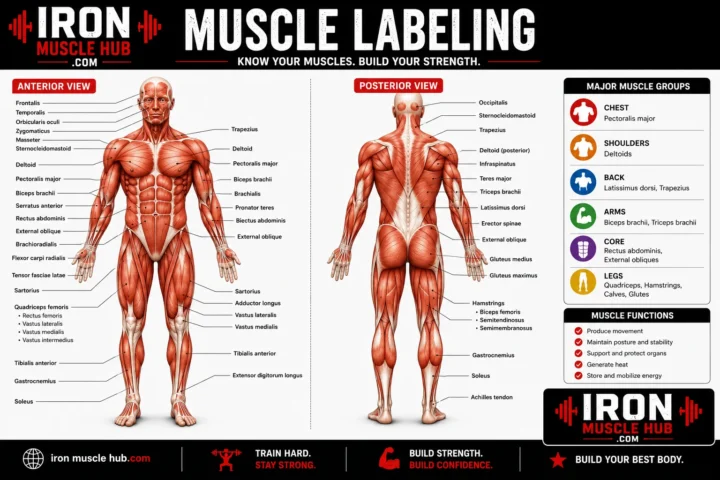
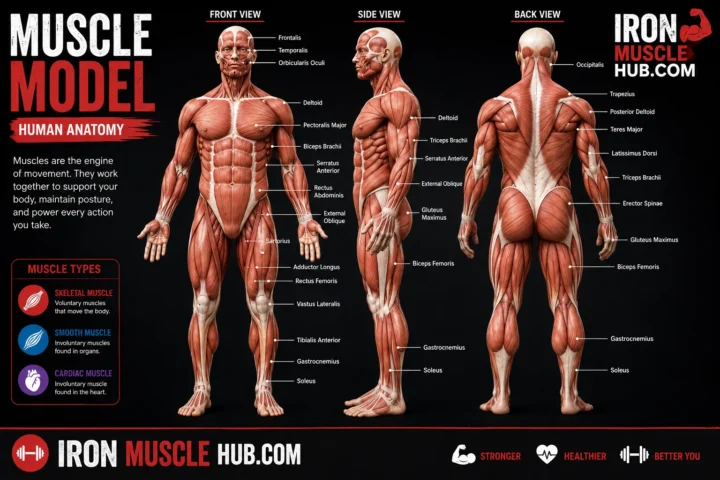
Whether you’re studying anatomy, preparing for an exam, or simply curious about how your body works, understanding these three muscle tissues is one of the best places to start. This guide explains each type in clear, beginner-friendly language with practical examples and easy-to-read comparison tables. For more insights read here :- muscles of the body and muscle anatomy.
Quick Answer
| Muscle Tissue | Found In | Voluntary or Involuntary | Main Function |
|---|---|---|---|
| Skeletal Muscle | Attached to bones | Voluntary | Moves the body and maintains posture |
| Cardiac Muscle | Heart | Involuntary | Pumps blood throughout the body |
| Smooth Muscle | Walls of organs and blood vessels | Involuntary | Moves substances through organs and regulates blood flow |
Key Takeaways
- The human body contains three different types of muscle tissue.
- Skeletal muscle helps you walk, run, lift objects, and control body movements.
- Cardiac muscle is found only in the heart and contracts continuously throughout life.
- Smooth muscle works automatically inside organs such as the stomach, intestines, bladder, and blood vessels.
- Although they have different structures, all three types contract to produce movement.
What Is Muscle Tissue?
Muscle tissue is a specialized body tissue made of cells that can contract and relax. These contractions generate force, allowing the body to move or perform essential internal functions.
Unlike many other tissues, muscle tissue is designed primarily for movement. Some muscles move your arms and legs, while others silently perform vital tasks like pumping blood or pushing food through your digestive tract.
Scientists classify muscle tissue into three major categories based on their appearance, location, and how they are controlled.
The Three Types of Muscle Tissue
Although all muscles produce movement, each type has unique characteristics that make it suitable for specific jobs.
| Type | Primary Role |
|---|---|
| Skeletal Muscle | Body movement |
| Cardiac Muscle | Blood circulation |
| Smooth Muscle | Internal organ movement |
Let’s look at each one in detail.
Skeletal Muscle
Skeletal muscle is the largest and most abundant type of muscle tissue in the human body. It makes up nearly all of the muscles you can see and consciously control.
These muscles attach to bones through strong connective tissues called tendons. When skeletal muscles contract, they pull on bones, creating movement at joints.
Examples include:
- Biceps
- Triceps
- Quadriceps
- Hamstrings
- Calf muscles
- Shoulder muscles
- Chest muscles
- Back muscles
These muscles work together every time you:
- Walk
- Run
- Jump
- Sit down
- Stand up
- Smile
- Lift weights
- Write with a pen
Structure of Skeletal Muscle
Under a microscope, skeletal muscle fibers appear striped, a pattern known as striations. These stripes are created by highly organized protein filaments called actin and myosin, which slide past one another during muscle contraction.
Key structural features include:
- Long cylindrical muscle fibers
- Multiple nuclei in each cell
- Visible striations
- Organized into bundles called fascicles
- Attached to bones by tendons
This highly organized structure allows skeletal muscles to produce powerful and precise movements.
Voluntary Control
One defining feature of skeletal muscle is that it is voluntary.
This means your brain consciously controls when these muscles contract.
For example, you decide to:
- Pick up a glass of water
- Kick a football
- Wave to a friend
- Type on a keyboard
Your brain sends electrical signals through motor neurons, telling the appropriate muscles exactly when to contract and relax.
Although skeletal muscles are voluntary, some actions become almost automatic with practice, such as riding a bicycle or playing a musical instrument.
Main Functions of Skeletal Muscle
Skeletal muscles perform several essential jobs beyond simply helping you move.
1. Produces Body Movement
Every major body movement depends on skeletal muscles.
Examples include:
- Walking
- Running
- Swimming
- Climbing stairs
- Throwing a ball
- Dancing
Without skeletal muscle, even simple everyday tasks would be impossible.
2. Maintains Posture
Even when you’re standing still, skeletal muscles remain slightly contracted.
These continuous, low-level contractions help keep you upright and balanced without requiring constant conscious effort.
3. Stabilizes Joints
Muscles surrounding joints provide support and reduce unwanted movement.
For example, muscles around the knee and shoulder help stabilize these joints during physical activity.
4. Generates Heat
Muscle contractions produce heat as a by-product.
This helps maintain your body’s normal temperature. During cold weather, rapid involuntary skeletal muscle contractions cause shivering, which increases heat production to keep you warm.
Examples of Skeletal Muscles
Some of the best-known skeletal muscles include:
| Muscle | Primary Function |
|---|---|
| Biceps brachii | Bends the elbow |
| Triceps brachii | Straightens the elbow |
| Quadriceps | Extends the knee |
| Hamstrings | Bends the knee |
| Deltoid | Raises the arm |
| Gastrocnemius | Helps you stand on your toes and walk |
| Gluteus maximus | Extends the hip and supports posture |
These muscles often work in pairs, with one contracting while the opposing muscle relaxes to produce smooth, controlled movement.
Why Skeletal Muscle Is Important
Healthy skeletal muscles are essential for:
- Daily movement
- Physical exercise
- Athletic performance
- Balance
- Joint protection
- Healthy metabolism
- Independence as you age
Regular strength training, adequate protein intake, proper hydration, and sufficient rest all help maintain strong skeletal muscles.
Cardiac muscle is a specialized type of muscle tissue found only in the heart. Its sole purpose is to pump blood throughout the body, delivering oxygen and nutrients to tissues while removing waste products.
Unlike skeletal muscle, cardiac muscle works without conscious effort. Your heart beats automatically from before you’re born until the end of your life.
Structure of Cardiac Muscle
Cardiac muscle shares some characteristics with skeletal muscle but also has several unique features that allow the heart to work efficiently.
Key characteristics include:
- Striated (striped) appearance under a microscope
- Short, branching muscle fibers
- Usually one centrally located nucleus per cell
- Cells connected by intercalated discs
- Rich supply of mitochondria for continuous energy production
Intercalated discs are specialized connections that allow electrical signals to pass quickly from one heart muscle cell to the next. This coordination helps the heart contract as a single, powerful pump.
Involuntary Control
Cardiac muscle is involuntary, meaning you do not consciously control its contractions.
Instead, the heartbeat is regulated by:
- The heart’s natural pacemaker (the sinoatrial node)
- The autonomic nervous system
- Hormones such as adrenaline
- The body’s oxygen demands
For example:
- During exercise, your heart beats faster.
- While sleeping, your heart rate slows.
- During stress, your heart pumps more rapidly to prepare your body for action.
All of these adjustments happen automatically.
Main Functions of Cardiac Muscle
1. Pumps Blood Throughout the Body
Every heartbeat pushes oxygen-rich blood to organs and muscles while returning oxygen-poor blood to the lungs.
2. Maintains Blood Pressure
Continuous pumping helps maintain blood pressure, ensuring every organ receives an adequate blood supply.
3. Supplies Oxygen and Nutrients
Without cardiac muscle, cells would quickly run out of oxygen and nutrients needed for survival.
4. Removes Waste Products
The circulatory system also carries carbon dioxide and other waste materials away from tissues.
Why Cardiac Muscle Is Unique
Unlike most skeletal muscle cells, cardiac muscle cells communicate directly with one another through intercalated discs. This allows the heart to contract in a coordinated rhythm instead of individual muscle cells working separately.
Another remarkable feature is endurance. The heart contracts roughly 100,000 times each day, making cardiac muscle one of the hardest-working tissues in the body.
Smooth Muscle
Smooth muscle is found inside the walls of hollow organs and blood vessels. Unlike skeletal muscle, it does not have visible stripes under a microscope, giving it a “smooth” appearance.
This muscle works automatically to move substances through the body and regulate the size of organs and blood vessels.
Where Is Smooth Muscle Found?
Smooth muscle lines many internal structures, including:
- Stomach
- Small intestine
- Large intestine
- Bladder
- Uterus
- Blood vessels
- Airways (bronchi)
- Esophagus
- Iris of the eye
Because these organs constantly perform essential functions, smooth muscle is active throughout the day and night.
Structure of Smooth Muscle
Smooth muscle cells differ significantly from skeletal and cardiac muscle.
Characteristics include:
- Spindle-shaped cells
- One central nucleus
- No visible striations
- Organized in sheets or layers
- Slow, sustained contractions
Although smooth muscle contracts more slowly than skeletal muscle, it can maintain contractions for much longer while using less energy.
Involuntary Control
Smooth muscle is also involuntary.
Its activity is regulated by:
- The autonomic nervous system
- Hormones
- Local chemical signals
- Stretch receptors within organs
For example:
- Food moves through your intestines while you sleep.
- Blood vessels widen during exercise.
- Your bladder contracts when it is full.
- Your pupils adjust automatically to changes in light.
You don’t have to think about any of these processes.
Main Functions of Smooth Muscle
1. Moves Food Through the Digestive System
Wave-like contractions called peristalsis push food from the esophagus through the stomach and intestines.
Without smooth muscle, digestion would stop.
2. Controls Blood Vessel Diameter
Smooth muscle can tighten or relax blood vessels.
This helps regulate:
- Blood pressure
- Blood flow
- Body temperature
3. Controls Airflow
Smooth muscle in the airways adjusts their diameter.
When the muscles relax, more air enters the lungs.
When they contract excessively, breathing becomes more difficult, as can occur during an asthma attack.
4. Supports Reproductive and Urinary Functions
Smooth muscle also helps:
- Empty the bladder
- Move urine toward the bladder
- Contract the uterus during childbirth
- Move reproductive cells through reproductive organs
Examples of Smooth Muscle in Daily Life
You experience smooth muscle activity constantly without noticing it.
Examples include:
- Digesting breakfast
- Emptying your bladder
- Adjusting blood flow during exercise
- Moving food through the intestines
- Controlling the size of your pupils
- Regulating blood pressure
These automatic actions are essential for survival.
Comparison of the Three Types of Muscle Tissue
| Feature | Skeletal Muscle | Cardiac Muscle | Smooth Muscle |
|---|---|---|---|
| Location | Attached to bones | Heart only | Walls of internal organs and blood vessels |
| Control | Voluntary | Involuntary | Involuntary |
| Appearance | Striated | Striated | Non-striated |
| Cell Shape | Long, cylindrical | Short, branching | Spindle-shaped |
| Nuclei | Many | Usually one | One |
| Speed of Contraction | Fast | Moderate, rhythmic | Slow, sustained |
| Main Function | Moves the body | Pumps blood | Moves substances through organs |
| Fatigue | Can become tired | Highly fatigue-resistant | Very fatigue-resistant |
How the Three Muscle Tissues Work Together
Although each muscle tissue has a different role, they constantly work together to keep your body functioning.
For example, imagine you’re going for a morning jog:
- Skeletal muscles move your legs, arms, and torso.
- Cardiac muscle increases your heart rate to deliver more oxygen-rich blood.
- Smooth muscle widens blood vessels to improve circulation and adjusts airflow in your lungs to support breathing.
This teamwork allows your body to respond efficiently to physical activity.
Common Misconceptions About Muscle Tissue
“All muscles are under conscious control.”
False. Only skeletal muscles are voluntary. Cardiac and smooth muscles work automatically.
“The heart is made of skeletal muscle.”
False. The heart contains only cardiac muscle, which has a unique structure and function.
“Smooth muscle is weak.”
Not at all. Smooth muscle is designed for long-lasting, energy-efficient contractions rather than producing powerful movements.
“Exercise strengthens every muscle equally.”
Exercise mainly strengthens skeletal muscles. Cardiac muscle benefits from regular aerobic activity, while smooth muscle remains active through normal body functions.
Real-Life Example
Imagine you’re carrying heavy grocery bags home.
- Your skeletal muscles allow you to lift and carry the bags.
- Your cardiac muscle pumps extra blood to your working muscles.
- Your smooth muscles regulate blood flow, keep your breathing passages open, and continue digesting the meal you ate earlier.
Even though you’re only thinking about carrying groceries, all three muscle tissues are working together continuously.
What are the three types of muscle tissue?
The three types of muscle tissue are skeletal muscle, cardiac muscle, and smooth muscle. Skeletal muscle moves your body, cardiac muscle pumps blood through your heart, and smooth muscle controls automatic movements inside organs such as the stomach, intestines, bladder, and blood vessels.
Which muscle tissue is voluntary?
Skeletal muscle is the only voluntary muscle tissue. You consciously control it when walking, lifting objects, writing, or exercising. Cardiac and smooth muscle are involuntary, meaning they work automatically without conscious effort.
Where is cardiac muscle found?
Cardiac muscle is found only in the heart. It forms the thick muscular walls that contract rhythmically to pump blood around the body. Its unique branching cells and intercalated discs help the heart beat in a coordinated, continuous pattern.
Why is smooth muscle called “smooth”?
Smooth muscle is called smooth because it lacks the visible stripes (striations) seen in skeletal and cardiac muscle under a microscope. Its cells are spindle-shaped and are specialized for slow, steady contractions that move substances through internal organs.
Which muscle tissue is the strongest?
Each muscle tissue is “strong” in a different way:
- Skeletal muscle produces powerful body movements.
- Cardiac muscle is exceptionally durable because it works nonstop throughout life.
- Smooth muscle is highly efficient at maintaining long-lasting contractions with minimal energy.
Rather than one being universally strongest, each is adapted to its specific function.
Can muscle tissue repair itself?
Some muscle tissues repair better than others.
- Skeletal muscle has a limited ability to repair small injuries through specialized stem cells called satellite cells.
- Smooth muscle generally repairs more effectively than skeletal muscle.
- Cardiac muscle has very little regenerative ability, which is why damage from a heart attack can result in permanent scar tissue.
Common Mistakes Beginners Make
When learning about muscle tissue, it’s easy to mix up the different types. Here are a few common mistakes:
| Mistake | Correct Information |
|---|---|
| Thinking all muscles are voluntary | Only skeletal muscle is voluntary. |
| Assuming all muscles look the same | Smooth muscle is non-striated, while skeletal and cardiac muscles are striated. |
| Believing the heart is made of skeletal muscle | The heart contains only cardiac muscle. |
| Forgetting where smooth muscle is located | Smooth muscle lines internal organs and blood vessels. |
| Confusing function with location | Each muscle type has a unique structure, location, and role. |
Remembering these differences makes understanding anatomy much easier.
Quick Revision Summary
If you only remember one thing from this guide, remember this table.
| Muscle Type | Location | Control | Primary Job |
|---|---|---|---|
| Skeletal Muscle | Attached to bones | Voluntary | Body movement and posture |
| Cardiac Muscle | Heart | Involuntary | Pumps blood |
| Smooth Muscle | Organs and blood vessels | Involuntary | Moves substances and regulates internal functions |
Why Understanding Muscle Tissue Matters
Knowing the three types of muscle tissue isn’t just useful for biology classes. It also helps you understand how your body works every day.
Whether you’re exercising, eating a meal, or simply sitting quietly, all three muscle tissues are working together. Skeletal muscles help you move, cardiac muscle keeps blood circulating, and smooth muscle supports automatic processes like digestion and blood flow.
Understanding these differences can also make it easier to learn about fitness, sports science, medicine, and many common health conditions.
Final Thoughts
The **three types of muscle tissue—skeletal, cardiac, and smooth—**each play an essential role in keeping your body functioning. Skeletal muscle gives you the ability to move and maintain posture, cardiac muscle powers the heart’s continuous pumping action, and smooth muscle quietly supports vital processes inside your organs.
Although they differ in appearance, location, and control, all three tissues work together every second of your life. Learning their key characteristics provides a strong foundation for understanding human anatomy, exercise science, and overall health. If you’re new to the topic, focus first on where each muscle type is found and whether it is voluntary or involuntary—those two facts make the rest much easier to remember.