If you want more protein without using up a large part of your daily calorie budget, focus on the best protein to calorie ratio foods. Shrimp, white fish, skinless chicken breast, tuna in water, egg whites, nonfat Greek yogurt, and lean turkey are among the most useful choices.
- Quick Answer
- What Does Protein to Calorie Ratio Mean?
- 15 Best Protein to Calorie Ratio Foods
- 1. Shrimp
- 2. Egg Whites
- 3. Skinless Chicken Breast
- 4. Tuna in Water
- 5. Cod and Other White Fish
- 6. Turkey Breast
- 7. Nonfat Greek Yogurt
- 8. Skyr
- 9. Low-Fat Cottage Cheese
- 10. Seitan
- 11. Tilapia
- 12. Lean Beef
- 13. Whole Eggs
- 14. Edamame
- 15. Low-Fat Dairy and Similar Foods
- If calories are tight:
- If calories are moderate:
- If you're struggling to eat enough calories:
- Mistake 1: Looking only at grams of protein
- Mistake 2: Adding lots of oil to lean protein
- Mistake 3: Eating only ultra-lean protein
- Mistake 4: Assuming protein powder is required
- Mistake 5: Chasing extremely high protein intake
- What food has the highest protein to calorie ratio?
- What is the best low-calorie high-protein food?
- How can I get 100 g of protein without many calories?
- Which meat has the most protein with the fewest calories?
- Is high protein good for building muscle?
The key isn’t simply finding foods with lots of protein. You want foods that provide a high amount of protein for the calories they contain. That makes meal planning easier when you’re trying to maintain muscle while controlling calories. Mayo Clinic similarly recommends lower-energy-density protein choices such as fish, lean poultry, low-fat dairy, beans, lentils, and egg whites. For more insights read here :- leaner physique and lean body women .
Quick Answer
- Shrimp is one of the most protein-dense whole-food choices, providing roughly 24 g protein per 100 calories.
- Egg whites, white fish, tuna in water, chicken breast, and nonfat Greek yogurt are other efficient options.
- For people who lift weights, total daily protein matters more than finding one “perfect” food.
- Research commonly supports around 1.4–2.0 g of protein per kg of body weight per day for exercising individuals.
Important nutrition note: Food nutrition values vary by brand, cooking method, water content, and serving size. The food figures below are practical approximate values rather than laboratory measurements for every brand. Protein-intake recommendations are supported separately by peer-reviewed sports-nutrition research.
What Does Protein to Calorie Ratio Mean?
Protein-to-calorie ratio tells you how much protein a food provides relative to its energy content.
A simple way to calculate it is:
Protein per 100 calories = grams of protein ÷ calories × 100
For example, suppose a food provides 25 g of protein and 125 calories:
25 ÷ 125 × 100 = 20 g protein per 100 calories
That means you get about 20 g of protein for every 100 calories.
This is useful because two foods can contain similar amounts of protein but have very different calorie costs.
A food providing 25 g of protein for 120 calories is much more protein-dense than a food providing 25 g for 350 calories.
Research on dietary protein also emphasizes that protein density isn’t the only consideration. Protein quality, essential amino acids, fat, carbohydrate, fiber, and micronutrients all matter when choosing protein foods.
So don’t treat protein-to-calorie ratio as a health score.
It’s a planning tool.
15 Best Protein to Calorie Ratio Foods
The following foods are useful starting points if your goal is to increase protein while keeping calories relatively controlled.
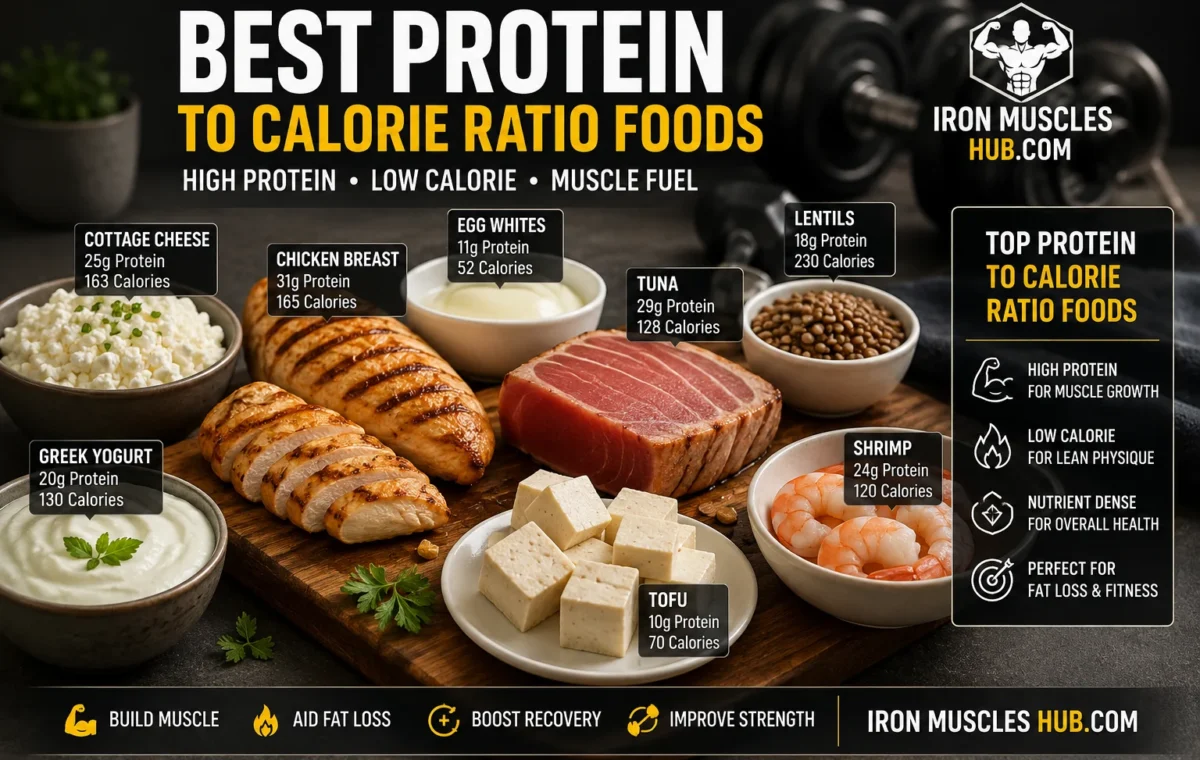
| Food | Approx. serving | Protein | Calories | Approx. protein / 100 kcal |
|---|---|---|---|---|
| Shrimp, cooked | 100 g / 3.5 oz | 24 g | 100 | 24 g |
| Egg whites | 100 g / 3.5 oz | 11 g | 52 | 21 g |
| Skinless chicken breast | 100 g / 3.5 oz | 31 g | 165 | 19 g |
| Tuna in water | 100 g / 3.5 oz | 25 g | 110–120 | 21–23 g |
| Cod | 100 g / 3.5 oz | 23 g | 100 | 23 g |
| Haddock | 100 g / 3.5 oz | 24 g | 110 | 22 g |
| Turkey breast | 100 g / 3.5 oz | 29 g | 135 | 21 g |
| Nonfat Greek yogurt | 170 g / 6 oz | 17–18 g | 90–110 | 16–20 g |
| Skyr, fat-free | 170 g / 6 oz | 17–18 g | 90–110 | 16–20 g |
| Low-fat cottage cheese | 100 g / 3.5 oz | 11–13 g | 80–100 | 11–16 g |
| Seitan | 100 g / 3.5 oz | ~25 g | ~140 | ~18 g |
| Tilapia | 100 g / 3.5 oz | ~26 g | ~130 | ~20 g |
| Lean beef | 100 g / 3.5 oz | ~26 g | ~170 | ~15 g |
| Whole eggs | 2 large | ~13 g | ~145 | ~9 g |
| Edamame, cooked | 100 g / 3.5 oz | ~12 g | ~120 | ~10 g |
Values are approximate and can change significantly between products and cooking methods.
Mayo Clinic’s guidance also supports fish, lean meat and poultry, low-fat or fat-free dairy, egg whites, beans, peas, and lentils as useful lower-energy-density protein choices.
1. Shrimp
Shrimp is one of the easiest foods to use when you want a high protein return for relatively few calories.
A typical 100 g portion contains around 24 g of protein and roughly 100 calories, although preparation and product type can change those numbers.
The main advantage is its low fat content.
You can grill, steam, boil, or pan-cook shrimp with minimal added oil. The cooking method matters because a lean protein can become a much higher-calorie meal if it’s coated in batter or cooked with large amounts of oil.
Best use: Stir-fries, salads, wraps, rice bowls, or quick dinners.
2. Egg Whites
Egg whites are another highly protein-dense option.
They contain much less fat than whole eggs because the yolk contains most of the egg’s fat and calories.
A 100 g portion of egg whites provides roughly 11 g protein for about 50 calories.
That makes them particularly useful when you want to increase protein without adding many calories.
You don’t need to eliminate whole eggs, though.
Whole eggs provide protein along with other nutrients, while egg whites give you a more calorie-efficient way to increase protein.
Best use: Omelets, scrambled eggs, breakfast sandwiches, or mixed with one or two whole eggs.
3. Skinless Chicken Breast
Chicken breast is popular among lifters for a simple reason: it’s protein-rich, widely available, versatile, and relatively lean.
A 100 g cooked portion can provide roughly 30 g of protein, depending on preparation and water loss.
Chicken is also a practical meal-prep food.
You can cook several portions at once, refrigerate them, and combine them with potatoes, rice, vegetables, wraps, or salads.
The biggest calorie trap is often not the chicken itself.
It’s the sauce, breading, cheese, oil, or creamy dressing added to it.
4. Tuna in Water
Tuna packed in water can provide a lot of protein without a large calorie load.
Around 100 g can provide approximately 25 g protein while remaining relatively low in calories.
It’s also extremely convenient.
Keep a can available for a fast lunch when you don’t have time to cook.
Try mixing tuna with Greek yogurt, mustard, lemon juice, herbs, and chopped vegetables instead of automatically using a large amount of mayonnaise.
One caution: tuna consumption should be varied with other seafood because different fish species have different mercury levels.
5. Cod and Other White Fish
Cod, haddock, pollock, and similar white fish are excellent options when protein density is your priority.
They tend to be lean while still supplying a substantial amount of protein.
A typical 100 g portion of cod provides around 20–23 g protein with relatively few calories.
White fish is especially useful if you’re bored with chicken.
Season it with lemon, garlic, paprika, black pepper, or herbs and serve it with potatoes and vegetables.
6. Turkey Breast
Skinless turkey breast can deliver a large amount of protein for its calorie content.
It’s useful for sandwiches, wraps, salads, meal-prep bowls, or a traditional dinner with potatoes and vegetables.
Choose minimally processed turkey when possible.
Deli turkey can be convenient, but some products contain considerably more sodium than fresh turkey.
7. Nonfat Greek Yogurt
Nonfat Greek yogurt gives you a different texture and meal option from meat and fish.
A typical 170 g serving can provide around 17–18 g protein, depending on the product.
It’s especially useful for breakfast or snacks.
Add berries and fruit for carbohydrates and fiber, or use it as a base for a high-protein sauce.
Check the label because flavored varieties can contain considerably more added sugar and calories than plain versions.
8. Skyr
Skyr is an Icelandic-style cultured dairy product with a thick texture and high protein content.
Many fat-free versions provide around 17–18 g protein per 170 g serving.
It’s an easy option if you want a protein-rich snack without cooking.
You can combine it with berries, oats, cinnamon, or a small amount of honey.
9. Low-Fat Cottage Cheese
Cottage cheese can provide roughly 11–13 g protein per 100 g, depending on the product.
It’s not as calorie-efficient as the very leanest fish or egg whites, but it’s still useful.
It also works in both sweet and savory meals.
Try it with fruit for a snack or with vegetables and whole-grain toast for a more substantial meal.
10. Seitan
Seitan can be a useful plant-based option because it’s unusually high in protein compared with many other plant foods.
It can provide roughly 25 g protein per 100 g, although products vary substantially.
One limitation is that seitan is made from wheat gluten, so it isn’t suitable for people who need to avoid gluten.
It also doesn’t provide the same nutritional profile as meat or fish, so variety still matters.
11. Tilapia
Tilapia is another lean fish that can provide a strong protein-to-calorie ratio.
A typical 100 g cooked portion provides roughly 25 g protein, with calories depending on preparation.
It works well in tacos, rice bowls, salads, or with roasted vegetables.
12. Lean Beef
Lean beef can fit into a high-protein diet even though it generally isn’t as protein-efficient as shrimp, white fish, or egg whites.
Its advantage is that it provides protein along with nutrients such as iron, zinc, and vitamin B12.
Choose lean cuts and control added fats during cooking.
You don’t have to avoid beef simply because another food has a better protein-to-calorie ratio.
13. Whole Eggs
Whole eggs are not at the top of the protein-density list, but they remain a useful food.
Two large eggs provide around 13 g protein and roughly 140–150 calories, depending on size.
The yolk contributes fat and calories, but it also contains important nutrients.
A practical strategy is to combine whole eggs with egg whites.
That gives you the nutritional benefits of the whole egg while increasing the total protein without adding as many calories as using only whole eggs.
14. Edamame
Edamame provides both protein and fiber.
It’s less protein-dense than shrimp or chicken, but it can be valuable for people who want more plant-based foods.
A 100 g cooked portion provides roughly 12 g protein.
Use it in rice bowls, salads, stir-fries, or as a snack.
15. Low-Fat Dairy and Similar Foods
Low-fat dairy foods can make protein intake easier without requiring another meat-based meal.
Mayo Clinic specifically lists low-fat and fat-free dairy among lower-energy-density protein choices.
Milk, yogurt, cottage cheese, and similar foods can all contribute to your daily protein total.
Why Protein-to-Calorie Ratio Matters for Lifters
For a beginner, the biggest mistake is thinking that every meal needs to contain the food with the absolute highest protein-to-calorie ratio.
It doesn’t.
The ratio becomes particularly useful when your calorie budget is limited.
Imagine you need 120 g of protein per day.
You could technically get protein from foods that also contain lots of fat and carbohydrates. But doing that may consume most of your daily calories before you’ve eaten enough fruit, vegetables, grains, or fats.
Lean protein foods give you more room.
Sports-nutrition research generally supports 1.4–2.0 g protein per kg of body weight per day for physically active people. For a 70 kg person, that’s approximately 98–140 g per day. For someone weighing 154 lb, that’s the same body weight.
Research also suggests that increasing total protein beyond roughly 1.6 g/kg/day doesn’t necessarily produce additional gains in fat-free mass during resistance training for most healthy adults.
That doesn’t mean 1.6 g/kg is a magic ceiling.
It means you shouldn’t assume that more protein automatically equals more muscle.
Your training, calories, carbohydrates, sleep, recovery, and total diet still matter.
Worked Example: 70 kg / 154 lb Beginner
Let’s make this practical.
Suppose you’re 70 kg (154 lb) and regularly perform resistance training.
A protein target somewhere around 1.6 g/kg/day gives:
70 × 1.6 = 112 g protein per day
Now imagine you build a day around lean protein sources:
- Breakfast: egg whites + 2 whole eggs = ~30 g protein
- Lunch: 120 g cooked chicken breast = ~35–37 g
- Snack: 170 g nonfat Greek yogurt = ~17–18 g
- Dinner: 120 g cod = ~27 g
Total:
Approximately 109–112 g protein
You don’t need a complicated supplement schedule.
You also don’t need every meal to be extremely low calorie.
The purpose of the protein-to-calorie ratio is to help you choose efficient foods when you need them.
A Simple Decision Rule
Use this 30-second rule when choosing between protein foods:
If calories are tight:
Choose shrimp, white fish, egg whites, tuna in water, chicken breast, turkey breast, or fat-free Greek yogurt.
If calories are moderate:
Add cottage cheese, lean beef, whole eggs, salmon, tofu, edamame, or other balanced protein foods.
If you’re struggling to eat enough calories:
Don’t automatically choose the leanest foods.
Foods with more fat or carbohydrates can make it easier to reach your energy needs.
This is an important point.
The highest protein-to-calorie ratio isn’t automatically the best food.
It’s the best tool for a specific problem: getting more protein without spending many calories.
Common Mistakes → Why → Fix
Mistake 1: Looking only at grams of protein
Why: A food can contain 30 g protein but also contain a large amount of calories.
Fix: Compare protein relative to calories when calorie control is important.
For example, don’t just ask:
“Which food has more protein?”
Ask:
“How much protein am I getting for the calories?”
Mistake 2: Adding lots of oil to lean protein
Why: Chicken, fish, and vegetables can be extremely calorie-efficient until large amounts of cooking oil are added.
Fix: Measure oils, sauces, mayonnaise, dressings, and cheese when calorie control matters.
The protein hasn’t changed.
The calorie cost has.
Mistake 3: Eating only ultra-lean protein
Why: Extremely lean foods can make it difficult to get enough total energy and dietary fat.
Fix: Include some healthy fat sources and carbohydrate-rich foods based on your overall needs.
A balanced diet shouldn’t consist of chicken breast and egg whites alone.
Mistake 4: Assuming protein powder is required
Why: Fitness marketing can make supplements seem essential.
Fix: Build most of your diet around regular foods first.
Research indicates that physically active people can meet protein needs through a varied diet, although protein supplements can be convenient when food isn’t practical.
Mistake 5: Chasing extremely high protein intake
Why: More isn’t automatically better.
Fix: Start with a sensible daily target based on body weight, training, and your overall diet.
For many exercising adults, 1.4–2.0 g/kg/day is a well-supported range.
What About Plant-Based Protein?
You don’t need to eat meat to use the protein-to-calorie concept.
Useful plant-based choices include:
- Seitan
- Edamame
- Tofu
- Tempeh
- Lentils
- Beans
- Peas
- Soy products
- Some higher-protein dairy alternatives
The challenge is that many plant foods contain meaningful amounts of carbohydrate, fat, or fiber alongside protein.
That’s not a problem.
In fact, those nutrients can be useful.
It simply means plant foods often won’t rank as highly by protein-per-calorie as very lean animal proteins.
Protein quality also matters. Research on protein sources considers amino-acid composition, digestibility, and the other nutrients that come with the food rather than judging foods solely by protein grams.
A varied diet can make this easier.
Best Protein Foods for Fat Loss
If your goal is fat loss, protein-to-calorie ratio can be especially useful.
Mayo Clinic recommends choosing foods that are relatively low in energy density while providing protein, including fish, lean meat and poultry, low-fat dairy, egg whites, beans, peas, and lentils.
A simple meal structure is:
Lean protein + high-volume vegetables + a sensible carbohydrate source + measured fat
For example:
Chicken + potatoes + vegetables + a measured amount of olive oil
or:
Cod + rice + vegetables + yogurt-based sauce
This gives you more than protein alone.
You also get carbohydrates for training, fiber, vitamins, minerals, and dietary fat.
Best Protein Foods for Muscle Gain
If you’re trying to gain muscle, don’t automatically choose the lowest-calorie protein foods at every meal.
Muscle gain usually requires enough total energy and consistent resistance training.
Very lean foods are still useful, especially if you already eat enough calories and simply need to reach your protein target.
But if you’re struggling to eat enough, foods such as:
- Whole eggs
- Salmon
- Dairy
- Lean beef
- Chicken
- Rice
- Oats
- Potatoes
- Nuts and seeds
can help create a more complete diet.
Protein supports muscle growth, but resistance training provides the stimulus.
A systematic review found that protein supplementation can modestly improve resistance-training gains in strength and fat-free mass, with no additional fat-free-mass benefit beyond roughly 1.6 g/kg/day in the analyzed data.
How Much Protein Should You Eat?
For healthy adults who exercise regularly, a commonly supported range is:
1.4–2.0 g/kg/day
Here are examples:
| Body weight | Approx. weight | 1.4 g/kg | 1.6 g/kg | 2.0 g/kg |
| 60 kg | 132 lb | 84 g | 96 g | 120 g |
| 70 kg | 154 lb | 98 g | 112 g | 140 g |
| 80 kg | 176 lb | 112 g | 128 g | 160 g |
| 90 kg | 198 lb | 126 g | 144 g | 180 g |
| 100 kg | 220 lb | 140 g | 160 g | 200 g |
These calculations are examples based on the cited 1.4–2.0 g/kg range, not personalized medical recommendations.
If you’re new to lifting, you don’t need to obsess over hitting the exact number every day.
Consistency over time matters more.
How Much Protein Per Meal?
A practical sports-nutrition recommendation is approximately 0.25 g/kg of high-quality protein per meal, or around 20–40 g, distributed across the day.
For a 70 kg / 154 lb person:
70 × 0.25 = 17.5 g
That’s a general starting calculation.
A meal containing around 20–40 g protein is often an easy practical target for many exercising adults.
You can achieve that with foods such as chicken, fish, Greek yogurt, eggs plus egg whites, cottage cheese, tofu, or other protein-rich foods.
There’s no need to eat exactly the same amount at every meal.
Who Is This NOT For?
The protein-to-calorie approach isn’t ideal as your only nutrition strategy if:
- You’re struggling to eat enough calories.
- You’re trying to gain weight but have a low appetite.
- You already have a balanced diet and don’t need to restrict calories.
- You have a medical condition requiring a specific diet.
- You’re under medical supervision for kidney, liver, metabolic, or other health issues.
- You’re replacing most of your diet with a handful of ultra-lean foods.
In those situations, overall nutrition matters more than maximizing protein density.
People with medical conditions should discuss significant dietary changes with an appropriate healthcare professional.
FAQ
What food has the highest protein to calorie ratio?
Among common whole foods, very lean options such as shrimp, egg whites, white fish, tuna packed in water, and skinless poultry provide some of the highest protein amounts relative to calories. The exact ranking changes according to the product, cooking method, and database used. Mayo Clinic also recommends lean protein sources such as fish, poultry, low-fat dairy, and egg whites when choosing lower-energy-density foods.
What is the best low-calorie high-protein food?
There isn’t one universally best choice. Shrimp, white fish, chicken breast, tuna in water, egg whites, and nonfat Greek yogurt are all practical choices. Your best option is the one you enjoy, can afford, can prepare consistently, and can fit into your overall diet. Rotating several sources is usually more practical than eating the same food every day.
How can I get 100 g of protein without many calories?
Build your day around several lean protein servings rather than trying to get 100 g from one food. For example, combine egg whites at breakfast, chicken or turkey at lunch, Greek yogurt as a snack, and fish at dinner. The exact calories depend on the products and portions. You can then add carbohydrates, vegetables, and fats according to your total energy needs.
Which meat has the most protein with the fewest calories?
Very lean poultry, such as skinless chicken or turkey breast, can provide a strong protein-to-calorie ratio. Lean fish can be even more calorie-efficient. The exact ranking depends on the cut, cooking method, and whether skin or added oil is included. For calorie control, compare the nutrition label or food database entry for the exact product you’re eating.
Is high protein good for building muscle?
Adequate protein supports muscle maintenance and growth when combined with resistance training. For healthy exercising adults, research commonly supports approximately 1.4–2.0 g/kg/day. A large meta-analysis found that increasing protein intake above roughly 1.6 g/kg/day did not produce additional resistance-training gains in fat-free mass on average.
Final Takeaway
The best protein to calorie ratio foods are useful when you want to increase protein without spending a large part of your calorie budget. Shrimp, egg whites, white fish, tuna in water, chicken breast, turkey breast, and low-fat dairy are excellent practical choices. But don’t turn protein density into a rule that controls every meal. Your body needs more than protein: carbohydrates, fats, fiber, vitamins, minerals, and enough total energy all matter. For lifters, a daily protein intake around 1.4–2.0 g/kg is a well-supported starting range. Choose several protein sources you enjoy, train consistently, and build your diet around foods you can realistically eat for months rather than chasing perfect numbers.