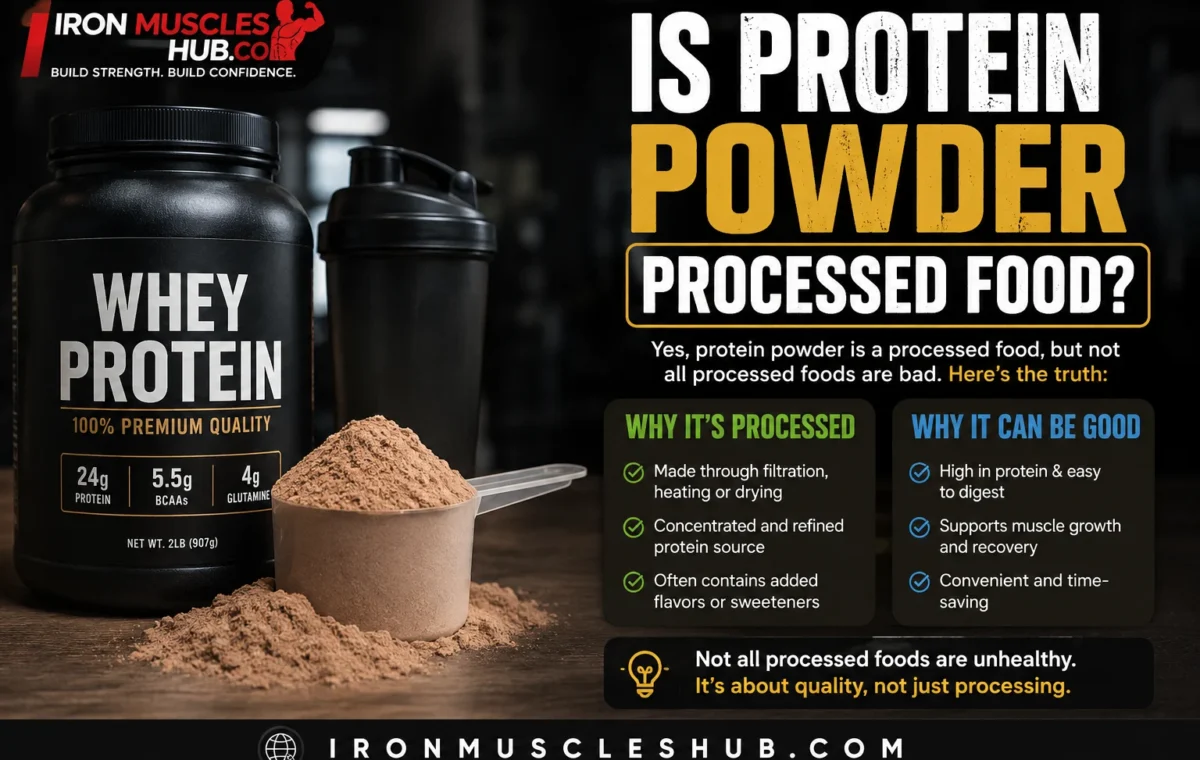
Yes. Protein powder is a processed food because protein has been extracted, concentrated or isolated from another food source and turned into a powder. Many commercial protein powders also meet the definition of an ultra-processed food under the NOVA system, especially products containing protein isolates, hydrolyzed proteins, flavors, sweeteners, emulsifiers or thickeners.
- Quick Answer
- is protein powder processed food
- Why Protein Powder Is Processed
- Whey Protein
- Whey Protein Concentrate
- Whey Protein Isolate
- Hydrolyzed Whey
- Worked Example: Where Powder Fits
- 1. Check the Protein Per Serving
- 2. Check the Ingredient List
- 3. Check Added Sugar
- 4. Check Your Tolerance
- 5. Look for Quality Testing
- Mistake 1: “Processed means unhealthy.”
- Mistake 2: Replacing meals with shakes
- Mistake 3: Choosing the biggest protein number
- Mistake 4: Ignoring the ingredient list
- Mistake 5: Assuming expensive means better
- Mistake 6: Taking several shakes because “more protein means more muscle”
- Simple decision:
- You're short on time
- Your appetite is low
- You're traveling
- You're struggling to reach your protein target
- 1. Is protein powder considered processed food?
- 2. Is protein powder ultra-processed?
- 3. Is whey protein processed food?
- 4. Is protein powder healthy?
- 5. Is protein powder better than whole-food protein?
- Final Thoughts
That doesn’t automatically mean protein powder is unhealthy.
For a beginner who lifts weights, the more useful question is: What is in the powder, how much processing does it involve, and does it help you meet your protein needs without replacing most of your normal food? For more insights read here :- map muscle and different kinds of bodybuilding .
Quick Answer
- Yes, protein powder is processed food. The protein has been separated from its original food source and concentrated into a powder.
- Many protein powders can be classified as ultra-processed, particularly flavored products containing isolates and cosmetic additives under the NOVA framework.
- Processing doesn’t automatically make a protein powder unhealthy. Nutritional value depends on the ingredients, serving size and your overall diet.
- Whole foods should still make up most of your diet, while protein powder can be a convenient way to fill a protein gap.
is protein powder processed food
The word processed sounds negative, but processing itself isn’t automatically bad.
Cooking chicken, pasteurizing milk, freezing vegetables, grinding oats and turning milk into yogurt are all forms of food processing.
The NOVA classification system looks at the type, extent and purpose of processing. It separates foods into four broad groups, ranging from minimally processed foods to ultra-processed formulations.
So there are two separate questions:
- Has the food been processed?
- Has it been ultra-processed?
Protein powder clearly falls into the first category.
The second question depends on the product and the classification method being used.
Why Protein Powder Is Processed
A whole food such as milk contains water, protein, fat, carbohydrates, minerals and other components.
Whey protein powder doesn’t look anything like milk because manufacturers have separated and concentrated specific components.
Whey, for example, comes from the liquid portion associated with cheese production. Producing a dry whey powder can involve filtration, concentration and spray drying. Food-science research describes filtration and spray drying as important stages in producing dried whey powders.
Plant proteins go through their own extraction and concentration processes.
Pea protein, for example, starts with a plant source rather than a finished protein powder. The manufacturer has to separate protein from other components before drying and packaging it.
That’s why calling protein powder “unprocessed” wouldn’t be accurate.
Is Protein Powder Ultra-Processed?
For many commercial products, yes, it can be classified as ultra-processed under NOVA.
The important word is can.
NOVA identifies ultra-processed foods partly by the presence of industrially derived ingredients and additives. Examples include protein isolates, hydrolyzed proteins, flavors, sweeteners, emulsifiers and thickeners.
That means a flavored protein powder with a long ingredient list is very different from a simple powder containing mainly one concentrated protein source.
However, there’s an important limitation:
The NOVA label tells you about processing, not the complete nutritional quality or health effect of a particular product.
A food can be highly processed and still provide a useful nutrient.
For a lifter, protein powder’s main job is simple: help you consume enough protein conveniently.
How Is Protein Powder Made?
The exact process depends on the type.
Whey Protein
Whey begins with milk.
During dairy processing, the milk is separated into different components. The liquid whey can then be processed to increase its protein concentration.
Common commercial forms include:
- Whey protein concentrate
- Whey protein isolate
- Hydrolyzed whey protein
The amount of processing differs between these products.
Whey Protein Concentrate
Whey concentrate has had much of the water and some other components removed.
It generally retains more lactose and other milk components than an isolate.
Whey Protein Isolate
Whey isolate undergoes additional separation to produce a product with a higher proportion of protein.
The result is more concentrated than the original whey.
Hydrolyzed Whey
Hydrolyzed protein has been broken down into smaller protein fragments.
This is another processing step and is one reason hydrolyzed proteins appear in discussions about ultra-processing.
What About Plant Protein Powder?
Plant protein powders can come from sources such as:
- Peas
- Soy
- Rice
- Hemp
- Other legumes or grains
The manufacturer needs to separate the protein from the original plant material.
This can involve grinding, extraction, filtration, concentration and drying.
The finished powder therefore isn’t equivalent to eating the original whole plant.
For example, eating lentils gives you protein alongside carbohydrates, fiber and other nutrients.
A highly refined protein powder is designed primarily to deliver concentrated protein.
That’s useful for a specific purpose, but it isn’t nutritionally identical to the whole food.
Protein Powder vs Whole Food: What’s the Difference?
Here’s the practical comparison beginners usually need.
| Feature | Protein Powder | Whole-Food Protein |
|---|---|---|
| Processing | Usually substantial | Can range from minimal to moderate |
| Convenience | Very high | Usually requires preparation |
| Protein concentration | High | Varies |
| Fiber | Usually low | Often higher, depending on food |
| Micronutrients | Depends on product | Often naturally present |
| Ingredients | One to many | Usually simpler |
| Portion control | Easy | Depends on food |
| Storage | Convenient | Varies |
| Main advantage | Convenient protein | Broader nutrition |
Neither option has to be “good” or “bad.”
Think of protein powder as a tool, not the foundation of your entire diet.
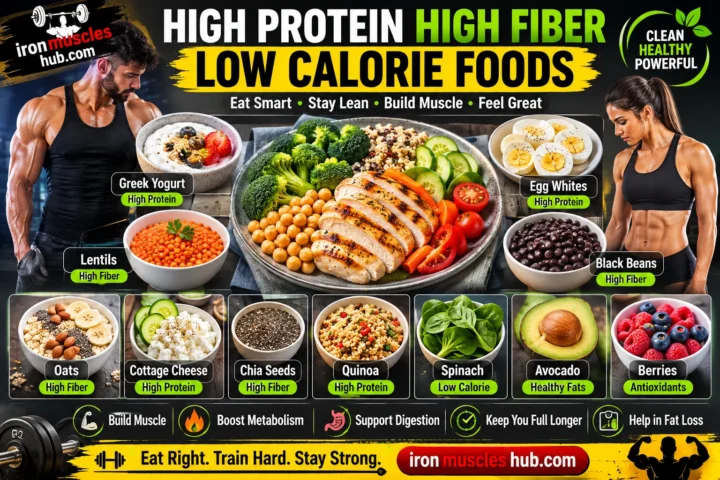
Chicken, fish, eggs, Greek yogurt, milk, beans, lentils, tofu and other protein-rich foods can provide protein alongside other nutrients.
Protein powder simply makes it easier to add protein when cooking or eating a full meal isn’t convenient.
Does Being Processed Make Protein Powder Unhealthy?
No. Processing alone doesn’t determine whether a food is healthy or unhealthy.
This is where many online discussions become unnecessarily confusing.
A protein powder can be processed and still be useful.
For example, if you’re a 75 kg (165 lb) beginner who struggles to get enough protein from meals, a simple protein shake can make your diet easier to manage.
On the other hand, drinking several shakes every day while barely eating normal meals would be a poor strategy for building a balanced diet.
The bigger picture matters.
Look at:
- Total daily protein
- Overall calorie intake
- Fruit and vegetable intake
- Fiber
- Dietary variety
- Added sugars
- Saturated fat
- Your training
- Sleep and recovery
- Individual tolerance
“Processed” is one characteristic. It isn’t a complete nutrition verdict.
How Much Protein Do You Actually Need?
You don’t need protein powder simply because you lift weights.
Your total diet matters first.
Research in resistance-trained adults suggests that increasing total protein intake can support gains in muscle and strength during resistance training, with a meta-analysis finding that benefits to fat-free mass did not continue to increase beyond roughly 1.6 g/kg/day under the conditions studied.
For a practical example:
A 75 kg (165 lb) person consuming 1.6 g/kg would get:
75 × 1.6 = 120 g protein/day
That doesn’t mean every beginner needs exactly 120 g.
It’s an example of how the math works, not a personal prescription.
Protein requirements vary with body size, age, training status, energy intake and other factors.
Worked Example: Where Powder Fits
Imagine a 75 kg (165 lb) beginner who wants roughly 120 g of protein across the day.
A sample day might look like:
| Meal | Protein |
| Breakfast | 25 g |
| Lunch | 30 g |
| Snack | 15 g |
| Dinner | 30 g |
| Protein shake | 20 g |
| Total | 120 g |
In this example, the powder contributes only 20 g of the day’s 120 g.
That’s a much different situation from getting most of your daily protein from shakes.
Is One Scoop of Protein Powder Ultra-Processed?
It depends on how the product is formulated.
A powder containing a concentrated protein source plus a small number of other ingredients is different from a heavily flavored product containing multiple sweeteners, thickeners, emulsifiers and flavoring agents.
Under the NOVA framework, ingredients such as hydrolyzed proteins and certain cosmetic additives are markers used to identify ultra-processed formulations.
So don’t judge a product by the front of the tub.
Turn it around and read the ingredient list.
What Should You Look for on a Protein Powder Label?
You don’t need to become a food scientist.
Start with five simple checks.
1. Check the Protein Per Serving
Look at the actual amount of protein rather than the marketing on the front.
A product might advertise itself as a “high-protein” shake, but the serving size can change how impressive the number looks.
2. Check the Ingredient List
Shorter isn’t automatically better, but a simple ingredient list makes it easier to understand what you’re consuming.
For a basic whey product, you might see whey protein concentrate or isolate near the beginning.
Flavored products can contain additional ingredients such as sweeteners and flavoring agents.
3. Check Added Sugar
If you’re using protein powder mainly to increase protein, there’s usually little reason to choose a product loaded with added sugar.
Compare the nutrition labels rather than assuming every powder is similar.
4. Check Your Tolerance
Some people experience digestive discomfort from certain protein products.
Whey concentrate may contain more lactose than whey isolate, so someone sensitive to lactose may tolerate one product differently from another.
If a powder repeatedly causes symptoms, don’t force yourself to keep using it.
5. Look for Quality Testing
Protein powders are dietary supplements in the U.S., and FDA explains that manufacturers are responsible for ensuring their products are safe and properly labeled, but FDA does not approve dietary supplements for safety and effectiveness before they reach the market.
That makes independent quality testing useful when available.
For competitive athletes, third-party sport certification can also matter because contamination with prohibited substances is a separate concern.
Common Mistakes → Why → Fix
Mistake 1: “Processed means unhealthy.”
Why: Processing and nutritional quality aren’t identical concepts.
Fix: Look at the ingredients, nutrition panel and how the powder fits into your overall diet.
Mistake 2: Replacing meals with shakes
Why: Protein powder is primarily a convenient protein source. It doesn’t automatically provide the full range of nutrients found in varied meals.
Fix: Build your diet around normal protein-rich foods first, then use powder where convenience helps.
Mistake 3: Choosing the biggest protein number
Why: More protein per scoop isn’t automatically better for your diet.
Fix: Consider the protein amount alongside calories, ingredients, taste, cost and how much protein you actually need.
Mistake 4: Ignoring the ingredient list
Why: The front label is marketing. The ingredient list tells you what’s actually inside.
Fix: Compare two products side by side before buying.
Mistake 5: Assuming expensive means better
Why: Price doesn’t guarantee a product is nutritionally superior.
Fix: Compare protein content, ingredients, serving size and independent testing.
Mistake 6: Taking several shakes because “more protein means more muscle”
Why: Muscle growth isn’t determined by protein alone.
Fix: Prioritize progressive resistance training, adequate total food intake, recovery and a sensible daily protein intake.
Protein supplementation can improve resistance-training adaptations when dietary protein intake is appropriate, but it isn’t a substitute for training.
A 30-Second Protein Powder Decision Rule
Before buying a protein powder, ask yourself these five questions:
1. Am I actually struggling to get enough protein from food?
If no, you may not need powder.
2. Will this make eating enough protein easier?
If yes, that’s a legitimate reason to use it.
3. Do I understand the ingredient list?
If no, compare another product.
4. Does it agree with my digestion?
If no, try a different protein source.
5. Is it replacing meals or supplementing them?
If it’s replacing most of your meals, step back and reassess your diet.
Simple decision:
Need convenience + tolerate it + reasonable ingredients = protein powder can be useful.
No need + dislike it + poor tolerance = skip it.
You don’t need a protein shake just because you’re training.
Is Whey Protein More Processed Than Milk?
Yes.
Milk is much closer to its original food form.
Whey protein powder has undergone additional separation and drying to concentrate protein.
That doesn’t mean whey protein has somehow become useless.
It means the product has been designed for a different purpose.
Milk is a complete food. Whey powder is a concentrated protein ingredient.
The difference is similar to comparing an orange with orange juice concentrate: they’re related, but they’re not the same product.
Is Whey Protein Ultra-Processed?
Many commercial whey protein products can fit the ultra-processed category under NOVA, especially when they contain isolated or hydrolyzed proteins plus additives used for flavor, sweetness, texture or appearance.
But this classification should not be confused with a claim that every scoop of whey protein is harmful.
Research on food processing classifications also highlights that “ultra-processed” is a classification concept and that processing and formulation should be considered carefully rather than treating the label as a complete nutritional assessment.
For a beginner, the practical takeaway is simple:
Don’t panic because the word “processed” appears in the discussion. Read the product and look at your whole diet.
Does Protein Powder Count as Real Food?
Protein powder is a real food-derived product, but it isn’t a whole food.
Whey comes from milk.
Soy protein comes from soy.
Pea protein comes from peas.
Egg protein comes from eggs.
But the manufacturing process changes the original food substantially.
That’s why it’s more accurate to call protein powder a processed protein supplement or protein ingredient rather than treating it as equivalent to eating the original food.
Is Protein Powder Better Than Chicken, Eggs or Greek Yogurt?
Not automatically.
Each option has a different use.
Protein powder wins on convenience.
You can mix it with water or milk in a few seconds.
Whole foods win on food variety and the broader package of nutrients they provide.
For example, eggs provide protein along with fats and micronutrients. Greek yogurt can provide protein plus calcium and other nutrients. Beans and lentils provide protein along with carbohydrate and fiber.
A smart beginner doesn’t need to pick one winner.
Use a mixture of protein-rich foods and use powder when it solves a practical problem.
What About Protein Powder and Heavy Metals?
Quality is worth taking seriously.
Studies have found that some protein supplements can contain trace amounts of potentially toxic metals, although the actual risk varies considerably by product and exposure. One human-health risk assessment found that the studied exposure scenarios did not indicate increased health risk overall, while other research has found contamination levels vary between products.
That doesn’t mean protein powder is dangerous.
It means product quality matters.
For that reason, beginners should avoid buying supplements solely because they’re cheap or heavily marketed.
Where possible, look for products with credible independent testing and transparent labeling.
Who Is Protein Powder NOT For?
Protein powder may not be necessary if:
- You already get enough protein from normal meals.
- You don’t enjoy drinking shakes.
- A particular product causes digestive problems.
- You’re using shakes to replace nearly all of your meals.
- You have a medical condition requiring specific dietary restrictions without guidance from your healthcare professional.
- You simply prefer whole foods.
There’s nothing wrong with building your protein intake entirely from food.
Protein supplements are optional.
They’re a convenience tool, not a requirement for getting stronger.
When Does Protein Powder Make the Most Sense?
Protein powder is particularly convenient when:
You’re short on time
A shake can take less time than cooking a full meal.
Your appetite is low
Some people find drinking protein easier than eating another large serving of food.
You’re traveling
A sealed powder can be easier to carry than perishable protein foods.
You’re struggling to reach your protein target
A 20–40 g serving can provide a straightforward protein boost. Sports-nutrition research commonly discusses approximately 20–40 g high-quality protein per feeding, depending on the individual and situation.
That doesn’t mean you must drink exactly 20 or 40 g.
Your overall diet and individual circumstances matter.
Do You Need Protein Powder After Every Workout?
No.
The idea that you must drink a shake immediately after every workout is overstated.
Resistance exercise increases muscle protein synthesis, and protein consumed around training can support this process. However, the overall daily protein intake and dietary pattern matter greatly.
If you ate a protein-rich meal before training and will eat another meal afterward, you may have no reason to rush for a shake.
A shake is useful when it makes your daily nutrition easier.
FAQ
1. Is protein powder considered processed food?
Yes. Protein powder is processed because protein is extracted, concentrated or isolated from a food source and converted into a powdered product. Many commercial powders can also meet the NOVA definition of ultra-processed food because they use isolated or hydrolyzed proteins and, in many cases, additives such as sweeteners, flavors and thickeners.
2. Is protein powder ultra-processed?
Many commercial protein powders are classified as ultra-processed under the NOVA framework, but the classification depends on the product’s formulation and ingredients. The important point is that “ultra-processed” describes how a product is formulated and processed; it doesn’t by itself tell you whether that particular powder is appropriate or inappropriate for your diet.
3. Is whey protein processed food?
Yes. Whey protein is made by processing the whey portion of milk and concentrating its protein. Whey concentrate, isolate and hydrolyzed whey involve different degrees or types of processing. Turning liquid whey into a shelf-stable powder requires processing such as filtration and drying.
4. Is protein powder healthy?
Protein powder can be a useful part of a balanced diet, particularly when it helps you meet protein needs conveniently. But it shouldn’t automatically replace whole foods. Check the ingredient and nutrition labels, consider independent testing, and use it as a supplement to a varied diet rather than the foundation of your nutrition.
5. Is protein powder better than whole-food protein?
No. It’s better at one thing: convenience. Whole-food protein sources provide protein within a broader food package and can contribute other nutrients. Protein powder can be useful when you’re busy, traveling or struggling to reach your protein intake. For most beginners, using both whole-food protein and occasional supplementation is a practical approach.
The Bottom Line
Yes, protein powder is a processed food, and many commercial protein powders can be classified as ultra-processed. But that doesn’t automatically make them unhealthy.
The processing is what turns milk, peas, soy or another source into a concentrated protein powder.
For a beginner lifter, focus less on the scary-sounding label and more on the complete picture: ingredients, protein content, product quality, tolerance and how the powder fits into your normal diet.
If you can easily get enough protein from chicken, fish, eggs, dairy, beans, lentils or other foods, you don’t need powder. If you’re consistently falling short, a sensible protein powder can be a convenient addition.
Use it as a tool—not as a replacement for eating well.
For more beginner-friendly muscle-building nutrition guides, explore the related protein articles on Iron Muscle Hub.
Final Thoughts
Protein powder is processed food, and some products may be classified as ultra-processed under the NOVA system. But that label alone doesn’t tell you whether a particular protein powder is a good or bad choice. Current research also points out that ultra-processed foods vary widely in their ingredients, nutritional quality and formulation.
For beginners, the practical approach is simple: build most of your diet around nutritious whole and minimally processed foods, then use protein powder when it makes reaching your protein intake easier. Check the ingredient list, protein content, added sugar and product quality rather than judging the tub by the word “processed.”
A protein shake isn’t a shortcut to muscle growth. Training consistently, eating an appropriate overall diet and recovering well still do the heavy lifting.
If you want, I can also make this article’s Final Thoughts more SEO-optimized and stronger for Google featured snippets.