If you’re searching for EWG protein powder, you’re probably trying to find a protein supplement with a better ingredient profile and fewer potential concerns. The important point is that EWG doesn’t manufacture one universal “EWG protein powder.” Instead, EWG provides databases and scoring tools that can help you examine individual products. EWG Food Scores considers nutrition, ingredient concerns, and processing, while EWG also maintains product lists containing several protein powders.
- Quick Answer
- How Does EWG Score Protein Powder?
- 1. Nutrition
- 2. Ingredient Concerns
- 3. Processing
- Worked Example: 75 kg / 165 lb Beginner
- Whey Protein
- Plant Protein
- Protein Source
- Sweeteners
- Flavors and Additives
- Mistake 1: Treating the EWG Score as a Muscle-Building Score
- Mistake 2: Comparing Scoops Instead of Protein
- Mistake 3: Assuming “Natural” Means Better
- Mistake 4: Ignoring Allergens
- Mistake 5: Taking Multiple Scoops Without Counting Them
- Mistake 6: Assuming Every Protein Powder Has the Same Contaminant Profile
- Step 1
- Step 2
- Step 3
- Step 4
- Step 5
- Step 6
- Easy Protein Shake
- What is EWG protein powder?
- Does EWG certify protein powder?
- What is the best EWG protein powder?
- Is protein powder safe to use every day?
- Does EWG protein powder help build muscle?
For a beginner, don’t stop at an EWG score. You should also check the protein amount, serving size, ingredients, allergens, added sweeteners, and whether the manufacturer provides independent testing information. For more insights read here :- guys that workout and lose weight or build muscle .
Quick Answer
- EWG protein powder isn’t a single brand or product. It usually means a protein powder evaluated through EWG resources.
- EWG Food Scores rates foods from 1 to 10, with 1 being the best and 10 the worst, using nutrition, ingredient concerns, and processing.
- A good EWG score doesn’t automatically mean a protein powder is best for muscle growth. Protein amount and overall diet still matter.
- For regular lifters, choose a product that gives you a useful amount of protein per serving, has ingredients you tolerate, and fits your dietary needs.
- Heavy-metal transparency deserves attention because recent testing and 2026 U.S. policy discussions have increased scrutiny of protein powders.
What Is EWG Protein Powder?
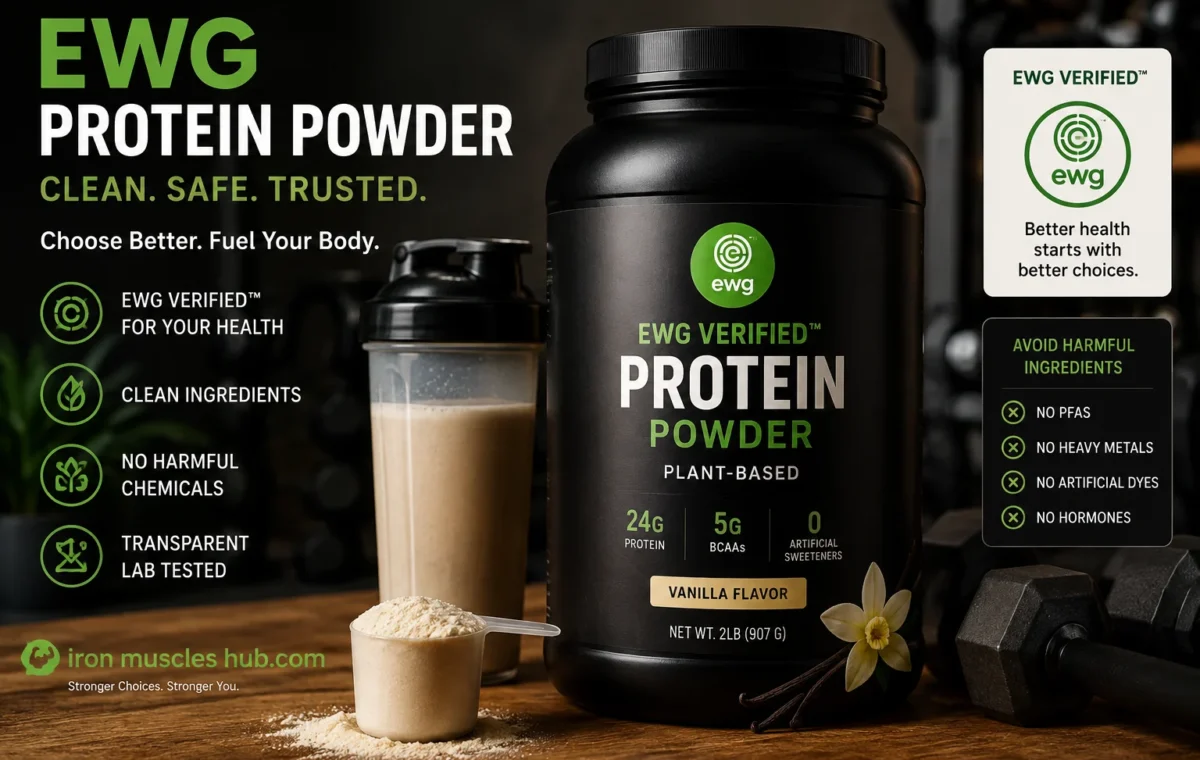
EWG protein powder usually refers to protein powders that appear in EWG’s product databases or are being evaluated using EWG’s Food Scores system.
EWG stands for the Environmental Working Group. Its Food Scores system isn’t simply a “clean protein” badge. EWG says its overall product score combines three major areas: nutrition, ingredient concerns, and processing. The organization generally gives nutrition the greatest weight, ingredient concerns the next-highest weight, and processing a smaller weight.
That distinction matters.
Imagine two protein powders:
- Powder A has 25 g protein but contains several ingredients you personally want to avoid.
- Powder B has a simpler ingredient list but only 10 g protein per serving.
If you’re using protein powder to help meet a muscle-building protein target, the second product isn’t automatically the better choice simply because its ingredient list looks simpler.
Your goal should be to combine ingredient quality with useful nutrition.
EWG currently has a protein-powder product list that includes products from brands such as Orgain, Ascent, Muscle Milk, Optimum Nutrition, BSN, Garden of Life and others. The exact products and labels can change, so you shouldn’t assume an old EWG listing represents the current formula.
How Does EWG Score Protein Powder?
EWG Food Scores uses a 1-to-10 scale.
A lower score is considered better within the EWG system. EWG explains that the score combines nutrition, ingredient concerns and processing rather than looking at only one characteristic.
1. Nutrition
The nutrition component considers factors such as:
- Calories
- Protein
- Fiber
- Sugar
- Sodium
- Saturated fat
- Trans fat
- Omega-3 fats
- Fruit, vegetable and nut content
The exact importance of each factor depends on EWG’s scoring methodology.
For a protein powder user, this means you should still read the actual Nutrition Facts label.
Don’t buy a powder simply because the overall score looks good.
Check:
Protein per serving → serving size → calories → carbohydrates → sugar → fat → sodium.
For example, a powder providing 25 g protein in a 30 g serving is very different from a product providing 12 g protein in a 50 g serving.
2. Ingredient Concerns
EWG also evaluates potential concerns related to ingredients.
Its methodology considers issues such as possible contaminants, pesticides, hormones, antibiotics and certain food additives.
This doesn’t mean every ingredient EWG flags is dangerous at normal intake.
That’s an important distinction for beginners.
A database score is a screening tool. It isn’t the same thing as a medical diagnosis or a guarantee that a particular product will harm you.
3. Processing
EWG also considers how heavily a food has been processed.
The organization says its processing assessment considers factors such as modification of individual ingredients, manufacturing information and the number of artificial ingredients.
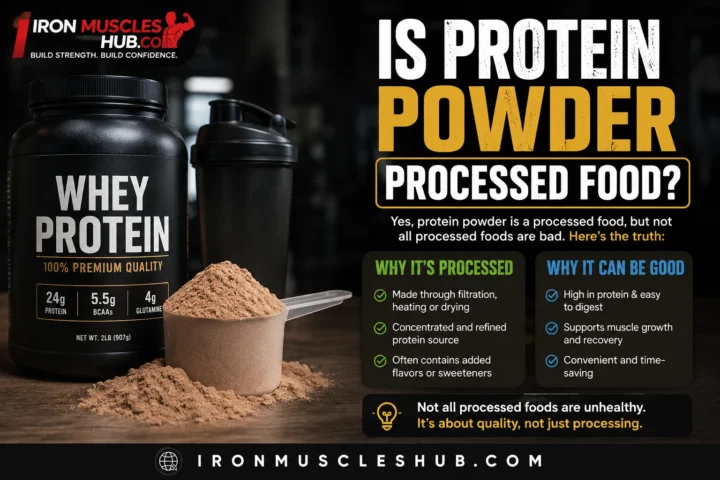
Protein powder is, by nature, a processed food.
That’s not automatically a reason to avoid it.
Whey has to be separated and processed into a usable powder. Plant proteins also require processing. The practical question is whether the finished product helps you meet your nutritional needs and fits your preferences.
Is EWG Protein Powder Safe?
An EWG score alone cannot establish that a protein powder is safe or unsafe for every person.
You need to look at the complete product.
That includes the ingredient list, allergen information, serving size, nutrition panel, manufacturer information and, when available, independent contaminant testing.
This is especially relevant to heavy metals.
In February 2026, EWG supported California legislation that would have required manufacturers to test and disclose lead, cadmium, mercury and arsenic levels in protein powders, shakes and bars. EWG reported that the proposed rules would have required regular testing and public disclosure.
By July 2026, EWG reported that SB 1033 had not advanced out of the California Senate.
So don’t tell yourself that every protein powder is contaminated.
That’s not supported by the evidence.
Instead, take the more useful position:
Heavy-metal transparency is a legitimate quality-control question worth asking, especially if you use protein powder frequently.
EWG Protein Powder vs Regular Protein Powder
The biggest misconception is that EWG protein powder is a special category of protein.
It isn’t.
A whey protein can be listed in an EWG database.
A plant protein can also be listed.
A product can have a relatively favorable EWG profile while using whey, pea, rice, milk or another protein source.
Here’s the practical comparison:
| Factor | What to Check | Why It Matters |
|---|---|---|
| Protein source | Whey, casein, soy, pea, rice, blend | Determines protein type and dietary suitability |
| Protein amount | Grams per serving | Helps you reach your daily target |
| Serving size | Total grams per scoop | Prevents misleading comparisons |
| Ingredients | Sweeteners, gums, flavors, additives | Helps match personal preferences |
| Allergens | Milk, soy, etc. | Important for allergies/intolerances |
| Calories | Calories per serving | Matters for gaining, maintaining or losing weight |
| Sugar | Total and added sugar | Useful when comparing flavored products |
| Sodium | mg per serving | Important for overall diet |
| EWG score | 1–10 when available | Screening tool for nutrition, ingredients and processing |
| Testing | Third-party/independent testing | Adds useful information about product quality |
The best choice isn’t necessarily the product with the lowest number in one column.
It’s the product that makes sense as part of your complete diet and training plan.
How Much Protein Do You Actually Need?
Protein powder only makes sense if it helps you meet an appropriate daily protein intake.
It isn’t magic.
A 2026 PubMed-indexed network meta-analysis reviewed 78 studies involving 4,755 participants and found that several protein supplements could improve outcomes when combined with resistance training, with whey showing a statistically significant benefit compared with placebo for strength and fat-free mass in that analysis.
Earlier systematic reviews have also found that protein supplementation can support gains from resistance training, particularly when it helps increase total protein intake.
For practical coaching, don’t make the mistake of thinking that more powder automatically equals more muscle.
Your total daily intake, resistance-training quality, calories, sleep and consistency all matter.
Worked Example: 75 kg / 165 lb Beginner
Suppose you’re a beginner who weighs:
75 kg / about 165 lb
You eat approximately:
- Breakfast: 20 g protein
- Lunch: 30 g
- Snack: 10 g
- Dinner: 35 g
That’s:
20 + 30 + 10 + 35 = 95 g protein
Now imagine your chosen protein powder provides 25 g protein per serving.
One serving would take your daily intake to:
95 + 25 = 120 g
That may make it much easier to reach an appropriate daily intake without adding another full meal.
Notice what the powder is doing.
It’s filling a nutritional gap.
It’s not replacing good training.
It’s not creating muscle independently.
It’s simply a convenient protein source.
Whey vs Plant EWG Protein Powder
You don’t have to choose whey just because you’re lifting weights.
Different protein sources can work.
Whey Protein
Whey is a milk-derived protein.
It’s popular because it’s convenient, relatively protein-dense and well studied in resistance-training contexts.
A 2023 network meta-analysis of 116 trials involving 4,711 participants found that milk proteins, including whey, were among the protein types associated with improvements in muscle mass and strength when combined with resistance training.
For many beginners, whey is a straightforward option if they tolerate dairy.
Plant Protein
Plant-based powders can use ingredients such as:
- Pea protein
- Soy protein
- Rice protein
- Other plant protein blends
A plant powder can be useful if you avoid dairy or follow a plant-based diet.
Don’t judge it solely by whether the word “plant” appears on the front.
Read the Nutrition Facts label.
Look at total protein per serving and the overall ingredient list.
EWG Protein Powder Ingredients to Examine
When you pick up a protein powder, spend 30 seconds reading the label.
Protein Source
Find the first major protein ingredient.
Examples include:
- Whey protein concentrate
- Whey protein isolate
- Milk protein
- Casein
- Pea protein
- Soy protein
- Rice protein
Sweeteners
Some products contain sugar.
Others use low-calorie sweeteners.
For example, EWG’s Food Scores entry for one Isopure product identifies sucralose as a low-calorie sweetener and also flags the nonspecific ingredient term “flavor.”
That doesn’t mean every product containing sucralose is automatically unsafe.
It means you should know what you’re buying.
Flavors and Additives
You may see:
- Natural flavors
- Artificial flavors
- Gums
- Lecithin
- Thickeners
- Stabilizers
- Enzymes
The presence of an unfamiliar ingredient doesn’t automatically make the product bad.
If you have a sensitive stomach, however, a simpler formula may be easier to tolerate.
Common Mistakes → Why → Fix
Mistake 1: Treating the EWG Score as a Muscle-Building Score
Why: EWG’s Food Scores system evaluates nutrition, ingredient concerns and processing. It isn’t specifically a muscle-hypertrophy ranking system.
Fix: Use the EWG score as one screening tool, then check protein quantity and your overall diet.
Mistake 2: Comparing Scoops Instead of Protein
Why: One scoop isn’t a standardized measurement.
One product might call 30 g of powder a serving while another uses 40 g.
Fix: Compare grams of protein per serving and per 100 g of powder when the information is available.
Mistake 3: Assuming “Natural” Means Better
Why: Marketing language doesn’t tell you the complete nutritional profile.
Fix: Read the Nutrition Facts panel and ingredient list before making a decision.
Mistake 4: Ignoring Allergens
Why: Whey and milk proteins aren’t appropriate for someone with a milk allergy.
Soy can also be an issue for people with soy allergies.
Fix: Check the allergen statement every time you change brands.
Mistake 5: Taking Multiple Scoops Without Counting Them
Why: It’s easy to forget that protein powder contributes to your total daily intake.
Fix: Add your protein powder to the rest of your day’s protein instead of treating it as separate from your diet.
Mistake 6: Assuming Every Protein Powder Has the Same Contaminant Profile
Why: Products differ in ingredients, sourcing and manufacturing.
Fix: Look for transparent quality-control information and independent testing when available.
A 30-Second EWG Protein Powder Decision Rule
Use this before buying.
Step 1
Check the protein.
Is the amount useful for your diet?
Step 2
Check the ingredients.
Are there ingredients you personally need or want to avoid?
Step 3
Check allergens.
Does it contain milk, soy or another ingredient relevant to you?
Step 4
Check calories and sugar.
Does the product fit your current eating goal?
Step 5
Check EWG information.
If the product is listed, see what EWG actually flags instead of focusing only on the overall score. EWG provides detailed information behind its scoring system.
Step 6
Check quality information.
Look for transparent manufacturing and testing information.
If the product passes those checks, you’ve made a much better decision than simply searching for the words “clean protein.”
Who Is EWG Protein Powder NOT For?
EWG Food Scores may be useful for shoppers who want another way to examine food products, but it shouldn’t be your only decision tool.
It’s not a substitute for medical advice.
You should be particularly careful about protein supplements if you have:
- A diagnosed food allergy
- Kidney disease
- Liver disease
- A medically restricted diet
- Pregnancy-related nutritional concerns
- A condition requiring specific protein or mineral restrictions
In these situations, speak with a qualified healthcare professional or registered dietitian before adding a supplement.
For a healthy beginner who simply struggles to eat enough protein, protein powder can be a convenient food product rather than something you must use.
Is a Lower EWG Score Always Better?
Not necessarily for your individual situation.
EWG says its Food Scores system rates products from 1 to 10 and combines multiple factors. It also explains that ingredient concerns are only one part of the overall score.
That creates an important lesson.
Suppose Product A has a lower overall score but doesn’t fit your dietary needs.
Product B may have a less favorable overall score but provide the protein source you tolerate, the calorie level you need and a flavor you can actually use consistently.
For you, Product B could be the more practical choice.
The best protein powder is the one that meets your nutritional needs, fits your preferences and helps you consistently reach your diet targets.
What About Protein Powder and Heavy Metals?
This deserves a separate discussion because the topic has received significant attention.
EWG and Consumer Reports have pushed for more transparency around lead, cadmium, mercury and arsenic in protein products. EWG reported in February 2026 that California legislation was introduced to require manufacturers to test and publicly disclose these contaminants.
The legislation later failed to advance, according to EWG’s July 2026 update.
The practical takeaway isn’t “never use protein powder.”
It’s:
Don’t assume a protein powder is automatically clean just because the front label says natural, organic or premium.
If you’re a frequent user, transparency matters.
Look for brands willing to provide meaningful quality-control information rather than relying entirely on marketing language.
Can EWG Protein Powder Help Build Muscle?
Yes, protein powder can help support muscle growth when it helps you consume enough protein alongside resistance training.
But the powder itself isn’t the training stimulus.
A recent 2026 PubMed-indexed network meta-analysis examined protein supplements alongside strength training and found significant effects for some protein supplements, including whey, on strength and fat-free mass compared with placebo.
Another PubMed-indexed meta-analysis of 35 trials found that multi-ingredient protein supplements combined with resistance training were associated with increases in fat-free mass and measures of strength compared with non-multi-ingredient supplementation conditions, although the authors noted that multi-ingredient products were not superior when directly compared with protein-only supplementation.
So think about the hierarchy:
Progressive resistance training → adequate calories → adequate protein → recovery → consistency → optional supplements.
Protein powder sits much lower on that list than beginners often think.
How to Use EWG Protein Powder
You don’t need a complicated routine.
For most beginners, the simplest approach is to use protein powder when a normal meal isn’t convenient.
For example:
Breakfast
Eggs + toast + fruit
Lunch
Chicken + rice + vegetables
Post-workout or afternoon
Protein shake
Dinner
Beef, fish, tofu or another protein source + potatoes/rice + vegetables
The powder fills the gap.
It doesn’t need to become the center of your diet.
Easy Protein Shake
A basic shake can contain:
- 1 serving protein powder
- Water or milk
- Fruit if desired
- Ice
If you’re trying to increase calories, milk, oats, nut butter or fruit can change the calorie content substantially.
If you’re trying to keep calories lower, water may be the simplest option.
The right choice depends on the rest of your diet.
EWG Protein Powder: What Beginners Should Look For
Here’s the short checklist I’d give a new lifter.
1. Useful protein amount
Don’t buy a powder that gives you very little protein unless you have a specific reason.
2. Ingredient list you understand
You don’t need to recognize every chemical name, but you should know what you’re buying.
3. Suitable protein source
Choose whey, milk, soy, pea, rice or another option that fits your diet.
4. Acceptable taste
A theoretically perfect product is useless if you can’t tolerate drinking it.
5. Reasonable calories
Check how the powder fits into your daily intake.
6. Allergen awareness
Read the allergen statement.
7. Quality transparency
Independent testing or accessible quality-control information can provide useful reassurance.
8. EWG information when available
Use the detailed score information rather than simply searching for a “best” number.
FAQ: EWG Protein Powder
What is EWG protein powder?
EWG protein powder isn’t one specific product or brand. The phrase generally refers to protein powders that appear in EWG resources or are being evaluated using EWG’s Food Scores. EWG’s Food Scores system considers nutrition, ingredient concerns and processing, with products receiving an overall score from 1 to 10. A lower score is considered better within that system.
Does EWG certify protein powder?
Not every protein powder appearing in an EWG database is “EWG certified.” EWG has different resources, including Food Scores and product lists. You should check the specific product page and understand what the particular EWG listing represents rather than assuming that every product has the same certification status. EWG’s Food Scores methodology is an evaluation system, not a general guarantee of product safety.
What is the best EWG protein powder?
There isn’t one universally best EWG protein powder for everyone. The right product depends on your protein needs, dietary restrictions, allergies, calorie requirements, taste preferences and ingredient preferences. Start by checking the protein amount and serving size, then review the ingredients, allergens and any available quality-testing information. If an EWG listing exists, use its detailed information as one part of the comparison.
Is protein powder safe to use every day?
For healthy adults, protein powder can be a convenient way to increase dietary protein, but the appropriate amount depends on your overall diet and individual circumstances. Protein powder isn’t required for muscle growth. If you have kidney disease, liver disease, food allergies or another medical condition affecting your diet, speak with a healthcare professional before using a protein supplement regularly.
Does EWG protein powder help build muscle?
A protein powder can support muscle growth when it helps you meet your protein needs while you’re following a suitable resistance-training program. Recent PubMed research supports benefits from some protein supplementation strategies when combined with resistance training. However, protein powder isn’t a replacement for progressive training, adequate food intake and recovery.
Final Takeaway
EWG protein powder should be viewed as a product-evaluation search term, not as the name of one special protein supplement. EWG provides useful information about nutrition, ingredient concerns and processing, and its databases can help you investigate individual products.
As a beginner, don’t make your decision from one score alone.
Check the protein per serving, serving size, ingredients, allergens, calories and quality-control information. If you’re using protein powder to support muscle growth, remember that the powder is simply a convenient food source. Your training, total diet and consistency still do most of the work.
If you find a product you like, use it because it fits your diet and routine—not because the label sounds impressive.