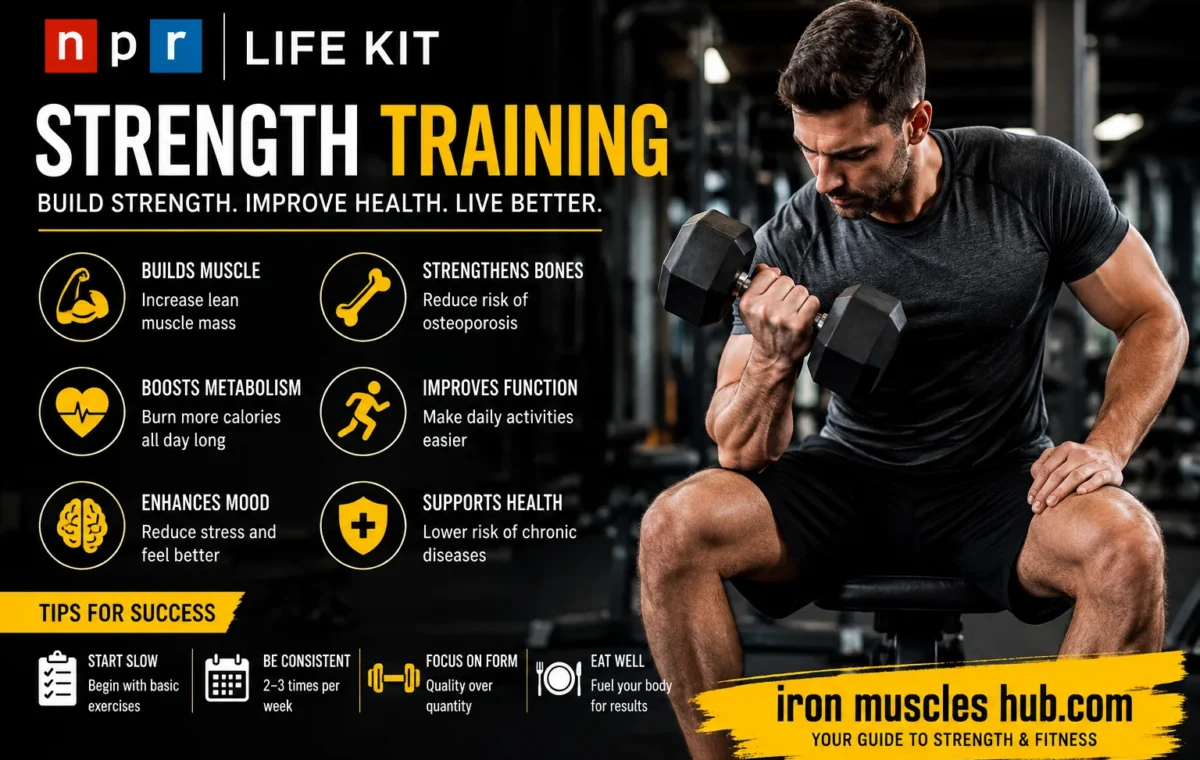
If you searched for NPR Life Kit strength training, you’re probably looking for a simple answer: how can a beginner start getting stronger without spending every day in the gym?
- Quick Answer
- What Does NPR Life Kit Say About Strength Training?
- A simple 2-day schedule
- A simple 3-day schedule
- Beginner Full-Body Workout
- How to perform the session
- 1. Squat
- 2. Hinge
- 3. Push
- 4. Pull
- 5. Carry or Core
- Option 1: Add repetitions
- Option 2: Add a small amount of weight
- Option 3: Improve technique
- Mistake 1: Starting Too Heavy
- Mistake 2: Training Seven Days a Week
- Mistake 3: Chasing Soreness
- Mistake 4: Changing the Workout Every Week
- Mistake 5: Copying an Advanced Lifters' Routine
- 1. Can I control every repetition?
- 2. Can I complete the target repetitions?
- 3. Could I repeat this workout after adequate recovery?
- At-home beginner session
- Week 1
- Week 2
- Week 3
- Week 4
- 1. How often should beginners do strength training?
- 2. Do you need to lift heavy weights to build muscle?
- 3. How long should a beginner strength workout be?
- 4. Is it normal not to be sore after strength training?
- 5. Can I start strength training at home without equipment?
The answer is encouraging. You can start with a small number of full-body movements, manageable resistance, good technique and a schedule you can actually maintain. NPR’s Life Kit coverage stresses that you don’t need extremely heavy weights, marathon gym sessions or constant soreness to make progress.
This guide takes that practical idea and turns it into a beginner-friendly plan for US and UK readers. For more insights read here :- workout and muscle chart and guys that workout .
Quick Answer
- Start with 2 full-body strength sessions per week if you’re completely new; 3 sessions can work once your recovery and technique are comfortable. NSCA guidance supports 2–3 nonconsecutive sessions for novice lifters.
- You don’t need maximum weights. Different loads can support muscle growth, while heavier loading tends to be better for developing maximal strength.
- Train the major movement patterns: squat, hinge, push, pull and core/carry work.
- Progress gradually. Add a few reps, a small amount of weight, or better control rather than trying to make every workout brutally hard.
- Recovery counts. Avoid hammering the same muscle groups hard on consecutive days when you’re starting out.
What Does NPR Life Kit Say About Strength Training?
The useful idea behind the NPR Life Kit strength training coverage is that resistance training doesn’t have to be intimidating or complicated.
The December 2025 Life Kit episode “Get into strength training in 2026” addressed common myths surrounding resistance training. It specifically pushed back against the idea that you must lift very heavy weights, spend hours at the gym or feel sore after every workout.
NPR’s related January 2026 coverage also discussed the idea of a minimum effective dose for beginners. The report described a starting point of roughly 45–90 minutes of total strength training per week, with even one weekly session involving several multi-muscle exercises being a possible entry point for someone completely new.
That doesn’t mean one workout a week is the ideal long-term target.
For general fitness, current evidence and professional guidance support training the major muscle groups at least twice weekly. The 2026 ACSM position stand found that resistance training improves strength, muscle size, power and physical function, with strength benefits associated with training at least twice per week.
So I’d make the distinction like this:
If once a week is what gets you started, that’s better than doing nothing. But two well-spaced full-body sessions are a stronger beginner target.
That’s a much more useful message than telling a new lifter that they need to follow a five-day bodybuilding split.
Why Strength Training Is Worth Your Time
Strength training isn’t just about looking more muscular.
Regular resistance exercise can improve muscular strength, muscle size, physical function and other aspects of fitness. The 2026 ACSM position stand synthesized 137 systematic reviews involving more than 30,000 participants and found meaningful benefits from resistance training compared with no exercise.
Mayo Clinic also lists benefits including increased lean muscle mass, stronger bones, improved physical function and better ability to perform everyday activities.
Think about what strength means outside the gym.
You might need to:
- Carry two shopping bags.
- Pick up a suitcase.
- Move furniture.
- Climb stairs.
- Get up from the floor.
- Carry a child.
- Lift a box from the ground.
- Maintain balance as you get older.
Those are strength tasks.
You don’t need to become a competitive powerlifter for resistance training to have value.
How Often Should a Beginner Strength Train?
For most beginners, 2–3 full-body sessions per week is a practical starting range.
The NSCA recommends two or three days per week for novice lifters performing whole-body resistance training, with nonconsecutive training days and recovery between sessions.
Mayo Clinic similarly recommends strength exercises for all major muscle groups at least twice weekly and advises against training the same muscle group on consecutive days.
A simple 2-day schedule
| Day | Training |
|---|---|
| Monday | Full body |
| Tuesday | Rest / easy activity |
| Wednesday | Rest |
| Thursday | Full body |
| Friday | Rest |
| Saturday | Optional walking |
| Sunday | Rest |
A simple 3-day schedule
| Day | Training |
|---|---|
| Monday | Full body |
| Tuesday | Rest |
| Wednesday | Full body |
| Thursday | Rest |
| Friday | Full body |
| Saturday | Rest |
| Sunday | Rest |
You don’t have to train Monday, Wednesday and Friday.
Tuesday, Thursday and Saturday works too.
The important point is spacing your harder sessions so your body has time to recover.
Do You Need to Lift Heavy Weights?
No.
This is one of the most useful points from the NPR Life Kit discussion.
Beginners often assume that a serious strength workout requires the heaviest dumbbells or barbells they can find. That’s unnecessary.
Research comparing different resistance-training loads shows that muscle growth can occur across a broad range of loads, while heavier loads generally have an advantage for developing maximal strength.
The 2026 ACSM position stand similarly found that heavier loads, particularly 80% or more of one-repetition maximum, were associated with greater voluntary strength improvements, while hypertrophy responded more strongly to sufficient overall training volume.
For a beginner, however, I don’t want you testing your one-rep maximum.
You have more important jobs:
- Learn the movement.
- Control the resistance.
- Find a repeatable range of motion.
- Stop before technique falls apart.
- Build consistency.
A 10 kg (22 lb) dumbbell you can control can be more useful than a 20 kg (44 lb) dumbbell that forces you to twist, swing or shorten every repetition.
The right starting weight is the one that lets you perform the exercise with good technique while still making the final repetitions challenging.
A Simple NPR Life Kit-Inspired Beginner Workout
Here’s where I’d turn the general Life Kit message into an actual training session.
You don’t need 12 exercises.
Start with five or six movements.
Beginner Full-Body Workout
| Exercise | Sets | Reps | Beginner option |
|---|---|---|---|
| Squat to bench | 1–2 | 8–12 | Bodyweight |
| Dumbbell Romanian deadlift | 1–2 | 8–12 | Light dumbbells |
| Incline push-up | 1–2 | 6–12 | Wall push-up |
| Seated cable or band row | 1–2 | 8–12 | Resistance band |
| Step-up | 1–2 | 6–10 each side | Low step |
| Plank | 1–2 | 15–30 sec | Kneeling plank |
Mayo Clinic notes that strength training can be performed using free weights, machines, resistance bands or bodyweight, so you don’t need a traditional gym setup.
How to perform the session
Start with a few minutes of easy movement to raise your temperature and prepare for training.
Then perform your first exercise.
Don’t rush.
For the first few weeks, your goal is not to prove how strong you are. Your goal is to learn what a good repetition feels like.
After each set, take enough recovery time that you can perform the next set with reasonable technique.
You can then move through the remaining exercises.
The workout might look surprisingly easy compared with what you see experienced lifters doing.
That’s fine.
You’re building the foundation.
The Five Movement Patterns Beginners Should Learn
Instead of memorizing dozens of exercises, learn a handful of movement patterns.
1. Squat
The squat pattern trains your lower body, particularly the muscles around the hips and thighs.
Begin with:
- Bodyweight squat
- Squat to a bench
- Goblet squat
If your mobility makes a deep squat uncomfortable, don’t force depth.
Use a range of motion you can control.
2. Hinge
The hinge teaches you how to move through your hips while keeping control of your trunk.
Good beginner choices include:
- Hip hinge drill
- Dumbbell Romanian deadlift
- Kettlebell deadlift from an elevated position
Don’t turn a hinge into a rushed lower-back movement.
Think hips back, then hips forward.
3. Push
You can push horizontally with:
- Wall push-ups
- Incline push-ups
- Knee-supported push-ups
- Standard push-ups
- Dumbbell bench press
Pick the variation where you can maintain control.
4. Pull
Pulling movements train your upper back and arms.
Try:
- Resistance-band row
- Cable row
- Chest-supported dumbbell row
- Machine row
A beginner doesn’t need to start with complicated pull-up progressions.
5. Carry or Core
You can train your trunk with:
- Planks
- Dead bugs
- Farmer carries
- Suitcase carries
- Bird dogs
A farmer carry is especially simple.
Pick up two manageable weights, stand tall and walk under control.
You don’t need to make it complicated.
Worked Example: Choosing Your Starting Weight
Let’s say you’re a beginner who weighs 75 kg (165 lb).
You have access to adjustable dumbbells.
You test a goblet squat with a 10 kg (22 lb) dumbbell.
You can perform:
- Rep 1: controlled
- Rep 2: controlled
- Rep 3: controlled
- Rep 4: controlled
- Rep 5: controlled
- Rep 6: controlled
- Rep 7: controlled
- Rep 8: controlled
- Rep 9: challenging
- Rep 10: challenging
- Rep 11: technique starts to slow
- Rep 12: still controlled
That’s a reasonable starting point.
You don’t need to jump immediately to 15 kg (33 lb).
Instead, repeat the movement over several sessions.
If you eventually reach 12 clean repetitions comfortably for all planned sets, you can increase the load slightly.
For example:
10 kg (22 lb) → 12.5 kg (27.6 lb)
Then work your repetitions back up.
This is a simple form of progressive overload.
It gives you a measurable way to improve without turning every workout into a test.
How to Progress Without Overthinking It
Progressive overload doesn’t mean you must add weight every workout.
You have several options.
Option 1: Add repetitions
If your target is 8–12 reps:
Week 1: 8 reps
Week 2: 9 reps
Week 3: 10 reps
Week 4: 11 reps
Week 5: 12 reps
If technique remains solid, increase resistance and return closer to 8 reps.
Option 2: Add a small amount of weight
Example:
10 kg (22 lb) → 12 kg (26.5 lb)
The exact jump depends on the equipment available.
Option 3: Improve technique
Progress isn’t always visible on a weight stack.
You might:
- Use a smoother tempo.
- Reach a comfortable deeper range.
- Reduce swinging.
- Maintain better posture.
- Control the lowering phase.
- Perform the same weight with less effort.
That’s real progress.
Common Mistakes → Why → Fix
Mistake 1: Starting Too Heavy
Why: Beginners often judge a workout by the amount of weight on the bar.
Fix: Start with a resistance level you can control. Technique comes before load.
Mayo Clinic specifically emphasizes proper technique because poor weight-training technique can contribute to injuries.
Mistake 2: Training Seven Days a Week
Why: More gym time feels like faster progress.
Fix: Start with 2–3 full-body sessions and leave recovery days between harder sessions.
The NSCA recommends nonconsecutive training days for novice whole-body resistance training.
Mistake 3: Chasing Soreness
Why: You assume that if you aren’t sore, the workout didn’t work.
Fix: Track performance instead.
Ask:
- Did I complete my planned repetitions?
- Was my technique better?
- Did the weight feel more manageable?
- Did I recover well?
- Can I repeat the workout next time?
Soreness isn’t a scorecard.
NPR’s Life Kit coverage specifically addressed the misconception that you need to remain sore to know your training is effective.
Mistake 4: Changing the Workout Every Week
Why: New exercises look exciting.
Fix: Keep your basic movements long enough to learn them.
A beginner needs repetition and practice.
If you change squats, presses, rows and hinges every session, it becomes harder to tell whether you’re actually improving.
Mistake 5: Copying an Advanced Lifters’ Routine
Why: You see someone training five days a week and assume that’s what you should do.
Fix: Match your training to your current experience.
A beginner doesn’t need the same workload as someone who has spent years lifting.
The goal is to create a routine you can perform consistently.
30-Second Beginner Strength Decision Rule
Before adding more weight, ask yourself three questions:
1. Can I control every repetition?
If no, keep the same weight or reduce it.
2. Can I complete the target repetitions?
If no, the load may be too challenging.
3. Could I repeat this workout after adequate recovery?
If the answer is yes, you’re probably working at a manageable level.
This isn’t a medical test or a guarantee of the perfect training load.
It’s simply a practical coaching filter.
Control → Complete → Recover → Progress.
How Long Should a Strength Workout Last?
You don’t need to spend two hours in the gym.
The NPR Life Kit material highlights relatively short sessions as a practical option, with its January 2026 coverage discussing roughly 45–90 minutes across an entire week as a possible minimum-dose starting point.
Mayo Clinic also notes that meaningful improvements can occur with two or three 20–30-minute strength sessions per week.
For a beginner, a useful structure is:
| Part | Approximate time |
|---|---|
| General warm-up | 5 minutes |
| Main exercises | 20–30 minutes |
| Optional accessory/core work | 5–10 minutes |
| Total | About 30–45 minutes |
The exact duration isn’t the important part.
The quality and consistency of your training matter more than making the workout unnecessarily long.
Do You Need a Gym?
No.
A gym is useful because it gives you access to lots of resistance options, but it isn’t mandatory.
You can train with:
- Bodyweight
- Resistance bands
- Dumbbells
- Kettlebells
- A backpack
- Household objects that are safe to handle
- Machines
- Barbells
Mayo Clinic lists bodyweight exercises, resistance tubing, free weights and machines among the available options for strength training.
At-home beginner session
Try:
- Squat to chair
- Hip hinge
- Incline push-up against a stable surface
- Resistance-band row
- Step-up
- Plank
You can perform the same movement patterns without walking into a weight room.
That can be a major advantage if the gym environment makes you uncomfortable.
Who This Is NOT For
This beginner guide is not a substitute for individualized medical or rehabilitation advice.
You should seek appropriate professional guidance before starting or changing an exercise program if you have:
- A current injury
- Significant joint pain
- A diagnosed medical condition affecting exercise
- Unexplained chest pain
- Fainting or unexplained dizziness
- Other symptoms that make exercise unsafe
- Specific rehabilitation needs
Mayo Clinic advises people with chronic conditions or safety concerns to speak with a healthcare professional before beginning a strength-training program.
If an exercise causes sharp or unusual pain, stop rather than trying to push through it.
What About People Over 40 or 50?
Strength training isn’t only for young gym-goers.
Mayo Clinic notes that muscle mass and strength tend to decline with age and that resistance training can help maintain or increase muscle and strength while supporting bone health and physical function.
For an older beginner, the same broad principles apply:
Start manageable. Learn technique. Progress gradually. Recover.
The exercises may simply need to be adjusted.
For example, instead of immediately performing a free-weight squat, you might start with a controlled sit-to-stand from a chair.
Instead of a floor push-up, use a wall or elevated surface.
The objective isn’t to make the exercise impressive.
The objective is to make it appropriate.
Strength Training and Body Weight
You don’t need to lose weight before starting resistance training.
You also don’t need to gain a large amount of body weight to become stronger.
Your training goal might be:
- General fitness
- Strength
- Muscle growth
- Better physical function
- Supporting bone health
- Improving confidence with movement
- Maintaining strength as you age
Those goals can require different programming.
For beginners, however, the foundation is similar: train consistently and eat a balanced diet that supports your overall needs.
Avoid extreme diets or aggressive weight changes simply because you started lifting.
Should You Train to Failure?
Beginners often think every set needs to end with the inability to perform another repetition.
That’s not necessary.
The 2026 ACSM review found that training to momentary muscle fatigue did not consistently affect outcomes across resistance-training programs.
For a new lifter, leaving some room before technical failure is often a sensible coaching approach.
If your final repetition is slow but controlled, that’s different from a repetition where you have to twist, bounce or use momentum.
Technical quality is your limit.
Once your technique starts breaking down, the set is effectively finished.
Recovery: The Part Beginners Often Ignore
Training provides the stimulus.
Recovery gives your body the opportunity to adapt.
That doesn’t mean lying on the sofa all day.
Recovery can include:
- Sleep
- Normal daily movement
- Walking
- Adequate food
- Hydration
- Rest days
- Managing training volume
The NSCA specifically recommends recovery spacing for novice whole-body resistance training.
You may experience some muscle soreness after a new workout.
That’s common, particularly when you introduce unfamiliar movements.
But soreness shouldn’t be your goal.
A good training program should allow you to return and perform useful work again.
A Simple Four-Week Beginner Plan
Here’s a straightforward way to put everything together.
Week 1
2 sessions
- Squat pattern
- Hinge
- Push
- Pull
- Core
Use conservative resistance.
Focus on learning the movements.
Week 2
2 sessions
Keep the exercises mostly unchanged.
Try to make your repetitions slightly smoother.
If the previous loads were clearly too easy, make a small adjustment.
Week 3
2–3 sessions
If you’re recovering well and your schedule allows it, add a third session.
Don’t automatically triple your workload.
Keep the sessions manageable.
Week 4
2–3 sessions
Review your log.
Look for:
- More repetitions
- Slightly heavier resistance
- Better technique
- Greater range of motion
- Easier completion of the same workout
Then choose what to progress.
This approach gives you something many beginners lack: a record of what you’re actually doing.
What to Track in Your Workout Log
You don’t need sophisticated software.
A notebook or phone note is enough.
Record:
| Exercise | Weight | Reps | Notes |
|---|---|---|---|
| Goblet squat | 10 kg / 22 lb | 10 | Good control |
| DB RDL | 8 kg / 17.6 lb each | 10 | Easy |
| Incline push-up | Bodyweight | 8 | Good |
| Band row | Medium band | 12 | Controlled |
| Step-up | Bodyweight | 8/side | Stable |
| Plank | Bodyweight | 20 sec | Moderate |
After a few weeks, you can see your progress instead of relying on memory.
That’s valuable.
A beginner who adds one clean repetition to an exercise has improved.
You don’t need a dramatic transformation every week.
FAQ: NPR Life Kit Strength Training Questions
1. How often should beginners do strength training?
For most beginners, 2–3 full-body sessions per week is a practical target. NSCA guidance recommends two or three nonconsecutive days for novice whole-body resistance training. Mayo Clinic also recommends training all major muscle groups at least twice weekly.
If you’re starting from zero and can only manage one session, don’t let the perfect schedule stop you from beginning. Build the habit first, then work toward two sessions when your schedule and recovery allow it.
2. Do you need to lift heavy weights to build muscle?
No. Research shows that muscle hypertrophy can occur across a broad range of resistance-training loads. Heavier loads generally have an advantage when the goal is maximal strength, but you don’t need maximal loads to stimulate muscle growth.
For beginners, controlled resistance that allows good technique is usually a better starting point than chasing the heaviest weight available. Increase resistance gradually as your skill improves.
3. How long should a beginner strength workout be?
It doesn’t need to be extremely long. Mayo Clinic notes that improvements can occur with two or three 20–30-minute strength sessions per week, while NPR’s 2026 Life Kit coverage discussed a relatively small weekly training dose as a starting point.
For practical purposes, 30–45 minutes is plenty of time for many beginners to warm up and complete five or six basic exercises without rushing.
4. Is it normal not to be sore after strength training?
Yes. Soreness isn’t a requirement for an effective workout. NPR’s Life Kit coverage specifically challenged the idea that you need to stay sore to prove your training is working.
Instead, monitor performance. Are you completing more repetitions? Is your technique improving? Does the same weight feel easier? Those are more useful indicators of progress than soreness alone.
5. Can I start strength training at home without equipment?
Yes. Strength training can be performed using bodyweight, resistance bands and other forms of resistance. Mayo Clinic lists bodyweight exercise and resistance tubing alongside free weights and machines as viable options.
Start with simple movements such as squats, incline push-ups, hip hinges, band rows, step-ups and planks. As you become stronger, you can add dumbbells, bands or other appropriate resistance.
Final Takeaway
The best lesson from NPR Life Kit strength training isn’t that you need a complicated program. It’s almost the opposite.
Start small.
Train your whole body.
Use resistance you can control.
Give yourself time to recover.
Then gradually make the work harder.
For most beginners, two full-body sessions per week are a sensible target, with a third session available when recovery, technique and schedule support it. You don’t need to chase maximum weights or soreness. Research supports resistance training across different loads, while heavier loading has particular value for maximal strength.
Your first goal isn’t to become an advanced lifter.
Your first goal is to become someone who trains consistently.
Start with the next manageable workout, record what you did, and build from there.
If you want more beginner-friendly guidance, explore the related muscle anatomy, human musculature chart, and protein breakfast resources on Iron Muscle Hub.