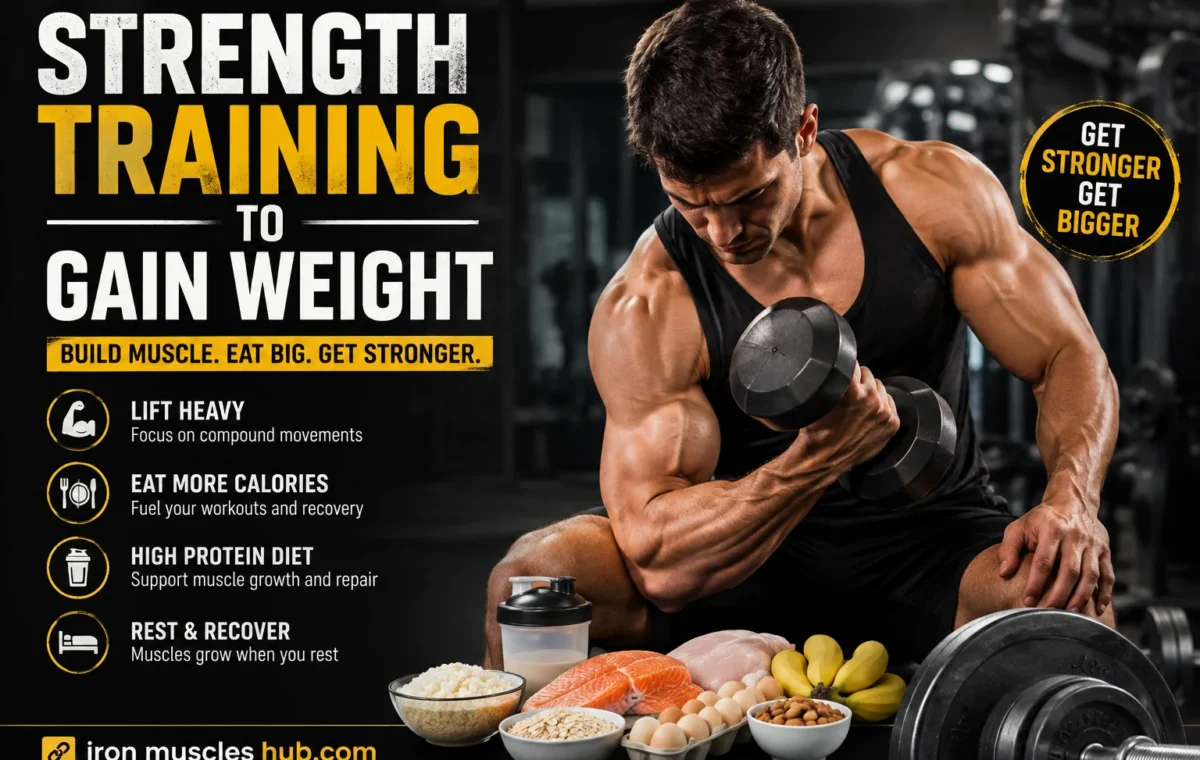
If your goal is to gain weight through strength training, don’t make the mistake of simply eating everything in sight. The better approach is to give your muscles a reason to grow, eat enough energy and protein to support that growth, and increase your training gradually.
- Quick Answer: Can Strength Training Help You Gain Weight?
- Weight Gain vs. Muscle Gain
- 1. Resistance Training
- 2. Enough Energy
- 3. Enough Protein
- Good Protein Foods for Weight Gain
- A Better Beginner Strategy
- Three-Day Full-Body Beginner Routine
- Workout B
- Step 1: Protein
- Step 2: Training
- Step 3: Weight Monitoring
- Step 4: Performance
- Breakfast
- Lunch
- Snack
- Dinner
- Before Bed
- Mistake 1: Eating Anything and Everything
- Mistake 2: Doing Lots of Cardio While Trying to Gain
- Mistake 3: Changing Your Workout Every Week
- Mistake 4: Training Hard but Not Eating Enough
- Mistake 5: Chasing the Scale Every Day
- Mistake 6: Adding Weight With Poor Form
- Mistake 7: Thinking More Protein Automatically Means More Muscle
- Question 1
- Question 2
- Question 3
- Question 4
- Can strength training help you gain weight?
- How much protein do I need to gain muscle?
- How many days a week should I strength train to gain weight?
- How many calories should I eat to gain weight?
- Can I gain weight without getting fat?
- Weeks 1–4: Learn
- Weeks 5–8: Progress
- Weeks 9–12: Build
- Final Thoughts
Strength training can help you gain body mass by stimulating muscle growth. But the scale only moves upward when your overall energy intake is sufficient. Current evidence also shows that there isn’t one magic calorie surplus that guarantees the perfect balance of muscle and fat gain. For more insights read here :- muscle gain fat loss and guys that workout .
Quick Answer: Can Strength Training Help You Gain Weight?
- Yes. Resistance training stimulates adaptations that can increase muscle size and strength.
- Eat enough total food to support weight gain rather than relying on training alone.
- Aim for roughly 1.6 g of protein per kg of body weight per day as a practical evidence-based target for many healthy adults doing resistance training.
- Train major muscle groups consistently and progress your exercises over time.
- Monitor your bodyweight and performance instead of chasing rapid scale increases.
strength training gain weight
Strength training helps you gain weight primarily by giving your muscles a stimulus to adapt and grow. If you combine progressive resistance training with adequate calories and protein, some of the additional body mass can come from lean tissue. However, strength training doesn’t guarantee that every kilogram or pound gained will be muscle.
Your body responds to resistance exercise by adapting to the training stress.
Over time, these adaptations can include increased muscle size and improved strength. The 2026 ACSM position stand, based on an overview of 137 systematic reviews involving more than 30,000 participants, found that resistance training improves muscle strength and hypertrophy among other physical outcomes.
That’s why the scale isn’t the only thing you should track.
If you gain 2 kg (4.4 lb) but your waist increases quickly while your gym performance stays unchanged, that’s a different outcome from gaining 2 kg while your lifts, measurements and overall performance are improving.
Weight Gain vs. Muscle Gain
These terms aren’t interchangeable.
Weight gain means your total body mass increases.
Muscle gain means some of that increase comes from skeletal muscle tissue.
Your bodyweight can increase because of:
- Muscle tissue
- Body fat
- Water
- Glycogen
- Food in your digestive system
- Other changes in body mass
So don’t expect the number on your bathroom scale to tell you exactly how much muscle you’ve gained.
For beginners, strength improvements can also happen because your nervous system becomes better at coordinating movement and producing force. In other words, becoming stronger doesn’t always mean you’ve added the same amount of muscle.
That distinction is important.
What You Need for Healthy Weight Gain
Think of weight gain as a three-part system:
Training + Food + Recovery
Remove one part and progress can become harder.
1. Resistance Training
Your muscles need a reason to adapt.
That stimulus comes from exercises such as:
- Squats
- Romanian deadlifts
- Deadlifts
- Bench presses
- Overhead presses
- Rows
- Pull-downs
- Pull-ups
- Lunges
- Split squats
You don’t need every exercise.
A beginner can make excellent progress with a small collection of movements that train the major muscle groups consistently.
2. Enough Energy
If you consistently eat less energy than your body uses, gaining body mass becomes difficult.
A calorie surplus can make weight gain easier, but the exact surplus required for optimal muscle growth isn’t firmly established. A PubMed review specifically noted that the commonly recommended surplus ranges haven’t been adequately validated as a universal “sweet spot.”
That’s why I prefer a monitoring approach rather than blindly adding huge amounts of food.
Start with a modest increase in food intake, monitor your average bodyweight and adjust if needed.
3. Enough Protein
Protein provides amino acids required for building and repairing body tissues.
A major meta-analysis of 49 studies involving 1,863 participants found that protein supplementation increased gains in fat-free mass and strength during prolonged resistance training, with no additional fat-free-mass benefit above approximately 1.62 g/kg/day in the analysis.
For practical purposes, around 1.6 g/kg/day is a useful target for many healthy adults who are resistance training.
You don’t need to turn every meal into a protein challenge.
Spread your intake across normal meals and choose foods you can consistently eat.
How Much Protein Do You Need to Gain Weight?
A simple calculation is:
Bodyweight in kg × 1.6 = approximate daily protein target
For someone weighing 70 kg (154 lb):
70 × 1.6 = 112 g protein/day
For someone weighing 80 kg (176 lb):
80 × 1.6 = 128 g protein/day
For someone weighing 60 kg (132 lb):
60 × 1.6 = 96 g protein/day
These are practical targets, not mandatory numbers.
Research shows that higher protein intake can provide additional benefits during resistance training, but the relationship isn’t unlimited. A systematic review found that younger adults performing resistance exercise generally showed meaningful lean-mass benefits at intakes around 1.6 g/kg/day or above, while additional effects beyond that level were smaller or uncertain.
Good Protein Foods for Weight Gain
You don’t need expensive supplements.
Build meals around foods such as:
- Eggs
- Greek yogurt
- Milk
- Chicken
- Turkey
- Fish
- Lean beef
- Cottage cheese
- Beans
- Lentils
- Tofu
- Soy foods
- Nuts and nut butter
For people who struggle to eat enough food, milk, yogurt, smoothies and other convenient foods can make the process easier.
Mayo Clinic also recommends nutritious, calorie-dense foods and notes that strength training can help people gain weight by building muscle.
How Many Calories Should You Eat to Gain Weight?
This is where beginners often get confused.
You’ll see recommendations telling you to add a fixed number of calories every day. Those numbers can be useful starting points, but they aren’t guarantees.
A 2022 PubMed review noted that sports nutrition recommendations commonly use an additional 300–500 kcal/day, but also concluded that the evidence for a universal approach is limited.
More recent research gives us another useful example.
In a 2024 randomized trial, 32 athletes followed a supervised whole-body resistance-training program three days per week while consuming an additional 500 kcal/day from either peanut-based foods or carbohydrate-rich snacks. After 10 weeks, average body mass increased by about 2.2 kg (4.9 lb), with about 1.5 kg (3.3 lb) classified as lean body mass across the groups.
That does not mean every beginner should add exactly 500 kcal.
It means controlled additional energy intake, combined with resistance training, can produce meaningful weight gain.
A Better Beginner Strategy
Instead of asking:
“How many calories must I eat?”
Ask:
“Is my current intake producing the weight and performance trend I want?”
Track your bodyweight consistently under similar conditions.
Use a weekly average rather than reacting to one day’s reading.
If your average weight isn’t moving after a reasonable observation period, gradually increase your food intake.
If your weight is increasing much faster than you want and you’re also seeing unnecessary fat gain, reduce the surplus.
Beginner Strength Training Plan for Weight Gain
The 2026 ACSM position stand emphasizes consistency and progressive resistance training. For strength, it identifies heavier loading, full range of motion, 2–3 sets and at least two sessions per week as useful factors. For hypertrophy, higher weekly training volume—around 10 sets per muscle group per week—was associated with greater growth.
You don’t need to start at the highest end of those recommendations.
A beginner should earn the right to do more work.
Three-Day Full-Body Beginner Routine
| Exercise | Sets | Reps | Main Muscles |
|---|---|---|---|
| Squat or Leg Press | 2–3 | 6–10 | Quads, glutes |
| Bench Press or Push-Up | 2–3 | 6–12 | Chest, triceps |
| Romanian Deadlift | 2–3 | 6–10 | Hamstrings, glutes |
| Seated Row | 2–3 | 8–12 | Back, biceps |
| Overhead Press | 2 | 8–12 | Shoulders, triceps |
| Lat Pulldown | 2 | 8–12 | Lats, biceps |
| Calf Raise | 2 | 10–15 | Calves |
| Plank | 2 | 20–45 sec | Core |
Perform the routine on non-consecutive days.
For example:
Monday — Workout A
Wednesday — Workout B
Friday — Workout A
The following week:
Monday — Workout B
Wednesday — Workout A
Friday — Workout B
You can alternate the emphasis slightly between A and B if needed.
Workout B
| Exercise | Sets | Reps |
|---|---|---|
| Leg Press or Goblet Squat | 2–3 | 8–12 |
| Incline Dumbbell Press | 2–3 | 8–12 |
| Hip Hinge or Romanian Deadlift | 2–3 | 8–10 |
| One-Arm Dumbbell Row | 2–3 | 8–12 |
| Dumbbell Shoulder Press | 2 | 8–12 |
| Lat Pulldown | 2 | 8–12 |
| Leg Curl | 2 | 10–15 |
| Side Plank | 2 | 20–40 sec |
The exercises can be changed based on equipment, mobility and experience.
The goal isn’t to find the “perfect” exercise.
The goal is to train consistently and improve.
How to Progress Your Weight Training
Progressive overload doesn’t mean adding weight every single workout.
It means gradually increasing the training challenge over time.
Suppose your dumbbell bench press target is:
3 sets × 8–12 reps
You might start with 16 kg (35 lb) dumbbells.
Your first session could look like:
- Set 1: 10 reps
- Set 2: 9 reps
- Set 3: 8 reps
Over the next few sessions, you might reach:
- 12
- 12
- 11
Eventually:
- 12
- 12
- 12
At that point, increasing the load slightly can make sense.
The next weight might be 18 kg (40 lb), depending on the equipment available.
Your repetitions may drop again.
That’s normal.
Then you gradually build them back up.
This is much more useful than randomly adding weight whenever you feel strong.
How Heavy Should You Lift?
You don’t need to test your one-repetition maximum as a beginner.
Choose a load that allows you to perform the planned repetitions with controlled technique.
For example, if your program calls for 8–12 reps, you should be able to complete the set without your technique breaking down.
The 2026 ACSM evidence review found heavier loads of at least 80% of one-repetition maximum were particularly useful for voluntary strength, while hypertrophy responded more strongly to higher weekly training volume.
That doesn’t mean beginners need to lift at 80% of their maximum on every exercise.
Your early training should prioritize learning movement patterns, controlling the resistance and building consistency.
Should You Train to Failure?
You don’t need to take every set to absolute muscular failure.
The 2026 ACSM position stand found that training to momentary muscular fatigue did not consistently affect the main training outcomes across the evidence reviewed.
For beginners, repeatedly pushing every set until you physically cannot complete another repetition can also make technique harder to maintain.
Instead, focus on:
- Good technique
- Controlled repetitions
- Appropriate loads
- Consistent progression
- Recovery between sessions
You can occasionally work very hard, but “harder” isn’t automatically “better.”
Worked Example: 70 kg Beginner Trying to Gain Weight
Let’s use a fictional beginner weighing:
70 kg / 154 lb
Height:
175 cm / 5 ft 9 in
Their goal is to gradually increase bodyweight while improving strength.
Step 1: Protein
70 kg × 1.6 g/kg = 112 g protein/day
That’s a practical target based on resistance-training research.
Step 2: Training
They train three days per week using a full-body routine.
Their main movements include:
- Squat
- Bench press
- Romanian deadlift
- Row
- Pulldown
- Overhead press
Step 3: Weight Monitoring
They weigh themselves under similar conditions several mornings each week and calculate a weekly average.
They don’t panic about a single 1 kg (2.2 lb) increase because daily bodyweight can fluctuate for reasons unrelated to muscle gain.
Step 4: Performance
They record their workouts.
For example:
Week 1 bench press: 40 kg / 88 lb × 8
Week 4 bench press: 40 kg / 88 lb × 12
Week 7 bench press: 42.5 kg / 94 lb × 9
That’s useful progress.
The scale is only one piece of the picture.
What Should You Eat to Gain Weight With Strength Training?
Your meals should be built around foods that make it practical to consume enough energy and protein.
A simple meal structure is:
Protein + carbohydrate + fruit/vegetable + calorie source
Examples:
Breakfast
- Eggs
- Whole-grain toast
- Greek yogurt
- Banana
- Milk
Lunch
- Chicken or beef
- Rice or potatoes
- Vegetables
- Olive oil or another suitable fat source
Snack
- Greek yogurt
- Fruit
- Nuts
Dinner
- Fish, chicken, beef, tofu or beans
- Rice, pasta or potatoes
- Vegetables
- Sauce or healthy fat source
Before Bed
If you’re hungry:
- Milk
- Yogurt
- Cottage cheese
- Fruit
- Nut butter
You don’t need to eat six meals.
Some people prefer three larger meals.
Others find four or five smaller meals easier.
Choose the pattern that helps you consistently meet your needs.
Easy Ways to Add More Calories
If you struggle to eat enough, don’t immediately resort to junk food.
Increase the energy density of meals you already enjoy.
Try:
- Adding olive oil to meals
- Using whole milk instead of a lower-calorie milk
- Adding nuts
- Adding nut butter
- Increasing rice or potato portions
- Adding cheese where appropriate
- Including yogurt
- Making a fruit-and-milk smoothie
- Adding avocado to meals
Mayo Clinic recommends nutritious, calorie-dense foods when trying to gain weight and suggests eating more frequently when appropriate.
The goal is to make adequate food intake easier, not to make eating miserable.
Strength Training Gain Weight: Common Mistakes → Why → Fix
Mistake 1: Eating Anything and Everything
Why: A huge calorie increase can make bodyweight rise quickly, but not all of that gain will be muscle.
Fix: Start with a moderate increase in food and monitor your weekly bodyweight trend and performance.
Research doesn’t establish one universally optimal calorie surplus, so there is little reason to assume that bigger is automatically better.
Mistake 2: Doing Lots of Cardio While Trying to Gain
Why: High amounts of additional activity can make it harder to maintain the energy surplus required for weight gain.
Fix: Keep cardiovascular exercise appropriate for your health and goals, but make resistance training the central training stimulus if muscle gain is your priority.
You don’t need to eliminate cardio.
Mistake 3: Changing Your Workout Every Week
Why: Constant exercise changes make it harder to determine whether you’re actually progressing.
Fix: Keep the main movements consistent long enough to improve technique, repetitions and load.
Mistake 4: Training Hard but Not Eating Enough
Why: Training creates the stimulus, but recovery and tissue growth also require sufficient energy and nutrients.
Fix: Monitor your food intake and bodyweight. If you’re consistently losing weight or staying flat despite wanting to gain, your current intake may not be enough.
Energy deficiency has been shown to impair lean-mass gains from resistance training even when strength gains can still occur.
Mistake 5: Chasing the Scale Every Day
Why: Bodyweight naturally moves up and down.
Fix: Look at weekly averages.
A single weigh-in doesn’t tell you whether your plan is working.
Mistake 6: Adding Weight With Poor Form
Why: Moving heavier loads with compromised technique can reduce the quality of the exercise and increase injury risk.
Fix: Earn heavier weights through controlled repetitions and good technique.
Mayo Clinic also emphasizes proper form and gradual progression when starting resistance training.
Mistake 7: Thinking More Protein Automatically Means More Muscle
Why: Protein is important, but it can’t replace effective resistance training.
Fix: Treat protein as one part of the plan.
Training provides the stimulus.
Food provides energy and nutrients.
Recovery gives your body time to adapt.
Research shows that protein intake and resistance training work together; protein alone isn’t a substitute for resistance exercise.
30-Second Decision Rule: Is Your Weight-Gain Plan Working?
Use this quick check once per week.
Question 1
Is your average bodyweight gradually increasing?
- Yes → keep monitoring.
- No → consider increasing food intake.
Question 2
Are your major lifts or repetitions improving?
- Yes → good sign.
- No → check technique, recovery, programming and nutrition.
Question 3
Is bodyweight rising much faster than you want?
- Yes → consider reducing your calorie surplus.
- No → continue.
Question 4
Are you recovering between workouts?
- Yes → continue.
- No → review sleep, training volume, food intake and exercise selection.
This is more useful than blindly following a calculator.
Original Comparison: Three Ways to Approach Weight Gain
| Approach | Training | Food Strategy | Likely Problem |
|---|---|---|---|
| Eat everything | Little structure | Very large surplus | Unnecessary fat gain |
| Train hard, eat too little | Lots of lifting | Maintenance or deficit | Poor weight gain |
| Train + eat adequately | Progressive resistance | Controlled increase | Better environment for muscle gain |
The third approach is the one I’d choose for most beginners.
You don’t need an aggressive “bulk.”
You need a repeatable plan.
How Long Does It Take to Gain Weight With Strength Training?
There isn’t one timeline that applies to everybody.
Your response depends on factors such as:
- Starting training status
- Genetics
- Age
- Sex
- Nutrition
- Training quality
- Sleep
- Recovery
- Previous training history
- Current body composition
Beginners can often see noticeable strength improvements relatively quickly, but strength increases aren’t identical to muscle increases.
The 2026 ACSM review found that resistance training produces improvements in both strength and muscle size, but the exact response depends on the individual and training prescription.
Don’t judge your program after seven days.
Give it enough time for meaningful trends to appear.
What If You Gain Fat Too Quickly?
This is one of the reasons I don’t recommend aggressive bulking for beginners.
If your weight is rising rapidly and your waist is increasing much faster than your strength and muscular measurements, your calorie surplus may be larger than necessary for your goal.
You don’t need to panic.
Simply review your food intake and make a modest adjustment.
Remember that some increase in fat mass can occur during intentional weight gain.
The goal isn’t necessarily to gain zero fat.
The goal is to gain weight in a way that fits your priorities.
Research on intentional weight gain also shows that commonly recommended weight-gain rates can be difficult to achieve as mostly lean mass, so expectations should remain realistic.
Does Strength Training Make You Lose Weight?
Not necessarily.
Strength training can increase energy expenditure and support healthier body composition, but whether your bodyweight rises or falls depends heavily on your overall energy balance.
If you eat less energy than you use, you can lose weight while lifting weights.
If you eat enough to create a sustained surplus, you can gain weight while lifting.
That’s why strength training and nutrition have to be considered together.
Mayo Clinic notes that strength training can help increase or maintain muscle mass while also helping people manage body composition and weight.
What About Supplements?
Supplements aren’t required to gain weight.
Your priorities should be:
- Consistent resistance training
- Enough total food
- Adequate protein
- Good sleep
- Progressive overload
- Consistency
Protein powder can be convenient if you struggle to reach your protein target through food, but it’s simply a convenient source of protein.
It isn’t a requirement.
The evidence on protein supplementation shows that it can augment resistance-training gains when total protein intake is otherwise appropriate, but there isn’t a reason to treat supplements as more important than your overall diet and training.
Who This Is NOT For
This general approach isn’t appropriate as a substitute for medical evaluation if you:
- Are losing weight unexpectedly
- Have persistent loss of appetite
- Have unexplained digestive symptoms
- Have a diagnosed medical condition affecting weight
- Are recovering from an illness or injury
- Have been advised by a healthcare professional to follow a specific diet
- Are underweight and unsure why
Unexpected weight loss deserves attention rather than simply adding more gym sessions and food.
Mayo Clinic specifically recommends discussing unexplained weight loss or being underweight with a healthcare professional.
FAQ: Strength Training Gain Weight
Can strength training help you gain weight?
Yes. Strength training provides a stimulus for your muscles to adapt and can increase muscle size and strength. To increase total bodyweight, however, you also need adequate overall food intake. Resistance training combined with additional energy intake has produced increases in body mass and lean mass in research, although the amount of gain varies between individuals.
How much protein do I need to gain muscle?
Around 1.6 g of protein per kg of bodyweight per day is a useful evidence-based target for many healthy adults performing resistance training. For a 70 kg (154 lb) person, that equals approximately 112 g per day. Research suggests that substantially increasing protein beyond this level doesn’t automatically produce proportionally greater gains in lean mass.
How many days a week should I strength train to gain weight?
A beginner can make progress with three full-body sessions per week. The 2026 ACSM position stand found that resistance training at least twice per week supports strength improvements, while higher weekly training volume is associated with greater hypertrophy. You don’t need to train every day. Start with a manageable schedule and progress as your ability to recover improves.
How many calories should I eat to gain weight?
There isn’t one calorie-surplus number that works perfectly for everyone. Sports nutrition recommendations often use approximately 300–500 kcal/day above usual intake, but research has not established one universal optimal surplus. A practical approach is to increase food intake modestly, monitor your weekly weight trend and adjust based on your results.
Can I gain weight without getting fat?
You can make your weight gain more controlled, but you can’t guarantee that every pound or kilogram gained will be muscle. Resistance training, adequate protein and an appropriate energy intake can support lean-mass gain. A controlled approach is generally more sensible than deliberately eating a very large surplus. Even research using an additional 500 kcal/day found both total body-mass and lean-mass increases rather than exclusively muscle gain.
A Simple 12-Week Beginner Strategy
If you’re starting from scratch, keep the first three months simple.
Weeks 1–4: Learn
Focus on:
- Exercise technique
- Consistent attendance
- Comfortable working weights
- Eating enough
- Getting adequate protein
Don’t worry about lifting as heavy as possible.
Weeks 5–8: Progress
Start recording:
- Weight used
- Repetitions
- Sets
- Bodyweight
- Key measurements
Try to gradually increase repetitions or resistance while maintaining good technique.
Weeks 9–12: Build
If recovery is good, continue progressing your training.
You may also gradually increase weekly volume where appropriate.
The ACSM evidence review suggests approximately 10 sets per muscle group per week as a useful higher-volume reference for hypertrophy, but beginners don’t need to jump immediately to that amount.
Consistency remains more important than squeezing every possible set into your program.
The Bottom Line
Strength training can help you gain weight, but lifting weights alone isn’t enough. If your goal is to add useful body mass, combine progressive resistance training with enough food, adequate protein and recovery.
For many beginners, a simple three-day full-body routine is enough to start. Build your major movements, record your performance and gradually increase the training challenge.
For protein, around 1.6 g/kg/day is a practical target supported by resistance-training research. For calories, don’t assume that a massive surplus is better. Start conservatively, monitor your weekly bodyweight trend and adjust based on what happens.
Most importantly, give the process time.
Your job isn’t to gain weight as quickly as possible.
Your job is to build a stronger body while making steady, sustainable progress.
If you’re ready to start, choose three training days, learn the basic movements, eat consistently and keep records. That’s enough to get moving.
Final Thoughts
Gaining weight with strength training doesn’t require an extreme bulk or complicated workout plan. The basics still do most of the work: train your major muscle groups consistently, gradually increase the challenge, eat enough to support weight gain, and get adequate protein and recovery.
The latest ACSM resistance-training guidance reinforces that consistency matters more than complexity. Progressive resistance training can improve both strength and muscle size, while higher weekly training volume can support hypertrophy.
Don’t judge your progress by the scale alone. Track your bodyweight trend, gym performance, measurements and how you feel during training. If your strength is improving and your bodyweight is gradually moving in the direction you want, you’re building a solid foundation.