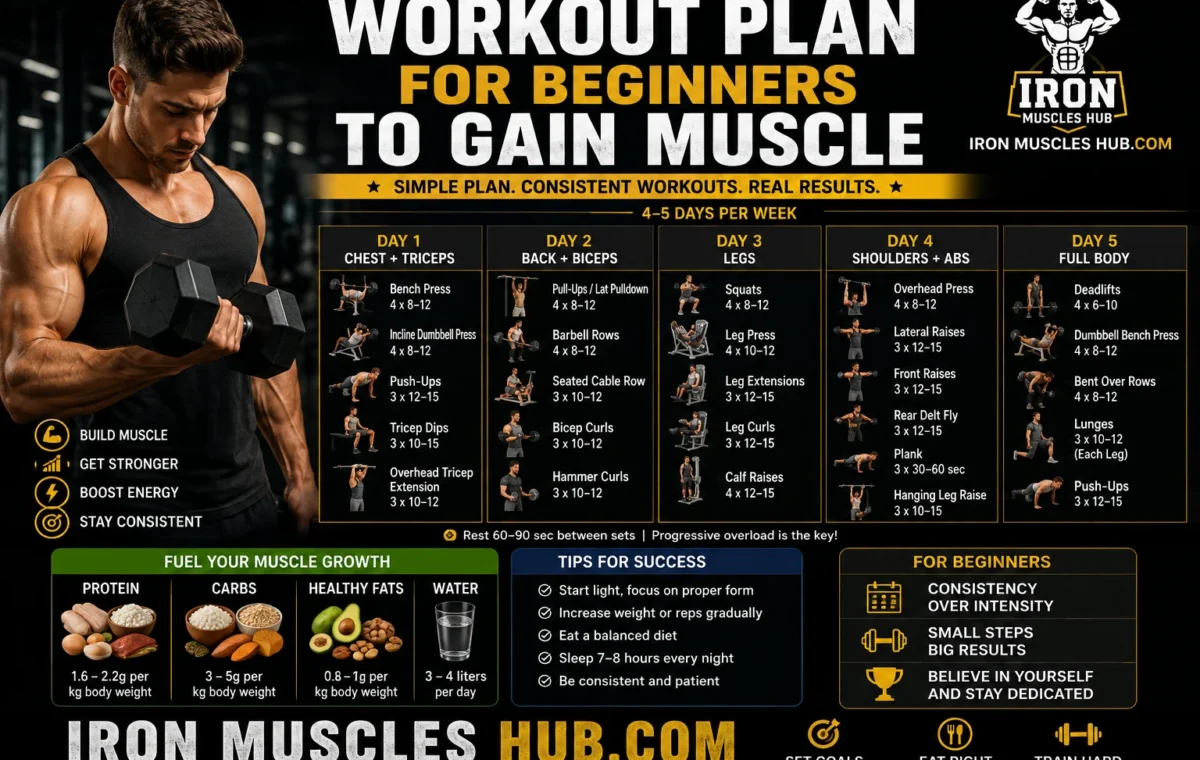
If you’re looking for a workout plan for beginners to gain muscle, start with three full-body resistance sessions per week, not a complicated six-day bodybuilding split. Your first goal is to learn the movements, train consistently, and gradually make the exercises harder.
- Quick Answer
- The 3-Day Beginner Workout Plan
- Workout A
- Workout B
- A simple beginner decision rule
- How Hard Should Your Sets Feel?
- Use Double Progression
- What to Record
- Mistake 1: Training Six Days Because You Want Faster Gains
- Mistake 2: Changing the Workout Every Week
- Mistake 3: Adding Weight Too Quickly
- Mistake 4: Taking Every Set to Failure
- Mistake 5: Ignoring the Lower Body
- Mistake 6: Treating Protein as More Important Than Training
- How Much Protein?
- Do You Need Protein Powder?
- What About Cardio?
- 1. Your Repetitions Increase
- 2. Your Weights Increase
- 3. Your Technique Improves
- 4. Your Body Measurements Change
- 5. Your Training Log Shows a Trend
- Weeks 1–4: Learn
- Weeks 5–8: Progress
- Weeks 9–12: Build
- How many days a week should a beginner work out to build muscle?
- How many reps should beginners do to build muscle?
- How much protein should I eat to gain muscle?
- Should beginners train to failure?
- Is a full-body workout better than a split for beginners?
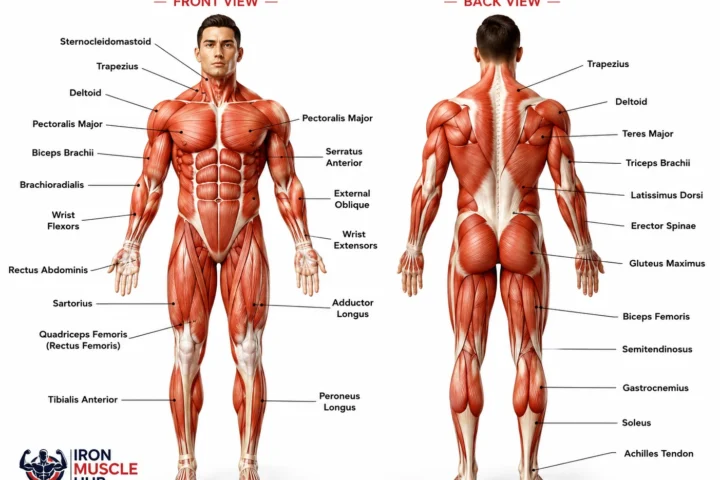
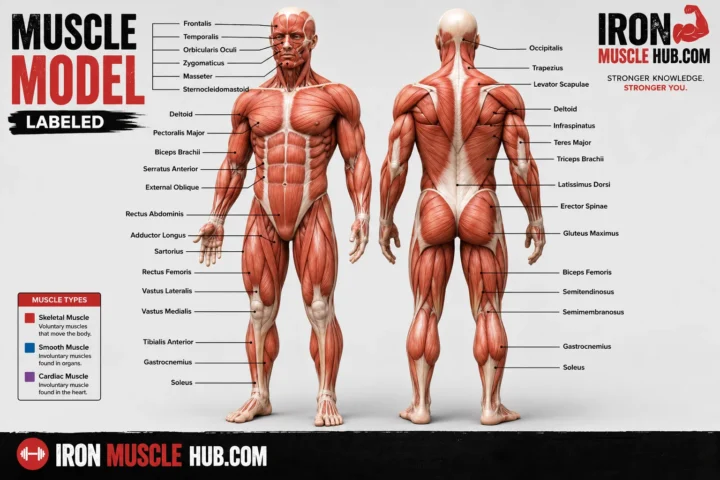
This beginner plan uses basic movements for your legs, chest, back, shoulders, arms, and core. You’ll train on non-consecutive days, keep most sets controlled rather than taking every set to failure, and record your reps and weights so you know when to progress. For more insights read here :- body muscle graph and muscle chart.
Quick Answer
- Train 3 days per week with full-body workouts on non-consecutive days.
- Start most exercises with 2–3 working sets and use controlled repetitions that allow you to maintain good technique.
- Progress by adding reps first, then a small amount of weight when you can complete the top of the target rep range with solid form.
- Eat enough overall food and get adequate protein. Research supports protein intakes around 1.6 g/kg/day as a useful evidence-based reference point for maximizing resistance-training-related gains in healthy adults.
workout plan for beginners to gain muscle
A beginner doesn’t need dozens of exercises. You need repeated exposure to fundamental resistance movements, enough challenging work to stimulate adaptation, and enough recovery to come back stronger.
The 2026 American College of Sports Medicine position stand reviewed 137 systematic reviews involving more than 30,000 participants and concluded that resistance training improves muscle size, strength, power, endurance, and other physical-function outcomes in healthy adults.
For beginners, NSCA guidance supports two or three full-body resistance-training days per week, with non-consecutive sessions and recovery between workouts.
That makes a Monday-Wednesday-Friday schedule a strong starting point.
You don’t need to destroy a muscle every session. You need to give it a repeatable training stimulus and improve your performance over time.
The 3-Day Beginner Workout Plan
Use this schedule:
| Day | Training |
|---|---|
| Monday | Full Body A |
| Tuesday | Rest or easy activity |
| Wednesday | Full Body B |
| Thursday | Rest or easy activity |
| Friday | Full Body A |
| Saturday | Rest or easy activity |
| Sunday | Rest |
The following week, switch the order:
B → A → B
This keeps the overall workload balanced without requiring a complicated split.
Workout A
| Exercise | Sets | Reps | Main muscles |
| Goblet squat | 3 | 8–12 | Quads, glutes |
| Dumbbell bench press | 3 | 8–12 | Chest, triceps, shoulders |
| Lat pulldown | 3 | 8–12 | Lats, upper back, biceps |
| Romanian deadlift | 2 | 8–12 | Hamstrings, glutes |
| Dumbbell lateral raise | 2 | 10–15 | Side delts |
| Plank | 2 | 20–40 sec | Core |
Workout B
| Exercise | Sets | Reps | Main muscles |
| Leg press | 3 | 8–12 | Quads, glutes |
| Seated cable row | 3 | 8–12 | Upper back, lats, biceps |
| Incline dumbbell press | 3 | 8–12 | Upper chest, shoulders, triceps |
| Dumbbell Romanian deadlift | 2 | 8–12 | Hamstrings, glutes |
| Dumbbell shoulder press | 2 | 8–12 | Shoulders, triceps |
| Cable crunch | 2 | 10–15 | Abdominals |
The exact exercise choices aren’t sacred. The important part is the movement pattern and your ability to perform it safely and consistently.
ACSM’s 2026 position stand supports resistance training as an effective way to improve hypertrophy and strength, while NSCA guidance supports full-body training two or three times weekly for novice lifters.
How to Choose Your Starting Weight
This is where many beginners make their first mistake.
Don’t walk into the gym and immediately test how much you can lift.
Your first working weight should be light enough to learn the movement and heavy enough that the final repetitions require meaningful effort.
For example, suppose you can perform a goblet squat with a 12 kg (26 lb) dumbbell for 10 controlled repetitions while maintaining good depth and posture.
That can be your starting point.
If 12 kg feels extremely easy and you could perform many additional clean repetitions, increase the load slightly.
If you struggle to maintain technique after only four or five repetitions, reduce the weight.
A simple beginner decision rule
Use this 30-second self-test:
Could I perform about 2–4 more clean repetitions right now?
- Yes, easily: The weight may be too light.
- Yes, but the final reps are challenging: Good starting point.
- No, technique is breaking down: Reduce the weight.
- Pain rather than normal muscular effort: Stop the exercise and reassess.
This is more useful than trying to guess your one-repetition maximum as a new lifter.
How Hard Should Your Sets Feel?
Beginners don’t need to take every set to absolute muscular failure.
A practical approach is to finish most working sets while you still have a few technically sound repetitions available.
Your goal is to challenge the muscle without turning every set into a test of survival.
That distinction matters because technique is still a skill you’re learning.
A set of 10 controlled goblet squats with good positioning is more useful than a heavier set where your knees, hips, back, or balance become difficult to control.
Progressive Overload: The Part That Actually Moves the Plan Forward
A workout plan only works for muscle gain if the training stimulus progresses.
Progressive overload doesn’t mean adding huge amounts of weight every week.
For a beginner, progression can mean:
- Performing more repetitions with the same weight.
- Adding a small amount of weight while maintaining the target repetitions.
- Improving exercise technique and range of motion.
- Adding a set when your current workload becomes manageable.
- Using a more difficult exercise variation later.
Use Double Progression
For this plan, use a simple 8–12 repetition range for many exercises.
Suppose your dumbbell bench press looks like this:
| Week | Weight | Set 1 | Set 2 | Set 3 |
| 1 | 10 kg / 22 lb each | 8 | 8 | 8 |
| 2 | 10 kg / 22 lb each | 9 | 8 | 8 |
| 3 | 10 kg / 22 lb each | 10 | 9 | 9 |
| 4 | 10 kg / 22 lb each | 11 | 10 | 10 |
| 5 | 10 kg / 22 lb each | 12 | 12 | 12 |
| 6 | 12 kg / 26 lb each | 8 | 8 | 8 |
This is a worked example, not a promise that every beginner will progress at this exact rate.
When you reach the upper end of the rep range across your working sets with good technique, increase the load by the smallest sensible increment available.
Then build the repetitions again.
That gives you a clear target for every workout instead of randomly changing exercises.
How Long Should You Follow the Plan?
Give the routine enough time to learn the movements and establish a progression pattern.
A useful beginner block is 8–12 weeks.
You don’t need to change exercises simply because you’ve been doing them for a few weeks.
If your squat, press, row, pulldown, and hinge variations are improving and your technique is becoming more consistent, there is a good reason to keep them.
The beginner phase is partly about building strength and movement skill.
The 2026 ACSM position stand found broad benefits from resistance training across healthy adults and updated the organization’s earlier resistance-training position stand.
What to Record
Keep a simple training log.
Record:
- Exercise
- Weight
- Repetitions
- Sets
- Optional notes about technique or difficulty
For example:
Goblet squat — 16 kg / 35 lb — 3 × 10
Next time, your target might be 11 repetitions with the same weight.
You don’t need a complicated spreadsheet.
A notes app or paper notebook is enough.
Warm-Up for Beginner Muscle Training
You don’t need a long, exhausting warm-up before lifting.
Start with a few minutes of easy general movement if you find it useful, then perform lighter practice sets of the first exercise.
For example:
Goblet squat
- Light warm-up set
- Another slightly heavier practice set if needed
- Working sets
The warm-up should prepare you for training, not make you tired before your actual work begins.
If a particular joint or movement feels uncomfortable, don’t try to force the exercise simply because it’s written in a program.
Use a suitable alternative and seek professional assessment if pain persists.
Common Mistakes → Why → Fix
Mistake 1: Training Six Days Because You Want Faster Gains
Why: Beginners often assume more gym days automatically mean more muscle.
Fix: Start with three full-body sessions. NSCA guidance specifically identifies two or three weekly sessions as appropriate for novice full-body resistance training, with recovery between sessions.
More training isn’t automatically better if your technique, recovery, or consistency suffers.
Mistake 2: Changing the Workout Every Week
Why: New exercises feel exciting, but constant variation makes it difficult to see whether you’re actually improving.
Fix: Keep the major movements stable for several weeks. Track your performance and make small changes only when there’s a clear reason.
Mistake 3: Adding Weight Too Quickly
Why: Beginners can become stronger quickly, particularly as they learn the movements, but that doesn’t mean every workout should involve a large jump in load.
Fix: Increase weight only when you can complete the target repetitions with controlled technique.
Mistake 4: Taking Every Set to Failure
Why: Beginners may confuse maximum effort with effective training.
Fix: Keep most sets challenging but technically controlled. Save true failure for situations where you understand the exercise and can perform it safely.
Mistake 5: Ignoring the Lower Body
Why: New lifters sometimes focus almost entirely on chest, arms, and shoulders.
Fix: Keep squats or leg presses and a hip-hinge movement in the program. Your lower body contains large muscle groups that deserve regular resistance training.
Mistake 6: Treating Protein as More Important Than Training
Why: Protein gets a lot of attention in muscle-building discussions, but nutrition cannot replace progressive resistance training.
Fix: Build the training habit first, then make your daily diet support it.
Beginner Muscle Gain Nutrition
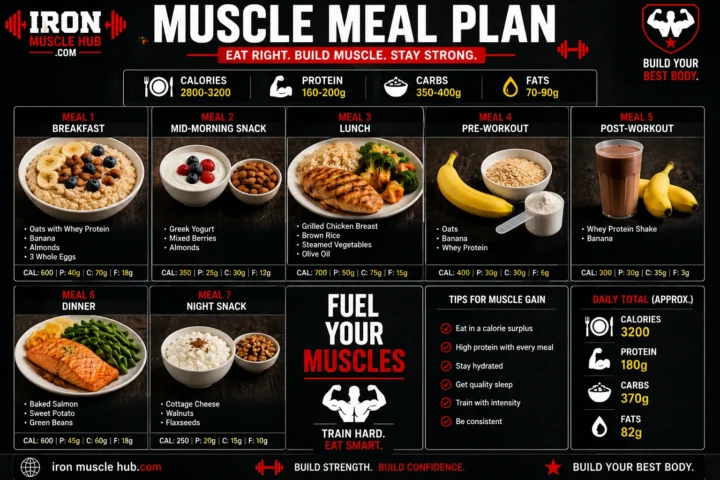
Training provides the stimulus. Food and recovery help you adapt to it.
You don’t need an extreme diet to gain muscle.
Focus on:
- Adequate total food intake
- Regular protein-rich meals
- Carbohydrate sources that support training
- Fruit and vegetables
- Dietary fats
- Adequate fluids
- Consistent sleep
How Much Protein?
Research on resistance training supports roughly 1.6 g of protein per kilogram of body weight per day as a useful reference point for maximizing gains in lean mass in healthy adults, with a large meta-analysis finding no additional benefit to resistance-training-related fat-free-mass gains above approximately 1.62 g/kg/day from protein supplementation.
For a 70 kg (154 lb) beginner:
70 × 1.6 = 112 g protein per day
That is a practical example, not a medical prescription.
You don’t need to hit exactly 112 g every day.
The larger point is to consistently consume enough protein while eating a balanced diet.
If you have kidney disease or another medical condition that affects your dietary needs, speak with a qualified healthcare professional before deliberately increasing protein intake.
Do You Need Protein Powder?
No.
Protein powder can be convenient, but it’s not required to build muscle.
Foods such as:
- Eggs
- Milk
- Greek yogurt
- Cottage cheese
- Chicken
- Fish
- Lean meat
- Beans
- Lentils
- Tofu
- Tempeh
can all contribute protein to your diet.
The goal is a sustainable eating pattern, not dependence on supplements.
Recovery: Where Beginners Often Underestimate the Work
Your workout is only one part of the process.
You also need time between challenging sessions.
NSCA guidance notes that novice lifters generally benefit from recovery between full-body resistance sessions, with one to three days between workouts that stress the same muscle groups.
That is one reason the Monday-Wednesday-Friday schedule works well.
You train.
You recover.
You return and train again.
This cycle is much easier to sustain than trying to lift hard every day from the beginning.
What About Cardio?
You don’t have to eliminate cardio because you want to gain muscle.
Easy walking, cycling, or other moderate activity can fit around a resistance-training program.
The key is managing the total workload.
If your cardio leaves you exhausted before every lower-body workout, reduce the amount or adjust the timing.
Your main training priority for this article is progressive resistance exercise.
What If You Only Have Dumbbells?
You can still run this plan.
Use:
- Goblet squat instead of leg press
- Dumbbell bench press instead of barbell bench press
- One-arm dumbbell row instead of cable row
- Dumbbell Romanian deadlift
- Dumbbell shoulder press
- Dumbbell lateral raise
- Plank or weighted crunch
The principle remains the same:
Choose a movement you can perform safely, track your repetitions, and gradually make the exercise harder.
You don’t need a perfect commercial gym to begin.
What If You’re Training at Home?
Home training can work if you have enough resistance and a way to progressively increase the challenge.
A bodyweight beginner might start with:
- Squat variations
- Elevated push-ups
- Resistance-band rows
- Split squats
- Hip hinges
- Pike push-ups
- Resistance-band pulldowns
- Planks
As you become stronger, the limiting factor may become available resistance.
That’s when adjustable dumbbells, resistance bands, a pull-up bar, or other suitable equipment can make progression easier.
30-Second Decision Rule: Should You Add Weight?
Before increasing the load, ask three questions:
1. Did I reach the top of my rep range?
2. Was my technique controlled from the first rep to the last?
3. Could I repeat that performance next session without a major form breakdown?
If the answer is yes to all three, a small weight increase is reasonable.
If not, keep the same weight and build your repetitions or technique.
This removes much of the guesswork from beginner programming.
Who This Plan Is NOT For
This plan is not designed for:
- Competitive powerlifters
- Advanced bodybuilders
- Experienced athletes with specialized sport requirements
- People currently dealing with an injury who need individualized rehabilitation
- Anyone with a medical condition that requires exercise restrictions without first getting appropriate professional guidance
It is designed as a general starting framework for healthy beginners who want to develop strength and muscle with basic resistance training.
If you’re completely new to exercise, learning the movements from a qualified trainer can be valuable, especially for exercises such as squats, hinges, presses, and rows.
How to Know the Plan Is Working
Don’t judge progress only by the mirror.
Look for several signals.
1. Your Repetitions Increase
If you can perform more clean repetitions with the same load, that’s progress.
2. Your Weights Increase
Over time, you may be able to use heavier dumbbells, machines, or barbells while maintaining similar technique.
3. Your Technique Improves
A movement that once felt awkward may become controlled and repeatable.
That’s meaningful progress for a beginner.
4. Your Body Measurements Change
If gaining muscle is your goal, you can occasionally monitor body weight and measurements.
Use the same conditions when measuring so that day-to-day fluctuations don’t confuse the picture.
For example, a person who is 175 cm (69 in) tall and weighs 70 kg (154 lb) might track body weight alongside waist, arm, thigh, and chest measurements.
Don’t expect every measurement to move in the same direction at the same speed.
5. Your Training Log Shows a Trend
This is one of the most useful indicators.
If you started with:
Goblet squat — 12 kg / 26 lb × 8
and eventually perform:
Goblet squat — 20 kg / 44 lb × 12
with good technique, you’ve clearly improved your training capacity.
That’s the kind of progress a beginner should care about.
A Simple 12-Week Roadmap
You can organize the plan into three phases.
Weeks 1–4: Learn
Focus on:
- Exercise technique
- Comfortable range of motion
- Consistent training days
- Recording every workout
- Avoiding unnecessary weight jumps
Don’t worry about lifting as much as possible.
Weeks 5–8: Progress
Now begin taking the progression system seriously.
Try to:
- Add repetitions within your ranges
- Increase loads gradually
- Improve technique
- Maintain your three-day schedule
You should have a clearer idea of your appropriate working weights by this stage.
Weeks 9–12: Build
Continue the same basic structure.
You can make small exercise substitutions if equipment or comfort requires them, but don’t change the entire program just for variety.
Your main objective is to create a repeatable cycle of:
Train → Recover → Improve → Repeat
That is a much better beginner strategy than constantly searching for a “perfect” new routine.
FAQ
How many days a week should a beginner work out to build muscle?
Three full-body resistance workouts per week are a practical starting point for many beginners. NSCA guidance states that novice lifters can benefit from two or three full-body sessions per week, with non-consecutive training days and recovery between sessions.
You don’t need to train every day. Consistency across months matters more than squeezing extra sessions into your first few weeks.
How many reps should beginners do to build muscle?
There isn’t one magic repetition number for muscle growth. A practical beginner plan can use moderate repetition ranges such as 8–12 for many exercises because they provide a manageable balance between resistance, technique, and training effort. NSCA educational guidance has also used 8–12 repetitions for novice hypertrophy-oriented programming.
The key is progressing the training over time rather than obsessing over one exact rep number.
How much protein should I eat to gain muscle?
Around 1.6 g/kg/day is a useful evidence-based reference for healthy adults doing resistance training. A large meta-analysis found that protein supplementation improved gains in strength and fat-free mass during prolonged resistance training, with benefits leveling off above approximately 1.62 g/kg/day.
For example, someone weighing 70 kg (154 lb) would calculate 70 × 1.6 = 112 g/day. Individual needs can differ.
Should beginners train to failure?
Not every set needs to reach complete muscular failure. Beginners should prioritize controlled technique and repeatable training. A set can be challenging without requiring you to continue until you physically cannot perform another repetition.
As your skill and training experience improve, you can make more informed decisions about how close different exercises should be taken to failure.
Is a full-body workout better than a split for beginners?
A full-body routine is an excellent starting option because it lets a beginner practice the major movement patterns regularly without requiring many weekly gym sessions. Research comparing split and full-body routines in untrained participants has found improvements in strength and muscle thickness with both approaches when training is structured appropriately.
For a beginner training three days per week, full-body training is simple and practical.
Final Takeaway
The best workout plan for beginners to gain muscle isn’t the one with the most exercises or the most days in the gym. It’s the one you can perform consistently while gradually improving your strength and technique.
Start with three full-body workouts each week. Use controlled exercises for your legs, chest, back, shoulders, arms, and core. Record your sets, repetitions, and weights. When you can complete the top of your rep range with good form, increase the load gradually.
Support the training with enough food, adequate protein, and recovery.
Give the plan time to work. Your first objective isn’t to train like an advanced lifter. It’s to become a stronger, more capable beginner who can keep showing up.
For more beginner-friendly guidance, explore the related Iron Muscle Hub articles on muscle anatomy, protein-rich foods, and protein breakfasts.