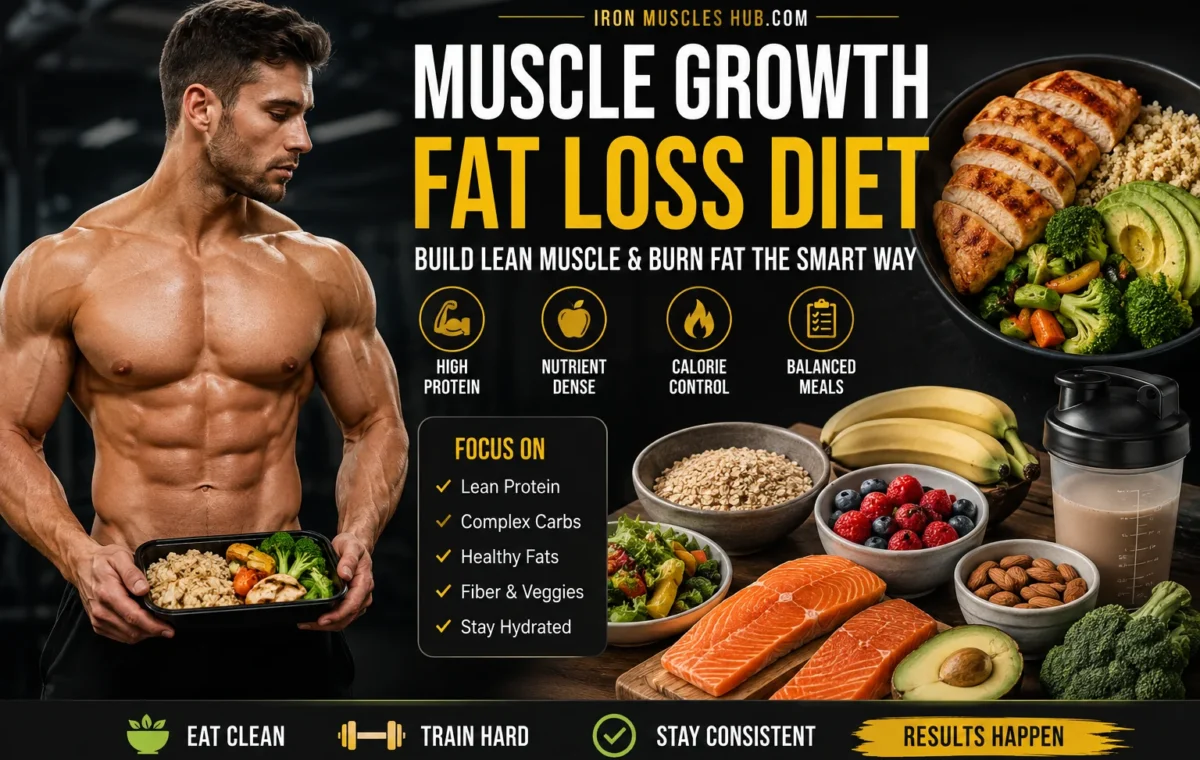
If you want muscle growth and fat loss at the same time, your diet needs to do two jobs: provide enough protein and training fuel while keeping energy intake controlled enough to reduce body fat.
- Quick Answer
- What Is a Muscle Growth Fat Loss Diet?
- Who Has the Best Chance of Recomping?
- Calories: The Foundation of Fat Loss
- Worked Example: 80 kg / 176 lb Beginner
- Protein: Your Highest-Priority Macro
- Good Protein Foods
- What Should You Eat?
- 1. Protein
- 2. Carbohydrates
- 3. Vegetables and Fruit
- 4. Dietary Fat
- Sample Day of Eating
- Breakfast
- Lunch
- Pre-Workout Snack
- Dinner
- Optional Snack
- Strength Training Is Non-Negotiable
- Your Main Training Goal
- Do You Need Cardio?
- Mistake 1: Cutting Calories Too Hard
- Mistake 2: Eating “Healthy” but Not Enough Protein
- Mistake 3: Doing Lots of Cardio and Little Lifting
- Mistake 4: Removing Carbohydrates
- Mistake 5: Watching Only the Scale
- Mistake 6: Changing the Plan Every Week
- If Waist ↓ + Strength Stable/↑
- If Waist ↓ + Strength ↓ Sharply
- If Waist Stable + Weight Stable + Strength Stable
- If Nothing Changes for Several Weeks
- 1. Body Weight
- 2. Waist Measurement
- 3. Progress Photos
- 4. Strength Log
- Can you build muscle and lose fat at the same time?
- What should I eat to gain muscle and lose fat?
- How much protein do I need for muscle growth and fat loss?
- Should I be in a calorie deficit or maintenance for body recomposition?
- Do I need cardio to lose fat and build muscle?
- Final Thoughts
For beginners, people returning to lifting, and some people carrying more body fat, this approach—often called body re composition—can work. The goal isn’t to crash-diet. It’s to combine sensible calories, adequate protein, progressive resistance training, and recovery. Research also shows that resistance training during weight loss helps protect lean mass, making it an important part of the plan. For more insights read here :- muscle model and Post Workout Meal.
Quick Answer
- Eat enough protein: Around 1.6 g/kg (0.73 g/lb) per day is a useful evidence-based target for many resistance-trained adults. A major meta-analysis found little additional benefit for muscle gain above roughly 1.6 g/kg/day when total protein intake was already adequate.
- Use a modest calorie deficit if fat loss is the priority: Avoid aggressive restriction. Research found that prolonged energy deficits can reduce lean-mass gains, with deficits around 500 kcal/day or greater particularly problematic for maximizing lean mass.
- Lift consistently: Resistance training is central to preserving or building muscle while losing fat.
- Track more than scale weight: Waist measurements, progress photos, gym performance, and body weight together give you a better picture of body-composition changes.
What Is a Muscle Growth Fat Loss Diet?
A muscle growth fat loss diet is a nutrition strategy designed to support resistance-training adaptations while creating enough energy control to reduce stored body fat.
In practical terms, you aren’t trying to eat as little as possible. You’re trying to create an environment where your muscles receive a strong training stimulus and sufficient protein while your overall energy intake is appropriate for gradual fat loss.
This is why body recomposition can be more complicated than simply saying “eat less.”
A large calorie deficit may make the scale fall faster, but it can also make it harder to gain lean mass. A 2022 meta-analysis found that energy deficiency impaired lean-mass gains during resistance training, while strength gains were not affected to the same degree.
For a beginner, that means your first goal shouldn’t be an extreme cut.
It should be better body composition while keeping your training performance moving forward.
Who Has the Best Chance of Recomping?
Body recomposition tends to be more realistic for:
- Beginners who have recently started resistance training
- People returning to training after a long break
- People with more body fat to lose
- People who previously ate too little protein or trained inconsistently
Experienced, relatively lean lifters can also improve body composition, but the process is generally slower.
That distinction matters.
If you’ve been lifting seriously for years and are already quite lean, expecting rapid muscle gain while simultaneously losing fat is unrealistic. A more focused muscle-gain or fat-loss phase may eventually make more sense.
Calories: The Foundation of Fat Loss
Fat loss requires an energy deficit over time.
That doesn’t mean you need to slash your food intake.
A practical starting point is to estimate your maintenance intake, then make a small adjustment downward if fat loss is the priority. Your exact calorie needs depend on body size, activity, age, sex, training, and other factors, so there isn’t one calorie number that works for everyone.
The important point is that bigger deficits aren’t automatically better.
Research examining resistance training during energy restriction found that prolonged energy deficits impair lean-mass gains, and the researchers reported that an energy deficit of approximately 500 kcal/day prevented lean-mass gains in their meta-regression.
That doesn’t mean every person should use exactly a 500-kcal deficit—or that 500 kcal is a universal safety cutoff.
It means that if building or preserving muscle matters, aggressive calorie restriction deserves caution.
Worked Example: 80 kg / 176 lb Beginner
Imagine an 80 kg (176 lb) beginner estimates their maintenance intake at approximately 2,500 calories per day.
Instead of immediately cutting to 1,700 calories, they might start with a modest reduction and monitor:
- Average weekly body weight
- Waist measurement
- Gym performance
- Hunger and energy
- Recovery
Suppose they start around 2,200–2,300 calories/day.
That’s an example starting point, not a prescription. If weight and waist measurements aren’t changing after several weeks, they can reassess intake and activity.
If strength is dropping rapidly, recovery is poor, and hunger is extreme, the deficit may be too aggressive.
The goal is not to lose weight as fast as possible. The goal is to lose fat while giving your muscles a reason and the raw materials to adapt.
Protein: Your Highest-Priority Macro
If you’re trying to build muscle while losing fat, protein deserves serious attention.
A large systematic review and meta-analysis of 49 studies involving 1,863 participants found that protein supplementation improved strength and fat-free mass during prolonged resistance training. The analysis found that benefits to fat-free mass generally plateaued around 1.62 g/kg/day of total protein intake.
For practical purposes, a beginner can use roughly:
1.6 g/kg/day ≈ 0.73 g/lb/day
Examples:
| Body weight | Approx. protein at 1.6 g/kg |
|---|---|
| 60 kg / 132 lb | 96 g |
| 70 kg / 154 lb | 112 g |
| 80 kg / 176 lb | 128 g |
| 90 kg / 198 lb | 144 g |
| 100 kg / 220 lb | 160 g |
These figures are calculations from the 1.6 g/kg target, not guarantees of a particular muscle-gain result.
You don’t need to obsess over hitting the number to the exact gram.
If you’re consistently close to your target and your overall diet is good, you’re in a much better position than someone eating very little protein.
Good Protein Foods
Build meals around foods such as:
- Eggs
- Chicken
- Turkey
- Lean beef
- Fish
- Greek yogurt
- Cottage cheese
- Milk
- Tofu
- Tempeh
- Beans
- Lentils
- Other protein-rich foods that fit your dietary preferences
For vegetarians and vegans, combining different plant protein sources across the day can help you reach your overall protein target.
What Should You Eat?
A good muscle-growth fat-loss diet doesn’t require eliminating carbohydrates or fats.
Instead, build most meals around four components:
1. Protein
Choose a substantial protein source at each main meal.
Examples:
- Eggs at breakfast
- Chicken or tofu at lunch
- Fish or lean beef at dinner
- Greek yogurt as a snack
2. Carbohydrates
Carbohydrates can provide useful training fuel.
Good choices include:
- Oats
- Potatoes
- Rice
- Whole-grain bread
- Pasta
- Fruit
- Beans
- Other minimally processed carbohydrate sources
You don’t need to fear carbs because you’re trying to lose fat.
Your total energy intake matters much more than declaring one food group “bad.”
3. Vegetables and Fruit
Vegetables and fruit make it easier to build filling, nutrient-dense meals.
Use different varieties rather than relying on the same two vegetables every day.
4. Dietary Fat
Include reasonable portions of foods such as:
- Nuts
- Seeds
- Olive oil
- Avocado
- Eggs
- Fatty fish
The goal is balance rather than removing dietary fat.
Sample Day of Eating
Here’s an illustrative day for an 80 kg / 176 lb beginner. It isn’t a personalized meal prescription.
Breakfast
- 3 eggs
- Oats with milk
- Berries or another fruit
Lunch
- Chicken breast
- Rice or potatoes
- Large serving of vegetables
- Small amount of olive oil
Pre-Workout Snack
- Greek yogurt
- Banana
Dinner
- Lean beef, fish, tofu, or another protein source
- Potatoes or rice
- Mixed vegetables
Optional Snack
- Cottage cheese or Greek yogurt
- Fruit
The exact portions should be adjusted according to your calorie needs, hunger, training schedule, and progress.
Strength Training Is Non-Negotiable
You can’t build much muscle from diet alone.
Your muscles need a reason to adapt.
That reason is resistance training.
Research consistently supports resistance training as an important component of improving body composition during weight loss. A recent systematic review and meta-analysis found that adding resistance exercise during dietary weight loss helped protect fat-free mass and increased fat-mass loss compared with diet-only approaches.
For a beginner, start simple.
Train the major movement patterns:
- Squat
- Hinge
- Horizontal push
- Horizontal pull
- Vertical push
- Vertical pull
- Loaded carry or trunk work
You don’t need a complicated six-day bodybuilding split.
A consistent full-body routine two or three days per week can be an excellent starting point.
Mayo Clinic’s general guidance also recommends strength training all major muscle groups at least twice per week for adults.
Your Main Training Goal
Don’t judge every workout by how exhausted you feel.
Instead, look for gradual improvement.
Over time, you might:
- Add a small amount of weight
- Perform another repetition
- Improve technique
- Increase your training volume gradually
- Use a better range of motion
That progression tells your body that maintaining or building muscle is still important.
Do You Need Cardio?
No, cardio isn’t mandatory for building muscle and losing fat.
But it can be useful for cardiovascular fitness, health, and increasing overall activity.
Mayo Clinic summarizes general adult activity guidance as at least 150 minutes of moderate aerobic activity per week, or 75 minutes of vigorous activity, alongside muscle-strengthening work.
You don’t have to immediately chase that number if you’re currently inactive.
Start with manageable activity such as:
- Brisk walking
- Cycling
- Swimming
- Easy jogging
- Recreational sports
The mistake is turning cardio into punishment for eating.
Your resistance training should remain a priority if preserving or gaining muscle is one of your main goals.
Muscle Growth Fat Loss Diet: Macro Comparison
There isn’t one magical macro split for body recomposition. Your protein target and total energy intake deserve more attention than finding a perfect carbohydrate-to-fat ratio.
| Approach | Calories | Protein | Carbs | Fat | Best use |
|---|---|---|---|---|---|
| Muscle-focused | Maintenance/slight surplus | High | Moderate-high | Moderate | Prioritizing muscle gain |
| Recomp | Maintenance/slight deficit | High | Moderate | Moderate | Trying to improve both |
| Fat-loss focused | Moderate deficit | High | Adjust to preference | Moderate | Prioritizing fat loss |
| Aggressive cut | Large deficit | High | Often restricted | Often restricted | Generally poor fit for muscle growth |
The table is a coaching framework rather than a medical diet prescription.
The evidence is clear on one important point: a prolonged energy deficit makes maximizing lean-mass gains harder.
So if muscle growth matters, don’t make your calorie deficit unnecessarily large.
Common Mistakes → Why → Fix
Mistake 1: Cutting Calories Too Hard
Why: A large or prolonged energy deficit can interfere with lean-mass gains during resistance training.
Fix: Start conservatively and monitor your average weight, waist, training performance, hunger, and recovery.
Mistake 2: Eating “Healthy” but Not Enough Protein
Why: A diet can contain plenty of vegetables and whole foods but still be relatively low in protein.
Fix: Put a protein source into every main meal.
Mistake 3: Doing Lots of Cardio and Little Lifting
Why: Cardio can help health and energy expenditure, but it doesn’t replace the muscle-building stimulus of resistance training.
Fix: Establish your strength-training routine first, then add cardio according to your goals and recovery.
Mistake 4: Removing Carbohydrates
Why: Cutting an entire food group isn’t necessary for fat loss and can make your diet harder to follow.
Fix: Keep useful carbohydrate sources such as rice, potatoes, oats, fruit, beans, and whole grains while controlling total calories.
Mistake 5: Watching Only the Scale
Why: Body recomposition can involve simultaneous changes in fat mass and lean mass, so scale weight may move slowly.
Fix: Track your waist, photos, body weight averages, and gym performance together.
Mistake 6: Changing the Plan Every Week
Why: You can’t properly evaluate a strategy if you constantly change calories, exercises, and meal patterns.
Fix: Give your approach enough time to collect useful data, then make one adjustment at a time.
A Simple 30-Second Recomp Decision Rule
Ask yourself these four questions:
1. Is my waist gradually decreasing?
If yes, fat loss is probably occurring.
2. Am I maintaining or improving my lifts?
If yes, your training stimulus is likely working.
3. Am I eating enough protein?
If not, fix that before making complicated changes.
4. Is recovery acceptable?
If you’re constantly exhausted, unusually hungry, or your performance is falling, reconsider how aggressive your deficit is.
If Waist ↓ + Strength Stable/↑
Keep the plan.
If Waist ↓ + Strength ↓ Sharply
Review calories, recovery, training volume, and protein.
If Waist Stable + Weight Stable + Strength Stable
Decide whether you want to continue recomposition or make a small adjustment.
If Nothing Changes for Several Weeks
Review portions, activity, adherence, and calorie intake before making a major change.
Who This Is NOT For
A muscle growth fat loss diet isn’t automatically the best strategy for everyone.
You may want a different approach if:
- Your primary goal is rapid fat loss.
- You’re already very lean and highly trained.
- You’re primarily interested in maximizing muscle gain.
- You have a history of disordered eating.
- You have a medical condition that affects nutrition, weight, or exercise.
- You’re pregnant or breastfeeding and need individualized nutrition guidance.
- Your relationship with calorie tracking is becoming stressful or obsessive.
In those situations, working with a qualified healthcare professional or registered dietitian can be more appropriate than following a generic online plan.
How to Track Progress
Your progress doesn’t need to become a full-time job.
Use four simple measurements.
1. Body Weight
If you weigh yourself, use consistent conditions and look at weekly averages rather than reacting to one day’s number.
Water, food volume, sodium, and other factors can move body weight temporarily.
2. Waist Measurement
Measure around the same location under similar conditions.
A gradually smaller waist can be useful evidence of fat loss, especially when body weight isn’t changing much.
3. Progress Photos
Take front, side, and back photos under similar lighting and distance.
You don’t need to post them anywhere.
They’re simply a personal comparison tool.
4. Strength Log
Record your exercises, sets, repetitions, and loads.
For example:
Squat: 60 kg / 132 lb × 8
Bench press: 50 kg / 110 lb × 8
Row: 55 kg / 121 lb × 10
Your goal isn’t to increase every number every workout.
Look for a gradual trend in performance over time.
How Long Should You Follow the Diet?
Don’t expect a dramatic transformation in a couple of weeks.
Muscle growth is a slow biological process, and fat loss is also influenced by your starting body composition, calorie intake, activity, training history, sleep, and adherence.
A better approach is to work in blocks long enough to identify trends.
If your waist is gradually decreasing, your training is progressing, and your recovery is reasonable, you probably don’t need to overhaul the plan.
If progress has genuinely stalled, make a small, measured adjustment rather than jumping into an extreme diet.
FAQ
Can you build muscle and lose fat at the same time?
Yes. This is called body recomposition. It’s more achievable for beginners, people returning to resistance training, and some people with higher amounts of body fat. The process still requires a useful training stimulus, sufficient protein, appropriate energy intake, and recovery. It isn’t guaranteed, and advanced lean lifters generally have a harder time gaining significant muscle while simultaneously losing fat.
What should I eat to gain muscle and lose fat?
Prioritize protein-rich foods, vegetables, fruit, carbohydrate sources that support training, and reasonable amounts of dietary fat. Foods such as eggs, chicken, fish, Greek yogurt, cottage cheese, tofu, beans, lentils, rice, potatoes, oats, fruit, vegetables, nuts, and seeds can all fit. Your total calorie intake and protein intake matter more than finding a single “perfect” food list.
How much protein do I need for muscle growth and fat loss?
A practical target for many resistance-trained adults is around 1.6 g/kg (0.73 g/lb) of body weight per day. A large meta-analysis found that protein supplementation supported increases in fat-free mass and strength during resistance training, with little additional fat-free-mass benefit above approximately 1.62 g/kg/day. Individual needs can differ.
Should I be in a calorie deficit or maintenance for body recomposition?
It depends on your starting point and priorities. If fat loss is the main goal, a modest deficit can make sense. If you’re already lean, highly trained, or primarily focused on muscle growth, maintenance or a small surplus may be more appropriate. Avoid assuming that a larger deficit will automatically produce better results; prolonged energy deficiency can impair lean-mass gains.
Do I need cardio to lose fat and build muscle?
No. Fat loss ultimately depends on your overall energy balance, while muscle growth requires a resistance-training stimulus and adequate nutrition. Cardio can still be useful for cardiovascular fitness, health, and increasing activity. General adult guidance recommends at least 150 minutes of moderate aerobic activity weekly plus muscle-strengthening activity at least twice weekly.
The Bottom Line
The best muscle growth fat loss diet isn’t an extreme cutting plan or a complicated bodybuilding menu. It’s a sustainable setup that gives you enough protein, controls calories without unnecessarily aggressive restriction, and supports hard resistance training.
Start with the basics: eat enough protein, build meals around minimally processed foods, lift consistently, stay active, and monitor your results using more than the scale.
For many beginners, body recomposition is a realistic goal. But progress won’t look identical for everyone. If your waist is coming down while your strength holds steady or improves, you’re heading in the right direction.
Final Thoughts
A successful muscle growth fat loss diet doesn’t need to be extreme or complicated. The fundamentals matter most: eat enough protein, keep your calorie deficit reasonable, train with weights consistently, stay active, and give your body enough time to adapt.
If you’re a beginner, focus less on chasing a perfect meal plan and more on building habits you can repeat every week. Your waist measurement, gym performance, body weight trend, and recovery will tell you far more than any single weigh-in.
Most importantly, don’t sacrifice muscle just to make the scale move faster. Research indicates that prolonged energy deficits can reduce the amount of lean mass gained during resistance training.
Keep the plan simple, track your progress, make small adjustments when needed, and stay consistent. That’s the foundation for improving your body composition without relying on extreme diets or unrealistic promises.