If you’re searching for the different types of bodybuilding, the first thing to know is that bodybuilding isn’t one single competition style. It includes divisions built around different combinations of muscularity, symmetry, conditioning, proportion, presentation, and overall physique.
- Quick Answer: What Are the Different Types of Bodybuilding?
- 1. What Are the Main Types of Bodybuilding?
- A beginner-friendly way to think about the divisions
- Why are there so many categories?
- 2. Men’s/Open Bodybuilding
- What does Open Bodybuilding emphasize?
- Who is Open Bodybuilding suited to?
- Training considerations
- 3. Classic Physique
- What makes Classic Physique different?
- Who might prefer Classic Physique?
- 4. Men’s Physique
- What usually stands out?
- Is Men’s Physique easier?
- 5. Men’s 212 Bodybuilding
- 6. Women’s Bodybuilding
- 7. Women’s Physique
- 8. Figure
- 9. Bikini
- 10. Wellness
- 11. Fitness
- 12. Natural Bodybuilding
- Is natural bodybuilding a different training style?
- 13. Bodybuilding Training Styles vs Competition Divisions
- Full-body training
- Upper/lower training
- Push/pull/legs
- Body-part split
- 14. Comparison Table: Which Bodybuilding Type Fits Your Goal?
- 15. How to Choose the Right Bodybuilding Type
- Choose Open Bodybuilding if…
- Choose Classic Physique if…
- Choose Men’s Physique if…
- Consider Women’s Bodybuilding if…
- Consider Women’s Physique if…
- Consider Figure if…
- Consider Bikini if…
- Consider Wellness if…
- Consider Fitness if…
- Consider natural competition if…
- 16. How Should a Beginner Train for Bodybuilding?
- A simple beginner framework
- Don't chase exhaustion
- 17. Worked Example: A Beginner Choosing a Bodybuilding Direction
- 18. Common Mistakes → Why → Fix
- Mistake 1: Choosing a category based only on appearance
- Mistake 2: Copying a professional's workout
- Mistake 3: Thinking heavier weights automatically build more muscle
- Mistake 4: Ignoring volume
- Mistake 5: Treating posing as an afterthought
- Mistake 6: Assuming every federation uses the same categories
- 19. 30-Second Decision Rule
- 20. Who Is Bodybuilding Competition NOT For?
- FAQ: Different Types of Bodybuilding
- What are the main types of bodybuilding?
- What is the difference between Classic Physique and bodybuilding?
- What is the difference between Men’s Physique and bodybuilding?
- What is the easiest type of bodybuilding for beginners?
- Can you build muscle without competing in bodybuilding?
- Final Takeaway
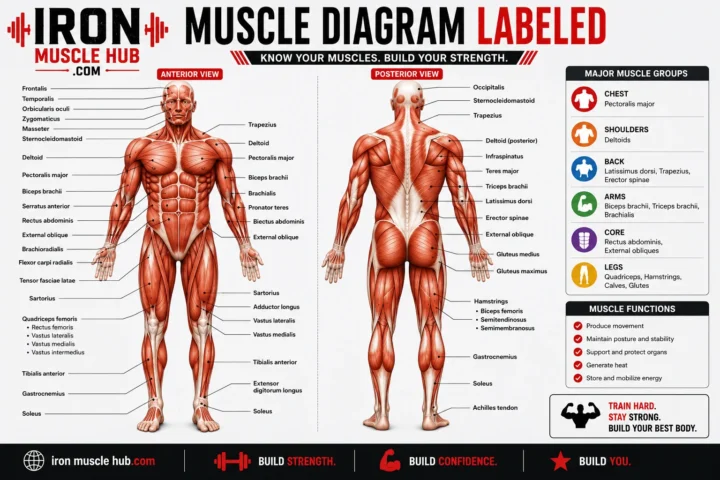
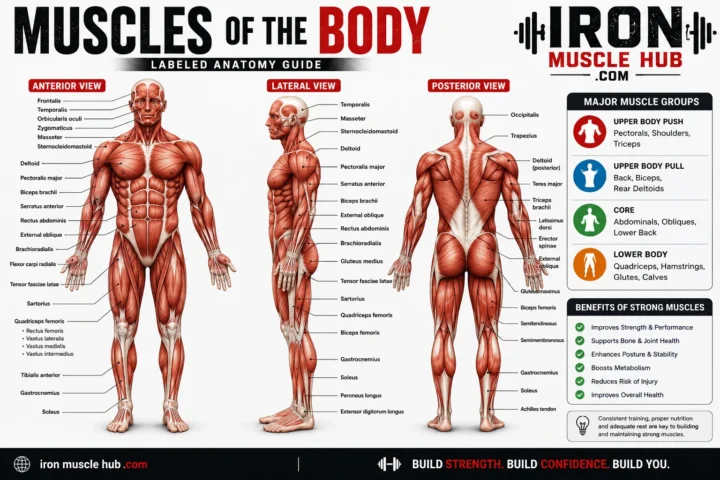
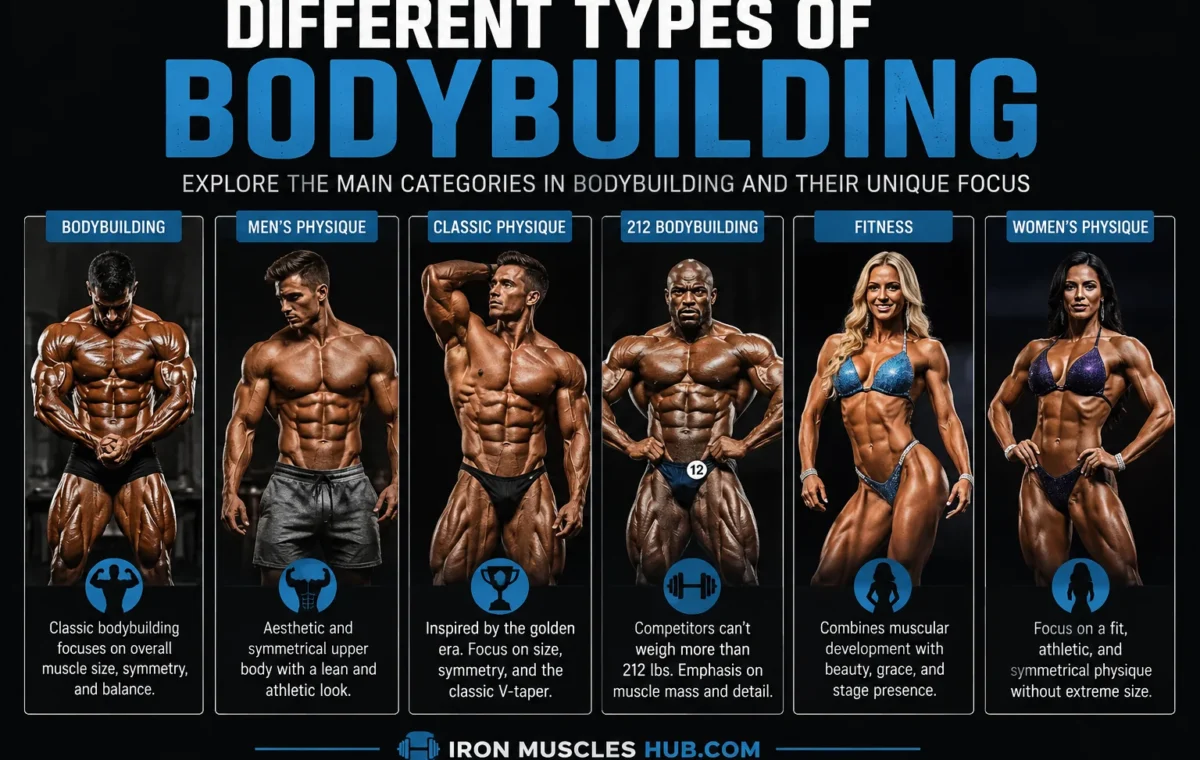
For beginners, the main divisions you’ll hear about include Men’s Bodybuilding, Classic Physique, Men’s Physique, Women’s Bodybuilding, Women’s Physique, Figure, Bikini, Wellness, and Fitness. The exact divisions and rules can vary between organizations and individual contests. Current IFBB and NPC Worldwide rules show a broad range of divisions rather than one universal bodybuilding format. For more insights read here :- muscle chart and muscle labeling
Quick Answer: What Are the Different Types of Bodybuilding?
- Men’s/Open Bodybuilding: Prioritizes maximum muscular development, conditioning, symmetry, and presentation.
- Classic Physique: Emphasizes muscularity with classic proportions, symmetry, and a strong V-taper.
- Men’s Physique: Focuses more heavily on an athletic upper-body look, proportions, conditioning, and presentation.
- Women’s divisions: Include categories such as Women’s Bodybuilding, Women’s Physique, Figure, Bikini, Wellness, and Fitness, depending on the organization.
- Natural bodybuilding: Refers to competitions operating under drug-testing rules; it can contain several of the same physique divisions.
The important point is that “type” can mean either a competitive division or a training style. This guide focuses mainly on competition divisions, then explains how those differences can influence your training.
1. What Are the Main Types of Bodybuilding?
The simplest way to understand bodybuilding categories is to look at what each division rewards.
Open Bodybuilding rewards extreme muscular development and conditioning. Classic Physique puts more emphasis on proportion and a classic shape. Men’s Physique places greater emphasis on an athletic upper-body appearance and presentation. Women’s divisions range from Bikini and Figure through Wellness, Women’s Physique, and Women’s Bodybuilding.
The exact judging standards are organization-specific, so don’t assume a category has identical rules everywhere. For example, the IFBB currently lists Men’s Bodybuilding, Classic Physique, Men’s Physique, Women’s Bodybuilding, Women’s Physique, Figure, Bikini, Wellness, and Fitness among its competitive categories. NPC Worldwide also lists these major divisions in its current rules.
A beginner-friendly way to think about the divisions
Imagine a spectrum.
At one end, the goal is maximum muscular development.
Moving across the spectrum, the emphasis can shift toward:
muscularity → proportion → athletic appearance → shape and presentation
That doesn’t mean one division is “easy.” Each category demands years of disciplined training, nutrition, recovery, posing practice, and competition preparation.
Why are there so many categories?
People don’t all build muscle in the same proportions.
One athlete may have naturally strong legs and respond very well to lower-body training. Another may have broad shoulders and a smaller waist. Someone else may prefer building a highly muscular full-body physique.
Competition divisions give athletes different ways to present their physique.
The judging standard is also important. A physique that is ideal for one category may not be ideal for another.
2. Men’s/Open Bodybuilding
Men’s Bodybuilding, often called Open Bodybuilding, is the division most people traditionally associate with the sport.
The central objective is very high muscular development combined with conditioning, symmetry, proportion, and stage presentation.
Competitors typically train the entire body rather than specializing in one or two muscle groups.
What does Open Bodybuilding emphasize?
The major priorities include:
- Overall muscle size
- Muscle density and development
- Proportion
- Symmetry
- Conditioning
- Posing
- Presentation
The IFBB continues to run Men’s Bodybuilding as a distinct competitive category, with classes and divisions varying by contest. Current IFBB event documentation includes Men’s Bodybuilding alongside Classic Bodybuilding, Classic Physique, Men’s Physique, and several women’s divisions.
Who is Open Bodybuilding suited to?
From a competition perspective, this path makes sense for an athlete whose primary goal is to maximize total muscular development.
For a beginner, however, you don’t need to decide immediately that you want to compete in Open Bodybuilding.
You can spend several years learning the basics:
- Squat and leg-training patterns
- Pressing movements
- Pulling movements
- Hip-hinge movements
- Direct arm and shoulder work
- Progressive resistance training
- Nutrition and recovery
- Posing later, if competition becomes a serious goal
Training considerations
A bodybuilding program should train all major muscle groups consistently.
A 2025 ACSM position stand synthesizing a large body of resistance-training research reported that muscle hypertrophy is enhanced by higher training volumes, while many other programming variables can be adjusted according to the individual’s needs and goals.
That gives beginners an important lesson:
You don’t need a complicated “bodybuilder workout” to start building a bodybuilding physique.
Good exercise selection, progressive training, adequate recovery, and consistency matter much more.
3. Classic Physique
Classic Physique sits between the extreme muscularity of Open Bodybuilding and the more streamlined appearance associated with Men’s Physique.
The category is strongly associated with proportion, symmetry, muscularity, presentation, and a classic V-taper.
Classic Physique is not simply “smaller bodybuilding.”
The athlete still needs substantial muscular development, but the desired overall appearance and competitive restrictions create a different target.
What makes Classic Physique different?
Common characteristics include:
- Broad shoulders
- Developed chest and back
- Strong legs
- Narrow-looking waist
- Balanced muscularity
- Symmetry
- Strong conditioning
- Classic posing
Current NPC Worldwide rules include specific height and weight limits for Classic Physique. For example, the rules publish height-based maximums rather than treating the division as completely unrestricted.
That is one reason beginners shouldn’t use a random bodyweight target from the internet as a universal Classic Physique standard.
Competition rules determine eligibility.
Who might prefer Classic Physique?
A lifter who loves:
- Proportion
- Symmetry
- A strong V-taper
- Visible leg development
- Traditional bodybuilding aesthetics
- Posing
may find Classic Physique particularly appealing.
It can also influence how you train.
For example, if your goal is a classic-looking physique, you might pay close attention to shoulder width, back development, leg balance, and waist presentation rather than simply chasing scale weight.
4. Men’s Physique
Men’s Physique emphasizes an athletic, muscular and well-conditioned appearance with particular attention to upper-body development, proportion, and presentation.
It differs from Open Bodybuilding because the competitive target isn’t simply “as much muscle as possible.”
The current IFBB structure includes Men’s Physique as its own category, with height classes used at many events.
What usually stands out?
Men’s Physique athletes commonly aim to develop:
- Shoulders
- Upper chest
- Back
- Arms
- Abdominals
- Overall V-taper
- Balanced conditioning
Legs still matter to overall physique development, even though the stage presentation differs from divisions where the legs are displayed more directly.
Is Men’s Physique easier?
Not necessarily.
That’s a common beginner mistake.
A category requiring less total muscularity than Open Bodybuilding can still be extremely demanding at a high competitive level.
The athlete must present the right combination of:
muscle + conditioning + proportions + posing + stage presentation.
The target is simply different.
5. Men’s 212 Bodybuilding
The 212 division is a professional bodybuilding category with a specific bodyweight ceiling.
It gives smaller-framed or lighter professional bodybuilders a separate competitive environment from the Open division.
The important point is that the 212 category is a competition division, not a separate muscle-building method.
You can use the same basic resistance-training principles to develop muscle whether your long-term goal is Open Bodybuilding, Classic Physique, or another category.
What changes is the physique target, competitive rules, and eventually how you manage bodyweight and conditioning.
Because competition regulations can change, always check the current rules for the specific federation and contest you plan to enter.
6. Women’s Bodybuilding
Women’s Bodybuilding is the most muscular of the major women’s physique divisions.
Athletes aim to display substantial muscular development, conditioning, symmetry, and proportion.
The division demonstrates an important point about bodybuilding:
Women can train for significant muscular development without following a completely different resistance-training system.
The principles remain familiar:
- Progressive resistance
- Sufficient training volume
- Appropriate exercise selection
- Recovery
- Nutrition
- Consistency
The desired competitive physique is what changes.
Current NPC Worldwide rules list Women’s Bodybuilding separately from Women’s Physique, Figure, Bikini, Wellness, and Fitness.
7. Women’s Physique
Women’s Physique is a muscular physique division that sits between Women’s Bodybuilding and less muscular categories such as Figure or Bikini.
The exact standard depends on the federation, but the category generally rewards a clearly muscular, conditioned, balanced physique.
Training may include substantial development of:
- Shoulders
- Back
- Glutes
- Legs
- Arms
- Abdominals
The goal isn’t simply to become as muscular as possible.
The athlete needs to build the right overall balance for the division.
That distinction is useful for beginners because bodybuilding training should always begin with a clear goal.
If you train without knowing what you’re trying to develop, you can spend a lot of time adding muscle without improving the proportions you actually want.
8. Figure
Figure bodybuilding emphasizes muscularity, symmetry, proportion, and a lean, athletic appearance.
It generally sits between the more muscular Women’s Physique category and the softer overall appearance associated with Bikini.
The exact judging rules differ between organizations, so competitors should study the rulebook and judging criteria of their intended federation.
Figure athletes commonly pay close attention to:
- Shoulder development
- Back width
- Glute and leg development
- Waist-to-shoulder appearance
- Symmetry
- Conditioning
- Presentation
This makes Figure particularly interesting for lifters who enjoy structured bodybuilding training but don’t want their competitive goal to be maximum muscularity.
9. Bikini
Bikini is a physique category that emphasizes shape, proportion, conditioning, presentation, and an athletic appearance rather than maximum muscular size.
It is one of the most recognizable women’s physique divisions.
Training for Bikini can still involve serious resistance training.
A beginner shouldn’t make the mistake of thinking that a category with less muscularity requires little strength training.
The athlete still needs to develop the physique required by the judging standard.
Depending on the federation, judging can include factors related to:
- Overall shape
- Proportion
- Symmetry
- Conditioning
- Presentation
- Stage presence
Current IFBB event categories include Women’s Bikini across multiple height classes.
10. Wellness
Wellness is a women’s physique division known for placing greater emphasis on lower-body development while maintaining a balanced upper body.
The category has become an established part of major bodybuilding competitions.
Current IFBB competition information lists Women’s Wellness, including height-based classes at some events.
For a Wellness-focused athlete, lower-body development can be particularly important.
Training may therefore place substantial attention on:
- Glutes
- Hamstrings
- Quadriceps
- Calves
- Shoulders
- Back
- Overall symmetry
The key is still balance.
A beginner shouldn’t interpret Wellness as “train legs and ignore everything else.”
A competitive physique is judged as a complete physique.
11. Fitness
Fitness competitions can combine physique presentation with a performance component, depending on the organization.
That makes Fitness different from a traditional bodybuilding category where the central focus is physique comparison.
Fitness-style competition can involve athletic skills, choreography, flexibility, strength, and other performance elements.
The IFBB currently lists Fitness separately from bodybuilding and physique categories.
This can appeal to athletes who enjoy both resistance training and performance-based training.
12. Natural Bodybuilding
Natural bodybuilding refers to bodybuilding competitions conducted under an organization’s drug-testing policies.
Natural bodybuilding isn’t necessarily one single physique category.
A natural competition may offer several divisions, such as:
- Natural Bodybuilding
- Natural Classic Physique
- Natural Men’s Physique
- Natural Women’s Physique
- Natural Figure
- Natural Bikini
The exact lineup depends on the organization.
For someone who wants to compete naturally, the most important step is to read the federation’s current prohibited-substance and testing rules.
Don’t assume that two organizations use identical testing policies.
Is natural bodybuilding a different training style?
Not fundamentally.
You can still use progressive resistance training, different exercise selections, different split structures, and different rep ranges.
The difference is the competitive drug-testing framework and the athlete’s commitment to competing without prohibited performance-enhancing drugs.
13. Bodybuilding Training Styles vs Competition Divisions
This distinction is often missed when people search for the different types of bodybuilding.
There are bodybuilding divisions and there are ways of organizing your training.
For example, these are training structures:
Full-body training
You train most major muscle groups during each session.
This can work very well for beginners because it lets you practice important movement patterns regularly without requiring a large number of weekly gym sessions.
Research comparing split and full-body resistance training found similar strength and muscle-growth outcomes when training volume was equated.
Upper/lower training
You divide sessions between upper-body and lower-body work.
This can provide a useful balance between training frequency and session length.
Push/pull/legs
You organize training around:
- Pushing muscles and movements
- Pulling muscles and movements
- Legs
It can work well for experienced lifters, but beginners don’t automatically need it.
Body-part split
You dedicate sessions to areas such as:
- Chest
- Back
- Shoulders
- Arms
- Legs
This is strongly associated with bodybuilding culture, but it isn’t mandatory for muscle growth.
The best structure is the one you can execute consistently while recovering adequately.
14. Comparison Table: Which Bodybuilding Type Fits Your Goal?
| Bodybuilding type | Main emphasis | Typical beginner appeal | Main training priority |
|---|---|---|---|
| Open Bodybuilding | Maximum muscular development | For lifters chasing size | Full-body hypertrophy |
| Classic Physique | Proportion, symmetry, V-taper | Traditional bodybuilding look | Balanced muscle development |
| Men’s Physique | Athletic upper-body appearance | Lean, muscular look | Shoulders, chest, back, arms |
| 212 Bodybuilding | High muscularity within a weight limit | Competitive specialist goal | Muscle development + weight management |
| Women’s Bodybuilding | High muscular development | Maximum muscularity goal | Full-body hypertrophy |
| Women’s Physique | Muscularity and conditioning | Strong muscular aesthetic | Balanced muscle development |
| Figure | Symmetry and muscular shape | Athletic physique goal | Shoulders, back, legs |
| Bikini | Shape, proportion and presentation | Fitness-focused physique | Glutes, legs, shoulders and overall balance |
| Wellness | Lower-body development and balance | Lower-body-focused physique | Glutes, quads, hamstrings |
| Fitness | Physique + athletic performance | Performance-oriented athlete | Resistance training + skill work |
| Natural bodybuilding | Physique competition under testing rules | Drug-tested competition | Progressive training + recovery |
Important: This table is a practical overview, not a universal judging rulebook. Competition standards differ between federations and contests.
15. How to Choose the Right Bodybuilding Type
You don’t need to choose based on what is currently popular.
Start with your goal.
Choose Open Bodybuilding if…
Your biggest priority is maximizing overall muscular development and you’re interested in the traditional bodybuilding format.
Choose Classic Physique if…
You enjoy the idea of a muscular but highly proportioned physique with a strong V-taper and classic presentation.
Choose Men’s Physique if…
You prefer an athletic, lean-looking upper body and don’t want maximum overall muscularity to be the central target.
Consider Women’s Bodybuilding if…
You want to pursue substantial muscular development across the entire body.
Consider Women’s Physique if…
You want a clearly muscular physique while following a different competitive standard from Women’s Bodybuilding.
Consider Figure if…
You like balanced muscular development and an athletic, symmetrical appearance.
Consider Bikini if…
Your preferred goal is shape, proportion, conditioning, and presentation without pursuing the muscularity expected in the higher-muscularity divisions.
Consider Wellness if…
You particularly enjoy developing your lower body and prefer the Wellness competitive aesthetic.
Consider Fitness if…
You want bodybuilding combined with athletic performance and routine-based competition.
Consider natural competition if…
Competing under a drug-tested framework is important to you.
16. How Should a Beginner Train for Bodybuilding?
You don’t need an advanced bodybuilding split on day one.
Start with the basics.
ACSM’s resistance-training guidance gives beginners a practical foundation: major muscle groups can be trained using multiple exercises, with controlled technique and progressive resistance. Its public guidance describes 8–10 multi-joint exercises, 2–3 sets of 8–12 repetitions, and training 2–3 times per week as a general resistance-training approach for health.
That isn’t a mandatory bodybuilding prescription.
It’s a starting framework.
Research also shows that muscle hypertrophy can occur across a relatively broad range of resistance-training loads when training is appropriately structured.
A simple beginner framework
Start each session with major movements such as:
- A squat or leg-press pattern
- A hip-hinge pattern
- A horizontal press
- A vertical press
- A horizontal pull
- A vertical pull
- Direct arm work if appropriate
- Calf or abdominal work if needed
You can then increase training volume gradually as your technique and recovery improve.
Don’t chase exhaustion
One of the biggest beginner misconceptions is that every set needs to reach absolute failure.
Current evidence doesn’t show that momentary muscular failure is consistently superior to non-failure training for hypertrophy.
A better approach is to perform challenging sets with good technique while leaving enough recovery capacity to train productively again.
17. Worked Example: A Beginner Choosing a Bodybuilding Direction
Imagine a beginner who is 175 cm (5 ft 9 in) and 75 kg (165 lb).
They have trained consistently for less than a year and want to develop a muscular, athletic physique.
Their first mistake would be choosing a competition category and immediately trying to copy an advanced competitor’s diet and training routine.
A better process would be:
Step 1: Build general strength and muscle.
Step 2: Train the whole body consistently.
Step 3: Develop shoulders, chest, back, legs, arms and trunk.
Step 4: Learn basic nutrition and recovery.
Step 5: After gaining experience, decide whether they prefer a Classic Physique, Men’s Physique, Open Bodybuilding, or simply recreational bodybuilding goal.
Their current bodyweight does not automatically determine the correct category.
Competition rules can include height classes, weight limits, age groups, and other requirements, so the final decision should be made using the current rules of the federation and specific contest.
18. Common Mistakes → Why → Fix
Mistake 1: Choosing a category based only on appearance
Why: A photograph doesn’t tell you how a physique was developed, what federation rules apply, or what the athlete’s competitive category requires.
Fix: Read the current rulebook for the federation you intend to enter.
Mistake 2: Copying a professional’s workout
Why: Professional competitors have years of training experience and very different recovery demands.
Fix: Build your program around your current training age, schedule, technique, and recovery.
Mistake 3: Thinking heavier weights automatically build more muscle
Why: Strength and hypertrophy overlap, but they’re not identical adaptations.
Fix: Use loads that allow you to train safely and progressively. Research indicates that different loading ranges can produce similar hypertrophy when training is appropriately structured, while heavier loading has an advantage for maximal strength.
Mistake 4: Ignoring volume
Why: Doing the same small amount of work forever may eventually limit progress.
Fix: Progress your training gradually instead of adding huge amounts of work at once. Research has found a relationship between resistance-training volume and muscle growth, although the ideal amount varies between individuals.
Mistake 5: Treating posing as an afterthought
Why: Bodybuilding competitions judge the physique as presented on stage.
Fix: If you plan to compete, learn posing early enough that it doesn’t become a last-minute skill.
Mistake 6: Assuming every federation uses the same categories
Why: They don’t.
Fix: Check the current rules of the organization and contest you’re considering. IFBB and NPC Worldwide, for example, publish their own category and qualification information.
19. 30-Second Decision Rule
If you’re completely new to bodybuilding, ask yourself these four questions:
1. Do I want maximum muscular development?
Choose Open Bodybuilding as the physique direction to study.
2. Do I prefer proportion and a classic V-taper?
Study Classic Physique.
3. Do I prefer a lean, athletic upper-body look?
Study Men’s Physique.
4. Am I more interested in women’s physique categories?
Compare Bikini, Figure, Wellness, Women’s Physique, and Women’s Bodybuilding based on the judging criteria of your federation.
You don’t have to compete just because you enjoy bodybuilding.
You can also use these categories as visual goals for recreational training.
20. Who Is Bodybuilding Competition NOT For?
Competition isn’t necessary for building muscle.
If you dislike strict dieting, posing, stage preparation, judging, or competition pressure, you can still train like a bodybuilder without entering a contest.
You can pursue:
- More muscle
- Better strength
- Improved fitness
- Better movement quality
- A healthier body composition
- Greater confidence in the gym
without stepping on a stage.
For many beginners, that’s the better starting point.
Build the training habit first. Decide about competition later.
FAQ: Different Types of Bodybuilding
What are the main types of bodybuilding?
The major competitive categories include Men’s/Open Bodybuilding, Classic Physique, Men’s Physique, Women’s Bodybuilding, Women’s Physique, Figure, Bikini, Wellness, and Fitness, although the exact lineup varies by organization. Natural bodybuilding can also offer several of these divisions under drug-testing rules. Current IFBB and NPC Worldwide information confirms that bodybuilding competition includes multiple distinct physique categories.
What is the difference between Classic Physique and bodybuilding?
Open Bodybuilding places greater emphasis on maximum overall muscular development, while Classic Physique combines substantial muscularity with a classic, proportioned appearance. Classic Physique competitions can also impose height-to-weight restrictions. Current NPC Worldwide rules publish specific Classic Physique height and weight limits, so competitors should check the current rules instead of relying on old charts.
What is the difference between Men’s Physique and bodybuilding?
Men’s Physique generally targets a lean, athletic and proportioned appearance rather than the maximum muscularity associated with Open Bodybuilding. The competitive presentation is also different. Men’s Physique is an established division in the current IFBB structure, with height classes used at many events.
What is the easiest type of bodybuilding for beginners?
There isn’t one universally easiest category. Every division has its own judging criteria and competitive demands. For a beginner, the smartest approach is usually to develop general strength and muscle first rather than immediately specializing. Once you understand your strengths, preferences, and competition goals, you can choose a division based on the current rules of the federation you want to enter.
Can you build muscle without competing in bodybuilding?
Absolutely. Bodybuilding-style resistance training can simply be a method for developing muscle, strength, and physical fitness. You don’t need posing, stage preparation, or a competition category to benefit from resistance training. Research summarized by ACSM and PubMed supports progressive resistance training for improving muscle size, strength, and physical function.
Final Takeaway
The different types of bodybuilding exist because athletes can pursue very different physique goals. Open Bodybuilding emphasizes extreme muscular development, Classic Physique prioritizes muscularity with classic proportions, and Men’s Physique targets a leaner athletic presentation. Women’s divisions range from Bikini and Figure to Wellness, Women’s Physique, and Women’s Bodybuilding. Fitness adds a performance component, while natural competitions apply drug-testing rules.
If you’re a beginner, don’t rush to copy an advanced competitor. Start by building muscle with sound resistance training, learn good technique, recover properly, and progress gradually. Once you understand what type of physique you enjoy building, choosing a competition division becomes much easier.