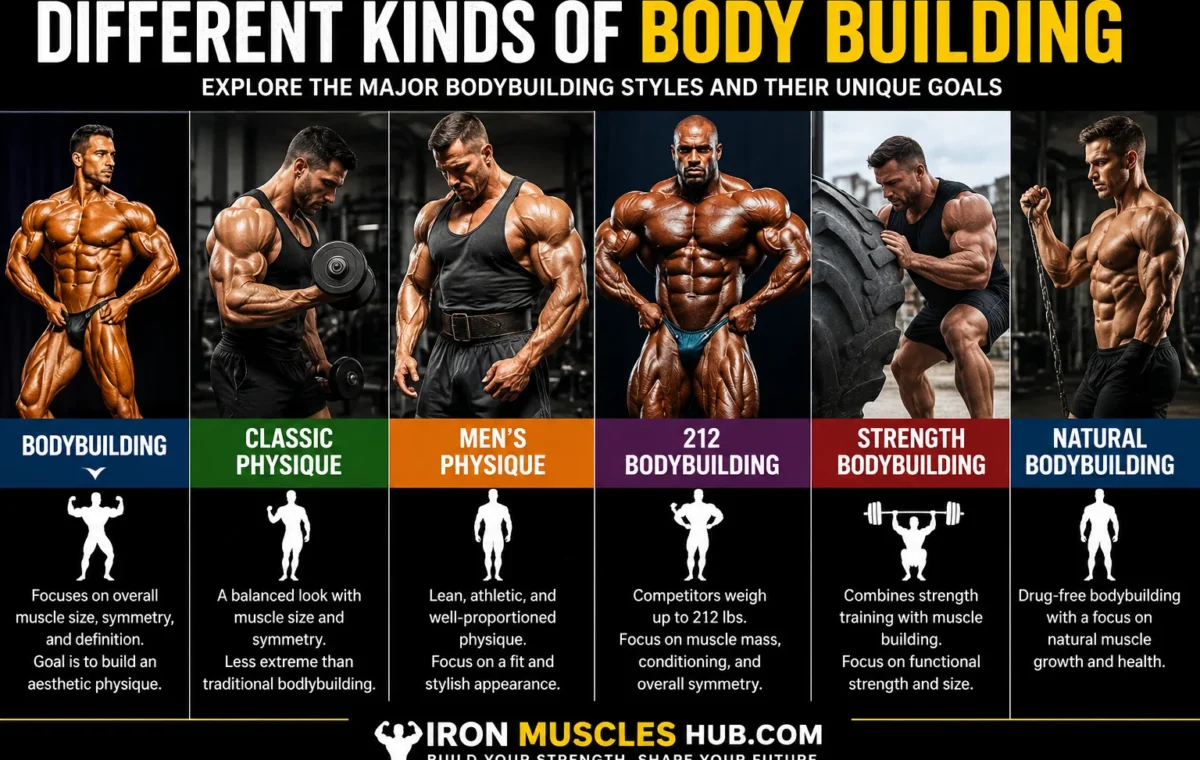
If you’re searching for the different kinds of bodybuilding, you’ll usually find that “bodybuilding” can mean two things: training to build muscle and competing in a specific physique division. Competitive bodybuilding has several divisions, each rewarding a different balance of muscularity, proportions, conditioning, presentation and overall appearance. The major professional divisions include Men’s Open, Men’s 212, Classic Physique, Men’s Physique, Wheelchair Bodybuilding, Women’s Bodybuilding, Fitness, Figure, Bikini, Women’s Physique, Wellness and Fit Model.
- Quick Answer
- What Are the Different Kinds of Bodybuilding?
- 1. Men’s Open Bodybuilding
- What makes Open Bodybuilding different?
- 2. Men’s 212 Bodybuilding
- Who might be interested?
- 3. Classic Physique
- Classic Physique vs Men’s Physique
- 4. Men’s Physique
- What does Men’s Physique reward?
- 5. Men’s Wheelchair Bodybuilding
- 6. Women’s Bodybuilding
- 7. Women’s Physique
- 8. Figure
- 9. Bikini
- Is Bikini just about being skinny?
- 10. Wellness
- 11. Fitness
- 12. Fit Model
- Mistake 1: Training for a professional physique immediately
- Mistake 2: Thinking every bodybuilding division needs the same physique
- Mistake 3: Focusing only on the scale
- Mistake 4: Copying a professional's workout
- Mistake 5: Assuming “leaner” always means “better”
- Mistake 6: Ignoring recovery
- What are the different kinds of bodybuilding?
- What is the difference between Classic Physique and Men’s Physique?
- Which bodybuilding division is best for beginners?
- Is bodybuilding only about building muscle?
- Can women do bodybuilding?
- Quick Answer
- What Are the Different Kinds of Bodybuilding?
- 1. Men’s Open Bodybuilding
- What makes Open Bodybuilding different?
- 2. Men’s 212 Bodybuilding
- Who might be interested?
- 3. Classic Physique
- Classic Physique vs Men’s Physique
- 4. Men’s Physique
- What does Men’s Physique reward?
- 5. Men’s Wheelchair Bodybuilding
- 6. Women’s Bodybuilding
- 7. Women’s Physique
- 8. Figure
- 9. Bikini
- Is Bikini just about being skinny?
- 10. Wellness
- 11. Fitness
- 12. Fit Model
- Mistake 1: Training for a professional physique immediately
- Mistake 2: Thinking every bodybuilding division needs the same physique
- Mistake 3: Focusing only on the scale
- Mistake 4: Copying a professional's workout
- Mistake 5: Assuming “leaner” always means “better”
- Mistake 6: Ignoring recovery
- What are the different kinds of bodybuilding?
- What is the difference between Classic Physique and Men’s Physique?
- Which bodybuilding division is best for beginners?
- Is bodybuilding only about building muscle?
For a beginner, the important point is simple: you don’t need to choose a competition division just because you enjoy bodybuilding training. You can lift weights for muscle, strength, health or appearance without competing. For more insights read here :- muscles of the body labeled and muscle chart .
Quick Answer
- Men’s Open Bodybuilding: The highest emphasis on overall muscular development, conditioning and density.
- Classic Physique: A balanced, aesthetic look with more emphasis on proportion and classic lines.
- Men’s Physique: An athletic upper-body look with a strong V-taper and less emphasis on leg presentation.
- Women’s divisions: Bikini, Figure, Wellness, Women’s Physique, Women’s Bodybuilding, Fitness and Fit Model each emphasize different combinations of muscle, shape, conditioning and presentation.
- For beginners: Start by building basic strength and muscle before worrying about a competition category.
What Are the Different Kinds of Bodybuilding?
The different kinds of bodybuilding are best understood as competition divisions rather than completely different ways of lifting weights. Athletes generally train with resistance exercise to develop muscle, but the final appearance they aim for depends on the division.
The IFBB Professional League currently lists 12 professional divisions: Men’s Open Bodybuilding, Men’s 212 Bodybuilding, Classic Physique, Men’s Physique, Men’s Wheelchair, Women’s Bodybuilding, Fitness, Figure, Bikini, Women’s Physique, Wellness and Fit Model.
The judging standards differ from one division to another. That means the “best” physique for one category isn’t necessarily the best physique for another.
For example, Open Bodybuilding places a major emphasis on muscularity and conditioning, while Men’s Physique focuses more strongly on an athletic upper-body appearance and presentation. Classic Physique sits between those two ideas, emphasizing muscularity alongside proportion and a classic silhouette.
For a beginner, think of the divisions as different targets. Your training foundation can be similar, but your long-term priorities can change depending on the target.
1. Men’s Open Bodybuilding
Men’s Open Bodybuilding is the division most people picture when they hear the word “bodybuilding.”
Competitors are judged on muscular development, conditioning, proportions, presentation and overall physique. The IFBB Pro rules include eight mandatory poses, covering areas such as the front and back double biceps, lat spreads, side chest, side triceps, abdominals and thighs, and most muscular.
What makes Open Bodybuilding different?
The goal is maximum overall muscular development while maintaining a highly conditioned physique.
That doesn’t mean simply becoming as heavy as possible. A competitive physique needs balance between different muscle groups and enough conditioning for those muscles to be clearly visible.
A beginner shouldn’t copy the training or lifestyle of a professional Open bodybuilder.
Professional competition represents an advanced level of physique development. A new lifter will usually make better progress by concentrating on:
- Consistent resistance training
- Good exercise technique
- Progressive training
- Adequate recovery
- Enough food and protein
- Sustainable habits
You can train like a bodybuilder without trying to look like a professional bodybuilder.
2. Men’s 212 Bodybuilding
Men’s 212 is another bodybuilding division listed by the IFBB Professional League. It provides a separate competitive category within men’s bodybuilding.
The name refers to the division’s weight limit structure rather than a different type of exercise.
The division still requires substantial muscular development and conditioning, but it gives athletes who fit the category a separate competitive pathway.
Who might be interested?
An experienced competitor whose physique and competition weight suit the division may consider it.
For a beginner, however, there’s no reason to structure your entire training program around a professional division before you’ve developed a solid training history.
Build the foundation first.
3. Classic Physique
Classic Physique has become one of the most recognizable bodybuilding categories.
It sits between Men’s Physique and Open Bodybuilding in terms of the general physique target. The emphasis is on muscularity, proportion, symmetry, conditioning and a classic-looking silhouette. The division also has height-related weight limits, with the exact rules depending on the competition organization.
This is one reason Classic Physique vs Men’s Physique is such a common beginner question.
Classic Physique vs Men’s Physique
Classic Physique requires competitors to display their legs, while Men’s Physique competitors wear board shorts that cover the legs. Classic Physique also places a stronger emphasis on complete lower-body development and classic posing.
A simple way to remember the difference:
Men’s Physique = athletic V-taper and upper-body presentation.
Classic Physique = balanced full-body development with classic proportions.
Classic Physique is not simply “smaller Open Bodybuilding.” The judging target is different.
4. Men’s Physique
Men’s Physique is often associated with a lean, athletic appearance.
The division emphasizes the upper body, including the shoulders, chest, arms, back and waistline. Competitors wear board shorts, meaning the legs aren’t presented in the same way they are in Classic Physique or Open Bodybuilding.
The IFBB continues to list Men’s Physique as an active professional division, with competitions throughout 2026.
What does Men’s Physique reward?
A competitor generally needs:
- Broad-looking shoulders
- A developed back
- A strong chest
- Well-developed arms
- A relatively tight waist
- Good conditioning
- Confident presentation
The goal isn’t to build every muscle as large as possible.
That distinction matters for beginners. If your personal goal is simply to look athletic, you don’t need to train for a competition. A balanced full-body program can produce an impressive physique without following contest-specific preparation.
5. Men’s Wheelchair Bodybuilding
Men’s Wheelchair Bodybuilding is a specialized professional division designed for athletes who compete using wheelchairs.
The IFBB Professional League lists Men’s Wheelchair as one of its professional divisions, and the division appears on major 2026 professional competition schedules.
Training needs to account for the athlete’s individual mobility, strength, equipment and medical considerations.
For someone with a disability, the right approach isn’t to copy a standard bodybuilding program and simply remove leg exercises.
Instead, work with a qualified coach and, where appropriate, a healthcare professional who understands your specific needs.
Women’s Bodybuilding Divisions
Competitive women’s physique sport includes several distinct divisions.
The current IFBB professional structure includes Women’s Bodybuilding, Fitness, Figure, Bikini, Women’s Physique, Wellness and Fit Model.
Each category has its own judging emphasis.
That means saying someone is “into women’s bodybuilding” doesn’t necessarily tell you what type of physique competition they mean.
6. Women’s Bodybuilding
Women’s Bodybuilding is the division with the greatest emphasis on muscular development among the women’s categories.
Athletes are judged on muscularity, conditioning, symmetry, proportion and presentation.
The goal is not simply to become lean.
A competitor needs substantial muscular development, which generally takes years of consistent resistance training.
For beginners, this is an important distinction: being lean and being highly muscular are different adaptations.
You can improve body composition without pursuing competitive bodybuilding.
7. Women’s Physique
Women’s Physique generally sits between Figure and Women’s Bodybuilding in the competitive physique spectrum.
It rewards substantial muscular development, conditioning, symmetry and presentation.
The IFBB lists Women’s Physique as a current professional division and includes it in major 2026 competitions.
For someone considering competition, the exact criteria should always be checked with the organization running the show.
Competition standards can vary between federations, and amateur categories don’t always mirror professional categories perfectly.
8. Figure
Figure emphasizes muscular development and an athletic, balanced physique without requiring the same degree of muscularity associated with Women’s Bodybuilding.
The physique generally places strong emphasis on balanced shoulders, back, legs and waist, along with conditioning and stage presentation.
Figure remains an active IFBB professional division in 2026.
A beginner considering Figure should understand that competition preparation is different from ordinary gym training.
Getting ready for a show involves posing, presentation, nutrition and eventually a level of conditioning that isn’t necessary for general health or fitness.
9. Bikini
Bikini is one of the most recognizable women’s physique divisions.
The target is different from Women’s Bodybuilding. Competitors aren’t trying to maximize muscular size.
Instead, the division emphasizes an athletic, balanced and conditioned appearance, along with presentation and stage presence. NASM identifies Bikini as a major women’s competition category and describes it as a leaner, presentation-focused division compared with the more muscular categories.
Is Bikini just about being skinny?
No.
That’s a common misunderstanding.
A competitive Bikini athlete still needs developed muscle, especially in areas that contribute to the desired shape. The goal is a specific combination of muscular development, conditioning, proportions and presentation.
Trying to become lighter without building the appropriate muscle doesn’t automatically produce a Bikini physique.
10. Wellness
Wellness is a newer addition to the major professional women’s physique divisions.
The category places greater emphasis on lower-body development compared with several other women’s physique categories. NASM describes Wellness as emphasizing more lower-body development relative to the upper body.
The IFBB Professional League currently lists Women’s Wellness as an active division, including at major 2026 events.
This makes Wellness particularly different from Bikini.
If you’re comparing Bikini vs Wellness, the easiest beginner-friendly distinction is:
| Feature | Bikini | Wellness |
|---|---|---|
| Overall look | Lean, balanced, athletic | More lower-body dominant |
| Muscle emphasis | Moderate | Greater lower-body development |
| Legs/glutes | Developed | Stronger emphasis |
| Upper body | Balanced | Generally less dominant than lower body |
| Presentation | Important | Important |
These descriptions are simplified. Actual judging standards should come from the federation and competition rules for the show you’re entering.
11. Fitness
Women’s Fitness is different because it combines physique presentation with athletic performance.
The IFBB lists Fitness as a professional division, and the division appears in major 2026 competitions.
This makes it particularly interesting for athletes who enjoy both resistance training and performance-based movement.
A Fitness competitor may need to develop:
- Muscularity
- Conditioning
- Flexibility
- Coordination
- Movement skills
- Stage presentation
- A performance routine
This isn’t the same goal as traditional bodybuilding.
12. Fit Model
Fit Model is another professional women’s division now listed by the IFBB Professional League.
It is designed around a different physique and presentation target from traditional bodybuilding divisions.
Because competitive categories can change over time, always check the current rules for the specific federation and show rather than relying on an old article.
That matters especially in 2026, as federations continue to develop their competition structures.
Bodybuilding Types Compared
Here’s a simple beginner’s comparison:
| Division | Main emphasis | Overall physique target | Legs important? | Best understood as |
| Men’s Open | Maximum muscular development + conditioning | Highly muscular | Yes | Traditional bodybuilding |
| Men’s 212 | Muscularity + conditioning | Dense muscular physique within division rules | Yes | Specialized bodybuilding division |
| Classic Physique | Proportion + muscularity + classic shape | Balanced, classic look | Yes | Middle ground between Physique and Open |
| Men’s Physique | Upper-body aesthetics + conditioning | Athletic V-taper | Less visible on stage | Athletic physique |
| Wheelchair | Muscularity + presentation adapted to wheelchair competition | Upper-body-focused competitive physique | Adapted | Accessible bodybuilding competition |
| Women’s Bodybuilding | Muscularity + conditioning | Highly muscular | Yes | Traditional women’s bodybuilding |
| Women’s Physique | Muscularity + symmetry | Muscular and conditioned | Yes | Intermediate-to-high muscularity |
| Figure | Muscle + balance + conditioning | Athletic, balanced physique | Yes | Structured physique competition |
| Bikini | Shape + balance + conditioning | Lean, athletic appearance | Yes | Presentation-focused physique |
| Wellness | Lower-body development + shape | Lower-body-dominant physique | Strong emphasis | Lower-body-focused physique |
| Fitness | Physique + athletic performance | Muscular and athletic | Yes | Physique plus performance |
| Fit Model | Fitness physique + presentation | Streamlined athletic appearance | Depends on rules | Model/fitness presentation |
The current professional division list comes from the IFBB Professional League’s 2026 rules.
What Kind of Bodybuilding Is Best for a Beginner?
If you’re completely new to lifting, don’t start by choosing a competition division.
Start by choosing your training goal.
Ask yourself:
- Do I want to build muscle?
- Do I want to become stronger?
- Do I want to improve my general fitness?
- Do I eventually want to compete?
- Do I enjoy posing and stage presentation?
- Am I willing to spend years developing a competition physique?
If your answer to the first three is yes and the others are no, ordinary resistance training may be all you need.
If you eventually want to compete, spend your first phase building muscle, learning good technique and establishing consistent training habits.
A competition category can come later.
A Simple Beginner Decision Rule
Here’s a 30-second self-test:
If you want maximum muscle → investigate Open Bodybuilding.
If you want classic proportions → investigate Classic Physique.
If you prefer an athletic upper-body look → investigate Men’s Physique.
If you’re a woman who wants more lower-body emphasis → investigate Wellness.
If you prefer a balanced, less muscular physique category → investigate Bikini or Figure, depending on your goals and the federation’s standards.
If you enjoy performance and movement → investigate Fitness.
But don’t treat this as a prescription.
Your bone structure, muscle development, preferences, competition federation and ability to meet the rules all matter.
Worked Example: What Does a Bodybuilding Goal Look Like?
Suppose you’re a beginner who weighs 80 kg (176.4 lb) and is 175 cm (5 ft 9 in) tall.
You decide that your first goal isn’t competition. You simply want to build more muscle.
A sensible starting target isn’t “become an Open bodybuilder.”
Instead, your target could be:
Phase 1: Learn fundamental exercises.
Phase 2: Build consistent training habits.
Phase 3: Gradually increase training loads or repetitions as your technique improves.
Phase 4: Monitor strength, body measurements, photos and how you feel.
Phase 5: After you’ve built a training base, decide whether competition still interests you.
If you eventually decide that Classic Physique fits your preferred look, you can adjust your training and competition preparation with an experienced coach.
The important lesson is that the division comes after the foundation, not before it.
Common Mistakes → Why → Fix
Mistake 1: Training for a professional physique immediately
Why: Professional athletes have years of specialized training and competition experience.
Fix: Follow a beginner resistance-training program and focus on technique, consistency and gradual progression.
Mistake 2: Thinking every bodybuilding division needs the same physique
Why: The divisions have different judging priorities.
Fix: Learn what the specific federation rewards before deciding on a category. The IFBB rules show clear differences between divisions.
Mistake 3: Focusing only on the scale
Why: Body weight doesn’t tell you how much muscle you have or how your physique is proportioned.
Fix: Track several useful measures, such as gym performance, waist measurement, progress photos and body weight.
Mistake 4: Copying a professional’s workout
Why: An advanced athlete has a different training history, recovery capacity and muscle-development level.
Fix: Use a program appropriate for your experience.
Mistake 5: Assuming “leaner” always means “better”
Why: Competition conditioning is a specialized physique goal and isn’t necessary for general fitness.
Fix: Set a health-focused goal unless you specifically want to compete.
Mistake 6: Ignoring recovery
Why: Muscle growth doesn’t come from training alone. Your body also needs recovery between sessions.
Fix: Treat sleep, food, rest days and manageable training volume as part of the program.
How Should Beginners Train for Bodybuilding?
If you’re new to resistance training, don’t make your program unnecessarily complicated.
Your first objective is to learn how to perform basic movements safely and consistently.
A beginner program can include movements that train:
- Chest
- Back
- Shoulders
- Arms
- Quadriceps
- Hamstrings
- Glutes
- Calves
- Core
You don’t need a separate exercise for every visible muscle in your first week.
Start with movements you can perform with good technique, then gradually make the training more challenging.
The NSCA notes that proximity to muscular failure can affect hypertrophy and strength adaptations, which is one reason training effort matters rather than simply counting repetitions.
For beginners, that doesn’t mean every set should be taken to absolute failure.
A better approach is learning how to finish a set with controlled technique and gradually understand how hard you can train while still recovering well.
Who This Is NOT For
Competitive bodybuilding isn’t a requirement for looking fit.
This guide isn’t the right starting point if you’re looking for:
- Steroid or PED instructions
- Extreme rapid weight loss
- Guaranteed muscle-gain results
- Crash diets
- Dangerous dehydration methods
- Contest-prep drug protocols
- A shortcut to a professional physique
Those approaches can carry significant health risks.
If you’re interested in competition, work with a qualified coach who understands your federation’s current rules and preparation demands.
How Long Does It Take to Build a Bodybuilding Physique?
There’s no reliable universal timeline.
Your rate of progress depends on factors such as:
- Training experience
- Genetics
- Starting muscle mass
- Nutrition
- Sleep
- Training consistency
- Age
- Sex
- Recovery
- Program quality
A beginner may notice changes relatively early, but building a highly developed competitive physique is a much longer process.
That’s why comparing yourself with professional competitors can be misleading.
A professional bodybuilder represents an advanced endpoint, not a realistic starting benchmark.
Focus on becoming stronger and more skilled than you were several months ago.
Different Kinds of Bodybuilding: Natural vs Competitive Training
Another source of confusion is the difference between bodybuilding as training and bodybuilding as competition.
You can practice bodybuilding-style resistance training without entering a contest.
You can also compete in organizations that have natural bodybuilding categories.
However, “natural” is not a universal rule across every federation. Testing procedures, banned substances and eligibility requirements vary.
If drug-tested competition matters to you, read the current rules of the exact organization you’re considering.
Don’t assume that the word “natural” means identical testing standards everywhere.
Frequently Asked Questions
What are the different kinds of bodybuilding?
The major professional bodybuilding and physique divisions currently include Men’s Open, Men’s 212, Classic Physique, Men’s Physique, Men’s Wheelchair, Women’s Bodybuilding, Fitness, Figure, Bikini, Women’s Physique, Wellness and Fit Model.
These categories aren’t simply different workout routines. They are competitive divisions with different judging priorities. The right choice depends on the physique and performance style an athlete wants to develop.
What is the difference between Classic Physique and Men’s Physique?
Classic Physique emphasizes full-body muscular development, proportion, symmetry and a classic silhouette. Competitors also present their legs on stage. Men’s Physique places greater emphasis on an athletic upper body and V-taper, while board shorts cover the legs during judging.
For a beginner, think of Classic as a more complete full-body physique category and Men’s Physique as a more upper-body-focused presentation.
Which bodybuilding division is best for beginners?
There isn’t one universally best division for beginners.
If you’re new to resistance training, your first goal should be learning basic movements, developing consistency and building muscle. You can decide on a competition category later.
If you already know you want to compete, compare the current rules of your chosen federation and speak with an experienced competition coach before selecting a division.
Is bodybuilding only about building muscle?
No.
Bodybuilding training is primarily associated with developing muscular size and shape, but competitive bodybuilding also involves conditioning, symmetry, proportion and presentation.
Some divisions add other requirements. Fitness, for example, combines physique presentation with athletic performance.
For general gym-goers, you can use bodybuilding-style resistance training simply to build muscle and improve your physique without entering a competition.
Can women do bodybuilding?
Absolutely.
Women’s competitive physique sport includes several divisions, including Bikini, Figure, Wellness, Women’s Physique, Women’s Bodybuilding, Fitness and Fit Model in the current IFBB professional structure.
The important point is that these categories don’t all reward the same level or distribution of muscularity. Someone interested in competing should study the specific judging criteria rather than assuming all women’s bodybuilding divisions have the same target physique.
Final Takeaway
The different kinds of bodybuilding are easier to understand when you stop thinking of them as completely different workouts and start thinking of them as different competitive targets. Open Bodybuilding prioritizes extensive muscular development and conditioning, Classic Physique focuses on classic proportions, Men’s Physique emphasizes an athletic upper body, and women’s divisions range from Bikini and Figure to Wellness, Fitness and Women’s Bodybuilding.
If you’re a beginner, don’t rush to copy an advanced competitor. Build your strength, learn good technique, recover properly and give your body time to adapt. Once you have a solid foundation, you can decide whether you simply want a muscular physique or whether stepping on stage is genuinely something you want to pursue.If you’re searching for the different kinds of bodybuilding, you’ll usually find that “bodybuilding” can mean two things: training to build muscle and competing in a specific physique division. Competitive bodybuilding has several divisions, each rewarding a different balance of muscularity, proportions, conditioning, presentation and overall appearance. The major professional divisions include Men’s Open, Men’s 212, Classic Physique, Men’s Physique, Wheelchair Bodybuilding, Women’s Bodybuilding, Fitness, Figure, Bikini, Women’s Physique, Wellness and Fit Model.
For a beginner, the important point is simple: you don’t need to choose a competition division just because you enjoy bodybuilding training. You can lift weights for muscle, strength, health or appearance without competing.
Quick Answer
- Men’s Open Bodybuilding: The highest emphasis on overall muscular development, conditioning and density.
- Classic Physique: A balanced, aesthetic look with more emphasis on proportion and classic lines.
- Men’s Physique: An athletic upper-body look with a strong V-taper and less emphasis on leg presentation.
- Women’s divisions: Bikini, Figure, Wellness, Women’s Physique, Women’s Bodybuilding, Fitness and Fit Model each emphasize different combinations of muscle, shape, conditioning and presentation.
- For beginners: Start by building basic strength and muscle before worrying about a competition category.
What Are the Different Kinds of Bodybuilding?
The different kinds of bodybuilding are best understood as competition divisions rather than completely different ways of lifting weights. Athletes generally train with resistance exercise to develop muscle, but the final appearance they aim for depends on the division.
The IFBB Professional League currently lists 12 professional divisions: Men’s Open Bodybuilding, Men’s 212 Bodybuilding, Classic Physique, Men’s Physique, Men’s Wheelchair, Women’s Bodybuilding, Fitness, Figure, Bikini, Women’s Physique, Wellness and Fit Model.
The judging standards differ from one division to another. That means the “best” physique for one category isn’t necessarily the best physique for another.
For example, Open Bodybuilding places a major emphasis on muscularity and conditioning, while Men’s Physique focuses more strongly on an athletic upper-body appearance and presentation. Classic Physique sits between those two ideas, emphasizing muscularity alongside proportion and a classic silhouette.
For a beginner, think of the divisions as different targets. Your training foundation can be similar, but your long-term priorities can change depending on the target.
1. Men’s Open Bodybuilding
Men’s Open Bodybuilding is the division most people picture when they hear the word “bodybuilding.”
Competitors are judged on muscular development, conditioning, proportions, presentation and overall physique. The IFBB Pro rules include eight mandatory poses, covering areas such as the front and back double biceps, lat spreads, side chest, side triceps, abdominals and thighs, and most muscular.
What makes Open Bodybuilding different?
The goal is maximum overall muscular development while maintaining a highly conditioned physique.
That doesn’t mean simply becoming as heavy as possible. A competitive physique needs balance between different muscle groups and enough conditioning for those muscles to be clearly visible.
A beginner shouldn’t copy the training or lifestyle of a professional Open bodybuilder.
Professional competition represents an advanced level of physique development. A new lifter will usually make better progress by concentrating on:
- Consistent resistance training
- Good exercise technique
- Progressive training
- Adequate recovery
- Enough food and protein
- Sustainable habits
You can train like a bodybuilder without trying to look like a professional bodybuilder.
2. Men’s 212 Bodybuilding
Men’s 212 is another bodybuilding division listed by the IFBB Professional League. It provides a separate competitive category within men’s bodybuilding.
The name refers to the division’s weight limit structure rather than a different type of exercise.
The division still requires substantial muscular development and conditioning, but it gives athletes who fit the category a separate competitive pathway.
Who might be interested?
An experienced competitor whose physique and competition weight suit the division may consider it.
For a beginner, however, there’s no reason to structure your entire training program around a professional division before you’ve developed a solid training history.
Build the foundation first.
3. Classic Physique
Classic Physique has become one of the most recognizable bodybuilding categories.
It sits between Men’s Physique and Open Bodybuilding in terms of the general physique target. The emphasis is on muscularity, proportion, symmetry, conditioning and a classic-looking silhouette. The division also has height-related weight limits, with the exact rules depending on the competition organization.
This is one reason Classic Physique vs Men’s Physique is such a common beginner question.
Classic Physique vs Men’s Physique
Classic Physique requires competitors to display their legs, while Men’s Physique competitors wear board shorts that cover the legs. Classic Physique also places a stronger emphasis on complete lower-body development and classic posing.
A simple way to remember the difference:
Men’s Physique = athletic V-taper and upper-body presentation.
Classic Physique = balanced full-body development with classic proportions.
Classic Physique is not simply “smaller Open Bodybuilding.” The judging target is different.
4. Men’s Physique
Men’s Physique is often associated with a lean, athletic appearance.
The division emphasizes the upper body, including the shoulders, chest, arms, back and waistline. Competitors wear board shorts, meaning the legs aren’t presented in the same way they are in Classic Physique or Open Bodybuilding.
The IFBB continues to list Men’s Physique as an active professional division, with competitions throughout 2026.
What does Men’s Physique reward?
A competitor generally needs:
- Broad-looking shoulders
- A developed back
- A strong chest
- Well-developed arms
- A relatively tight waist
- Good conditioning
- Confident presentation
The goal isn’t to build every muscle as large as possible.
That distinction matters for beginners. If your personal goal is simply to look athletic, you don’t need to train for a competition. A balanced full-body program can produce an impressive physique without following contest-specific preparation.
5. Men’s Wheelchair Bodybuilding
Men’s Wheelchair Bodybuilding is a specialized professional division designed for athletes who compete using wheelchairs.
The IFBB Professional League lists Men’s Wheelchair as one of its professional divisions, and the division appears on major 2026 professional competition schedules.
Training needs to account for the athlete’s individual mobility, strength, equipment and medical considerations.
For someone with a disability, the right approach isn’t to copy a standard bodybuilding program and simply remove leg exercises.
Instead, work with a qualified coach and, where appropriate, a healthcare professional who understands your specific needs.
Women’s Bodybuilding Divisions
Competitive women’s physique sport includes several distinct divisions.
The current IFBB professional structure includes Women’s Bodybuilding, Fitness, Figure, Bikini, Women’s Physique, Wellness and Fit Model.
Each category has its own judging emphasis.
That means saying someone is “into women’s bodybuilding” doesn’t necessarily tell you what type of physique competition they mean.
6. Women’s Bodybuilding
Women’s Bodybuilding is the division with the greatest emphasis on muscular development among the women’s categories.
Athletes are judged on muscularity, conditioning, symmetry, proportion and presentation.
The goal is not simply to become lean.
A competitor needs substantial muscular development, which generally takes years of consistent resistance training.
For beginners, this is an important distinction: being lean and being highly muscular are different adaptations.
You can improve body composition without pursuing competitive bodybuilding.
7. Women’s Physique
Women’s Physique generally sits between Figure and Women’s Bodybuilding in the competitive physique spectrum.
It rewards substantial muscular development, conditioning, symmetry and presentation.
The IFBB lists Women’s Physique as a current professional division and includes it in major 2026 competitions.
For someone considering competition, the exact criteria should always be checked with the organization running the show.
Competition standards can vary between federations, and amateur categories don’t always mirror professional categories perfectly.
8. Figure
Figure emphasizes muscular development and an athletic, balanced physique without requiring the same degree of muscularity associated with Women’s Bodybuilding.
The physique generally places strong emphasis on balanced shoulders, back, legs and waist, along with conditioning and stage presentation.
Figure remains an active IFBB professional division in 2026.
A beginner considering Figure should understand that competition preparation is different from ordinary gym training.
Getting ready for a show involves posing, presentation, nutrition and eventually a level of conditioning that isn’t necessary for general health or fitness.
9. Bikini
Bikini is one of the most recognizable women’s physique divisions.
The target is different from Women’s Bodybuilding. Competitors aren’t trying to maximize muscular size.
Instead, the division emphasizes an athletic, balanced and conditioned appearance, along with presentation and stage presence. NASM identifies Bikini as a major women’s competition category and describes it as a leaner, presentation-focused division compared with the more muscular categories.
Is Bikini just about being skinny?
No.
That’s a common misunderstanding.
A competitive Bikini athlete still needs developed muscle, especially in areas that contribute to the desired shape. The goal is a specific combination of muscular development, conditioning, proportions and presentation.
Trying to become lighter without building the appropriate muscle doesn’t automatically produce a Bikini physique.
10. Wellness
Wellness is a newer addition to the major professional women’s physique divisions.
The category places greater emphasis on lower-body development compared with several other women’s physique categories. NASM describes Wellness as emphasizing more lower-body development relative to the upper body.
The IFBB Professional League currently lists Women’s Wellness as an active division, including at major 2026 events.
This makes Wellness particularly different from Bikini.
If you’re comparing Bikini vs Wellness, the easiest beginner-friendly distinction is:
| Feature | Bikini | Wellness |
|---|---|---|
| Overall look | Lean, balanced, athletic | More lower-body dominant |
| Muscle emphasis | Moderate | Greater lower-body development |
| Legs/glutes | Developed | Stronger emphasis |
| Upper body | Balanced | Generally less dominant than lower body |
| Presentation | Important | Important |
These descriptions are simplified. Actual judging standards should come from the federation and competition rules for the show you’re entering.
11. Fitness
Women’s Fitness is different because it combines physique presentation with athletic performance.
The IFBB lists Fitness as a professional division, and the division appears in major 2026 competitions.
This makes it particularly interesting for athletes who enjoy both resistance training and performance-based movement.
A Fitness competitor may need to develop:
- Muscularity
- Conditioning
- Flexibility
- Coordination
- Movement skills
- Stage presentation
- A performance routine
This isn’t the same goal as traditional bodybuilding.
12. Fit Model
Fit Model is another professional women’s division now listed by the IFBB Professional League.
It is designed around a different physique and presentation target from traditional bodybuilding divisions.
Because competitive categories can change over time, always check the current rules for the specific federation and show rather than relying on an old article.
That matters especially in 2026, as federations continue to develop their competition structures.
Bodybuilding Types Compared
Here’s a simple beginner’s comparison:
| Division | Main emphasis | Overall physique target | Legs important? | Best understood as |
| Men’s Open | Maximum muscular development + conditioning | Highly muscular | Yes | Traditional bodybuilding |
| Men’s 212 | Muscularity + conditioning | Dense muscular physique within division rules | Yes | Specialized bodybuilding division |
| Classic Physique | Proportion + muscularity + classic shape | Balanced, classic look | Yes | Middle ground between Physique and Open |
| Men’s Physique | Upper-body aesthetics + conditioning | Athletic V-taper | Less visible on stage | Athletic physique |
| Wheelchair | Muscularity + presentation adapted to wheelchair competition | Upper-body-focused competitive physique | Adapted | Accessible bodybuilding competition |
| Women’s Bodybuilding | Muscularity + conditioning | Highly muscular | Yes | Traditional women’s bodybuilding |
| Women’s Physique | Muscularity + symmetry | Muscular and conditioned | Yes | Intermediate-to-high muscularity |
| Figure | Muscle + balance + conditioning | Athletic, balanced physique | Yes | Structured physique competition |
| Bikini | Shape + balance + conditioning | Lean, athletic appearance | Yes | Presentation-focused physique |
| Wellness | Lower-body development + shape | Lower-body-dominant physique | Strong emphasis | Lower-body-focused physique |
| Fitness | Physique + athletic performance | Muscular and athletic | Yes | Physique plus performance |
| Fit Model | Fitness physique + presentation | Streamlined athletic appearance | Depends on rules | Model/fitness presentation |
The current professional division list comes from the IFBB Professional League’s 2026 rules.
What Kind of Bodybuilding Is Best for a Beginner?
If you’re completely new to lifting, don’t start by choosing a competition division.
Start by choosing your training goal.
Ask yourself:
- Do I want to build muscle?
- Do I want to become stronger?
- Do I want to improve my general fitness?
- Do I eventually want to compete?
- Do I enjoy posing and stage presentation?
- Am I willing to spend years developing a competition physique?
If your answer to the first three is yes and the others are no, ordinary resistance training may be all you need.
If you eventually want to compete, spend your first phase building muscle, learning good technique and establishing consistent training habits.
A competition category can come later.
A Simple Beginner Decision Rule
Here’s a 30-second self-test:
If you want maximum muscle → investigate Open Bodybuilding.
If you want classic proportions → investigate Classic Physique.
If you prefer an athletic upper-body look → investigate Men’s Physique.
If you’re a woman who wants more lower-body emphasis → investigate Wellness.
If you prefer a balanced, less muscular physique category → investigate Bikini or Figure, depending on your goals and the federation’s standards.
If you enjoy performance and movement → investigate Fitness.
But don’t treat this as a prescription.
Your bone structure, muscle development, preferences, competition federation and ability to meet the rules all matter.
Worked Example: What Does a Bodybuilding Goal Look Like?
Suppose you’re a beginner who weighs 80 kg (176.4 lb) and is 175 cm (5 ft 9 in) tall.
You decide that your first goal isn’t competition. You simply want to build more muscle.
A sensible starting target isn’t “become an Open bodybuilder.”
Instead, your target could be:
Phase 1: Learn fundamental exercises.
Phase 2: Build consistent training habits.
Phase 3: Gradually increase training loads or repetitions as your technique improves.
Phase 4: Monitor strength, body measurements, photos and how you feel.
Phase 5: After you’ve built a training base, decide whether competition still interests you.
If you eventually decide that Classic Physique fits your preferred look, you can adjust your training and competition preparation with an experienced coach.
The important lesson is that the division comes after the foundation, not before it.
Common Mistakes → Why → Fix
Mistake 1: Training for a professional physique immediately
Why: Professional athletes have years of specialized training and competition experience.
Fix: Follow a beginner resistance-training program and focus on technique, consistency and gradual progression.
Mistake 2: Thinking every bodybuilding division needs the same physique
Why: The divisions have different judging priorities.
Fix: Learn what the specific federation rewards before deciding on a category. The IFBB rules show clear differences between divisions.
Mistake 3: Focusing only on the scale
Why: Body weight doesn’t tell you how much muscle you have or how your physique is proportioned.
Fix: Track several useful measures, such as gym performance, waist measurement, progress photos and body weight.
Mistake 4: Copying a professional’s workout
Why: An advanced athlete has a different training history, recovery capacity and muscle-development level.
Fix: Use a program appropriate for your experience.
Mistake 5: Assuming “leaner” always means “better”
Why: Competition conditioning is a specialized physique goal and isn’t necessary for general fitness.
Fix: Set a health-focused goal unless you specifically want to compete.
Mistake 6: Ignoring recovery
Why: Muscle growth doesn’t come from training alone. Your body also needs recovery between sessions.
Fix: Treat sleep, food, rest days and manageable training volume as part of the program.
How Should Beginners Train for Bodybuilding?
If you’re new to resistance training, don’t make your program unnecessarily complicated.
Your first objective is to learn how to perform basic movements safely and consistently.
A beginner program can include movements that train:
- Chest
- Back
- Shoulders
- Arms
- Quadriceps
- Hamstrings
- Glutes
- Calves
- Core
You don’t need a separate exercise for every visible muscle in your first week.
Start with movements you can perform with good technique, then gradually make the training more challenging.
The NSCA notes that proximity to muscular failure can affect hypertrophy and strength adaptations, which is one reason training effort matters rather than simply counting repetitions.
For beginners, that doesn’t mean every set should be taken to absolute failure.
A better approach is learning how to finish a set with controlled technique and gradually understand how hard you can train while still recovering well.
How Long Does It Take to Build a Bodybuilding Physique?
There’s no reliable universal timeline.
Your rate of progress depends on factors such as:
- Training experience
- Genetics
- Starting muscle mass
- Nutrition
- Sleep
- Training consistency
- Age
- Sex
- Recovery
- Program quality
A beginner may notice changes relatively early, but building a highly developed competitive physique is a much longer process.
That’s why comparing yourself with professional competitors can be misleading.
A professional bodybuilder represents an advanced endpoint, not a realistic starting benchmark.
Focus on becoming stronger and more skilled than you were several months ago.
Different Kinds of Bodybuilding: Natural vs Competitive Training
Another source of confusion is the difference between bodybuilding as training and bodybuilding as competition.
You can practice bodybuilding-style resistance training without entering a contest.
You can also compete in organizations that have natural bodybuilding categories.
However, “natural” is not a universal rule across every federation. Testing procedures, banned substances and eligibility requirements vary.
If drug-tested competition matters to you, read the current rules of the exact organization you’re considering.
Don’t assume that the word “natural” means identical testing standards everywhere.
Frequently Asked Questions
What are the different kinds of bodybuilding?
The major professional bodybuilding and physique divisions currently include Men’s Open, Men’s 212, Classic Physique, Men’s Physique, Men’s Wheelchair, Women’s Bodybuilding, Fitness, Figure, Bikini, Women’s Physique, Wellness and Fit Model.
These categories aren’t simply different workout routines. They are competitive divisions with different judging priorities. The right choice depends on the physique and performance style an athlete wants to develop.
What is the difference between Classic Physique and Men’s Physique?
Classic Physique emphasizes full-body muscular development, proportion, symmetry and a classic silhouette. Competitors also present their legs on stage. Men’s Physique places greater emphasis on an athletic upper body and V-taper, while board shorts cover the legs during judging.
For a beginner, think of Classic as a more complete full-body physique category and Men’s Physique as a more upper-body-focused presentation.
Which bodybuilding division is best for beginners?
There isn’t one universally best division for beginners.
If you’re new to resistance training, your first goal should be learning basic movements, developing consistency and building muscle. You can decide on a competition category later.
If you already know you want to compete, compare the current rules of your chosen federation and speak with an experienced competition coach before selecting a division.
Is bodybuilding only about building muscle?
No.
Bodybuilding training is primarily associated with developing muscular size and shape, but competitive bodybuilding also involves conditioning, symmetry, proportion and presentation.
Some divisions add other requirements. Fitness, for example, combines physique presentation with athletic performance.
For general gym-goers, you can use bodybuilding-style resistance training simply to build muscle and improve your physique without entering a competition.
Final Takeaway
The different kinds of bodybuilding are easier to understand when you stop thinking of them as completely different workouts and start thinking of them as different competitive targets. Open Bodybuilding prioritizes extensive muscular development and conditioning, Classic Physique focuses on classic proportions, Men’s Physique emphasizes an athletic upper body, and women’s divisions range from Bikini and Figure to Wellness, Fitness and Women’s Bodybuilding.
If you’re a beginner, don’t rush to copy an advanced competitor. Build your strength, learn good technique, recover properly and give your body time to adapt. Once you have a solid foundation, you can decide whether you simply want a muscular physique or whether stepping on stage is genuinely something you want to pursue.