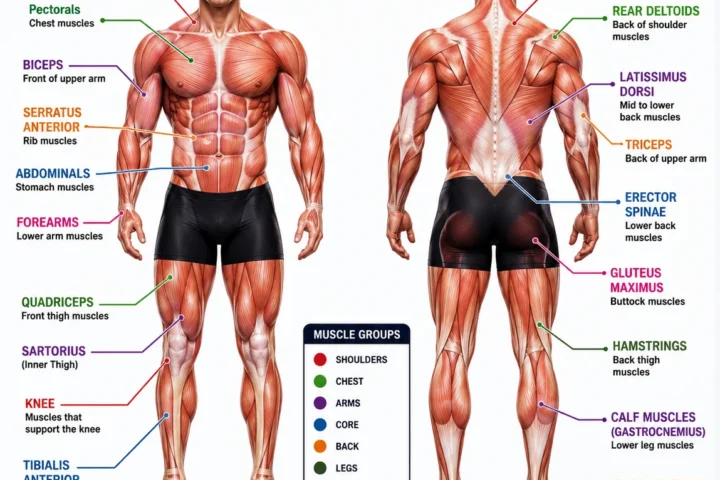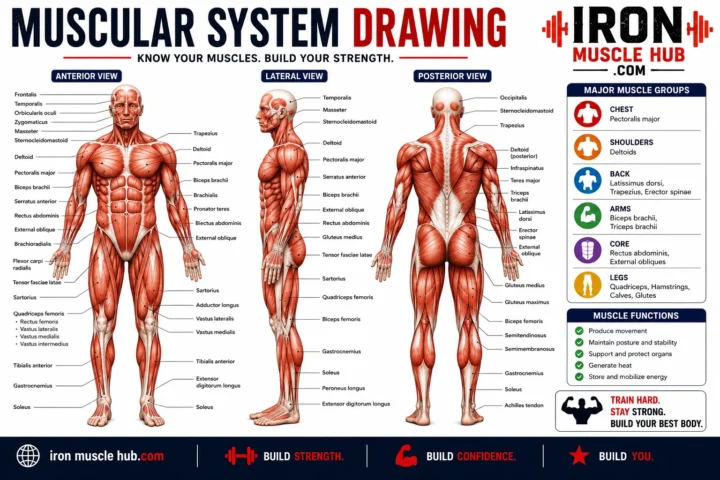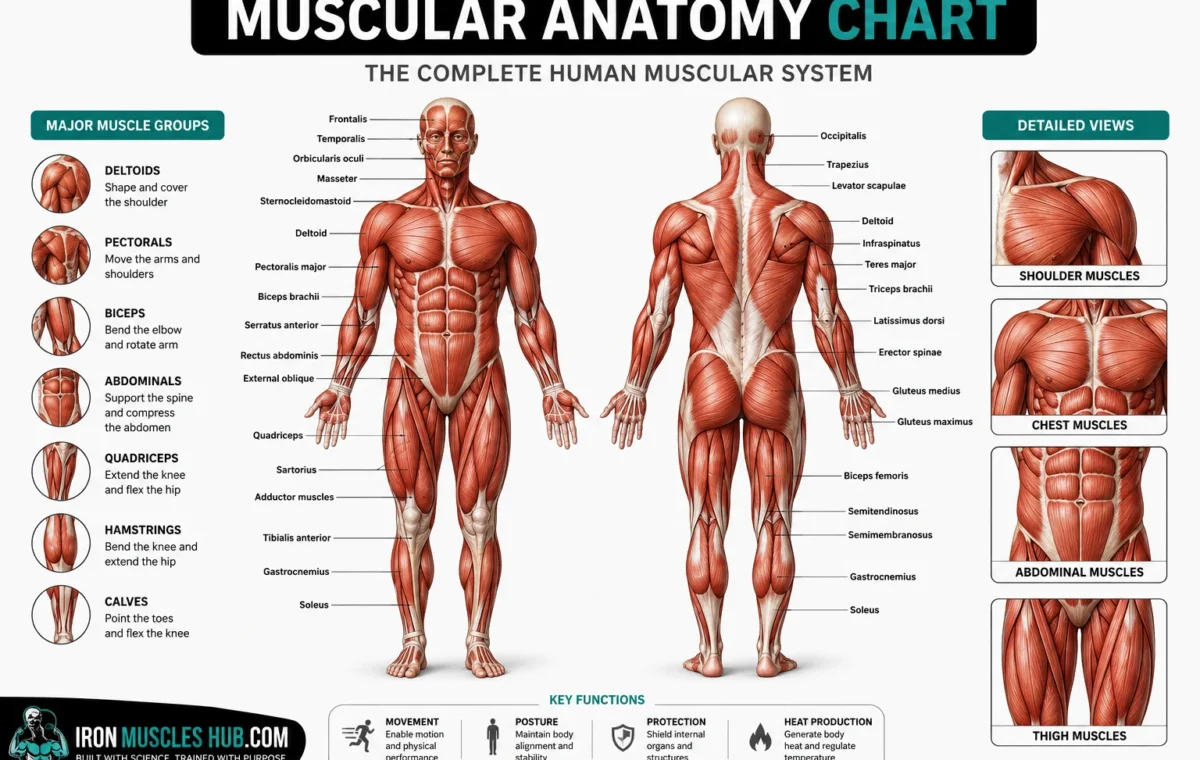
If you’re new to lifting, a muscular anatomy chart can make the gym much easier to understand. Instead of memorizing dozens of individual muscles, start by learning the major muscle groups, where they sit, and the basic movements they produce.
- Quick Answer: What Does a Muscular Anatomy Chart Show?
- What Is a Muscular Anatomy Chart?
- Beginner exercises
- Beginner tip
- Latissimus dorsi
- Trapezius
- Rhomboids
- Erector spinae
- Exercises commonly used for the shoulders
- Biceps
- Triceps
- Common beginner core exercises
- A simple way to remember them
- Step 1: Learn the body region
- Step 2: Learn the major muscle
- Step 3: Connect the muscle to an exercise
- Step 4: Learn the assisting muscles
- Day 1
- Day 2
- Day 3
- 1. Which joint is moving?
- 2. What direction is the movement?
- 3. Which muscles cross that joint and produce that movement?
- Example: Dumbbell curl
- Example: Squat
- What is a muscular anatomy chart?
- How many muscles are in the human body?
- What are the major muscle groups to train?
- What is the most important muscle anatomy to learn as a beginner?
- Can a muscular anatomy chart help me build a workout?
The easiest approach is to learn the body region first, then the major muscles inside it, and finally connect each muscle to common exercises. This gives you a practical anatomy map without requiring you to become a medical student.
This guide breaks down the major muscles from head to toe, explains their basic functions, and shows how beginners can use a muscle chart to build better workouts. For more insights read here:- muscle model labeled and muscle man diagram.
Quick Answer: What Does a Muscular Anatomy Chart Show?
- A muscular anatomy chart identifies muscles by location and name.
- Major areas include the chest, back, shoulders, arms, abdomen, glutes, thighs and lower legs.
- Learning a muscle’s location and primary action helps you understand why an exercise works.
- You don’t need to memorize every small muscle before starting resistance training.
What Is a Muscular Anatomy Chart?
A muscular anatomy chart is a visual reference showing muscles of the human body, usually with labels identifying individual muscles or muscle groups.
For beginners, the most useful charts aren’t necessarily the most detailed ones. A chart containing hundreds of tiny anatomical structures can be difficult to apply to normal gym training.
A practical training-focused chart should help you answer three questions:
- Where is the muscle?
- What movement does it help produce?
- Which exercises train it?
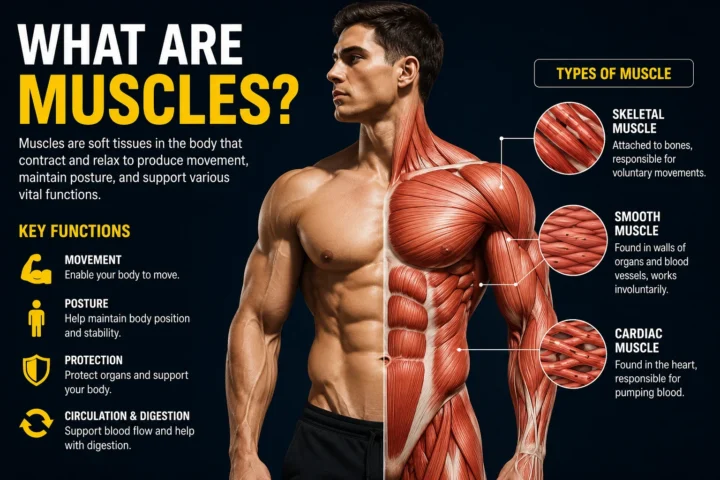
Skeletal muscle attaches to bones through tendons and helps create voluntary movement. Muscle tissue contains organized muscle fibers and connective tissues, while the contractile machinery includes proteins such as actin and myosin.
That basic structure matters because resistance exercises don’t simply “work a body part.” They create force through specific muscles and joints.
For example, a bench press isn’t just a “chest exercise.” The pectoral muscles contribute to the movement, while the triceps and anterior shoulder muscles also assist.
That’s why understanding anatomy can improve exercise selection without making your training unnecessarily complicated.
Major Muscle Groups: A Beginner’s Anatomy Chart
The following table is a practical starting point for learning the major muscles you’ll encounter in strength training.
| Body area | Major muscles | Basic function | Common training examples |
|---|---|---|---|
| Chest | Pectoralis major | Moves the upper arm across/in front of the body | Bench press, push-up, chest press |
| Upper back | Trapezius, rhomboids | Scapular movement and stabilization | Rows, carries, pulls |
| Lats | Latissimus dorsi | Pulls the upper arm down and back | Pull-up, pulldown, row |
| Shoulders | Deltoids | Move the upper arm in several directions | Overhead press, lateral raise |
| Front of upper arm | Biceps brachii | Helps bend the elbow and rotate the forearm | Curl, chin-up |
| Back of upper arm | Triceps brachii | Straightens the elbow | Pressing, pushdown |
| Abdomen | Rectus abdominis and deeper abdominal muscles | Trunk movement and stabilization | Crunch, plank, loaded carry |
| Glutes | Gluteus maximus, medius and minimus | Hip movement and pelvic control | Squat, hip thrust, split squat |
| Front thigh | Quadriceps | Extends the knee | Squat, lunge, leg extension |
| Back thigh | Hamstrings | Knee flexion and hip extension | Romanian deadlift, leg curl |
| Lower leg | Gastrocnemius, soleus | Plantarflexion at the ankle | Calf raise |
| Lower back | Erector spinae and other spinal muscles | Spinal extension and stabilization | Deadlift, back extension |
This table is intentionally simplified. Human anatomy is more detailed than a gym muscle-group chart, and individual muscles often have multiple actions.
For example, the shoulder isn’t a single muscle. The deltoid has different portions that contribute to different movements. Likewise, the “back” contains numerous muscles with different roles.
The purpose of a beginner chart is to create a useful map, not replace a full anatomy textbook.
Chest Muscles
The pectoralis major is the large superficial muscle covering much of the front of the chest.
It contributes to movements of the upper arm, including bringing the arm across the front of the body. That’s why pressing and fly-type movements can train the chest.
Beginner exercises
- Push-ups
- Dumbbell bench press
- Barbell bench press
- Machine chest press
- Cable or dumbbell fly variations
You may hear people refer to the “upper chest” and “lower chest.” These terms can be useful for discussing different training angles, but remember that you’re still training portions of the pectoral muscle rather than completely separate muscles.
A moderate incline press, for example, changes the position of the shoulder and can change how different portions of the chest and assisting muscles contribute.
Beginner tip
Don’t build an entire chest workout around five different pressing movements.
Start with one or two movements that you can perform consistently and progress over time.
Back Muscles
The back is one of the most complicated regions on a muscular anatomy chart.
It includes large superficial muscles and smaller deeper muscles that contribute to movement, posture and spinal stability. The erector spinae group, for example, contributes to movement and stabilization of the vertebral column.
For gym training, beginners commonly focus on:
- Latissimus dorsi
- Trapezius
- Rhomboids
- Erector spinae
Latissimus dorsi
The latissimus dorsi, commonly called the lats, is the broad muscle covering much of the middle and lower back.
Its actions include movements that bring the upper arm down and back.
That’s why exercises such as pulldowns and pull-ups are commonly associated with lat training.
Trapezius
The trapezius spans a large area from the neck into the upper and middle back.
Rather than thinking of it as one simple “shrug muscle,” understand that different portions contribute to different movements of the shoulder blades.
Rows, carries, shrugs and various pulling movements can involve the trapezius.
Rhomboids
The rhomboids sit between the shoulder blades and help with scapular movement and control.
They work during many rowing and pulling exercises.
Erector spinae
The erector spinae are muscles running along the back of the spine.
They contribute to spinal extension and stabilization. They can be trained indirectly during exercises such as deadlifts and directly through controlled back-extension movements.
Shoulder Muscles
The main muscle you’ll see on a beginner muscular anatomy chart for the shoulder is the deltoid.
The deltoid has three commonly described portions:
- Anterior deltoid
- Lateral deltoid
- Posterior deltoid
These portions contribute to different shoulder movements.
Exercises commonly used for the shoulders
Anterior deltoid:
- Overhead pressing
- Some chest pressing movements
- Front raises
Lateral deltoid:
- Lateral raises
- Certain pressing movements
Posterior deltoid:
- Reverse fly variations
- Some rowing movements
- Cable rear-delt exercises
A common beginner mistake is treating every shoulder exercise as interchangeable.
They’re not.
Changing the arm position and direction of resistance can change the muscles that contribute most strongly to an exercise.
Arm Muscles
The arms contain many muscles, but beginners can start with two major groups:
- Biceps
- Triceps
Biceps
The biceps brachii is located on the front of the upper arm.
It contributes to elbow flexion and forearm rotation.
Common exercises include:
- Dumbbell curls
- Barbell curls
- Cable curls
- Chin-ups
Pulling exercises also involve the elbow flexors, so you don’t necessarily need a huge number of direct biceps exercises.
Triceps
The triceps brachii occupies much of the back of the upper arm.
Its primary action is elbow extension.
Common exercises include:
- Triceps pushdowns
- Overhead extensions
- Close-grip pressing
- Dips
If your goal is larger arms, don’t ignore the triceps. They make up a substantial portion of the upper-arm musculature.
Core and Abdominal Muscles
The word “core” describes more than just the visible abdominal muscles.
A muscular anatomy chart may identify structures such as:
- Rectus abdominis
- External obliques
- Internal obliques
- Transversus abdominis
The muscles around the trunk contribute to controlling and stabilizing the torso.
Common beginner core exercises
- Planks
- Side planks
- Dead bugs
- Controlled crunches
- Loaded carries
You don’t need to perform hundreds of repetitions to train your core.
Good technique, appropriate resistance and progressive training are more useful than chasing a huge repetition number.
Also remember that visible abdominal definition depends on more than abdominal exercise. Muscle development and body-fat levels both influence how the abdominal area looks.
Glute Muscles
The gluteal muscles are among the largest and strongest muscle groups associated with hip movement.
The major muscles commonly discussed are:
- Gluteus maximus
- Gluteus medius
- Gluteus minimus
The gluteus maximus is particularly important for hip extension.
Common exercises include:
- Squats
- Hip thrusts
- Split squats
- Lunges
- Step-ups
- Romanian deadlifts
Your glutes can contribute strongly to both athletic movement and basic strength exercises.
However, don’t assume that one exercise “isolates” the entire glute complex. Different movements place different demands on the hip and surrounding muscles.
Quadriceps
The quadriceps are located on the front of the thigh.
They’re a group of four muscles that work together to extend the knee.
You’ll commonly train them with:
- Squats
- Leg presses
- Split squats
- Lunges
- Step-ups
- Leg extensions
A simple way to remember them
Think front of thigh = quadriceps = knee extension.
That’s not the complete anatomy, but it’s a useful beginner memory aid.
Hamstrings
The hamstrings are located on the back of the thigh.
They contribute to both knee flexion and hip extension.
Common exercises include:
- Romanian deadlifts
- Leg curls
- Good mornings
- Hip-hinge movements
This is one reason a balanced lower-body program shouldn’t consist only of squats.
Squats can train the hamstrings to some degree, but hip-hinge and knee-flexion movements provide different training demands.
Calf Muscles
The two major muscles you’ll commonly see on a beginner muscular anatomy chart for the lower leg are:
- Gastrocnemius
- Soleus
Together, they contribute strongly to plantarflexion of the ankle.
Common exercises include:
- Standing calf raises
- Seated calf raises
- Single-leg calf raises
The gastrocnemius crosses both the knee and ankle, while the soleus primarily acts around the ankle.
That difference helps explain why changing knee position can alter the training emphasis.
How to Read a Muscular Anatomy Chart
A good way to study a muscle chart is to work from large regions to smaller details.
Step 1: Learn the body region
Start with:
Chest → back → shoulders → arms → core → hips → thighs → calves
Don’t try to memorize every anatomical term at once.
Step 2: Learn the major muscle
For example:
Back → latissimus dorsi
Then learn what it generally does:
Latissimus dorsi → pulls the upper arm down and back
Step 3: Connect the muscle to an exercise
For example:
Latissimus dorsi → pulldown
Now the anatomy has a practical purpose.
Step 4: Learn the assisting muscles
A pulldown doesn’t use only the lats.
Your elbow flexors, shoulder muscles and other back muscles can contribute too.
This is an important concept for beginners: most compound exercises train multiple muscles simultaneously.
Muscular Anatomy Chart: Muscle vs Movement vs Exercise
Here’s a more useful comparison for lifters.
| Muscle/group | Where to find it | Main training movement | Example exercise |
| Pectoralis major | Chest | Horizontal arm movement/pressing | Bench press |
| Latissimus dorsi | Mid/lower back | Shoulder extension/adduction | Lat pulldown |
| Deltoids | Shoulder | Shoulder movement | Overhead press |
| Biceps brachii | Front upper arm | Elbow flexion | Curl |
| Triceps brachii | Back upper arm | Elbow extension | Pushdown |
| Rectus abdominis | Front abdomen | Trunk flexion/stability | Crunch |
| Gluteus maximus | Buttocks | Hip extension | Hip thrust |
| Quadriceps | Front thigh | Knee extension | Squat |
| Hamstrings | Back thigh | Knee flexion/hip extension | Romanian deadlift |
| Gastrocnemius | Calf | Ankle plantarflexion | Standing calf raise |
This is Information Gain #1: a movement-based anatomy map. Instead of simply naming muscles, it connects anatomy to what you actually do in the gym.
How Anatomy Helps You Build a Better Workout
You don’t need to design a separate exercise for every muscle shown on an anatomy chart.
That’s one of the biggest mistakes beginners make.
A well-designed resistance-training program can train several muscles with compound movements and then use targeted exercises where useful.
For example, a simple full-body session might include:
- Squat variation
- Horizontal press
- Row
- Hip-hinge movement
- Overhead press
- Optional arm or calf exercise
That doesn’t mean every muscle is trained equally. It means several major movement patterns can cover a lot of musculature efficiently.
The 2026 American College of Sports Medicine position stand reviewed 137 systematic reviews involving more than 30,000 participants and found that resistance training improves muscle strength, size and several physical-function outcomes. It also found that different prescription variables can influence specific adaptations.
For hypertrophy, the position stand found a benefit from higher weekly training volume, with 10 or more sets per muscle group per week associated with greater hypertrophy in its evidence synthesis. This shouldn’t be interpreted as a mandatory starting target for every beginner.
A beginner can start lower and build gradually.
Worked Example: Turning Anatomy Into a Weekly Plan
Information Gain #2: worked example
Imagine a beginner weighing 70 kg (154.3 lb) who trains three days per week.
The goal isn’t to train every named muscle individually.
Instead, the beginner could organize training around major muscle groups and movements.
Day 1
- Squat: 3 sets
- Bench press: 3 sets
- Row: 3 sets
- Romanian deadlift: 2 sets
- Lateral raise: 2 sets
Day 2
- Split squat: 3 sets
- Overhead press: 3 sets
- Lat pulldown: 3 sets
- Leg curl: 2 sets
- Biceps curl: 2 sets
Day 3
- Leg press: 3 sets
- Dumbbell press: 3 sets
- Cable row: 3 sets
- Hip thrust: 2 sets
- Triceps extension: 2 sets
This is an example framework, not a prescription that everyone should follow.
Notice what happens anatomically:
- Squat and split-squat movements train the quadriceps and glutes.
- Pressing trains the chest, triceps and anterior shoulder.
- Rows and pulldowns train the back and involve the elbow flexors.
- Romanian deadlifts and leg curls address the posterior thigh through different functions.
- Smaller muscles receive additional direct work where appropriate.
The exact load should be based on your ability and technique.
For example, if your bench press working weight is 40 kg (88.2 lb), that doesn’t mean you should automatically increase it by a fixed amount next week. A smaller increase may be appropriate if your technique or repetitions aren’t ready.
The same principle applies to body measurements. A height of 178 cm is about 70.1 inches, while 170 cm is about 66.9 inches. These conversions are useful for comparing information from US and UK sources, but your height doesn’t determine which exercises you must perform.
How Much Weight Should You Lift?
Your muscular anatomy chart tells you what muscles are involved. It doesn’t tell you the correct weight for every exercise.
That depends on your experience, exercise technique, equipment and goal.
Research reviewed by the ACSM and previous systematic reviews indicates that muscle hypertrophy can occur across a relatively broad range of resistance-training loads when training is appropriately challenging. Higher loads have a clearer advantage for maximal strength, while lower and higher loads can both support muscle growth.
For a beginner, the practical lesson is simple:
Don’t chase the heaviest possible weight. Choose a load you can control with good technique and progressively make the exercise more challenging.
If your form breaks down badly, the number on the dumbbell is no longer the most useful measurement of progress.
Common Mistakes → Why → Fix
Information Gain #3
| Common mistake | Why it causes problems | Better fix |
| Trying to memorize every muscle | Anatomy becomes overwhelming | Learn major regions first |
| Training only visible muscles | Important muscles and movement patterns get neglected | Build around compound movements |
| Assuming one exercise trains only one muscle | Most movements involve multiple muscles | Think primary + assisting muscles |
| Adding exercises constantly | More exercises can make recovery and progression harder to manage | Keep a simple exercise menu |
| Using anatomy to chase “perfect” isolation | Real movement is more complex | Use anatomy to understand, not obsess |
| Changing exercises every week | Progress becomes difficult to track | Keep core movements consistent |
| Training only the front of the body | Creates an unbalanced program | Include pulling and posterior-chain work |
| Treating soreness as proof of effectiveness | Muscle damage isn’t the same as hypertrophy | Track performance and long-term progress |
One particularly important point is that muscle soreness isn’t a reliable scorecard for muscle growth.
Research on resistance-training hypertrophy has challenged the old idea that deliberately creating large amounts of muscle damage is necessary for growth. Training can produce hypertrophy without deliberately maximizing muscle damage.
A 30-Second Anatomy Self-Test
Here’s another simple decision rule you can use whenever you’re looking at an exercise.
Information Gain #4
Ask yourself:
1. Which joint is moving?
Is it primarily the:
- Shoulder?
- Elbow?
- Hip?
- Knee?
- Ankle?
- Spine?
2. What direction is the movement?
Examples:
- Pressing
- Pulling
- Squatting
- Hinging
- Rotating
- Stabilizing
3. Which muscles cross that joint and produce that movement?
You don’t need to name every muscle.
You just need to identify the major contributors.
Example: Dumbbell curl
Joint: elbow
Movement: elbow flexion
Main muscle: biceps brachii, with other elbow flexors assisting
Exercise: dumbbell curl
Example: Squat
Joints: hip and knee, with ankle movement also involved
Movement: coordinated lower-body extension
Major contributors: quadriceps and gluteal muscles, with other muscles assisting
Exercise: squat
This decision rule turns a static anatomy chart into something you can actually use.
Who Is a Muscular Anatomy Chart NOT For?
A basic muscular anatomy chart isn’t enough if you’re trying to diagnose pain, injury or a medical condition.
An anatomy diagram can show where a muscle is located, but it can’t tell you why a particular area hurts.
It’s also not a substitute for an individualized assessment if you’ve had surgery, a significant injury, neurological symptoms or another medical concern.
Use anatomy charts for education and training understanding—not self-diagnosis.
If an exercise produces unusual, persistent or worsening pain, stop and seek appropriate professional guidance.
Muscular Anatomy vs Skeletal Anatomy
Beginners sometimes mix up a muscular anatomy chart with a skeletal anatomy chart.
They’re related, but they show different structures.
A skeletal chart focuses on bones and joints.
A muscular chart focuses on muscles and their attachments, actions and surrounding structures.
You can understand a muscle better by knowing the bones around it because muscles generate force across joints.
For example, the quadriceps cross the knee and contribute to knee extension. The hamstrings cross the back of the thigh and contribute to knee flexion and hip extension.
That’s why anatomy makes more sense when you study muscle + joint + movement rather than memorizing isolated names.
Why Muscle Charts Show Different Names
You may find the same muscle described differently across websites, textbooks or training resources.
That’s usually because anatomy uses specific terminology while fitness communities often use shorter names.
For example:
- Pectoralis major → often called the chest
- Latissimus dorsi → usually called the lats
- Trapezius → commonly called the traps
- Quadriceps femoris → usually called the quads
- Gastrocnemius → commonly discussed as part of the calves
Learning both terms is useful.
If you’re watching a training video, “lats” may be the word used.
If you’re reading an anatomy resource, “latissimus dorsi” is more likely.
A good muscular anatomy chart should ideally include both where appropriate.
How Muscle Anatomy Relates to Muscle Growth
Anatomy explains where muscles are and what they do.
Training provides the stimulus for adaptation.
Resistance exercise increases muscle protein synthesis and contributes to the processes involved in muscle adaptation. Research reviews describe resistance exercise and adequate nutrition as important factors in skeletal-muscle hypertrophy.
The current evidence doesn’t support the idea that you need to destroy a muscle with extreme workouts to make it grow.
The 2026 ACSM position stand supports progressive resistance training for improving muscle size and strength in healthy adults.
That gives beginners a much simpler target:
Train consistently, use sound technique, progressively challenge the muscles, recover adequately and give the process time.
Frequently Asked Questions
What is a muscular anatomy chart?
A muscular anatomy chart is a visual reference that labels muscles and shows where they are located in the body. Some charts are highly detailed and include individual muscles, attachments and functions. A beginner-friendly chart usually focuses on the major muscle groups, making it easier to connect anatomy with common exercises such as presses, rows, squats, curls and hip hinges.
How many muscles are in the human body?
There isn’t one simple number that’s useful for gym beginners because different anatomical references classify muscles and muscle structures differently. Instead of memorizing a total, learn the major muscle groups first. Once you understand the chest, back, shoulders, arms, core, glutes, thighs and calves, you can gradually learn smaller muscles and their functions.
What are the major muscle groups to train?
For general resistance training, beginners commonly organize their training around the chest, back, shoulders, arms, abdomen/core, glutes, quadriceps, hamstrings and calves. These are broad training categories rather than strict anatomical divisions. Individual muscles within each region have different functions, so exercises should be selected to cover useful movement patterns rather than simply checking off body parts.
What is the most important muscle anatomy to learn as a beginner?
Start with three things: muscle location, primary action and common exercises. For example, learn that the quadriceps are on the front of the thigh and contribute to knee extension, then connect that idea to exercises such as squats and leg presses. This approach is more practical than trying to memorize every attachment, nerve and microscopic structure immediately.
Can a muscular anatomy chart help me build a workout?
Yes, but it should be a starting reference rather than your entire program. A chart can help you see whether your routine includes major areas such as pushing muscles, pulling muscles and the lower body. You still need to consider exercise technique, training frequency, recovery, progression and your individual circumstances. Evidence supports resistance training for improving muscle size and strength in healthy adults.
Final Takeaway
A muscular anatomy chart is most useful when you treat it as a map rather than a test you have to pass. Start with the major regions of the body, learn the main muscles in each region, then connect those muscles to basic movements and exercises.
You don’t need to know every small anatomical structure before you start lifting.
Learn enough to understand what you’re training, why an exercise works, and how different movements complement one another. As your training experience grows, you can add more detailed anatomy knowledge.
Keep your workouts simple, progress gradually and prioritize good technique. Anatomy should make training easier to understand—not make training unnecessarily complicated.
Want to keep learning? Use the related guides above to study labeled muscles, exercise anatomy and nutrition for muscle growth.